INTRODUCTION
Previous clinical trials for the detection and treat-ment of small pancreatic carcinoma have shown the possibility of improved prognosis ; however, at the time of diagnosis, only 10 -11.6% of the patients can be given a resection (1, 2). Moreover, in many cases, despite the smallness of the primary lesion, liver metas-tases were detected. Though the outcome of a patient with liver metastases has not been satisfactory, some
recent studies have reported the possibility of im-proved prognosis by modified chemotherapy. Among them, arterial infusion chemotherapy has been reported to be effective for the treatment of liver metastases (3-5). This study reports a case of pancreatic carcin-oma with multiple liver metastases that responded well to transarterial infusion chemotherapy.
CASE REPORT
A 65-years-old male, diagnosed with multiple liver tumors, visited our hospital. He was symptom-free, and physical examination revealed no abdominal tumor or signs of jaundice. Laboratory examinations showed a slight elevation of liver function tests : asparate
ami-CASE REPORT
Arterial infusion chemotherapy for the patient of unresectable
pancreatic carcinoma with multiple liver metastases : a case
report
Masahiko Fujii, Hidenori Miyake, Katsuya Sasaki, Toshihide Takagi,
Kazuhito Takamura, and Seiki Tashiro
Department of Digestive Pediatric Surgery, The University of Tokushima School of Medicine, Tokushima, Japan
Abstract : Introduction : Despite various treatment trials for unresectable pancreatic carcinoma with liver metastases, the outcome has not been satisfactory. This paper reports a case of pancreatic carcinoma with multiple liver metastases that responded well to arterial infusion chemotherapy. Case report : A 65-year-old male was diagnosed with multiple livertumors,andneedlebiopsyrevealed adenocarcinoma. With endoscopic ultrasonography, a tumor in the pancreatic head was detected, and pancreatic carcinoma with multiple liver metastases was diagnosed. He received arterial infusion chemotherapy : cisplatin at a dose of 10mg/body/day and 500mg/body/day of 5-fluorouracil. After 14days administration, liver metastases had decreased in number and size, but thereafter, because of hepatic arterial occlusion, the same dose of drugs was administered intravenously. The patient was discharged from the hospital and was given chemotherapy 3daysaweekonan outpatient basis. Although the chemotherapy was effective, it was stopped because of severe general fatigue 5 months after discharge. His general status continued to gradually worsen, and he died 12 months after diagnosis. Conclusions : Prognosis of pancreatic carcinoma with liver metastases is poor ; however, transarterial infusion chemotherapy may be effective to improve the prognosis and quality of life of the patients. J. Med. Invest. 50 : 199-202, 2003
Keywords : pancreatic carcinoma, arterial infusion chemotherapy, liver metastases
Received for publication January 21, 2003 ; accepted March 1, 2003.
Address correspondence and reprint requests to Masahiko Fujii, M.D., Department of Digestive Pediatric Surgery, The University of Tokushima School of Medicine, Kuramoto-cho Tokushima 770-8503, Japan and Fax : +81-88-633-9277.
The Journal of Medical Investigation Vol. 50 2003 199
notransferase (AST) ; 43 IU/L (normal range ; 10-35 IU/L), alanine aminotransferase (ALT) ; 50IU/L (nor-mal range ; 15-40IU/L), alkaline phosphatase (ALP) ; 420 IU/L (normal range ; 81-231IU/L) and gamma-glutamyl transpeptidase (gamma-GTP) ; 241 (normal range ; <60IU/L). There were no elevations of tumor markers : alpha fetoprotein (AFP), carbohydrate anti-gen (CA) 19-9 and carcinoembryonic antianti-gen (CEA). Diagnostic images
An abdominal ultrasonography detected multiple liver tumors, the largest being 8×8 cm in diameter.
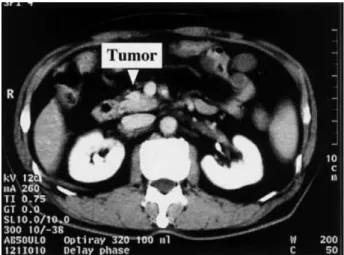
A contrast enhanced computed tomography (CE-CT) showed multiple low-density tumors in the liver (Fig. 1a), and a low-density mass 2 cm in diameter, in the pancreatic head (Fig. 1 b). Endoscopic retrograde cholangiopancreatography (ERCP) showed obstruc-tion of the main pancreatic duct at the head of pancreas (Fig. 2a). Endoscopic ultrasonography detcted a hy-poechoic mass 3×2 cm in diameter in the pancreatic
head (Fig. 2b). Celiac angiography showed multiple hypervascular tumors in the liver (Fig. 3).
Fig. 2a. ERCP showed obstruction of the main pancreatic duct
at the head of pancreas.
Fig. 1a. CE-CT showed multiple low-density tumors in the liver. Fig. 2b. Endoscopic ultrasonography detected a hypoechoic
mass 3×2 cm in diameter in the pancreatic head.
Fig. 3. Celiac angiography showed multiple hypervascular
tumors in the liver.
Fig. 1b. CE-CT revealed a low-density mass 2cm in diameter
in the pancreatic head.
M. Fujii et al. Chemotherapy for pancreatic cancer 200
US guided fine needle aspiration biopsy of the liver tumor revealed adenocarcinoma, and then pancreatic carcinoma with multiple liver metastases was diagnosed. Therapeutic regimen
A catheter was placed in the common hepatic artery for arterial infusion chemotherapy via the right fem-oral artery, and then the gastroduodenal artery and right gastric artery were embolized with the microcoils. The catheter was connected to the port implanted in the subcutaneous space of the right lower abdomen. The patient received 5-fluorouracil (5-FU) and cisplatin (CDDP) combination chemotherapy for 14 days (5-FU at a dose of 500mg/day and CDDP of 10mg/day. Total dose : 5-FU ; 3500 mg, CDDP ; 140 mg). After 14 days administration, because of hepatic arterial occlusion, the same dose of CDDP and 5-FU were administered intravenously for 14 days until his discharge (Total dose : 5-FU ; 3500 mg, CDDP ; 140 mg). At the same time, the tumor in the pancreatic head was irradiated with total 50 Grays (2 Grays/fraction per day). Images after arterial infusion
After 14 days administration, CE-CT revealed a de-crease of liver metastases in number and size (Fig. 4a), and a reduction in the size of the pancreatic tumor (Fig. 4 b).
Clinical course after discharge
The patient was discharged from the hospital and given chemotherapy intravenously 3 days a week on an outpatient basis. Although the chemotherapy was effective, it was stopped because of severe general fatigue 5 months after discharge. CE-CT showed no sign of progression of liver and pancreatic tumors, but ascites had appeared. His general status
contin-ued to gradually worsen ; however, he could remain at home. The patient died 12 months after diagnosis because of peritonitis carcinomatosa.
DISCUSSION
The prognosis and outcome of patients with pancre-atic carcinoma still remain poor, despite various trials. One of the major reasons for these unsatisfactory results is its tendency to cause liver metastases. The incidence of liver metastases from pancreatic carcin-oma was 27.4% at diagnosis (2), and 63% to 78% at autopsy (6). Moreover, in 50-62% of the patients after operations or chemotherapies, liver metastasis was the reason for therapeutic failure(2).
Recently, hepatic arterial infusion chemotherapy was reported as an effective treatment for liver meta-stases. Furuse et al. (4) treated liver metastases from pancreatic carcinoma using hepatic arterial infusion with 5-FU, and reported higher response rates than venous infusion, but no improvement of survival (the median survival time ; 15.9 weeks). Also, Suzuki et al. (5) reported a case of percutaneous isolated hepatic perfusion after local resection ; however, despite a distinct regression of liver metastases, the patient died 9 months after diagnosis. On the other hand, Homma et al. (3) administered 5-FU and CDDP via a catheter placed in the splenic and common hepatic artery after hemodynamic change, and then the mean survival period was improved (16.25±8.35 months). In our patient, although the primary pancreatic carcin-oma was small in size and there was no evidence of local invasion, metastatic liver tumors were very large and multiple. Then, liver metastases were regarded as a prognostic factor, and hepatic arterial infusion
Fig. 4a. CE-CT revealed decrease of liver metastases in number
and size after 14 days administration.
Fig. 4b. Pancreatic tumor was reduced after14days administration.
chemotherapy with radiation was selected for the primary pancreatic carcinoma. Liver tumors decreased in number and size, and no progression was observed throughout the follow-up period even after occlusion of the hepatic artery. Although Furuse et al. (4) pointed out that hepatic arterial occlusion during arterial chemotherapy would be responsible for the rapid pro-gression of liver metastases, systemic chemotherapy after arterial occlusion may contribute to the improve-ment of the prognosis.
After discharge, the patient received systemic chem-otherapy on an outpatient basis, and he could remain at home without severe side effects. In conclusion, transarterial infusion chemotherapy and subsequent systemic chemotherapy may be effective for the treat-ment of patients with pancreatic carcinoma with liver metastases, and moreover, may improve the quality of life of the patient.
REFERENCES
1. Connolly MM, Dawson PJ, Michelassi F, Moosa AR, Lowenstein F : Survival in 1001 patients with carcinoma of the pancreas. Ann Surg 206 : 366-73, 1987
2. Muchmore JH, Preslan JE, George WJ : Regional chemotherapy for inoperable pancreatic carcin-oma. Cancer 78 : 664-73, 1996
3. Homma H, Doi T, Mezawa S, Takada K, Kukitsu T, Oku T, Akiyama T, Kusakabe T, Miyanishi K, Niitsu Y : A novel arterial infusion chemotherapy for the treatment of patients with advanced pan-creatic carcinoma after vascular supply distribution via superselective embolization. Cancer 89 : 303-13, 2000
4. Furuse J, Maru Y, Yoshino M, Mera K, Sumi H, Tajiri H, Satake M, Onaya H, Ishikura S, Ogino T, Kawashima M, Ikeda H : Hepatic arterial infusion of 5-fluorouracil for liver metastases from pan-creatic carcinoma : results from a pilot study. Hepatogastroenterology 48 : 208-11, 2001 5. Suzuki Y, Ku Y, Tominaga M, Kamigaki T, Fujino
Y, Tamioka Y, Iwasaki T, Fukumoto T, Takeyama Y, Kuroda Y : Two-staged treatment with local resection and percutaneous isolated hepatic chemoperfusion for advanced pancreatic cancer with multiple liver metastases:report of a case. Hepatogastroenterology 48 : 574-77, 2001 6. Lee YN, Tatter D : Carcinoma of the pancreas
and periampullary structures. Arch Pathol Lab Med 108 : 584-87, 1984
M. Fujii et al. Chemotherapy for pancreatic cancer 202