Development of Speaking Performance and
Affective Dispositions among Japanese
University EFL Students through Storytelling
Tasks
著者
Ise Megumi
学位授与機関
Tohoku University
学位授与番号
11301甲第17072号
博士論文
Development of Speaking Performance and Affective Dispositions among
Japanese University EFL Students through Storytelling Tasks
(ストーリーテリング・タスクを用いた日本人大学生英語学習者の
スピーキング・パフォーマンスと情意的側面の発達)
伊勢 恵
i
Abstract
In the present study, the term “storytelling” is used interchangeably with “narrative” and
refers to talking about a series of real or fictive events in the order they took place (Dahl, 1984:
116). Given that storytelling is a very common social activity in our daily life (Wong & Waring,
2010), the ability to tell a story can be considered one of the important communication skills that
should be incorporated in second or foreign language (FL) classroom. However, FL teaching or
studies that focus on the development of storytelling skills seem to be rare. This dissertation
aimed to demonstrate storytelling-based English classes for Japanese EFL learners and provide
empirical evidence on learners’ developmental changes in L2 speaking performance and
affective dispositions.
The educational intervention is a thirty-class hour speaking course that utilized storytelling
activities in a fifteen-week long semester. To design syllabi that are expected to enhance L2
linguistic skills and affect, the course employed four principles, where learners made use of their
linguistic resources creatively, engaged in pair and group work, practiced speaking consistently,
and reflected their speaking performance regularly. Sixty undergraduate students of beginning to
low-intermediate English proficiency participated in the study.
Two studies were conducted. Study 1 explored how the students developed speaking
performance and narrative adequacy through the storytelling-based English instruction. Speaking
performance was assessed from the aspects of complexity, accuracy, and fluency. Narrative
adequacy was measured by elaboration with the number of information included as well as the
use of adjectives and adverbs, and coherence through the use of conjunctions. A self-evaluation
questionnaire on linguistic skills at the end of the semester, and two storytelling performances
ii
analyzed. Study 2 concerned how the students felt about the storytelling-based English classes
and how they changed their motivation, anxiety, and self-confidence in studying and using
English. A course-evaluation questionnaire and a self-evaluation questionnaire on L2 affect at the
end of the semester, and a general L2 affective disposition questionnaire at the beginning and
end of the semester were investigated.
The dissertation mainly showed the following three points. First, as for speaking
performance, the students became to speak more accurately with a wider variety of vocabulary
than before, but they did not improve in syntactic complexity and speaking speed. Second,
regarding narrative adequacy, their storytelling became more coherent through conjunctions and
included more information at the end of the course. Third, although the students found
enjoyment, got motivated, and became less anxious and more confident in the storytelling-based
English course, the gains in their affective dispositions toward L2 study and use were limited to
anxiety and self-confidence. Some pedagogical implications for L2 speaking instruction were
iii
Acknowledgments
First, I would like to express my sincere gratitude to my academic supervisors, Professor
Mitsuhiro Shigaki, Professor Takeshi Okada, and Professor Peter John Wanner for very insightful
input and generous feedback, and for continuous support and encouragement in all the process of
my Ph. D study and research.
My gratitude also goes to the rest of my thesis committee members, Professor Teruo
Asakawa and Professor Kensuke Sugiura who provided valuable suggestions and comments at
my Ph. D study presentation sessions in the university. Their questions made me think about my
research from various perspectives.
I would also like to thank my fellow teachers who cooperated with me in checking the
transcriptions of the oral data and judging accuracy of the students’ speaking performance.
Last but not least, I would like to show my deep appreciation for the students who
participated in the study and offered me a lot of valuable information. I was greatly encouraged
iv
Table of Contents
Abstract ... ⅰ
Acknowledgements ... ⅲ
Table of Contents ... ⅳ
List of Figures and Tables ... ⅵ
Chapter 1 Introduction ... 1
1.1 Background of the Study ... 1
1.2 Organization of the Thesis ... 7
Chapter 2 Literature Review ... 9
2.1 Speaking Performance ... 9
2.1.1 Levelt’s Speech Production Model ... 9
2.1.2 Storytelling / Narrative Speaking Performance ... 12
2.1.3 Measuring Speaking Performance with a Storytelling / Narrative Task ... 15
2.2 Individual Learner Differences and L2 Learning ... 21
2.2.1 Motivation ... 21
2.2.2 Foreign Language Anxiety ... 24
2.2.3 Linguistic Self-confidence ... 26
Chapter 3 Educational Intervention: Storytelling-based English Classes ... 29
3.1 Overall Goals, Topics, and Materials ... 29
3.2 Lesson Plans ... 35
Chapter 4 Study 1: Changes in Speaking Performance and Narrative Adequacy ... 39
4.1 Purposes and Research Questions ... 39
4.2 Method ... 39
4.2.1 Participants ... 39
4.2.2 Instruments and Task Administration Procedures ... 43
4.2.3 Coding and Measures for the Storytelling Tasks ... 45
v
4.3 Results ... 52
4.3.1 The Students’ Perceptions of the Changes in their L2 Skills ... 52
4.3.2 Changes in L2 Speaking Performance ... 60
4.3.3 Changes in Narrative Adequacy ... 64
4.4 Discussion ... 68
Chapter 5 Study 2: Changes in L2 Affective Dispositions ... 73
5.1 Purposes and Research Questions ... 73
5.2 Method ... 73
5.2.1 Participants ... 73
5.2.2 Instruments ... 74
5.2.3 Analyses ... 77
5.3 Results ... 78
5.3.1 The Students’ Impressions about the Storytelling-based English Classes ... 78
5.3.2 The Students’ Perceptions of their L2 Affective Changes in the Storytelling-based English Classes ... 79
5.3.3 Changes in General L2 Affective Dispositions ... 88
5.4 Discussion ... 90
Chapter 6 Conclusion ... 93
6.1 Overview of Findings ... 93
6.2 Pedagogical Implications for L2 Speaking Instruction ... 99
6.3 Limitations and Suggestions for Future Research ... 104
References ... 105
vi
List of Figures and Tables
Figure 2.1 Levelt’s (1989) production model ... 10
Table 3.1 Topics and Language Focus in the Storytelling-based English Classes ... 31
Table 3.2 Schedule and Materials for the Storytelling-based English Classes ... 33
Table 3.3 The 10-stage Lesson Flow for a Story (3 class-hours) ... 37
Table 4.1 Number of Participants for Each Storytelling ... 41
Figure 4.1 English skills/knowledge that participants had studied in their previous learning and wanted to improve in the future ... 42
Table 4.2 Participants’ CEFR Level Calibrated by the OPT Scores ... 42
Table 4.3 Summary of L2 Speaking Performance Measures Used in Study 1 ... 50
Table 4.4 Summary of Narrative Adequacy Measures Used in Study 1 ... 52
Table 4.5 Students’ Perceptions of the Changes in their L2 Skills ... 53
Table 4.6 Students’ Comments on L2 Skill Improvements and Related Classroom Factors ... 53
Table 4.7 Descriptive Summary of the Basic Data for the Speaking Performance by the Native Speakers and the Students ... 61
Table 4.8 Changes in the Speaking Performance Measures from Pretest to Posttest for Picture-based Storytelling ... 62
Table 4.9 Changes in the Speaking Performance Measures from Pretest to Posttest for Personal Storytelling ... 63
Table 4.10 Descriptive Summary of the Basic Data for the Narrative Adequacy Measures ... 64
Table 4.11 Changes in the Narrative Adequacy Measures from Pretest to Posttest for Picture-based Storytelling ... 65
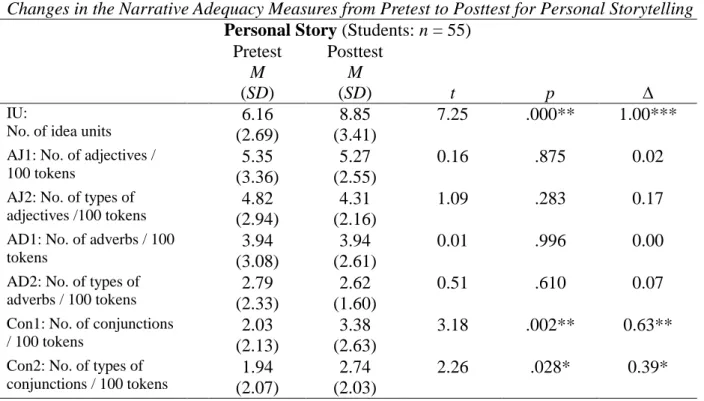
Table 4.12 Changes in the Narrative Adequacy Measures from Pretest to Posttest for Personal Storytelling ... 66
Table 4.13 Frequencies and Types of Conjunctions Observed at Pretest and Posttest ... 67
Table 5.1 Descriptive Results of the Storytelling-based English Course Evaluation ... 78
Table 5.2 Students’ Perceptions of their L2 Affective Changes ... 80
Table 5.3 Students’ Comments on L2 Affective Changes and Related Classroom Factors ... 80
1
Chapter 1 Introduction
1.1 Background of the Study
Language is our primal vehicle for mental and social life. Through a language, we can
exchange information, share feelings and thoughts, and deepen a mutual understanding. While
successful communication makes us feel pleased and satisfied, a language barrier for
communication brings about frustration and disappointment. Indeed, language is colorless if we
cannot communicate with it. Development of learners’ linguistic knowledge in the target
language is an essential part of second or foreign language (L2) learning. However, this
linguistic knowledge alone does not guarantee success in L2 communication. As suggested by
Larsen-Freeman (2003), there is a gap between what learners know about a language and what
they can do with the language. Therefore, promoting learners’ ability to use the target language is
also an important part of L2 learning. This dissertation views language as a means of
communication and pays special attention to development of spoken communication skills, the
significant form of storytelling in particular.
In Japan, the importance of language use ability is clearly reflected in the Course of Study
(the national curriculum guidelines) and related documents released by the Ministry of Education,
Culture, Sports, Science and Technology (MEXT). Foreign language proficiency required in
global society is defined as the ability to communicate smoothly with people from different
countries and cultures using foreign languages as a tool (MEXT, 2011). Further, developing
students’ communicative ability in the target language is emphasized as the overall objective of
English teaching (MEXT, 2008; 2010). In order to achieve the goal, the Course of Study states
that instruction should entail the balanced teaching of four skills (listening, reading, speaking,
2
communicative contexts, and provide students with sufficient opportunities to use the language
(MEXT, 2008; 2010). Along with communicative ability, the other major goal is fostering a
positive attitude toward communicating in the target language, which should be adequately
covered at all grade levels from elementary to senior high schools. It is expected that favorable
L2 learning motivation can be enhanced by the experience of using the language for
communication (MEXT, 2011). Thus, ensuring students’ language use opportunities, English
teaching aims to develop students’ language use ability and positive attitude for successful L2
communication.
In fact, we have much work to do to achieve these overall goals of English teaching in
Japan. MEXT conducted a nationwide survey into English proficiency, and experiences and
attitudes on English learning with about 70,000 high school third-year students in 2014. MEXT
has expected that 50 percent of high school graduates would attain English proficiency of CEFR
level A2 or above. Unfortunately, the survey revealed that the high school students’ proficiency
fell short of this target in all four skills, speaking and writing skills in particular (MEXT, 2015).
As for speaking skills, about 17,000 students took a speaking test and 87.2 percent of them were
judged as CEFR A1 level speakers. It was also found that the more the students had opportunities
to engage in language activities integrating multiple skills such as discussing what they read or
listened, the higher they tended to score on the tests. For example, the students who obtained
higher scores on the speaking test responded that they had had experiences of speaking activities
such as exchanging ideas on what they read or giving a speech in English. In addition, more than
half of the students answered that they did not like studying English, and this tendency was more
clearly observed in the case of the low-achievers. In contrast, the high-achievers liked to study
English. Along with the relationship between the test scores and language use experiences, this
3
successfully enhance their English proficiency through effective language-use activities. The
survey also found that speaking activities were not incorporated very often in English classes.
However, considering that speaking skills of Japanese students are remarkably low, speaking
activities should be vigorously included in the English classroom in order to develop sufficient
speaking skills as well as enhance their confidence and interest in L2 communication.
From theoretical perspectives, there is a growing recognition that producing the target
language has the potential to facilitate L2 learning. First, although different linguistic features
and various learner variables may produce different outcomes, research suggests that the effects
of practice are basically skill specific (e.g., Dekeyser & Sokalski, 1996; DeKeyser, 1997; 2007).
That is, input practice is necessary for comprehension skills, and output practice is beneficial for
production skills. Assuming that language knowledge that learners have studied through reading
and translation has little transferability to their oral performance, speaking practice is essential
for development of successful L2 spoken communication. Second, Swain’s Output Hypothesis
lends support to the importance of producing the target language in L2 learning. Swain (2005)
argues that output is not just the product of learning but also the process in which L2 learning
can occur. While learners attempt to produce the target language, they may notice their linguistic
problems and direct their attention to relevant input, formulate and test their hypothesis about the
language systems, and reflect consciously on their language use and utilize syntactic processing
(Swain, 1985; 1995; 1998; 2005). In short, by encouraging learners’ output, we can create
facilitative conditions and stimulate cognitive processes for their L2 learning. Empirical studies
support these functions of output (e.g, Izumi, 2002; Swain & Lapkin, 1998; Lynch & Maclean,
2001). Furthermore, de Bot (1996) claims that output practice turns declarative knowledge into
procedural knowledge and promotes automatization. In other words, through consistent output,
4
more smoothly without much attention and spare more attentional resources for other
communicative skills such as pragmatic aspects. Such automatization is considered a vital
process for spontaneous language use. Thus, theories and research indicate that output practice
contributes to L2 learning in several ways, especially to production skills. However, as suggested
by Muranoi (2007), what kind of output practice learners need and how such output practice
impacts their learning have remained unclear, and there is room for further investigation.
There are many kinds of output practice available in the L2 classroom: presentations,
debates, discussions, text reconstruction tasks, summary writing tasks, and story-retelling tasks
to name but a few. In the present study, storytelling tasks are chosen as output practice. Telling
stories about experiences or events is very common in our daily life and plays an important role
to build social relationships with people in a community (Wong & Waring, 2010). The Common
European Framework of Reference for Languages, which concerns what language learners have
to learn to do in order to use a language for communication, also includes the ability to describe
experiences and events as one of the goals for independent language users (Council of Europe,
2011). For these reasons, storytelling can be considered one of the necessary communication
skills that all kinds of language learners need to acquire and should be included in the L2
classroom. However, L2 teaching that focuses on the development of learners’ storytelling skills
seems to be rare. Pavlenko (2006) assumes that one of the reasons for this oversight is a
misunderstanding that learners who can successfully produce the target language at the sentence
level should be able to tell a good story. Even though storytelling performance may be dependent
on L2 proficiency, there is research that implies storytelling-specific approaches serve better than
conventional conversation-oriented approaches in order to develop learners’ storytelling skills
(Rifkin, 2002). Transfer appropriate processing (TAP) would also encourage storytelling-specific
5
learning and the language use conditions demand similar cognitive processes from learners
(Lightbown, 2008). From this perspective, it seems that learners would more easily retrieve L2
knowledge and perform better if they get accustomed to telling stories in the classroom and find
similarities between learning and performing situations. In this sense, it is possible to think that
storytelling activities in the classroom serve learners well in fostering storytelling outside the
classroom. Lastly, given that grammar teaching out of context has limited effects on L2 learning
(Swain, 1998), it is advantageous that stories can provide context, and help learners to make a
connection between linguistic forms and meanings and understand how the language works in
contextualized practice.
L2 learners’ speaking has been examined inside and outside the Japanese context from
various aspects such as task planning (e.g., Yuan & Ellis, 2003; Kawauchi, 2005), task structure
(e.g., Tavakoli & Skehan, 2005; Tavakoli & Foster, 2011), task type (e.g., Foster & Skehan,
1996; Skehan & Foster; 1997), learners’ proficiency (e.g. Iwashita, 2010; Ota, 2003),
comparisons of native and non-native performance (e.g., Kawahara, 2004; Koizumi, 2009),
developmental changes (e.g., Koizumi & Katagiri, 2007; Kosuge, 2004), and proficiency
measurements (e.g., Inoue, 2010; Koizumi & Fujimori, 2010). Although there is research that
investigated the benefits of task repetition on spoken output (e.g., Bygate, 1996; 2001; Bygate &
Samuda, 2005; Gass et al., 1999), studies that have explored the relationship between L2 learners’
speaking performance and pedagogic intervention are still limited. However, this vein of study is
necessary to obtain more concrete implications for L2 teaching and learning, and it is desirable
to conduct it under various conditions in classroom settings.
Recognizing all the considerations mentioned above, storytelling-based English classes
were planned and implemented as an educational intervention in the present study. With the aim
6
Japanese undergraduate students consistently engaged in storytelling activities based on picture
sequences in 24 class hours during a fifteen-week long semester. Even though storytelling with
picture sequences gives the students limited freedom of what they want to say, the present study
allows them to choose how they want to express the storyline with their own linguistic resources.
Hence, it is expected that the students would direct their attention to form, while thinking about
how best to express their intended meaning in the L2. Also, unlike providing storylines in the
students’ L1 (Japanese), pictures are likely to offer a variety of interpretations and generate
variations among the students’ final products. The variations would give the students a chance to
compare their own language use and story structure with their classmates’, even with the same
storyline to convey. Moreover, storytelling activities make it possible for the students to work in
pairs or small groups. Employing pair or small group work on a regular basis encourages group
cohesiveness and cooperation among the students, which may lead to favorable L2 motivation
(Dӧrnyei, 2001). Furthermore, the students can learn from each other, while collaboratively
thinking about the language to express storylines in small groups. All in all, picture-based
storytelling seems to have the potential to create conditions conducive to the development of
learners’ L2 speaking skills and positive affective disposition, in line with the major goals of
English teaching in the Japanese context.
This dissertation consists of two studies. Study 1 concerns the students’ linguistic
improvement and explores the development of the students’ speaking performance and narrative
adequacy over the course of the semester in this storytelling-based instruction. While L2
speaking development is considered to be manifested in improved levels of complexity, accuracy,
and fluency, narrative adequacy is regarded as constructing cohesive stories with sufficient
details, and measured by idea units and the use of adjectives, adverbs, and conjunctions. The
7
non-linguistic outcomes through the pedagogic intervention and investigates the development of
the students’ affective dispositions toward L2 learning and use, namely L2 motivation, anxiety,
and linguistic self-confidence. The students’ impressions of the storytelling-based English course
and their perceptions of the attitudinal or motivational changes through the course were also
analyzed. Given that L2 linguistic improvement and affective disposition are closely related, it is
expected that these two studies will complement each other in the attempt to gain a better
understanding of the students’ L2 learning in this storytelling-based English course. In addition,
by examining the students’ perceptions of the changes in their L2 skills as well as their affective
dispositions in relation to various aspects of the storytelling-based English classes, it is hoped
that the two studies will provide some concrete pedagogical implications for designing L2
speaking instruction.
Speaking skills are important for communication. As I found with the participants of the
present study, I believe that there are many students who want to improve speaking skills.
However, a good level of speaking English cannot be achieved easily, especially for EFL learners
who have limited opportunities to use the target language. That is why it is crucial to include
enough speaking activities at least in English classes. It is undeniable that the teaching of
speaking, not to mention the assessment of speaking performance, takes a lot of time and effort.
It is challenging to deal with speaking performance in this dissertation. However, it is hoped that
the present research demonstrates an example of L2 speaking instruction that may prove
effective and provides empirical evidence on development of learners’ speaking performance as
well as affective dispositions toward L2 learning and use.
1.2 Organization of the Thesis
8
and rationale of the study as background information. Chapter 2 reviews previous studies on
speaking performance with three sections on (a) Levelt’s speech production model, (b)
storytelling speaking performance, and (c) measuring speaking performances, and on individual
learner differences with three sections on (a) motivation, (b) foreign language anxiety, and (c)
linguistic self-confidence. Chapter 3 describes the elements and class process in the
storytelling-based English classes as a pedagogical intervention designed to develop the students’
L2 speaking skills and affective dispositions. Chapter 4 reports linguistic outcomes of the
storytelling-based English classes from Study 1, describing the participants of the study and
examining the students’ perceptions of their progress in L2 skills, as well as the actual changes in
their speaking performance and narrative adequacy. Chapter 5 presents non-linguistic outcomes
of the storytelling-based instruction from Study 2, exploring the changes in the students’ L2
affective dispositions of motivation, anxiety, and self-confidence. Chapter 6 concludes the
dissertation, pulling together the overall results of the studies and suggesting pedagogical
implications for L2 speaking classes. Limitations of the studies and recommendations for future
9
Chapter 2 Literature Review
In Chapter 2, research related to the present study is reviewed in two sections: (1) speaking
performance addressing Levelt’s speech production model, narrative speaking performance, and
measuring speaking performance with a narrative task, and (2) individual learner differences and
L2 learning in terms of motivation, foreign language anxiety, and linguistic self-confidence.
2.1 Speaking Performance
2.1.1 Levelt’s Speech Production Model
Despite the fact that Levelt’s (1989) language production model was originally developed for adult monolingual L1 speaking from a psycholinguistic perspective, it is considered one of
the most comprehensible models available (de Bot, 1996) and has been widely adopted to
account for L2 speaking processes as well (e.g., Bygate, 2001; Bygate & Samuda, 2005; de Bot,
1992; Dӧrnyei & Kormos, 1998; Skehan, 2009). Undoubtedly, there are differences between L1
and L2 speaking. But still, researchers and teachers benefit from this model to theorize and
interpret L2 speaking performance and to design and validate speaking tasks for educational
purposes.
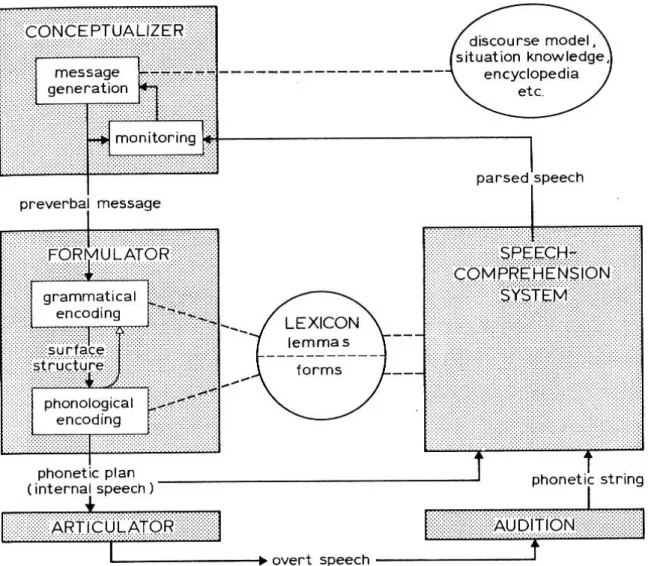
In the Levelt model, speech production is theoretically described by three major
components in the speaker’s process: the conceptualizer, the formulator, and the articulator (see
Figure 2.1 for a schematic representation). First, in the conceptualizer phase, the message content
as a non-linguistic proposition (a preverbal message) is planned to express the speaker’s intended
meaning, while the relevant information is selected and organized. Next, the formulator receives
the preverbal message and converts it into language as a speech plan by accessing lexicon. The
10
information in lemmas, and morphological and phonological information in lexemes. In the
formulator phase, the semantic information for the preverbal message is searched and matched in
the lemmas, which leads to relevant syntactic building procedures (grammatical encoding) and
forms a surface structure. Meanwhile, the morphological and phonological information for the
lemmas and for the utterance is activated (phonological encoding) and provides a phonetic plan
for the articulation. In the articulator phase, the phonetic plan is finally executed as actual speech.
The speech productions are also monitored by assessing appropriateness and correctness of the
message, internal speech, and overt speech.
Figure 2.1 Levelt’s (1989) production model: A blue print for the speaker. From Speaking: From intention to articulation (p.9), by W. J. M. Levelt, 1989. Reprinted with permission.
11
Levelt (1989) posits that these processing components work automatically or
simultaneously with very little control, especially in the formulating and articulating stages. This
may be true for native speakers who have a full command of the language. However, in the cases
of L2 speakers who do not possess enough knowledge of the target language, such smooth
parallel processing cannot be expected at the formulating and articulating stages (Muranoi, 2007;
Skehan, 2009). More specifically, with respect to lexical items in the Levelt model, L2 learners’
limited mental lexicon is a major area responsible for the interruption of the automatic processes
and leads to differences between L1 and L2 speaking performance (Skehan, 2009). Assuming
that there is a limit in a human’s information processing capacity, it is likely that supporting or
expanding learners’ vocabulary knowledge is essential to reduce loads on the formulator and
spare attentional resources for the other speaking processes, which may guide smooth L2
production.
By identifying factors that affect each component of the Levelt model, it may be possible
to forecast learners’ difficulties in their L2 speaking and speculate about the reasons for their
performance. Summarizing the findings of task-based performance studies, Skehan (2009) has
shown that while the nature and the number of ideas to be expressed (e.g., the degree of
complexity; abstract, dynamic information vs. concrete, static information) seem to exert an
influence on the conceptualization, task types (e.g., monologic vs. dialogic; structured vs.
unstructured) and task implementation variables (e.g., the availability of preparation, time
pressure and post-task activities) are likely to have an effect on the lemma retrieval and the
syntactic encoding in the formulator. He also argues that syntactic and lexical complexity in L2
production primarily link with the conceptualization stage, whereas accuracy and fluency are
associated with the formulator stage (Skehan, 2009). The present study employs two types of
12
Skehan (1996) examined the influence of task type and planning on L2 oral performance and
found that performance generated on a narrative task was the most complex but the least accurate,
compared to a decision-making task and a personal information exchange task. Adding to that, in
the narrative task, the detailed and non-detailed strategic planning led to greater improvement in
complexity but not much in accuracy. They interpreted this to mean that the narrative task
required learners to use precise and extended language, which resulted in the highest level of
complexity at the expense of accuracy. Personal tasks are likely to be cognitively less demanding
on the formulator because learners are able to adjust the content to their linguistic knowledge if
necessary, instead of somehow searching precise lexical items and structures to express the
storyline prescribed by picture prompts. Hence, it is possible to suppose that learners’ L2 oral
productions would be more accurate and more fluent in a personal narrative task, and more
complex in a picture-based narrative task.
2.1.2 Storytelling / Narrative Speaking Performance
In order to design storytelling-based English classes, it is important to understand what
constitutes good storytelling in general and what difficulties L2 learners tend to encounter in
storytelling. In the present study, the term “storytelling” is used interchangeably with “narrative,”
and rather broadly refers to a discourse “where the speaker relates a series of real or fictive
events in the order they took place” (Dahl, 1984: 116).
Luoma (2004:144) specifies the essential features of narratives as “setting the scene,
identifying characters and referring to them consistently, identifying the main events, and telling
them in a coherent sequence.” In a similar vein, Pavlenko (2006:107) defined L2 narrative
competence as “L2 users’ ability to interpret, construct, and perform personal and fictional
13
three components related to the competence, (1) narrative structure, (2) evaluation and
elaboration, and (3) cohesion. She argues that competent storytellers understand conventional
narrative structures of the target language, make the story vivid and attractive through sufficient
elaboration and evaluation and construct coherent stories through cohesive devices in a
linguistically and culturally appropriate manner. The present study adheres to Pavlenko’s three
components as the general teaching outlines of the storytelling-based English instruction.
To make the teaching outlines more specific, it is necessary to understand how each of
Pavlenko’s (2006) three components of L2 narrative competence can be achieved, and how L2
learners deal with them. The first component, narrative structures, can be investigated by
elements composing in a story. One of the most influential narrative structures is Labov’s (1972)
model (de Fina & Georgakopoulou, 2012). Based on personal experiences spoken by young
black people in the United States, he found six elements in well-formed narratives: abstract (a
short summary of the story at the beginning), orientation (references to time, place, and
characters), complicating action (the main events), evaluation (personal comments on the events),
resolution (the conclusion of the events), and coda (a signal of the end of the story). Labov
(1972: 370) also regarded narratives as a series of answers to fundamental questions: what was
this about? (abstract), who, when, what, where? (orientation), then what happened?
(complicating action), so what? (evaluation), and what finally happened? (resolution). Hence, if
all of these answers can be found in a story, then it can be considered a well-formed narrative,
including the necessary narrative elements. With respect to the second component, elaboration
and evaluation, Pavlenko (2006) explains that good narratives exhibit skillful uses of lexical
choices, figurative language, reported speech, imagery, and descriptive details, whereas poor
narratives with insufficient elaboration overuse compensatory strategies such as repetition,
14
considers lexical diversity (e.g., type-token ratio) as one of the measures for elaboration. The
third component, cohesion is related to semantic connectivity within and between sentences in a
discourse. According to Halliday and Hasan (1976:4), cohesion is set up “when the interpretation
of some elements in the discourse is dependent on that of another. The one presupposes the other,
in the sense that it cannot be effectively decoded except by recourse to it.” They identified five
types of cohesion: (1) reference, (pronouns, demonstratives, comparatives), (2) substitution, (3)
ellipsis, (4) conjunction, and (5) lexical cohesion (reiteration, collocation). Thus, by examining
these cohesive devices in learners’ storytelling, we can see how well each utterance is connected
and well organized as a coherent story.
There are some empirical studies that demonstrated L2 learners’ weakness in storytelling
and related aspects. For example, Rintell (1990) compared personal emotional storytelling
produced by adult native English speakers and adult ESL students with intermediate proficiency,
and found that learner stories were lacking details and far less elaborated than native speakers’
stories. While the native speakers employed a wider variety of strategies such as figurative
language, reported speech, epithets and depersonalization to elaborate the stories, the learners’
strategies were limited to direct and minimized statements of emotion and references to physical
sensations. In the same line, Ordóñez (2004) observed that the learners tended to produce short
and less elaborated stories with a bare sequence of generalized events without references to
complex time aspects and characters, and be holistically evaluated lower by the judges,
comparing to their monolingual counterparts. In the study of narrative development, Viberg
(2001) showed that L2 learners were likely to prefer one type of connector over the others and
overuse it in the beginning stage, and that a certain L2 linguistic level might be required to
include the basic components of narrative structure. In the Japanese context, Kawahara (2004)
15
American high school students. He reported that the Japanese EFL learners spoke less, in
particular, without using adjectives, adverbs, and conjunctions. The learners’ frequency of
adjectives and adverbs were only one-eighth and one-thirteenth of the native speakers’ frequency,
respectively. Even if the fact that the native speakers spoke five times more than the Japanese
students is considered, the ratios of adjectives and adverbs in the total utterances are much
smaller in the case of the Japanese students. As for conjunctions, while the native speakers used
152 tokens in nine different types, the Japanese students’ performance involved only four tokens
in one type “and.”
All in all, good stories require the basic narrative elements with enough details, strategies,
lexical elements and evaluation in a coherent sequence. However, telling good stories is not an
easy task for L2 learners because they tend not to fully possess necessary skills, especially for
elaboration and cohesion. Therefore, the storytelling-based English lessons in the present study
focus on the narrative elements and linguistic devices for elaboration and cohesion as teaching
targets and revisit them throughout the course.
2.1.3 Measuring Speaking Performance with a Storytelling / Narrative Task
Narrative tasks are frequently used in assessing L2 learners’ speaking performance.
Learners are asked to tell a story based on picture sequences (e.g., Koizumi, 2009; Tavakoli &
Skehan, 2005; Yuan & Ellis, 2003) or on short films (e.g., Bygate, 1996; 2001). In another case,
learners are asked to tell what they will do during a specific period of time or to tell something
that happened to them (e.g., Ano, 2002; Rintell, 1990). One of the advantages for narrative tasks
is that they can be monologic and elicit enough talk from each learner without the interlocutor’s
influences. Moreover, storytelling generated by pictures or films can control too much individual
16
they want to tell, personal stories vary a great deal in the content. Nevertheless, the present study
included personal stories for assessing spoken proficiency too because people quite often talk
about their own stories in real life and that is the main motivation to deal with storytelling in this
study.
L2 performance is regarded as multidimensional in nature and often investigated using three
distinct but interconnected dimensions of complexity, accuracy and fluency. Considering that
language learning involves both knowing and doing, Tonkyn (2012) claims that complexity and
accuracy are likely to relate to knowing (repertoire, grammar, vocabulary), and fluency appears
to connect with doing (rapid access to knowledge achieved through doing). Many studies have
shown that complexity, accuracy and fluency interact with each other supportively in some cases
and competitively in other cases, and cannot be assumed to have a linear development. Also,
these dimensionsare affected by various factors such as linguistic features, learner variables, and
pedagogical intervention (Housen, Kuiken & Vedder, 2012).
The first step in quantitatively measuring these dimensions of performance is to divide oral
data into units for the calculation of frequencies and ratios. Among available units for analysis
such as T-unit, C-unit, and Utterance, the AS-unit proposed by Foster, Tonkyn and Wigglesworth
(2000) is specifically designed for spoken data. AS-unit is a syntax-based unit with intonation
and pause features, and comprises “an independent clause or sub-clausal unit, together with any
subordinate clause(s)” (Foster et al., 2000: 365). Particularly, the inclusion of a sub-clausal unit
is helpful because it can take fragmentary but understandable utterances from the discourse into
account. Unlike written data, it is anticipated that such fragmentary utterances will often appear
in spoken data, especially in the case of L2 learners who are less experienced in speaking in the
target language. Therefore, the present study employs the AS-unit as the basis for a quantitative
17
Complexity
Complexity can be defined as “the ability to use a wide and varied range of sophisticated
structures and vocabulary in the L2” (Housen et al., 2012: 2). Skehan and Foster (2001) note that
complexity may indicate the upper limit of learners’ interlanguage systems when experimenting
with recently acquired structures, and language learning process of restructuring their
interlanguage knowledge. As for general measures, syntactic complexity can be analyzed by the
number of words and clauses per unit: the number of words per T-unit (Bygate, 2001), the
number of clauses per C-unit (Robinson, 2007), the number of clauses per AS-unit (Koizumi,
2009), and the number of subordinations per clause (Iwashita, 2010). These global measures are
considered to be more sensitive for discriminating between proficiency levels or detecting
treatment effects in experimental conditions (Housen et al., 2012). However, complementing
them with specific measures targeting more focused linguistic features is also recommended
(Ellis & Barkhuizen, 2005). Such specific measures include the number of different verb forms
used (Yuan & Ellis, 2003; Ellis & Yuan, 2005), the number of cohesive devices (articles,
pronouns, connectors) per AS-unit (Koizumi & Fujimori, 2010), and the number of noun phrase
and verb phrase elaborations (auxiliaries, catenative verbs, and adverbs) in performance (Tonkyn,
2012). Along with general complexity measures, the number of cohesive devices per AS-unit
detected consistent changes in both Japanese high school and university student groups’ speaking
complexity (Koizumi & Fujimori, 2010), and the number of modal auxiliaries, catenative verbs
and adverbs in oral interview data from upper intermediate learners of English (Tonkyn, 2012).
Both studies have suggested these measures as progress-sensitive ones that can detect short-term
gains in speaking instruction.
The other aspect of complexity is vocabulary. Lexical richness can be examined in terms
18
proportion of low-frequency words and different words used in a text. It is assumed that
proficient learners possess a larger vocabulary knowledge that they can choose from to express
their intended meaning with uncommon but precise and appropriate words for a topic
(sophistication) and/or without using the same words repeatedly (variation) (Read, 2000). One
frequently examined aspect is lexical diversity with the indices of type-token ratio (Robinson,
2007), mean segmental type-token ratio (Yuan & Ellis, 2003), the D index (Iwashita, 2010;
Kormos & Dénes, 2004) and the Guiraud index (Koizumi & Katagiri, 2007; Koizumi, 2009).
One notable drawback with simple type-token ratio is its relationship with text length. As the
total number of words uttered increases, new types of words introduced in the text tend to
decrease (Durán, Malvern, Richards & Chipere, 2004). On the contrary, the D index is a valid
measure without being affected by the text length. But it requires a minimum of 50 valid words
for computing (Durán et al., 2004) and may not be suitable for L2 performance of low-proficient
learners. The Guiraud index appears to perform better in some cases (van Hout & Vermeer,
2007). Considering that the participants in the present study did not produce more than 50 words
on average in the pretest phase, the Guiraud index seemed to be the best possible measure for
lexical diversity.
Accuracy
Accuracy can be characterized as “the ability to produce target-like and error-free
language” (Housen et al., 2012; 2). Both complexity and accuracy are associated more with L2
knowledge, but they reflect different aspects of knowledge. Skehan and Foster (2001) maintain
that complexity relates to a learner’s willingness to use more challenging and difficult language,
whereas accuracy may demonstrate a learner’s effort to avoid errors, using more stable and
19
the interlanguage system”, and accuracy captures “a particular interlanguage level” (Foster &
Skehan, 1996: 304). The global accuracy measures include the percentage of error-free clauses
(Ellis & Yuan, 2005; Foster & Skehan, 1996; Kormos & Trebits, 2012), the percentage of
error-free C-units (Robinson, 2007), the number of errors per T-unit (Bygate, 2001), error-free
AS-units per AS-unit (Koizumi, 2009; Koizumi & Fujimori, 2010), and errors per 100 words
(Mehnert, 1998). Researchers also employ specific measures like the percentage of correct verb
forms (Ellis & Yuan, 2005; Kormos & Trebits, 2012), the percentage of error-free relative
clauses and past tense verbs (Kormos & Trebits, 2012), and the percentage of target-like verbal
morphology (Wigglesworth, 1997). As in the case of complexity, specific measures of accuracy
work best as a complement to general measures that appear to be more sensitive to capturing
differences in learner performance. However, specific measures are especially recommended for
focused tasks that have been designed to produce particular linguistic features (Ellis &
Barkhuizen, 2005).
Fluency
Fluency can be described as “the ability to produce the L2 with native-like rapidity,
pausing, hesitation, or reformulation” (Housen et al., 2012; 2). Contrary to complexity and
accuracy, which represent L2 form, fluency reflects meaning. Ellis and Barkhuizen (2005:139)
state that “fluency occurs when learners prioritize meaning over form in order to get a task done.”
Therefore, fluency may indicate what learners can do with their L2 resources in real-time
communication. If learners continuously engage in speaking activities using their L2 resources,
they may get to be able to smoothly access to their L2 knowledge and develop fluency in their
speaking performance.
20
hesitation phenomena (Ellis & Barkhuizen, 2005). Temporal variables concern the speed of
speaking. The measures include speech rate (Ellis & Yuan, 2005; Kawauchi, 2005; Koizumi,
2009), the number of pauses (Koizumi & Katagiri, 2007; Kawauchi & Kamimoto, 2000;
Tavakoli & Skehan, 2005), pause length (Tavakoli & Skehan, 2005), and the length of run
(Tavakoli & Skehan, 2005). Hesitation phenomena indicate dysfluency such as false starts,
repetitions, reformulations, and replacement (Ellis & Barkhuizen, 2005), and can be measured by
counting the frequencies of each dysfluency marker. Kormos and Dénes (2004) investigated the
relationships between measures and speaking judges’ perceptions of fluency in L2 storytelling
performance of advanced and low-intermediate proficiency learners. The study revealed that
while the speech rate and the mean length of run were associated the most with fluency scores
rated by the judges, the number of filled and unfilled pauses and other dysfluency markers did
not affect fluency judgments. Given that hesitation phenomena have less impact than temporal
variables on listeners’ fluency judgment, the present study focused on temporal variable
measures.
Narrative task specific measures
Considering that higher scores on the measures of complexity, accuracy and fluency may
not always indicate the success and appropriateness of a learner’s L2 performance, Pallotti
(2009) proposed another dimension, adequacy, to be included for investigation. It should reflect
whether a learner’s performance is appropriate or not in achieving the goals of a task, and can be
measured in task-specific ways. As mentioned in the previous section, including all the essential
information to convey an intended story is one of the requirements for good narratives. Therefore,
one possible way of measuring narrative adequacy is to examine idea units that a learner covers
21
that is separated from contiguous units syntactically and/or intonationally” (Ellis & Barkhuizen,
2005:154). It can be categorized into major idea units and minor idea units. While major idea
units are the indispensable content of a story, minor idea units are not indispensable but are
details that can elaborate a story. Ellis and Barkhuien (2005) note that baseline data from fully
competent target-language speakers who perform the same task can best establish main and
minor idea units. Inoue (2010) explored picture-sequence narrative performance produced by 24
Japanese learners of English at six different levels (level 4 to level 9: approximately CEFR A2 to
B2/C1) of the Standard Speaking Test, employing idea units along with commonly used
performance measures. Although the study could not ensure exactly the same amount of time
availability for every speaker’s narration due to the speaking test administration conditions, the
results showed that the number of main idea units did not differentiate between proficiency
levels, whereas the minor idea units revealed more variation in nonlinear development.
2.2 Individual Learner Differences and L2 Learning
The present study explores not only the learners’ L2 speaking performance but also their
motivation, anxiety, and linguistic self-confidence before and after the educational intervention.
Motivation, anxiety and self-confidence are well-established individual learner factors that
mediate L2 learning directly or indirectly. In this section, these three factors of individual learner
differences are reviewed focusing mainly on their changes over time and influences on L2
speaking.
2.2.1 Motivation
Motivation, one of the key factors in determining success or failure in L2 learning, has
22
undergoing some changes in perspectives from social psychological approaches to cognitive and
process-oriented approaches (Dӧrnyei, 2005). Recent L2 motivational studies not only focus on
the general and stable aspects of motivation (e.g., values, beliefs) but also on the
classroom-related influences (e.g., teachers, learner groups, instruction, tasks) and treat
motivation as a complex and dynamic construct that differs across the contexts and changes over
time. Further, along with L2 overall proficiency measured by final course grades and general
language test scores, specific learning behaviors such as task engagement and strategy use are
also explored in their relationship with motivation. Accordingly, classroom-based motivation has
become a matter of wide interest.
Some empirical studies have demonstrated how and why learners’ motivation changes
over time. Ushioda (2001) conducted an interview study with 20 undergraduate students taking
L2 French courses at an Irish university, and described their motivational changes over a period
of 15 months. The study observed that initially, motivation was shaped by the learners’ liking and
enjoyment, rooted in their L2 learning and L2-related experiences to date; later, it was shaped by
future goals or perspectives that had developed gradually overtime as the students progressed in
their studies. Similarly, Busse and Walter (2013) explored motivational changes among first-year
students studying German at prestigious English universities, and revealed that language learning
became less enjoyable over time while the desire to improve the language was slightly increased.
Their motivational decline arose from the lack of opportunities to engage actively with the
language, limited progress in oral skills, intellectual dissatisfaction with learning tasks, and the
low status of language learning and language teachers. Moreover, the learners’ perceived effort
was more closely related to their motivation than to their desire to attain proficiency. Observing
learners’ motivational downturn from the beginning to end of the course is not rare (e.g., Gardner,
23
(2004) measured 197 university students’ affective variable changes six times in a year-long
intermediate-level French course, and showed that their motivation generally went down toward
the end of the course, especially in the case of less successful learners. The students who
obtained A’s as their final grade maintained their initial favorable motivation, whereas the B
students exhibited some declines in motivation and the less-than-B students exhibited greater
declines. On the other hand, it is possible to spot learners’ motivational upturn. In the Japanese
EFL context, Hiromori (2006) investigated the effects of creative writing activities on 100
first-year university students’ motivational development over a period of 12 weeks. He classified
the students into four groups according to their initial motivational state: externally-motivated,
intrinsically-motivated, unmotivated, and internal-pressure group. The results revealed that the
learners’ level of motivation was improved in all the groups, and that the sources of their
motivational increase were competence with learning tasks and relationships with classmates for
the less motivated learners, and autonomy in learning for the highly motivated learners. These
studies indicate that motivation is changeable depending on a variety of factors such as learners’
perception of L2 learning and related experiences, future perspectives, progress and achievement,
and instruction. As in the case of Hiromori’s (2006) study, it is possible to enhance learners’
motivation by implementing learning tasks in a motivating manner.
How does motivation affect learners’ engagement in L2 speaking? Gliksman, Gardner and
Smythe (1982) explored high school students studying French in Canada. The method used was
to administer the attitude battery (e.g., motivational intensity, attitudes toward learning French)
and to observe and assess class participation (e.g., the total number of volunteering, elicited
utterances, correct answers, incorrect answers) six times in four months. The results showed that
integratively motivated students volunteered more and provided more correct answers in class
24
learners’ motivational and attitudinal disposition and their engagement in an oral argumentative
task in pairs. The study indicated that the students who were highly motivated to learn English
along with positive task attitudes tended to speak more words and take more turns than less
motivated peers. In addition, he found that the learners were influenced by their partner’s level of
motivation. These studies suggest that motivated learners take a more active role in their L2
learning processes than less motivated learners.
2.2.2 Foreign Language Anxiety
Anxiety, another influential variable in L2 learning, is also related to specific L2 learning
contexts and behaviors. Anxiety is classified into three types: trait (the anxious personality), state
(the temporal anxiety at a particular moment), and situation-specific (the anxiety triggered from
specific situations). Language anxiety is considered situation-specific. And a number of studies
have indicated that L2 speaking is most closely associated with language anxiety. Koch and
Terrell (1991) found that oral presentation, oral skits, oral quizzes and being called on to speak
were the major anxiety producers in the L2 Spanish classrooms with Natural Approach activities
and teaching techniques. Likewise, in Woodrow’s (2006) study, performing English in front of
classmates, giving an oral presentation, and speaking in English to native speakers are the three
most prominent ‘stressors’ for advanced L2 English learners at intensive English courses in
Australia. The possibility of making mistakes while speaking and the resultant reactions from the
audience appear to make learners nervous (Nerlicki, 2011). Given that language anxiety develops
when negative experiences with L2 learning repeatedly occur (Gardner & MacIntyre 1993a),
most learners encounter special difficulty in L2 speaking and the accumulation of unpleasant
memories related to the L2 speaking difficulty may lead to language anxiety.
25
Summarizing the results from the studies of anxiety, Gardner and MacIntyre (1993a) concluded
that anxiety would disturb learners’ basic learning and verbal production, and hinder learners
from providing answers voluntarily in class and from expressing themselves in L2 conversation.
In fact, Steinberg and Horwitz (1986) compared the degree of personal interpretation in
picture-based oral descriptions produced by low-intermediate L2 English learners at university in
a stressful environment (anxiety condition) with those by learners in a stress-free environment
(nonanxiety condition), and reported that the learners in the stressful environment described the
pictures less interpretively than the learners in the relaxed environment did. Similarly, in the
investigation of an oral self-description task produced by first-year university students taking L2
French courses in Canada, MacIntyre and Gardner (1994) found that anxious learners produced
shorter descriptions with lower fluency and complexity and less of a French accent. For class
participation, Ely (1986) demonstrated that language class discomfort, operationalized as the
degree of anxiety, self-consciousness, or embarrassment when speaking in the L2 in the
classroom, influenced the amount of voluntary participation indirectly through language class
risk-taking. In other words, anxiety lowered the learners’ level of risk-taking, which resulted in
the lower level of active class participation. Moreover, anxious learners tend to rate their own
speaking ability lower than less anxious learners (e.g., Gardner & MacIntyre, 1993b). Thus, it is
reasonable to assume that learners with high anxiety are those who possess a lower level of
confidence in their own L2 ability with a passive learning attitude. As shown in these studies,
reducing learners’ anxiety is essential to encourage learners to engage in L2 communication and
acquire a good level of L2 speaking skills.
Some studies have shown that anxiety takes a favorable upturn when learners progress in
their L2 studying. Piechurska-Kuciel (2011) explored the relationship between language anxiety
26
Poland over three years. The first-year students held the highest level of anxiety and rated their
FL speaking skills lowest, compared to the second and third-year students. On the contrary, the
third-year students exhibited the lowest level of anxiety and assessed their FL speaking skills
highest. In the study by Gardner et al. (2004), university students’ French class anxiety decreased
over the year, regardless of their course grades. However, the students with the less-than-B grade
had a significantly higher anxiety than the students with the B and A grades. These results
suggest that learners’ anxiety is closely associated with their low achievement or negative
self-image of their capabilities in the L2, but it would be reduced when they gradually become
accustomed to the target language and develop linguistic confidence in the process of learning.
2.2.3 Linguistic Self-confidence
Not only is anxiety considered important, but learners’ linguistic self-confidence has
consistently been shown to be important in research as well. Baker and MacIntyre (2000) claim
that for the non-immersion students who have limited opportunities to use the target language,
perceived competence predicts the students’ L2 communication to a greater extent than anxiety.
Furthermore, MacIntyre and Charos (1996) reported that beginning learners’ frequency of L2
communication was directly influenced by perceived competence. L2 learners’ linguistic
self-confidence has been studied in its relationship to their willingness to communicate (WTC)
that is the tendency of an individual to initiate communication when free to do so. WTC is
important because it is considered the immediate prerequisite of actual communication behavior.
Employing structural equation modeling, Yashima (2002) showed that Japanese university
students’ WTC was predicted by perceived L2 communicative competence and a lower level of
anxiety. Further, L2 learning motivation influenced L2 communicative competence but did not
27
WTC and L2 communicative behavior can be found in the study by Yashima, Zenuk-Nishide,
and Shimizu (2004). They investigated WTC and L2 communicative behavior inside and outside
the classroom among two groups of Japanese high school students. Group 1 consisted of the
students in a high school who could freely interact with native speakers of English as their EFL
and homeroom teachers. Group 2 was composed of the students who participated in a
study-abroad program in America. The study with both groups indicated not only that perceived
communicative competence was most strongly associated with WTC in the L2, but also that
WTC scores were related to L2 use. In Group 1, the students with high WTC tended to initiate
communication in the classroom and to ask questions or talk to the teachers outside class more
frequently. In Group 2, the students who had high WTC before departure of the study-abroad
program appeared to engage in L2 communication more frequently and for longer periods of
time during the stay. In this study, the motivated learners seemed to have a higher level of
confidence, but motivation did not influence WTC directly. The studies by Yashima (2002) and
Yashima et al. (2004) imply that merely having motivation does not seem to be sufficient to have
learners actively engage in L2 communication. On the other hand, WTC does not always
influence actual L2 use without motivation. For example, in Dӧrnyei’s (2002) study of the
learners’ motivational disposition and oral argumentative task performance, WTC had significant
positive correlations with both the number of words and the number of turns the learners
produced only for those who had a higher level of task attitudes.
Taken together, motivation, anxiety, and linguistic self-confidence are of great importance
on L2 learning. In addition, they do not stand alone. Motivated learners are likely to put more
efforts into L2 learning, which may lead to higher confidence and lower anxiety about the target
language. In contrast, anxious learners may lose motivation to study an L2 and become less
28
transform one of these individual factors in a positive direction, there seems to be a good chance
of improving the other factors as well. Therefore, the present study examined how the students
developed their L2 affective dispositions in the storytelling-based instruction, hoping that at least
one of these three affective factors would be enhanced and produce a favorable influence on
29
Chapter 3 Educational Intervention: Storytelling-based English Classes
As described in Chapter 1, the overall objectives of English teaching in Japan are developing students’ communicative ability and fostering a positive attitude toward
communicating through English. In order to achieve these goals, it is essential that students have
plenty of opportunities to engage in language-use activities in the classroom and become
accustomed to using the language. Adding to that, among various language-use activities, talking
about experiences and events is very common in our daily life and acquiring good storytelling
skills is advantageous for everyone to build human relations in social interaction. In other words,
ultimately the ability to construct and convey a narrative is needed in all walks of life. With these
considerations in mind, storytelling-based English classes were designed for university students
of beginning to low-intermediate proficiency who have at least six-year English learning
experience. In this chapter, the overall goals, topics, materials, and lesson plans employed in the
storytelling-based English classes will be described.
3.1 Overall Goals, Topics, and Materials
Recall that the term “storytelling” in the present study can be replaced with “narrative”
and is roughly defined as a discourse “where the speaker relates a series of real or fictive events
in the order they took place” (Dahl, 1984: 116). Following Pavlenko’s (2006) three components
related to L2 narrative competence, good stories are considered to the ones that have the basic
narrative elements with enough details and evaluation in a coherent sequence. On the basis of the
ingredients of good stories as well as the objectives of English teaching in Japan, the overall
30
(1) To develop the ability to construct stories about experiences and events including all
necessary information and sufficient details in a coherent sequence to make the stories
understandable and interesting for listeners.
(2) To improve speaking skills to get stories across to listeners, while making the most use
of available linguistic resources that have already been learned.
(3) To become accustomed to and enjoy expressing intended meaning in English by using
linguistic resources freely and creatively.
Drawing on Lavob’s (1972) narrative structure, Halliday and Hasan’s (1976) cohesive
devices, and Pavlenko’s (2006) summary of narrative elaboration based on past studies, the
following topics and linguistic features were chosen for the storytelling-based English classes in
order to achieve these overall goals (see Table. 3.1). These topics and language focuses were