Dance
著者
Miyanari Shizuka
journal or
publication title
Tohoku Anthropological Exchange
number
17
page range
25-44
year
2018-03-31
25
Research Note
An Anthropological Study of Alaska Native Dance
Shizuka Miyanari
Introduction
Christianization and assimilationism have weakened Native Alaskan cultures including dancing and singing (T. Johnston 1976; 宮岡 1987; 久保田 2005). Although the historical processes of the decline of dancing differ from area to area in Alaska, Alaskan Natives tried to revive their dances in the 1970s (久保田 2005; Ikuta 2011). Today, Native people continue to give meanings to their dances and practice them (益子 2000; Dombrowski 2001; 岡庭 2008; 齋藤 2008; 久保田 2009, 2010; Ikuta2010, 2011; 岸上 2014).
I studied at the University of Alaska, Fairbanks (here after "UAF") in 2015 and saw Native students dance. I felt that their dance was different from the cases reported in previous researches. The dance group included students who had never hunted or danced. Also, they sometimes talked about
experiencing the spiritual world and spirits in the dance. I found that Native students shared such experiences. Previous researches describe how people express meanings in Native dance, but they do not clarify what people feel in the dance.
Based on my participant observation of and interview with the Native Alaskan dance group at UAF (here after "dance group A"), this paper discusses in what context they practice their dance, in what way they view their dance, and what kind of experience they have during dancing. I conducted participant observation at dance group A and conducted interviews with lecturers of UAF from October 2015 to May 2016. I also conducted interviews with three students via Facebook Messenger in October and November 2017.
26
Dance Group A
(1) Dance group A and its sociocultural environment
Dance group A is composed of students who attend UAF, which is located in Fairbanks, Alaska. Fairbanks is the second largest city in Alaska and the ratio of the Alaska Native population to the total population is ten percent (Bureau of the Census 2010). The city is included the area of in Tanana people, one of Athabascan tribes, so the city has several places to experience
Athabascan’s culture. UAF, in which Alaska Native students account for around twenty percent of the total student body in fall semester 2016, has a Rural Student Services (here after “RSS”)―service for Alaska Native students. RSS offers Alaska Native students a place to practice their cultural activities (Office of Admissions and the Registrar Signers’ Hall 2017). RSS is based in B building, where Alaska Native Studies offer classes, students hold various meetings, and dance group A practices dance. B building is like a home to which Alaska Native students belong. At UAF, students manage Festival of Native Arts. Various dance groups in Alaska come to the Festival, celebrate every culture together, and spend exciting three days.
(2) What dance group A does
Dance group A was founded in 1995. Their mission is “to continue on our way of motion dancing even though we are ‘away from home’ (Dance group A 2017).” They practice Yup’ik dances and Iñupiaq dances and perform these dances at events hosted by RSS or other events held in town. During the time when I participated in their practices, the group had around twenty students. Dance group A was active as of October 2017. Although most of the main group members graduated in May 2017, many freshmen joined the group, so the number of members did not change much.
Basically, anybody can visit and join their practices. Students shared dances they knew and created new dances inspired by their daily life, so they had a large repertoire of Native dances. Students joked around each other
27
during the practice. Sometimes they had traditional arts and foods. When requested, the group members performed at various locations. When they performed at Festival of Native Arts, theyfelt their immaturity as dancers or drummers. When they performed at the opening ceremony of an Arctic
workshop, audiences asked them to express their opinion as Alaska Natives. Through these experiences, students reconsidered the meaning of Native dance and reconstructed their relationship to the dance.
Interview with three Students
As mentioned earlier, I conducted interviews via Facebook Messenger with three students in dance group A in October and November 2017. I sent them a list of questions and they answered freely. After I got their answers, I asked some follow-up questions to make sense of what they said. Profiles of the interviewees are shown in table 3.1.
Table3.1: Profiles of interviewees Name Origin Age Home Danced in
home village
Interview date
Ms. A Yup’ik 15-19 Manokotak October to November 2017
Mr. B Yup’ik 15-19 Kongiganak October to November 2017
Ms. C Yup’ik 20-24 Newtok October 2017 (1) Ms. A
Ms. A had not experienced dancing in her home village, so it was not until she entered the university that she practiced Native dance. In 2016, she came to every practice but only watched other students dance. She told me that
28
she was able to dance in 2017. I asked, “Now you teach how to dance to new students?” She answered “Yes, I dance!!!! I learned it by watching it. Now I know Native dancing!!!”
The following are my questions and Ms. A’s reply.
(a) Your village doesn’t have opportunity for Native dancing, right? Do you know why?
My village during the 70s, 80s, the Elders wouldn't let people in community dance or perform because they thought that would invite the evil spirits in and take control of the dancers.
(b) Why did you join the dance group?
My interest in joining the dance group here at UAF is that back in my school there was no dance group like there used to be in the 90s and during the time in my high school I wanted to learn a Eskimo dance to preserve and to keep our Native dancing going. When there is a dance group A dance practice, I feel it is important, special time to go and spend time and fun with our fellow peers in practice learning.
(c) Why do you continue to be in the group?
The reasons why I'm still in the dance group performing is that I want to keep the culture alive and repeat what our ancestors created in the past. Alaska Native dancing is part of our Native life. Our Native dancing represents our culture and shows who we are. We continue to Native dance because we want to keep it alive and put effort into it. If we don't, our Native dancing would be devastated and disappointing to our ancestors if they were still alive to this day.
(d) What do you get from human-relations in the group?
In the group, I feel like the people in the dance group are like a family in Native dancing. I never thought I would be in a dance group like this here at UAF with these people who lead and teach the dance movements and drum solos to the new students and the people new to the dances and drumming. These people I see live culturally and happy in the group that I am in. They welcome anyone into learning the dances and come watch in practice.
29
(e) During dancing, what do you feel?
During dancing, I feel connected spiritually and culturally representing the Eskimo cultures and my culture when performing. I feel happy and
enjoyment while dancing to the Alaska Native Eskimo dance songs from the vocals and beats of the drummers and drums.
(f) Have you ever received guidance about spiritual world?
I have never had guidance about spirit world because my grandparents never tell them about it and very religiously Christians to God.
Following her answer, I had a chat with her:
The author: I understand you have not gotten some guidance of spiritual world, so how do you understand "spirit" that is included in Native dance?? What do you mean "dance for me is spiritual"??
Ms. A: In the word "spirit" with Native dance, I could feel and imagine that like our loved ones watching us over and have something bad go away.
The author: Is that like god?
Ms. A: Umm…. not god. But, Native dance can connect to spirit world somehow.
The author: Hum… where did you get these ideas? At school? Ms. A: I heard something like that not from the school. (g) What do you feel when you do Iñupiaq dance?
In Iñupiaq dance, even if I'm not Iñupiaq. I feel connected with having to dance with them as my cousins to Yup’iks. We both culture groups are Eskimos that have almost same but different traditions and in culture. (h) Will you continue to dance after you graduate?
I might continue to dance for a short while after I graduate because I might never know that there might be things going in my path.
(i) What is Native dance for you?
Native dance for me is cultural, spiritual, and traditional. It is very special to native dance as I feel culturally Native.
30
(2) Mr. B
Mr. B told me that he learned Yup’ik language and dancing in his village. Because he had basic skills, he immediately could dance after receiving a short lecture at UAF.
The following are my questions and Mr. B’s reply.
(a) You said you have dance activities in your village. How was that? I used to have dance activities back at my village at Kongiganak. Kongiganak dance group was so fun that a woman told me I was so eccentric during practice, making them laugh and joy at the same time, until one of our drummers decided to quit on us and our dance group fell apart. We don't have a dance group now.
(b) Why did you join the dance group?
I joined dance group A because I forgot how to dance in my Native dance ability. Also, the member of dance group A text me before dance practice that if I am going to the dance practice.
Following his answer, I had a chat with him:
The author: I don't think you forgot how to dance. From the beginning your dance was great.
B: Maybe it's already in my system to dance (c) Why do you continue to be in the group?
I continue dancing for my dad who passed away. To have fun with my dance group and the people around me. It's basically that dancing makes everybody happy and joy with laugh. Meeting new people and other friendly faces to me.
(d) What do you get from human-relations in the group?
Group member is like a family. Everybody knows who is in the dance group. Talking and laughing, letting one know what was gonna happen before performance and what so ever. Building trust and care within dance group A. (e) During dancing, what do you feel?
During our dancing, I feel like I am making my dad proud that I am dancing. Watching over me with his joy and laughing. In the dance group I feel
31
that they are watching me how it goes whether that forgot or doesn't know how it goes. Giving them memories so they won't look at me if I am not there to dance.
Every member followed his dance motion. I had a chat with him about a level of dancer.
Mr. B: Someone who was better than me back then. The author: You are the best dancer I know.
Mr. B: Nah, I’m not. The author: Why?
Mr. B: ’Cause back in ancient history of dancers. They are still better dancers. Even till now…
The author: I see. But I like your dancing. Your dance is so energetic and makes people smile. You wanna be like these ancient dancers? Mr. B: In somewhat way with them.
The author: Hum… what is “way with them”? Mr. B: Like they are, but below level with them.
The author: I understand. I wanna ask you “what is difference between you and the ancient dancers?”
Mr. B: Ancient dancers are the one who made the dance movement and the lyrics
The author: Hum... you mean, if you can make dance movement and the lyrics, you would be better dancer? Like ancient dancer.
Mr. B: Yes. Ancient dancers made us how to dance and we are learning from them. Making new movement and how the lyric of each song is making new best dancers
The author: I see. So will you make songs sometime? Mr. B: I've been thinking about it.
(f) Have you ever received guidance about spiritual world?
Spiritual world is a place where hunters are and also dancers. Even the world is full of magic. Even myths are real in Yupik culture.The great hunters who passed away will go to spirit world hunting in some areas in Alaska. I have
32
been called upon the spirit world that they let my mind think of singing and dancing. My mind making songs about my life and others that I spent time with.
To understand what “spirit” mean, I had a chat with him:
The author: what do you think about "spirit" that is often included in dance motions? Do you understand that? For me, the "spirit" is little bit difficult.
Mr. B: They will lead us to where they want us to go. And the spirit, we can't see it but we know it is there. It'll tell if the tundra is good. That means they are happy. If it hits like bad weather for few months or years. They are angry at us.
The author: Now I understand. It's like believing. I know similar way of thinking among Japanese. How did you lean that? At home? Or at school?
Mr. B: There are people who are somewhat magical. Little people and shamans.
The author: Are there shamans in your village? Mr. B: That's classified.
(g) What do you feel when you do Iñupiaq dance?
Iñupiaq dance is almost like Yup’ik dance. Both of them makes me fill my heart with joy and my body move on their own due to dancing.
(h) Will you continue to dance after you graduate?
Yes. I will continue to dance till my last breath. Making other feel like they're in their home village and making them feel like home.
(i) What is Native dance for you?
Native dance makes me feel like I'm part of every dance group I go with. Without it, I’ll be lost and bored with no joy.
(3) Ms. C
Ms. C is from Newtok. She told me “The Yup’ik word for Newtok is Niugtaq which means ‘a place of rustling sound (grass).’”
33
The following are my questions and Ms. C’s reply.
(a) Have you had any dance experience before you entered UAF? If you did, how was that? If you did not, would you tell me why?
I had some dance experience before I came to UAF, though I didn’t dance a lot because I was shy. We did it once for my P.E. class. The teacher gave us some pointers on how to dance and now I am happy he taught us how to dance because I see some dancers who are slouching or their arms are too low and it doesn’t look graceful.
(b) Why did you join the dance group?
I joined dance group A because I love dancing and now that I’m not shy anymore. I am more outgoing. I also took the dance class and it help me
understand more of the Yup’ik and Iñupiaq song structures and their meanings. (c) Why do you continue to be in the group?
I continue to go to dance group A because it’s fun. I love dancing and being with friends.
(d) What do you get from human-relations in the group?
We all need a good community. We all love dancing. We know the feeling. There are individualistic cultures and then there’s collectivistic cultures. Yup’ik and Iñupiaq are collectivistic cultures. We feel a sense of our identity when we are all together. Enjoying what we love and practicing our culture and tradition.
(e) During dancing, what do you feel?
I went through a hard time 4 years ago… and every week I went to dance practice. Whenever I dance, it felt healing. I didn’t tell people what I went through and every time I danced, it was very therapeutic. Dancing helped me in a way. A spiritual way. I don't know how to explain it...
Interview with the Lecturers
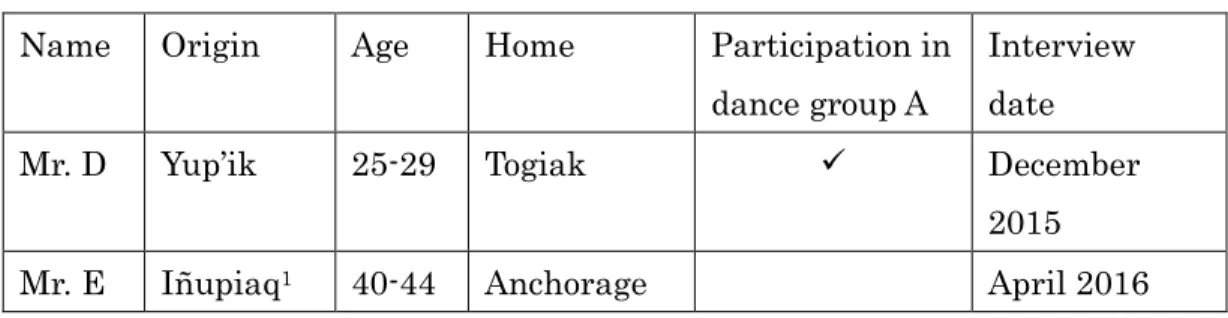
I conducted interviews with two lecturers at UAF from December 2015 to April 2016. Profiles of interviewees are shown in table 4.1.
34
Table 4.1:Profiles of interviewees Name Origin Age Home Participation in
dance group A
Interview date Mr. D Yup’ik 25-29 Togiak December
2015 Mr. E Iñupiaq1 40-44 Anchorage April 2016
(1) Mr. D
Mr. D was a graduate student and worked as the lecturer of Yup’ik language classes and Alaska Native dance classes for undergraduate students at that time. He was an oldest member in dance group A. He viewed Native dance differently from students.
(a) People restarted a dance group in Togiak, then Mr. D joined them There is a dance band in Togiak, but it’s not as regular because it depends on who is there, they don’t practice all the time. A group got small, one thing I mention is every village is different, like even in terms of how dancing was stopped. Some religion is stricter than others, like Moravians, a type of Christianity, Moravians came to Togiak. It’s like religions may have divided Alaska. It’s very strange. So different religions are different. Like, Russian orthodox they liked Native dance, I think. Like they got keep traditions. And Moravians didn’t like it, and stopped it. So in the 1990s, somebody brought dancing back to Togiak, so they had to restart the dance group. Young man talked his mother, and he knew, and he got some young people to join it. He taught how to dance. Then I joined it. […] One thing I’m interested is that because dancing was stopped in Togiak, there is not much older people who dance. Because middle age people, no older people danced when I was fifteen. Like no body older than twenty, except teachers. There are two or three dance teachers. And my mom didn’t dance, and my dad, white, didn’t dance, but my mom said my grandpa used to dance. And she said he singed all the time. […] I
35
joined dance group in high school because just I could travel to Anchorage with them. I joined a group, they’re going to Anchorage, for this performance a lot of songs. After I went to Anchorage, some people quit. They just traveled. I
couldn’t quit. Because so much fun, I really liked it. And it’s funny because I looked white. Do I look white? I’m a half. I shouldn’t look very brown, you know? […] In Togiak, there are still people who believe dancing is evil. Because onetime church people came, they told everybody not to dance. It’s evil. Still some older people believe dances are evil.
(b) Expert dancers can beat drums
I’d like to go to Togiak someday, teach there. I still want to. I think a little bit is good. If they hired me, it would be good for Yupik program, ’cause when I was there, there was no Yupik program. Yupik language. […] In Bethel, one of guys who taught me how to sing and dance, he teaches in Bethel, and the kids he teaches beat drums themselves. They are very experts. I’d like to do that in Togiak. They could learn.
(c) It is better to remember the past and change dances to be relevant with today’s population
I think Native dance has to change to be relevant with today’s
population, especially because its changes are good, also it’s good to remember the past to keep up our traditions and not to forget all dances, because all dances are very important, too. And people are creative, so always gonna make new things. And not everyone is like them, there are people who don’t like new dances, like only old ones. Some people think old one is boring, and new one is good. I mean those are too extremes. For the most part, everybody enjoys old one and new one. That should be fun. That’s the feeling I get to dance, it’s so much fun. I miss dancing.
(d)Native dance is very important for self-identity and creates good communities
Native dance is very important. That’s one important thing to remember tradition and people they used to be, but also I think it’s very important for self-identity. It’s like people from that culture can identify with
36
the dance, things that my ancestors used to do, and I’m doing this, and keeping a traditional life. It can give you self-esteem, like motivation, and also it can build community with people who are dancing with us. I can feel close to them, it’s a really nice way to spend time for fun. The group gets the way from time to time like the group feels like a very little community inside. People become very good friends, joke around each other, and it can be beneficial to things like homework when you go to school here. So isn’t it a good way to build connection between people? You can learn a lot besides like your own dances, because we know dances from all of Alaska. If I was in Togiak, it would be very hard to learn songs from other regions. So it’s nice to be in the dance group for everybody.
(2) Mr. E
Mr. E received a Ph.D. in Indigenous Studies at UAF and worked as an assistant professor at that time. Though he visited events held in B building and took part in managing Festival of Native Arts, he did not visit dance group A’s practices. He founded his own Iñupiaq dance group in 1999 and he
continued to participate in his dance group. He viewed Native dance on a larger scale.
(a) Reason why dance group A does not practice Indian dance
There used to be Yupik and Athabascan dance group here, at the University. They graduated and moved on and the group didn’t have anybody continue on. That’s a different between, you know? Dance group A continue on, you know, it’s still dance group, so you have some of the songs that’re passed on, but sometimes another some dance groups passed. They teach songs to dance group A, which is great.
(b) Several occasions for performance in Fairbanks
Well, we practice every second and fourth Saturdays of each school years at Denali center. Denali center is the place for people who can’t take care of themselves, ether they’re physically unable to take care themselves, ether too elderly, they can’t take care themselves. There are nurses, you know, other
37
health care. We practice there, so that the residents are able to watch Native dancing. Resident and their family are very appreciated for that. […] I remember two Athabascan elders. They got up and danced. When they were supposed to have dinner, they set them down. Though they were not supposed to be standing, but they stand up and danced with us, which is great. Some elders drummed with us. It’s well. They were dancing in their way, Athabascan way. They just wanted to join in, which is great. It was wonderful.
We performed at the Festival of Native Arts, we performed at the world Eskimo Indian Olympics, we performed at various conferences. Last week we performed at a school, they had potluck. We just performed. There were several people, there was Thai dance group, some Samoa dancers, so we danced as well. That was multi-cultural potluck. And tomorrow we will perform at elders’ summit. So we perform at school, at several conferences, sometimes Alaska federation of Natives. We performed there for the closing ceremony. So we perform all over Fairbanks. You know? People request us.
(c) Some people are still influenced by missionary thinking
A lot of villages, not all of them, because of missionaries, they think dancing is evil, so they forbid dancing. We couldn’t speak our language. We can’t practice any cultural heritage. So some people still influenced by missionary thinking. Dancing is evil. Some villages are relearning their dances. Even in United states census, in 2010 the First People that would be counted, north Alaska, Norbic Alaska, Indian Iñupiaq region. And Norbic knew that there’s gonna be lots of TV media, lots people there, but there didn’t know dances, so they wanted to learn some dances for media people came. So, what the people of Norbic did November of 2009? They asked the church for permission to dance again, and they got a permission from church. So, they’re still bearing with the missionaries.
(d) In the old days, there were different types of dancing
There’s different type of dancing. And Iñupiaq people also has different type of dancing. There were shaman dancers, they were forgotten right now. Athabascan people had songs and dances, that was about somebody died, that’s only for when they die, they don’t perform the dance anymore. There were some
38
Yupik dances like the Athabascan dance, but now forgotten. (e) Sharing dances
We have motion dances that just tell stories and that is specially, you know, when we travel, we travel quite a bit, and dance. A person visit community and share his dance, and the community share their dance. That’s the way of sharing. They tell either hunting stories or venture stories, sometimes, they dance their originated village, like dances from other villages, a lot of share dances. Most of today’s dances are sharing dances. You know, our dance group is a young dance group compared to some other Iñupiaq dance groups. First term, I encouraged our members to perform at Indian Olympics, and there were other Iñupiaq dance groups there. They just told us many dances. They were encouraging us to dance. To create dance here at Fairbanks, even though this is Athabascan country. But there were a lot of Iñupiaq. They live here. They are starting more dance groups in villages.
(f) We can take dances to everywhere
You are more welcome to take the dances to Japan, and keep on dancing, I did with the somebody in Juneau, another Iñupiaq person, Juneau, southeast Alaska, ancestral territory of Tlingit, but he is Iñupiaq, but he learned my dances, and he is teacher, so he told students how to dance, so he is dancing my dances, the dances I learned. So some of them are mine, I
composed, because I was encouraged by my instructor, so he is one of popular dancer a lot of people like his old Iñupiaq tail and I made a motion of dance, from the story, and so a lot of kids like the dance. So I think that’s very neat. And they messenger me, “Mr. E, your dances are performed in Juneau,” that’s kind of neat, because they recognized, they knew that I was one of who made that. Created that. That’s confirmed.
Discussion
From interviews with students and lecturers, I found three things: (1) they thought about themselves as “Alaska Native” beyond the border of village community and language family, (2) they valued their dance although it is no
39
longer so important in their home village, (3) they shared a sense of spiritual world or a vision of what best dancers should be. I will discuss these points in more detail below.
(1) They thought about themselves as “Alaska Native” beyond the border of village community and language family.
Although students thought about themselves as Yup’ik during dancing, they did not emphasize the difference between Yup’ik and Iñupiaq. Mr. B could relate other villages’ dances with his home village’s dances. This means that students saw themselves not just as the members of their village but as that of Yup’ik, or Eskimo, or even of the entire Alaska Native. Mr. D, who valued learning songs from all of Alaska, also saw himself as an “Alaska Native,” which includes a wide range of ethnic groups. This “Alaska Native” consciousness was observable not only on campus but also in the town.
Today’s Alaska Native dance is independent of the traditional contexts, so people can dance away from their villages and share dances with others easily. Mr. E called this type of Alaska Native dance “sharing dance” and gave an example that people shared dances beyond the borders of language families. This type of “sharing dance” enabled the students in dance group A shared their home villages’ dances with each other and increased their repertoire and still created new dances based on the shared repertoire. Alaska Native dance as sharing dance allowed people to share their dances beyond the boundaries of villages and language families and forced them to see themselves as part of the larger “Alaska Native.”
(2) They valued their dance although it was no longer so important in their home village.
The lecturers recognized the history that Christianization had banned Alaska Native dance. The historical process of the decline and reconstruction of Alaska Native dance differed from area to area and the history is now in progress. That is why Ms. A had not experienced dancing in her village while Mr. B and
40
Ms. C had. Mr. B and Ms. C realized that the experience made them to be better dancers from the view point of dancing skills. Mr. B had a good grounding in Native dancing, and Ms. C thought that her dance motion was well refined.
On the other hand, the fact that people in Ms. A’s home village did not dance anymore and the fact that it was not until the 2000s that the Norbic people reconstructed their dancing as Mr. E mentioned illustrate that people can live without Native dance. Nevertheless, Ms. A thought she needed Native dance. There are two attractive aspects of Alaska Native dance that is independent of traditional contexts; one is that it tells you what you are, and the other is that it helps people form a good community.
According to Mr. D, it is not a new thing that dancing Native dances make people to realize who they are. While village-based Native dances played the role in his grandfather’s generation, dances that Mr. D practiced were not always his village’s dances. This provides several different answers to the question “who you are”—sometimes Alaska Native, sometimes Eskimo, sometimes a member of dance group A. In the interviews with students, four senses of belonging can be detected; by practicing Native dances, 1) they can embody their Alaska Native culture, 2) they can get a feeling of connection with the spiritual world, 3) they can keep things that their ancestors made, and 4) they can get along with people in their own ways.
You cannot perform Alaska Native dance alone. Alaska Native dance needs one dancer and one drummer at least and generally many people join in. In addition, people often try to make others to laugh and to have fun through dancing. That many people join in and engage in joking makes a place for Alaska Native dance into a place for social gathering. In this social gathering, students build close relationships and they say it is like a “family.” This means that Alaska Native dance helps people form a community far away from their home villages.
Therefore, today’s Alaska Native dance gives some hints as to “who I am” and encourages people to build a good community. Because people live far away from Native villages, they need Alaska Native dance to experience a sense of belonging. Although students did not know how they are going to live after
41
graduation, they expressed interests in continuing to dance. That is, they value Alaska Native dance even though it is now independent of village contexts. (3) They shared a sense of spiritual world or a vision of what best dancers should be.
To some degree, students understood the spiritual world that often appeared as a motif of Native dance and perceived somethings in it. According to students’ explanations, they cannot see spirits, but spirits have a will and the will has impact on humans and natural environments. By dancing Eskimo dance related to spirits, dancers can connect with the spiritual world. The spiritual world is full of magic and this magic power lets people to think of singing and dancing. That is, people do not dance spontaneously. The spiritual world encourages people to dance. This is why Mr. B felt like his father watched over him during dancing and Ms. C felt that dancing helped her in a spiritual way when she went through a hard time. Students said that people who are somewhat magical told them this way of thinking. It was such a belief that Christian missionaries banned as superstition.
Mr. D enjoyed both traditional old dances and new dances. Dance group A also enjoyed both. Dance group A’s Programs included old programs that were handed down in Native villages and new programs that expressed how daily life in UAF was carried on. Dance group A did not judge which type of dance was better. They thought that all dances were important.
Mr. D thought that people who can sing songs as drummers are experts. Mr. B thought that people who can create new dances are best dancers. This means that people cannot become a best dancer by just imitating others’ dance motions. Ancient best dancers also created dance motions and the lyrics from both a dancer’s view and a drummer’s view. Newly created dances are indeed new things but the act of creating is not new. Because of this, people positively value the act of creating new dances.
42
Conclusion
I focused on how Alaska Natives in the city practice Alaska Native dance and found that Alaska Native dance has become independent of village contexts, and this change enabled people to share their dances with others easily. It is my conclusion that Native people gave positive meanings to this new form of Native dances that now represent the category of “Alaska Natives” beyond villages and language families.
People also positively value creating new dances, so people will continue to create new Alaska Native dances. Finally, Native people maintain their belief in the spiritual world behind Native dance. People not only continue to create new dances but also are influenced by the spirituality of Alaska Native dance. The relationship between Alaska Native dance and Alaska Natives is reflexive. Alaska Natives continue to live Alaska Native dance and Alaska Native dance keeps changing with Alaska Natives.
References
Bureau of the Census 2010 2010 Census
Retrieved 1 October 2017 from: <https://www.census.gov/2010census/>. Dance group A
2017 “Our Mission” and “Becoming a Member” Retrieved 24 September 2017 from:
<http://inuyupiaqdancers.tripod.com/>. Dombrowski, Kirk
2001 Against culture: development, politics, and religion in Indian Alaska, Lincoln: University of Nebraska Press.
43
Ikuta Hiroko
2010 “Eskimo language and Eskimo song in Alaska: A sociolinguistics of deglobalisation in endangered language,” Pragmatics, 20(2): 171-189. 2011 “Embodied Knowledge, Relations with the Environment, and Political
Negotiation: St. Lawrence Island Yupik and Iñupiaq Dance in Alaska,”
Arctic Anthropology, 48(1): 54-65. Johnston, Thomas F
1976 “Alaskan Eskimo and Indian Musical Performance: Its Many Psychological and Social Ramifications,” Trends and New Vistas in Contemporary Native American Folklore Study (eds.), Folklore Forum Bibliographic and Special Series, 15: 117-131, Department of Folklore and Ethnomusicology, Indiana University. Retrieved 1 October 2017 from: <https://scholarworks.iu.edu/dspace/bitstream/handle/2022/2625/BSS%20 15%20117-131.pdf;sequence=1>.
益子待也
2000 「メトラカトラにおける『伝統』の創造について」岡田淳子編『変容する Metlakatla Indian Community―北西海岸インディアンの開発人類学的研 究』pp.26-29、札幌: 北海道東海大学国際文化学部。
宮岡伯人
1987 『エスキモー―極北の文化誌』東京: 岩波書店。 Office of Admissions and the Registrar Signers’ Hall
2017 “Race” Data as of Fall 2016, “UAF Facts and Figures” Retrieved 1 October 2017 from:
44 岡庭義行 2008 「アラスカ・ツィムシアンとアラスカ先住民法」岸上伸啓編『北アメリカ 先住民の社会経済開発』pp.193-220、東京: 明石書店。 岸上伸啓 2014 『クジラとともに生きる―アラスカ先住民の現在』京都: 臨川書店。 久保田亮 2005 「儀礼とダンスの断絶―宣教師の活動をめぐるアラスカ先住民ユピックの 歴史認識」『東北人類学論壇』4: 1-20。 2009 「チュピック村落社会の学校にみる先住民の自律」窪田幸子・野林厚志 (編)『「先住民」とはだれか?』pp179-201、京都: 世界思想社。 2010 「アラスカの周縁に生きる人びとの民族誌―先住民‐国家関係の歴史動態 とチュピックの日常」東北大学大学院文学研究科人間科学専攻博士論文。 齋藤玲子 2008 「アラスカ・ツィムシアンの観光開発と文化復興」岸上伸啓(編)『北アメ リカ先住民の社会経済開発』pp.221-246、東京: 明石書店。