Japan Advanced Institute of Science and Technology
JAIST Repository
https://dspace.jaist.ac.jp/Title Knowledge Services : A New Research Field between KM and SSME
Author(s) Xia, Haoxiang; Wang, Zhongtuo; Dang, Yanzhong Citation
Issue Date 2007-11
Type Conference Paper
Text version publisher
URL http://hdl.handle.net/10119/4152 Rights
Description
The original publication is available at JAIST Press http://www.jaist.ac.jp/library/jaist-press/index.html, Proceedings of KSS'2007 : The Eighth International Symposium on Knowledge and Systems Sciences : November 5-7, 2007, [Ishikawa High-Tech Conference Center, Nomi, Ishikawa, JAPAN], Organized by: Japan Advanced Institute of Science and Technology
Knowledge Services: A New Research Field between KM and SSME
Haoxiang Xia Zhongtuo Wang Yanzhong Dang
Institute of Systems Engineering, Dalian University of Technology, Dalian, China 116024
{hxxia, ztwang, yzhdang}@dlut.edu.cn
Abstract
In this article the authors give a suggestion to develop a possible new research field called “knowledge services”, which is regarded on one hand as an evolution of the field of knowledge management, and on the other hand as a key branch of the emerging discipline of service science, management and engineering (SSME). Consequently some key research issues of this new research field are briefly discussed.
Keywords: Knowledge Services, Knowledge
Management, SSME
1 Introduction
In the last decade, Knowledge Management (KM) has attracted great attention and enormous researches have contributed to improve our understandings of the knowledge-related activities and processes within an organization. However, one limitation of these contributions is that their research scope is largely fenced inside the boundary of a single organization, taking it for granted that the creation, storage, transfer and application of knowledge are merely internal activities of the organization. In today’s densely inter-connected knowledge society, there is a need to extend KM studies toward an inter-organizational level since the organization’s knowledge activities and processes cannot be separated from its social and business contexts. For example, consider knowledge co-generation by a business company
together with a consultancy organization. The consultancy organization gives a feasibility analysis for the business company’s possible risk investment on a new product. In this scenario, the consultancy organization provides the business company with some sort of “knowledge service” in the form of the feasibility analysis report. The key characteristics of such knowledge services are two-fold. On one hand, what is offered by the consultancy organization is some “service” instead of “product”, which is co-created by the collaborative activities of the service provider and the customer (i.e. the consultancy organization and the business company). On the other hand, at the core of the offered service is by nature knowledge other than anything else. That is, behind the provision of the feasibility analysis report is the knowledge transfer from the consultancy organization to the business organization. The previous concept of “knowledge services” is furthermore in concord with the growing concerns on service science, management and engineering (SSME) [3]. Therefore, there may be a disciplinary demand to combine KM and SSME to explain how knowledge is created, transferred and applied at a cross-organizational level, and to practically promote effective provision of knowledge services.
Based on the prior considerations, in this article we would give a primitive imagination on the research field of “knowledge services” that is rising from KM and SSME. We would first discuss the academic connections of the
knowledge services field to KM and SSME, pointing out that knowledge services are the natural evolution of knowledge management and on the other hand a key branch of service science, management and engineering. Then a few research issues are shortly discussed, which we believe being important to develop this emerging research field.
2 Academic Origins of Knowledge
Services
2.1 From Knowledge Management to Knowledge Services
First we attempt to conceptualize the knowledge service studies from a Knowledge Management perspective. From this perspective, the “knowledge services” field can be regarded as a natural evolution of KM. Such evolution can be analogous to the development of business logistic services. A common case is that an organization’s logistic system initially functions just for the sake of satisfying the organization’s
internal needs. Nevertheless, the further development of the organization’s logistic system may gradually enhance its delivery capabilities so that the organization may also provide logistic services to some external customers. Similarly, it can be imagined that the well management of the organizational knowledge resources may eventually allow the organization to provide inter-organizational knowledge services, i.e. to deliver specific knowledge or expertise to special customers. As an academic response, there is a need to extend the current KM researches to cover inter-organizational knowledge services.
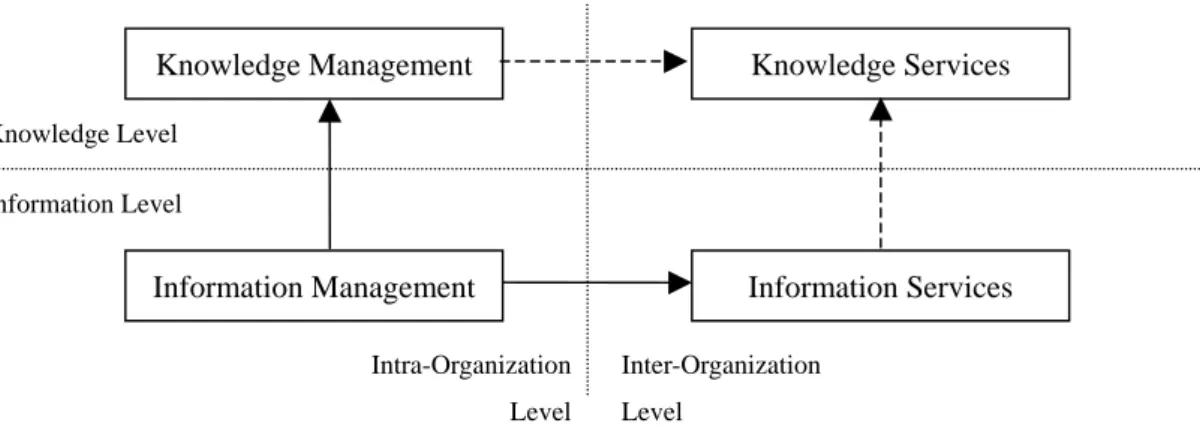
From a more academic point of view, the studies on knowledge services can be traced back to enterprise “Information Management” (IM), which has been widely discussed since 1970s. As illustrated by the following figure, we conjecture that there may be a path of an academic development through which the field of knowledge services gradually emerges from the IM field.
In Figure 1 four inter-related research fields rooted in IM are shown. The focus of IM is on the management and utilization of information resources for an organization’s own purpose. Instead, the purpose of “information services” (IS) [1] is basically on the management and utilization of information resource for serving
some external customers. One well-discussed type of information services is the literature retrieval services provided by libraries. This information service is to satisfy the information needs of the readers. Another field that is partially developed from IM is Knowledge Management, whose focus is on the Information Management Information Services
Knowledge Management Knowledge Services
Knowledge Level Information Level
Intra-Organization Level
Figure 1 Evolution Path from IM toward KS
Inter-Organization Level
management and utilization of knowledge and expertise. At the current stage, a possible tendency is that a new field of knowledge services may grow from the further development and fusion of the fields of knowledge management and information services. Currently in library science, there has been the increasing concern on providing “knowledge services” as an improvement of the traditional library “information services” [1, 6]. We believe that this may reflect the rising of a more general research direction of “knowledge services”.
2.2 Knowledge Service Studies as Branch of SSME
The second academic root of the knowledge service studies is the development of “Service Science, Management and Engineering” or SSME. Reflecting the growing importance of the service section in modern economy, SSME has attracted great attention in the recent years. However, this field is still in its infancy and it essentially lacks a holistic view. It is the authors’ argument that a “knowledge-centered” aspect is vital to develop SSME but this aspect is largely neglect in the previous efforts in the SSME community. One standpoint in the SSME community is that “services are the soul of the knowledge economy as technologies are the core of the manufacturing economy” [5]. In our view, this contention is just partly true. With the rapid growth of services in modern society, nowadays there are tremendous types of services; it is obvious that not all types of the services can be regarded as the “soul” of the emergent knowledge economy. Instead, we notify the particular importance of a special type of services in today’s service and knowledge society, namely the services to provide the customers with knowledge. Examples of this type of services include education services that raise students, consultancy services that provide
business companies with professional suggestions, and patent query services that provide the requesters with specialized patent information. We believe that it is these “knowledge services” that can be regarded as the “soul” of the emergent knowledge economy, as they fundamentally immits knowledge into the social economic system. For example, most of the knowledge-workers are raised through a school-based educational system; thus the education services are doubtlessly one key enabler of the knowledge economy. The technology intermediation services that assist knowledge transfer from the research institutes to business companies are another example of the noteworthy knowledge services. Studies of such knowledge services would be important to develop the discipline of SSME.
In academia the importance of knowledge-associated services has also been recognized in the studies of professional services and “Knowledge Intensive Services” [2,4]. However, our emphasis on knowledge services is different from the prior KIS in two aspects. First, the concept of a “knowledge service” is differentiated from that of a “knowledge-intensive service” in that the latter emphasizes that knowledge plays an important role during service creation and provision, whilst the former stresses that the major aim of the service is to provide the customers with knowledge. Thus, a knowledge service is commonly a knowledge-intensive service, but a knowledge-intensive service is not necessarily a knowledge service. For example, higher-education is a knowledge service and simultaneously a knowledge-intensive service, while medical diagnosis is a knowledge-intensive service but not a knowledge service as the major purpose of the medical diagnosis is not to deliver knowledge to the patient. Second, the current research field of KIS is essentially based on the macro- and
regional economic perspective, i.e. the researches are usually focused on the role of KIS sector plays in the service sector and in the whole economic system, and on the policies to develop the KIS sector. In contrast, we consider that a micro-perspective is necessary to initiate the studies on knowledge services. That is, there is the need to investigate the micro-mechanism of how a knowledge service is provided and correspondingly how knowledge is transferred from the service provider to the customer.
In summary, in this section we try to conceive the research field of knowledge services from the viewpoint of disciplinary development. Behind our suggestion to study knowledge services is a prediction that knowledge services will grow to be an important economic sector in modern society and to play an important role in knowledge economy. However, currently we don’t have the statistical data to measure the growth of the knowledge service sector. Thus to further motivate our suggestion on studying knowledge services, an industrial economy research is needed so as to measure the growth of knowledge service sector in a national or regional economy.
3 Primitive Considerations on Knowledge
Services Researches
As discussed in the previous section, the need of studying knowledge services can be identified from both KM and SSME. Thus there is the possibility that a new field may rise between these two research fields. However, at the current stage, we are still not able to draw a clear picture for this emerging field of knowledge services. In this section we attempt to present our primitive considerations on a few key research issues to promote the development of this emerging field.
The first issue of our concern is the concept
of knowledge services. As discussed in the previous section, our basic understanding of the concept of knowledge services is that knowledge services are the services that provide knowledge to customers, i.e. knowledge is the basic output of a knowledge services. This differentiates the studies on knowledge services from those of “knowledge-intensive services”, which basically regard knowledge as input of the services. With this concept, “knowledge” is the distinctive characteristics of knowledge services and the knowledge services researches should be centered on knowledge.
The second issue worthy of deep investigation to develop the knowledge service field is the classification of knowledge services. One classification is to divide knowledge services into public services and commercial services. The public services are usually non-profit and widely-available services which aim at improving the whole society’s knowledge substrate and innovative capabilities. Typical examples of such services are the public-school education services and the public library services. In contrast, the commercial knowledge services are essentially business services through which commercial organizations expect to make commercial profits. Apparently the running mechanisms behind these two categories of services are significantly different from one another. Thus there is a need to respectively study these two types of knowledge services.
Knowledge service can also be classified into shallow services and deep services, with respect to knowledge content provided to the service customers. “Shallow” services refer the services that simply provide the customers with general knowledge rather than customized knowledge specific to particular users or user groups. Instead, what is provided by the “deep” services is knowledge being customized according to specific user requests or interests. For example, the current library information retrieval services
are mostly shallow knowledge services, as the libraries provide similar services to all users. When a library offers specialized users with specialized retrieval services, e.g. providing knowledge contents to the users with respect to user interests, we can say that this library offers deep services. Provision of deep knowledge services requires more collaboration between the provider and the customer; and thus particular attention should be paid on investigating the deep services. In addition, the development from shallow services to deep services is also a noteworthy research topic.
Thirdly, we believe that the central theme of knowledge service researches is to explore the mechanisms of knowledge service provision. Especially in the case of deep knowledge services, the process or knowledge service provision is essentially a process of inter-organizational knowledge co-creation and transmission. Such process is more difficult to model comparing with the knowledge processes within the boundary of a single organization, which is investigated in knowledge management. A lot of work needs to be done to fully understand and well manage such co-creation process. To develop the process models of knowledge service provision, a possible way is to study actual cases in different business contexts. As an example, the authors are now interested in the service provision models of the technology intermediation organizations, hoping that the thorough surveys and analysis of the actual technology intermediation modes would ultimately lead to theoretic findings on the mechanisms of knowledge service provision processes. Another interesting and open subject of knowledge service researches is the pricing of business knowledge services. Essentially the pricing of services is difficult as services are endogenously intangible; the pricing of knowledge services is even more difficult because it is even more difficult to measure the
commercial value of knowledge. Thus the pricing of knowledge services is a challenging problem but it is on the other hand an important problem to develop the economic sector of knowledge services.
Finally, the information technological substrate of knowledge services should be exploited. In our opinion, two categories of computing technologies are of particular importance to develop knowledge services. The first is the technologies of service-oriented computing and ubiquitous computing. We believe that network-accessible computer applications would become a form of knowledge service provision; service-oriented computing and ubiquitous computing may provide the basic platform to support such computerized knowledge services. On the other hand, to support inter-organizational knowledge transfer with computer systems, shared understanding of the common concepts is required, thus the technologies about knowledge transfer and ontologies originally developed in artificial intelligence may also be of great help. Utilization of the above computer technologies to support knowledge service provision should be a noteworthy research topic.
4 Conclusion
In this article we advocate to develop a new research field of “knowledge services” as an extension and combination of KM and SSME researches. It is our argument that different categories of knowledge services may eventually form one important foundation of our future knowledge society, in the sense that knowledge services may become a major form of societal knowledge creation and transmission. Thus thorough inquiry of principles of knowledge services may be of particular importance. However, we’d admit that our current considerations on this academic field are still
primitive. Our major aim in the present article is to call for the attention to this new field. We believe that although the disciplinary framework of this field is largely unclear at the point, efforts on this field would be of real-world value.
Acknowledgment
This work is in part supported by National Natural Science Foundation of China under Grants 70431001 (as Key Project), 70301009, 70620140115 and 60603023.
References
[1]. Hu C. and Qiao H. Information Services and Users. Wuhan: Wuhan University Press, 2001 (In Chinese).
[2]. Kemppilä, S. and Mettänen P. “Innovations in Knowledge Intensive Services”, The 5th International CINet Conference, Sydney, Australia, Sept. 22–25, 2004.
[3]. Maglio P., Sprinivasan S., Kreulen J. and Spohrer J. “Service Systems, Service Scientists, SSME, and Innovation”, Communications of the ACM, 49(7): 81-85, 2006.
[4]. Miles, I., Kastrinos, N., Bilderbeek, R., den Hertog, P., Flanagan, K., Huntink, W. and Bouman, M. ‘Knowledge-intensive business services: their role as users, carriers and sources of innovation’, Report to the EC DG XIII, Luxembourg: Sprint EIMS Programme, 1995.
[5]. Wang F., “Service Science: A New and Old Scientific Field”, Science Times, Dec. 12, 2006 (in Chinese), also available at: http://org.cas.cn/html/Dir/2006/12/12/14/6 4/19.htm
[6]. Wu Y. and Wang L., “From Information Services to Knowledge Services”, China Information Review, p30-31, Dec. 2005. (In Chinese)