$\mathrm{C}$
-algebras and their applications
to reflection
groups
and
conformal
field theories
J.-B. Zuber
$CEA$ SA CLAY Service de Physique $Th\acute{e}or\dot{i}que$ de Saclay,
F-91191
Gif
sur Yvette Cedex, FranceThe aim of this lecture is to present the concept of $\mathrm{C}$-algebra and to illustrate its
applica-tions in two contexts: the study of reflectiongroups and their folding on the one hand, the
structure of rational conformal field theories on the other. For simplicity the discussion
is restricted to finite Coxeter groups and conformal theories with a $sl(2)\wedge$ current algebra,
1. Introduction
The purpose of this talk is to present the notion of $\mathrm{C}$-algebra, a concept that appears
particularly suited in the discussion of various topics of current interest in mathematics
and mathematical physics: rational conformal field theories (rcft), topological field
the-ories, singularity theory and related problems. The concept was originally developed in
relation with finite groups and the algebras of their characters and classes (whence the
“$\mathrm{C}$”): this exposes clearly one of the key features of these algebras, namely the pattern
of two dual algebras. More generally, (the precise definition will be given in sect. 3),
$\mathrm{C}$-algebras are associative, commutative algebras with a finite number of generators. They
come in dual pairs, endowed with different multiplication laws, one algebra being
gener-ated by the idempotents of the other. We shall illustrate and apply this concept in two
different contexts: the association between rational conformalfield theories and graphs on
the one hand; the folding of root systems and Dynkin diagrams on the other. In both
cases, generalized Dynkin diagrams are the central objects, and pairs of algebras that are
naturally associated with these graphs are $\mathrm{C}$-algebras. The study of the $\mathrm{C}$-subalgebras (to
be also defined below) then enables one to understand the relationship between rcft and
graph-how to construct one object from the other-and to understandthe folding of root
systems, Dynkin diagrams and reflection groups.
Because certain positivity properties play an important role in the discussion of
C-algebras, we start with a presentation of such properties that are empirically observed in
different contexts but do not seem to have been given enough attention.
For the sake of brevity, all the discussion will be restricted to the simplest-and best
understood-case: rcft associated with $sl(2)$, “minimal” topological field theories, simple
singularities, ordinary Coxeter-Dynkin diagrams, etc. There is ample evidence, however,
-and a few proofs-, that the present considerations extend to a much larger context.
2. Three empirical facts
Consider the prepotential $F(\mathrm{t})$ of one of the $ADE$ singularities. Here $\mathrm{t}=(t^{1}, \cdots , t^{n})$,
where $n$ is the rank of the associated $ADE$ algebra(the Milnor numberof the singularity);
the$t^{j}$ are the flat coordinates in the versal deformation of the singularity. $F(\mathrm{t})$ satisfiesthe
Witten-Dijkgraaf-Verlinde-Verlinde(WDVV) equations [1], which express the associativity
ofthe algebra with structure constants $C_{ij}k(\mathrm{t})$, where $C_{ijk}( \mathrm{t})=\frac{\partial^{3}F}{\partial t^{t}\partial t^{j\partial}t^{k}}$, and indices are
prepotential $F$ is a quasihomogeneous polynomial of degree
$2(h+1)$ if we assign to the
variables $t^{i}$
the degrees $\deg(t^{i})=(h+1-\lambda_{i})$, where $\lambda_{i}$ is the i-th Coxeter
exponent
of the $ADE$ algebra: these exponents are supposed to be labelled in
increasing
order:$\lambda_{1}=1<\lambda_{2}\leq\cdots\leq\lambda_{n-1}<\lambda_{n}=h-1,$ $h$ the Coxeter number. It is
convenient to change
notations, labelling the $t’ \mathrm{s}$ with thevalue of
$\lambda_{i}$, hence replacing $t^{i}$
with$t^{\lambda_{i}}$
, andaccordingly
to denote the structure constants $C_{\lambda_{i}\lambda_{i^{\lambda}k}}$ or $C_{\lambda\mu\nu}$, for $\lambda,$
$\mu,$ $\nu$ exponents. The expressions
of the prepotentials for the various $ADE$ cases have been listed in the
literature
([2-3] andfurther references therein).
Now, by inspection, we observe the following
Fact 1 : For the $A_{n},$ $D_{2n},$ $E_{6}$ and $E_{8}$ cases, th$\mathrm{e}re$ exists a choice of flat coordinates for
which all the coefficients of$F$ arereal positi$\mathrm{v}e$. For$D_{2n+1}$ an$dE_{7}$ there is no such choice.
Two remarks are in order.
First, why is it meaningful to look at reality and positivity properties in a problem that looks intrinsically complex?
Secondly it is curious that this splitting of the $ADE$
classification
scheme into the sametwo sub-families appears also in other contexts. Let us quote
1) the structure of the modular invariant partition function of conformal field theories
with a $sl(2)\wedge$ current algebra. The latter are
known to follow an $ADE$
classification
scheme $[4,5]$. The question is to know if this partition function, which is a certain
sesquilinearform with non negative integer coeflicients, may or may not be written as
a sum ofblocks
$Z= \sum N_{\lambda\overline{\lambda}}\chi\lambda\overline{x}_{\overline{\lambda}}$ $\Lambda_{\lambda\overline{\lambda}}’\in \mathbb{N}$ $(2.1a)$
$= \sum_{i}?|\sum_{\lambda\in\hat{\tau}_{\alpha}}\chi_{\lambda}|2$ $($2.1$b)$
For example, the cases labelled by $D_{10}$ and $E_{7}$ read respectively
$Z^{(D_{1})}0=|x_{1}+x17|2+|x3+\chi 15|2+|x5+\chi_{1}3|^{2}+|x7+x11|^{2}+2|\chi 9|^{2}$ $(2.2a)$ $Z^{(E_{7})}=|\chi_{1}+\chi_{17}|2+|x5+x13|^{2}+|\chi_{7}+\chi_{11}|^{2}+|\chi_{9}|^{2}+$($(\chi_{3}+\chi_{15})x_{9}^{*}+\mathrm{c}\mathrm{o}\mathrm{m}\mathrm{p}\mathrm{l}\mathrm{e}\mathrm{X}$ conj.)
$=|\chi_{1}+\chi 17|2|x5+\chi_{1}3|^{2}+|x7+x_{1}1|2++|x_{9}+\chi_{3}+\chi 15|2-|x_{3}+x_{1}5|2(2.2b)$
(for more details and explanation of notations, see below sect. 5).
2) the positivity of the structure constants of the “Pasquier algebras” to be discussed
3) the existence or non-existence of a “flat connection” on the pathalgebraon the Dynkin diagram [6];
4) the positivity of the coefficients of the prepotential just discussed;
5) the positivity properties ofthe coefficients of the factors of the Poincar\’epolynomial of
the local (or “chiral”) ring of the singularity. Let us discuss briefly this latest aspect,
as it does not seem to be generally known. For any of the $ADE$ singularities, let
$p$ denote the minimal number of non morsian variables $X_{i}$.that enter the singular
polynomial. Let us write the Poincar\’e polynomialin the form
$P(t)= \prod_{i=1}^{p}\frac{(1-t^{h-}\deg(xi))}{(1-t^{\mathrm{d}\mathrm{e}}\mathrm{g}(X_{i}))}$ (2.3)
in terms of the degrees of the variables $X_{i}$ and of the Coxeter number $h$, equal to the
degree of the singular polynomial.
$h$ $p$ $\{\deg(xi)\}$ exponents $\lambda$
$A_{n}$ $n+1$ 1 1 $1,2,$ $\cdots,$ $n$ $D_{l+2}$ $2(P+1)$ 2 2,$l$ 1, 3, $\cdots,$$2P+1,l+1$ $E_{6}$ 12 2 3,4 1,4,5,7,8,11 $E_{7}$ 18 2 4,6 1, 5, 7, 9, 11, 13,17 $E_{8}$ 30 2 6,10 1, 7, 11, 13, 17, 19, 23,29
It is then an easy and amusingexerciseto check that $P(t)$ may be written as a product
of $p$ factors with positive coefficients only in the first subfamily. (I owe this observation
to M. Bauer [7]$)$. This is somehow the $\mathrm{m}\dot{\mathrm{u}}\mathrm{l}\mathrm{t}\mathrm{i}\mathrm{p}\mathrm{l}\mathrm{i}\mathrm{c}\mathrm{a}\mathrm{t}\mathrm{i}\mathrm{v}\mathrm{e}$ counterpart of the property 1)
mentionned above.
The interesting thing is that the simultaneous occurrence of several of these
proper-ties seem to extend beyond the $ADE$ case discussed here. The status of these various
occurences is however not the same. I think it is fair to say that 1) is the best understood,
as it is related to a structural property of the underlying conformal field theory. 2) is
related to 4) as we shall see soon, but I doubt that 4) may be extended beyond the case of
simple singularities, as the prepotential is then no longer a polynomial. Finally it seems
that 5) does not generalize: for some singularities believed to be in correspondence with
some conformal field theory, property 5) may fail while 1) and 2) are true (for example,
the singularity associated with the fusionpotential of $sl(4)_{4}\wedge)$.
In fact we are not going to make use of Fact 1 for generic $\mathrm{t}$, but only for a particular
the $ADE$ singularity for which all the flat coordinatesbut the one, $t^{n}$, with the smallest
de-gree $\deg(t^{n})=2$, (the largest exponent $\lambda_{n}=h-1$), i.e. the “less relevant” in the language
of physics, is kept non zero. As it isthe onlyparameterin thehomogeneous deformed
poly-nomial $W(X_{1}, \cdots, X_{p}, tn)$, one may rescale it to $t^{n}=1$. The origin of the
denomination
isthat for the $A_{n}$ case, the deformed polynomial reads then
$W_{A_{n}}(X_{1;}t^{n}=1)=T_{n+1}(x_{1})$,
with $T_{n+1}(x)$ the degree $n+1$ Chebishevpolynomial offirst kind,
$T_{n+1}(x)=2\cos(n+1),\theta$
if $x=2\cos\theta$.
We also need some notations on the $ADE$ Dynkin diagrams. Let $G_{ab}$ denote the
adjacency matrix of the Dynkin diagram under consideration: $a,$$b=1,$ $\cdots,$ $n$ label the
vertices. The corresponding Cartan matrix is $C_{ab}=2\delta_{ab}-G_{ab}$. The eigenvectors $\psi^{(\lambda)}$
and eigenvalues of these symmetric matrices are indexed by the Coxeter exponents $\lambda$,
$G_{ab} \psi^{(\lambda)}b=2\cos\frac{\pi\lambda}{h}\psi^{(\lambda)}a$
(2.4) The $\psi^{(\lambda)}$ may be chosen
orthonormal. Then we can state the
Fact 2 : The structure constan$ts$ of the chiral ring in the Chebishev specialization
$\mathrm{a}\mathrm{r}e$
$di$agonalized by the $\psi^{(\lambda)}$
$M_{\lambda\mu} \nu:=C_{\lambda\mu}\mathcal{U}(t^{n}=1)=\sum_{a}\frac{\psi_{a}^{(\lambda)()}\psi a\mu\psi_{a}*(\nu)}{\psi_{a}^{(1)}}$ (2.5)
Here I have introduced the notation $M$ to be used in the forthcoming discussion. In
the denominator of the right hand side, there appears the exponent 1, that yields the
largest eigenvalue of the matrix $G$. By the
Perron-Frobenius
theorem, all the componentsof $\psi^{(1)}$ are non vanishing and of the same
sign.
Fact 2 is not a surprise in the $A_{n}$ case, where it follows from the combined work
of Verlinde [8] and Gepner [9]. Indeed the above structure constants reduce then to the
fusion coefficients of the $sl(2)\wedge$
algebra, for a value of the level (central extension) equal to
$k=n-1$
, and the latter are known to have an interpretation in terms of the chiral ringof a topological field theory. For the other $D$ and $E$ cases, the observation was made (in
essence, not quite in these terms) by Lerche and Warner [10], and made more systematic
The previous formula suggests to consider also the dual algebra (we shall see below
that the word “dual” is legitimate), with structure constants
$N_{ab}C:= \sum_{\lambda}\frac{\psi_{a}\psi(\lambda)(\lambda)b\psi_{C}^{(}\lambda)*}{\psi_{1}^{(\lambda)}}$ (2.6)
where the sum runs over the exponents $\lambda$ of the case at hand. This definition depends
on a choice of a vertex denoted 1 for which all the $\psi_{1}^{(\lambda)}$ are non-vanishing. Such a vertex
exists for all the $ADE$ cases. There may remain, however, some arbitrariness in the choice
of that vertex 1 and also, in the case $D_{2n}$ for which an exponent occurs with multiplicity
2, in the choice of the basis $\psi_{a}^{(\lambda)}$. Now comes the
Fact 3
:
For the $A_{n},$ $D_{2n},$ $E_{6}$ and $E_{8}$ cases, th$\mathrm{e}re$ exists a choice of vertex 1 and of the$b$asis $\psi_{a}^{(\lambda)}$ such that the struct$\mathrm{u}re$ constants $M_{\lambda\mu}\nu$ and $N_{ab}c$ are all non negative. For the
cases $D_{2n+1}$ and $E_{7}$, there exists no such choice.
Note that the non-negativity of the $M$ is a simple consequence of Fact 1 $\cap$ Fact 2.
For the $ADE$ cases, the numbers $N$ turn out to be integers (with an adequate choice of
1 and the basis). The interpretation of these numbers in the various contexts in which
they occur (conformal field theories, topological theories and singularities, lattice models)
has remained elusive so far. In contrast, the $M$ that are in general non integers but
rather algebraic numbers, have such an interpretation: they give the structure constants
of the chiral ring of the Chebishev specialization, as just explained; in the context of
conformal field theories and integrable lattice models, they give the coupling constants of
field operators [11], [8], [12]. It is in that context that this algebra was first introduced by
Pasquier [11], whence the name of Pasquier algebras that I give to the pair of $M$ and $N$
algebras.
3. C-algebras
3.1.
Definitions
and examplesThe appropriate language to discuss these Pasquier algebras is that of $C$-algebras, (“$\mathrm{C}$”
for character), introduced in the $40’ \mathrm{s}$ by Kawada and recently reviewed and revived by
Bannai and Ito [13].
Definition
: An alge$\mathrm{b}r\mathrm{a}$ut
over $\mathbb{C}$ with a given $b$asis$x_{1},$ $\cdots,$$x_{n}$, is a $C$-alge$\mathrm{b}ra$ if$it$
$i)$ it is a commutative and associative algebra
with real structure constants $p_{ab^{C}},$ $i.e$.
$Xa \cdot xb=\sum_{C}p_{ab}cx_{c}$;
$\mathrm{i}i)$ it has an identity element, denoted
$x_{1},$ $i.e$. $p_{1a}=\delta bab$;
$iii)$ there is an involution on the generators
$x_{a}-+x_{\overline{a}}$ that is an automorphism of the
algebra, $i.e$. $p_{ab}=p_{\overline{a}\overline{b}}c\overline{C}$;
$iv)p_{ab}1=k_{a}\delta_{a\overline{b}}$, with $k_{a}$ a real positive number
$k_{a}>0$;
v) the $k_{a}$ form a
one-dimensional
representation of the algebra.
Among the various consequences of these axioms, is the fact that $\mathfrak{U}$ is semi-simple.
There are $n$
one-dimensional
representations of the algebra, thatwe label by an index $\lambda$
taking $n$
values:
$x_{a}\mapsto p_{a}(\lambda)\in \mathbb{C}$. The value $\lambda=1$ refers to the special representationofaxiom v): $p_{a}(1)=k_{a}$. If $e_{\lambda}$ denote the corresponding
idempotents,
one may decompose
$x_{a}= \sum_{\lambda}p_{a}(\lambda)e_{\lambda}$ The matrix $p_{a}(\lambda)$ is invertible,
let $q_{\lambda}(a)$ denote the matrix such
that $\sum_{\lambda}p_{a}(\lambda)q_{\lambda}(b)=\kappa\delta_{ab},$ $\kappa:=\sum_{a}k_{a}$. More explicitly,
the matrices $P_{a}$ of
elements
$(P_{a})_{b}^{c}=\sqrt{\frac{k_{c}}{k_{b}}}p_{ab^{C}}$formarepresentationof the algebra
$\mathfrak{U}$. They are normal and
commuting,
and thus diagonalizable in a
common orthonormal
basis $\psi_{a}^{(\lambda)}$. All $\psi_{1}^{(\lambda)}$ and $\psi_{a}^{(1)}$ are nonvanishing and may thus be chosen real positive. One may write
$p_{ab}=c \sqrt{\frac{k_{a}k_{b}}{k_{c}}}\sum\frac{\psi_{a}^{(\lambda)}\psi^{(}b\psi_{\mathrm{C}}\lambda)(\lambda)*}{\psi_{1}^{(\lambda)}}\lambda$
$\sqrt{k_{a}}=\frac{\psi_{a}^{(1)}}{\psi_{1}^{(1)}}$
$p_{a}( \lambda)=\frac{\psi_{a}^{(\lambda)(1}\psi_{a})}{\psi_{1}^{(\lambda)}\psi^{()}11}$
(3.1)
$q_{\lambda}(a)= \frac{\psi_{a}*\psi_{1}(\lambda)(\lambda)}{\psi_{a}^{(1)}\psi^{()}11}$
and let $\hat{k}_{\lambda}$
be such that
$\sqrt{\hat{k}_{\lambda}}=\frac{\psi_{1}^{(\lambda)}}{\psi_{1}^{(1)}}$
(3.2)
One may then show that the dual $\hat{\mathfrak{U}}$
ofUt, defined as the set oflinear maps from $\mathfrak{U}$ into $\mathbb{C}$,
is endowed with a
structure
of$\mathrm{C}$-algebra:its basis is labelled by the $\lambda$, its one
dimensional
representations are provided by the $q_{\lambda}(a)$,
among
which $q_{\lambda}(1)=\hat{k}_{\lambda}$ are positive, and thestructure constants of the algebra are
$q_{\lambda\mu}= \nu\sqrt{\frac{\hat{k}_{\lambda}\hat{k}_{\mu}}{\hat{k}_{\nu}}}\sum_{a}\frac{\psi_{a}^{(\lambda)}\psi^{(\mu)()}a\psi a*\nu}{\psi_{a}^{(1)}}$
The $k_{a}$ and $\hat{k}_{\lambda}$ are called the Krein parameters of the algebras. They satisfy $\kappa=\sum_{a}k_{a}=$
$\sum_{\lambda}\hat{k}_{\lambda}=1/\psi_{1}(1)2$
Alternatively, one may regard this dual $\hat{\mathfrak{U}}$
as a second $\mathrm{C}$-algebra structure on Ut, with
basis $\kappa e_{\lambda}$ and idempotents $x_{a}$. To recapitulate,
$\mathfrak{U}$ is endowed with a pair of dual
C-algebra structures, one with multiplication., structure constants $p_{ab}C$ in the basis $x_{a}$, and
idempotents $e_{\lambda}$, and the other with multiplication $0$, structure constants
$q_{\lambda\mu}\nu$ in the basis $\kappa e_{\lambda}$ and idempotents $x_{a}$
$x_{a}.x_{b}= \sum_{C}p_{ab}x_{c}C$ , $e_{\lambda}.e_{\mu}=\delta_{\lambda\mu}e\lambda$
(3.4)
$\kappa e_{\lambda^{\circ\kappa e}\mu}=\sum q_{\lambda\mu}\nu\nu\kappa e_{\mathcal{U}}$ ,
$x_{a}\mathrm{o}x_{bb^{X_{a}}}=\delta a$
Examples:
1. Character and class algebras of a finite group. Let $\Gamma$ be a finite group, $C_{a}$ denote its
equivalence classes, $(\rho)$ its irreducible representations, $\chi^{(\rho)}$ their characters, $\chi_{a}^{(\rho)}$ the value
of these characters on class $a;a=1$ refers to the class of the identity, $\rho=1$ to the identity
representation; $d_{\rho}=\chi_{1}^{(\rho)}$ is the dimension ofrepresentation $\rho$. One has two dual algebras
$C_{a}C_{b}=cbCacC$
$–(3.5)$
$xx=(\lambda)(\mu).I\mathrm{t}\chi(’\lambda\mu\nu\nu)$
Introducing the $\chi_{a}^{\lambda}\wedge=\sqrt{\frac{|C_{a}|}{|\Gamma|}}\chi_{a}^{(\lambda)},$
orthonorma!
by virtue of the standard orthogonality andcompleteness relations ofcharacters, one may write
$p_{ab}=C_{ab}cc= \sqrt{\frac{|C_{a}||Cb|}{|.C_{C}|}}\sum$
.
$\frac{\chi_{a}^{(\lambda)}x_{b}\chi^{(\lambda)*}\wedge\wedge(\lambda)\wedge C}{\chi_{1}^{(\lambda\rangle}\wedge}\lambda$
(3.6)
$q_{\lambda\mu} \nu=\frac{d_{\lambda}d_{\mu}}{d_{\nu}}K^{\lambda\mu}\nu=\frac{d_{\lambda}d_{\mu}}{d_{\nu}}\sum_{a}\frac{\chi_{a}x\wedge(\lambda)\wedge(a\mu)\chi_{a}^{(}\wedge\nu)*}{\chi_{a}^{(1)}\wedge}$
The two dual algebras have integer Krein parameters $k_{a}=|C_{a}|,\hat{k}_{\lambda}=d_{\lambda}^{2}$ with the well
known relation $| \Gamma|=\sum k_{a}=\sum\hat{k}_{\lambda}=\sum d_{\lambda}^{2}$.
2. The Pasquier algebras introduced above are obviously a pair of dual $\mathrm{C}$-algebras. The
structure constants$p_{ab}C$ and $q_{\lambda\mu}\nu$ are respectively proportional to $N_{ab}c$ and $M_{\lambda\mu}\nu$, as
indi-cated in (3.1) and (3.3). In that case, in contrast with example 1, the Krein parameters
algebras $\hat{\mathrm{g}}$.
In that case, the two dual algebras are in fact isomorphic: this isdue to the fact
that according to the Verlinde formula, the diagonalizingmatrix is the symmetric unitary
matrix $S$ of modular transformations of the affine characters [8].
Also, in that case, the
Krein parameters are equal to $\hat{k}_{\lambda}=(\frac{s_{1\lambda}}{s_{11}})^{2}$, that is $\hat{k}_{\lambda}=D_{\lambda}^{2}$, the square of the quantum
dimension of the corresponding representation of $\hat{\mathrm{B}}$. This is thus a quantum deformation
of the finite group situation of the previous example.
3.2. C-subalgebras
One then defines $\mathrm{C}$-subalgebras of a C-algebra:
Definition
:
Given a $C$-algebra with a basis $\{x_{a}\},$ $a=1,$$\cdots,$ $n$, a $C$-subalgebra is a
C-alge$br\mathrm{a}$genera$ted$ by a subset of the
$x_{a},$ $a\in T,$ $T\subset\{1, \cdots, n\}$, closedunder multiplication,
$i.\mathrm{e}.$ if
$a,$ $b\in T,$ $p_{ab}c\neq 0$ only if$c\in T$.
Note that this condition implies that $T$ contains 1 and is stable under the involution
$a\mapsto\overline{a}[13]$.
We shall be mainly interested in the situation where the two dual algebras have non
negative structure constants. Then there is a remarkable theorem that tells us that the
existence of a $\mathrm{C}$-subalgebra in $\mathfrak{U}$ implies the existence of
a $\mathrm{C}$-subalgebra in the dual. More
precisely, suppose $\mathfrak{U}$ has a $\mathrm{C}$-subalgebra
$\mathfrak{U}_{T}$ associated with a subset $T$. One
may then
define an equivalence relation $a\sim b$ if $\exists c\in T$ : $p_{ac}b\neq 0$, and there is a partition of the
set $\{1, 2, \cdots n\}$ into equivalence classes, $T_{i},\dot{i}=1,$ $\cdots,p,$ $T_{1}\equiv T$. Let $\rho=\sum_{a\in T}k_{a}$ and let
$X_{i}:= \sum a\in\tau_{i}xa$. One also defines $\mathrm{t}\mathrm{h}\mathrm{e}_{\vee}$ subset
$\hat{T}$
of the dual basis by the decomposition of
$X_{1}= \sum_{T}x_{a}$ into idempotents $X_{1}= \rho\sum_{\lambda\in\hat{T}}e_{\lambda}$.
Theorem (Bannai-Ito [13], theorem 9.9): Consider a $C$-algebra
ut
with non nega$ti\mathrm{v}e$stru cture constants$p_{ab}C$ and $q_{\lambda\mu}\nu$. With the notations just introduced,
$i)t \mathrm{A}e\frac{1}{\rho}X_{i},$ $i=1,$ $\cdots,\cdot p,$ $g$enera$te$ th$\mathrm{e}m\mathrm{s}$elves a $C$-alge$br\mathrm{a}$, call$\mathrm{e}d$ the quotient C-algebra $\mathfrak{U}/\mathfrak{U}_{T}$, with a product $inh$erited from
$\mathfrak{U},\cdot$
$ii)$ the $\kappa e_{\lambda}$, for $\lambda\in\hat{T}$, genera$t\mathrm{e}$ a C-su$b$algebra$\hat{\mathfrak{U}}_{\hat{T}}$ of the dual algebra $\hat{\mathfrak{U}}$
;
$iii)$ these two $C$-algebras are $d\mathrm{u}al$ to oneanother.
Thus one has a dual pattern of subsets $T$ and $\hat{T}$
, of $\mathrm{C}$-subalgebras
$\mathfrak{U}_{T}$ and $\hat{\mathfrak{U}}_{\hat{T}}$, and of
quotients$\mathfrak{U}/\mathfrak{U}_{T}$ and$\hat{\mathfrak{U}}/\hat{\mathfrak{U}}_{\hat{T}}$with the isomorphisms$\overline{\mathfrak{U}/\mathfrak{U}_{T}}\cong\hat{\mathfrak{U}}_{\overline{T}}$
One proves also that all $X_{i}$ may be expanded on the $e_{\lambda},$
$\lambda\in\hat{T}$, and conversely.
Recalling that $x_{a}= \sum_{\lambda}p_{a}(\lambda)e_{\lambda}$ and $\kappa e_{\lambda}=\sum_{a}q_{\lambda}(a)Xa$
’ with expressions of
$p_{a}(\lambda)$ and
$q_{\lambda}(a)$ given in (3.1), we find that
$\sum_{a\in T_{i}}p_{a}(\lambda)=0$ if
$\lambda\not\in\hat{T}$
thus $\sum_{a\in T_{i}}\psi^{(\lambda)}a\psi(a1)=0$ if
$\lambda\not\in\hat{T}$
(3.7) for $\lambda\in\hat{T}$ $q_{\lambda}(a)= \frac{\psi_{a}^{(\lambda)*}}{\psi_{a}^{(1)}}\frac{\psi_{1}^{(\lambda)}}{\psi_{1}^{(1)}}$ independent of $a\in T_{i}$ .
These two conditions may be conveniently assembled into a single one
$\forall\lambda,\forall T_{i},$$\forall a\in\tau_{i}$ $\sum_{b\in Ti}\psi_{b}\psi_{b}^{(1})(\lambda)=\delta_{\lambda\in\hat{T}^{\frac{\psi_{a}^{(\lambda)}}{\psi_{a}^{(1)}}}}\sum_{b\in Ti}(\psi_{b}^{()})^{2}1$ , (3.8)
a form that will be useful in the sequel. It is also easy to write explicitly the expressions
of the structure constants of the quotient algebras. For example, from $X_{i}= \sum_{a\in T_{i}}Xa$ it
follows that $\frac{1}{\rho}X_{i}.\frac{1}{\rho}X_{j}=\sum_{k}\mathrm{p}_{ij^{k}}\frac{1}{\rho}X_{k}$ with
$\mathrm{p}_{ij}k=\frac{1}{\rho}\sum_{c\in Tk}pabC,$ $\forall a\in T_{i},$$b\in T_{j}$
.
(3.9)In the following two sections, I shall present two applications of this theorem. The
first deals with reflection groupsand their folding, the secondwith conformal field theories.
The first starts with $\mathrm{C}$-subalgebras of the $M$ algebra(subject to an additional constraint),
the second with those of the $N$ algebra.
4. Folding of$ADE$ Dynkin diagrams
4.1.
The problemIt is well known that non simply laced Dynkin diagrams (of type $B_{n},$ $c_{n},$$F_{4},$$G_{2}$) may be
obtained by folding the simply laced ones, using the symmetries of the original diagram.
Theextensionto Coxeter diagrams of$H$ or$I$type, associated withthenon-crystallographic
$\mathrm{c}_{\mathrm{o}\mathrm{X}\mathrm{e}}\mathrm{t}\mathrm{e}\mathrm{r}$ groups, seems more recent $[14,15]$. In all these works, one is given a simply laced
Dynkin diagram describing the scalar products of a set of simple roots $\{\alpha_{a}\},$ $a=1,$$\cdots$ ,$n$,
according to
($G$ the adjacency matrix as in (2.4)). Then a certain partition is found of this set into
subsets $\{\alpha_{a}, a\in T_{i}\}$ of mutually orthogonal roots
$(\alpha_{a}, \alpha_{b})=0$ if $a,$ $b\in T_{i}$ . (4.2)
Let $S_{a}$ denote the reflection in the hyperplane orthogonal to
$\alpha_{a}$ through the origin,
$\mathrm{a}\mathrm{n}\dot{\mathrm{d}}G$
the group generated by all the $S_{a},$ $a=1,$
$\cdots,$ $n$. Then one forms the products
$R_{i}= \prod_{a\in T_{i}}s_{a}$ (4.3)
in which the order is immaterial, since the $\alpha$ are orthogonal within the same $T_{i}$, and thus
the $S_{a}$ commute. The group $G’$ generated by the $R_{i}$ is clearly a subgroup of $G$. Since
$G$ is a Coxeter group (of finite order), $G’$ is also of finite order, hence in the $A-I$ list.
The corresponding Coxeter diagram thus results from identifying the vertices of a same
block $T_{i}$, while the superscript of an edge $i-j$, which yields the order of the element
$R_{i}R_{j}$
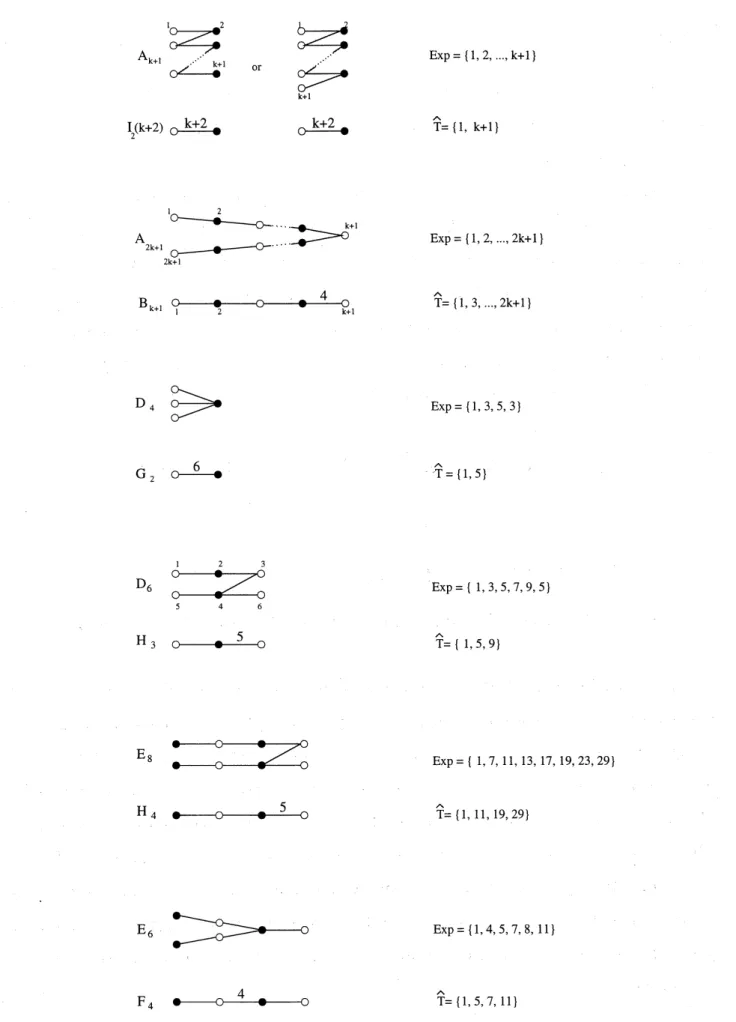
may be computed easily in terms of the original $S_{a}$. One finds empirically the adequate
foldings of the $A,$$D,$$E$ diagrams necessary to manufacture all the others (see Fig. 1). For
example, the order 5 of the product $R_{2}R_{3}$ in the diagram $H_{3},\dot{i}.e$. the smallest power $m$
$\mathrm{s}.\mathrm{t}$. $(S_{2}S_{3}S4S_{6})^{m}=I$ is simply the order of the Coxeter
element of the $A_{4}$ Coxeter group
generated by these four reflections.
As far as I can see, this procedure is, however, empiric, and doesn’t say whichfolding
does the job and in which subspace of the original $n$-dimensionalspacethe subgroup acts.
In the fairly different context of topological field theories $(\mathrm{t}\mathrm{f}\mathrm{t})$, a parallel observation was
made. Starting from the so-called minimal $\mathrm{t}\mathrm{f}\mathrm{t}’ \mathrm{s}$ labelled by
$ADE$ Dynkin diagrams, i.e.
solutions of the WDVV equations of the type mentionned in sect. 2, one finds that there
are other solutions obtained by restriction of the latter. In such a restriction, only a subset
of the flat coordinates $t$ is kept non-vanishing. These non-vanishing $t’ \mathrm{s}$ are labeled by the
Coxeter exponents ofsome non simply laced Coxeter groups $[16,17]$. These restrictions are
consistent with the algebra ofthe $\mathrm{t}\mathrm{f}\mathrm{t}$, in the sense that they correspond to a
sub-algebraof
the $C_{\lambda\mu}\nu(\mathrm{t})$. Ifwe consider the Chebishev specialization and recall Fact 2 of sect. 2, this
means that the Pasquier algebra $M$ of the original $ADE$ diagram admits a sub-algebra,
whose generators are labelled by the exponents of a Coxeter group of type $B,$$C,$ $F,$$G-I$
[17].
In fact there is a strong connection between the two observations, and through the
theory of$\mathrm{C}$-algebras,oneis able
to answer the previous objection and determine thefolding
4.2.
From a $M$-subalgebra to a subgroupConsider a simply laced $ADE$ Dynkin diagram such that the structure constants $M$ and
$N$ are non negative (see Fact 3 of sect. 2). Recall that all Dynkin diagrams may be
2-coloured, $\dot{i}.e$. their vertices may be assignend a $\mathbb{Z}_{2}$ grading $\tau$, the “colour”, such that
$G_{ab}--0$ if$\tau(a)=\tau(b)$. Now suppose that a subalgebraof the $M$ algebrahas been found,
$\dot{i}.e$. a subset $\hat{T}$ of exponents such that
$\lambda,$ $\mu\in\hat{T}$ $M_{\lambda\mu}\nu\neq 0\Rightarrow\nu\in\hat{T}$ ; (4.4)
the subset $\hat{T}$ of exponents is assumed to be stable under $\lambda\mapsto h-\lambda$. The positivity
condition tells us that we are in the conditions of the theorem of sect. 3.2. Because here
we start from a $\mathrm{C}$-subalgebra of the $M$ (or
$q$) algebra, the theorem has to be transposed
to its dual version, namely
(i) there is a partition of the set of exponents into equivalence classes $\hat{T}_{\alpha}$
,
$\mu\sim\nu$ if $\exists\lambda\in\hat{T},$ $M_{\lambda\mu}\nu\neq 0$ ; (4.5)
(ii) there exists a special subset $T$ of the dual set of vertices that contains 1;
(iii) the set $T$ enables one to define a dual equivalence relation: $b\sim c$ if $\exists a\in T$ such that $N_{ab}C\neq 0$, and hence a partition of the set of vertices into equivalence classes $T_{i;}$
(iv) the relation (3.8) is satisfied.
Now the assumption made above that $\hat{T}$
is stable under $\lambda\mapsto h-\lambda$ implies that:
(i) the same is true for each class $\hat{T}_{\alpha}$ ; (ii) the class $T$
contains only vertices $a$ satisfying
$\tau(a)=\tau(1))(\mathrm{i}\mathrm{i}\mathrm{i})$ more generally all the vertices within a same class $T_{i}$ have the same
colour $\tau$ and thus the corresponding roots are mutually orthogonal. These are trivial
consequences of the symmetry of the $\psi$
$\psi_{a}^{(h-\lambda)}=(-1)^{\mathcal{T}()}a\psi_{a}^{(}\lambda)$ (4.6)
I now claim that with this pattern of subalgebras one may associate a subgroup of
$G$; it is again described by a graph, whose vertices are in $\mathrm{o}\mathrm{n}\mathrm{e}- \mathrm{t}_{\mathrm{o}^{-}\mathrm{o}\mathrm{n}\mathrm{e}}$correspondence with
the classes $T_{i}$ and whose set of exponents is
$\hat{T}$
. This subgroup is generated by reflections
in the hyperplanes orthogonal to some $\beta$, that are some linear (real) combinations of the
roots $\alpha$:
the normalisation is adjusted so that $(\beta_{i}, \beta_{i})=2$, namely
$N_{i}^{2} \sum_{a\in Ti}(\psi_{a}^{(1)})2=1$ (4.8)
(since the $\alpha_{a},$ $a\in T_{i}$ are mutually orthogonal). One verifies, using (3.8), that the product
$\prod_{a\in}\tau_{i}S_{a}$ has the same action as the reflection $R_{i}$ in the hyperplane orthogonal to $\beta_{i}$, in
the subspace spanned by the $\beta[18]$.
The scalar products of two distinct roots $\beta_{i}$ and $\beta_{j}$ is non positive, asfollows fromthe
same property for the original simple positive roots $\alpha_{a}$ and from the positivity of the $\psi_{a}^{(1)}$
$( \beta_{i}, \beta_{j})=N_{i}N_{j}b\in T\sum_{a\in T_{ij}}(\alpha_{a}, \beta_{b})\psi_{a}(1)\psi_{b}(1)\leq 0$ .
The metric defined on the original roots may be diagonalized by the $\psi$
$g_{ab}=( \alpha_{ab}, \alpha)=\mathrm{o}\mathrm{n}\sum_{\exp \mathrm{e}\mathrm{n}\mathrm{t}\mathrm{s}\lambda}g\psi_{a}\lambda)\psi_{b}^{(}(\lambda)(\lambda)*$ , (4.9)
with $g^{(\lambda)}=2-2 \cos\frac{\pi\lambda}{h}$. From the expressions of the new roots $\beta_{i}$ it is easy to compute
the new metric, making use again of (3.8)
$g_{ij}=( \beta i, \beta_{j})=\Lambda_{i^{-}}^{\prime 1}N_{j}^{-}1\sum g^{(}\lambda\in^{\hat{\tau}}\lambda)_{\frac{\psi_{a}^{(\lambda)}}{\psi_{a}^{(1)}}}\frac{\psi_{b}^{(\lambda)*}}{\psi_{b}^{(1)}}$ $\forall a\in T_{i},$$\forall b\in T_{j}$
(4.10)
$= \sum_{\lambda\in\hat{T}}g\Psi^{(}(\lambda)\lambda)\Psi_{j}(\lambda)*i$
in terms of the new eigenvectors
$\lambda\in\hat{T}$
$\Psi_{i}^{(\lambda)}=N_{i}^{-1}\frac{\psi_{a}^{(\lambda)}}{\psi_{a}^{(1)}}$ $\forall a\in T_{i}$
(4.11)
$= \Lambda_{i}’\sum_{a\in\tau i}\psi_{a}(\lambda)\psi(1)a$
or
$\mathrm{E}\mathrm{x}\mathrm{p}=\mathrm{t}\mathrm{l},2,$ $\ldots,\mathrm{k}+1\mathrm{I}$
$\mathrm{I}(\mathrm{k}+2)2\underline{\mathrm{k}+2}$ $\underline{\mathrm{k}+2}$ $\wedge \mathrm{T}=\{1, \mathrm{k}+1\}$
$\mathrm{E}\mathrm{x}\mathrm{p}=\{1,2,$ $\ldots,2\mathrm{k}+1\mathrm{I}$
$\mathrm{B}_{\mathrm{k}+1}\ovalbox{\tt\small REJECT}^{4}12\mathrm{k}+1$ $\wedge \mathrm{T}=\{1,3, \ldots,2\mathrm{k}+1\}$
$\mathrm{D}_{4}$
$\mathrm{E}\mathrm{x}\mathrm{p}=\{1,3,5,3\}$
$\mathrm{G}_{2}$
$\underline{6}$ $\wedge \mathrm{T}=\{1,5\mathrm{I}$
$\mathrm{D}_{6}$
$\mathrm{E}\mathrm{x}\mathrm{p}=\{1,3,5,7,9,5\}$
$\mathrm{H}_{3}$ $\underline{5}$ $\wedge \mathrm{T}=\{1,5,9\}$
$\mathrm{E}_{8}$
$\mathrm{E}\mathrm{x}_{\mathrm{P}^{=}\mathrm{t}\}}1,7,11,13,17,19,23,29$
$\mathrm{H}_{4}$ $\underline{5}$ $\wedge \mathrm{T}=i1,11,19,29\}$
$\mathrm{E}_{6}$ $\mathrm{E}\mathrm{x}\mathrm{p}=\{1,4,5,7,8,11\}$
$\mathrm{F}_{4}$ $\underline{4}$
$\wedge \mathrm{T}=\{1,5,7,11\}$
Fig. 1: The folding of ADE Dynkin diagrams ofpositive type. Classes $T_{i}$ of
4.3.
DiscussionThe reader may wonder what happens in (4.7) if the Perron-Frobenius eigenvector $\psi^{(1)}$ is
changed into another eigenvector. In fact, this has the effect of giving roots of the folded
diagram that are simple but not positive.
The result of the procedure is presented in fig. 1. For each simply laced Dynkin
diagram of type $A,$ $D_{2\ell},$ $E_{6}$ or $E_{8}$, a systematic search of subalgebra of the $M$ algebra,
satisfying the invariance of $\hat{T}$
under $\lambda\mapsto h-\lambda$ has been carried out. All cases are not
exhibited in the Figures, as there is some redundancy. For example, any diagram of the
previous type admits a subalgebra associated with $\hat{T}=\{1, h-1\}$. This corresponds to
folding all vertices of a given colour onto one another, resulting in a2-vertex graph of type
$I_{2}(h)$. This has been represented only for $A_{k+1}\mapsto I_{2}(k+2)$ or $D_{4}\mapsto G_{2}\equiv I_{2}(6)$.
$\mathrm{E}\mathrm{x}\mathrm{p}=\mathrm{t}1,3,$
$\ldots,$$4_{\mathrm{P}}+1,2\mathrm{p}+1\}$
$\mathrm{Q}_{\mathrm{p}+1}\overline{12}$. .. $\frac{4}{2\mathrm{p}2\mathrm{p}}+1$ $\wedge \mathrm{T}=\mathrm{t}1,3,$
$\ldots,$$4\mathrm{p}+1$}
Fig. 2: A case offolding which is discarded by the assumption of positivity
By inspection offig. 1, the reader may convince herself or himself that the procedure
is exhaustive, in the sense that all non simply laced Coxeter diagrams, or all Coxeter
groups, have been obtained. In fact, one possiblefolding of$D_{2p+2}$ into $C_{2p+1}$ (fig. 2) does
not appear in the present discussion. To expose the corresponding $M$ subalgebra of the
$D_{2p+2}$ diagram requires indeed to change the basis of eigenvectors $\psi$ into another one, in
which positivity is lost [12]. In the present case, because of the isomorphism of $B_{n}$ and
$C_{n}$ Coxeter-Weyl groups, this does not hinder the exhaustivity,
but we may expect that
the extension of the method to more general cases may require relaxing the hypothesis of
positivity. We refer the reader to [18] for a discussionof the appropriate extension of the
5. Dynkin diagrams and RCFT
I shall be more concise on this part as it has already been expounded elsewhere $[12,19]$.
As recalled above in sect 2, conformalfield theories with a $sl(2)\wedge$ current algebrahave been
classified according to an $ADE$ scheme. This manifests itself first in the form of their
modular invariant genus 1 partition function, written as a sesquilinear form of characters
$\chi_{\lambda}(q),$ $q=e^{2i\pi\tau}$, of the affine $sl(2)\wedge$ algebra at a given level $k$, with the integrable weights
$\lambda$ labelled by integers $1\leq\lambda\leq k+1$. One proves [4-5] that the possible expressions of that
partition function
$z= \sum N_{\lambda\overline{\lambda}\chi\lambda(}q)\overline{x}\overline{\lambda}(\overline{q})$ $N_{\lambda\overline{\lambda}}\in \mathbb{N}$ (5.1)
are such that the $d_{i}ag,onal$ terms $\lambda=\overline{\lambda}$ are the
Coxeter exponents of one of the $ADE$
Dynkin diagrams of Coxeter number $h=k+2$ .
As alluded to in sect 2, the $A,$ $D_{2f},$ $E_{6}$ and $E_{8}$ cases-and only those-are such that
$Z$ is a sum of blocks $Z= \sum_{\alpha}|\sum_{\lambda\in\overline{T}_{\alpha}}\chi_{\lambda}|^{2}$:
$Z^{(A_{n})}= \sum_{1\lambda=}^{n}|\chi_{\lambda}|2$ $k+2=n+1$,
$Z^{(D_{2t})}=$ $\sum$ $|\chi_{\lambda}+\chi_{4}l-2-\lambda|2+2|x_{2l}-1|2$ $k+2=4\ell_{-2}$
(5.2)
$\lambda=1,3,\cdots,2\ell-3$
$Z^{(E_{6})}=|\chi_{1}+\chi 7|2|+x4+x_{8}|2+|\chi_{5}+x11|^{2}$ $k+2=12$
$Z^{(E_{8})}=|\chi_{1}+\chi 11+x19+x_{2}9|^{2}+|\chi 7+\chi_{13}+\chi 17+\chi 23|^{2}$ $k+2=30$ .
This pattern reflects the existence of an underlying “extended” chiral algebra, containing
the current algebra $sl(2)\wedge$ as a subalgebra. The combinations
$\hat{\chi}_{\alpha}=\sum_{\lambda\in\hat{T}_{\alpha}}\chi\lambda$ that appear
in (5.2) are characters of the extended algebra decomposed into irreducible characters of
$sl(2)\wedge$. Let us denote $S_{\lambda\mu}$, resp $\mathrm{S}_{\alpha\beta}$, the matrices of modular transformations of the two
sets of characters
$x \lambda(\tilde{q})=\sum_{\mu}s\lambda\mu\chi\mu(q)$
(5.3)
$\hat{\chi}_{\alpha}(\tilde{q})=\sum_{\beta}\mathrm{s}_{\alpha}\beta\hat{x}_{\beta(q})$ ,
where $\tilde{q}=e^{\frac{-2i\pi}{\tau}}$ One has
$\mathrm{S}_{\alpha\beta}=\sum_{\lambda\in\hat{T}_{\alpha}}s_{\lambda}\mu’\forall\mu\in\hat{T}_{\beta}$. The quantum dimensions of the
It has been observed in $[12,19]$ that there is a second manifestation of the $ADE$
diagrams hidden in the structure of the operator algebra. For the theories (5.2), one
proves that the fusion coefficients $\mathrm{N}_{\alpha\beta}\gamma$ ofthe extended algebra satisfy
$\mathrm{N}_{\alpha\beta}\gamma=\sqrt{\frac{\mathrm{D}_{\alpha}}{D_{\lambda}}}\sqrt{\frac{\mathrm{D}_{\beta}}{D_{\mu}}}\sum_{\mathcal{U}\in\hat{T}_{\gamma}}M\nu\sqrt{\frac{D_{\nu}}{\mathrm{D}_{\gamma}}}\lambda\mu$
’ $\forall.\lambda\in\hat{T}_{\alpha},$
$\mu\in\hat{T}_{\beta}.$
,
(5.4)where $M$ are the structure constants of the Pasquier algebra of the relevant Dynkin
dia-gram. (For the sake of simplicity, we assume here and in the rest of the discussion that
none of the exponents has a multiplicity larger than 1: this excludes the $D_{\mathrm{e}\mathrm{v}\mathrm{e}\mathrm{n}}$ case. The
cases with multiplicities require a more elaborated labelling, see [19]$)$.
This equation has several interesting consequences. First, since the matrix $\mathrm{N}$ is
diagonalized by the $\mathrm{S}$ matrix, according to the Verlinde formula, it follows from (5.4)
that $Y_{\lambda}:= \frac{\mathrm{s}_{\alpha\delta}}{\mathrm{s}_{1\delta}}\sqrt{\frac{D_{\lambda}}{\mathrm{D}_{\alpha}}}$, where $\hat{T}_{\alpha}$
is the
blo.ck
containing $\lambda$ and $\delta$ is any representationof the extended algebra, forms a one-dimensional representation of the $M$ algebra, i.e.
$Y_{\lambda} \mathrm{Y}_{\mu}=\sum_{\nu}M_{\lambda\mu}\nu \mathrm{Y}_{\nu}$, and may thus be identified with some $\frac{\psi_{d}^{(\lambda)}}{\psi_{d}^{(1)}}$, for some vertex $d$
$\frac{\psi_{d}^{(\lambda)}}{\psi_{d}^{(1)}}=\frac{\mathrm{S}_{\alpha\delta}}{\mathrm{S}_{1\delta}}\sqrt{\frac{D_{\lambda}}{\mathrm{D}_{\alpha}}}$ . (5.5)
In particular, the Krein parameter of the Pasquier algebra reads
$\hat{k}_{\lambda}=D_{\lambda}\mathrm{D}_{\alpha}$, if $\lambda\in\hat{T}_{\alpha}$ (5.6)
to be compared with the formula $\hat{k}_{\lambda}=D_{\lambda}^{2}$ of sect. 3.1, example 2, valid for the fusion
algebras, i.e. for the $A$ cases for which the blocks $T_{\alpha}$ contain only one exponent. Let $T$
denote the subset of vertices $d$for which (5.5) holds. Each of them may be identified with
a weight $\delta$ of
the extended algebra. Further analysis [19] reveals that: 1) $\forall d\in T,$ $\delta$ the corresponding extended weight, and for $\lambda\in\hat{T}_{\alpha}$ one has
$\frac{\psi_{d}^{(\lambda)}}{\psi_{1}^{(\lambda)}}=\frac{\mathrm{S}_{\delta\alpha}}{\mathrm{S}_{1\alpha}}$ and $\psi_{1}^{(\lambda)}=S_{1\lambda}\mathrm{S}_{1\alpha}$ ; (5.7)
2) one is precisely in the conditions of sect. 3.2: the set $T$ defines a $\mathrm{C}$-subalgebra of the
$N$ algebra. In the cases of (5.2) discussed here, the $M$ and $N$ structure constants are non
negative (see Fact 3 of sect. 1). One may apply the theorem of Bannai and Ito: the dual
subalgebrais associated with a special set $\hat{T}$
and it defines apartition of the set ofexponentsinto classes$T_{\alpha}$. Finallyequation (5.4) may
be seen to be equivalent to equation (3.9) (or rather its dual), if one takes into account the
change of normalization between the $q_{\lambda\mu}\nu$ and $M_{\lambda\mu}\nu$ structure constants and the explicit
expressions of the Krein parameters (5.6).
Thus behind the modular invariants (5.4), there is again a structure of C-algebras
and subalgebras. This had been first pointed out in [20], and then the more systematic
discussion of [19] has shown that this follows from the basic equation (5.4), and that
it yields a way to determine the expressions of some eigenvectors from conformal data
(quantum dimensions).
6. Conclusion and
perspectives
The purpose of this lecture was to present the concept of $\mathrm{C}$-algebra and to illustrate its
utility in two contexts: the discussion of reflection groups and their foldings on the one
hand, and the structure of conformal field theories, on the other.
Note that these two seemingly disparate problems are in fact related in the framework
of2-dimensional topologicalfield theories. For those theories, or at least for those that are
obtained by twisting a$N=2$ superconformalcoset fieldtheory, one has two approaches at
one’s disposal: the discussion of the (super)conformal field theoryfollowing lines analogous
to the discussion of sect. 5; and the analysis of the
Witten-Dijkgraaf-Verlinde-Verlinde
equations [1], for which Dubrovin [16] has shown the appearance of monodromy groups
generated by reflections. In fact the concept of $\mathrm{C}$-algebra seems to be underlying in a
natural way the whole discussion of topological field theories.
Note also that in the two discussions of the previous sections, the same C-algebras
(based on the Pasquier algebra of the Dynkin diagrams) have been used in two different
ways: in one case (folding), we have been looking at the $\mathrm{C}$-subalgebras of the $M$ algebra
(subject to some constraint); in the other (rcft), it is rather some subalgebra of the $N$
algebra that has determined the special set $T$ of vertices, and by duality the blocks $T_{\alpha}$.
One issue that requires clarification is the role of positivity. We have from the start
restricted our attention to the subcases of the $ADE$ list that have certain positivity
prop-$\mathrm{e}\mathrm{r}\mathrm{t}\dot{\mathrm{i}}\mathrm{e}\mathrm{s}$
(see sect. 2). The mainbenefit has been the possibilityto use the theorem ofBannai
and Ito (sect. 3.2). It is possible to relax the positivity assumption in the discussion of
folding of graphs and groups: what is really crucial is eq. (3.8), see [18]. In the case of
know that any theory with a non block diagonal modular invariant (e.g. $(2.2b)$) may be
obtainedfrom a block diagonal one ($(2.2a)$ in that case) by an automorphism of the fusion
algebra [21]. The proper incorporation of that fact in the present considerations remains
to be done.
As already mentionned, the very good news isthat all this discussion is not limited to
the $sl(2)$-ADE cases to which I have restricted myselfhere for simplicity. On the contrary,
both the folding of generalized Dynkin diagrams associated with $sl(N)$ and the block
structureof $sl(N)\wedge$ RCFT may be discussedin quite general terms. The
$\mathrm{C}$-algebra
method
enables one to find in a fairly systematic way the possible foldings of these generalized
diagrams that respect some general properties, and in the second context, it gives non
trivial relations between conformal data (fusion coefficients and quantum dimensions) and
eigenvectors of the adjacency matrices. It may even enable one to construct the graph
from these data. See [18] for the former subject and [19] for the latter.
Acknowledgements It is a pleasure to thank the organisers of this symposium for a
very interesting and profitable meeting. I have benefited from an interesting conversation
with T. Yano. Stimulating discussions with M. Bauer are also gratefully acknowledged.
Finally I want to recall that most of the results presented here have been worked out in
collaborations with P. Di Francesco and V. Petkova.
References
[1] E. Witten, Nucl. Phys. B340 (1990) 281-322;
R. Dijkgraaf, E. Verlinde and H. Verlinde, Nucl. Phys. B352 (1991) 59-86; in String
Theory and Quantum Gravity, proceedings of the 11990 Trieste Spring School, M.
Green et al. eds., World Sc. 1991.
[2] M. Noumi, Tokyo J. Math. 7 (1984)
1-60.
[3] P. Di Francesco, F. Lesage and J.-B. Zuber, Nucl. Phys. B408 (1993) [FS]
600-634:
hep-th/9306018.
[4] A. Cappelli, C. Itzykson, and J.-B. Zuber, Nucl. Phys. B280 (1987) [FS18] 445-465;
Comm. Math. Phys. 113 (1987) 1-26.
[5] A. Kato, Mod. Phys. Lett. A2 (1987)
585-600.
[6] A.
Ocneanu
in Operator Algebras and Applications, vol.2, 119-172, London Math. Soc.Lecture Notes Series, Vol. 136, Cambridge Univ. Press, London 1988; Quantum
Tokyo Seminar Notes 45, notes taken by Y. Kawahigashi;
Y. Kawahigashi, J. Funct. Anal. 12763-107;
D. Evans and Y. Kawahigashi, Pub. RIMS, Kyoto Univ. 30151-166; Quantum
Sym-metries in Operator Algebras,
Oxford
Univ. Press to appear.[7] M. Bauer, unpublished.
[8] E. Verlinde, Nucl. Phys. B300 [FS22] (1988)
360-376.
[9] D. Gepner, Comm. Math. Phys. 141 (1991)
381-411.
[10] W. Lerche and N.P. Warner, in Strings 6; Symmetries, 1991, N. Berkovits, H. Itoyama
et al. eds, World Scientific 1992.
[11] V. Pasquier, J.Phys. A205707-5717 (1987); Th\‘ese d’Etat, Orsay, 1988.
[12] V.B. Petkova and J.-B. Zuber, Nucl. Phys. B438 (1995)
347-372:
hep-th/9410209.[13] E. Bannai, T. Ito, Algebraic Combinatorics I: Association Schemes, $\mathrm{B}\mathrm{e}\mathrm{n}\mathrm{j}\mathrm{a}\mathrm{m}\mathrm{i}\mathrm{n}/\mathrm{C}\mathrm{u}\mathrm{m}\mathrm{m}\mathrm{i}\mathrm{n}\mathrm{g}\mathrm{s}$
(1984).
[14] J. Sekiguchi and T. Yano, Sci. Rep. Saitama Univ. IX (1980) 33-44; T. Yano, ibid.
61-70.
[15] O.P. Shcherbak, Russ. Math. Surveys 43:3 (1988) 149-194 ;
R.V. Moody and J. Patera, J. Phys.A 26 (1993)
2829-2853.
[16] B. Dubrovin, Nucl. Phys. B379 (1992)
627-689:
hep-th/9303152; Springer Lect.Notes in Math. 1620 (1996) 120-348: hep-th/9407018; B. Dubrovin and Y. Zhang,
Extended
affine
Weyl groups and Frobenius manifolds, $\mathrm{h}\mathrm{e}_{\mathrm{P}^{-\mathrm{t}\mathrm{h}}}/9611200$.[17] J.-B. Zuber, Mod. Phys. Lett. A 8 (1994)
749-760:
hep-th/9312209.[18] J.-B. Zuber, Generalized Dynkin diagrams and root systems and their folding, to
ap-pear in proceedings of the Taniguchi Symposium Topological Field Theory, Primitive
Forms and Related Topics, Kyoto Dec
19.96,
M. Kashiwara, A. Matsuo, K. Saito andI. Satake eds, Birkha\"user.
[19] V. Petkova and J.-B. Zuber, Nucl. Phys. B B463 (1996) 161-193: hep-th 9510175;
Conformal
Field Theory and Graphs, hep-th/9701103, to appear in the proceedings ofthe 21st International Colloquium on Group Theoretical Methods in Physics, Goslar,
Germany, July 1996.
[20] P. Di Francesco and J.-B. Zuber, in Recent Developments in
Conformal
Field Theories,Trieste Conference, 1989, S. Randjbar-Daemi, E. Sezgin and J.-B. Zuber eds., World
Scientific 1990 ;
P. Di Francesco, Int. J. Mod. Phys. A7 (1992)
407-500.
[21] R. Dijkgraafand E. Verlinde, Nucl. Phys. (Proc. Suppl.) 5B (1988) 87-97;
G. Moore and N. Seiberg, Nucl. Phys. B313 (1989) 16-40; Comm. Math. Phys. 123