
JAIST Repository: Assessment and Improvement of Security Awareness Training Methodologies [Project Paper]
115
0
0
全文
(2) Master’s Research Project Report. Assessment and Improvement of Security Awareness Training Methodologies. 1810026. Liangwen Yuan. Supervisor Razvan Beuran Main Examiner Razvan Beuran Examiners Yasuo Tan Shinobu Hasegawa Yuto Lim. Graduate School of Advanced Science and Technology Japan Advanced Institute of Science and Technology (Information Science). March 2020.
(3) Abstract IBM 2016 study of the cost of data breach for the USA found that the total cost of data breaches had increased 7% by an average. Some companies affected by a serious security incident lose not only the trust of their customers but also their entire business after a major data breach. The average data breach incidents are 29,611 records, a cost of $221 each. It means during an accident,there is an estimated loss of $6,544,000. What’s more, not only data breaches, but also other security problems, like Viruses, Worms, Trojan horses and so on, are taking place which cause serious problem. Security awareness training is considered to be one of the main factors in reducing the risks of data breach and other security problems. Security awareness training approach aims to teach people multiple layers of protection on the computer, network, program or data they intended to protect. There are a lot security awareness training programs and systems nowadays. We want to figure out whether they can be improved or not. In this report, we introduce the security awareness training programs within four categories. The first category is e-learning training programs. When the interactive whiteboard appeared on the training site, it was big news because it replaced the old chalk and rags as a key tool for education. Today, online learning tools may make traditional classroom training a thing of the past. The second category is video training programs. Traditional training make it difficult to measure the effectiveness of training. With video, the training can be done on the road or at home. The more readily training are available, the more likely they are to be studied. It’s safe to say that trainees prefer fast, engaging videos to other time-consuming training tasks. The third category is reading material training programs. When trainees have a chance to select their reading content, they have more ownership in education. Trainees must read at their own reading level and cannot rely on other’s support to understand the materials. The fourth category is focus on technology training and practice. Technology training is critical to providing individuals with the computer tools they need to protect themselves from attacks. Common training content in technology training systems points to web security but also includes firewalls, DNS filtering, malware prevention, antivirus software and email security solutions. For those security awareness training programs/systems categories introduced, we make a questionnaire to evaluate them. The questionnaire includes two parts, one is security knowledge quiz questions and the other is the actual assessment criteria. The main purpose of assessment criteria is to.
(4) see whether it meets its objectives or not. Therefore, we gather feedback and data on how participants feel about the training will enable us to identify ways to improve. This applies to any other area. Trainers can contribute to the company by developing the improvements we offer to conduct an effective training. In security knowledge quiz questions, we prepare 8 questions and participants don’t know the difficulty and this part is not counted into the evaluation of training programs/systems. Participants can provide feedback on the concept of the question, the level of knowledge required to answer, the range of possible answers. It is the process of informal testing questionnaire for potential respondents. For example, if we find out a strange value for a participant in the assessment criteria, we can use his or her score of the security knowledge quiz questions to help us figure the reason whether the content is too difficult for him or her. In assessment criteria, we create 9 close-end questions and 3 open-end questions depending on opinions from three experts in cyber security field. The 9 close-end questions are presented by Likert Scale. Some people advocate a 7-point or 9-point scale to add granularity. Sometimes using a 10-point(even number) scale to generate a forced choice measurement in which case there are no unrelated choices. However the most common scale is 5-point which is “Strongly agree”, “Agree”, “Neutral”, “Disagree” and “Strongly Disagree”. In our report, we use the common 5-point scale to measure the assessment criteria. About calculation for the assessment criteria(Likert scale), we found a new method to measure discreteness that is expressed as agreement and disagreement. This measurement based on the recognized Shannon entropy utilizes the probability distribution and the distance between categories to generate a value spanning the unit interval. With this measurement, ordinal scale’s data can be assigned a dispersion value which is logically and theoretically reasonable. We select 6 representative participants among the original 25 participants to conduct our assessment criteria of three e-learning training programs, four video training programs and three advanced training systems. From the outcome, we want to improve the gamification and practicality(be practial or easy to apply) to e-learning training program; the learning environment, gamification, addressing real security threats and engagement to video training program; engagement and practicality(be practial or easy to apply) to advanced training system. Therefore, in the overall proposed improvements, we propose the detailed improvements which seems possible. With 9 close-end questions and 3 open-end questions in this report, we can easily weed out old and ineffective training methods and find better ones. The more appropriate a safety awareness solution is to the unique needs of social 2.
(5) organization, the more effective it will be in reducing violations, building a strong security culture, and providing positive experiences for trainees..
(6) Contents 1 Introduction 1.1 Background . . . . . . . . . 1.2 Objectives . . . . . . . . . . 1.3 Originality and Significance 1.4 How to select the original 23. . . . . . . . . . . . . . . . . . . . . . . . . . . . . . . . . . . . . . . . . . . . . . . . . training programs/systems. . . . .. . . . .. . . . .. 1 1 1 2 3. 2 E-learning Training Programs 2.1 ProProfs . . . . . . . . . . . . 2.2 Secure Click . . . . . . . . . . 2.3 Marshal Security . . . . . . . 2.4 ECSM . . . . . . . . . . . . . 2.5 DARK Reading . . . . . . . .. . . . . .. . . . . .. . . . . .. . . . . .. . . . . .. . . . . .. . . . . .. . . . . .. . . . . .. . . . . .. . . . . .. . . . . .. . . . . .. . . . . .. . . . . .. . . . . .. . . . . .. . . . . .. 4 4 5 8 9 10. 3 Video Training Programs 3.1 SANS . . . . . . . . . . 3.2 ESET . . . . . . . . . . 3.3 Khan Academy . . . . . 3.4 INFOSEC Institute . . . 3.5 Lynda.com . . . . . . . . 3.6 MakeUseOf . . . . . . . 3.7 Udemy . . . . . . . . . . 3.8 ENISA . . . . . . . . . . 3.9 CSIAC . . . . . . . . . .. . . . . . . . . .. . . . . . . . . .. . . . . . . . . .. . . . . . . . . .. . . . . . . . . .. . . . . . . . . .. . . . . . . . . .. . . . . . . . . .. . . . . . . . . .. . . . . . . . . .. . . . . . . . . .. . . . . . . . . .. . . . . . . . . .. . . . . . . . . .. . . . . . . . . .. . . . . . . . . .. . . . . . . . . .. . . . . . . . . .. 13 13 16 18 19 23 24 25 27 29. . . . . . . . . .. . . . . . . . . .. . . . . . . . . .. 4 Reading Material Training Programs 4.1 U.S. Security Awareness . . . . . . . . . . . . . 4.2 UNIVERSITY OF CALIFORNIA (Systemwide Security) . . . . . . . . . . . . . . . . . . . . . . 4.3 INFOSEC . . . . . . . . . . . . . . . . . . . . .. 1. 31 . . . . . . . . 31 Information . . . . . . . . 33 . . . . . . . . 35.
(7) 5 Advanced Training Systems 5.1 DVWA . . . . . . . . . . . . . . . . . . . 5.1.1 Brute Force . . . . . . . . . . . . 5.1.2 Command Injection . . . . . . . . 5.1.3 CSRF(Cross-site request forgery) 5.1.4 File Inclusion . . . . . . . . . . . 5.1.5 File Upload . . . . . . . . . . . . 5.2 OWASP Security Shepherd . . . . . . . . 5.3 OWASP Mantra . . . . . . . . . . . . . . 5.4 GameOver . . . . . . . . . . . . . . . . . 5.5 Mutillidae . . . . . . . . . . . . . . . . . 5.6 Damn Vulnerable Linux . . . . . . . . .. . . . . . . . . . . .. . . . . . . . . . . .. . . . . . . . . . . .. . . . . . . . . . . .. . . . . . . . . . . .. . . . . . . . . . . .. . . . . . . . . . . .. . . . . . . . . . . .. . . . . . . . . . . .. . . . . . . . . . . .. . . . . . . . . . . .. 6 Assessment Criteria and Results 6.1 General rules for writing survey questions . . . . . . . . . . 6.2 Questionnaire in survey . . . . . . . . . . . . . . . . . . . . . 6.2.1 Part 1: Security Knowledge Quiz . . . . . . . . . . . 6.2.2 Part 2: Assessment criteria . . . . . . . . . . . . . . . 6.3 Likert Scale question . . . . . . . . . . . . . . . . . . . . . . 6.3.1 Use Likert’s five choices in the sample questions . . . 6.3.2 Scoring and analysis . . . . . . . . . . . . . . . . . . 6.3.3 Scale of measurement . . . . . . . . . . . . . . . . . . 6.4 Consensus Based Assessment (CBA) . . . . . . . . . . . . . 6.4.1 Consensus and Dissention . . . . . . . . . . . . . . . 6.4.2 Issues in consensus . . . . . . . . . . . . . . . . . . . 6.4.3 Rules for consensus . . . . . . . . . . . . . . . . . . . 6.4.4 Calculation for Cns . . . . . . . . . . . . . . . . . . . 6.4.5 The measure of consensus and the rules . . . . . . . . 6.5 Results . . . . . . . . . . . . . . . . . . . . . . . . . . . . . . 6.5.1 How to determine participants . . . . . . . . . . . . . 6.5.2 How to determine which training programs to assess . 6.5.3 Outcome . . . . . . . . . . . . . . . . . . . . . . . . . 6.5.4 The state of each training programs/systems . . . . . 6.5.5 Participants’ answers in open-end questions . . . . .. . . . . . . . . . . .. 39 39 40 43 44 45 47 52 55 56 58 60. . . . . . . . . . . . . . . . . . . . .. 65 65 67 67 70 74 74 75 76 76 77 77 77 78 79 81 81 82 82 85 86. 7 Analysis and Proposed Improvements 91 7.1 The outcome comparison and analysis for 3 e-learning training programs . . . . . . . . . . . . . . . . . . . . . . . . . . . . . . 91 7.2 The outcome comparison and analysis for 4 video training programs . . . . . . . . . . . . . . . . . . . . . . . . . . . . . . . 93. 2.
(8) 7.3 7.4 7.5. The outcome comparison and analysis for 3 advanced training programs . . . . . . . . . . . . . . . . . . . . . . . . . . . . . . 95 Proposed improvements for each assessment criterion . . . . . 96 Overall Improvements . . . . . . . . . . . . . . . . . . . . . . 98. 8 Conclusion. 101.
(9) List of Figures 2.1 2.2 2.3 2.4 2.5. The The The The The. homepage homepage homepage homepage homepage. of of of of of. ProProfs . . . . . Secure Click . . . Marshal Security ECSM . . . . . . DARK Reading .. . . . . .. . . . . .. . . . . .. . . . . .. . . . . .. . . . . .. . . . . .. . . . . .. . . . . .. . . . . .. . . . . .. . . . . .. . . . . .. . . . . .. . 4 . 5 . 8 . 9 . 10. 3.1 3.2 3.3 3.4 3.5 3.6 3.7 3.8 3.9. The The The The The The The The The. homepage homepage homepage homepage homepage homepage homepage homepage homepage. of of of of of of of of of. SANS . . . . . ESET . . . . . Khan Academy INFOSEC . . . Lynda . . . . . MakeUseOf . . Udemy . . . . . ENISA . . . . . CSIAC . . . . .. . . . . . . . . .. . . . . . . . . .. . . . . . . . . .. . . . . . . . . .. . . . . . . . . .. . . . . . . . . .. . . . . . . . . .. . . . . . . . . .. . . . . . . . . .. . . . . . . . . .. . . . . . . . . .. . . . . . . . . .. . . . . . . . . .. . . . . . . . . .. . . . . . . . . .. 13 16 18 19 23 24 25 27 29. 4.1 4.2 4.3 4.4. The homepage of U.S Security Awareness . . . . . . . . . The homepage of UC(Systemwide Information Security) UC’s TDI service . . . . . . . . . . . . . . . . . . . . . . The homepage of INFOSEC . . . . . . . . . . . . . . . .. . . . .. . . . .. . . . .. 31 33 34 35. 5.1 5.2 5.3 5.4 5.5 5.6 5.7 5.8 5.9 5.10 5.11. The homepage of DVWA . . . . . . . . . . . Brute Force Login . . . . . . . . . . . . . . . Brute Force intercept . . . . . . . . . . . . . Brute Force Position . . . . . . . . . . . . . Use built-in dictionary . . . . . . . . . . . . Load external dictionary . . . . . . . . . . . The three links of File Inclusion . . . . . . . File Upload low level . . . . . . . . . . . . . File Upload medium level . . . . . . . . . . The homepage of OWASP Security Shepherd The homepage of OWASP Mantra . . . . . .. . . . . . . . . . . .. . . . . . . . . . . .. . . . . . . . . . . .. 39 40 41 41 42 42 46 48 50 52 55. 4. . . . . . . . . .. . . . . . . . . . . .. . . . . . . . . . . .. . . . . . . . . . . .. . . . . . . . . . . .. . . . . . . . . . . .. . . . . . . . . . . .. . . . . . . . . . . ..
(10) 5.12 5.13 5.14 5.15 5.16 5.17 5.18 5.19 5.20 5.21. The homepage of Mutillidae . . Successful SQL Injection attack DVL Login . . . . . . . . . . . Determine to format which disk Select disk to be partitioned . . View the partition option . . . Add a new partition . . . . . . View the created partition . . . Save the new partition . . . . . Exit . . . . . . . . . . . . . . .. . . . . . . . . . .. . . . . . . . . . .. . . . . . . . . . .. . . . . . . . . . .. . . . . . . . . . .. . . . . . . . . . .. . . . . . . . . . .. . . . . . . . . . .. . . . . . . . . . .. . . . . . . . . . .. . . . . . . . . . .. . . . . . . . . . .. . . . . . . . . . .. . . . . . . . . . .. . . . . . . . . . .. . . . . . . . . . .. . . . . . . . . . .. 58 60 61 62 62 63 63 64 64 64. 6.1 6.2 6.3 6.4. Security Knowledge Quiz . . . Security Knowledge Quiz . . . Assessment Criteria . . . . . . The almost identical reliability. . . . . . . . . . . . . . . . . . . . . . . . . . . . . . . . . . . . . . . . of 5-7-11-point scales. . . . .. . . . .. . . . .. . . . .. . . . .. 68 69 73 74. 7.1 7.2 7.3. The outcome of 3 e-learning training programs . . . . . . . . . 91 The outcome of 4 video training programs . . . . . . . . . . . 93 The outcome of 3 advanced training programs . . . . . . . . . 95.
(11) List of Tables 1.1. The criteria for original select of training programs/systems .. 6.1 6.2 6.3 6.4 6.5 6.6 6.7 6.8 6.9 6.10 6.11 6.12 6.13 6.14 6.15 6.16 6.17 6.18 6.19 6.20 6.21 6.22 6.23 6.24 6.25 6.26 6.27 6.28. Masha Sedova’s opinions and our choice . . . . . . . . Donald Kirkpatrick’s opinions and our choice . . . . . . Jonathan Deller’s opinions and our choice . . . . . . . Lacking consensus data . . . . . . . . . . . . . . . . . . The movement towards a single category . . . . . . . . . . . . . . . . . . . . . . . . . . . . . . . . . . . . . . . Security Knowledge Quiz results of the 24 participants The results of Proprofs . . . . . . . . . . . . . . . . . . The results of DARK Reading . . . . . . . . . . . . . . The results of Marshal Security . . . . . . . . . . . . . The results of Lynda.com . . . . . . . . . . . . . . . . The results of Khan Academy . . . . . . . . . . . . . . The results of Udemy . . . . . . . . . . . . . . . . . . . The results of SCIAC . . . . . . . . . . . . . . . . . . . The results of DVWA . . . . . . . . . . . . . . . . . . . The results of Security Shepherd . . . . . . . . . . . . . The results of GameOver . . . . . . . . . . . . . . . . . The state of each training programs/systems . . . . . . The answers of Proprofs . . . . . . . . . . . . . . . . . The answers of Marshal Security . . . . . . . . . . . . . The answers of DARKReading . . . . . . . . . . . . . . The answers of Khan Academy . . . . . . . . . . . . . The answers of Lynda.com . . . . . . . . . . . . . . . . The answers of Udemy . . . . . . . . . . . . . . . . . . The answers of CSIAC . . . . . . . . . . . . . . . . . . The answers of DVWA . . . . . . . . . . . . . . . . . . The answers of Security Shepherd . . . . . . . . . . . . The answers of GameOver . . . . . . . . . . . . . . . .. . . . . . . . . . . . . . . . . . . . . . . . . . . . .. . . . . . . . . . . . . . . . . . . . . . . . . . . . .. . . . . . . . . . . . . . . . . . . . . . . . . . . . .. . . . . . . . . . . . . . . . . . . . . . . . . . . . .. 3 70 71 72 80 80 80 81 82 82 83 83 83 84 84 84 85 85 86 87 87 87 88 88 88 89 89 89 90.
(12) Chapter 1 Introduction 1.1. Background. As WannaCry and NotPetya recently demonstrated, cyber attacks are spreading at an unprecedented rate. The more networks are infected, the greater risk for other networks. Similarly, with the Internet, a decrease in the security of a single network increases the overall threat to other networks. A lack of security awareness training in one organization can leave other organizations vulnerable to attack. It’s a bit like leaving a door unlocked – the key next door is waiting inside. Nowadays, as people have realized cyber security is a huge problem, there are many ways to get security awareness training, like books, videos or taking some courses; some authority websites provide professional training programs for companies to train their employees. But we cannot ensure the effectiveness of those training methods. According to an EMA research study, 48% of trainees stated they were measured the effectiveness of the security awareness training program; while 18% were certain that it was not measured and 34% did not have any idea whether the training was effective or not. In order to make sure the training is effective to trainees, the current developers begin to focus on interactive training ways.. 1.2. Objectives. A good security awareness training is a great way to inform trainees of any kind of malicious activity. The important aspect of focus on is whether the training implemented is effective and really address the needs of the organizations or trainees themselves. Assessment is necessary. Attempts to ignore any assessment reflect a lack of interest and professionalism. The effort involved in designing any assessment pays off handsomely but identifying 1.
(13) the right questions is always the key starting point. n order to analyze and understand which factors have succeeded in achieving their objectives and which have not. When the time and cost of conducting a comprehensive evaluation are limited, we should consider which techniques and methods best suit the intended purpose. It is important to keep in mind the benefits and challenges of the selected tools before applying them to the assessment process. Therefore, in this research we first should do a detailed survey about how security awareness training is being conducted today. Then develop some assessment criteria. At last, considering in what ways current security awareness training could be improved, for example by using interactivity.. 1.3. Originality and Significance. Although security awareness training is being promoted energetically today, many trainees who got training before still suffer from phishing attacks in their daily life. If a training method cannot communicate with its trainees, resonate with them, make the training content impressive, then the warning of phishing attacks is likely to go in one eat out the other. Security awareness training needs to achieve a specific outcome. Before evaluating any solution, we should get clear on goals. Then search for a solution designed for that outcome, such as a 75% increasing in reporting incident rates, 80% decreasing in user-generated incidents, or 100% completion rate for the training. Another goal is to have trainees to want to take the training instead of being forced to take it. In this research, we will assessment the most used training programs within two categories, online training programs, which can be accessed via the Internet, and open-source training programs, which can be installed locally. Our main goal is to find out what kind of training is most effective and appreciated, such as gamification, competition or something that is straightto-the-point and can act as a reference guide in the future. Section 2 discusses the online training programs and section 3 discusses the open-source training programs.Then, a assessment and an improvement of those training programs are separately presented in section 4 and section 5. This research ends with conclusions, acknowledgments and appendices.. 2.
(14) 1.4. How to select the original 23 training programs/systems. When we are ready to start security awareness training, we want an interesting approach to appeal our users and give them secure feeling. Therefore, we create those 4 generic assessment criteria to select the original 23 training programs. Criterion Criterion Criterion Criterion. 1 2 3 4. The training content is engaging. The training program is optimized for learning and retention of content. The training program is easy to undergo. The training program can address real security threats.. Table 1.1: The criteria for original select of training programs/systems. 3.
(15) Chapter 2 E-learning Training Programs E-learning is a learning system provided via a computer or other digital device, acting in an educational course online. It is lent to every type of training using various techniques like presentations, quizzes, games, simulations, social elements.. 2.1. ProProfs. Figure 2.1: The homepage of ProProfs. 4.
(16) ProProfs [1] was founded in 2010 by Sameer Bhatia, starting out as a quiz making website freely for users and developing into a full-fledged software provider for companies including SONY, Dell, CISCO, DHL, Yale and University of Phoenix at a fast speed. Look at Figure 2.1, this is the homepage of ProProfs. As of April 2013, there are more than 1 million registered users in ProProfs. In June 2015, HelpIQ was acquired for developing an online help center, user manuals, knowledge base. Until May 2019, ProProfs had more than 7 million website visitors every month and its global Alexa Rating is 4122. The products line of Proprofs includes: survey and quizzes, knowledge base software and training course creation tools online. Also, for supporting reporting features, ProProfs provides LMS(Learning Management System). The ProProfs’s tools are used for corporate training, business, e-learning and some other industries.. 2.2. Secure Click. Figure 2.2: The homepage of Secure Click Secure Click [2] are fervent about IT security and they are also interested in studying and changing human behavior in information security. Because the 5.
(17) most security threats today are designed to make use of poor user security behaviors. In Secure Click, the following are training modules: • IT Security is Everybody’s Business This module lets users understand why IT restrictions are set and explain why failure to comply with them can lead to data leaks and network attacks. • Cyber-security Awareness Training Embed network security practices among users to protect user organization from intrusions, IP theft and malware. • Anti-Phishing/Spear-Phishing Training Spear phishing is the most common form of attack we’ve seen. It means a well-designed email is most likely to be sent to an unsuspecting trainee, potentially triggering a major data breach. • Simulated Phishing Training At the Electricity Supply Board(ESB) which supplies power to Northern Ireland and the Republic, senior engineers are received a private email containing malware from a group linked to Russia’s GRU intelligence agency. • Ransomware Prevention Training Trainees need to be educated about ransomware threats to prevent ransomware infection. • Information Security Training for Mobile Computing 79 percent of businesses consider employees are the biggest security threat. • Data Protection Training Human error plays an important role in data breaches. This module describes common data leakage and provides trainees with actionable measures to prevent. • IT Policy Reinforcement 82 percent cyber professionals worry about trainees not following cloud security policies. 6.
(18) For many people, Cyber security can be abstract and boring topic. The enduser security awareness training in Secure Click is engaging, interesting and relevant. Like the funny teacher you met in school when content is delivered in an interesting and engaging way, people will remember it. In addition, we try to use relevant examples of good security practices based on job titles of industry sectors or participants. People pay attention to it when they think the topic is related to them. Cyber attacks can bring your daily operations to a complete standstill. Maersk, the Danish shipping company, ground to a halt globally when IT confirmed that its IT systems had been compromised. When the French television station TV5 suffered a serious cyber attack, their business was immediately shut down. Stories abound about how cyber attacks forced organisations to stop operating. Cyber attacks not only cause inconvenience to the company’s business, but also cause long-term damage to the way the company operates. With the right planning and implementation, you can identify threats before they become risks.. 7.
(19) 2.3. Marshal Security. Figure 2.3: The homepage of Marshal Security Marshal Security [3] is the best Provider of Security Guard Training and Supplier of Security Services. They are contributed to encompassing Security Guarding, Ontario Security Guard Training and CCTV solutions. Totally they are committed to provide users perfect services and work continually with clients to realize all security goals with a competitive price. Marshal Security is a member of the speediest growing security companies in Canada. It has the expertise to provide professional, high quality, costeffective and reliable security training and security guarding services by retail, public sector and corporate. Whatever and whenever are user’s needs relevant to security, Marshal Security can be trusted to offer users professional services customized and completely integrated to answer their needs. Marshal Security provides security guarding solutions to shopping centres, retail stores, industries, educational institutions, health care, condominiums, corporate offices, custom events, office complex and so on. Their office building for security are fully trained, licensed and produce the best standards which is required. The commitment and dedication of Marshal Security enable them to provide an improving service including the very newest technology and ensuring 8.
(20) the professional training programs to satisfy every user’s needs. They give prompt and professional response and the piece of mind and satisfaction of knowing to fulfill users’ security requirements. Marshal Security is an approved excellent centre training with the licensing requirements under the Private Security and Investigative Services Act, 2005. They not only provide In-class but also online Ontario Security Guard training to prepare users for achieving their Security Guard Licence.. 2.4. ECSM. Figure 2.4: The homepage of ECSM European Cyber Security Month(ECSM) [4] is an European Union awareness campaign. It encourages cyber security to citizens and organizations about the importance of information security and also highlights the simple steps which can be operated to protect their financial, personal or professional data. Raising awareness, changing behaviour and providing resources to all people about how to protect themselves in current cyber environment online is the main goal. The European Union Agency for ENISA(European Union Agency for Network and Information Security) and the European Commission DG CON9.
(21) NECT and Partners are contributed to deployed the European Cyber Security Month(ECSM) every October. The objectives of the European Cyber Security Month(ECSM): 1.Generate general awareness of cyber security, which is one of the main priorities identified in the European Union Cyber Security Strategy. 2.Generate specific awareness on Network and Information Security(NIS), which is presented in the proposed NIS Directive. 3.Promote more safer use of Internet to all users. 4. Develop a string track record through ECSM to raise people’s awareness. 5.Absorb relevant stakeholders. 6.Arouse national media interest through the European and global dimensions of the projects. 7.Increase interest and attention in regard to information security through media and political coordination.. 2.5. DARK Reading. Figure 2.5: The homepage of DARK Reading As one of the most widely read Internet security sites, DARK Reading [5] is the most popular online community for security professionals. The community includes leading thinking security researches and technologists. 10.
(22) This is where enterprise security personnel and policy makers learn about new cyber threats, vulnerabilities and technology trends. Here, they discuss potential defense against the latest attacks, as well as key technologies and practices that could help protect their sensitive data in the future. They can communicate with each other, embrace new ideas with DARK Reading editors, find answers to their security problems and solve their pressing problems. DARK Reading includes 13 communities, each of them delves into security challenges: analysis, attack and sabotage, application security, careers and people, cloud security, endpoints, Internet of Things, mobile, operations, perimeter, risk, threat intelligence, vulnerabilities and threats. Editors and subject matter experts lead each community. They collaborate with security researchers, technical experts, industry analysts to provide timely, accurate, informative articles to generate spirited discussions. DARK Reading is a platform where cyber security researches, consultants and technicians collaborate across industries and regions to build a better defense but not every platform has the same goals. Therefore, DARK Reading has a range of media tools and custom services to allow marketers building a program to meet their needs like: Lead Generation: • Custom Research Report • Research Report • Technology Digests • Theme Alignment Program • Virtual Events • Web Seminar Native Advertising: • Sponsored Article • Partner Perspective • Native Content Advertising Unit Advertising: • Advertising Targeting 11.
(23) • In-Read Video • Banner Advertisements • e-Newsletters. 12.
(24) Chapter 3 Video Training Programs A security awareness training video, whether a knowledge training or technology training, is a video focus on educating trainees on a specialized topic. In short, the video based content shows people how to do something.. 3.1. SANS. Figure 3.1: The homepage of SANS. 13.
(25) In 1989, SANS [6] Institute was built as a cooperative and educational organization. Today, its programs has reached over 165,000 security professions around the world. From network administrators to information security offices, a wide range of individuals are sharing the learnt content and looking for solutions to face their challenges. Various global organizations’ security professionals from universities to corporations are the heart of SANS. They are working jointly to help the whole security community. By far, for information security training and security certification SANS is the most believable and the most rich source in the world. It is free of development, maintenance and available for the largest collection of research about different aspects of information security. The Internet’s beginning warning system named Internet Storm Center is operated by SANS. SANS offers concentrated, immersion training to help users take the practical steps necessary to defending against the most dangerous security threats. The courses include important and useful technical skills you can apply in work as soon as you go back your offices. They were improved by a continued process including many administrators, information security professionals and security managers and deal with security fundamentals and awareness. From SANS-certified instructors, self-paced in the Internet around the world, SANS training can be taken in class. SANS programs provide education for over 30,000 people internationally every year. In order to look for the perfect instructors in each topic, SANS operates a competition for instructors. More than 90 people participated but only 5 people were passed. Work Study Program is also provided by SANS acting as a candidate of SANS conference member and coordinators would attend not at a incremental rate. Coordinators are expected to achieve their educational recompense for what they are doing. • Information Security Training —— Over 400 courses in 90 cities around the world • The GIAC Certification Program —— Technical Certification for people to protect systems Many valuable SANS resources are free to all users including Internet Storm Center, NewsBites(the weekly news report), @RISK(the weekly vulnerability report and original information security research thesis. • SANS Information Security Reading Room —— 3000+ original research thesis in 100 important categories of security 14.
(26) • SANS Weekly Bulletins and Alerts —— Authoritative updates on security news and culnerabilities • SANS Security Policy Projects —— Highlighting the vendors that can help make security more effective • Vendor Related Resources —— Drawing attention to the vendors that can help make security more effective • Information Security Glossary —— Words, acronyms, more • Internet Storm Center —— The Internet’s Early Warning System • S.C.O.R.E —— Helping the security community reach agreement on how to secure guard common software and systems • CIS Critical Security Controls —— A consensus ranking of the security controls that are the most effectiveness in declining risk from real world attacks. • SANS Press Room —— Our press room is designed to assist the media in coverage of the information assurance industry. 15.
(27) 3.2. ESET. Figure 3.2: The homepage of ESET ESET [7] is held privately, building its branch company in San Diego,US; Montreal Canada; Buenos Aires, Argentina and some other countries as well as more than 180 countries. ESET proves it has the fastest worldwide growth rate in the range of the Consumer Security industry for 2011 according to Gartner. And also according to the Gartner report, a fundamental installed base in Europe especially in Eastern Europe has been built by ESET and it has a fast growing business presence. Its Completeness of Vision score is beneficial from malware effectiveness in a lightweight client but suffering from weak expert management capabilities and lucking of investment in market —— leading features like virtualization and application control. ESET is a good option for organizations looking for an light, effective, integrated malware solution. ESET is proud of its rich history and numerous achievements : In 1987, NOD, ESET’s first antivirus code, is developed by ESET’s founders. In 1992, ESET, spol. s r.o. is established; its first AV products go on sale in Czechoslovakia and abroad. 16.
(28) In 1995, a streamlined version of ESET’s NOD-iCE antivirus program is released. In 1995, ESET NOD32 v1.0 wins its first VB100 award for malware detection. In 1999, ESET, LLC is established in San Diego (USA). In 2004, ESET’s Latin America office opens in Buenos Aires (Argentina). In 2009, Inc. magazine ranks ESET as one of America’s fastest-growing private companies. In 2010, Our Asia-Pacific office opens in Singapore. In 2010, ESET becomes the first company to receive 60 VB100 awards for malware detection. In 2012, ESET exhibits for the first time at the GSMA Mobile World Congress in Barcelona. In 2012, A new ESET technology hub opens in Montreal(Canada). In 2013, ESET opens its office in Jena(Germany). In 2013, ESET marks an unbroken 10-year run of VB100 awards. In 2013, Launch of dedicated WeLiveSecurity website, covering a vast spectrum of security-related topics. In 2014, ESET wins te Peter Szor Award for uncovering Operation Windigo. In 2015, More than 1,000 employees worldwide now work for ESET. In 2016, ESET opens its office in Toronto.. 17.
(29) 3.3. Khan Academy. Figure 3.3: The homepage of Khan Academy Khan Academy [8] is created in 2008 as a non-profit educational organization aiming at helping educate students with online tools. It generates lessons in the form of videos. Khan Academy’s website includes supplementing exercises and learning materials to educators. All resources are free to website users. The website and the content are mainly provided in English and other languages including Armenian, Bulgarian, Chinese, Danish, French, Dutch, Czech, Bengali, Georgian, German, Gujarati, Hindi, Indonesian, Italian, Japanese, Korean, Norwegian, Polish, Portuguese, Serbian, Spanish, Swedish, Tamil and Turkish. Khan Academy provides exercises, a personal learning board and instructional videos to encourage learners study at pace on their own at any place. The videos are displayed on an blackboard similar to a teacher giving a lecture. The teacher describes every drawing and the relation to material which is taught. In Latin America, Asia, Africa, the groups with no profit distributes the videos which are not connected to Internet. The videos cover all subjects and range from kindergarten to high school.. 18.
(30) 3.4. INFOSEC Institute. Figure 3.4: The homepage of INFOSEC Infosec [infosecinstitute] believes that knowledge is the most powerful tool in fighting against cybercrime. IT and security professionals careers are advanced with skills development training and a full regimen of certifications. All employees are also empowered with security awareness and training to remain secure at work or home. Established by smart users wanting to do better, Infosec educates how to defend from cybercrime to entire organizations and equipping everyone with the newest security skills is what Infosec is doing every day so that the good guys win. Tools to help users outmart the bad guys: 1. INFOSEC IQ With the knowledge and skills to remain cybersecure at work or home empowering users, more than 2,000 security awareness resources and phishing simulations are helped to change users behaviour and culture. • Infosec IQ content library. Its massive library about role based training resources and industry is updated weekly to help users deliver relevant and fresh training whatever the style they need. 19.
(31) • Security awareness resource center. From here starting security awareness program. Users can download their cybersecurity tips to share with their friends and they can explore Infosec security awareness webinar library. • Funny situations, real security training. Users will learn to love and connect with the office security through watching and learning as characters and they can still manage to keep themselves in-office behaviors. 2. INFOSEC Skills Keeping users skills updated year-round. Over 50+ security certification studying paths and more than 400 courses are opened to the National Initiative for Cybersecurity Education’s Cyberseek model. When users are growing in their cybersecurity career, Infosec Skills takes the role as the platform to make sure their skills are able to defeat the latest attracts. According to courses are directly mapped to the NICE Cybersecurity Workforce Framework, users can control their career and get ahead of criminals and learn building defenses to future threats. Cybersecurity roles : • Cybersecurity specialist / technician • Cybercrime analyst / investigator • Incident analyst / responder • IT auditor • Cybersecurity analyst • Cybersecurity consultant • Penetration and vulnerability tester • Cybersecurity manager / administrator • Cybersecurity engineer • Cybersecurity architect Featured learning paths Skill paths: • Ethical Hacking • Information Security Fundamentals 20.
(32) • Networking Fundamentals • Computer Forensics • Mobile Forensics • Computer Incident Response • Web Application Pentesting • Malware Analysis & Reverse Engineering • ICS / SCADA Security Fundamentals • Information Security Auditing Certification paths : • (ISC)2 CISSP • CompTIA Security+ • CompTIA PenTest+ • CompTIA CySA+ • EC-Council Certified Ethical Hacker(CEH) • Cisco Certified Network Associate R&S(CCNA) • Project Management Professional(PMP) • ISACA Certified Information Systems Auditor(CISA) • ISACA Certified Information Security Manager(CISM) • Certified Computer Forensics Examiner(CCFE) Featured courses : • Security Technologies and Tools • Threats and Threat Actors • Common Malware Behavior • Introduction to Cryptography • Introduction to Reverse Engineering • Computer Forensics Investigations • Digital Evidence and Legal Issues • Fundamentals of Exploitation • Post-Exploitation Techniques • Obfuscation, Encoding and Encryption 21.
(33) Featured courses : • Security Technologies and Tools • Threats and Threat Actors • Common Malware Behavior • Introduction to Cryptography • Introduction to Reverse Engineering • Computer Forensics Investigations • Digital Evidence and Legal Issues • Fundamentals of Exploitation • Post-Exploitation Techniques • Obfuscation, Encoding and Encryption 3. INFOSEC Flex Designing boot camps for advancing users career to help them pass their first certification exam and guaranteed. Users can take from any location on their favourite.. 22.
(34) 3.5. Lynda.com. Figure 3.5: The homepage of Lynda Lynda.com [9] is a leading learning online platform helping people study business, software, technology and skills to reach their goals. Learning by individual, corporate, academic, users are able to access to Lynda’s video library of qualitative, attractive courses taught by recognized experts. Lynda has given learning to students, leaders, IT design professors, project managers. software developers. More than 10,000 organizations are severed in Lynda with five languages, Lynda is a global successful platform. For Developer Training and Tutorials course, learning how to code how to create applications in Java those object-oriented functional programming. At Lynda’s developer tutorials, users can learn developing and creating mobile apps and work with PHP, MySQL databases, start with the statistical processing language R and so on.. 23.
(35) 3.6. MakeUseOf. Figure 3.6: The homepage of MakeUseOf MakeUseOf [10] was founded in 2007 as an online publication releasing tips and guides on how to take the most advantage of Internet, computer software and mobile applications. In PC & Mobile modules, there are 6 fields: 1. Windows Know your Windows operating system inside. Get tips, tricks and find out the best Windows software and modern applications. 2. Mac If you have different ideas, please read this field carefully. You’ll find the best software to do almost anything on your Mac, some of Apple’s less known guides and hints to speed up Mac OS workflow. 3. Linux Take advantage of the best open source operating systems on the planet. We’ll focus on the best Linux distributions, software, games and share useful tips for users switching operating system. 24.
(36) 4. Android A tutorial that teaches you how to best customize and use your Android smartphone, tablet, or other device. 5. Security It is vital to keep your personal online data and private source. With the beat firewall and antivirus, you will learn how to manage your passwords and identify fraud and security risks. 6. Programming Whether you are a novice or an expert programmer, you can find everything from Python and SQL.. 3.7. Udemy. Figure 3.7: The homepage of Udemy Udemy [11] is providing a learning platform for students and professional adults. It is a portmanteau of YOU + ACADEMY, has 50,000 instructors. 25.
(37) teaching a wide variety of courses(over 4,000 million course enrollments) in over 60 kinds of languages and more than 30 million students. Instructors and students come from over 190 countries and 2/3 of the students are not located the U.S. Udemy also owns more than 4,000 enterprise customers and 80% of Fortune 100 companies using Udemy for improving employee skills through Udemy for Business. Most students take courses as for improving job-related skills and some courses are generated toward achieving technical certification. Udemy has done a special effort to appeal corporate trainers seeking to design coursework for employees in their company. Until 2019, Udemy has more than 130,000 courses online. Furthermore, Udemy allows instructors to create online courses freely on topics of their choosing as a serving platform. In Udemy, they can upload PowerPoint, presentations, PDFs, audio, zip files and live classes by using course development tools to create courses. Instructors can also engage or be interactive with uses through online discussion. Courses are offered in each category including the arts, business and entrepreneurship, health and fitness, language, music and technology. Most classes such as Excel or using an iPhone camera are in practical subjects. Udemy for Business is also offered in Udemy, building business access to the targeted over 3,000 training courses from the topics of digital marketing to design, programming, office productivity and more. For corporate training, organization users they can develop custom learning portals. Udemy has been worthy of note for the various courses provided, and is part of the developing Massive Open Online Course(MOOC) moving available among the traditional university system.. 26.
(38) 3.8. ENISA. Figure 3.8: The homepage of ENISA The abbreviation ENISA’s [12] original name is the European Union Agency for Cybersecurity, created by EU Regulation No 460/2004 in 2004 under the name of European Network and Information Security Agency. Since September 1, 2005 it is in full operation. The Agency is in Athens, Greece and owns a second office in Heraklion, Greece. The Agency works as a parterner with the EU Members States and other stakeholders to provide suggestions and solutions and improve their capabilities in cybersecurity. This support includes: • the pan-European Cybersecurity Exercises; • the development and evaluation of National Cybersecurity Strategies; • CSIRT’s cooperation and capacity buliding; • studies on IoT and smart infrastructures, addressing data protection issues, privacy enhancing technologies and privacy on emerging technologies, eIDs and trust services, identifying the cyber threat landscape, and others. 27.
(39) Since 2019 it gives support to develop a cooperative response for large scale and cross-border cybersecurity incidents, it has been in process in drawing up cybersecurity certification. ENISA cooperates the Member States, the Commission and the business community in satisfying the requirements of information security and network, whatever present and future EU legislation. Ultimately ENISA tries to operate as a centre of expertise for EU Institutions and Member States to find advice on incidents relevant to information securty and network. ENISA’s approach is presented blow by its activities: • Suggestions on cybersecurity and independent suggestions; • Activities which provide assistance to policy making and implementation; • According to hand-on work, ENISA collaborates with operational teams throughout EU directly; • Drawing up cybersecurity certification; • Linking with each EU Community and coordinating the reaction to large cross-border incidents in cybersecurity.. 28.
(40) 3.9. CSIAC. Figure 3.9: The homepage of CSIAC The Cyber Security and Information Systems Information Analysis Center [13] is a Department of Defense(DoD) Information Analysis Center(IAC) supported by the Defense Technical Information Center. The three names used before are: Data and Analysis Center for Software(DACS), Information Assurance Technology IAC(IATAC) and Modeling & Simulation IAC(MSIAC), with the technical area of Knowledge Management and Information Sharing. The Cyber Security and Information Systems Information Analysis Center is sponsored by DTIC, performing the Basic Center of Operations functions and it is necessary to realize the objectives and missions which is applicable to the needs of DoD Research, Development, Test and Evaluation and Acquisition communities. The collection,synthersizing/processing, analysis and dissemination of Scientific and Technical Information(STI). The Basic Center of Operations functions, explicitly the collection and dissemination of Scientific and Technical Information, produce some worthy resources in the core technology areas of Cyber Security and Information Systems Information Analysis Center like Software Engineering, Knowledge Management/Information Sharing, Modeling & Simulation and Cybersecurity. Beside offering access to resource we have mationed before, the Cyber 29.
(41) Security and Information Systems Information Analysis Center performs towards 4 hours support reponsing to Technical Inquiries. Another service Core Analysis Tasks(CATs) provided by the CSIAC are funded by the issuance of Delivery Orders. CSIAC provides the following types of produce : • State-of-the-Art Reports • Technology Assessments/ Critical Reviews • Handbooks/ Data Books • Technical Journals • Webinars&Podcasts CSIAC provides the following types of service : • Free Technical Inquiry Services • Core Analysis Tasks • Subject Matter Expert Referrals • Training Classes The Cyber Security and Information Systems Information Analysis Center is contributed to give people best practices and shills from industry, government in information technology and cyber security. The assignment is to supply DoD with a central point of approach to Cybersecurity and Information Assurance for emerging technologies in vulnerabilities, models and analysis to develop and implement the effective defense against information attacks.. 30.
(42) Chapter 4 Reading Material Training Programs 4.1. U.S. Security Awareness. Figure 4.1: The homepage of U.S Security Awareness The site [14] is dedicated to raising safety awareness among the public and the technology community. The basic safety section focuses on the safety 31.
(43) awareness of ordinary people. Senior security departments should be interested in technicians, senior managers, and legislators involved in security awareness. U.S. Security Awareness has been rated as one of the top providers of IT system user security awareness training. With a systematic approach, multiple delivery formats (including instructor-guided, CBT/WBT, SCORM modules), and access to industry-recognized subject matter experts. It can raise key security awareness issues for your organization in a thought-provoking manner. U.S. Security Awareness provides a deeper level of security awareness training for technical personnel on specific issues that IT professionals need to understand in order to protect their infrastructure. Software developers increasingly need to develop more secure applications. It is an impossible task without the necessary knowledge. The InfoSec institute provides software developers with a bridge between poorly designed and executed code and secure code, and provides them with an internationally recognized sense of security. There are two sections in U.S. Security Awareness: 1. Basic Security • Secure Your Computer • Personal Security • Disaster Preparedness • Homeland Security • Security Awareness Tips 2. Advanced Security • Security Awareness Program • Security Awareness Training • INFOSEC Professional • INFOSEC Program • INFOSEC Auditing • Risk Management • Insider Threats • Incident Response • Free Resources • Security Awareness Day 32.
(44) 4.2. UNIVERSITY OF CALIFORNIA (Systemwide Information Security). Figure 4.2: The homepage of UC(Systemwide Information Security) The University of California Office [15] of the President tries to establish a secure environment for technology development which can protect information in University of California and cyber resources and reduces disruption to research mission and academic mission. Nevertheless, technology alone is not able to protect Institutional Information at all times. Every person at UC has an obligation to guard Institutional Information and IT resources. The Cyber-Risk Coordination Center(C3) is the programmatic support for the Cyber-Risk Governance process at UC. Systemwide cybersecurity training, events, programs are coordinated with C3.. 33.
(45) Figure 4.3: UC’s TDI service Threat Detection and Identification(TDI) system takes the role of a systemwide tool to assistant management and reduction of cybersecurity risks and gives a common view of security which is critical to notifying readiness, measuring reduction of risk and budget. Also giving a consistent way to UC to identify malware and system compromises and enables a rapid response to any risks.. 34.
(46) 4.3. INFOSEC. Figure 4.4: The homepage of INFOSEC Infosec [infosecinstitute] believes that knowledge is the most powerful tool in fighting against cybercrime. IT and security professionals careers are advanced with skills development training and a full regimen of certifications. All employees are also empowered with security awareness and training to remain secure at work or home. Established by smart users wanting to do better, Infosec educates how to defend from cybercrime to entire organizations and equipping everyone with the newest security skills is what Infosec is doing every day so that the good guys win. Tools to help users outmart the bad guys: 1. INFOSEC IQ With the knowledge and skills to remain cybersecure at work or home empowering users, more than 2,000 security awareness resources and phishing simulations are helped to change users behaviour and culture. • Infosec IQ content library. Its massive library about role based training resources and industry is updated weekly to help users deliver relevant and fresh training whatever the style they need. 35.
(47) • Security awareness resource center. From here starting security awareness program. Users can download their cybersecurity tips to share with their friends and they can explore Infosec security awareness webinar library. • Funny situations, real security training. Users will learn to love and connect with the office security through watching and learning as characters and they can still manage to keep themselves in-office behaviors. 2. INFOSEC Skills Keeping users skills updated year-round. Over 50+ security certification studying paths and more than 400 courses are opened to the National Initiative for Cybersecurity Education’s Cyberseek model. When users are growing in their cybersecurity career, Infosec Skills takes the role as the platform to make sure their skills are able to defeat the latest attracts. According to courses are directly mapped to the NICE Cybersecurity Workforce Framework, users can control their career and get ahead of criminals and learn building defenses to future threats. Cybersecurity roles : • Cybersecurity specialist / technician • Cybercrime analyst / investigator • Incident analyst / responder • IT auditor • Cybersecurity analyst • Cybersecurity consultant • Penetration and vulnerability tester • Cybersecurity manager / administrator • Cybersecurity engineer • Cybersecurity architect Featured learning paths Skill paths: • Ethical Hacking • Information Security Fundamentals 36.
(48) • Networking Fundamentals • Computer Forensics • Mobile Forensics • Computer Incident Response • Web Application Pentesting • Malware Analysis & Reverse Engineering • ICS / SCADA Security Fundamentals • Information Security Auditing Certification paths : • (ISC)2 CISSP • CompTIA Security+ • CompTIA PenTest+ • CompTIA CySA+ • EC-Council Certified Ethical Hacker(CEH) • Cisco Certified Network Associate R&S(CCNA) • Project Management Professional(PMP) • ISACA Certified Information Systems Auditor(CISA) • ISACA Certified Information Security Manager(CISM) • Certified Computer Forensics Examiner(CCFE) Featured courses : • Security Technologies and Tools • Threats and Threat Actors • Common Malware Behavior • Introduction to Cryptography • Introduction to Reverse Engineering • Computer Forensics Investigations • Digital Evidence and Legal Issues • Fundamentals of Exploitation • Post-Exploitation Techniques • Obfuscation, Encoding and Encryption 37.
(49) 3. INFOSEC Flex Designing boot camps for advancing users career to help them pass their first certification exam and guaranteed. Users can take from any location on their favourite.. 38.
(50) Chapter 5 Advanced Training Systems If you want to have a deep understanding of cyber security, you can’t talk on paper, you need to try and practice. It is only through trial and error that your skills improve substantially.. 5.1. DVWA. Figure 5.1: The homepage of DVWA DVWA(Damn Vulnerable Web Application) is a PHP/MySQL web application for security vulnerability identification. It aims to provide a legal envi39.
(51) ronment for security professionals to test their professional skills and tools, and help web developers better understand the process of web application security prevention. DVWA has 10 modules, which are:. 5.1.1. Brute Force. Brute force cracking generally refers to the exhaustive method. The basic idea of exhaustive method is to determine the approximate range of the answer according to the partial conditions of the question and verify all possible cases one by one within this range until all the cases are verified. If a situation is verified to meet all the conditions of the problem, then is a solution of the problem; There is no solution to the problem if all the conditions are not met after verification. The exhaustive method is also known as enumeration. 1. We first configured the local agent for burp suite • Enter your username and password in Login. See Figure 5.2.. Figure 5.2: Brute Force Login • Then intercept with burp suite. See Figure 5.3.. 40.
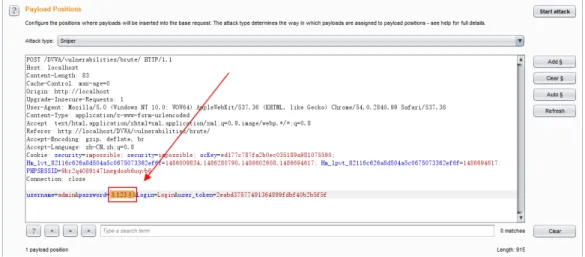
(52) Figure 5.3: Brute Force intercept 2. Submit the form to the intruder module and set the password as the payload cracked • Then set the variables which is needed to cracked in the Position option. Burpsuite automatically sets a number of variables. Click the ”Clear” button to clear all default variables, select the password 123 and click the ”Add” button to set it to the variable need to be cracked. See Figure 5.4.. Figure 5.4: Brute Force Position 3. Set dictionary file 41.
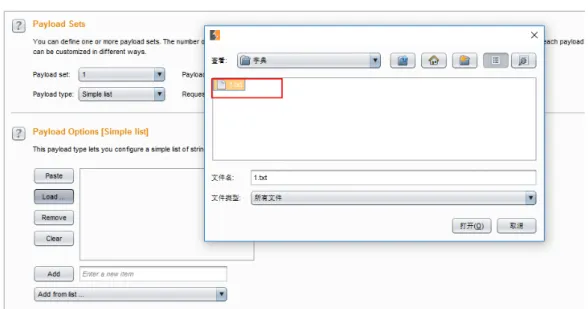
(53) • Use built-in dictionary. See Figure 5.5.. Figure 5.5: Use built-in dictionary • Load external dictionary. See Figure 5.6.. Figure 5.6: Load external dictionary. 42.
(54) 4. Start the enumeration to get the password. • Sniper • Battering ram • Pitchfork • Cluster bomb. 5.1.2. Command Injection. A common pattern of command injection attacks is that when only data is required to enter, malicious code is entered along with the data and the system which loads the data doesn’t have a well-designed filtering process. Finally resulting in the execution of the malicious code and information leakage or the destruction of normal data. Low level As can be seen from the source code, the server directly gets the IP input from the user, splicing the ping command before IP and running it in the shell without any filtering. Windows and Linux have many command concatenates that spline the commands attackers want to run with previous ping commands, allowing arbitrary code execution. if isset( $ POST[ ’Submit’ ]) then $target = $ REQUEST[ ’ip’ ]; if stristr( php uname(’s’), ’Windows NT’ ) then $cmd = shell exec( ’ping’.$target ); else $cmd = shell exec( ’ping -c 4’.$target ); end end Algorithm 1: Low level. 1 2 3 4 5 6 7 8. Medium level Compared with Low level source code, only ’&&’ and ’;’ two command linker are filtered but the command linker also has ’k’ and ’|’, which is unfiltered.. 43.
(55) if isset( $ POST[ ’Submit’ ]) then $target = $ REQUEST[ ’ip’ ]; $substitutions = array(’&&’=’ ’, ’;’ = ’ ’); $target = str replace(array keys( $substitutions ),$substitutions,$target); if stristr( php uname(’s’, ’Windows NT’) ) then $cmd = shell exec(’ping’.$target); else $cmd = shell exec(’ping -c 4’.$target); end end Algorithm 2: Medium level. 1 2 3 4. 5 6 7 8 9 10. High level If you look at the source code, it looks like all connectors were filtered out but if you’re a little more careful, you’ll notice that there is a space after the pipe where has a picture description. So you can still use the pipe character for command injection without a space after the pipe character. if isset( $ POST[ ’Submit’ ]) then $target = trim(REQUEST[ ’ip’ ]); $substitutions = array(’&&’=’ ’, ’;’ = ’ ’, ’|’ = ’ ’, ’−’ = ’ ’, ’$’ = ’ ’, ’(’ = ’ ’, ’)’ = ’ ’, ’`’ = ’ ’, ’k’ = ); $target = str replace(array keys( $substitutions ),$substitutions,$target); if stristr( php uname(’s’, ’Windows NT’) ) then $cmd = shell exec(’ping’.$target); else $cmd = shell exec(’ping -c 4’.$target); end end Algorithm 3: High level. 5.1.3. 1 2 3. 4. 5 6 7 8 9 10. CSRF(Cross-site request forgery). Cross-site request forgery is also known as ”One Click Attack” or ”Session Riding”, often abbreviated as CSRF or XSRF. It is a malicious exploitation of a website. Attackers stealing your identify and sending malicious request in the name of you. For server the request is perfectly legal but it finished the attacker’s 44.
(56) expected operation such as sending emails, massages, stealing your account, adding a system administrator or even buying goods in the name of you. If the spam massages sent by CSRF are accompanied by worm links, those who received harmful massages will also become the dissemination when they open the connection in the private message. Thus thousands of users are stolen information planted Trojan. CSRF defense: 1. Verification code Requiring customer in interaction to operate. 2. Referer check Referer Check one of the most common application is to prevent hotlinking images, by looking at the source of the request to determine whether a request is reasonable, such as embedded from the attacker’s web site access blog address, the Referer is an attacker website address, so much can tell this is a CSRF attacks, but the defects of this method is: the server is not to take to the Referer information every time. 3. Construct an unpredictability URL CSRF can attack successfully, the essence of the reason is that the requested URL is guessed by the attacker, if the requested URL is unpredictable, then the attacker has no way to start. The most common way to do this now is to include a token parameter in the URL. The token can be stored in the user’s cookie, and the server also holds the token value for that customer. Because CSRF attacks only use login cookies and cannot obtain the specific values of cookies (unless the user is also attacked by XSS and the cookie is compromised, it is useless).. 5.1.4. File Inclusion. File Inclusion, which means that when the server opens the allow url include option, it can dynamically include files through some PHP feature functions (include(), require(), include once(), and require once()) by using urls. At this point, any File reading or arbitrary command execution will result if the File source is not strictly checked. File containing vulnerability is divided into local file containing vulnerability and remote file containing vulnerability, which is caused by the allow url fopen option in the PHP configuration (after the option is enabled, the server is allowed to include a remote file).. 45.
(57) Low level Sever-side core code is: $file = $ GET[’page’];. 1. As you can see, the page parameter is not filtered or checked on the server side. What the server expects the user to do is click on the three links Figure 5.7, the server will contain the appropriate file, and the result will be returned. Need of special note is that the server contains files, regardless of whether file suffix is PHP, will try to perform as a PHP file, if the file content for PHP, for sure will be normal execution and returns the results, if not, will print the file content intact, so the file contain bugs often leads to read arbitrary files with arbitrary command execution.. Figure 5.7: The three links of File Inclusion Medium level Sever-side core code is: $file = $ GET[’page’]; $file = str replace(array(”http://”, ”http://”), ””,$file); $file = str replace(array(”../”, ”..\”), ””,$file);. 1 2 3. As you can see, the medium-level code adds the str replace function and deals with the page parameter taking ”Http: //”, ”https://”, ”../” and ”..\” replaced by a null character. High level Sever-side core code is: $file = $ GET[’page’]; if !fnmatch(”file*”, $file)&&$file!=”include.php” then echo”ERROR: Filenotfound!”; exit; end. 46. 1 2 3 4 5.
(58) As you can see, the high-level code uses the fnmatch function to check the page parameter, requiring the page parameter to start with a file so that the server will include the corresponding file. Impossible Sever-side core code is: $file = $ GET[’page’]; if $file != ”include.php”&&$file != ”file1.php”&&$file != ”file2.php”$file != ”file3.php” then echo”ERROR: Filenotfound!”; exit; end. 1 2. 3 4 5. As you can see, the code at the impossible-level is protected by the white list mechanism which is very simple and rough. The page parameter must be one of ”include.php”, ”file1.php”, ”file2.php”, ”file3.php”.. 5.1.5. File Upload. File upload is one way to quickly gain server privileges during penetration testing. If the developer is not strict in filtering uploaded content, then there will be any vulnerability in file upload. Even if it can not be resolved, it also can hang a black page. If used by fghk, it will cause a very bad impact. If the uploaded file can also be parsed or if the file contains vulnerabilities, then you can gain access to the server. Low level Sever-side core code is:. 47.
(59) if isset( $ POST[ ’Upload’ ]) then $target path = DVWA WEB PAGE TO POOT.”hackable/uploads/”; $target path = basename($ FILES[’uploaded’][’name’]); if !move upload file($ FILES[’uploaded’][’tmp name’], $target path) then echo ’<pre>Your image was not uploaded. </pre> ’; else echo ’<pre> $target path successfully uploaded! </pre> ’; end end. 1 2. 3 4. 5 6 7 8 9. Taking the file, uploading it to hack-able/uploads/ and echoing the path, this is the simplest file upload. Figure 5.8.. Figure 5.8: File Upload low level Medium level Sever-side core code is:. 48.
(60) if isset( $ POST[ ’Upload’ ]) then 1 $target path = 2 DVWA WEB PAGE TO ROOT.”hackable/uploads/”; $target path .= basename($ FILES[’uploaded’][’name’]); 3 $uploaded name = $ FILES[’uploaded’][’name’]; 4 $uploaded type = $ FILES[’uploaded’][’type’]; 5 $uploaded size = $ FILES[’uploaded’][’size’]; 6 if ($uploaded type == ”image/jpeg” )k ($uploaded type == 7 ”image/png”) && ($uploaded size¡100000) then if !move uploaded file($ FILES[’uploaded’][’tmp name’], 8 $target path) then echo ’<pre>Your omage was not uploaded.</pre>’; 9 else 10 echo ’<pre>$target path successfully uploaded! </pre>’; 11 end 12 else 13 echo ’<pre>Your image was not uploaded. We can only accept 14 JPEG or PNG images. </pre>’; end 15 end 16 Algorithm 4: Medium level The point is that the following code restricts the content-type of uploads. You can upload a picture directly and then add a sentence at the end to upload successfully. Figure 5.9 $uploaded type = $ FILES[’uploaded’][’type’]; $uploaded type == ”image/jpeg” k $uploaded type == ”image/png”;. 49. 1 2.
(61) Figure 5.9: File Upload medium level High level Sever-side core code is:. 50.
(62) if isset( $ POST[ ’Upload’ ]) then 1 $target path = 2 DVWA WEB PAGE TO ROOT.”hackable/uploads/”; $target path .= basename($ FILES[’uploaded’][’name’]); 3 $uploaded name = $ FILES[’uploaded’][’name’]; 4 $target ext = substr($uploaded name, strrpos($uploaded name, 5 ’.’) + 1); $uploaded tmp = $ FILES[’uploaded’][’tmp name’]; 6 $uploaded size = $ FILES[’uploaded’][’size’]; 7 if (strtolower($uploaded ext) == ”jpg” )k 8 (strtolower($uploaded ext) == ”jpeg”)k (strtolower($uploaded ext) == ”png”)&& ($uploaded size¡100000) then if !move uploaded file($uploaded tmp, $target path) then 9 echo ’<pre>Your omage was not uploaded.</pre>’; 10 else 11 echo ’<pre>$target path successfully uploaded! </pre>’; 12 end 13 else 14 echo ’<pre>Your image was not uploaded. We can only accept 15 JPEG or PNG images. </pre>’; end 16 end 17 Algorithm 5: High level The specific situation is related to the version of PHP and the version of middle ware, which cannot be practiced directly in DVWA. Upload the picture with the suffix.png and then use the file containing vulnerability to match. Upload with %00 truncation vulnerability requires PHP version less than 5.3.4. Resolve vulnerabilities using.htaccess.. 51.
(63) 5.2. OWASP Security Shepherd. Figure 5.10: The homepage of OWASP Security Shepherd The OWASP Security Shepherd is a security training platform specialized in web and mobile application. It is aimed at educating and improving security awareness in various skilled demographic. Taking APP Security beginners or experienced engineers and making their penetration testing skill sharper are the OWASP Security Shepherd’s goals. The OWASP Security Shepherd project gives users opportunity to improve their existent manual penetration testing skills. By presenting security risk concepts accomplishes this to users in challenging lessons, which provides users help about a specific security risk and a text version of the issue. Insufficient security mitigation to vulnerabilities are included in challenges. The OWASP top ten —— Injection, Broken Authentication and Session Management, Sensitive Data Exposure, XML External Entity, Broken Access Control, Security Misconfiguration, Cross-Site Scripting, Insecure deserialization, Using Components With Known Vulnerabilities, Insufficient Logging and Monitoring as a challenging test bed. Most security vulnerabilities can be solved and their impact on systems is worked. The necessary skill of this challenge game is by product to make a user’s own environment serious among OWASP top ten security risks. The modules provide a challenging chance for security and also for professionals. So the reasons for why we use Security Shepherd are: 1. Wide Topic Coverage 52.
(64) Security Shepherd covers 70+ levels from the whole spectrum of web to mobile application security in the form of a single project. 2. Gentle Learning Curve Security Shepherd is a good entry for the user who is new to security field with increasing difficulty. 3. Layman Write Ups Every security concept is shown using plain language when first acted. 4. Real World Examples In Security Shepherd, risks are real vulnerabilities. The attack vectors used are how they would act in the real world. 5. Scalability A single user or a server for a great deal of users can use Security Shepherd locally. 6. Highly Customisable Admins can set the suitable levels and the way they are presented(Open, CTF and Tournament Layouts). 7. Perfect for Classrooms Security Shepherd supplies users specific keys in order to stop them sharing their keys. 8. Scoreboard For encouraging a competitive environment, Security Shepherd adopts a scoreboard. 9. User Management It’s available for Security Shepherd admits to create users, suspend, unsuspend, add bonus points. Students can segmented into specific class by admins. 10. Localisation Support Even though from a single instance, Security Shepherd material is presented in many languages.. 53.
(65) 11. Robust Service There are online CTFs such as the OWASP Global CTF and OWASP LATAM Tour CTF 2015 run in Security Shepherd, both of them exceeding 200 users. 12. Configurable Feedback Before a project is marked as complete, an admin can enable a feedback process. This function not only promotes project improvement but for system admins to gather whether understanding or not from their students. 13. Granular Logging The log reports by Security Shepherd is detailed. The Security Shepherd covers the following security topics about web and mobile application: Lack Of Binary Protections, Client Side Injection, Broken crypto, Poor Authentication and Authorisation, Unintended Data Leakage, Insecure Data Storage, Poor Data Validation, Invalidated Redirects and Forwards, Cross Site Request Forgery, Missing Function Level Access Control, Sensitive Data Exposure, Security Misconfiguration, Insecure Direct Object Reference, Cross Site Scripting, Broken Authentication and Session Management, SQL Injection. 54.
図


+7


![Figure 4.2: The homepage of UC(Systemwide Information Security) The University of California Office [15] of the President tries to establish a secure environment for technology development which can protect informa-tion in University of California and cyb](https://thumb-ap.123doks.com/thumbv2/123deta/6076282.1073706/44.892.157.740.292.658/systemwide-information-university-california-environment-development-university-california.webp)

Outline
関連したドキュメント
The paper is structured as follows: In Section 2, we will start with general observations about bases and we prove that metric spaces and weakly separated spaces are base
Background paper for The State of Food Security and Nutrition in the World 2020.. Valuation of the health and climate-change benefits of
Using an “energy approach” introduced by Bronsard and Kohn [11] to study slow motion for Allen-Cahn equation and improved by Grant [25] in the study of Cahn-Morral systems, we
Taking the opportunity of leadership training, we set three project goals: (1) students learn about Japan beyond the realm of textbooks, (2) teachers and students work in
Then it follows immediately from a suitable version of “Hensel’s Lemma” [cf., e.g., the argument of [4], Lemma 2.1] that S may be obtained, as the notation suggests, as the m A
“Do two program fragments behave the same?”.1. Reasoning about
Key words and phrases: Monotonicity, Strong inequalities, Extended mean values, Gini’s mean, Seiffert’s mean, Relative metrics.. 2000 Mathematics
Kartsatos, The existence of bounded solutions on the real line of perturbed non- linear evolution equations in general Banach spaces, Nonlinear Anal.. Kreulich, Eberlein weak
