Coalescence Enhancement of Oil Droplets in W/O
Emulsions with Packed-Bed Type Coalescers
著者
NOZAWA Satoru, KIKUCHI Katsuki, GOSHIMA
Takashi, MIZUTA Kei, MASUI Tatsuya, NII Susumu
journal or
publication title
The Research Reports of the Faculty of
Engineering, Kagoshima University
volume
60
page range
21-21
year
2019
ISEC 2017 – The 21st International Solvent Extraction Conference, Miyazaki, November 5 – 9, 2017
Coalescence Enhancement of Oil Droplets in W/O Emulsions
with Packed-Bed Type Coalescers
Satoru Nozawa
1*, Katsuki Kikuchi
1, Takashi Goshima
1, Kei Mizuta
1, Tatsuya Masui
2and
Susumu Nii
11. Introduction
Separation of oil droplets from W/O emusion is important for both reducing environmental impact and recoverying resources. Coalescer has advantages of simplicity in the operation and no additional chemicals required. When W/O emulsions flowed through the coalescer consisting of PTFE fiber bed, oil drops would successfully coalesce and grow at the outlet of the bed. Visual observation proved that the spreading of oil film on fiber surface and flowing of oil along the fibers. The finding suggested that the importance of affinity of oil and surface of the fiber as well as narrow spacings in the fiber bed. Although capturing oil droplets in the bed is a complex phenomena, surface property of the fiber material should play an important role. Thus, for developing the perfrmance of coalescer, the present study aims to examine the effect of property of polymeric fibers or foam on the separation performance.
2. Experimental
Tetradecane is selected as an oil and 3 cm3 of tetradecane was mixed
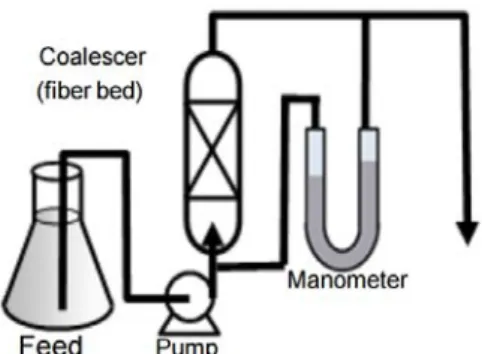
with deionized water. The mixture was vigorously stirred with an ultrasonic homogenizer to prepare W/O emulsion. Fibers of polytetrafluoroethylene, PTFE, and polypropylene, PP, and foam of polyurethane, PU, were selected as packing material. Packed beds of these fibers and a foam were used as coalescer. Figure 1 shows the schematic diagram of experimental apparatus. The feed was supplied to the coalescer and the pressure drop was measured with a manometer. Samples were taken from feed reservoir and effluent. The absorbance was measured to determine the separation ratio.
3. Results and Discussion
Figure 2 shows a result of separation ratio and pressure drop of various polymer fiber bed. Compared to the result of PTFE as a benchmark, the material and the structure of fiber affected the performance. The difference between PP-A and PTFE reflects the effect of material because the two beds have a similar volume fraction. PP-B gave a better separation than PP-B which has a different structure of the fiber, square cross-section of the fiber. PU exhibited the maximum separation factor with much lower volume fraction. However, PU showed the highest pressure drop. The result clearly shows the effect of material properties as well as the physical spacial structure of the fiber bed.
1. Department of Chemical Engineering, Kagoshima University, JAPAN, 2. Morimatsu Industry
Co.,Ltd,1430-8,Minobe,Motosu,Gifu 501-0413, JAPAN
Fig.1 Experimental setup
Fig.2 Effect of fiber type on separation ratio and pressure drop