Comparative Analysis of Formal and Informal
Educational Levels among Fishermen : Akune and
Nomaike Fisheries Cooperative Associations
著者
IWAKIRI Shigero, RIVERA Maria
journal or
publication title
鹿児島大学水産学部紀要=Memoirs of Faculty of
Fisheries Kagoshima University
volume
30
page range
63-85
別言語のタイトル
漁業者の職業教育水準の比較分析 : 阿久根および
野間池漁業協同組合について
Mem. Fac. Fish., Kagoshima Univ.
Vol. 30 pp. 63-85 (1981)
Comparative Analysis of Formal and Informal
Educational Levels among Fishermen
-Akune and Nomaike Fisheries Cooperative
Associations-Shigero Iwakiri* and Maria Rivera
Abstract
Some typical aspects of formal and informal technological education in two groups of fisher
men are analyzed in this survey.
The authors have pointed out the relations between these two educational levels, and com pared them, taking into account the type of urban or rural zone where the fishermen live, because the technological educational level is related to job-improvement to reaching better
economic output.
Introduction
As, generally speaking, the educational level in Japanese urban zones is higher than
in rural zones, the Japanese government wants to raise the educational level in un
developed areas. The questions which arise are related to matters of how large the
gap is, what substructure they have to improve in job technical levels and general
culture, and what other factors are influencing the gap.
The purpose of this study is to compare the formal and informal education, related
to technological levels and job consciousness among fishermen belonging to the
Fisheries Cooperative Associations located in areas characterized by different stages
of economic development.
The Akune Fisheries Cooperative Association, placed in
Akune city, is classified as an urban zone, where fishing is just one of the economic activities of the area, and the Nomaike Fisheries Cooperative is placed in a isolated zone, classified as a fishing community where the population included in the Fisheries Cooperative area depends upon fishing for livelihood.
Data were taken by written questionnaires of 24 fishermen in the Akune Fisheries Cooperative Association and 25 fishermen members of the Nomaike Fisheries Co
operative Association, in June, 1980. These samplings included fishermen of different ages engaged in distinct kinds of fisheries operations.
The general questionnaire concerned their formal education, the relationship
between their formal education and their actual jobs, their opinion of cooperative
system, their individual job-training participation and interest, their capacity and
facilities for repair, and maintenance of their own equipment, their technical extension
systems, the effect of mass communication, and media related to job and
self-improve-* Laboratoryof Fisheries Economics, Facultyof Fisheries, Kagoshima University.ment, etc. Data were analyzed by percentage tabulation. Akune General Background:
Akune city is located 80 km. northwest of Kagoshima city, and belongs to Kago shima Prefecture, one of the prefectures of Kyushu island in Japan. The city lies between east longitude 13T12' and north latitude 32°01'.«
City Boundaries:
To the north of Akune lies Nagashima island with the famous Kuronoseto current, to the northeast lies Takaono town, to the east Noda town, to the south Sendai city and Togo town. Akune city topographically is surrounded by mountains and low hills in which no more than 20% of the area is arable. The river Takamatsu flows through the city. To reach Akune from Kagoshima city, one proceeds by train or bus. Transportation is comparatively more accessible than to Nomaike, an advan tageous situation for marketing.
Population:
The Akune city area is 135.85 km2 with a population of 32,310 inhabitants. The population density is 221.62 inhabitants per km2. Their working population is distributed as follows: primary industry 6,456 persons (including agriculture 5,534 persons or 38.9%; forestry 72 persons or 0.50%; fisheries 841 persons or 6%); secon dary industry 2.076 persons or 19%; and service industry 5,100 persons or 35.8%, according to the National Japanese Population Census of 1975.1)
Nomaike Background:
Nomaike is a fishing community that belongs to the Kasasa district at the southwest of the so-called Satsuma peninsula, 70 km. from Kagoshima city and 35 km. from Makurazaki city. Topographically, it is surrounded by hills, no auspicious situation for engaging in agriculture activities, though almost all houses cultivate their own vegetable garden for self-supply. There is no secondary industry established, and only a small percentage of people can engage in service industry jobs. This is one of the principal reasons why the youngest generation, has migrated to industrialized zones. The location is far from an urban zone, and to reach Nomaike it is necessary to proceed by car or bus, there is no train. It is known as a fishing community, with 105 houses, which means that the 60% of the population depends on fishing for livelihood.
Akune Fisheries Cooperative Association:
The Akune Fisheries Cooperative Association was recognized by the Law of Fisheries Cooperative Association in 1949, but there is precedent of their existence from 1926. It was composed of 707 fishermen on March 1980, among whom 458 were regular members, working more than 90 days a year on fisheries operations, and 249 as associate members, working less than 90 days a year.2)
IWAKiwRivera: Educational Level among Fishermen 65
The cooperative management is characterized by its small scale in coastal zone
fisheries operations. For work in different types of fishing operations, fishermen are divided in groups according to the fishing gear they use on daily jobs. Most Akune fishermen in 1 to 5 ton boats are engaged in pole and line fishing, while those in 10 to 15 ton boats and in 10 and 20 tons boats are engaged in purse seine fishing. One of the important characteristics of this work is the interdependency of the fishermen because usually one net is necessarily operated by 20 or more fishermen at the same time. This kind of cooperative work organization is maintained, utilized for job im provement, and in this way is easier for them to interchange knowledges about work
matters.
Those with years of experience are valued in teaching the young generation of fishermen. The gear masters of any operation group contact the technical extension service agents, the fisheries cooperative leaders or their respective authorities to deal with specific labour problems. Usually they have educative interchanges in new fisheries technologies and knowledges with fishermen from other more advanced
fisheries cooperatives.
The principal fish captured in a year are sardines (sold for feeding), horse mackerel, and sea bream. These products are transported fresh or frozen to consumer markets.
Nomaike Fisheries Cooperative Association:
Nomaike was also recognized by the Law of Fisheries Cooperative Association in 1949, but there is precedent of their foundation from 10 years before. Actually in
1980 it was composed of 435 fishermen, 177 of whom are regular members living in
the Cooperative Association area, while 258 are associate members.3^The fish species caught vary according to the season, but main ones are yellowtails,
skipjacks, striped pig fish, squid, and marlin mullets. Most of them are sold in the
Kagoshima City Fisheries Central Market, and get high prices because they are very
appreciated among consumers.The fishermen organized not only groups for fisheries operations, but also study
circles including the Fisheries Development Association with 50 members, and the
gill net circle, also with 50 members.
These groups go to other prefectures for study
ing new fisheries and exchanging job experience.
Japanese Fisheries Extension Service:
From 1950Japan put into practice the Inshore Extension Service, with the purpose
of improving the technological work conditions of small scale fisheries. The persons engaged in this work are graduates of fisheries universities. They are government
officials and work along with all prefectures in the country. Their job is to provide
technological assistance to all fishermen belonging to the fisheries Cooperative As
sociations. In 1980, Kagoshima provided Extension Services to 3,000 fishermen ofTable 1 shows the age distribution of our sample. The major distribution is between 41 to 50 years old, with 57% and between 51 to 60 years old, with 20%. Akune fishermen have the most high percentage of those 41 to 50 years old (75%), while for the Nomaike sample 51 to 60 years old fishermen consist of 32%.
Table 1. AgeDistribution.
Less than 20 years old 21-30 years old 31-40 years old 41-50 years old 51-60 years old More than 60 years old total Nomaike Akune 2 (8%) 3 (12%) 3 (12%) 10 (40%) 18 (75%) 8 (32%) 2 ( 8%) 2 (8%) 1 (4%) 25 24 Total 2 (4%) 6 (12%) 28 (57%) 10 (20%) 3 (6%) 49
Table 2 shows the income of both Fisheries Cooperative Association members.
The percentage distribution of the income is as follows: 200,000 yen, 22%; then with
a very small differentiation range 150,000 yen, 20%; both 250,000 and over 300,000
yen income 18%. In detail, the lowest range is 100,000 yen for Akune and 300,000
for Nomaike, while the upper range for Nomaike is 250,000 yen and for Akune it is 200,000 yen. The reason for the higher figures at Nomaike is because the species caught by Nomaike generally have higher quotations in the consumer market.
Table 2. Monthly Income.
50,000 yen 100,000 yen 150,000 yen 200,000 yen 250,000 yen 300,000 yen Nomaike Akune 2 (8%) 1 (4%) 5 (20%) 5 (21%) 3 (12%) 8 (33%) 7(28%) 2 ( 8%) 1 (4%) Total 3 (6%) 10 (20%) 11(22%) 9 (18%) 1 (2%) More than
300,000 yen Other DKNA* Total Nomaike Akune 4(16%) 5(21%) 1 (4%) 1 (4%) 2 (8%) 2 (8%) 25 24 Total 9 (18%) 2 (4%) 4(8%) 49
* Note: Related to not answer, (hereinafter cited as DKNA)
As for the relation between work and formal education, as noted in Table 3, only
a low percentage had graduated from fisheries schools. The majority of them, 71%,
chose their work by their own initiative, but it is important to note that a large per centage, 22%, had been introduced by their own family members. Specifically
among Akune fishermen, this figure is 29%, compared to 16% for their Nomaike
IwAKiRi-Rivera: Educational Level among Fishermen 67
Table 3. Relationship between Work andFormal Education. Education related
with actual job
University and
actual job Other DKNA Total
Nomaike Akune 1 (33%) 1 (50%) — 2 (66%) 1 (50%) _ _ 3 2 Total 2 (40%) — 3 (60%) — 5
Table 4. Reasons for ChoosingFisheries.
Own Family
initiative introduced For invesment Other DKNA Total
Nomaike Akune 18(72%) 4(16%) 17(71%) 7(29%) 3 (12%) 25 24 Total 35(71%) 11(22%) 3 ( 6%) — 49 70 60 50 40 30 20 10 D AKUNE
3-5 6-10 10-19 Mor» lhan 20 years
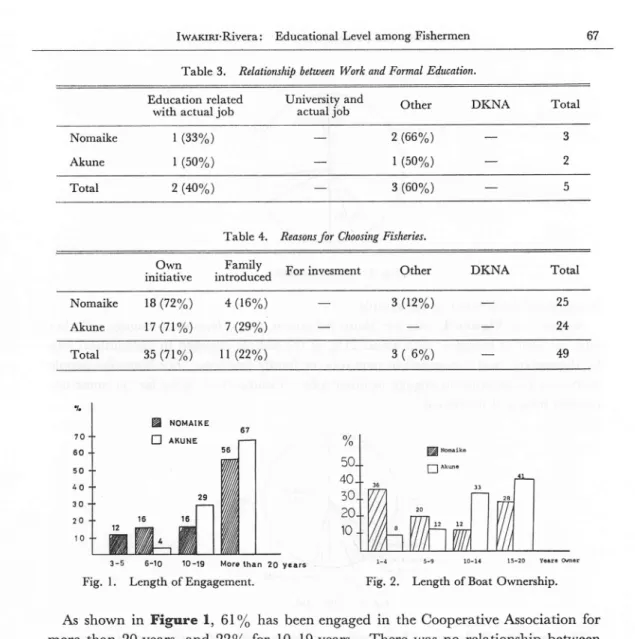
Fig. 1. Length of Engagement.
% 50. 40. 30 20 10 • "
fci
± i 5-9 10-14 15-20 YanrB OrfneiFig. 2. Length of Boat Ownership.
As shown in Figure 1, 61% has been engaged in the Cooperative Association for more than 20 years, and 22% for 10-19 years. There was no relationship between this term of engagement and the length of boat ownership (Figure 2).
Formal Education:
These two fishermen's groups don't have any clear differentiation in terms of formal education, as we can see in Figure 3, 63% had graduated from middle school and 12% from high school. But the 32% at Nomaike responding "other" is large com pared to Akune. This is related to the old Japanese educational system before World War II. At that time, for rural area students, it was expensive to continue high school studies, and after finishing middle school, to help the family economy, they had to participate in the labour market. Only the rich people's children were allowed to reach a higher educational level, so their formal education is more or less equivalent to the middle school level. There was no graduate from university or with similar
AKUHE NOMAIKE Elanantary school Elementaryschool
middle acho piddleschool
Fig. 3. Formal Education.
educational attainment in the sample.
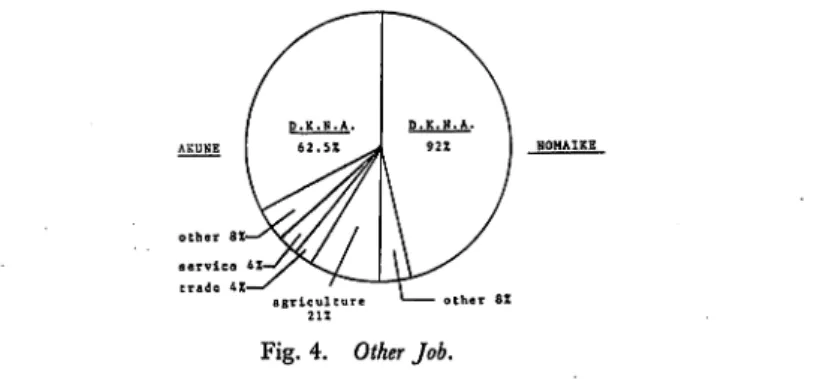
As shown in Figure 4, only for Akune fishermen, was it feasible to engage in"other jobs" as well as fisheries, with about 21% of the sample engaged in agricultural jobs by themselves, and 2 engaged in part time or family business. For Nomaike people
there was no possibly to engage in other jobs. Fishing then, is by far the most im portant means of livelihood.
service 4X-trado
4Z-Fig. 4. Other Job.
The majority of them are boat owners; there was no differentiation between the groups in this matter (Table 5). The longest period of boat ownership, as shown in
Figure 2, is between 15-20 years, at 35%. It is important to note that Nomaike
fishermen; with 36% having between 1-4 years had a shorter period of boat owning
than Akune, where 41% had 15-20 years of ownership.
Table 5. Boat Ownership.
Yes No DKNA Total
Nomaike Akune 24 (96%) 23 (96%) 1 (4%) 1 (4%) 25 24 Total 47(96%) 2 (4%) — 49
IwAKiRpRivera: Educational Level among Fishermen 69
Job Training Course Attendance:
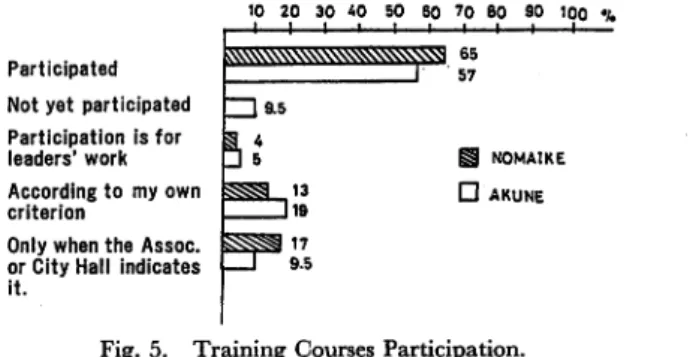
In both fishermen's groups, the majority had attended work training courses, spe cifically more than 50% of them, as shown iri Figure 5. The attendance, meaning "according to own criterion", showed a high percentage in both places, but the Akune colleagues presented a high percentage compared to Nomaike. However, the attendance was higher in Nomaike when the Association or Prefecture indicates
the program.
Participated Not yet participated Participation is for leaders' work According to my own criterion
Only when the Assoc, or City Hall indicates it. 10 20 30 *0 50 60 70 80 90 100 % —I 1 1 1 1 1 1 1 1 1
^S^^^SS^ 65
5 §§§L.i3 I 17 9.5 |g NOMAIKE • akuneFig. 5. Training Courses Participation.
Figure 6 shows attendance by the order of frequency. The typology is as follows:
a) Association planned courses; b) Prefecture or City Hall planning courses; and c) by groups. A: Assoc, planned courses B: City Hall planning courses C: By groups 10 20 30 40 50 60 70 60 90 100 —I 1 1 1 1 1 1—i 1 1— m m s m \ m * » ] 53 I 27 Kssssa 21 1 20 M^Ma Fig. 6. Typology. S NOMAIKE • AKUNE
According to Figures 5 and 6, the majority had attended training courses, but the frequency of attendance was related to the job that determines the patterns of work training courses. As we can see in Figure 7 the highest percentage of attendance occurs when the program was planned by groups; second when a person comes to the Cooperative Association "to teach us"; and third when they "have a problem" as in
the 17% at Akune.
About the knowledge received, the results are as follows: 69% agreed with "now, I know more than before", but is noted that 88% of the Nomaike fishermen gave this answer, a high percentage compared to their Akune colleagues. Figure 8 shows that
21% of Akune fishermen "have had an increase in problem after attendance" which is high compared to Nomaike. The 21% at Akune answering DKNA is also high
Once a year Twice a year When we have problems By groups When an experienced person comes DKNA 10 20 30 40 50 60 70 SO -* H -H 1--+• 3* -4-&3 NOMAIKE Q AKUNE ! • • • sssa 3232 J *2
Fig. 7. Frecuency of Attendance. Fig. 8. Knowledge.
compared to Nomaike fishermen. It can be deduced that Akune fishermen are more
doubtful of the knowledge gained from training courses than their colleagues at
Nomaike.
Knowledge about the Cooperative Association Law:
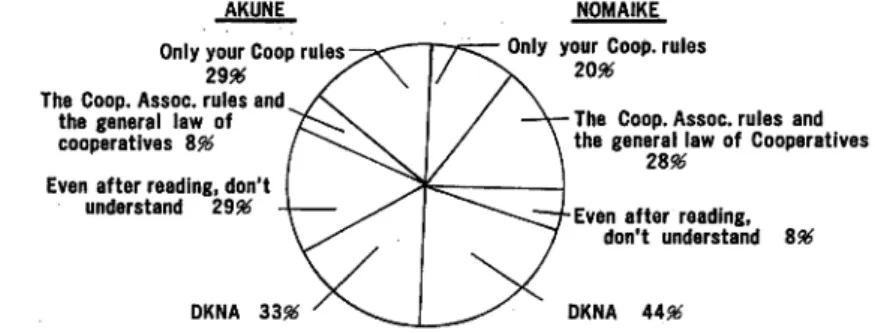
Only 18% of the fishermen knows the general Cooperative Association Law and 24% their own Cooperative Association rules. The fishermen who "even after read ing it, don't understand" number 18% too. It is significant to note that the highest percentage of knowledge of both laws was shown in Nomaike where 48% of the fishermen knows about the Cooperative Association Law but many don't know about
it. Figure 9 shows Nomaike with 44% answering DKNA. At Akune there was a
large percentage who know both, but also many "even after reading, cannot under
stand it".
AKUNE Only your Coop rules
29$ The Coop. Assoc, rules and
the general law of cooperatives 8$ Even after reading, don't
understand 29$
NOMAIKE Only your Coop, rules
20$
The Coop. Assoc, rules and the general law of Cooperatives
28$
Even after reading, don't understand 8$
DKNA 33$ ' \ ^ J _ ^ ^ ' DKNA 44#
Fig. 9. Knowledge about Cooperative Association Law.
As for opinion about the Cooperative system, more than half of those sampled, 61%, consider it "a good system". There is also a large percentage, 28%, who think it is "not good but there are no other way". In detail, Nomaike fishermen had a higher percentage of positive opinion than their Akune colleagues (Figure 10).
IwAKiRi'Rivera: Educational Level among Fishermen AKUNE Good system 58$ Coop, work in creases profit 8$ Not good, but there is no other way 33$
NOMAIKE
Good system 64$
Coop, work increases profit 12$ Not good, but there is no other way 8$.
71
Fig. 10. About the Cooperative Association System. (Opinion)
responding "not attended" was higher at Akune than at Nomaike (Table 6).
As for
the increase or decrease of knowledge about Cooperative Associations after belonging,
the results are that more than half of the fishermen sampled, 65%, responded "now
know more than before" (Table 7). But it is noted that at Akune the percentage is
low compared to Nomaike even when Akune people had more years of engagement in
the Cooperative than their Nomaike colleagues.
Also, Akune fishermen are more
doubtful in matters of the apprehension of knowledge.Table 6. Attendance of Courses Relatedto Fisheries Cooperative Associations.
Nomaike Akune Total Yes 12 (48%) 11(46%) 23 (47%) No 6 (24%) 8 (33%) 14 (29%) Want to attend but haven't time
2 (8%) 2 (8%) 4(8%)
Not interested DKNA Total
Nomaike Akune 2 (8%) 4(16%) 1 ( 4%) 25 24 Total 2 (4%) 5 (10%) 49 Participation is
for leaders' work
1 (4%)
1 (2%)
Table 7. Knowledge about Cooperative Movement after Certain Periods of Engagement.
Now, know more than before The same as before Don't know Not
interested Other DKNA Total Nomaike Akune 19 (76%) 13 (54%) 3 (12%) 6(25%) 3 (13%) — 1 (4%) 3 (12%) 25 24 Total 32 (65%) 9 (18%) 3 ( 6%) — 1 (4%) 3 (-6%) 49
The most usual means of apprenticeship in the Cooperative Association had been
when an experienced person comes to teach us," the answer given by 67% overall.
A higher percentage was maintained by Nomaike fishermen, while their Akune
colleagues who said it was "only for the leaders" was also high (Table 8).
Table 8. Means of Apprenticeship in the Cooperative Association.
Radio T. V. Courses Seminars Teacher c o m e s Only for
leader Not necessary Other DKNA Total Nomaike Akune 1 (4%) 2 (8%) 19 (76%) 14 (58%) 2 ( 8%) 4(17%) 2 (8%) 1 (4%) 2(8%) 2(8%) 25 24 Total 1 (2%) 2 (4%) 33 (67%) 6 (12%) 2 (4%) 1 (2%) 4(8%) 49
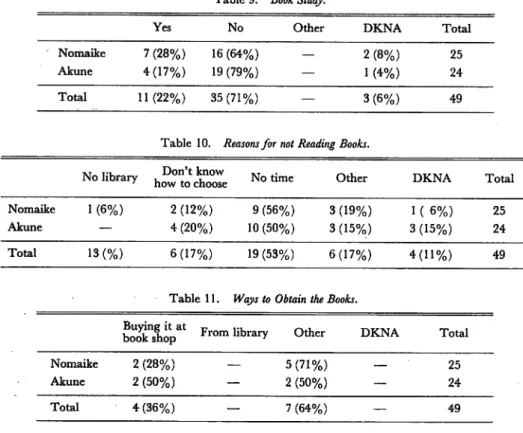
As to book study related to general work matters, the higher percentage was given
by Nomaike fishermen, 28% of whom read books (Table 9). Seventy nine percent
of Akune fishermen said they did "no study". The reasons cited were "don't have
time forit for 53%, then "don't know how to choose it" for 17% (Table 10).
Among
fishermen who said they studied books, 36% said they bought them in a book shop,
while those who said they got books "another ways" was higher at 64% (Table 11).
Table 9. Book Study.
Yes No Other DKNA Total
Nomaike Akune 7(28%) 16(64%) -4(17%) 19(79%) -2 (8%) 1 (4%) 25 24 Total 11(22%) 35(71%) - 3(6%) 49
Table 10. Reasons for not Reading Books.
N°'*-y hSS££
N°*-
Other DKNA TotalNomaike 1(6%) 2(12%) 9(56%) 2 Akune — 4(20%) 10(50%) 2 >(19%) K15%) 1 ( 6%) 3 (15%) 25 24 Total 13 (%;) 6(17%) 19(53%) 6»(17%) 4(11%) 49
Table 11. Ways to Obtain the Books.
booknshopat Fromlibrary
Other
DKNA TotalNomaike Akune 2(28%) — 5(71%) 2 (50%) - 2 (50%) — 25 24 Total 4 (36%) - 7 (64%) — 49
IwAKiRrRivera: Educational Level among Fishermen 73
More than half those sampled were studying by themselves but a large number, 24%, said "even if interested they have no time for it". In detail Nomaike fishermen studying on their own initiative numbered 68%, the highest percentage, while for their Akune colleagues, reasons such as "even if interested, no time" prevailed at 30%. The percentage answering "no" was higher at Akune too (Table 12). Those
Table 12. Studies by Own Initiative;
Yes No Interested but
no time
Without
interest Other DKNA Total Nomaike Akune 17(68%) 9 (38%) 2 ( 8%) 5(21%) 4(16%) 8 (33%) — — 2 (8%) 2(8%) 25 24 Total 26(53%) 7 (14%) 12 (24%) — — 4(8%) 49
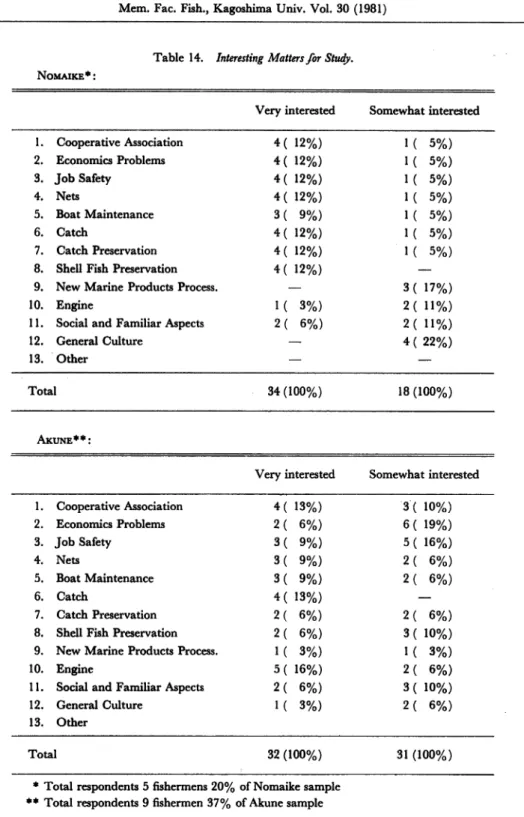
who answered "interested but don't have time" were asked to indicate subjects of
interest to them. The results are listed in Tables 13 and 14. From the results shown
in those tables, it is deduced that there was not much interest in the subjects proposed. The Nomaike fishermen had a higher percentage in the category "very interested" while their Akune colleagues chose subjects such as engines, catch, and Cooperative Association as more interesting than study.
Table 13. Matters.
Work Culture Social Coop. Assoc. Other DKNA Total Nomaike Akune 15 (88%) 7 (78%) 1(11%) — 1 ( 6%) 1(11%) 1 (6%) — 17 9 Total 22 (85%) 1(11%) — 2 ( 8%) 1 (4%) — 26 Repairs:
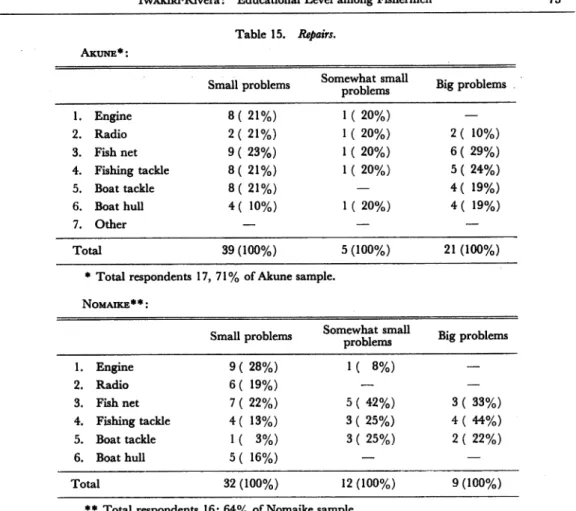
In the case of Akune, there were 17 fishermen, or 71% of the total sample, who
could make repairs in their equipment, divided between those who could handle
"small problems" and those who could handle "big problems". A large percentage
said they could repair small problems of engines, fish nets, fish tackle, and boat tackle.
A large number also said they could repair big problems of engines, fish nets, fishing tackle, boat tackle, and boat hulls.
In the case of Nomaike, there were 16 fishermen, 64% the sample, who could repair
their own equipment. In the categories "small" and "somewhat small" jobs such
as engines, radios, fish nets, fishing tackle, and boat hulls, obtained the highest per
centage (Table 15).
Maintenance:
Table 14. Interesting Matters for Study.
Nomaike* :
Very interested Somewhat interested
1. Cooperative Association 4( 12%) 1( 5%) 2. Economics Problems 4( 12%) 1( 5%) 3. Job Safety 4( 12%) 1( 5%) 4. Nets 4( 12%) 1( 5%) 5. Boat Maintenance 3( 9%) 1( 5%) 6. Catch 4( 12%) 1( 5%) 7. Catch Preservation 4( 12%) 1 ( 5%)
8. Shell Fish Preservation 4( 12%) —
9. New Marine Products Process. — 3( 17%)
10. Engine 1( 3%) 2( 11%)
11. Social and Familiar Aspects 2( 6%) 2( 11%)
12. General Culture — 4 ( 22%)
13. Other — —
Total 34(100%) 18 (100%)
Akune**:
Very interested Somewhat interested
1. Cooperative Association 4( 13%) 3( 10%) 2. Economics Problems 2( 6%) 6( 19%) 3. Job Safety 3( 9%) 5( 16%) 4. Nets 3( 9%) 2( 6%) 5. Boat Maintenance 3( 9%) 2( 6%) 6. Catch 4( 13%) — 7. Catch Preservation 2( 6%) 2( 6%)
8. Shell Fish Preservation 2( 6%) 3 ( 10%)
9. New Marine Products Process. 1( 3%) 1( 3%)
10. Engine 5( 16%) 2( 6%)
11. Social and Familiar Aspects 2( 6%) 3( 10%)
12. General Culture 1( 3%) 2( 6%)
13. Other
Total 32 (100%) 31 (100%)
* Total respondents 5 fishermens 20% of Nomaike sample
Akune*:
IWAKiwRivera: Educational Level among Fishermen 75
Table 15. Repairs.
e 11 ui Somewhat small «. u\~~„
Small problems
problems
Blg Problems
1. Engine 8( 21%) 1 ( 20%) — 2. Radio 2( 21%) 1 ( 20%) 2( 10%) 3. Fish net 9 ( 23%) 1 ( 20%) 6( 29%) 4. Fishing tackle 8(21%) 1 ( 20%) 5 ( 24%) 5. Boat tackle 8( 21%) — 4( 19%) 6. Boat hull 4( 10%) 1 ( 20%) 4 ( 19%) 7. Other — — — Total 39(100%) 5(100%) 21(100%)
* Total respondents 17, 71% of Akune sample. Nomaike**:
Small problems Somewhat smallproblems Big problems
1. Engine 9 ( 28%) 1( 8%) — 2. Radio 6( 19%) _ _ — 3. Fish net 7 ( 22%) 5 ( 42%) 3 ( 33%) 4. Fishing tackle 4( 13%) 3( 25%) 4 ( 44%) 5. Boat tackle 1( 3%) 3 ( 25%) 2 ( 22%) 6. Boat hull 5( 16%) — — Total 32 (100%) 12 (100%) 9(100%)
** Total respondents 16; 64% of Nomaike sample.
possible to verify some general trends as was mentioned before (Table 16).
Table 16-A. Boat Maintenance.
Nomaike: 1-3 Tons Boat*
Every day Once a week Every 15 days Once a month Twice a year Once a year
1. Engine
—
1( 50%)
1( 50%)
~
2( 22%)
1(100%)
2. Fish 2(33%) 1(50%) 1(50%) — 1(11%) — nets 3. Boat 1 ( 17%) — — — 2 ( 22%) — tackle 4. Radio 1(17%) — — — 1(11%) — 5. Boat, 2 ( 33%) — — 2 (100%) 3 ( 33%) — hull Total 6(100%) 2(100%) 2(100%) 2(100%) 9(100%) 1(100%)3-5 Tons Boat**
Every day Once a week Every 15 days Once a month Twice a year Once a year
1. Engine 1(11%) 1(17%) — 1(13%) 2(22%) 5(45%) 2. Fish 4(44%) 3(50%) — 2(25%) 1(11%) 1( 9%) nets 3. Boat 2(22%) 1(17%) 2(100%) 2(25%) — — tackle 4. Radio 1(11%) — — 1(13%) — 5(45%) 5. Boat, 1(11%) 1(17%) — 2(25%) 6(66%) — hull Total 9(100%) 6(100%) 2(100%) 8(100%) 9(100%) 11(100%) ** 10 fishermen owned 3-5 tons boats.
Table 16-B. Boat Maintenance.
Akune: 1-3 Ton Boat*
Every day Once a week Every 15 days Once a month Twice a year Once a year
1. Engine — — — — 3 ( 60%) 1 ( 50%) - 2 ( 50%) - -- 1 ( 25%) — 1 ( 50%) 2. Fish nets 1 ( 50%) 1 (100%) 3. Boat tackle 1 ( 50%) — 4. Radio — — 5. Boat hull — — 1 ( 25%) 2 ( 40%) Total 2(100%) 1(100%) 4(100%) 5(100%) 2 (100%) 3-5 Tons Boat**
Every day Once a week Every 15 days Once a month Twice a year Once a year
1. Engine 3 ( 18%) 1 ( 33%) 1 ( 33%) 2 ( 22%) 3 ( 30%) 1 ( 33%) 2. Fish 8(50%) 1(33%) — 1(11%) 1(10%) — nets 3. Boat 5(31%) 1(33%) 1(33%) 2(22%) — — tackle 4. Radio — — — 1(11%) 2(20%) 2(66%) 5. Boat — — 1(33%) 3(33%) 4(40%) — hull Total 16(100%) 3(100%) 3(100%) 9(100%) 10(100%) 3(100%) * 4 fishermen owned 1-3 tons boats.
IwAKiRpRivera: Educational Level among Fishermen 77 5-10 Tons Boat***
Every day Once a week Every 15 days Once a month Twicea year Oncea year
1. Engine — — 1 (100%) — 2. Fish — — — 1 ( 50%) nets 3. Boat — — — 1 ( 50%) tackle 4. Radio hull — — — — 1 (100%) -Total — — 1(100%) 2(100%) 1 (100%) —
More than 10 Tons Boat****
Every day Once a week Every 15 days Once a month Twice a year Once a year
1. Engine 1 ( 50%) 1 ( 50%) — 1 ( 20%) 3( 25%) — 2. Fish 1 ( 50%) 1 ( 50%) 1 ( 50%) 1 ( 20%) 2 ( 17%) — nets 3. Boat — — 1 ( 50%) 2 ( 40%) 1 ( 8%) — tackle 4. Radio — — — — 2 ( 16%) 1 (100%) 5. Boat — - - 1(20%) 4(33%) -hull Total 2 (100%) 2 (100%) 2 (100%) 5 (100%) 12 (100%) 1 (100%)
*** Only one fishermen owned 5-10 ton boats.
**** 6 fishermens owned more than 10 Ton boats.
Learning about Repairs:
The highest percentage, 31%, learned about repairs from colleagues; then from
family, 22%; DKNA, 20%; and from seminars and courses 16%. Among the
Akune group learning about repairs from books was one of the greatest percentages
(Table 17).
Table 17. Learned about Repairs.
At school
From colleagues
^e^nar?
From books
From family
Nomaike — 8 (32%) 4 (16%) 1( 4%) 5 (20%)
Akune 1(4%) 7(29%) 4(17%) 3(12%) 6(25%)
Total 1 (2%) 15 (31%) 8 (16%) 4 ( 8%) 11 (22%)
Other Dkna Total
Nomaike Aune — 7(28%) 3 (12%) 25 24 Total — 10 (20%) 49
Use of Cooperative Association Facilities:
Nomaike has facilities such as a dock, supported by the Cooperative Association, where a fisherman can repair "small problems" such as painting, washing, mainte nance, etc. The cost of pieces required for repairs is financed by the boat owner.
The boat with big problems have to be taken outside the fishing community for
repairs.
This cooperative also has a house for net repairs, divided inside into 12
parts, 10 of them designated working places for the members and 2 of them open for
use by any associated member. The cooperative supports, in part, the electricity
payments.Akune has also a dock. The building is Cooperative Association property, but its
management is run by a private company.
As a result, the Nomaike Fisheries As
sociation facilities are cheaper than those of Akune.All fishermen have to pay vessel insurance once a year on boats of more than 1 ton. When the fishermen lack money for repairs, they can take out a loan from the Fisheries Cooperative Association, and pay it back at low interest.
On the use of the Cooperative Association facilities were "had used it," 49%;
DKNA, 22%; "none for us55, 18%, and "not used yet" 10%.
In detail, the Nomaike
fishermen, who had used their own Cooperative facilities at 72%, was high compared
to their Akune colleagues, 38% of whom said that "none for us" and another large
percentage, 29% of whom, DKNA (Table 18).
Table 18. Use of the Cooperative Association Facilities.
Yes No None for us Dkna Total
Nomaike Akune 18(72%) 6 (25%) 3(12%) 2 ( 8%) 9 (38%) 4(16%) 7 (29%) 25 24 Total 24 (49%) 5 (10%) 9 (18%) 11(22%) 49
Forty three percent of the fishermen sampled said the facilities supplied by the
Cooperative are "useful and cheap". In detail the Nomaike fishermen showed more
satisfaction, with 60%, giving positive answers though there was also a high per
centage, 32%, indicating dissatisfaction.
A lower percentage of their Akune col
leagues used their Cooperative facilities (Table 18); and a greater percentage of them
Table 19. 0/union aboutCooperative Association Facilities.
Useful and cheap somewhat useful somewhat useful Not useful and not cheap
Other Dkna Total
Nomaike Akune 15 (60%) 6 (25%) 8 (32%) 5(21%) 1 (4%) 2 (8%) 2(8%) — 1 ( 4%) 9 (37%) 25 24 Total 21 (43%) 13 (26%) 3 (6%) 2 (8%) — 10 (20%) 49
IWAKiRi-Rivera: Educational Level among Fishermen 79
expressed dissatisfaction (Table 19).
As Table 20 shows, the fishermen's study interest are related directly to the oper
ational job, then to matters such as engines, fish nets, catch preservation. Only for Nomaike are matters such as economy and laws noticeably important.
Table 20. Matters of Study Necessary to Improve Work. Nomaike*:
Very necessary Somewhat necessary 1. Engine 13 ( 16%) — 2. Fish net 14 ( 18%) 2 ( 12%) 3. Fish tackle 16 ( 20%) 1( 6%) 4. Radio 8( 10%) 4 ( 24%) 5. Catch preservation 11 ( 14%) 3( 17%) 6. Economy, law 9( H%) 3( 17%) 7. Electricity 9( 11%) 4( 24%) 8. Other — — — — Total 80(100%) 17 (100%) Akune**:
Very necessary Somewhat necessary 1. Engine 16 ( 26%) 5 ( 23%) 2. Fish net 10 ( 16%) 3 ( 14%) 3. . Fish tackle 11 ( 18%) 4( 18%) 4. Radio 8( 13%) 3( 14%) 5. Catch preservation 7( 11%) 2( 9%) 6. Economy, law 3( 5%) 3( 14%) 7. Electricity 6( 10%) 2( 9%) 8. Other — — — — Total 61 (100%) 22 (100%)
* Total respondents 21 fishermen, 84% of Nomaike sample. ** Total respondents 20 fishermens, 83% of Akune sample.
Mass communication media were not used so frequently, according to Tables 21
and 22. Radio, T.V., and newspaper were the most used media, and programs such as general culture, work, leisure, and sports were the most popular. But there was
no so much distinction about this in either groups.
According to Table 23, the fishermen agree that the mass communication media increases considerably their general culture, but this percentage is greater among the Nomaike group than the Akune group.
Table 24 shows responses to a question about how many radio and T.V. programs
Table 21. Mass Communication Media Use I*.
Akune
Sports Work Education Leisure Drama General Culture Radio — 1 ( 50%) — — — 1( 9%) T.V. 1 ( 20%) — — 3(100%) 2 (66.6%) 5 ( 45%) Radio and T.V. 4(80%) — — — 1 (33.3%) 2 ( 18%) Newspaper — — — — — 3 ( 27%) Comics — 1 ( 50%) 2(100%) — — — Total 5 (100%) 2 (100%) 2 (100%) 3(100%) 3 (100%) 11 (100%) Nomaike
Sports Work Education Leisure Drama General Culture Radio — — — — — — T.V. 2 ( 29%) 2 ( 40%) — 2 ( 40%) 1 ( 25%) 2 ( 40%) Radio and T.V. 4( 57%) 1 ( 20%) — 3 ( 60%) 3 ( 75%) 2 ( 40%) Newspaper 1 ( 14%) 1 ( 20%) 1 (100%) — — 1 ( 20%) Comics — 1 (20 %) — — — — Total 7 (100%) 5(100%) 1 (100%) 5(100%) 4(100%) 5 (100%) Sports
Table 22. Mass Communication Use II*.
Akune**
Work Education Leisure Drama General Culture Radio 3( 11%) 1( 7%) 1 ( 11%) 2 ( 13%) — 3 ( 23%) T.V. 9 ( 35%) 5 ( 36%) 2(22%) 8(50%) 8 ( 72%) 7 ( 53%) Radio and T.V. 4( 15%) 1( 7%) 1 ( 11%) 3( 19%) 2 ( 18%) — Newspaper 9 ( 35%) 5(36%) 3 ( 33%) 1( 6%) — 2 ( 15%) Comics 1( 4%) 2 ( 14%) 1 ( H%) 1( 6%) 1( 9%) 1( 8%) Other — — 1 ( H%) 1( 6%) — — Total 26(100%) 14(100%) 9(100%) 16(100%) 11(100%) 13(100%)
* These results are from people who answered "we are using mass communication media
frequently".
IwAKiRi-Rivera: Educational Level among Fishermen 81
Nomaike***
Sports Work Education Leisure Drama General Culture Radio 2( 8%) — — 3 ( 20%) — — T.V. 9 ( 36%) 6 ( 32%) 4( 32%) 9( 60%) 6( 75%) 9(47%) Radio and T.V. 3 ( 12%) 4(21%) 2 ( 14%) — — 3 ( 16%) Newspaper 10 ( 40%) 8 ( 42%) 5 ( 36%) — — 6( 32%) Comics 1( 4%) 1( 5%) 3 ( 21%) 3 ( 20%) 1 ( 13%) 1( 5%) Other — — — — 1 ( 13%) — Total 25 (100%) 19 (100%) 14 (100%) 15 (100%) 8(100%) 19 (100%)
*** Total answered: 20 persons 41% of total sample. Dkna 8 persons 16% of total sample.
Table 23. Culture Promoted by Mass Communication Media.
Nomaike*
Very much Somewhat increase General Culture Work Family Contents Social Contents Others 11 ( 30%) 8 ( 22%) 8 ( 22%) 9 ( 25%) 3 ( 13%) 10 ( 42%) 7 ( 29%) 4 ( 17%) Total 36 (100%) 24 (100%) Akune**
Very much Somewhat increase General Culture Work Family Contents Social Contents Others 5 (22%) 6 ( 26%) 6 ( 26%) 6 ( 26%) 9 ( 32%) 9 ( 32%) 4 ( 14%) 5 ( 18%) 1 ( 4%) Total 23 (100%) 28 (100%)
* Total respondents 20 persons, 41% of total sample. ** Total respondents 21 persons 43%, of total sample.
Dkna 8 persons, 16% of total sample.
Table 24. T. V. and Radio Programs Related to Their Work.
There are many
Not
Not so many interested Not time Dkna Total
Nomaike Akune Total 3 (12%) 5(21%) 8(16%) 19(76%) 15 (62%) 34(69%) 3 (12%) 3(6%) 3 (12%) 1 ( 4%) 4( 8%) 25 24 49
Summary
A survey was conducted on aspects of formal and informal education, related to
technological level and job consciousness among small scale fishermen, belonging to
places classified as urban and rural zones.
All respondents were males and all married, their age ranged from 21 to more than
60 years old. The average age for Akune was 44 and for Nomaike 47. Although
there was a little income differentiation, Nomaike fishermen had comparatively betterincomes than their Akune colleagues. The majority of them had graduated from middle school, and there was no differentiation in this matter. The average period of formal education attained was 9 years.
About 92% of Nomaike fishermen depend upon fishing for livelihood while 62%
of Akune fishermen depend on fishing, and 37% engaged in other jobs such as agri
culture, service, and commerce by themselves or in family enterprise. There are
many boat owners, and the term of boat ownership is shorter at Akune than at
Nomaike.
The length of engagement in both groups averaged more than 20 years,
with Nomaike having a higher percentage than Akune. There was no relation
between the length of boat ownership and the term of engagement. They can be
associated members while buying or thinking of buying their own boat.
Job and Training Courses:
Fifty percent of them had attended work training courses.
Frequencies of at
tendance in descending order may be presented by typologies.
A) Association
planned courses, seminars; B) the City Hall; C) by groups when there are enough
interested fishermen. It is also significant to mention the fishermen's labour or
ganization, because it is directly linked to the Extension Service program.
The fishing
operation master contacts the Extension Service officials in charge, or the Cooperative
Association leaders. As for opinions about knowledge gained after attending the
courses, Nomaike respondents gave the highest number of affirmative responses, with
88%, compared to Akune, which gave only 50%.
Knowledge about Cooperative Movement:
Forty eight percent of Nomaike fishermen knows not only their own Cooperative
Association rules but also the General Laws of the Cooperative Association, while only37% of those at Akune knows them. And there was a much larger percentage at Akune which said that even after reading the rules, they didn't understand them.
Opinion about the Cooperative Association system showed 33% of the Akune group
dissatisfied, a higher figure than at Nomaike.
In general, 65% had changed their opinion about the cooperative movement after
a long term of engagement.
But doubtful answers continued to show a high per
centage at .Akune,
Most agreed the best method of learning about Cooperative was
IwAKiRi-Rivera: Educational Level among Fishermen 83
when a experienced person came to the Cooperative to teach them. But 17% of
those at Akune said it was only for leaders to attend to. There was a low percentage of them, reading books related to work, and the most frequent reason for not doing so
was because there was no time. Those, who answered affirmatively, said they bought
the books in a book shop and got them in other, unspecified ways.
Studies by Own Initiative:
More than half of the respondents were studying by themselves. But at Akune, more said that though interested, they had no time for it. The matters studied were related to work-general matters for 88% of those at Nomaike.
Repairs and Maintenance:
The cost of repairs and maintenance was financed by fishermen and a large per centage of them can repair and maintain their own equipment. Those of Akune said they could handle "small problems" and "big problems", while those at Nomaike said they could generally handle "small problems" or "somewhat small problems". Maintenance of boats and fishing gear depended on the length of use and the boat
size. Almost all small boats were maintained daily or once a week, but for big
vessel (more than 10 tons), the period is related to the toil. Thus, for example, engine maintenance is once a week or once a month and boat hulls once a year. The percentage who had learned about repairs from "colleagues" was highest in both places, but at Akune the percentage of those who had learned from family members
was also high.
Use of Cooperative Association Facilities:
The use of the Cooperative Association facilities is cheaper at Nomaike than at Akune. It is fairly comprehensible that Nomaike fishermen count on better facilities in the Cooperative. About matters necessary to improve work, Nomaike chose those related to the production process, while Akune chose engines because of the high
price of repairs.
Mass Communication Media:
The most used mass communication are newspapers, radio, and T.V. Leisure
programs were indicated as favorites. Both groups said that mass media increased their general culture, but for those at Nomaike the percentage was far higher.
In 1979, the Akune Fisheries Cooperative Association, registered the following
activities in educational matters:
1) Association newspaper distribution (contents: general information for fisher men);
2) Economic subsidy for educational and recreational activities of the Young
Fishermen Generation Circle;
As-sociation;
4) Economic subsidy for educational activities of the Agriculture and Fisheries
Young Women's Association; and
5) Economic subsidy for educational activities of the Yellowtail Larve (moyako) Culture Circle.
Akune's budget for information and educational purposes was expected to be
2,450,000 yen in 1979, but the total expenditure was 1,582,331 yen. For 1980, they planned to invest 2,250,000 yen in:
1) Subsidy for the Young Fishermen Generation Circle (500,000 yen);
2) Subsidy for Fishermen's Wives Association (750,000 yen); and 3) Subsidy to promote the regional technical advance (1,000,000 yens).
The Nomaike Fisheries Cooperative Association in the same year registered the following informative and educational activities:
1) Association newspaper distribution;
2) Subsidy for recreational and cultural activities such as the Fishery Festival and
the Cooperative Association soft-ball Circle;
3) Subsidy to attend meetings held by the Prefectural Federation of Fisheries Cooperative Associations; and
4) Subsidy for the recreational and educational activities of Fishermen's Wives
Association.
Their budget for the year 1979 was 1,050,000 yen, but expenditures reached to
2,541,729 yen. For 1980, they expected to invest 2,200,000 yen in it.
Conclusions
In general, there was no great differentiation found in this comparative analysis of the formal and informal education of two groups of Japanese small-scale fishermen
related to their technological levels. However, the following conclusions can be
stated.
The 9 years of compulsory education were advantageous for any posterior informal education. At the same time, it is important that the Japanese government has promulgated laws to protect and promote inshore fisheries such as the Law Promoting Inshore Fisheries (1962), the Practical Cooperative Extension Service Acts of Fisheries (1965), the Law Promoting Adult Education in Fisheries Villages (1967), etc. This
was an important factor in the improvement and success of the technological develop ment of inshore fisheries. So the two areas, both urban and rural, had reached a high and homogeneous level of technical education.
Differences of opinion about the Cooperative Association system, facilities, etc. were owning to the role that the Cooperative played in the two regions. The Nomaike Fisheries Cooperative Association is an important socio-economic organization for
the fishermen because they depend upon it for their livelihood. It is also important
IwAKiRi-Rivera: Educational Level among Fishermen 85
For Akune fishermen the Fisheries Cooperative Association is one of the work alternatives. Since urban zone living costs are higher than in a rural zone, the principal cause for their decreasing interest in personal studies was a lack of time.
For the Nomaike Fisheries Cooperative Association, with a little improvement of their economical infrastructure, specifically, the introduction of new fish processing facilities, and given the great interest they have, it should be possible for them to play the leading role in the region.
It is also remarkable that the mutual cooperative job among colleagues is a relevant characteristic of these job-groups, related to the interchange of knowledge and ex perience. The educational activities are linked to the recreational and informative ones. The Fisheries Cooperative Association is not only an isolated organization to help fishermen earn their livelihood, but is also strongly connected to the community where they belong. They promote good human relations by means of sports, cultural
festivals and other communal activities.
Further investigation related to these two places, Akune and Nomaike, is being conducted by this laboratory.
Acknowledgments
Acknowledgment is gratefully given to the Prefectural Federation of Fisheries Cooperative Associations, the Kagoshima Prefecture Department of Agriculture and Fisheries Development Office; the Akune and Nomaike Fisheries Cooperative As sociations and to the fishermen's families, involved in this study, for all kinds of fa
cilities and collaboration received.
References 1) Akune City Hall annual report 1977.
2) Akune Fisheries Cooperative Association annual report 1980. 3) Nomaike Fisheries Cooperative Association annual report 1980.