Fixation
probabilities in
evolutionary
game
dynamics
in finite
diploid populations
(進化ゲームダイナミクスにおける 2 倍体集団での変異遺伝子の固定確率)
Koh
Hashimoto1’2
and KazuyukiAihara2’1
1Aihara Complexity Modelling Project, ERATO, JST, Tokyo 153-8505, Japan
2Institute
of
Industrial Science, The Universityof
Tokyo, Tokyo 153-8505, JapanFixationprocesses inevolutionary gamedynamicsin finite diploid populationsare investigated.
Traditionally, bequency dependent evolutionary dynamics is modeled as deterministic replicator
dynamics. $Th\dot{\infty}$ implies that the infinite size of the population is assumed implicitly. In nature,
however, population$size\epsilon$ arefinite. $B\epsilon cently$, stochastic$proce\infty$infinite populations have been
introduced in order to study finite size effects in evolutionary game dynamics. One of the moet
significant studiae onevolutionary dynamics in finite populations wascarried out by Nowak et al.
which daecribae the $on\triangleright third$law.” It states that underweak selection,if the fitness of stratey $\alpha$
$i\epsilon$greaterthan thatofstrategy$\beta$when$\alpha$ has abequency 1/3, strategy$\alpha$ fixatesin a$\beta$-population
withselective advantage. In this study,weapply theirhamework toadiploid population that plays
atwo-strategy game. The fixation probabilities of mutantallelesin diploid populationsarederived.
A(three-tenthlaw” for acompletelyrecessive mutantalleleanda $twc\succ fifth1aw^{1}$’for acompletely
dominant mutantallelearefound; moreover,othercasae arealsodiscussed.
‘Raditionally, evolutionary
game
dynamioe [1-3] ismodeled
ae
deterministic equations, for example, thewell-known replicator equation [4]. However, in such
equations, the population sizeis intrinsically assumedto
be infinite,andthe equations fail to consider the
stochas-ticeffects. In natural, population sizes
are
finite andde-terministic
procaesae
are
disturbed by stochastic effects.This fact has long been recognized in population
genet-ics [5-8]. Only recently,
some
stochastic processesare
introduced inorderto investigate evolutionarygame
dy-namicsin finitepopulations, and it hasbeen shown that
the finitenaes ofpopulation sizes may occasionally play
asigniRcantrole in an evolutionary
procaes
[9-20]. Ina
finite population,the fate ofamutant is determined in
a
stochastic procaes. Even
an
advantageous mutant couldbecomeextinct and adeleterious mutant could fixate in
the population by chance. Anatural definition of
an
advantageousmutation in afinite population
was
intro-ducedby comparing the fixation probability ofamutant
strategy with thatofaneutralstrategy [11]. If the
prob-abilitythat thedescendant of asingle strategy$\alpha$mutant
invading apopulation of $(N-1)$ strategy $\beta$ individuak
takae
over
the entire population is higher than thecor-raeponding probabilityfor the
caee
ofaneutral mutant,strategy $\alpha$ is advantageous. Further, it is shown that
under weak selection, if the fitness of
an
$\alpha$ individual ishigher than that of
a
$\beta$individual when the hequencyof$\alpha$ individualsisl/3, stratey $\alpha$is advantageous. This is
called the one-third law.
Sincethe mainfocus
area
ofevolutionarygamedynam-icsinitsearly stage
was
theevolution of strategiesinani-mal conflicts[1, 21-23], the evolutionof phenotypes
were
primarily considered,andgenetic mechanisms
were
oftenneglected. Also in recent years, inheritance is assumed
to be
asexual
in most studies. Makinga
niodel siinpleisalways important; however, at the
same
time it is alsotruethat sexual combination
can
playan
importantroleand be akey factor in theevolutionary process. In fact,
evolutionary
game
dynamioe in sexual populations hasalso longbeen considered in many studies [1, 24-33].
In this study,
we
appiy
the framework proposed byNowak et al. [11]to adiploid population and derive the
fixation
probability ofamutant
allele in adiploidpopula-tionplayingatwo-strategy
game.
In diploid populations,each individual has twohomologous copi$\infty$ of each
chro-mosome–one
Rom its mother and the other from itsfather. Let
us
consider two $allel\infty$ $A$ and $B$on
asinglelocus. Therefore,there
are
three genotypes $AA,$ AB,and$BB$
.
Thegenotypeofanew
offspringwillbedeterminedbythoseof its parents according totheprobability
distri-butions showninTablel. Let$x_{AA},$ $x_{AB}$, and$x_{BB}$ denote
the hequencies of the genotypes $AA,$ AB, and $BB$,
re-spectively. Itshould be noted that in alarge population,
the frequency distributionofthe genotypes in each
sex
isapproximately identical to that in the entire population
since the genotype of
anew
offspringdoes notdependon
the sex of the offspring but depends only
on
the $gen\triangleright$types ofits parents
as
shown in Tablel. For simplicity,we
assume
that the fitneaeofan
individualdepends onlyon
thegenotypeon
the locus.数理解析研究所講究録
Consider
a
process in which apair ofindividuals–amale and a female–is chosen
as
parents forreproduc-tion in proportion to their fitnesses, and their offspring
replaces
a
randomlychosen individual. Thus, inthispro-cess,the number ofindividualsisconstant. Let$N$denote
the number of individuals;
we assume
a
large but finitevalue of $N$
.
Thesex
ratio ofoffsprings isan
arbitraryconstant. Let $f_{A\mathcal{A}},$ $f_{AB}$, and $f_{BB}$ denote
the average
fitnesses
of the three genotypes $AA,$ AB, and $BB$,re-spectively. The probabilities that the genotype of
a new
offspringis $AA,$ AB,
or
$BB$are
given by$p_{AA}=\psi_{A}^{2}$, $p_{AB}=2\psi_{A}\psi_{B}$, $p_{BB}=\psi_{B}^{2}$, (1)
respectively, where
$\psi_{A}=x_{AA}\frac{f_{AA}}{\overline{f}}+\frac{x_{AB}}{2}\frac{f_{AB}}{\overline{f}}$,
(2) $f_{BB}$ $x_{AB}f_{AB}$
$\psi_{B}=x_{BB}+\overline{f}\overline{2}\overline{f}$
.
$\overline{f}$ denotes the
average
fitness of the population $(\overline{f}=$
$x_{AA}f_{AA}+x_{AB}f_{AB}+x_{BB}f_{BB})$
.
Flrther, theprobabili-tiae that the genotypeof the individual replaced by the
offspring is $AA,$ AB,
or
$BB$are
given by$xx$
, and$x_{BB}$, respectively. The process isakind ofaMoran
pro-caes
[7], and it is called the frequency dependent Moranprocess [11, 12] for diploid populations. It defines
a
Markov process. For example, in asingle time step of
this
process,
the number ofgenotype$AA$ individualsin-creaees
byone
and that of$AB$ individuals decreases byone
with aprobability Prob$(AA\uparrow, AB\downarrow)=p_{AA}x_{AB}$.
Probabilities in otherpossible
cases
are
calculated in thesame
manner
(Prob$(AB\uparrow,BB\downarrow)=p_{AB}x_{BB}$andso
on).Let
us
assume
that $N$ individuals interact with eachother through
agame
and that the genotype of thelocus
determines
the strategy of thegame.
Because
there exist three genotypes, they
can
correspond to threestrategies in general. In this study,
we
aaeume
thatthe
game
played by the population has two strategies$-\alpha$ and $\beta$
.
Let $(\begin{array}{ll}m_{\alpha\alpha} m_{\alpha\beta}m_{\beta\alpha} m_{\beta\beta}\end{array})$ denote the payoffma-trix of the game. We also
sssume
that $\alpha$ and $\beta$ arethe best replies to themselves, $i.e.,$ $m_{\alpha\alpha}>m_{\beta a}$ and
$m_{\beta\beta}>m_{\alpha}\rho$
.
This assumption allowsus
to deduce that$\mu=m_{\alpha\alpha}+m_{\beta}\rho-m_{\alpha\beta}-m\rho_{\alpha}$ispositive and that
an
un-stable equilibrium $(q_{\alpha},q_{\beta})=(m_{\beta\beta}-m_{\alpha\beta}, m_{\alpha\alpha}-m_{\beta\alpha})/\mu$
exists. Further,
we
consider asituation in which an $AA$individual plays the pure strategy $\alpha$
, a
$BB$ individualplays the pure strategy $\beta$, and
an
$AB$ individual playsamixed strategy comprising $\alpha$ and $\beta$
,
i.e. $s_{\alpha}\alpha+s_{\beta}\beta$$(s_{\alpha},s_{\beta}\geq 0, s_{\alpha}+s_{\beta}=1)$
.
The frequencies of thestrategies $\alpha$ and $\beta$ played in
the
populationare
givenby $\pi_{\alpha}=x_{AA}+s_{\alpha}x_{AB}$ and$\pi_{\beta}=x_{BB}+s_{\beta}x_{AB},$
respec-tively. The
average
payoffs for thestrategie6are
given by$f_{\alpha}=m_{\alpha\alpha}\pi_{\alpha}+m_{a}\rho\pi\rho$ and$f_{\beta}=m_{\beta\alpha}\pi_{\alpha}+m_{\beta\beta}\pi_{\beta}$
.
Then,the average fitnesses ofthegenotypes $AA,$ AB, and $BB$
are
given by$f_{AA}=1-w+wf_{\alpha}$,
$f_{AB}=1-w+w(s_{\alpha}f_{\alpha}+s_{\beta}f_{\beta})$, (3)
$f_{BB}=1-w+wf_{\beta}$,
respectively. $w\in[0,1]$ is called “the selection intensity
parameter) [11]. If$w\ll 1$, this
game
provides asmallperturbation to the fitness of
an
individual and these-lection with this
game
is termedas
“weakselection.” Inprevious studies [11, 18-20], it is aaeumed that selection
issufficiently weak. In thestudy by baulsen et al. [19],
it is asserted that weak selection is
an
importantcon-cept for two
reasons:
(i)many
analytical resultscan
beobtained only in the limit of weak selectlon; however,
agood approximation
can
also be obtained for alargervalue of$w$ and (ii) many factors affect the fitness of
an
individual; however, only aparticulargame is under
con-sideration. For these reasons, we restrict the value of$w$
to the domain ofweak selection; i.e., in this study,
we
assume
that $Nw\ll 1$.
Nowak et al. introduced anatural definition of
an
ad-vantageous mutation by comparing the fixation
probabil-ity of amutant strategy with that of aneutral strategy
[11]. For amutant allele in adiploid population, the
definition is modified
as
follows. The fixationprobabil-ity $\rho_{A}$ of mutant allele $A$ is defined
as
the probabilitythat apopulation consisting of
$(N-1)BB$
individualsand asingle $AB$ individual is eventually taken
over
by$AA$individuak. Ifallele$A$is alwaysneutral,thefixation
probability is equal to the reciprocal ofthe total number
of genesin thepopulation, $i.e.,$ $\frac{1}{2N}$
.
Let $\tilde{\rho}$denote thefix-ation probability ofallele $A$ in aneutral
case
$( \tilde{\rho}=\frac{1}{2N})$.
Therefore, allele$A$isdeemed advantageous if the fixation
probability$\rho_{A}$ is greater than $\tilde{\rho}$
.
Since
this is atwo-dimensional Markovprocess,
it isdifficult to obtain theexact value of the fixation
proba-bility. However, in the limit of weak selection, $Nw\ll 1$,
thepopulation
goes
close to the Hardy-Weinbergequilib-rium(H-W eq.). Let$\phi_{A}$ and$\phi_{B}$denote the frequencies of
$A$and$B$$($i.e., $\phi_{A}=x_{AA}+\frac{1}{2}x_{AB}$and$\phi_{B}=x_{BB}+\frac{1}{2}x_{AB})$
.
In the H-W eq., $x_{A\mathcal{A}},$ $x_{AB}$, and $XBB$ satisfy
$x_{AA}=\phi_{A}^{2},$ $x_{AB}=2\phi_{A}\phi_{B},$ $x_{BB}=\phi_{B}^{2}$
.
(4)Thus, in the H-W
eq.,
$h=x_{AB}^{2}-4x_{AA}x_{BB}\in[-1,1]$ iszero.
By evaluatingtheexpectedchange in $h$ in asinglestep at time $t$, denoted by $\langle h_{t}\rangle$, it
can
be provedthat$\langle h_{t}\rangle=-h\hat{N}+O(N^{-2})$ with the assumption$Nw\ll 1$
.
This implies that the population tends to the H-W eq.
even
though demographic stochasticity constantlyper-turbs the system
state.
Furthermore, $h$ is almostzero
in the initial state, $h_{t=0}=N^{-2}$
.
Thus;the populationis very close to the H-W eq. right from the beginning.
These facts help
us
to obtainan
approximate value ofthe fixation probability. By the approximation that the
population is always in the H-W eq., we
can
substitutea
simplegene
pool model for the originaldiploidpopula-tion model. The simple gene pool model is described
as
follows. There exist two types ofgenes in thepool $-A$
and $B$-andthetotal numberof
genes
is$2N$.
$A$(or$B$)isreproducedwith $a$probability$\psi_{A}$ (or$\psi_{B}$)andit replaces
a
randomly chosengene.
$\psi_{A}$ and $\psi_{B}$are
determined byEqs. (2), (3), and (4). When the diploid population is
in the H-W eq.,
a
single step of the originalprocess
isequivalent to two steps of this simplified
process.
Thesimplified process is
a
one-dimensionalMarkov process.The number of gene$A$
can
increaseby one, staythe same,or
decreasebyone.
Thetransition matrix of the processis tri-diagonal anddefines
a
birth-death processgiven by$R_{\tau,i+1}=\psi_{A}\phi_{B},$ $R_{i}=\psi_{\mathcal{A}}\phi_{A}+\psi_{B}\phi_{B},$
$R_{i-1}=\psi_{B}\phi_{A,(5)}$
where $i$ denotes the numberof$A(i=2N\phi_{A})$
.
Thefix-ation probability $\rho_{\mathcal{A}}$ in the original process
can
beap-proximated by the fixationprobability of$A$, denoted by
$\rho_{A}’$, in the process definedby Eq. (5). It isgiven by
$\rho_{A}\approx\rho_{A}’=(1+\sum_{k=1}^{2N-1}\prod_{i=1}^{k}\frac{R_{i-1}\prime}{R_{i+1}})^{-1}$
(see [34]). In the limit ofweak selection, $Nw\ll 1$,
we
obtain
$\rho_{A}\approx\frac{1}{2N}-\frac{w\mu}{6}\{s_{\beta}(q_{\alpha}-\frac{3}{10})+2s_{\alpha}(q_{\alpha}-\frac{2}{5})+\frac{1}{5}s_{\alpha}s_{\beta}\}$
(6)
by neglecting orders higher than the first order of $w$
.
From this equation,
we
observethat the threshold valueof$q_{\alpha}$ for allele$A$ tobe advantageous depends
on
geneticmechanisms. If allele$A$iscompletelyrecessive,
an
$AB$in-dividualplays thepure strategy$\beta$ $(i.e. (s_{\alpha}, s_{\beta})=(O, 1))$
.
Therefore, in this case, Eq. (6) is simplified into
$\rho_{A}\approx\frac{1}{2N}-\frac{w\mu}{6}(q_{\alpha}-\frac{3}{10})$
.
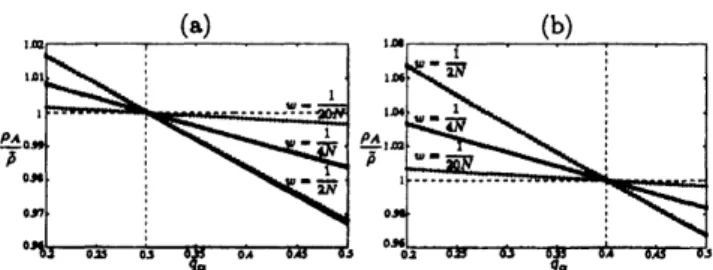
(7)In Fig. 1(a), $\rho_{A}/\tilde{\rho}$ obtained by Eq. (7) for three values
of $w$
are
plotted. The numerically evaluated values of$\rho_{A}/\tilde{\rho}$
are
also plotted. From Fig. l(a),we
observe thatEq. (7) approximatesthe fixation probability quitewell
not only when $Nw\ll 1$ but also when $w$ is significantly
large $(Nw=1/2)$
.
Equation (7) suggests that when themutant allele$A$iscompletelyrecessive,$A$isadvantageous
if strategy $\alpha$ has
a
higher payoff than strategy $\beta$ whenthe frequency of$\alpha$ individuals is 3/10 (i.e., $\rho_{A}\gtrless\tilde{\rho}\Leftrightarrow$
$q_{\alpha} \lessgtr\frac{3}{10})$
.
This isa
“three-tenth law” fora
completelyrecessive mutant allele. On the other hand, ifallele $A$ is
completely dominant,
an
$AB$ individual plays the purestrategy $\alpha$, and this indicates that $(s_{\alpha}, s_{\beta})=(1,0)$
.
Inthis case, Eq. (6) \’issimplifled into
$\rho_{A}\approx\frac{1}{2N}-\frac{w\mu}{3}(q_{\alpha}-\frac{2}{5})$
.
(8)FIG.1: Ratioof$\rho_{A}$to$\tilde{\rho}$plotted
as
afunction of$q_{\alpha}$
.
Allele$A$iscompletelyrecessivein (a), $s_{\alpha}=0$,and completelydominant
in (b),$s_{\alpha}=1$
.
The pointsdenote$\rho_{A}/\overline{\rho}$evaluated numericallyforthreevaluesof$w$which areindicated in the figures. The
lines are obtained with Eq. (7) in (a) and Eq. (8) in (b).
Thesystemparameters
are
given by $N=100,$ $m_{\alpha\alpha}=1-q_{\alpha}$,$m_{\alpha\beta}=m_{\beta\alpha}=0$, and $m_{\beta\beta}=q_{\alpha}$
.
Equation (8) provides
a
“two-fifthlaw” fora
completelydominant mutant allele, $\rho_{A}\gtrless\overline{\rho}\Leftrightarrow q_{\alpha}\lessgtr\frac{2}{5}$ (see Fig.
1$(b))$
.
If the two alleles $A$ and $B$ havean
additive effecton the fitness, i.e.,
an
$AB$ individual plays $\alpha$ and $\beta$ inequal proportions, $(s_{\alpha}, s_{\beta})=(1/2,1/2)$,
we
obtain $\rho_{A}\approx$$\overline{2}w^{-\lrcorner i}1w_{4}(q_{\alpha}-\frac{1}{3})$ from Eq. (6), Thus, in this case, the
”one-third law” appears again.
Since Eq. (6)
can
be rewrittenas
$\rho_{A}$ $\approx$ $\overline{2}\pi 1-$$\underline{w_{6}}g(1+s_{\alpha})\{q_{T^{R}}^{s^{2}}\alpha^{-\frac{3}{10}-}51+s_{\alpha}\urcorner\},$ $A$is advantageousif$q_{\alpha}$ is smallerthan $Q_{\alpha}= \frac{3}{10}+T^{s_{S}^{2}}51+\urcorner_{\alpha}$, i.e., $\rho_{A}\gtrless\tilde{\rho}\Leftrightarrow q_{\alpha}\lessgtr$ $Q_{\alpha}$
.
Since$Q_{\alpha}$ isa
monotoneincreasingfunction of$s_{\alpha}$, itisconcluded that
a
more
dominantalleleis advantageousin
a
wider domain of$q_{\alpha}$ (see Fig. 2).$q_{\alpha}$
FIG. 2: Thethreshold$Q_{a}$of$q_{\alpha}$for allele$A$tobe advantageous
isplottedas afunctionof$s_{\alpha}$
.
Intheshadedregion$(q_{\alpha}<Q_{\alpha})$,$A$ is advantageous.
We compared the fixation probability of $A$ with
the corresponding probability under neutral drift.
Here,
we
compare
the fixation probability of $A$with that of $B$, which is given by $\rho_{B}$ $\approx$ $\nabla 2^{1}-$
$\underline{w}_{6}g\{s_{\alpha}(q_{\beta}-\frac{3}{10})+2s_{\beta}(q_{\beta}-\frac{2}{5})-\frac{1}{5}S_{\alpha^{\mathfrak{l}}}9_{\beta}\}$
.
From thisand Eq. (6), it is shown that $\rho_{A}\geq<\rho_{B}\Leftrightarrow q_{\alpha}>\leq\frac{1}{2}$ (see
Fig. 3) regardless of the strategy of$AB$
.
This is closelyrelated totheconceptof”risk-dominance“ : strategy$\alpha$is
risk-dominant
over
strategy$\beta$if$\alpha$getshigher payoff than$\beta$ when the
two
strategies have thesame
frequencies of1/2. Our result
can
be restatedas
follows: if the strategyof$AA$ is risk-dominant
over
the strategy of$BB$,
regard-less of the strategy ofAB, $\rho_{A}$ is larger than $\rho_{B}$, which
suggests thatin
a
process with infrequent mutations, $A$dominatesthe population
more
frequently than$B$.
FIG. 3: $\rho_{A}$and$\rho_{B}$ areplottedasfunctions of$q_{a}$where$A$isa completely recessive gene $(i.e., (8_{\alpha}, S\beta)=(O, 1))$
.
$\beta A$ is larger(smaller) than$\rho_{B}$ when$q_{\alpha}$ isless (greater) than 1/2.
We have studied akequency dependent Moran
pro-cess
for adiploid populationin orderto investigategamedynamics in afinite diploid population and
we
havede-rived the fixation probabilities of mutant alleles under
weak selection. The criterion of the internal equilibrium
of the game for amutant allele to be advantageous is
derived, and its dependency
on
genetic mechanisms isrevealed. Similar to the 1/3law,thereare several laws of
the criterion for the determination of advantageous
mu-tant
genes;
the3/10law for acompletelyrecessive alleleand the 2/5 law for acompletely dominant allele.
Fur-ther, it is shown that whether the fixation probability of
$A$ is higher than that of$B$does not depend
on
thestrat-ey
of $AB$, instead, it depends onlyon
the position ofthe internal equilibrium.
In this study,
an
$AB$ individualplaysamixedstrategycomprising the strategies of $AA$ and $BB$
.
There existother possible cases; $AA$
or
$BB$ plays amixed strategy.Moreover, the genotypes
can
correspond to completelydifferent strategies; this indicates three-strategy game.
Further, although
we
consideronly asingle gamein thisstudy, several
games
are
played simultaneously ingen-eral. This situation is described by “multi-game” [35].
Furthermore, it is assumed that every individual joins
the
game
irrespectiveof itssex.
However, it is observedthat
some
games
in natureare
played only inasinglesex.
Studies for these situations willbe reported in future.
[1] J. Maynard Smith, Evolution and the Theory
of
Games(Cambridge University Press, Cambridge, $19S2$).
[2] J. Hofbauer,K. Sigmund,$Evolutionar^{v}y$ Games and
Pop-ulation Dynamics (Cambridge Univ. Press, Cambridge,
$199S)$
.
$|3]$ M.A. Nowak, Evolutionary Dynamics (Harvard
Univer-sityPress, Cambridge, 2006).
[4] P.D. Taylor, L.B. Jonker, Math. Biosci. 40, 145 (1978).
[5] S. Wright, Genetics 16, 97 (1931).
[6] R.A. Fisher, The Genetical Theory
of
Natuml Selection(Clarendon,Oxford, 1930).
[7] P.A.P. Moran, The Statistical Processes
of
EvolutionaryTheory (Clarendon, Oxford, 1962).
[8] M. Kimura, Nature 217, 624(1968).
[9] M. Schaffer, J. Theor. Biol. 132,469 (1988).
$[$10$]$ F.$Bo$usset, S. Billiard, J. Evol. Biol. 1$\theta,$ $814$ (2000).
[11] M.A. Nowak, A. Sasaki,C.Taylor,D. Rdenberg,Nature
428, 646 (2004).
[12] C. Taylor, D. Fudenberg, A. Sasaki, M.A. Nowak, Bull.
Math. Biol. 66, 1621 (2004).
[13] C. Taylor, Y. Iwasa, M.A. Nowak, J. Theor. Biol. 243,
245(2006).
[14] G. Wild, P.D. Taylor, Proc. R. Soc. Lond. $B271$,2345
(2004).
[15] D.Fudenberg,M.A.Nowak,C.Taylor, A.Sasaki,Theor.
Popul. Biol. 70, 352 (2006).
[16] S. Ficici, J. B. Pollack,J. Theor. Biol. 247, 426 (2007).
[17] H. Ohtsuki, C. Hauert, E. Lieberman,M.A. Nowak,$N$
a-ture441, 502 (2006)
[18] A. Traulsen, J.C. Claussen, C. $H$auert, $P$hys. Rev. Lett.
95, 238701 (2005).
[19] A. TYaulsen,J.M.$Pa\iota heco$, M.A. Nowak, J.Theor. Biol.
246,522 (2007).
[20] J.C. Claus$sen$,A. baulsen,$P$hys.$B\epsilon v$
.
Lett. 100,058104$(200S)$
.
[21] J. Maynard Smith, G.R. Price,Nature 246, 15 (1973).
[22] P. Schuster, K. Sigmund, J. Hofbauer, R. Wolff,
.
Biol.Cybern. 40,1(1981).
[23] E.C. Zeeman, J. Theor. Biol. 89, 249 (1981).
[24] W.G.S.Hines, J. Theor.Biol. 87, 379 (1980).
[25] J. Maynard Smith, Amer. Natur. 117, 1015 (1981).
[26] J. Hofbauer, P. Schuster, K. Sigmund, Biol. Cyber. 43,
51 $(19S2)$
.
[27] I. Bomze, P. Schuster,K. Sigmund, J. Theor. Biol. 101,
19 (1983).
[28] R.L.W. Brown, Theor. Pop. Biol. 24, 313(1983).
[29] S. Lessard, Theor. Pop. Biol. 26, 210 (1984).
[30] R. Cressman, J. Theor. Biol. $1\theta 0,147$ (1988).
[31] R. Cressman,J. Theor. Biol. 130, 167 (1988).
$[$32] G.W. Rowe,
.
J. Theor. Biol. 184, 89 (1988).[33] S. Lessard, Theor. Pop. Biol. 68, 19 (2005).
[34] S. Karlin, H. Taylor, AFirst Course in Stochastic
Pro-cesses
(Academic Press, 1975).[35] K. Hashimoto, J. Theor. Biol. 241, 669 (2006).