実
3
次元上半空間上の保型関数
北海道大学大学院理学研究科
松本圭司
(Keiji
Matsumoto)
Division
of
Mathematics,
Graduate School of
Science,
Holdcaido
University
1
序
上半空間
$\mathbb{H}=\{\tau\in \mathbb{C}|{\rm Im}(\tau)>0\}$には
$SL_{2}(\mathbb{R})$が
$g \cdot\tau=\frac{a\tau+b}{c\tau+d}$
,
$\tau\in \mathbb{H},$ $g=(\begin{array}{ll}a bc d\end{array})\in SL_{2}(\mathbb{R})$で作用している。
$SL_{2}(\mathbb{R})$のある離散部分群の作用で不変な
$\mathbb{H}$上の有理型関数はた
くさん知られている。
Example
1Eisenstein
Series
$E_{k}( \tau)=\sum_{(0,0)\neq(m.1*)\in \mathrm{Z}^{2}}\frac{1}{(m+n\tau)^{2k}}$
,
$(k\in \mathrm{N}, k\geq 2)$定義より
$E_{k}(\tau)$は上半空間
$\mathbb{H}$上の正則関数で
$E_{k}( \frac{a\tau+b}{c\tau+d})=(c\tau+d)^{2k}E_{k}(\tau)$
,
$(\begin{array}{ll}a bc d\end{array})\in SL_{2}(\mathbb{Z})$をみたすことはすぐにわかる。
a(\mbox{\boldmath $\tau$})m/E
、
(\mbox{\boldmath $\tau$})
は
$\mathbb{H}$上の有理型関数で
$SL_{2}(\mathbb{Z})$の
作用で不変となる。
Exmple
2Jacobi’s
theta
constants
$\theta_{a,b}(\tau)=\sum_{n\in \mathrm{Z}}\exp(\pi i(n+a)^{2}\tau+2\pi i(n+a)b)$
$(a, b)=(0,0),$
$(0,1/2),$
$(1/2,0)$
ラムダ関数
$\lambda(\tau)=\theta_{0,0}(\tau)^{4}/\theta_{0,1/2}(\tau)^{4}$は
$\mathbb{H}$上有理型で
$\ovalbox{\tt\small REJECT}=\{(\begin{array}{ll}a bc d\end{array})\in SL_{2}(\mathbb{Z})|a-1, b, c, d-1\in 2\mathbb{Z}\}$
数理解析研究所講究録 1270 巻 2002 年 126-137
の作用で不変となる。
また
$\text{、}$ $j$関数
$j( \tau)=\frac{4}{27}\frac{(1-\lambda(\tau)+\lambda(\tau)^{2})^{3}}{\lambda(\tau)^{2}(1-\lambda(\tau))^{2}}$
は
$\mathbb{H}$上の有理型関数で
$SL_{2}(\mathbb{Z})$の作用で不変となる。
Remark 1
$SL_{2}(\mathbb{Z})/\Gamma_{2}$は
3
次対称群
$S_{3}$と同型。
$j(\tau)$は
$\lambda(\tau)$の
$S_{3}$不変式となっ
ている。
一方 ‘ 実
3
次元上半空間
$\mathbb{H}^{3}=\{(z,t)\in \mathbb{C}\cross \mathbb{R}|t>0\}$
上の実解析的関数で
$\mathbb{H}^{3}$の自己同型群の離散部分群
$\Gamma$の作用で不変となるものはほ
とんど知られていない。
この講演ではいくつかの離散群
$\Gamma$の作用に関して不変な
$\mathbb{H}^{3}$上の実解析的関数
を具体的に構成する。 そしてそれらを並べてできる
$\mathbb{H}^{3}/\Gamma$から射影空間への写像に
対し、
像を決定し同相写像であることを紹介する。
2
$\mathbb{H}^{3}$に作用する離散群
$\mathbb{H}^{3}$の自己同型群は
$GL_{2}(\mathbb{C})$と
involution
$T$で生成されている。
また、
$\mathbb{H}^{3}$は
3
次
元球
$\mathrm{B}^{3}=\{(t_{1}, t_{2}, t_{3})\in \mathbb{R}^{3}|t_{1}^{2}+t_{2}^{2}+t_{3}^{2}<1\}$
と同型で
$\mathbb{H}^{3}$の自己同型群は直交群
$O_{H}(\mathbb{R})=\{g\in GL_{4}(\mathbb{R})|{}^{t}gHg=H=\mathrm{d}\mathrm{i}\mathrm{a}\mathrm{g}(-1, -1, -1, 1)\}$
をその中心で割った群と同型である。 これらの事実を良く理解するには以下の線型
空間を考えるとよい。
$V$
を
$2\cross 2$Hermite
行列からなる実
4
次元線型空間で
2
次形式
$\det(v)$
が定義さ
れているとする。
$V=\{v\in M_{\mathbb{C}}(2,2)|v^{*}=v\}$
,
$\det$:
$V\ni v\vdash*\det(v)\in \mathbb{R}$
.
$V^{\mathrm{x}}$
$=$
$\{v\in V|\det(v)>0\}$
,
$SV=$
$\{v\in V^{\mathrm{x}}|v>0, \det(v)=1\}$
,
と定めると
$V^{\mathrm{x}}/\mathbb{R}^{\mathrm{x}}\simeq SV$となっている。
$\mathbb{H}^{3}$は
$V^{\mathrm{x}}/\mathbb{R}^{\mathrm{x}}$
と以下の写像により同型と
なっている:
$g_{1}$
:
$\mathbb{H}^{3}\ni(z,t)\vdasharrow\frac{1}{t}(\begin{array}{ll}t^{2}+|z|^{2} z\overline{z} \mathrm{l}\end{array}) \in SV\simeq V^{\mathrm{x}}/\mathbb{R}^{\mathrm{x}}$.
$GL_{2}^{T}(\mathbb{C})$
を
$GL_{2}(\mathbb{C})$と
involution
$T$で生成され関係式
$T\cdot g=\overline{g}\cdot T$をみたす群
とする。
$GL_{2}^{T}(\mathbb{C})$は半直積
$GL_{2}(\mathbb{C})\mathrm{x}\langle T\rangle$であり、
$V^{\mathrm{x}}$や
$SV$
に
$T\cdot v={}^{t}v$
,
$g \cdot v=\frac{1}{|\det(g)|^{2}}gvg^{*}$で作用している。 この作用を同型
$g_{1}$を用いて
$\mathbb{H}^{3}$に誘導すると
$(\begin{array}{ll}a bc d\end{array})\cdot(z,t)$ $=$ $( \frac{a\overline{c}t^{2}+(az+b)\overline{(cz+d)}}{|c|^{2}t^{2}+(cz+d)\overline{(cz+d)}},$$\frac{|\det(g)|t}{|c|^{2}t^{2}+(cz+d)\overline{(cz+d)}})$,
$T\cdot(z,t)=(\overline{z},t)$となる。
$GL_{2}^{T}(\mathbb{C})$の離散部分群たちを
$\Gamma=GL_{2}(\mathbb{Z}[i])$
,
$S\Gamma=$
$\{g\in GL_{2}(\mathbb{Z}[i])|\det(g)=\pm 1\}$
,
$\Gamma(1-i)$
$=$ $\{g\in\Gamma|g\equiv I_{2}\mathrm{m}\mathrm{o}\mathrm{d} (1-i)\}$,
$\Gamma(2)$ $=$ $\{(\begin{array}{ll}a bc d\end{array})\in\Gamma|a-d,b,c\equiv \mathrm{O}\mathrm{m}\mathrm{o}\mathrm{d} (2)\}$
,
$\Gamma(3)$ $=$ $\{(\begin{array}{ll}a bc d\end{array})\in\Gamma|a-d,b,c\equiv \mathrm{O}\mathrm{m}\mathrm{o}\mathrm{d} (3)\}$
,
$S\Gamma(3)$
$=\Gamma(3)\cap S\Gamma$
.
で与える。
$GL_{2}(\mathbb{C})$の部分群
$G$に対して
$\mathrm{C}^{T}=G\aleph\langle T\rangle$とする。
$\Gamma^{T},$$\Gamma(1-i)^{T},$$\Gamma(2)^{T}$は
reflections
で生成される
o
一方、
2
次形式
$\det$の符号数は
$(1, 3)$
のなので
$V^{\mathrm{x}}/\mathbb{R}^{\mathrm{x}}$は
3
次元球
$\mathrm{B}^{3}$と同型で
ある。
実際
$V$の基底を
$v_{1}=(_{-}$
$-\lrcorner 1\dot{\mathrm{g}}02$ $\frac{-1-}{2,1}$),
$v_{2}=(21i-1+$
$\frac{-1-}{02})$,
$v_{3}=$
(
.
$\frac{1-}{02}.\cdot$),
$v_{4}=(_{\mathrm{i}-1+}^{1}2$ $\frac{-1-}{12}.\cdot)$,
で定めると
2
$\det(\sum_{j=1}^{4}y_{j}v_{j})={}^{t}yHy$,
$H=$
市
$\mathrm{a}\mathrm{g}(-1,$$-1,$
$-1, 1)$
,
$y={}^{t}(y_{1}, \ldots, y_{4})$となるので
$V^{\mathrm{x}}/\mathbb{R}^{\mathrm{x}}=\{y\in \mathrm{P}_{\mathrm{R}}^{3}|y_{1}^{2}+y_{2}^{2}+y_{3}^{2}<y_{4}^{2}\}\simeq \mathrm{B}^{3}$
Figure 1: Discrete
subgroups
of
$GL_{2}^{T}(\mathbb{C})$であり、
$GL_{2}^{T}(\mathbb{C})$の作用は
$\mathrm{B}^{3}$の自己同型群
$O_{H}(\mathbb{R})$の作用として翻訳される。
$\mathbb{H}^{3}$と
$\mathrm{B}^{3}$との具体的な同型は
$\mathbb{H}^{3}\ni(z, t)\}arrow\frac{1}{t}(\begin{array}{l}-|z|^{2}-\mathrm{R}\mathrm{e}(z)-\mathrm{I}\mathrm{m}(z)-t^{2}-\mathrm{R}\mathrm{e}(z)-\mathrm{I}\mathrm{m}(z)-1\mathrm{R}\mathrm{e}(z)-\mathrm{I}\mathrm{m}(z)|z|^{2}+\mathrm{R}\mathrm{e}(z)+\mathrm{I}\mathrm{m}(z)+t^{2}+\mathrm{l}\end{array})\in \mathrm{B}^{3}$
で与えられる。
$O_{H}(\mathbb{R})$
の離散部分群を
$G_{H}$ $=O_{H}(\mathbb{R})\cap GL_{4}(\mathbb{Z})$
,
$SG_{H}$
$=$ $\{g\in G_{H}|1g^{t}1\equiv 0\mathrm{m}\mathrm{o}\mathrm{d} 4\}$,
$G_{H}(3)$
$=$ $\{g\in G_{H}|g\equiv\pm I_{4}\mathrm{m}\mathrm{o}\mathrm{d} 3\}$,
$SG_{H}(3)$
$=$$SG_{H}\cap G_{H}(3)$
,
で与える。
ここで
$1=(1,1,1,1)$
とする。
Lemma 1
$P\Gamma^{T}\simeq PG_{H}$
,
$P\Gamma(3)\simeq PG_{H}(3)$
,
$PS\Gamma(3)\simeq PSG_{H}(3)$
.
以下で
$S\Gamma(3),$$\Gamma(2)^{T},$$\Gamma(1-i)^{T},$
$\Gamma^{T}$の作用に関して不変な実解析的な関数を構
3
$S\Gamma(3)$
の作用で不変な関数
前節でみたように
$\mathbb{H}^{3}$と
$\mathrm{B}^{3}$とは同型であり、
$\mathrm{B}^{3}$は
4
次ジーゲル上半空間
$S_{4}=\{\tau\in M_{\mathrm{C}}(4,4)|t_{\mathcal{T}\mathcal{T}}=, {\rm Im}(\tau)>0\}$
へ以下のように埋め込むことができる。
$\mathrm{B}^{3}\ni y\mapsto t\frac{1}{2}H-\frac{\sqrt{3}i}{2}[H-2(y{}^{t}y)/({}^{t}yHy)]\in \mathrm{S}_{4}$
.
この埋め込みにより、
準同型写像
$O_{H}(\mathbb{R})\ni g\}arrow(\begin{array}{ll}g OO HgH\end{array})\in Sp(8,\mathbb{R})$
が引き起こされる。
$(-\text{て}$.
$Sp(8,\mathbb{R})\dagger\mathrm{h}\tau\in \mathrm{S}_{4}\}^{\vee}$.
$(\begin{array}{ll}A BC D\end{array})\cdot\tau=(A\tau+B)(C\tau+D)^{-1}$
で作用している。
したがって
$\mathbb{H}^{3}$から
$\mathrm{S}_{4}$への埋め込み
$J$
が得られる。
4
次
Siegel
上
半空間
$\mathrm{S}_{4}$上には
theta
constants
が定義されている。
\mbox{\boldmath$\theta$}
。
,b(\mbox{\boldmath$\tau$})
$= \sum_{n\in \mathrm{Z}^{4}}\exp(\pi i{}^{t}(n+a)\tau(n+a)+2\pi i{}^{t}(n+a)b)$
ここで
$\tau\in S_{4},$ $a,$$b\in \mathbb{Q}^{4}$とする。
Proposition 1
$\mathbb{H}^{3}$上の関数
$f_{a}(z,t)= \exp(\frac{\pi i}{12})\theta_{a,aH}^{3}(g(z,t))$
は
$\mathbb{H}^{3}$上の実解析的関数で、
$g\in\Gamma(3)$
に対し
$f_{a}(g\cdot(z,t))=\det(g)^{2}f_{a}(z,t)$
をみたす。
ここで
$a$は
$\frac{\mathrm{z}^{4}}{6}$の冗で
$6a$
の各成分は
$\pm 1,$ $\pm 3$であり、
$(6a)H^{t}(6a)\equiv$
$-2\mathrm{m}\mathrm{o}\mathrm{d} 24$
をみたすものとする。
このような
$a$は差が整数ベクトルとなるものや
符号が異なっているものを同一視すると
15
個ある。
Theorem
115
個の
$f_{a}$を用いて定まる写像
$\eta_{3}$
:
$\mathbb{H}^{3}\ni(z,t)\daggerarrow[\ldots, f_{a}(z,t), \ldots]\in \mathrm{P}_{\mathrm{R}}^{14}$の像は
$\{[x_{0}, \ldots, x_{5}]\in \mathrm{F}_{\mathrm{R}}|\sum_{\mathrm{j}=0}^{5}xj=0, \sum_{j=0}^{5}x_{j}^{3}=0\}$
と同型な
$\mathrm{P}_{\mathrm{R}}^{14}$内の
1
次式と
3
次式で与えらる代数多様体に含まれる。 写像
$\eta_{3}$
は
$\mathbb{H}^{3}/\Gamma(3)-$
と
Segre cubic
から
10
個の特異点を除いた集合との同相写像を引き起
Remark 2
$\mathrm{P}_{\mathrm{R}}^{1}$上の
6
点の配置空間
$GL_{2}(\mathbb{R})\backslash \{(\begin{array}{ll}x_{11} x_{16}x_{21} x_{26}\end{array})|d_{k_{p}k_{q}}(x)\neq 0(p\neq q)\}/(\mathbb{R}^{\mathrm{x}})^{6}$
は
$(xjk)\vdash+[\ldots, d_{k_{1}k_{2}}(x)d_{k_{3}k_{4}}(x)d_{k_{5}k_{6}}(x), \ldots]$
$(\{k_{1}, \ldots, k_{6}\}=\{1, \ldots, 6\})$
?
こより
$\mathrm{P}_{\mathrm{R}}^{14}${
こ埋め込める。
ここで
$d_{k_{\mathrm{p}}k_{q}}(x)=\det(\begin{array}{ll}x_{1k_{p}} x_{1k_{q}}x_{2k_{\mathrm{p}}} x_{2k_{q}}\end{array})$
とする。
Theorem 1
における
$f_{a}$がみたす
1
次関係式と
3
次関係式は
$d_{k_{1}k_{2}}(x)d_{k_{3}k_{4}}(x)d_{k_{5}k_{6}}(x)$がみたす関係式と一致している。
Remark
3
$\mathbb{H}^{3}/\Gamma(3)$の基本領域は苫
gure 2
で与えられる。
cusps
は
10
個ある。
4
$\Gamma(2)^{T},$
$\Gamma(1-i)^{T},$
$\Gamma^{T}$の作用で不変な関数
$\mathbb{H}^{3}$
上の関数
$_{a,b}(z,t)$
を
$\sum\exp(-\pi(n+\frac{a}{1-i})W(n+\frac{a}{1-i})^{*}+2\pi i{\rm Re}(\frac{nb^{*}}{1+i}))$
,
n\epsilon z
国
2
$W= \frac{1}{t}$
(
$\overline{z}$
$z1$
),
$(z,t)\in \mathbb{H}^{3}$,
$a,$$b\in \mathbb{Z}[i]^{2}$で定める。
Proposition 2
$_{a,b}(z, t)$
は実解析的関数で
$_{a,b}(\overline{z},t)=_{a,b}(z,t)$
をみたし、
$g\in\Gamma(2)$
に対して
$_{a,b}(g\cdot(z, t))=_{a,b}(z, t)$
をみたす。
また、
$g\in\Gamma(1-i)$
1 こ対して
$_{a,b}^{2}(g\cdot(z, t))=_{a,b}^{2}(z,t)$
をみたす。
$(z, t)=_{00,00}(z, t)$
は正値で
$g\in\Gamma$に対して
$(g\cdot(z, t))=(z,t)$
をみたす。
131
Theorem
2
$\mathbb{H}^{3}$から
$\mathbb{R}^{3}$への写像
$\eta_{2}$
:
$(z,t) \vdash*\frac{1}{\Theta(z,t)}(\Theta_{11,11}(z,t),$ $\Theta_{10,01}(z,t),$ $\Theta_{01,10}(z,t))$の像は正八面体
$\{(x_{1},x_{2},x_{3})\in \mathbb{R}^{3}||x_{1}|+|x_{2}|+|x_{3}|\leq 1\}$
から
6
個の頂点
$(\pm 1,0,0),$ $(0, \pm 1,0),$ $(0,0, \pm 1)$
を除いた集合
$Z_{2}$(Figure
$S$)
となる。
写像
$\eta_{2}$は
$\mathbb{H}^{3}/\Gamma(2)^{T}$と
$Z_{2}$との同相写像を引き起こす。
Remark 4
$\mathbb{H}^{3}/\Gamma(2)^{T}$の基本領域は
Figuoe4
で与えられる。
cvps
は
6
個ある。
Corollary
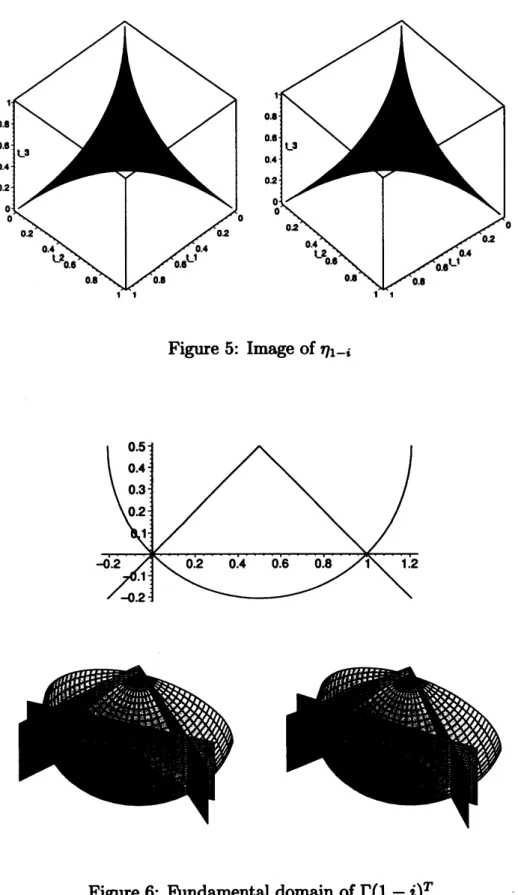
1
$\mathbb{H}^{3}$から
$\mathbb{R}^{3}$への写像
$\eta_{1-:}$
:
$(z,t)| arrow\frac{1}{\Theta^{2}(z,t)}(\Theta_{11,11}^{2}(z,t),$ $\Theta_{10,01}^{2}(z,t),$ $\Theta_{01,10}^{2}(z,t))$の像は、集合
$\{(t_{1},t_{2},t_{3})|t_{1},t_{2},t_{3}\geq 0, F(t_{1},t_{2},t_{3})\geq 0\}$
から
(1,
0,
0), (0,
1,
0), (0,
0,
1)
を除いた集合の
(0,
0,
0)
を含む連結成分
$Z_{1-:}$(Figure5)
となる。
。
ここで
$F$
は
$F(t_{1},t_{2},t_{3})$ $=$ $\frac{1}{16}(t_{1}+t_{2}+t_{3}+1)^{4}-4t_{1}t_{2}t_{3}$$+(t_{1}t_{2}+t_{2}t_{3}+t_{3}t_{1}+t_{1}+t_{2}+t_{3})^{2}$
$- \frac{1}{2}(t_{1}+t_{2}+t_{3}+1)^{2}(t_{1}t_{2}+t_{2}t_{3}+t_{3}t_{1}+t_{1}+t_{2}+t_{3})$
とする。
写像
$\eta_{1-:}$は
$\mathbb{H}^{3}/\Gamma(1-i)^{T}$と
$Z_{1-:}$との同相写像を引き起こす。
Remark
5
$\mathbb{H}^{3}/\Gamma(1-i)^{T}$の基本領域は苫聾
$re$6
で与えられる。
cusps
は
3
個ある。
$\Gamma(1-i)^{T}/\Gamma^{T}|\mathrm{h}3^{\text{、}次}\lambda\text{、}\mathrm{f}\mathrm{f}\mathrm{f}\mathrm{i}\mathrm{f}\mathrm{f}\mathrm{l}S_{3}\text{と_{}\mathrm{p}}\mathrm{R}\text{型で}\Theta_{11,11}^{2}(z,t),$$\Theta_{10,01}^{2}(z,t),$ $\Theta_{0110}^{2}(z,t).-\mathrm{E}$
の置換として作用している。
$\Phi_{j}(z,t)$をこれらの関数たちの
$j^{\text{、}}*\text{基}*\text{対}\#\text{式}$として定
める。
Proposition
3
$\Phi_{j}(z,t)$は
$\Gamma^{T}$の作用で不変な関数である
o
CoroUary
2
写像
$\eta$
:
$(z,t) \vdasharrow(\frac{\Phi_{1}(z,t)}{\Theta^{2}(z,t)},$ $\frac{\Phi_{2}(z,t)}{\Theta^{4}(z,t)},$$\frac{\Phi_{3}(z,t)}{\Theta^{6}(z,t)})$の像は
$t_{3}\geq 0$
,
$t_{3} \geq\frac{1}{64}(4t_{2}-(t_{1}-1))^{2}$,
$- \frac{2}{27}t_{1}^{3}+\frac{1}{3}t_{1}t_{2}+\frac{2}{27}(t_{1}^{2}-3t_{2})^{3/2}\geq t_{3}\geq-\frac{2}{27}t_{1}^{3}+\frac{1}{3}t_{1}t_{2}$ $- \frac{2}{27}(t_{1}^{2}-3t_{2})^{3/2}$
,
から
(1,
0,
0)
を除いた集合
$Z$となる。
この写像
$\eta$は
$\mathbb{H}^{3}/\Gamma^{T}$と
$Z$との同相写像を
引き起こす。
Remark
6
$\mathbb{H}^{3}/\Gamma^{T}$の基本領域は苫
gure
7
で与えられる。
cusps
は
1
個ある。
References
[Igu]
J. Igusa, Theta
Functions,
Springer,
1972.
[Hu]
B.
Hunt, The
geometry
of
some
special
Arithmetic Quotients, LNM 1637,
Springer,
1996.
[MN]
K.
Matsumoto
and H.
Nishi,
Afundamental
domain for the
principal
congru-ence
subgroup of
$GL(2,\mathbb{Z}[i])$of level 3, preprint.
[MSY]
K. Matsumoto, T.
Sasaki
and M. Yoshida, The monodromy
of the period
map
of a4-parameter family of K3 surfaces and the
AomotO-Gel’fand
hyperge-ometric function of type
$(3,6)$
, Internat. J. of
Math., 3(1992),
1-164.
[MT] K.
Matsumoto
and
T.
Terasoma,
Theta constants
associated
to
cubic three
folds,
math
$.\mathrm{A}\mathrm{G}/0008024$.
[MY]
K.
Matsumoto and M.
Yoshida,
Invariants
for
some
real hyperbolic
groups,
Kyushu
Univ.
preprints
2001-2.
[Mal]
K. Matsumoto, Theta functions
on
the
bounded symmetric domain of
tyPe
$I_{2,2}$