Doctoral Dissertation
Balance of Power and Deterrence between Saudi Arabia and Iran in the Era
of Post-Arab Uprisings and Shale Oil Revolution
March 2017
Doctoral Program in Policy Science
Graduate School of Policy Science
Ritsumeikan University
Doctoral Dissertation reviewed
by Ritsumeikan University
Balance of Power and Deterrence between Saudi Arabia and Iran in the Era
of Post-Arab Uprisings and Shale Oil Revolution
アラブの春及びシェール革命以降の
サウジアラビア・イラン間の勢力均衡及び抑止
March 2017
2017 年 3 月
Doctoral Program in Policy Science, Graduate School of Policy Science
Ritsumeikan University
立命館大学大学院政策科学研究科政策科学専攻博士後期課程
Alshammary Sfoug Faraj H
アルシャマリ スフォグ
Supervisor:Professor Noboru Miyawaki
Abstract of Doctoral Dissertation
Balance of Power and Deterrence between Saudi Arabia and Iran in the Era
of Post-Arab Uprisings
Doctoral Program in Policy Science Graduate School of Policy Science Ritsumeikan University
アルシャマリ スフォグ ALSHAMMARY Sfoug Faraj H
The political situation in the Middle East is still one of the main concerns for the rest of the world because of the vital interests of the global economy, world energy stability, and the state of international peace. Dramatic, ongoing developments in the past few years—specifically the period that followed the Arab uprisings—have changed the dynamics of politics, alliances, and disputes in the region. Other important factors have contributed to those changes as well, such as US withdrawing from the region as “Gulf Police” to counterbalance Iran’s influence due to the revolution of shale oil and gas in the United States, the emergence of the concept of the Asian pivot, and the P5+1–Iran nuclear agreement. These factors combined have reduced the United States’ desire to remain responsible for Gulf security. Thus, the shape of policies in the Middle East will be defined mainly by the balance of power and deterrence between Saudi Arabia and Iran, as it has been for decades. I try to analyze the balance of power in the Gulf region in the era of post-Arab uprisings and US
withdrawal. In particular, the rapid occurrence of events has increased the demand for research that addresses and understands those alterations. I find that recent developments in the Middle East have forced Saudi Arabia, mainly, and some members of the Gulf Cooperation Council (GCC) to shift their policy to be more independent and to adopt an assertive neorealist doctrine to keep the status quo in the region. Saudi Arabia has started taking major steps to develop its military capabilities and has also tried to change the map of alliances in the Middle East by forming a pan-Arab force and creating a new Arab coalition, including some of the GCC (Saudi Arabia, UAE, Bahrain, Kuwait, and Qatar) plus Jordan, Egypt, Morocco, and Sudan, which played an important role in Operation Decisive Storm in Yemen to confront Iranian expansion in the Arab world. On the other hand, Iran will have a greater budget after removing the UN sanctions related to its nuclear file and unfreezing assets, thus giving Iran the capabilities to finance its proxy wars in the region, which may thus augment the intensity of the dispute between Saudi Arabia and Iran.
Acknowledgment
I would like to thank the policy Science department in Ritsumeikan University, all professors, Staff, and Students for their kind help all of these good years I have spent with them. And I would like to thank Prof. Miyawaki for his teaching, advices and supporting during the course, I would not be reaching this level in the policy science knowledge without his supervision and guidance.
Table of Contents Introduction
Chapter 1: History of the Region and Modern Events
1.1 Pre-Arab Spring History of Rivalry between the Saudi Arabia and Iran
1.1.1 Pre-1979 Revolution Stage
1.1.2 Post-Iranian Revolution 1979 Stage 1.1.2.1 1980–1988 Iran–Iraq War 1.1.2.2 1987 Incidents in Saudi Arabia 1.1.2.3 1997 First Saudi visit
1.1.2.4 1999 Good times
1.1.2.5 2003 After US invasion of Iraq
1.2 Recent Years: Major Changes in the Middle East
1.2.1 Arab Uprisings
1.2.2 US Withdrawing from the Region 1.2.3 The Shale Oil Revolution
1.2.4 Pivot to Asia
Chapter 2: The Importance of the Region in Security Dimension 2.1 Energy Security and International Trading
2.2 The Importance of the Sunni-Shiite Relations and Five Issues of the Rivalry
2.2.1 Sectarian Religion
2.2.2 Muslim World Leadership 2.2.3 The Relation with the West 2.2.4 The Competition in OPEC 2.2.5 Iran’s Nuclear Program
2.3 The War on Terror and Iran’s Relation to Terrorist Organizations Chapter 3: Theoretical Framework
3.2 Neorealism Theory
3.3 Main Features of Neorealism
3.3.1 The System 3.3.2 Primary Actors 3.3.3 Anarchy 3.3.4 Self-Help
3.3.5 Security Dilemma 3.3.6 Polarity of the System
3.4 Balance of Power
3.4.1 The Definition of Balance of Power 3.4.2 The Deterrence
3.4.3 Internal Balance 3.4.4 External Balance
3.4.5 Strategies for Balance of Power 3.4.6 Major School of Neorealism
3.4.7 Other Independent Variables for Measuring Power Changes
Chapter 4: The application of the framework in the region
4.1 Neorealism perspective among Competitors in the Region 4.2 New Deterrence in the Region
4.3 The New Saudi Arabian Doctrine
Chapter 5: Analysis of Economic and Military Power of Saudi Arabia and Iran 5.1 The Power and the Calculation of Balance of Power
5.2 Economic and Competence Measures
5.2.1 Human Development Index 5.2.2 Worldwide Governance Indicators
5.3 Military Power of Saudi Arabia and Iran Chapter 6: Analysis of External Power
6.1 The change of power after Arab Uprisings 6.2 Operation Decisive Storm
6.3 The Pan-Arab Force
6.4 Strategies of the Competitor for Balance of Power and Deterrence Chapter 7: Conclusion
1 Introduction
Politics in the Gulf region involve multidimensional perspectives and combined factors.In order to build a comprehensive vision of the subject, we should touch on the historical background and the local and external factors that led to the current policies in the region. This includes the local factors of competition between Arabs and Persians, such as the first is sectarian issues and the Sunni–Shia tension, the Second is the history of the Arab–
Persian dispute, and the third is the cultural and ethnic competition. Regarding external factors, I will discuss the fourth factor which is the external forces responsible for the security of the region historically, mainly the Ottoman Empire in the 1500s, the British
Empire from the early eighteenth century for 150 years, and then the United States after World War II.
If the researcher wishes to discuss the first factor which is sectarian issues and the
Sunni–Shia relationship, he needs to go back in history more than 1,400 years to an episode
that occurred after the death of the Prophet Mohammed, peace be upon him, in 632 CE. All Muslims believe Mohammed was the last messenger; he had no male children alive when he died, only daughters. Also, he did not leave a will indicating who would be his successor and the next leader of Muslims.1 After his death in Medina, there were two types of his
companions in the city. Al Anssar, which means “the supporters” in Arabic, were the original people of Medina who supported the Prophet when he immigrated to there. Al Anssar are mainly composed of two tribes: the Aws and the Khazraj.2The second group of companions
was called Al Muhajirun, which means “the immigrants” in Arabic. They were not originally from Al Medina but followed the prophet Mohammed or even immigrated from Makkah to
2
Medina before his immigration. The Prophet immigrated in 622 CE after escaping
assassination in his hometown, Makkah, where Muslims were being harassed and tortured at that time.3 Most of the well-known companions of Al Muhajirun came from the Quraysh of
Makkah (the same tribe as Mohammed), who, at the beginning of Islam, were considered the biggest enemy of Muslims.4Therefore, Al Medina was like a safe haven for Muslims,
especially Muhajirun. After the death of Mohammed, Al Anssar held a meeting to select the new leader of the Muslims in a place called Sagifah (or Sagifah Bani Saidah). They planned to select the head of Khazraj, Saad Ibn Obadah, as the new Muslim leader. The news reached Umar ibn Alkhatab, one of the prominent leaders of the Muslims from Al Muhajirun. He discussed it with Abu Bakr, the closest man to Prophet Mohammed, and decided to go to Sagifah before Al Anssar selected the new leader. Umar wanted to talk, but Abu Bakr stopped him and gave a good speech to Al Anssar in which he praised their effort to support the prophet Mohammed during his life. He explained that the Arabs found it difficult to accept new leaders from outside the tribe of Mohammed because even before Islam the Quraysh were the leaders of the Arabs, and the coming of Islam affirmed this, as the Prophet was also from the Quraysh. Therefore, Abu Bakr asked Al Anssar to support the new caliph (the successor of Mohammed) as they had supported the Prophet.5One of the Anssar suggested an
alternative of having one leader from the Quraysh and the next one from the Anssar, but the suggestion was dropped by Al Muhajirun. Therefore, Abu Bakr asked the Anssar to select either Umar or Abo Ubiedah, but Umar insisted on selecting Abu Bakr as the new leader of the Muslims. He took a bay’ah (oath of allegiance), and the rest of the Muslims in Sagifah followed, selecting Abu Bakr as the first caliph for Muslims after Prophet Mohammed.6
3
The selection of Abu Bakr was not surprising among the Sunni because his name and title, Abu Bakr Alsadeeq, meant “the believer.” He was the first man who believed
Mohammed’s prophecy and was the closest man to the Prophet. In fact, Mohammed was asked in his life who he liked most among his male companions, and he replied that it was Abu Bakr. The Holy Quran also mentioned Abu Bakr as the companion of Prophet
Mohammed during their immigration from Makkah to Medina, as well as when the Quraysh followed them to kill the Prophet while he was hiding in a cave.7 Quran Chapter Al-Tawba
Verse No. 40 states:
(If you help him (Muhammad SAW) not (it does not matter), for Allah did indeed help him when the disbelievers drove him out, the second of two, when they (Muhammad SAW and Abu Bakr) were in the cave, and he (SAW) said to his companion (Abu Bakr): “Be not sad (or afraid), surely Allah is with us.” Then Allah sent down His Sakinah (calmness, tranquility, peace, etc.) upon him, and strengthened him with forces (angels) which you saw not, and made the word of those who disbelieved the lowermost, while it was the Word of Allah that became the uppermost, and Allah is All-Mighty, All-Wise.)8
The Prophet mentioned that Abu Bakr was the first person who would enter heaven from the nation of Mohammed.9
The events that followed the death of Prophet Mohammed proved that Abu Bakr’s plan was to keep the caliphate among the Quraysh; otherwise it would lead to the
4
anybody to be a leader unless he was from the tribe of Mohammed.10The Sunni claimed that Ali, the cousin of Mohammed, accepted Abu Bukr as the first caliph, while the Shia said that he had been forced to accept him. Regardless, both agreed that Ali was not present at the
meeting in Sagifah.11
It is worth mentioning that there was no use of these terms (Shia or Sunni) after the death of Mohammed directly, but the term Shia started to be used frequently around the time of Ali, about 35 years after the death of the Prophet. Therefore, the dispute between the Sunni
and the Shia after Prophet Mohammed’s death was retrospective. The Shia believed that the cousin of Prophet Mohammed and the husband of his beloved daughter Fatima, Ali ibn Abi Talib, should have been the first caliph of the Muslims after Mohammed,12 while the Sunni thought the Shoura, or election, should have decided who would be the caliph. However,
during the Sagifa meeting, Ali and his wife, Fatima, were busy preparing for the funeral of Prophet Mohammed, therefore he wasn’t a candidate to be the first caliph.13
The story of forcing Ali to accept Abu Bakr as caliph seems odd because both Sunnis and Shias know very well that nobody could have forced Ali to do something he didn’t want to do. It is well known in Muslim history, and both Sunnis and Shias agree, that Ali was a courageous man and a strong warrior.14 Shias said the Prophet Mohammed endorsed Ali as
the next caliph in his life in the Hadiath of the pond of Khumm when Prophet Mohammed went back to Al Medina from Makkah after he took his last farewell pilgrimage. He made a speech and stated, “Who am I his Maula (master), Ali is his Maula (master),” and this is why Shias celebrate this day.15 Sunnis, however, think that the event was just a sequence of a long
5
companions. Ali was decisive with them, and when they returned to the Prophet, some of them complained about his behavior. After the Prophet heard both sides of the story, he found that Ali had made the right decision, and therefore, he gave a speech.16
The succession of Mohammed has been in dispute for 1,400 years, and both parties— Sunni and Shia—claim they are right. After Abu Bakr’s death, the second caliph was Umar, one of the most important strategic and military leaders in the history of Muslims. The Islamic State expanded greatly, and he defeated the two biggest empires at that time: the Persian Empire and the Roman Empire. The role of Umar and his relationship with Persia have been very controversial issues among Shia and Sunni Muslims.17Shias, especially from Iran, blame
Umar for not handing over the leadership of Muslims to Ali after the death of Abu Bakr, and they believe Ali was the legitimate leader. Sunnis, on the other hand, argue that the
relationship between Ali and Umar was excellent; otherwise, Umar would not have married Ali’s daughter, which showed that they were very close. Umar considered Ali a very close adviser and sought his wisdom on important matters. Umar once said that if Ali hadn’t existed, Umar would have perished.18This well-known statement shows how Umar depended
on Ali in handling state affairs. Umar even dictated in his will that there should be an election to choose the caliph after him, and he asked six of the Muslim leaders to select the next caliph (Shura).
Muslims finally elected Uthman Ibn Affan. His nickname, Thou Alnourain, means “the man with two lights” in Arabic because he married two of Prophet Mohammed’s
daughters. Therefore, he was a son-in-law of Prophet Mohammed,19like Ali, but Shias refused
6
caliphs—Abu Bakr, Umar, and Uthman—and they thought Uthman’s marriage to two of the Prophet Mohammed’s daughters was not enough reason, claiming that they had been forced marriages.
Under the leadership of Uthoman, the Islamic state expanded more, but at the end of his reign, fitna (troubles and disorder) occurred. Thugs came to Al Medina to complain of corruption among governors in the provinces, and they surrounded Uthman’s house for a period before finally killing him. It is worth mentioning that Ali was so concerned about the safety of Uthman that he posted his sons, Al Hassan and Al Hussein, to guard him; thus, the relationship was strong between the two sons-in-law of Prophet Mohammed.20
After the assassination of Uthman, Ali became caliph. He tried to change the controversial governors of the provinces, who had many complaints against them. Some people wanted him to take revenge on the people who had killed Uthman. The governor of Laven (most of present-day Syria) in Damascus, Muawiyah Ibn Abi Sufyan, refused the orders of Ali as the new caliph.21 Thus, Muslims became divided into two groups, some with
Muawiyah and the majority with Ali. Finally, they met at the battle of Siffin, which is famous in the history of the Muslims. Ali’s army almost defeated Muawiyah, but Muawiyah escaped from the situation by putting the Holy Quran on the tips of his soldiers’ spears, which meant they wanted the rule of the Quran. As a result of the arbitration, the battle was stopped and the two armies left, one toward Damascus and the other (Ali’s) toward Kufa. This was the
beginning of Shiism.
The people who supported Ali called themselves Shiite Ali, which means “supporters of Ali.” Then Ali was assassinated in 661CE after five years of leadership as caliph, by Kharijite Abdul Rahaman Ibn Muljim. Shias consider Ali is first imam and legitimate caliph,
7
and he was from Ahl Al-Bayt, which means “the house of Prophet Mohammed.” After the death of Imam Ali, his son Al Hassan took over for several months. Eventually, Al Hassan reached an agreement with Mauiyah, abdicating his position to Mauiyah in order to unify the Muslims. However, Al Hassan imposed conditions that Mauiyah didn’t follow. For example, after Mauiyah, the Muslim leadership role was not supposed to be hereditary, but Mauiyah sought to make his son Yazied the next caliph. Hussein Ibn Ali, the son of Ali, refused this plan and went to Iraq, looking for support. He did not find actual support from the Iraqis, but the army of Yazied, son of Mauiyah, followed him and fought him. The army killed people around Hussein Ibn Aliin the Karbala battle; then, Hussein Ibn Aliwas killed by Shamar ibn thi Al-Joshan by beheading, which is considered one of the biggest crimes in Muslim history among both Shias and Sunnis. This crime was condemned by both Sunnis and Shias because Yazied’s army had killed the beloved grandson of Prophet Mohammed, who was of the most royal blood of Arabs and Muslims. His mother was Fatima, the beloved daughter of Prophet Mohammed, and his father was Ali, the cousin of Prophet Mohammed and fourth caliph.22As
a result, the rift increased between the Shias and Sunnis.
Surprisingly, there are many mistakes and misunderstandings in the history of Sunni–
Shia tension in foreign sources and books, mainly regarding the beliefs of Sunnis and Shias
such as the beginning of dispute and the divisions of Sunnis23; therefore, I have discuss this topic in detail and it is good to clarify some points regarding these issues. First, Sunnis
believe that Ali was the right fourth caliph of the Muslims and that Mauiyah made a mistake when he fought Ali. By consensus, all Sunnis call the first four caliphs (Abu Bakr, Umar, Uthman, and Ali) the Rashidun, which means “rightly guided caliphs,” but they have not given this title to Mauiyah. In addition, all Sunnis agree that Ali was better than
8
Mauiyah.24The second issue is that Sunnis believe that the rightly guided caliphs were on
Ali’s side during the war between Mauiyah and Ali because the Prophet Mohammed stated clearly that Ammar Ibn Yasser, a companion of Prophet Mohammed and one of the
supporters of Ali, would be killed by a transgressing group (Mauyeah’s army) during the Battle of Siffin.25 The third issue is that all Sunnis have high respect for Al Bayt, the house of
Mohammed, and all Sunnis say “o God, bless Mohammed and Al Bayt” five times in their prayers.
The difference between Sunnis and Shias is that Sunnis have refused to curse any
companion of Prophet Mohammed because he said not to. Prophet Mohammed knew very
well what would happen in the future after his death and gave many prophecies about it, such as predicting Ammar ibn Yasser’s death. Yet, he mentioned that the best generation of Muslims was his generation; therefore, it is difficult for Sunnis to damn any companion of Prophet Mohammed,26even if the companion did make mistakes. They believe the Lord holds
people accountable, while Shias—mostly the Twelvers group—damn a lot of companions of Prophet Mohammed, even the first three caliphs and the wife of Mohammed, Aiysha, whom Sunnis consider the mother of all believers since she was the closest wife to Prophet
Mohammed. Furthermore, Sunnis consider any cursing or insults to any companions as an insult to all Muslims, especially since the dispute is 1,400 years old and should already be forgotten. Also, they think the leadership should be determined by Islamic election (Shoura), not hereditary rule, as the Shias believe.
From the historical events—such as the marriage of Umar to the daughter of Ali, despite Shias claims that it was a forced marriage,27 and the sons of Ali protecting Uthman’s
9
life—we can devise that the relations between Ali and the first three caliphs were very good. The Sunnis want to stop this brutal dispute, and they have asked why the Sunnis should be blamed for Kufa City’s mistakes and the betrayal of Al Hussein when the people of Kufa didn’t protect him. The Shias, mainly the scholars, remember this story every year as part of their religious rituals and remember the revenge of Al Hussein.28
Since then, Muslims have been divided into two groups: The majority group is called Sunni and the minority group is called Shia.
Shias are further divided into three types: Twelvers, Zaidiyya, and Ismailis.
1. Twelver Shias, or Ithnv’ashariyyah’, comprise the biggest group of Shias and are located mainly in Iran and Iraq. They are called the Twelvers because they believe that twelve imams were selected by God from the descendants of the first imam, Ali; these twelve are infallible, according to the Twelver Shia beliefs.
2. The Zaidiyya sect is named after Zayd ibn Ali. Followers are also called the Fivers because they follow five imams. The Zaidi believe the imams are fallible and the selection of imams can be nonhereditary and performed by the bay’at. Zaydi is the closest Shia group to the Sunnis, and they don’t damn the first three caliphs. The Zaidi are located mainly in Yemen.
3. Ismailis are named after Isma’il ibn Jafar, the older son of Ja’far al-Sadiq. In this way, they differ from the Twelvers, who follow Ja’far’s younger son, Musa al-Kadhim. Ismailis believe that Ismail didn’t die but rather that his father faked a funeral to protect him. They say he had the right to be the imam after his father. They are called the Seveners because they follow seven imams.29
10
Sunnis compose the majority of Muslims, following all four caliphs after the death of Prophet Mohammed. They have only one group, but there is a misunderstanding among Western historians that they are divided into four branches.30 All Sunnis have the same
principles, but they have four schools for interpreting the details of the laws of Islam. The four schools are Hanafi, Shafi’ite, Malikite, and Hanbalite. Sunnis have the choice to select any school they wish at any time, as well as more than one school for any law, whereas Shias can’t convert from one branch to another because the main principles are so different.31
Despite the disagreements between Sunnis and Shias started after the Prophet Muhammad’s death and regarded his legitimate successor. However, the disputes resolved quickly historically, and ordinary Sunnis and Shias have lived peacefully together throughout most of Islamic history. This is because of intermarriage and blood relations between Shias and Sunnis; the wisdom of Al-Bayt imams, such as Jaafar Sadegh; and the huge difference in number between the two groups, with Shias representing a small minority compared to Sunnis.32
I have already mentioned the sectarian factor, but the second factor which is historical one has also played an important role in the competition. Umar is considered a milestone leader in the history of the competition between Arabs and Persians. He was the strategic leader who collapsed the Persian Empire and made Persians subordinate of Arabs until now. Therefore, even recently some Persian writers have blamed him for collapsing the Persian civilization. Before the Islamic states, a huge number of Arabs were simply followers who showed loyalty and obedience to the Persian Empire; the only exception was the battle of Dhi Qar, when the Arabs united and defeated the Persian Empire for a short time before the
11
Islamic states.33Otherwise, the Persian Empire dominated the Arabs for centuries until Umar
came and collapsed the Persian Empire forever. Persia became a state belonging to the Arabs for several centuries. Eventually, Umar was assassinated by a Persian worker in Al Medina while he was praying in the mosque, which was considered by some Persians to be revenge for what he had done to the Persian Empire.
If we discuss the history of the Arabian–Persian wars, we also need to discuss the Muslim conquest of Persia. Umar was the mastermind behind the Arab conquest of Iran, which led to the disappearance of the Sasanian Empire, and the Muslims started their war against the Sasanian Empire with an army led by a well-known general, Khalid ibn Alwaleed. He made some progress in Iraq, but he was shifted to the Syrian front, and the Muslims lost their gains. In 636, Umar sent another famous leader to Persia, Saad ibn Abi Waqqas, and he defeated the Persians at the battle of Qadisiyyah, gaining almost all of the western part of the Sasanian Empire. Arab Muslims continued progressing in Persia, and finally, the Battle of Nihawand was the decisive battle that ended the real power of the Sasanian Empire and caused the last Sassanid emperor, Yazdgerd III, to flee. By 651, the Sasanian Empire was finished forever, and declined of Zoroastrian religious began in Persia.34
The third competition factor isthe cultural and ethnic issues. If we review the
opinion of Iranian authors—such as Sadeq Chubak, Nader Naderpour, Mehdi Akhavan Sales, and Mohammad Ali Jamalzadeh—to examine the cultural dimension of the rivalry, we will see that they consider themselves other-than-Arabs and think they are different from Arabs in all aspects: culture, thoughts, and even religion They stress nationalism and ideological factors that represent a world of difference from the Arabs.35
12
Even in their stories and novels they describe the Arabs in a very bad way. Sadeq Hedayat, for example, describes Arabs as “dark-skinned, dirty, diseased, ugly, stupid, cruel and shameless, bestial and demonic. Moreover, Hedayat portrays present-day Iranian Muslims as corrupt and hypocritical. Only his Sassanid Iranians are attractive, courageous, intelligent, cultured and virtuous.”36 As can be seen, even Iranian authors think the golden age of Iran
was before Islam and Islamic invaders (Arabs) destroyed their culture, which is significant if we look at the Iranian state as an Islamic state, as the Iranian regime claim to be. Some Iranians even believe that the Iranian race is superior to the Semitic race (Arabs). In addition, Mehdi Akhavan says “According to ‘The Ending of the Shahnameh,’ the ending of
Zoroastrian Iranian cultures with the defeat of the Sassanid Empire and the coming of Islam has resulted in ruin and despair, which can be resolved only by returning to Iran’s pre-Islamic golden age. The Iranian Self was pure, bright and beautiful, but has been corrupted by the Arab Other, false, dark, and evil.”37Sadeq Chubak describes Arabs as ugly and Iranians as
corrupted by Arabs’ hypocrisy in reference to Islam, for Chubak believes they founded “the institution of Shi’i Islam in Iran only as a tool for oppression.”38
On the other hand, there are many authors who have less aggressive views about Arabs or even some positive ideas, but it is worth mentioning that the majority of Iranian authors look at Arabs as having a different culture that has many opposite characteristics to the Iranian culture.
While the fourth factor is the historical external power can be divided into three eras, the first real rift between Sunnis and Shias in the region started during the competition
between the Ottoman and Safavid Empires. Ismail I initiated a religious policy to recognize Shiism as the official religion of the Safavid Empire. Then, the Safavids declared Shia Islam
13
to be the state religion and used proselytization to force a lot of Sunni Muslims in Iran to convert to Shiism.39 The fact that modern Iran remains an officially Shiite state is a direct
result of Ismail I’s actions, while the Ottoman Empire is Sunni. Shah Ismail I of the Safavid dynasty destroyed the tombs of Abu-Hanifa and the Sufi Abdul Qadir Gilani in 1508. In 1533, the Ottomans fought back and defeated the Safavids in Iraq and rebuilt the Sunni mosque.40
After the Ottoman–Safavid dispute, the British Empire came as a protector of the Gulf, as most of Gulf States were called at that time British protectorates. For about one and a half centuries—from the early 1820s until about the 1970s—Great Britain was the dominant power in the Gulf region. The British controlled the major political and economic issues, as they needed to ensure the safety and stability of the trading paths through their colonies in India, the Gulf, and the Middle East.41In this way, the East India Company played a leading
role in the formation of policies and economics in the region and had a huge influence—to the degree that it made a state within a state (the British Empire).42
After the British Navy won battles against the Qawasim, the dominant rulers of the region (now known as Al Sharjah and Ras Al Khaimah), and enforced an antipiracy treaty in 1820, the rest of the rulers in the region followed suit. The British Empire created a political position for the lower Gulf. It was first located on Qashim Island but was then was moved to Bushire; it was united with the political agent there to form a high British official position that was practically like the ruler of the Gulf region. He controlled and coordinated all activities in the region. Most the Gulf Arab states—Al Sharijah, Ras Al Khaimah, Abu Dhabi, Dubai, ‘Ajman, Umm al-Qaiwain, Fujairah, Oman, Bahrain, Qatar, and Kuwait—were part of Britain’s Indian Empire. Great Britain controlled most oil concessions in the region, and no
14
concession could be issued unless it was approved by British officials. Therefore, the British could grant oil works to British companies. In 1947, the British political resident moved to Bahrain. Great Britain was responsible for the security and stability of the Gulf States, and even after the expansion of oil wealth among the Gulf States, Britain asked the Gulf people to invest their revenues in Britain.43
After World War II, the United States became the new patron of the region and took upon itself the duty to protect the Gulf States in return for a smooth oil supply to move the world economy. Thus, the third era is the US presence in the region after World War II. As a result, the United States has had a huge influence on the politics in the region. There have been some changes recently, but because of the importance of the US’s role in the region and its continuous effect, this paper will discuss US role in detail when I mention Saudi–Iranian relations in the twentieth century. It is worth mentioning, however, that in modern times the Sunni–Shia competition is defined by the Saudi–Iranian rivalry.
In terms of the balance of power in the Gulf, the researcher will find that most of the available literature discussing the issue has concentrated on the period preceding major recent events in the region, such as the surprising events of the Arab Spring, the changes in US policy in relation to the Middle East, and the shift of the United States toward Asia (the so-called “pivot to Asia”). The emerging warm relationship between Iran and the United States regarding nuclear file negotiation was a dramatic modification to the way that strategic policy in the region has been since World War II. In the short space of time since this
development, political authors have not had the chance to analyze the changes in the balance of power. In addition, the modifications in the Middle East are part of an ongoing process that continues to reshape the area, and we can see clearly that some countries’ international
15
to answer the question of how recent events have changed the doctrine of Saudi Arabia and the Gulf Cooperation Council (GCC) to keep the status quo and the balance of power in their favor (versus Iran) and to maintain a peaceful state in the region. I have chosen to discuss this subject because it is vital to the rest of the world to be reassured about the global economy and the energy supply in the Gulf area, which contains almost half of the world’s oil and gas reserves. The world, especially Asia, depends significantly on the Gulf region for its energy supply and as an important trade route to the rest of the world. Also, the Gulf region plays a significant role in international security, peace, and the war on terror; this is why this updated research has been significantly important for global policy making. The Gulf–Iranian conflict is considered by many authors to be similar to the Saudi–Iranian competition because both countries are responsible for mainly defining the intensity of the struggle. And traditionally, among political authors such as Steven Walt and Paul Aarts, neorealism theory has been used to explain politics in the Middle East, especially the Saudi–Iranian dispute44; therefore, from a
neorealism prospective, I have tried to understand the effects of new developments, such as the Arab uprisings and US withdrawing from the region, on the balance of power there. I also tried to apply the features of neorealism to the competitors and their behavior in the
international political system. I have used combined qualitative and quantitative research methods, including a literature review and interviews with experts in the field. I have also tried to use many scientific methods to measure the power of the two nations to ensure that I reach a high degree of objectivity in my analysis and conclusions. For example, I have
utilized well-known equations to measure the power of nations and have used indicators from the international military research institutes, United Nations and World Bank,to compare several factors of hard and soft power, such as military assets, military spending, the human
16
This thesis is divided into seven chapters. I began with this introduction as shown above, which provides a historical sequence of events for the past 1,400 years to show the background and the roots of the dispute. Then, in the first chapter I discuss the history of the Saudi–Iranian relationship from the twentieth century until the present, its stages, and the recent developments in the region. The second chapter contains the importance of the region for the rest of the world, especially as the main energy supplier for global energy demands, as well as the important role of the region in the war on terror. The third chapter discusses theoretical realism and neorealism and their explanations. The fourth chapter contains the application of neorealism to the competitors. The fifth chapter provides a definition of power, as well as equations to measure the power and balance of power among the region’s nations; presents calculations; and compares the power of Saudi Arabia, Iran, and the United States, also the economic indicators and military assets of the Saudi Arabia and Iran, and then the sixth chapter discusses in detail the developments in the region, their effects on the external balance of power and the strategies of the Saudi Arabia and Iran in this dispute. Finally, I close with seventh chapter by drawing my conclusion.
17
Chapter 1: History of the Region and Modern Events
1.1 Pre-Arab Spring History of the Rivalry between the Saudi Arabia and Iran
Throughout the history of the GCC (Saudi Arabia, Bahrain, Kuwait, U.A.E., Qatar and Oman)–Iranian relationship, the main parameter has been the Saudi–Iranian relationship.45
Therefore, the rest of the GCC refers to Saudi Arabia as the “Big or Grand Sister.” 46There are
two important stages in the history of the Saudi–Iranian relationship: Stage one, which covered the period from the early twentieth century until the 1979 revolution, is called the pre-1979 revolution stage. The second stage covers the period from the 1979 revolution until the Arab Spring and is called the post-1979 revolution stage.
1.1.1 Pre-1979 Revolution Stage
Relations between Saudi Arabia and Iran began in 1928, when Habibullah Hoveyda was appointed the first ambassador. During the reign of Shah Reza Pahlavi from 1921 to 1941, Iranian passports bore the phrase “This allows the holder of the passport to visit all the countries except the Hijaz.”(Hijaz is west region of Saudi Arabia) In 1929, then a treaty of friendship was established with Iran. In 1930 saw the opening of the Iranian Embassy in Jeddah, which involved only countries with minimal understanding of the issue of
nonaggression. A Saudi delegation team was sent to Tehran to negotiate a treaty of friendship and proposed an alliance between the two countries, but the Iranian government rejected this proposal. Saudi King Abdulaziz made an effort to support relations with Iran and, in May
18
1932, sent his son, Prince Faisal, who was his deputy in the Hijaz, to be head of the official delegation to Tehran.47
After the marriage of the Shah Pahlavi of Iran with Princess Fawzia, the sister of King Farouk of Egypt, the Shah started liking the Arabs. That led to an improvement in the Iranian relations with Egypt and Saudi Arabia. In 1957, Shah Mohammad Reza Pahlavi visited Saudi Arabia, including Mecca and Medina, in spite of secularism, which encouraged Mr.Omar Saqqaf (former Saudi minster of foreign affair) to visit Tehran. King Faisal rewarded Iran for its position by visiting Tehran in December 1967. The significance of the visit was that Iran regained its mind in the eyes of the Arabs.48The relationship of Saudi Arabia and Iran with
great powers, especially the United States at that time, was known as the Twin Pillars Strategy (TPS). The United States had a strategic understanding with Riyadh on the one hand and Tehran on the other.49 These understandings were to protect US interests and ensure stability
in the region. However, the relationship between Iran and Saudi Arabia was a bumpy one at times, such as when the shah refused the independence of Bahrain and kept Bahrain’s seats in the Iranian parliament empty, which caused a sharp conflict between the two countries in 1968. This continued until Bahrain’s independence in 1971.50The Saudi–Iranian relationship
also experienced some tension in the 1970s because of the 1973 oil embargo by the Organization of Arab Petroleum Exporting Countries (OAPEC), when Iran continued supplying Israel and South Africa with oil.51However, the relationship became smoother in
19
Kashmir region. The two countries felt that the Western powers had betrayed Pakistan; therefore, they showed strong support of Pakistan.52
1.1.2 Post-Iranian Revolution 1979 Stage
The Iranian Revolution in 1979 and the fall of the shah, the new regime (Khomeini’s regime) launched hostile statements against Saudi Arabia and the GCC, but what made the Gulf officials worried was Iran’s intention to export its revolution (new expansionist doctrine
of Iran) to the other side of the Gulf.53
1.1.2.1 1980–1988 Iran–Iraq War
Iranians accused the GCC, especially Saudi Arabia, of supporting Iraq during the 1980–1988 Iran–Iraq War, an accusation that Saudi Arabia never publicly denied.54
1.1.2.2 1987 Incidents in Saudi Arabia
During the Hajj season in 1987, a clash between Saudi security and Iranian pilgrims resulted in the death of 402 pilgrims, the majority of whom were Iranian. Angry protesters in Tehran attacked the Saudi Embassy and the Kuwaiti Embassy. A Saudi diplomat was killed due to severe wounds after he was thrown from an embassy window. As a result, the Saudi king cut diplomatic relations with Iran in 1988. Relations were resumed in 1991.55
20
King Abdullah (the crown prince at that time) visited Iran for an Islamic summit in December 1997, which was the first time such a high-level Saudi official had visited Iran since the 1979 revolution.56Which refers to the relation improvement between Saudi Arabia
and Iran
1.1.2.4 1999 Good Times
The Saudi–Iranian relationship improved after the election of President Mohammad Khatami in 2001; this was considered by many to be the most stable period of political relations between the two nations to date. Then, the Iranian president visited Saudi Arabia for the first time since the Khomeini regime had taken over in Iran. Saudi Arabia and Iran even signed a security agreement.57
Saudi–Iranian rapprochement was significant during the late 1990s and Khatami’s period. In 1999, trade exchange reached $150 million, while total investments in many
projects reached $280 million. During the collapse in oil prices in the late 1990s, Saudi Arabia and Iran cooperated to stabilize the oil market. An Iranian cultural week was even held at King Fahad Cultural Center in Saudi Arabia.58This period can give a good example about the
cooperation potential between the two countries if the political leaders agree especially with presence of moderate governments of Khatami who show less interest to do destabilizing actions in the region.
21
After the 2003 US invasion of Iraq, the US administration brought in Shia groups to take over Iraq ruling. Saudis were upset that most of the new faces in the government were friends and allies of Iran, which increased its influence in Iraq.59
In 2006, Saudi Arabia accused Hezbollah, a militia group from Iran, of misadventure after the war with Israel, which caused huge infrastructure damage in Lebanon. Saudis were suspicious that Iran had used proxy war tactics to gain an influence in the region.60
One of the main reasons for tension between Saudi Arabia and Iran was the nuclear file. Saudis believed Iranians were expanding their nuclear capabilities because of military proposals to form nuclear weapons, which Iran denied. In 2008, King Abdullah told the United States to “cut off the head of the snake,” referring to Iran.61
1.2 Recent Years: Major Changes in the Middle East
1.2.1 Arab Uprisings
In a discussion of the Arabian Gulf or the Middle East in general, it is necessary to specify the time period as either before or after the Arab uprisings (which are sometimes referred to as the “Arab Spring”) because they were very important historical events that changed the shape of the Middle East. They affected all aspects of life in the region.62The
Arab uprisings started on December 17, 2010, with the self-immolation of Mohamed Bouazizi in Tunisia in protest of unfair treatment from the authorities. This sparked demonstrations throughout Tunisia.63President Bin Ali was forced to flee the country. Then, demonstrations
22
symbol of the Egyptian Revolution, which removed President Hosni Mubarak from the presidency. The revolution then reached Libya and toppled the regime of the Libyan leader Muammar Gaddafi, who was killed by rebels.64It was like a snowball that kept getting bigger
and bigger; the demonstrations and uprisings spread through many Arab countries. Unsurprisingly, the major causes of the uprisings were the same in many Arab states, including the economy, failure of the government, corruption, unemployment, and injustice.65The uprisings increased in intensity, especially in those countries that were
suffering from suppression, severe corruption, and a brutal regime, such as Syria and Yemen. In Yemen, the revolution eliminated President Ali Saleh’s regime, which had controlled the country for more than three decades, at least in thought.66Syria was the biggest human disaster
in the Middle East; the Syrian Revolution opposed a very brutal regime that used the worst methods ever to suppress it. So far, after four years, Assad’s regime has killed more than 200,000 people, the majority of whom have been civilians. Chemical weapons have been used frequently against them.67
During the Arab uprisings, Saudi Arabia and Iran maintained the same policy to protect their interests and allies, which caused confrontation in many places in the Middle East. Saudis supported the military against the Muslim Brotherhood (MB) in Egypt, while Iran had a good relationship with the MB.68In Syria, Iran helped Assad’s regime, while the
Saudis and Qatar helped the revolutionaries.69Bahrain is another place of confrontation, where
the Saudis and some of GCC interfered with the government and Iran supported the Shias, who had a long relationship with Iran.70
23
1.2.2 US Withdrawing from the Region
Another major event that hit the region in recent years was the United States’
withdrawing from the Gulf. For decades following the end of World War II, Gulf oil and a US military presence have coincided because of the huge demand for energy sources to support the worldwide industrial sector, especially for the biggest economy in the world, the United States, which made politicians and Pentagon officials to put the Arabian Gulf region at the top of their priorities to ensure the smooth movement of oil.71
This importance was confirmed after the oil shocks in the ’70s, when the United States’ vital need for oil from the Arabian Gulf became clear.72 Consequently, the Jimmy
Carter Doctrine was a strong commitment to stabilization of the region: “Let our position be absolutely clear: An attempt by any outside force to gain control of the Persian Gulf region will be regarded as an assault on the vital interests of the United States of America, and such an assault will be repelled by any means necessary, including military force.”73
The history of the US–Gulf oil relationship began when Franklin D. Roosevelt hosted King Abdul-Aziz of Saudi Arabia aboard the USS Quincy on Egypt’s Great Bitter Lake in February 1945. The meeting strongly linked Middle Eastern oil with US national security. It also significantly helped form the twentieth century’s one of the most important strategic relationship, in which the Saudis would supply cheap oil to global markets in exchange for US protection.74
But the situation has changed recently due to many factors, such as the shale oil revolution and the pivot to Asia.
24
1.2.3 The Shale Oil Revolution
Despite the fact that the shale oil and gas revolution occurred mainly in the United States, its fallout reflected strongly in the Gulf region, making it a big event in the history of the Gulf as well.
Shale, which is also called kerogen, releases oil-like liquids when it is cracked (fracked) by high temperature, pressure, and chemical agents.75 The expansion of the
development of two techniques, called horizontal drilling and multistage hydraulic fracturing, was revolutionary.76
In 2004, shale oil production was insignificant and did not exceed a half-million barrels daily, but it accelerated from 2008 onward to reach about four million barrels per day in 2014–2015.77The Energy Information Administration (EIA) expected US production to rise
by more than 600,000 barrels this year to reach 9.3 million per day in 2015. By 2016, it is expected to reach 9.5 million barrels daily.78US production of oil and associated liquids is
expected to rise to 13.1 million barrels per day by 2019. EIA report indicated that the United States’ production will plateau thereafter, but it will maintain its first-place rank for almost a decade before it will be lost in about 2030.79The EIA forecast showed that US importation
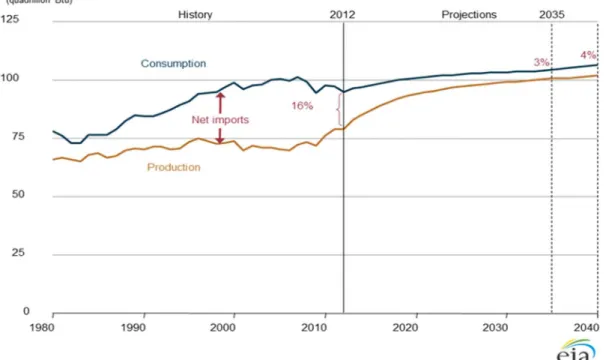
will decline from 16% in 2012 to 3% by 2030. This small amount of product can be imported from more nearby resources, so if this forecast comes true, then the importance of the Arabian Gulf will diminish tremendously for the United States.80Please see figure 1 from the Energy
Information Administration that showed the forecast of EIA of US energy imports in the future.
25
Figure 1. EIA’s forecast of U.S. energy imports
Source: Energy Information Administration.81
This huge surge in production has renewed the old, sweet dream of politicians and energy decision makers that the United States will be energy independent soon82 so that it no
longer needs to be concerned about its supply of oil from unstable regions like the Middle East.
Tom Donilon, the US national security advisor, said, “the shale gas/tight oil or simply shale revolution has done more than boost economic activity and create jobs at home: it has increased government revenue, improved the country’s trade balance, and reduced US
26
dependence on energy imports from politically unstable regions, thus also widening its room for diplomatic maneuver.”83
1.2.4 Pivot to Asia
The Asia-Pacific region is home to 4.3 billion persons, which is about 60% of the human population on Earth. According to the World Bank, in 2013, Southeast Asia, the Indian subcontinent, Oceania, and the Pacific Rim produced a total Gross Domestic Product (GDP) at purchasing power parity of $38.8 trillion.84The developing economies of East Asia
saw a growth rate of 6.9% in 2014.85 Therefore, the area is a large and important market for
US interests. For example, the Trans-Pacific Partnership (TPP), which is a trade agreement between some Asian and Pacific countries and the United States, generated a GDP of $11.9 trillion in 2012 among non-US TPP partners, and these countries have a population of about 478 million, which is larger than the US population.86
Since former Secretary of State Ms. Hillary Clinton’s famous article “America’s Pacific Century” was published in Foreign Policy, the concept of a pivot to Asia has become quite common in the discussions of political elites in the United States and the rest of the world.87 Ms. Clinton stated, “Asia-Pacific has become a key driver of global politics, [and] it
boasts almost half of the world’s population. It includes many of the key engines of the global economy.”88 A simple definition of the pivot to Asia has been described by M. Schiavenza in The Atlantic: “The pivot is meant to be a strategic rebalancing of US interests from Europe
27
future of politics will be decided in Asia, not Afghanistan or Iraq, and the United States will be right at the center of the action.”90
No doubt the pivot to Asia is an important factor that reduces the significance of the Arabian Gulf to the United States, both by itself and as related to the shale revolution, which gives US the chance to look for their interests elsewhere, in this case in East Asia.
28
Chapter 2: The Importance of the Region in Security Dimension
2.1 Energy Security and International Trading
Three of the world’s top ten producers of oil are located on the Arabian Peninsula: Saudi Arabia (ranked first), the United Arab Emirates (UAE; seventh), and Kuwait (ninth). According to reserves data from the US Energy Information Agency (EIA) and country rankings from the Central Intelligence Agency, as of May 2013, Saudi Arabia had the largest proven oil reserves of any country in the world, with 267.91 billion barrels, or 18.17% of the world’s total. Kuwait (104 billion barrels) and the UAE (97.8 billion barrels) followed with the sixth- and seventh-largest proven reserves, comprising 7.05% and 6.63% of the world’s total, respectively. Iran has 154.58 billion (10.48%), and Iraq has 141.35 billion (9.59%).The region also has key natural gas producers, namely Qatar and Saudi Arabia. The British Petroleum (BP) Statistical Review of Energy for 2012 estimated that the Gulf Cooperation Council (GCC) states hold 20.4% of the world’s gas reserves, compared with 15.9% for Iran and 1.7% for Iraq. Some estimate that the GCC also has 17% of the world’s conventional gas reserves. Qatar and Saudi Arabia have the world’s third- and fourth-largest gas reserves, with about 12–13% and 3.94% of the world’s total, respectively. Saudi Arabia also has extensive mineral resources.91
The Gulf is located in the center of the old world, and it connects the three continents of Asia, Africa, and Europe. Roughly 35% of all oil is transported via ocean, and 20% of all internationally traded oil passes through the Strait of Hormuz, some 17 million barrels daily. According to the EIA, the Strait of Hormuz is by far the world’s most important chokepoint
29
for oil trade.92In addition, 3.8 million barrels of oil pass through the Bab-el-Mandeb Strait per
day.93More than 20,000 ships pass through every year, and just the goods going to and
coming from Europe were estimated to be worth $952 billion in 2009.94The trade that passes
through the Suez Canal represents 11% of global sea trade flow.95
2.2 The Importance of the Sunni-Shiite Relations and Five Issues of the Rivalry
Islam is the second most common religion in the world, and accounts show that 1.6 billion persons are following its rules; 90% of them are Sunni, and the rest are Shiite.96Sunnis
and Shias exist in almost all countries in the world, either as citizens or immigrants. Therefore, any rift or rise in tension between Sunnis and Shias will affect global peace and stability.97 In the modern era, the Sunni–Shia disparity is shaped by the Saudi–Iranian rivalry.
As the sovereign power over Mecca and Medina, the Kingdom of Saudi Arabia claims special status as a protector of Islam. But Shiite Iran is competing with it for leadership of the Muslim world.
Iranian–Saudi relations involve a mixture of politics and religion, especially following the Iranian/Islamic Revolution with its extreme religious identity (Shia Ithna).98 There are five
30
related to competition for leadership in the Muslim world. The third issue is the relationship with the West, particularly with the United States, while the fourth is the oil within
Organization of the Petroleum Exporting Countries (OPEC), by which I mean the policies on pricing and production quantities.The fifth is the Iranian nuclear program. In fact, the last issue is linked to the nature of developments related to the previous three issues, and usually if there is tension between the two countries on any issue, it will quickly cast a shadow on the file of oil and the first point.99
2.2.1 Sectarian Religion
There have been a range of developments, such as war between Iran and Iraq; the situation of Shias in the region, beginning with Lebanon and Iran’s support for Hezbollah; the religious and political intervention in Iraq after 2003; and the Iranian role in the development movements in Bahrain and Syria in the context of the Arab Spring. Historically, the sectarian tension has its roots dating back to the criticism exchanged between Shias and the Wahhabi movement, which is not far from the political differences between the two countries in the competition to lead the Muslim world.100The leading of Islamic world is important because of
its political, economic and influential benefits, the modern tension between Sunnis and Shias is reminiscent of a similar story of the competition between the Safavids and the Ottoman Empire.101 The Safavids forced the people in Persia to convert to Shiism to ensure their
loyalty, and they raised a sectarian dimension against the Ottoman Empire. Iran is doing the same; therefore, we can understand the Sunni–Shia tension as a political tool rather than a cause for competition. The evidence is that, throughout most eras of Islam, Shias and Sunnis
31
have lived together in peace unless politicians have made it otherwise.102 Even in the same
family, there can be both Sunni and Shia brothers. A good example of how Iran cares about political interests more than ideology is the cooperation between Al-Qaeda and Iran against the United States and Saudi Arabia despite their differences in ideology.103 Sectarian tension
also diminished significantly during Khatami’s era because politicians willed it so.104
2.2.2 Muslim World Leadership
The second issue of the competition to lead the Islamic world is a contest of almost pure political interest; each party desires to be the leader because it will benefit politically, economically, and culturally. Saudi Arabia has the two most holy mosques; therefore, it is the most religious among the Islamic countries.105 Although Iran heavily advertises Qom City as
a holy city for Shiism,106 the two most holy Shia sites—Karbala and Najaf—are located in
Iraq, not in Iran.107 This may partially explain the Iranian keenness to intervene in Iraq to gain
more influence over the original holy cities for Shias.108
2.2.3 Relations with the West
As previously mentioned, relations with the West are one of the major issues of competition between Saudi Arabia and Iran, as Iran desires to be recognized as a power in the Middle East by the great powers. It lost the position it held during the shah’s era after the 1979 Revolution and the unacceptable behavior of the Iranian government, such as the
32
in the Gulf.109 Iran felt it was obvious that the international community supported the GCC,
especially Saudi Arabia, to be the power in the region.
2.2.4 The Competition in OPEC
The fourth point is OPEC leadership and the policies regarding oil price and quantity. Saudi Arabia is the leader of OPEC, the most influential member, and the biggest producer; therefore, there is another issue of competition in the organization.110 Saudi Arabia tends to
adopt moderate policies that serve oil producers and consumers,111 whereas Iran has a
hawkish view and is looking for high prices because its production is small compared to Saudi Arabia’s.112 Saudi Arabia produces nine to ten million barrels per day, whereas Iran produces
about three million;113 therefore, any drop in prices will affect the Iranian budget, and Iran
needs currently to raise prices to about $130 a barrel to balance its budget.114
2.2.5 Iran’s Nuclear Program
The fifth issue is the nuclear file, which is very important for all parties in the region and internationally. Saudi Arabia believes that Iran is seeking nuclear weapons with the belief that this approach will provide invulnerability and the privilege of augmenting its leverage in the global political system.115 In addition, some states, such as Iran, do not have the ability to
compete through the conventional power race.
Nuclear deterrence is different from the conventional military race because in the nuclear race the price any country will pay if it tries to attack a competitor that also has
33
nuclear arms is higher than any state can tolerate; therefore, the balance line is fixed. In a conventional power race, the line is relative and not absolute; it moves according to changes in the power abilities of the states.116 Hence, even limited nuclear military power would
provide a state with deterrence against big nuclear powers and nonnuclear powers.117 The
Gulf States are worried about the possibility that Iran will possess nuclear arms, which will give Iran more influence in the region and decrease the ability of the international powers to contain the Iranian threat to the Saudi Arabia.118 Therefore, the most important principles for
Saudis regarding the P5+1 to meet their expectations and to be satisfactory are that the system of surveillance on the Iranian nuclear program should be very restrictive, without any gap that would give Iran the capability to produce nuclear bombs, and that there should not be
concessions at the expense of the interest of the Gulf states.119 Although the GCC, mainly
Saudi Arabia has made it clear that the states of the region have the right to utilize nuclear power but for peaceful purposes only.120 Finally, the frozen Iranian assets that will be relieved
(more than $100 billion) should not be used to destabilize the region.121
The Iranian nuclear program as I mentioned is not only regional concern but it is an important international issue, which is why all the world powers (including the United States, the United Kingdom, France, China, and Russia) plus Germany are deeply involved in this issue. They made the group called P5+1 to negotiate with Iran to ensure the peaceful purposes of its program and to prevent Iran from getting nuclear weapons.122The agreement between
34
detailed conditions that restrict Iran from getting nuclear weapons. The summary of the agreements indicates several conditions, including the following:
(a) Iran must reduce its enriched uranium from 10,000 kg to 300 kg, and future Iranian uranium enrichment will be restricted to only 3.67% for fifteen years, which is enough to serve medical and electrical purposes.
(b) More than two-thirds of Iranian centrifuge machines must be stored, and Iran is allowed to use only 5,060 centrifuges out of the 19,000 it has now. In addition, only IR-1 centrifuges can be used and only in one place, the Natanz plant. This condition will continue for ten years.
(c) Iran must modify the Arak heavy water reactor to make it unable to produce platinum, which could be used for nuclear weapons. Also, Iran is prohibited from building any new heavy water plants for fifteen years. It must also implement an additional protocol agreement, which will continue in perpetuity for as long as Iran remains a party to the Nuclear Nonproliferation Treaty (NPT).
(d) Iran must sign the additional protocol of the International Atomic Energy Agency (IAEA) and must stay a member of the NPT.
(e) The IAEA will have comprehensive surveillance of Iranian nuclear facilities and activities.
(f) Iran must stop uranium enrichment in Fordow for fifteen years. In return, Iran will gain the following:
(g) UN and European sanctions related to Iran nuclear activities will be relieved as soon as the IAEA gives the green light for the agreement’s
implementation. US sanctions related to Iran’s nuclear program will also be relieved. It is estimated that more than $100 billion will be made available to Iran from its
35
frozen assets. Weapons sales sanctions will be relieved after five years, while the missiles sanctions will terminate after eight years.123
If we wish to discuss the Iranian nuclear program we should review the history of Iranian program but I wrote the section retrospectively, due to the importance of recent developments of the Iranian nuclear program and the agreement between P5+1 and Iran The Iranian nuclear program began in the 1950s; Iranian nuclear activities started on a small scale until the country received help from the United States, which in 1967 supplied Iran with a small 5MWt research reactor that used highly enriched uranium. The shah of Iran had big ambitions for nuclear power and was planning to have 23 Gigawatt electricity (GWE) by the 2000s; therefore, he formed a new organization to handle Iranian nuclear activities, called the Atomic Energy Organization of Iran. However, the Iranian Revolution, the isolation of Iran from the international community, and the Iraq–Iran War caused the nuclear program to slow down significantly. In the 1990s, the nuclear momentum was again accelerated by the Iranian regime, especially because it had more resources to spend after the end of the Iraq–Iran War. Iran sought help from Pakistan and China, and they signed cooperation agreements in 1987 and 1990, respectively. Russia also entered online and built the Bushire reactor.124
International suspicion about the nature of the Iranian nuclear program forced Iran to negotiate with the EU-3 (UK, France, and Germany) before referral to the UN Security Council. Iran agreed in 2003 to cooperate with the IAEA and to sign an additional protocol, but Iran continued to produce and use centrifuges to enrich uranium. Despite the Paris Agreement in 2004 and the promises to temporarily suspend sensitive nuclear activities, Iran continued to stock enriched uranium and centrifuges; therefore, it was placed under many
36
sanctions for its nuclear activities by the UN, the United States, and the European Union until Iran and the international community reached an agreement in 2015.125
2.3 The War on Terror and Iran’s Relation to Terrorist Organizations
The region contains the bases of many terrorist organizations that are threatening world security and peace, such as Al-Qaeda in the Arabian Peninsula; the Houthis group in Yemen; Daesh in Iraq and Syria; and Hezbollah in Syria, Iraq, and Yemen. Therefore, the stability of the region is an important factor in the war on terror.126
The relationship between Iran and terrorist organizations has a long, documented history and includes groups such as Hezbollah and Palestinian militant groups. It also includes Hamas and the Palestinian Islamic Jihad (PIJ), both of which are proud of their ties to Iran. For instance, Hezbollah leader Hassan Nasrallah considers himself a soldier of the Wilayat al Faqih (supreme leader of Iran).127
Iran is considered by many high-ranking officials in the US administration to be one of the biggest sponsors of terrorism in the world, mainly against US interests, and the evidence is “overwhelming,” as described by Michael McConnell, the director of US national
intelligence. Iran has even been labelled as a “central bank” of terrorism because of its activities in Iraq and Afghanistan.128
The cooperation between Iran and Al-Qaeda may look odd at first glance because of their different ideologies (extreme Shiism versus extreme Sunnism), but they worked out a way to put their differences aside, at least temporarily, to collaborate against the United
37
States, using the proverb, “The enemy of my enemy is my friend.” About 20 members of Osama bin Laden’s family lived in Iran, and high-ranking Al-Qaeda members moved freely through Iran with the knowledge of Iran’s authorities after US invasion of Afghanistan.129In
fact, Al-Qaeda in Iraq after the US’s invasion received huge support from the Iranian Ministry of Intelligence and Security (MOIS) for attacking US and Iraqi targets, according to the US Department of the Treasury.130
The report of the US Department of State on terrorism in 2010 mentioned clearly that “Iran remained the most active state sponsor of terrorism. Iran’s financial, material, and logistic support for terrorist and militant groups throughout the Middle East and Central Asia had a direct impact on international efforts to promote peace, threatened economic stability in the Gulf, and undermined the growth and democracy.”131
To discuss the long history of the relations between Iranian regime and terrorist activities we should go back to the era of eighties, which is after 1979 revolution, Iran had a prominent role in establishing Hezbollah in the 1980s, and the majority of the organization’s budget and weapons were provided by Iran. In return, Iran was given full control of
Hezbollah’s political and military decisions.132
Iran has been linked to many terrorist attacks since the 1980s. Famously, a US Marines compound in Lebanon was attacked, which caused the death of 243 US Marines, making it the largest terrorist attack in the history of the United States in the twentieth century. In addition, French facilities in Lebanon were attacked, which resulted in 58 deaths. The United States accused Iran and Hezbollah of these attacks despite the fact that other
38
terrorist groups claimed responsibility.133 Still, an Iranian official admitted that Iran helped
the terrorist group, and Revolutionary Guard Commander Mohsen Rafiqdoust said, “Of course we helped. We don’t know if our equipment was used in this operation. A foreign Army occupied Lebanon. So it was right to hit back with martyrs.”134
On April 18, 1983, in Lebanon, an attack by a car loaded with explosives in front of the US Embassy in Beirut killed 36 US Embassy employees. On October 23 of the same year, another huge attack on Marine facilities killed 241 and wounded 81.135 On December 12 of
the same year, in Kuwait, al-Dawa Shia terrorists who had connections with Iran initiated a suicidal bombing attack against the United States, the French Embassy, US Raytheon employees, and the international airport; they also tried to assassinate Prince Jaber Al-Sabah (the prince of Kuwait), causing six deaths and wounding 80. The man behind these attacks was Imad Mughniyah, a high-ranking operative in Hezbollah.136
Hezbollah has a long history of hijacking airplanes, such as Kuwaiti Airlines Flight 221, onboard which two Americans were killed. Also, Hezbollah hijacked TWA Flight 847 and killed one American onboard. Hezbollah practices all types of terrorist attacks, and it is well known for hostage kidnappings, specifically during the period of the 1980s, when it started kidnapping Westerners, some of whom died under torture.137
Not only US and western governments were complaining of Iranian terrorist activities but Saudi Arabia has accused Iran of supporting terrorism in the Middle East, such as the
Al-39
Khobar Towers bombing, which caused high casualties among Americans in Saudi Arabia.138
Also, Iran has been accused of creating camps in Lebanese and Iranian lands to train terrorists to wage deadly attacks in Bahrain and the eastern provinces of Saudi Arabia.139In addition,
there is a public connection between the Iranian regime and the Houthi group in Yemen, which attacked Saudi Arabia’s southern border in 2009. Then, in 2015, Houthi toppled the legitimate government and seized power in Yemen, which led to the start of the military operation Decisive Storm, mainly by Saudi Arabia and the UAE, to reinstate the legitimate president and government.140Iran has even helped Al-Qaeda members logistically, as Saif
al-Adel (a senior Al-Qaeda operative) was working freely from his Iranian base to arrange terrorist attacks on Saudi Arabia in 2003.141