Report of Trolling Fishing Practice
(T/V Tenyo-Maru’s 242nd voyage) in Japan Sea.
Masahiko Mohri
1†, Hideaki Tanoue
1, Takumi Okawa
2, Kazuhiro Hata
3,
Yukio Okita
3, Hiroshi Goto
3, Masaki Kokatsu
3, Youhei Sugawara
3,
Kenichi Sakai
1, Toshie Wakabayashi
1, Shinya Shimokawa
1Abstract: The trolling fishing operations were carried out off Yamaguchi Prefecture of Japan Sea using our
training vessel Tenyo-Maru in September 11 to 14, 2016. The results were as follows: i) A total of 17 common dolphins, Coryphaena hippurus, were caught. Their total length ranged from 51cm to 95cm, and their weight, from 1.1kg to 4.5kg. Of the common dolphins caught, ten were females, six, males and one, of an unknown sex, which means that females had a larger number and accounted for a little less than two-thirds. As for the content of the stomach, 12 individuals or a little larger than two-thirds had no content, and four took food. The content of the stomach included squid, Japanese anchovy, whitebait and some unknown small fish. ii) According to vertical sections of the water temperature and salinity obtained by our ocean observation with a CTD, the water temperature was ≧ 25℃ in the layers about 30m deep or less in all of the sea areas surveyed. The layers where the water temperature was ≧20℃ were distributed in the depth of about 30m or less in the north and became deeper in the coastal waters in the south, where the layers were equal to or more than about 50m in depth. Salinity was 32psu in all of the sea areas studied in the layers shallower than about 10m. The layers where the salt content was ≧33psu were deeper in the north and found in about 30m deep a nd grew shallower in the sea off the southern coasts, about a depth ≧10m. Common dolphins are distributed higher than about 25℃ .
Key word: Fisheries, Fishery management, Fishery resources, Fisheries oceanography, Trolling fishing
Introduction
The Department of Fishery Science and Technology (including the Navigation and Fishing Course) of National Fisheries University provides practical training in trawling and tuna long-line fishery on a training vessel for the purpose of helping students learn the basics of “fishing work” and the “survey of marine resources.” But in the practical training on the University’s training vessel in Japanese waters, no sufficient practical training is given for adult fish while training in fishing fry by trawling and the survey of pelagic fish resources using ring nets are carried out mainly in the waters off Yamaguchi Prefecture. Moreover, practical training using the two fishing methods stated above, i.e., trawling
and tuna long-line fishery, not only requires hard labor for the fishing work, including preparations and clearing up after the training, but may also cause unexpected accidents, such as injuries to the participants. In order to reduce this labor and the risk of these accidents and secure safety in fishing training, there is the need to adopt the fishing methods other than trawling and tuna long-line fishery that are applicable to the training courses.
Trolling can be mentioned as a fishing method that can fish adult fish and has a high degree of safety. Trolling is one of angling methods and is mainly used on small-sized fishing boats that are operated in coastal waters. Kaneda 1) and Nomura2) defines “trolling fishing” as the “angling fishery where fishing boats use fishing gears equipped
1 Department of Fisheries Science of technology, National Fisheries University
2 Under graduate student, Department of Fisheries Science of technology, National Fisheries University 3 Tenyo-Maru, National Fisheries University
with fishing lines and hooks.”
In trolling, an artificial bait is generally put on the hook at the lowest point of the fishing gear. While the artificial bait is sank in the sea, a diving board or an airplane-type artificial bait (hereinafter referred collectively as “diving board”) is mounted on the top of the hook in order to cause the fish to be caught to recognize the artificial bait as a fresh one. Inada3) stated that the roles that a diving board is expected to play are (1) to sink the hook to the area where the fish in question can attack most easily; (2) to attract the fish by the motions and sounds generated by vibration; and (3) To create the movement of the artificial and fresh bait in such a way to prompt the subject fish’s feeding behavior by the motion of the diving board and the whirlpools back the board.
The effective work of the diving board is an important element affecting the success in fishing in trolling. Therefore, trolling is carried out almost always in the surface and middle layers of the sea where the water resistance is not excessively strong except the case where such bottom fish as bastard halibut and flatfish is caught in shallow waters as in the case of Yamaguchi Prefecture4).
The species caught by trolling range widely, including small tuna, marlin, skipjack, spanish mackerel, sea bream, yellowtail, amberjack, hairtail, common dolphin, mackerels, frigate mackerel and common sea bass. Because of this, if the survey area is determined and trolling is carried out in the area, it is possible to identify the species of the marine life that can be caught in the surface and middle layers of the sea covered by the study.
Thus in this study, we adopted the trolling method considering the safety of our practical fishing training first of all and carried out the fishing operation in the west part of Japan Sea using our training vessel Tenyo-Maru. We selected the sea off Yamaguchi Prefecture as the area for our fishing practice where we had already used our training vessel to collect fry by trawling and larval fish with ring nets and aimed at identifying the fish species that could be caught in the surface and middle layers by utilizing the characteristics of trolling.
Materials and methods
Fig.1 shows the location of trolling fishing area A and B. The period of the study was September 11 to 14, 2016, and the area surveyed was the sea off Hagi, Yamaguchi Prefecture, located in the west of Japan Sea, where we did practical fishing training by trolling.
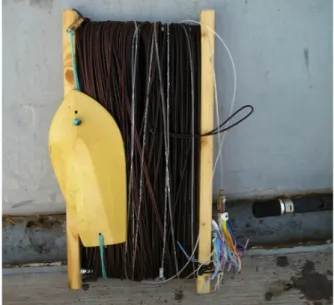
Fig.2 and 3 are the photos of the trolling gear used for this study, respectively. The gear shown in Fig. 2 was made by using a diving board and mounting a kite-type artificial bait on the board. The gear in Fig. 3 was made by attaching an airplane-type artificial bait, which was different from the artificial bait for the gear in Fig. 2. The operations were carried out from 06:00 to 18:00 of the day when it was suitable to catch common dolphin individuals by sailing the training vessel at 4-5 knots and hauling 4 trolling lines in total from the stern.
A
B
Fig. 1. Location of research area.
A and B show trolling gear.
Fig. 1. Location of research area.
Results
Fig.4 and 5 show the wakes of the training vessel that carried out the operation by trolling, respectively. We observed the three elements, i.e., the schools of fish, the flocks of birds and the activities of the fishing boats around the training vessel, by visual inspection, and when we considered that we could get a good catch, we sailed the training vessel in the direction where it was possible to confirm that we would gain the three elements in an effort to achieve a better result. This is why the wakes had many turns. We found the three elements most often for the flocks of birds (19 times),
followed by 12 times for the schools of fish and seven times for fishing boats (Fig. 6).
Table 1 and 2 show the outcome of the catches by
Fig. 3. Trolling gear (Airplane type)
1 Fig. 3. Trolling gear (Airplane type)
Fig. 2. Trolling gear (Diving board type)
1 Fig. 2. Trolling gear (Diving board type)
Fig. 4. Trajectory of trolling gear operation (A)Fig. 4. Trajectory of trolling gear operation (A) A Caught: 3 Attacked: 1 9/11(PM)15:29‐18:30 9/12(AM)5:59‐9:30 Non operation
Fig. 5. Trajectory of trolling gear operation (B)
B Caught: 14 Attacked: 17 Fig. 5. Trajectory of trolling gear operation (B) 9/12(PM) 14:52‐18:00 9/13(AM) 6:15‐9:30 9/13(PM) 15:00‐17:44 9/14(AM) 6:00‐8:29 Non operation ●: Tuna △: Fishing boat ○: Fish school □: Birds Fig.6. Result of visual observation A B ●:0 △:4 ○:2 □:8 ●:0 △:3 ○:1 □:8 ●
trolling. A total of 17 individuals were caught, and these individuals were all common dolphins (Coryphaena
hippurus). Their total length ranged from 51cm to 95cm,
and their weight, from 1.1kg to 4.5kg. Of the common dolphins caught, ten were females, six, males and one, of an unknown sex, which means that females had a larger number and accounted for a little less than two-thirds. As for the content of the stomach, 12 individuals or a little larger than two-thirds had no content, and four took food. The content of the stomach included squid, Japanese anchovy, whitebait and some unknown small fish.
Fig. 7 shows the north-south vertical section of the water
temperature and salinity obtained by our ocean observation with a CTD. According to this figure, the water temperature was ≧ 25℃ in the layers about 30m deep or less in all of the sea areas surveyed. The layers where the water temperature was ≧20℃ were distributed in the depth of about 30m or less in the north and became deeper in the coastal waters in the south, where the layers were equal to or more than about 50m in depth. Salinity was 32psu in all of the sea areas studied in the layers shallower than about 10m. The layers where the salinity was ≧33psu were deeper in the north and found in about 30m deep and grew shallower in the sea off the southern coasts, about a depth ≧10m.
Table. 1 List of fish caught in the area (A)
Attacked (○) /Caught (◎)
Fishes caught/
Attacked Gear type Sex Weight (kg) Total length (cm) Stomach contents Day Latitude Longitude Temperature (℃) Bottom depth (m) ° ′ ° ′
◎ Common dolphinfish Diving board (L) ♀ 1.1 56 Empty 9/11 18:13 35 0.17 N 131 2.5456 E 26.3 102.7
○ unknown 9/12 7:58 34 54.22 N 131 4.9724 E 25.9 84.6
◎ Common dolphinfish Air plane ♂ 1.4 59 Empty 9/12 8:48 34 52.33 N 131 5.2261 E 25.9 90.0 ◎ Common dolphinfish Air plane ♀ 4.5 95 Squid (large) 9/12 9:32 34 51.46 N 131 4.5757 E 25.7 100.7
Table. 1 List of fish caught in the area (A)
Table. 2 List of fish caught in the area (B)
Attacked (○)
/Caught (◎) Fishes caught/ Attacked Gear type Sex Weight (kg) Total length (cm) Stomach contents Day Latitude Longitude Temperature (℃) Bottom depth (m) ° ′ ° ′
◎ Common dolphinfish Air plane ♂ 1.5 55 Empty 9/12 14:55 35 13.66 N 131 11.0564 E 24.9 128.7
○ unknown Diving board (L) 9/12 14:58 35 13.61 N 131 10.7518 E 24.9 128.4
○ Common dolphinfish Air plane 9/12 15:38 35 14.25 N 131 11.9516 E 24.9 129.1
◎ Common dolphinfish Diving board (L) ♂ 1.3 56 Empty 9/12 15:57 35 15.86 N 131 12.3141 E 24.7 121.1
○ unknown Air plane 9/12 16:02 35 16.29 N 131 12.3947 E 24.7 117.6
○ Common dolphinfish Air plane 9/12 16:32 35 15.56 N 131 13.0384 E 24.7 120.6
◎ Common dolphinfish Diving board (L) ♀ 1.4 60 Empty 9/12 16:32 35 15.58 N 131 13.0529 E 24.7 120.4 ◎ Common dolphinfish Diving board (L) ? 1.2 51 unknown 9/12 16:35 35 15.83 N 131 13.0287 E 24.7 118.1
○ Common dolphinfish Air plane 9/12 16:36 35 15.93 N 131 13.0244 E 24.7 115.9
◎ Common dolphinfish Air plane ♀ 1.3 58 Squid(small),
Small fish 9/12 17:35 35 16.11 N 131 13.3178 E 24.7 113.0
○ Common dolphinfish Air plane 9/12 17:53 35 16.11 N 131 13.6016 E 24.7 111.8
◎ Common dolphinfish Air plane ♀ 1.6 66.5 Empty 9/13 6:43 35 21.99 N 131 14.7184 E 24.5 112.6
○ unknown Air plane 9/13 7:34 35 17.42 N 131 14.5255 E 24.4 103.9
◎ Common dolphinfish Air plane ♀ 1.3 63.5 Empty 9/13 7:44 35 16.91 N 131 14.2084 E 24.5 104.2
○ Common dolphinfish Air plane 9/13 7:51 35 17.32 N 131 14.1638 E 24.4 105.5
○ unknown Air plane 9/13 7:54 35 17.54 N 131 14.2224 E 24.4 106.1
○ unknown Air plane 9/13 7:57 35 17.73 N 131 14.2668 E 24.4 107.1
○ Common dolphinfish Air plane 9/13 8:33 35 16.11 N 131 14.599 E 24.5 107.4
◎ Common dolphinfish Air plane ♂ 1.5 61 Empty 9/13 8:37 35 16.34 N 131 14.5607 E 24.5 104.7
○ Common dolphinfish Air plane 9/13 8:45 35 16.83 N 131 14.463 E 24.4 104.5
◎ Common dolphinfish Air plane ♀ 1.5 61 Empty 9/13 9:07 35 17.31 N 131 14.8432 E 24.4 101.9
○ unknown Diving board (L) 9/13 15:06 35 14.02 N 131 12.6666 E 24.7 130.2
○ unknown Diving board (L) 9/13 15:16 35 14.90 N 131 13.2137 E 24.7 128.7
◎ Common dolphinfish Air plane ♂ 1.3 59 Small fish 9/13 16:04 35 19.27 N 131 14.8884 E 24.7 108.1 ◎ Common dolphinfish Air plane ♂ 1.8 64 Empty 9/13 16:43 35 17.58 N 131 15.5631 E 24.8 94.1 ○ Common dolphinfish Diving board (L) 9/13 16:53 35 18.17 N 131 14.6931 E 24.7 94.9 ◎ Common dolphinfish Diving board (L) ♀ 1.8 56 Empty 9/13 17:01 35 18.09 N 131 13.67 E 24.8 111.6
○ unknown Air plane 9/13 17:17 35 17.46 N 131 12.2773 E 24.8 120.0
◎ Common dolphinfish Air plane ♀ 1.5 63 Empty 9/13 17:31 35 17.45 N 131 13.3935 E 24.7 110.5
○ unknown Air plane 9/14 6:32 35 17.89 N 131 15.0686 E 24.5 98.4
◎ Common dolphinfish Air plane ♀ 1.3 59 Small fish 9/14 8:30 35 21.55 N 131 10.6913 E 24.5 109.6
Discussion
As stated in the result section above, we caught common dolphin only in the sea areas where we did this study by trolling. The past study conducted in Furukawa5) shows that the relation between the age and fork length of common dolphin is 38cm for one-year old fish, 68cm for two-year old one, 90cm for three-year old one, 108cm for four-year old one and 122cm for five-year old one, and it is reported that this species grows to 175cm at most. If we check Table 1 considering this, we can consider that the individuals caught in this study were almost all those one-year old ones approaching two-year old except the longest one 95cm long supposed to be a three-year old one.
The report in Kochi Prefecture (unpublished) also states that it is supposed that common dolphin attains maturity when its fork length has exceeded 60cm. This means that the individuals we were able to catch in our study included adult fish, too, which was the target of our research.
We studied tuna as an example of the fish species other than common dolphin from the standpoint of trolling. The period when we did the trolling operation was the fishing season of bluefin tuna in the fishing grounds of tuna formed near Mishima Island off Hagi, Yamaguchi Prefecture (e.g. Shiomaki fishing ground). But we were unable to get any information indicating that any fishing ground of bluefin tuna was established.
In this study, we carried out trolling operation, including
(a)
(b)
(c)
Fig. 7. Vertical cross section of water
temperature and salinity by CTD
(a): CTD stations (b): Water temperature
(c): Salinity
(a)
(b)
(c)
Fig. 7. Vertical cross section of water
temperature and salinity by CTD
(a): CTD stations (b): Water temperature
(c): Salinity
Fig. 7. Vertical cross section of water temperature and salinity by CTD
(a): CTD stations (b): Water temperature (c): Salinity
visual inspection, as stated above. In this operation, we found schools of tuna in the waters very close to the coast (in Fukawa Bay in Nagato) soon after we left port but were unable to catch this species by trolling in the sea areas covered by this study.
Studies in the past shows that the main tuna species distributed in Japan Sea (bluefin tuna and long-tailed tuna) need water temperature of 25 ℃ or more for hatching and growing. When we checked Fig. 3 again considering that this study was conducted in the spawning season of tuna in Japan Sea, we found that the layers where the water temperature was ≧20 ℃ were distributed in shallow areas of about 30m in the north and became thicker in the coastal waters in the south (the depth≧approx. 50m).
Therefore, the fact that no tuna was caught by trolling in the sea areas covered by this study may have been as a result of the migration of tuna, in order to spawn, to the sea areas nearer to the coast, looking for the high temperatures suitable for hatching and growing mentioned above. On the other hand, some say that tuna just before spawning do not feed, and so it is also supposed that even though tuna were distributed in the survey sea areas, they were not caught by the trolling method. In the future, there will be the need to conduct surveys similar to this study to examine the situation of the distribution of fish species other than common dolphin, too, in Japan Sea.
Acknowledgement
We thank the officer and crew of the training vessel Tenyo-Maru, Tetsutarou Takikawa, Noriyasu Takikawa, Shun Yokota from National Fisheries University. This work was supported by JSPS KAKENHI Grant Number 15K18739 and Hagi city.
References
1) Kaneda S: Fishig gear of Japan and illustration of fishing method (a revised and enlarged edition), Seizando, Tokyo (1986)
2) Nomura M: A general of the latest fishing technology. Seizando, Tokyo (1990)
3) Inada H: Fishing as the fishery technology. In: Yayoi I (ed) The 19th open lecture in Tokyo Fisheries University-relationship of nature and human ‐ . Seizando, Tokyo, 94–145 (1995)
4) Shigeru G: Fishery of trolling gear in Yamaguchi Prefecture. In: Kyushu and Yamaguchi areas fisheries research section of fishery (ed) Trolling gear sea area of West Japan. Kouseisyakouseikaku, Tokyo, 1–13 (1977)
5) Furukawa M: Age, growth, and reproductive characteristics of dolphinfish Coryphaena hippurus in the waters off west Kyushu, northern East China Sea. Fisheries Science,78,1153–1162 (2012)
日本海における曳縄実習(天鷹丸242次航海)の報告
毛利雅彦
1†・田上英明
1・大川託史
2・秦 一浩
3・起田行央
3・後藤洋史
3・小
勝 正貴
3・菅原陽平
3・酒井健一
1・若林敏江
1・下川伸也
1要 旨
2016年9月11~14日,練習船・天鷹丸により日本海西部 で曳縄漁法を採用し,操業を試みた。その結果は,次の通 りである。i)17個体のシイラ(Coryphaena hippurus)が釣 獲された。同種の全長は51~95cm,体重は1.1~4.5kgの範 囲にわたった。性別は,♀10個体,♂6個体,不明1個体 で,♀の方が多く全体の2/3弱を占めた。胃内容物について, 空が最も多く12個体で全体の2/3強を占め,摂餌をしてい た個体が4個体という結果となった。胃内容物の内訳は, イカ類,カタクチイワシ,シラス,魚種が不明の小魚であっ た。ii)CTDによる海洋観測から得られた水温,塩分の南 北にわたる鉛直断面によると,約30m以浅では全ての海域 で水温≧25℃となった。水温≧20℃の層は,北で浅く30m ほどに分布し南の沿岸に向かうほどこの層が厚くなり深さ ≧約50mとなった。塩分について,約10m以浅では,全て の海域で32psu台となった。塩分≧33psuの層は,北で深 く30mほどに分布し南の沿岸に向かうほどこの層が浅くな り深さ≧10mほどとなった。1 水産大学校海洋生産管理学科(Department of Fisheries Science of technology, National Fisheries University) 2 水産大学校海洋生産管理学科学生
(Under graduate student, Department of Fisheries Science of technology, National Fisheries University) 3 水産大学校練習船天鷹丸(Tenyo-Maru, National Fisheries University)