Fracture mechanism of an aluminium cast alloy locally
reinforced by SiC particles and Al
2O
3whiskers under
monotonic and cyclic load: boundary and whisker
orientation effect.
(一部分が SiC 粒子と Al
2O
3ウィスカーで強化され
た Al 鋳造合金の単調および繰返し荷重下における
破壊機構の評価:境界およびウィスカー方位の効果)
2008 年 3 月
埼玉大学大学院理工学研究科(博士後期課程)
生産科学専攻(主指導教員 荒居 善雄)
RAFIQUZZAMAN MD.
Fracture mechanism of an aluminium cast alloy locally
reinforced by SiC particles and Al
2O
3whiskers under
monotonic and cyclic load: boundary and whisker
orientation effect.
A Dissertation submitted to the Saitama University in partial
fulfillment of the requirements for the degree of Doctor of
Philosophy
In
Production Science
By
Rafiquzzaman MD.
Examining Committee:
Prof. Yoshio ARAI
Prof. Hiroshi KATO
Prof. Kenichiro HORIO
Prof. Kensuke KAGEYAMA
Doctor Course in Production Science
Graduate School of Science and Engineering
Saitama University
Japan
TABLE OF CONTENTS
ABSTRACT ...i
ACONOWLEDGEMENTS ...……….iv
List of Figures ... vii
List of Tables ...xv
List of Symbols ... xvii
Chapter 1 Introduction ...1
1.1 Background...1
1.2
Application of MMCs
...31.3 Concept of locally reinforced material ...5
1.4 Literature review ...8
1.5 Scope and objectives ...14
1.6 Outline of present research ...15
References ...17
Chapter 2: Materials and Experimental Procedures...23
2.1
Materials fabrication
...232.2
Materials preparation
...252.3
Microstructural features
...252.4
Experimental setup and procedures
...30References ...33
Chapter 3: Experimental Results ...34
3.1 Introduction ...34
3.3 Boundary effect on fracture mechanism under cyclic loading ...40
3.4 Whisker orientation effect on monotonic and fatigue strength ...45
3.5 Summery...53
References ...56
Chapter 4 Numerical Study of Fracture Mechanism, Boundary effect
and Whisker Orientaion Effect ...57
4.1 Introduction ...57
4.2 Numerical model ...60
4.3. Prediction of stress distributions and fracture mechanism ...72
4.4. Prediction of whisker orientation effect on strength……….81
4.5 Summary...86 References ...87
Chapter 5 Conclusion...90
5.1 General conclusions...90APPEDIX
AppendixⅠ...93 AppendixⅡ...94 AppendixⅢ...95 AppendixⅣ...98 AppendixⅤ...101 AppendixⅥ...103 Appendix VII………....105 References……….117ABSTRACT
This dissertation presents the research work done for the degree of Doctor of philosophy. The research project is on Fracture mechanism of an aluminium cast alloy locally reinforced by SiC particles and Al2O3 whiskers under monotonic and cyclic load:
boundary and whisker orientation effect.
Metal matrix composites (MMCs) have been widely considered as possible substitute of traditional materials (such as metals, plastics, ceramics etc.) for structural applications because of their high strength and stiffness, low density, high temperature properties and excellent wear resistance. These advantages made this material more and more potential and alternative in the engineering application. However, the high productive cost, poor ductility and low fracture toughness of MMCs are the major barriers for their structural application.
In this dissertation, fracture mechanisms and corresponding stress distributions in an aluminium cast alloy locally reinforced by SiC particles and Al2O3 whiskers, under
monotonic and cyclic load, are investigated experimentally and numerically. The effect of whisker orientation on monotonic and fatigue strength has also been investigated. The material is monotonically and cyclically deformed to failure at room temperature. The fracture origin and the fracture path are investigated on the fracture surfaces. The stress distributions around the boundary between the reinforced part and the unreinforced part are calculated based on an inclusion array model considering the microscopic inhomogeneous effects. A three-dimensional single whisker unit cell model of cylindrical shape whisker in the periodic boundary condition is conducted using finite element method (FEM) to describe the overall behavior of the composite
motivation, proposed concepts, the objectives and the scopes of this research. In this chapter also reviews the past research on the MMC.
In chapter 2, Materials fabrication and its microstructure, the experimental set up and the experimental procedures are discussed. Materials are successfully fabricated by squeeze casting method. The polishing surface observations are treated by optical microscope and the fracture surface observations are treated by the scanning electron microscope (SEM) and energy dispersive X-ray (EDX) analysis.
In chapter 3, the experimental results are discussed, which describes the fracture mechanisms, boundary effect and whisker orientation effect. The fracture origin and fracture path are investigated by SEM on the fracture surfaces. The fracture occurs in the reinforced part under both monotonic and cyclic loads. SEM analysis of the fracture surfaces shows that the fatigue fracture is controlled by the fracture of coarse Al2O3
whiskers. The static fracture (monotonic loading) shows that the fracture mechanism is the combination of reinforcing particle fracture and interfacial debonding between reinforcing ceramics and matrix metal. A significant effect of reinforcement orientation on the monotonic strength and fatigue strength are observed experimentally and numerically. With respect to the stress direction the whisker orientation gives significant difference in strength of this material. SEM analysis shows almost all whiskers are transversely debonded when whisker direction is perpendicular to the stress direction and almost all whiskers are broken when the whisker direction is random to the stress direction.
In chapter 4, a numerical analysis is discussed. The stress distributions around the boundary between reinforced part and unreinforced part are calculated based on an inclusion array model considering the microscopic inhomogeneous effects. A
three-dimensional single whisker unit cell model of cylindrical shape whisker in the periodic boundary condition is conducted using FEM to describe the overall behavior of the composite. The prediction results based on FEM analysis are found to be in reasonable agreement with the experimental observations.
ACKNOWLEDGEMENTS
All the credits, for which the dissertation put forward for submission, are due to my supervisor Prof. Yoshio ARAI. I, therefore, sincerely express my cordial sense of gratitude to him for his cooperative and constructive suggestions throughout the period of this research work. His intelligent supervision with continuous and overflowing enthusiasm, unrelenting efforts, great patience and invaluable inputs helped me to put the research ideas in the form that this dissertation presents. His insightful meticulous and persistent supervision helps me complete the work successfully.
I would like to express my sincere thanks and gratitude to Prof. Eiichiro TSUCHIDA, the emeritus professor of Saitama University, Japan for his valuable suggestion, constructive criticism and continuous encouragement throughout the period of this research work.
It is certainly a great pleasure for me as well to express my profound gratitude to my dissertation committee members, Prof. Hiroshi KATO, Prof. Kenichiro HORIO and Prof. Kensuke KAGEYAMA for graciously agreeing to review this dissertation, and their helpful comments.
My special appreciation is extended to Mr. Tatsuo Tamagawa and Mr. Toyomi Uchiyama and for their help during the study. Sincere thanks to all the members of strength of materials laboratory, with whom I spent a colorful life in Japan.
Education, Science, Sports and Culture, Government of Japan.
Finally, the patience, adoration, sympathy and empathy extend to me by my family members including my parents, my beloved wife Monima Alam and beloved brother MD. Shafiquzzaman were also a source of inspiration for completing the dissertation in final form.
Dedicated to
Late MD. MOZAMMEL HAQUE
&
MS. NURJAHAN BEGUM
List of Figures
No. Captions
Page
Fig.1.1 Brake disc structure. 6
Fig.1.2 Example illustration of application of locally reinforced material.
7
Fig. 2.1 Squeeze casting method. 24
Fig. 2.2 Specimen cut out from a disc (unit: mm). 26 Fig. 2.3 Optical micrograph of the composite on the tensile side
face, representing the SiC particle and Al2O3 whisker
distribution and Al2O3 whisker orientation angle: (a) and
(b) Locally reinforced material (α =90o) and (c) Homogeneous MMC (α =0o ~90o) (d) Definition of whisker orientation angleα .
27
Fig. 2.4 Optical micrograph of the composite on the tensile side face, representing the coarse Al2O3 whiskers which were
formed during the materials fabrication.
28
Fig. 2.5 Measurement of inter particle/whisker distance with respect to the boundary between reinforced and unreinforced part.
28
Fig. 2.6 Inter particle/whisker distance with respect to the boundary (a) particle to particle (b) whisker to whisker (c) particle to whisker.
29
Fig. 2.7 Experimental setup. 31
Fig. 3.1 Nominal bending stress versus deflection curves under monotonic loading of locally reinforced material(α =90o).
36
Fig. 3.2 Matching surface view of fractured specimen )
90
(α = o under monotonic loading, σf =272 MPa.
38
Fig.3.3 Matching surface view of fractured specimen )
90
(α = o under monotonic loading, σf =318 MPa.
38
Fig 3.4 Matching fracture surface of locally reinforced material(α =90o) under monotonic loading, σf =272
MPa.
39
Fig.3.5 Stress versus fatigue life behavior locally reinforced material )(α =90o (stress ratio, R =0.1).
42
Fig. 3.6 Matching surface view of fatigue fractured specimen under cyclic loading, maximum stress σmax =156 MPa,
5 10 73 . 5 × = f N . 43
Fig. 3.7 Matching fracture surface after fatigue fracture, maximum stressσmax =156 MPa, Nf =5.73×10⁵.
43
Fig. 3.8 Matching surface view of fatigue fractured specimen under cyclic loading, maximum stress σmax =156 MPa,
716 =
f
N .
44
Fig.3.9 Matching fracture surface after fatigue fracture, maximum stressσmax =156 MPa, Nf =716.
Fig. 3.10 Nominal bending stress versus deflection curves under monotonic loading.
47
Fig. 3.11 Stress versus fatigue life behavior (stress ratio, R=0.1), the plots on Nf =0 show average strength under monotonic load.
48
Fig. 3.12 Comparison of two types of fracture surface (a) locally reinforced material (α =90o)[CTP5] (b) Homogeneous MMC )(α =0o ~90o [HCTP4], under cyclic loading condition (Observed locations are near the tensile side).
50
Fig. 3.13 Comparison of two types of fracture surface (a) locally reinforced material (α =90o) [TP1] (b) Homogeneous MMC )(α =0o ~90o [HTP1]; under monotonic loading condition (Observed locations are near the tensile side).
50
Fig. 3.14 Matching fatigue fracture surface of homogeneous MMC )
90 ~ 0
(α = o o after fatigue fracture σmax =191MPa, N f
= 4 10 67 . 6 × . 53
Fig. 4.1 Global model of homogeneous materials joint (a) model illustration (b) finite-element mesh.
62
Fig. 4.2 Infinite periodic unit cell model.
63
Fig. 4.3 Inclusion array model (a) model illustration (b) finite-element mesh.
64
Fig. 4.4 Illustration of loading and unloading process during fatigue analysis.
65
Fig. 4.5 Fig.4.5 3-D single whisker model representing the whisker reinforced Al alloy (a) and (b) schematic illustration of the
periodic fiber arrangement (c) finite-element mesh.
Fig. 4.6 Fig.4.6 3-D hybrid model representing the whisker/ particle reinforced Al alloy (a) schematic illustration of the periodic whisker and particle arrangement (b) 1/8 model analyzed based on symmetry and (c) finite element mesh (9 Vol.% Alumina whisker and 21 Vol.% SiC particle) (Model-2, Model-3)
69
Fig.4.7 3-D hybrid model representing the whisker/ particle reinforced Al alloy (a) schematic illustration of the periodic whisker and particle arrangement (b) 1/8 model analyzed based on symmetry and (c) finite element mesh (9 Vol.% Alumina whisker and 21 Vol.% SiC particle) (Model-4, Model-5).
70
Fig. 4.8 Stress distribution along y direction of global model of homogeneous joint.
72
Fig. 4.9 Stress distributions along y direction of inclusion array model under nominal bending stress (a) 300 MPa (b) 156 MPa.
73
Fig. 4.10 Stress distributions along y direction of inclusion array model under nominal bending stress 300 MPa.
74
Fig. 4.11 Stress distributions along y direction of inclusion array model under nominal bending stress 300 MPa.
76
Fig. 4.12 Stress distributions along y direction of inclusion array model under nominal bending stress 156 MPa.
Fig. 4.13 Distributions of total strain in matrix along normal to the boundary of inclusion array model under cyclic loading at maximum stress 156 MPa.
78
Fig. 4.14 Equivalent plastic strain distribution along y direction of inclusion array model under nominal bending stress 300 MPa.
79
Fig. 4.15 Equivalent plastic strain distribution along y direction of inclusion array model under nominal bending stress 156 MPa.
80
Fig. 4.15 Stress distribution along z direction for longitudinal loading (parallel to the stress direction).
79
Fig. 4.16 Compares the stress distribution and magnitude of
zz
σ along z direction of whisker composite and hybrid
composite.
82
Fig. 4.17 Compares the stress distribution and magnitude of
yy
σ along z direction of whisker composite and hybrid
composite.
83
Fig. 4.18 Predicted stress calculated from different nominal stress. 84
Fig. A1-1 Microscopic photograph of locally reinforced material (α =90o) representing the coarse Al2O3 whisker (a) Before
bending test (b) After bending test.
93
Fig.A1- 2 Microscopic photograph of locally reinforced material (α =90o) representing the coarse Al2O3 whisker (a) Before
bending test (b) After bending test.
Fig. A2-1 Fracture path of locally reinforced material (α =90o) under monotonic loading.
94
Fig. A2-2 Fracture path of homogeneous MMC(α =0o ~90o)under monotonic loading.
94
Fig. A3-1 Sample configuration of locally reinforced material ( α =90o ) (boundary location at the center between reinforced and unreinforced part) (unit: mm).
95
Fig. A3-2 Sample configuration of locally reinforced material (α =90o) (boundary location not at the center between reinforced and unreinforced part) (unit: mm).
95
Fig. A3-3 Nominal bending stress versus deflection curves under monotonic loading (boundary location effect on strength).
96
Fig. A3-4 Stress versus fatigue life behavior (stress ratio, R=0.1) (boundary location effect on fatigue strength).
97
Fig. A3-5 Matching fatigue fracture surface of homogeneous MMC )
90 ~ 0
(α = o o after fatigue fracture σmax =191MPa, N f
= 5.6×10⁵.
98
Fig. A4-1 Inclusion array model illustration to evaluate average elastic constant for homogeneous material joint model.
99
Fig. A4-2 Stress distribution along y direction of inclusion array model.
100
Fig. A5-1 Schematic description of moiré interferometry 101 Fig. A5-2 Comparison results of experimental (moiré interferometry) 102
and numerical displacement fields.
Fig.A6-1 Stress distribution along y direction of inclusion array model for two meshing system.
103
Fig. A6-2 Stress distribution around the boundary of homogeneous material joint model and inclusion array model under nominal bending stress (a) 300 MPa (b) 156 MPa.
104
Fig. A7-1 3-D single whisker model representing the whisker reinforced Al alloy (a) schematic illustration of the periodic fiber arrangement (b) 1/8 model analyzed based on symmetry and (c) finite-element mesh.
107
Fig. A 7-2 3-D single whisker model representing the hybrid whisker/ particle reinforced Al alloy (a) schematic illustration of the periodic fiber and particle arrangement (b) 1/8 model analyzed based on symmetry and (c) finite-element mesh.
109
Fig. A7-3 Stress distribution along z direction for longitudinal
loading (parallel to the stress direction). 111
Fig. A7-4 Stress distribution along z direction for transverse loading
(perpendicular to the stress direction). 112
Fig. A7-5 Stress distribution along z direction for longitudinal loading (parallel to the stress direction).
Fig. A7-6 Stress distribution along z direction for transverse loading (perpendicular to the stress direction).
115
Fig. A7-7 Stress distribution along z direction for transverse loading (perpendicular to the stress direction).
List of Tables
No. Captions
Page
Table 1 Chemical compositions of AC4CH alloy (wt. %). 24 Table 2 Volume fraction and mechanical properties. 24 Table 3 Fracture stresses and minimum distance from the fracture
location to macroscopic boundary between reinforced part and unreinforced part under monotonic loading of locally reinforced material(α =90o).
36
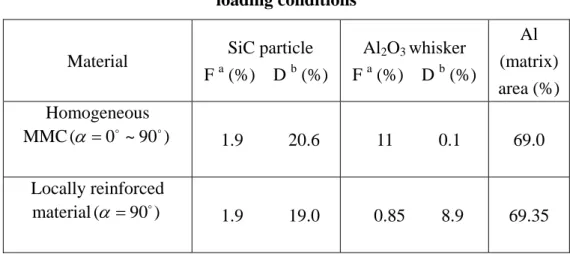
Table 4 Area fractions of SiC particle and Al2O3 whisker fracture
and interface debonding between SiC particle-matrix and Al2O3 whisker-matrix under monotonic and cyclic
loading condition.
37
Table 5 Fatigue life and distance from fatigue fracture location to macroscopic boundary of locally reinforced material(α =90o).
41
Table 6 Fracture stresses under monotonic loading of homogeneous MMC(α =0o ~90o).
46
Table 7 Fatigue life of homogeneous MMC(α =0o ~90o). 47 Table 8 Area fractions of SiC particle and Al2O3 whisker fracture
and interface debonding between SiC particle-matrix and Al2O3 whisker-matrix under cyclic loading conditions.
50
Table 9 Area fractions of SiC particle and Al2O3 whisker fracture
and interface debonding between SiC particle-matrix and
Al2O3 whisker-matrix under monotonic loading
conditions.
Table 10 Mechanical properties of materials. 60
Table 11 Flow stresses predicted by the model. 61
Table 12 Geometry of numerical model (unit: mm). 62
Table 13 Model chart 71
List of Symbols
Symbol Definition
α
Whisker orientation angle with respect to the externally applied stress
direction b σ Bending stress f N Fatigue life P Load
df Minimum distance from boundary to fracture site
f σ Fracture stress max σ Maximum stress p ε Plastic strain y
ε Total normal strain along y direction
y
ε
Δ Strain amplitude
E Young’s modulus
Ei Young’s modulus of material i ui Displacement component
y
σ Normal stress along y direction
z
List of Publications
Reviewed journal paper:
1. Rafiquzzaman MD., Yoshio ARAI “Fracture mechanisms under monotonic and cyclic load of aluminium cast alloy locally reinforced by SiC particles and Al2O3 whiskers”, Materials Science and Technology (Accepted, July 18th, 2007).
2. Rafiquzzaman MD., Yoshio ARAI, Eiichiro TSUCHIDA”一部分が SiC 粒子と Al2O3 ウィスカで強化された Al 鋳造合金の強度評価とフラクトグラフィ (Strength Evaluation of Aluminium Cast Alloy Locally Reinforced by SiC Particles and Al2O3 whiskers and Its Fractography)”, Japan Society of Material Science, 材料, Vol. 56, No. 11, pp. 1016-1021, 2007.
3. Rafiquzzaman MD., Yoshio ARAI. “Effect of Whisker Orientation on Monotonic and Fatigue Strength of Aluminium Cast Alloy Locally Reinforced by SiC Particles and Al2O3 Whiskers under Monotonic and Cyclic load” Journal of Solid Mechanics and Materials Engineering, JSME, Vol.2, No. 1, pp 47-57,2008.
Conference presentation:
1. Rafiquzzaman MD., Yoshio ARAI “一部分が SiC 粒子と Al2O3 ウィスカで強化 された Al 鋳造 合金の単調および繰返し荷重下における破壊機構の評価 (Fracture mechanism under monotonic and cyclic load of aluminium cast alloy locally reinforced by SiC particles and Al2O3 whiskers)” Mechanical Engineering Congress, 2007 Japan (MECJ-07), No.07-1, Vol. 6, pp. 197-19, 2007.
2. Rafiquzzaman MD., Yoshio ARAI, Eiichiro TSUCHIDA, Atsushi SUZUKI. Seiya MURAYAMA., “Evaluation of stress fields around macroscopic interface edge of a metal locally reinforced by ceramic particles”. (局所的にセラミック粒子で強化 された金属の巨視的界面端部応力場の評価,)日本機械学会 M&M2006 講演論
文集, No. 06-4, pp. 515 - 516 (2006 8).
3. Rafiquzzaman MD., Yoshio ARAI, Eiichiro TSUCHIDA, atsushi SUZUKI. Seiya MURAYAMA. , “Effect of Stress Field around interface Edge on Fatigue Strength of Aluminium Cast Alloy Locally Reinforced by SiC and Al2O3” (局所的にセラミッ
ク粒子で強化された金属の疲労強度に及ぼす端部応力場の影響)、Mechanical
Engineering Congress, 2006 Japan (MECJ-06), 日本機械学会 2006 年度年次大会 講演論文集, No. 06-1, Vol. 6, pp. 547 - 548 (2006 9).
4. Riquzzaman MD., Yoshio ARAI, Eiichiro TSUCHIDA, atsushi SUZUKI. Seiya MURAYAMA. , “SiC/Al2O3 ハイブリッド MMC/Al 鋳造合金接合部の強度評価 とフラクトグラフィ.” 日本材料学会第 11 回フラクトグラフィシンポジウム 前刷集, pp. 43 - 47 (2006 11). 5. Rafiquzzaman MD, 荒居善雄, 土田栄一郎, 村山誠哉,局所的にセラミック粒 子で強化された金属の巨視的界面端部応力場の評価,日本機械学会 M&M2006 講演論文集, No. 06-4, pp. 515 - 516 (2006 8). 6. Rafiquzzaman Md., 荒居善雄, 土田栄一郎, 鈴木敦志, 村山誠哉,SiC/Al2O3 ハイブリッド MMC/Al 鋳造合金接合部の応力解析と強度評価,日本機械学会 第 1 回埼玉ブロック大会(講演会)講演論文集, No. 050-5, pp. 107 - 108 (2005 11).
7. Rafiquzzaman MD., Yoshio ARAI, Eiichiro TSUCHIDA, atsushi SUZUKI. Seiya MURAYAMA. , “Strength evaluation of aluminium cast alloy locally reinforced by SiCp/Al2O3 Hybrid MMC.” Mechanical Engineering Congress, 2005 Japan
(MECJ-05), Vol.1, No. 05-1, pp. 261-262, 2005.
8. Yoshio ARAI, Eiichiro TSUCHIDA, Rafiquzzaman MD. Seiya MURAYAMA. , “Evaluation of fracture mechanism of aluminium cast alloy locally reinforced by SiCp/ Al2O3 Hybrid MMC.” Mechanical Engineering Congress, 2004 Japan (MECJ-04), Vol.1, No. 04-1, pp. 361-362, 2004.
Chapter 1: Introduction
1.1 Background
The mechanical components made by traditional materials (e.g. metals, plastics and ceramics) do not always give all the properties they require under their service conditions. In this way, different industries, such as the automotive and railway ones, are looking for low cost methods to improve the final performance of components made of steel, cast iron or even conventional aluminum alloys (e.g. for components such as automotive pistons, brakes, brake drums, brake discs). In order to obtain more efficient product for structural application, it is necessary to improve wear and fatigue behavior, weight reduction, high thermal conductivity, low coefficient of thermal expansion of the materials. Therefore, metal matrix composites (MMCs) have been widely considered as possible substitute which could comply with those characteristics.
MMCs consist of at least two chemically and physically distinct phases, e.g. a fibrous or particulate phase, distributed in a metallic matrix. For three decades, metal matrix composite materials have been popular subjects of applied engineering research [1, 2]. Recently MMCs have become attractive materials for structural applications such as aerospace, automotive industry and wear applications, especially in the frictional area of braking systems because of their great advantages and mechanical performance. The major advantages of MMCs compared to unreinforced material are as follows:
z Greater strength z Improved stiffness
z Improved high temperature properties z Controlled thermal expansion coefficient z Improved abrasion and wear resistance z Improved damping capabilities
The above advantages made this material (MMCs) more and more attractive and alternative in the engineering applications. Despite their great advantages, the high productive cost, poor ductility and low fracture toughness of MMCs are the major barriers for their structural applications. For minimizing theses limitations, a clear understanding of the micromechanisms of damage characteristics of MMCs is necessary to design the microstructure of these materials. During past few decades many researchers have investigated such kind of research [1-42]. Strength and stiffness are the two most important characteristics for structural applications. Fracture properties, such as ductility, toughness and fatigue response, are often of primary importance for structural applications.
Consideration of type and contribution of reinforcement component MMCs can be classified as
1. Particle reinforced MMCs.
2. Short fiber/whisker reinforced MMCs
3. Continuous fiber/whisker reinforced MMCs . 4. Laminated or layered MMCs.
The reinforcement and the matrix system for the MMCs are mainly determined by the intended application of the composites. For example, the MMCs used in the frictional area e.g. brake rotor, there is needed the high thermal conductivity with improved
ductility therefore ceramics and high toughness aluminum should be chosen. By using hybrid techniques, the combined application of two or more reinforcements is possible. Fabrication step of the composite is an important part to minimize their limitation (high cost, low toughness) in the structural applications. Metal matrix composite materials can be manufactured by many different techniques [1, 2]. The fabrication techniques divided into two categories: (1) solid state includes powder metallurgy and diffusion bonding and (2) liquid state includes infiltration, dispersion and spraying. MMCs of commercial applications are now produced by the liquid state process because of the following advantages over the solid state process;
z Less expensive
z Liquid metal is easier to handle than are powders z Complex shape can be produced by liquid state process
Among the various types of the liquid state fabrication techniques, squeeze casting have now become one of the most feasible techniques for the production of low cost MMCs and complex shape components [2]. Additionally, compared to other casting method e.g. gravity or die casting, a wide range of alloy can be cast using squeeze casting. Preparation of the whisker/particle preform is an important step in the fabrication of MMCs by squeeze casting method. Reinforcement breakage, porosity, inhomogeneous reinforcement orientation, bad interfacial bonding in the composites is the barrier to obtain adequate strength and mechanical properties of MMCs.
1.2 Application of MMCs
In the past 15- 20 years, MMCs have emerged as a class of materials capable of advanced structural, aerospace, automotive and wear applications. These alternative
materials (substitute of conventional materials) provide the specific mechanical properties necessary for elevated and ambient temperature applications. Up to now the major applications served by the MMCs in the automotive industries include selectively or partially reinforced pistons for diesel engine, selectively reinforced cylinder bores in Al engine blokes, intake and exhaust valves, driveshafts and propshafts, brake components (discs, rotors and calipers) and power module components for hybrid and electric cars. The first major MMC application in the commercial automotive market was a selectively reinforced piston produced for a diesel engine in 1983[1]. The success of this application was followed by the use of selectively reinforced engine cylinder bores in 1990. Reduction of overall vehicle weight is important for improving fuel economy. Therefore, the application of MMCs for disc brake rotor has been receiving considerable world wide attention. A brake rotor weight saving approximately 52% may be possible if MMCs can be substituted for the cast iron [5]. The high thermal conductivity of aluminum reinforced with SiC provides additional advantages for the thermal management of brake system. Metal matrix composites are finding a wide range of applications in aerospace. Aeronautical MMC applications have been established in the aero structural, aero propulsion, and subsystem categories. Aero structural components include ventral fins, fuel access door covers and rotor blade sleeves. Also few MMC applications have been established in the space systems. Particulate reinforced are in use as recreational products including golf club shafts and heads, skating shoes, base ball shafts and bicycle frames. They are also in use as microprocessor lids and integrated heat sinks in electronic packaging.
1.3 Concept of locally reinforced material
Due to excellent mechanical performances (higher thermal properties, great strength and stiffness) and considerable weight reduction, SiC particulates aluminum based MMCs was capable of being used an axle mounted brake discs in automotive industry [5]. Despite their great advantages, lower ductility and higher cost is the major limitation of this composite. Therefore, there is a critical need to develop and design a new idea and concept in this material for structural applications. The use of the combine advantages of brittle MMCs and a ductile carrier body can be promising alternative [5]. The ductile matrix material (e.g. Al, Mg etc.) partially or locally reinforced by brittle particles or whiskers is called locally or partially reinforced material. The application of reinforced part of this material to the most important functional area of the mechanical component especially which are the frictional surfaces may reduce the cost and improve the mechanical performances. For example, in the brake disc application, ductile aluminium alloy which has high fracture toughness supports the whole disc and the reinforced part by ceramic particles/whiskers is used in the area required (e.g. frictional area) (Fig. 1.1 and 1.2). To produce locally or partially reinforced materials squeeze casting is the most common and feasible techniques. Some of manufacturing processes of locally reinforced (A365 Al alloy locally reinforced by SiC particles) friction ring with a ductile carrier body and their mechanical performance have been investigated by Zeuner et al. in 1998 [5] where, they found that the friction ring of an Al alloy locally reinforced by SiC particles can capable to use as a brake disc application.
Fig.1.2 Example illustration of application of locally reinforced material
A locally reinforced material has a boundary between the reinforced part and the unreinforced part. The resulting strength of the boundary between locally reinforced and unreinforced parts will undoubtedly play an important role in many structural applications. The fracture location and the fracture mechanism give critical information for the design or placement of the mechanical component having the locally reinforced part. Therefore, various experimental and numerical investigations are needed to clarify the role of boundary on fracture mechanism of locally reinforced material. By using hybridization techniques, the combined application of particles and whiskers to the reinforced part in a locally reinforced material may improve the mechanical performance for the structural applications. So, the effect of boundary and fracture mechanism of hybrid MMCs would be studied for the safety of engineering application.
1.4 Literature review
During the past decades, many investigations have been carried out on the mechanical performance of MMCs relating to aspects such as strength, damage, and failure mechanism [5-22]. MMCs have high strength and stiffness, low density, high temperature properties and excellent wear resistance compared to unreinforced materials [1-4]. Despite their excellent mechanical properties, low ductility is the limitation for this material. In order to improve ductility of MMCs, it is needed to study the factor which resulting the low ductility. In generally, presence of second phase brittle reinforcement and their fracture are considered as the main factor of decreasing the ductility of MMCs. But the presence of reinforcements is also the main strengthening mechanism of MMCs [6]. Many researchers were investigated the effect of the reinforcement volume fraction, size and shape and distribution on mechanical performance [7, 8]. Particle clustering effect may reduce the ductility of composite [8]. Increase the volume fraction of reinforcement promotes the higher tensile stress in the reinforcement causing higher degree of particle fracture [17]. Reinforcement shape also has a strong influence of failure mechanism in the metal matrix composites. In 1991, Lorca et al. showed that rounded corner reinforcement increase ductility and delay the void growth significantly compared with the sharp corner reinforced metal matrix composites [18].
Many researchers have investigated the monotonic and cyclic fracture behavior and the fracture mechanisms of ceramic particulates/aluminium based MMCs [9-25]. Large difference in strain carrying capability of elastically deforming reinforcement and plastically deforming matrix alloy determines the key mechanism of fracture of MMCs
[11-18]. Thus, stress is concentrated near the interface edge between reinforcement and matrix or concentrated in the reinforcement, which causes interfacial debonding or reinforcement fracture. This reinforcement fracture or interfacial debonding may decrease the ductility of MMCs [11].
Plastic constraint developed in the matrix has strong effect on cyclic and monotonic deformation of MMCs. Deformation and failure of MMCs by the nucleation and growth of voids and within the ductile matrix were studied by Lorca et al. [17, 18, 20]. They demonstrated that due to constrained plastic flow of the matrix between the reinforcement particles in the MMCs, hydrostatic stresses develop in the matrix which plays an important role in the failure mechanism during monotonic and cyclic deformations [17-19]. This hydrostatic stress enhances the nucleation of the voids in the matrix alloy. Different constraint levels on the matrix flow may control the local failure process (e.g. particle fracture, interfacial debonding and dimple fracture of matrix alloy). In the particulate composites the plastic strain and voids around the inclusions spread throughout the matrix whereas, in the whisker reinforced composite they are localized in the vicinity of the reinforcement [17].
The failure mechanism is greatly influenced by different loading condition (e.g. monotonic and cyclic load). Poza et al. demonstrated the difference of fracture mechanism of a metal matrix composite under monotonic and cyclic loading condition [19]. The tension loaded reinforcements in the matrix are subjected to higher tensile stress than those loaded in fatigue results in high degree of reinforcement fracture. During the loading and unloading process in the cyclic deformation cyclic hardening is
occur due to the accumulation of plastic strain. During the monotonic deformation the plastic strain also develop, especially at the interface between reinforcement and matrix, but significantly lower than in cyclic deformation [19].
The presence of interfaces is the common feature of MMCs which has an important role in mechanical behaviors of these materials such as strength and stiffness. Strong interface between matrix and reinforcement, the triaxiality of stress generated during tensile deformation causes the void growth within the matrix [20]. The failure of a composite often arises at the interface. Therefore themechanical behavior of interfaces has a strong influence on the mechanical properties of composites, including their strength and toughness. Good interfacial bonding yields high dislocation density in the matrix which increases the strength of MMCs, while low fracture toughness due to cracking of the reinforcing particles is given by the good interfacial bonding [21]. Moreover, interfacial bonding between reinforcing particles and matrix alloy also tends to be a dominating factor in local failure processes and the strengthening of MMCs.
Due to thermal load and external load such as brake force acting on the component, the locally reinforced materials are subjected to in-plane load of the reinforced face in which the whiskers are distributed randomly and also out-of-plane load which is perpendicular to the whisker orientation. The mechanical properties of whisker/ particle composites are strongly dependent on their compositions and the volume fraction as well as the arrangement of reinforcement such as random orientation and distributions. In the whisker/fiber composites, the whisker/fiber orientation with respect to the load is very important. Due to the large influence of whisker/fiber orientation on mechanical
properties (e.g. fracture behavior and overall strength) many researchers have investigated the whisker/fiber composites [26-36]. Some studies have shown that the composite strength highly depends on its reinforcement orientation [26-31]. Kang et al. Showed that the elastic modulus and fiber axial stress is strongly dependent on the fiber orientation angle (α ) [26, 27]. The strength of whisker/particle composites is greatly influenced by load transfer from matrix to reinforcement [27]. Whisker-matrix stress transfer in whisker/fiber composite have been generally accepted as a predominant parameter in controlling the micro-failure modes and the most important influencing factor in macroscopic mechanical behavior.The load transfer between whisker and matrix in a metal matrix composite (MMC) depends on the properties and conditions of the whisker/matrix interfacial region. The interfacial bond has a remarkable effect on the stress transfer from matrix to whisker. Good interfacial bonding enhances the stress transfer between matrix and fiber which results in increase of overall strength [27]. Elastic modulus and axial strength of composites are increased with decreasing the orientation angle (α =0ois parallel to the externally applied stress direction). Other literatures show that the stress in whisker parallel to the loading direction (α =0o) is largest compared with other orientation angle [28, 29]. Trojanova et al. [30] demonstrated that the tensile strength is significantly increased in the parallel orientation (α =0o) of whisker composite compared with the perpendicular orientation (α =90o) of Al2O3 whisker MMC. However Nutt et al. demonstrated that, in the
whisker reinforced MMCs a hydrostatic stresses develop in the vicinity of the whisker ends which lead to debonding the whisker from the matrix and also low ductility and premature failure [34-36].
A few investigations have been made recently [37–42] in which the influence of hybrid reinforcements such as silicon carbide + graphite, Al2O3 + silicon carbide and
carbon fiber + alumina on the wear/tribological behavior of aluminum were investigated. Moreover, some studies have focused on the hybrid effect on the mechanical properties of whisker/particle hybrid metal matrix composites [37-39]. In 2000, wear behavior of Al/Al2O3/C hybrid metal matrix composites were investigated by Song et al. [37]. The
wear resistance was remarkably increased compare with Al/Al2O3 composite due to
hybrid effect. Other literature shows that wear resistance of hybrid MMCs are higher under dry sliding condition but lower under lubricated sliding condition compared with the non-hybrid MMCs [38]. An analytical analysis considering tensile strength and stiffness enhancement in particle/fiber reinforced aluminum hybrid metal matrix composites were investigated by Jung et al. in 2000 [39]. They have demonstrated that the strength and stiffness of hybrid composites are much larger than the fiber composite due to the cluster structure which increased the bending rigidity and change the fracture mechanism.
A locally reinforced material consists of reinforced part and unreinforced part. The resulting strength of the boundary between locally reinforced and unreinforced parts will undoubtedly play an important role in many structural applications. The fracture location and the fracture mechanism give critical information for the design or placement of the mechanical component having the locally reinforced part. Under a mechanical loading or temperature change, high stresses occur near the interface edge in the joint of two homogeneous dissimilar materials due to the mismatch of material properties (e.g. thermal and elastic mismatch, plastic flow stress etc.) of the joined
components [43-45]. These high stresses (stress singularity) may influence the fracture of the joint.
The stress concentration and its influence on the fracture behavior around the boundary of locally reinforced materials is an unsolved problem. The best of our knowledge, there is no experimental and numerical investigations of locally of partially reinforced materials have been conducted, especially those reinforced by SiC particles and Al2O3 whiskers and having a macroscopic boundary between reinforced and
unreinforced part. Studies of the fracture mechanism, under monotonic and cyclic load, of aluminium cast alloy, locally reinforced by SiC particulates and Al2O3 whiskers, are
rare. We believe that knowledge of monotonic and cyclic fracture behaviors of the locally reinforced aluminium alloy would have an essential role for many structural applications such as in the brake disc of a high speed railway coach.
In order to describe the whisker orientation effect on overall strength of composites, a large number of experimental and numerical investigations have been carried out successfully [26-36]. However, the whisker orientation and the hybrid (reinforced by whisker and particle) effect on overall strength in the hybrid composites are still unsolved problem. The effect of whisker orientation on the strength of hybrid composites (reinforced by whisker and particle) is very complicated due to the presence of whiskers and particles. Due to the complicated microstructure, various experimental and numerical investigations are needed to be explained to clarify the fracture mechanism of the composite. Therefore, in this research, an experimental and numerical investigation was carried out to describe the whisker orientation effect on overall strength of hybrid composites.
1.5 Scope and objectives
The best knowledge on the research of locally or partially reinforced MMCs is strongly required to secure the structural application. The aim of the present research is to clarify the effects of the boundary between the reinforced part and the unreinforced part on the fracture mechanism, under monotonic and cyclic load, of aluminium cast alloy locally reinforced by SiC particles and Al2O3 whiskers. Also the effect of the whisker
orientation on the monotonic strength and fatigue strength and its effect on fracture mechanism of aluminium cast alloy locally reinforced by SiC particles and Al2O3
whiskers under monotonic and cyclic load are investigated. Fractographic analysis is used to explain the failure location and the fracture mechanism. The stress and strain distributions predicted by simulations, using a microscopic mechanical model for the locally reinforced materials, are compared to the experimental observations. A three-dimensional single whisker unit cell model of cylindrical shape whisker in the periodic boundary condition is conducted using finite element method (FEM) to describe the overall behavior of the composite.
The specifics objectives of the present research are as follows:
z To investigate the effect of the boundary between the reinforced part and the unreinforced part on the fracture mechanism under monotonic and cyclic load. z To investigate the effect of monotonic and cyclic load on the fracture mechanism of
MMCs.
z To investigate the effect of the whisker orientation on the monotonic strength and fatigue strength and on the fracture mechanisms.
mechanical model for the locally reinforced materials, are discussed with the experimental observations.
z The whisker orientation effects predicted by using a three-dimensional single whisker model are compared to the experimental observations.
1.6 Outline of present research
The research work conducted for this project is completely presented in this dissertation, which is organized as follows:
Chapter 1 is an introduction of the research, which describes the back ground, the motivation, proposed concepts, the objectives and the scopes of this research.
In chapter 2, Materials fabrication and its microstructure, the experimental set up and the experimental procedures were discussed. Materials were successfully fabricated by squeeze casting method. The polishing surface observations were treated by optical microscope. The fracture surface observations of the composites were treated by the scanning electron microscope (SEM). The failure mechanisms of the composites were investigated by the composition analysis of energy dispersive X-ray (EDX). The measured areas of dimple, interfacial debonding and particle/whisker fractures on the fracture surface were also examined by area fraction techniques.
In chapter 3, the experimental results were discussed, which describes the fracture mechanisms, boundary effect and whisker orientation effect. The fracture path and fracture origin were investigated by SEM on the fracture surfaces. With respect to the load, the whisker orientation effect was investigated by SEM and EDX analysis.
In chapter 4, a numerical analysis was discussed. The stress distribution around the boundary between reinforced part and unreinforced part were calculated based on an inclusion array model considering the microscopic inhomogeneous effects. A three-dimensional single whisker unit cell model of cylindrical shape whisker in the periodic boundary condition was conducted using finite element method (FEM) to describe the overall behavior of the composite.
References
[1] Suresh, S., Mortensen, A. and Needleman, A. Fundamentals of metal matrix composites. London: Butterworth/Heinemann; 1993.
[2] K. U. Kainer., Basic of Metal Matrix Composite, in Custom-made Materials for Automotive and Aerospace Engineering., 2006, WILEY-VCH Verlag Gmbh and Co. KGaA, Weinheim.
[3] D.B. Miracle., Metal matrix composite- From science to technological significance, Composite Science and Technology, Vol. 65 (2005), pp. 2526-2540
[4] Xicong, Liu. and Claude, Bathias., Defects in squeeze-cast Al2O3/Al alloy
composites and their effects on mechanical properties, Composite Science and Technology, Vol. 46(1993), pp. 245-252.
[5] Zeuner, T., Stojanov, P., Sahm, P.R., Ruppert. H., and Engels A., Developing trends in disc brake technology for rail application, Material Science and Technology, Vol. 14 (1998), pp. 857-863.
[6] N. Shi and R. J. Arsenault: Plastic flow in SiC/Al composites-strengthening and ductility. Annual Review Material Science, Vol. 24 (1994), pp. 321-357.
[7] Y. Ochi, K. Masaki, T. Matsumura and M. Wadasako: Effects of volume fraction of alumina short fibers on high cycle fatigue properties of Al and Mg alloy composites. Material Science and Engineering A, Vol. 468-470 (2007), pp. 230-236.
[8] T. C. Tszeng: The effects of particle clustering on the mechanical behavior of particle reinforced composites. Composite Part B, Vol. 29B (1998), pp. 299-308. [9] M. Levin and B. Karlsson: Influence of SiC particle distribution and prestraining
Science and Technology, Vol. 7 (1991), pp. 596-607.
[10] D. L. Davidson: Fatigue and fracture toughness of aluminum alloys reinforced with SiC and alumina particles Composite. Vol. 24 (1993), pp. 248-255.
[11] AL. Chen, Y. Arai and E. Tsuchida: An experimental study on effect of thermal cycling on monotonic and cyclic response of cast aluminum alloy-SiC particulate composites. Composites Part B., Vol. 36 (2005), pp. 319-330.
[12] AL. Chen, Y. Arai and E. Tsuchida: A numerical study on effect of thermal cycling on monotonic and cyclic response of cast aluminum alloy-SiC particulate composites. Theoretical Applied Mechanics, Vol. 53 (2004), pp. 63-73
[13] T.S. Srivatsan and M. Al-Hajiri: The fatigue and final fracture behavior of SiC particle reinforced 7034 aluminum matrix composites., Composite Part B., Vol. 33 (2002), pp. 391-404.
[14] Q. Zhang, H. Zhang, Gu. Mingyuan and J. Yanping: Studies on the fracture and flexural strength of Al/Sip composite. Materials Letters. Vol. 58 (2004), pp.
3545-3550.
[15] X. Q. Xu and D. F. Watt: A finite element analysis of plastic relaxation and plastic accumulation at second phase particles. Acta Materilia., Vol. 44 (1996), pp. 801-811.
[16] X. Q. Xu and D. F. Watt: A numerical analysis of the effects of reinforcement content on strength and ductility in Al/(SiC)p MMCs. Acta Materilia., Vol. 44
(1996), pp 4501-4511.
[17] L. Llorca, S. Suresh and A. Needleman: An experimental and numerical study of cyclic deformation in metal-matrix composites. Metallurgical Transaction A: Vol. 23A (1992), pp. 919-934.
[18] L. Llorca, A. Needleman and S. Suresh: An analysis of the effects of matrix void growth on deformation and ductility in metal-ceramic composites. Acta. Metall. Mater., Vol. 39, No. 10 (1991), pp. 2317-2335.
[19] P. Poza and J. Llorca: Mechanical behavior and failure micromechanisms of Al/Al2O3 composites under cyclic deformation. Metallurgical and materials
Transaction A: Vol. 26A, pp. 3131-3141, 1995.
[20] T. Christman, A. Needleman and S. Suresh: An experimental and numerical study of deformation in metal-ceramic composites. Acta Materilia., Vol. 37, No. 11, pp. 3029-3050, 1989.
[21]. R.J. Arsenault and Y. Flom: Proc. Symp. Phase Boundary Effects on Deformation, TMS, AIME, Toronto, Canada, pp. 261 – 279, 1985.
[22] H. Lilholt: Aspects of deformation of metal matrix composites. Material Science and Engineering A, Vol. 135, pp. 161-171, 1991.
[23] T. S. Srivatsan, M. Al-Hajiri and V. K. Vasudevan: Cyclic plastic strain response and fracture behavior of 2009 aluminum alloy metal-matrix composite. International Journal of Fatigue, Vol. 27, pp. 357-371, 2005.
[24] R. J. Zhang, Z. Wang and C. Simpson: Fatigue fractography of particulate-SiC reinforced Al (A356) cast alloy. Material Science and Engineering, Vol. A148, pp. 53-66, 1991.
[25] J. Llorca and P. Poza: Influence of matrix strength on reinforcement fracture and ductility in Al-Al2O3 composites. Material Science and Engineering, Vol. A185, pp.
25-37, 1994.
[26] Guo-Zheng, Kang. and Quing, Gao., Tensile properties of randomly oriented short δ -Al2O3 fiber reinforced aluminium alloy composites: 1. Microstructure
characteristics, fracture mechanisms and strength prediction, Composites part A, Vol. 33 (2002), pp. 647-656.
[27] Guo-Zheng, Kang. and Quing, Gao., Tensile properties of randomly oriented short δ -Al2O3 fiber reinforced aluminium alloy composites: 2. Finite element
analysis for stress transfer, elastic modulus and stress-strain curve, Composites part A, Vol. 33 (2002), pp. 657-667.
[28] Bing, Jiang., Charlie, Liu., Chuck, Zhang., Ben, Wang. and Zhi, Wang., The effect of nono-symmetric Distribution of fiber orientation and aspect ratio on elastic properties of composites, Composites part B, Vol. 38 (2007), pp. 24-34
[29] Li, A.B., Geng, L., Meng, Q.Y. and Zhang, J., Simulation of the large compressive deformation of the metal matrix composites with misaligned whiskers, Material Science. and Engineering A, Vol. 358 (2003), pp. 324-333.
[30] Trojanova, Z., Szaraz, Z., Labar, J. and Lukac, P., Deformation behaviour of an AS21 alloy reinforced by short Saffil fibers and SiC particles, Journal of Material Processing Technology, Vol. 162-163 (2005), pp. 131-138.
[31] Xicong, Liu. and Claude, Bathias., Defects in squeeze-cast Al2O3/Al alloy
composites and their effects on mechanical properties, Composite Science and Technology, Vol. 46(1993), pp. 245-252.
[32] Rafiquzzaman, MD. and Arai, Y., Fracture mechanism of aluminium cast alloy locally reinforced by SiC particles and Al2O3 whiskers under monotonic and cyclic
load, Material Science and Technology, 2007(to be published).
[33] Levy, A. and Papazian, J. M., Tensile properties of short fiber-reinforced SiC/Al composites: part 2. Finite-Element analysis, Metallurgica Transection A, Vol. 21 (1990), pp. 411-420
[34] T. Christman, A. Needleman, S. Nutt and S. Suresh: On microstructural evolution and micromechanical modeling of deformation of a whisker-reinforced metal-matrix composite. Material Science and Engineering A, Vol. 107, pp. 49-61, 1989.
[35] S. R. Nutt and J. M. Duva: A failure mechanism in Al-SiC composites. Scripta Metallurgica, Vol. 20, pp. 1055-1058, 1986.
[36] S. R. Nutt and A. Needleman: Void nucleation at fiber ends in Al-SiC composites. Scripta Metallurgica, Vol. 21, pp. 705-710, 1987.
[37]. J. I. Song, S. I. Bae, K. C. Ham and K. S. Han: Abrasive wear behavior of hybrid metal matrix composites. Key Engineering Materials, Vols. 183-187, pp. 1267-1272, 2000.
[38] H. Fu, K. Han and J. Song: Wear properties of saffil/Al, saffil/Al2O3/Al and
saffil/SiC/Al hybrid metal matrix composites. Wear, Vol. 256, pp. 705-713, 2004. [39]. S.W. Jung, J. H. Lee, J. B. Nam, H. W. Nam and K. S. Han: Analysis of
strengthening mechanism in hybrid short fiber/particle reinforced metal matrix composites. Key Engineering Materials, Vols. 183-187, pp. 1297-1302, 2000. [40] X. N. Zhang, L. Geng and G. S. Wang: Fabrication of Al-based hybrid composites
reinforced with SiC whiskers and SiC nanoparticles by squeeze casting. Journal of Material Processing Technology, Vol. 176, pp. 146-151, 2006.
[41] J. Q. Jiang, H. N. Liu, A. P. Ma and R.S. Tan: The structure and tensile properties of Al-Si alloy hybrid reinforced with alumina-aluminosilicate short fiber. Journal of Material Science, Vol. 29, pp. 3767-3773, 1994.
[42] A. B. Gurcan and T. N. Baker: Wear behaviour of AA6061 aluminium alloy and its composites. Wear, Vol. 188, pp. 185-191, 1915.
[43]. D. B. Bogy: Edge-bonded dissimilar orthogonal elatic wedge under normal and shear loading. ASME Journal of Applied Mechanics. Vol. 35, pp. 460-466, 1968. [44] B. J. Dalgleish, M. C. Lu and A. G. Evans: The strength of ceramics bonded with
metals. Acta Metallurgical. Vol. 36, pp. 2029-2035, 1988.
[45] M.A. Sckuhr, A. Brueckner-fott, D. Munz and Y. Y. Yang: Stress singularities at a joint formed by dissimilar elastic-plastic materials under mechanical loading. International Journal of Fracture. Vol. 77, pp. 263-279, 1996.
Chapter 2: Materials and Experimental
Procedures
The aim of this chapter is to describe the material fabrication and preparation for the bending test and then described the experimental procedures and methodology of this research. For minimizing the limitation of MMCs (low ductility and higher cost), in our research we introduced the new conception locally reinforced material for structural applications especially in the brake disc application. The locally reinforced brake discs were fabricated successfully by squeeze casting method. Monotonic and cyclic bending tests were conducted by MTS machine with a special bending fixture. The fracture surface observations of the composites were made by the SEM. The failure mechanisms of the composites were investigated by the composition analysis of EDX.
2.1 Materials fabrication
Metal matrix composites are generally produced either by liquid metallurgy or powder metallurgy techniques [1-3]. In the liquid metallurgy, the reinforcement phase is mechanically dispersed in the liquid before solidification of melt. For the production of low cost and complex shaped MMCs, squeeze casting technology have now become most feasible techniques. In the present work, materials were fabricated by squeeze casting method. Commercial aluminum alloy of JIS-AC4CH was used as a based material [6]. The chemical composition of the aluminum alloy is given in Table 1.
Fig 2.1 Squeeze casting method
Table 1 Chemical compositions of AC4CH alloy (wt. %)
Si Fe Mg Ti Al
7.99 0.2 max 0.57 0.07 Bal.
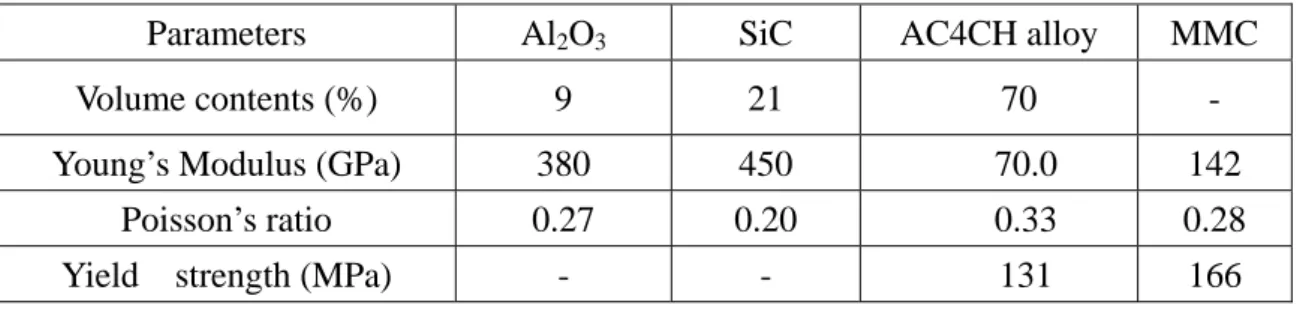
Table 2 Volume fraction and mechanical properties
Parameters Al2O3 SiC AC4CH alloy MMC
Volume contents (%) 9 21 70 -
Young’s Modulus (GPa) 380 450 70.0 142
Poisson’s ratio 0.27 0.20 0.33 0.28
The reinforced phase consisted of 21 volume% SiC particles and 9 volume% Al2O3
whiskers. The locally reinforced part was fabricated with the squeeze casting method shown in Fig. 2.1. Hybrid performs which is made of SiC particles and Al2O3 whiskers
placed in the die cavity and therefore the molten Al alloy was poured in to the mold. Subsequently, 100 MPa pressure was applied on the mixture using a hydraulic press. The squeeze casting pressure of 100 MPa is adequate to overcome the resistance against flow and to press the melt into all the open pores of the hybrid preform. Volume fractions and mechanical properties are listed in Table 2.
2.2 Materials preparation
The test specimens were cut out from a locally reinforced aluminium disc shown in Fig.2.2. The bend specimen size (width, depth and length) is limited by the limited MMC layer thickness. To investigate the boundary effect, whisker orientation effect and the fracture mechanism, two types of specimens were prepared for the bending test shown in Fig 2.2. The longitudinal orientation is normal to or parallel to the boundary (r−θplane in Fig. 2.2) between reinforced part and unreinforced part. The former is called as “locally reinforced material(α =90o)”. The latter is called as “homogeneous MMC(α =0o ~90o)”.
2.3 Microstructural features
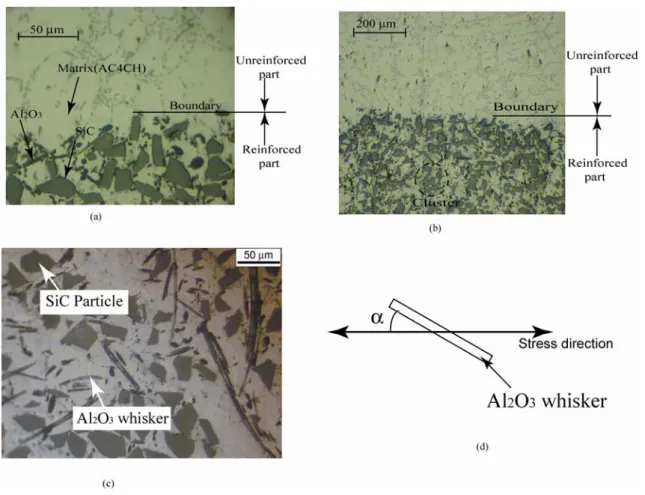
The machined surfaces of the specimens were hand polished using progressively finer grade (2000 and 3000 grit) of silicon carbide impregnated emery paper and then finished with a polishing machine using 1 mμ diamond particles until all scratches and surface machining marks were removed. The typical microstructure of locally
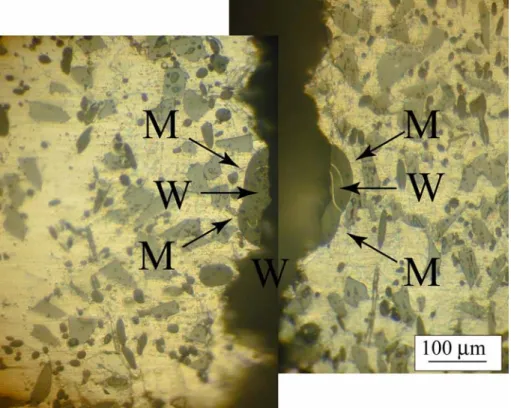
reinforced material(α =90o)and the homogeneous MMC(α =0o ~90o)is shown in Fig 2.3 which representing the SiC particles and Al2O3 whiskers distribution, boundary
between reinforced part and unreinforced part and Al2O3 whisker orientation angleα .
Most of the SiC particles are rectangular-shaped with sharp corners and most of the Al2O3 whiskers are roller-shaped as shown in Fig. 2.3(a) and Fig. 2.3 (c). The SiC
particles have an average length of 23 mμ . The average length of the Al2O3 whiskers is
33 μm and the average diameter is 2 mμ . In the Al alloy side, the Al has an average grain size of 48 mμ .
Disc Unreinforced Al part
Specimen cut out from disc
(reinforced by SiC particles and Al2O3 whiskers)
Reinforced part
z
rx
θ
Reinforced part Unreinforced Al part 8.5 16.5 Unreinforced part Boundary Reinforced partLocally reinforced material
) 90 (α = o 2 25 2 Reinforced part (MMC) Homogeneous MMC ) 90 ~ 0 (α = o o Stress direction α Αl2O3 whisker
At frequent intervals a clustering of SiC particles and Al2O3 whiskers were observed in
the low magnification photograph as shown by the dashed line in Fig.2.3 (b). The cluster has an average size of 90 mμ . Fig. 2.3 (d) represent the Al2O3 whisker
orientation angleα .Generally, the Al2O3 whisker orientation in the disc is random in
θ −
r plane in Fig.2.2. In the “homogeneous MMC” specimen whiskers are oriented randomly(α =0o ~90o)to the load direction (Fig. 2.3(c)) and in the “locally reinforced material” almost all whiskers are perpendicular (α =90o)to the load direction as shown in Fig. 2.3(a) and the cross-section shape is almost circle.
Fig. 2.3 Optical micrograph of the composite on the tensile side face, representing the SiC particle and Al2O3 whisker distribution and Al2O3 whisker
orientation angle: (a) and (b) Locally reinforced material (α =90o)and (c) Homogeneous MMC (α =0o ~90o) (d) Definition of whisker orientation angleα .
Fig. 2.4 Optical micrograph of the composite on the tensile side face, representing the coarse Al2O3 whiskers which were formed during the materials fabrication.
d1 d2 d3 d4 d5 d6 d7 d8 Particle Whisker Reinforced part Unreinforced part Boundary
Fig. 2.5 Measurement of inter particle/whisker distance with respect to the boundary between reinforced and unreinforced part.
0 0.5 1 1.5 25
50 75 100
Distance from the bounday [mm]
Distance from one particular
Average value
particle to another particle
[μ
m]
0 0.5 1
10 20
Distance from the bounday [mm]
Distance from one particular
Average value
whisker to another whisker
[μ m] 0 0.5 1 1.5 0 20 40 60
Distance from particle to another whisker
Distance from the boundary [mm] Average value
[μ
m]
(a)
(b)
(c)
Fig. 2.6 Inter particle/whisker distance with respect to the boundary (a) particle to particle (b) whisker to whisker (c) particle to whisker
Some coarse Al2O3 whisker which is formed during the fabrication of hybrid
whisker/particle prefrom is shown in Fig 2.4. When the materials subjected to monotonic and cyclic loading, this coarse Al2O3 might have an influence on failure
mechanism of the composite such as premature failure (crack initiation in the coarse Al2O3 and propagation quickly) the monotonic and cyclic test. Also this can be point out
that; the coarse Al2O3 whisker does play an important role in mechanical properties.
To evaluate the density of reinforcement with respect to the boundary, inter particle/whisker distance was calculated (Illustration shown in Fig. 2.5) and the results shown in Fig. 2.6. From this results, it can be seen that the inter particle/whisker distance with respect to the boundary is random. Therefore, the particle/whisker dispersed randomly through matrix alloy.
2.4 Experimental setup and procedures
Symmetric four-point bending tests were performed using special bending fixtures equipped with a 980N load cell. An experimental set up is shown in Fig 2.7. The inner span was 10 mm and outer span was 20 mm. Load and deflection data were recorded by a computer data acquisition system. Monotonic bending tests were conducted with a displacement rate of 0.0025 mm s-1. Strength was calculated from the maximum load at failure as a nominal bend stress. Schematic illustration of four-point bending test is shown in Fig. 2.8. The nominal bending stress was calculated from the following equation 2 2 6 bh aP b = σ ……… (2.1)
Cyclic fatigue tests were conducted in the load control mode under the load ratio R =0.1 at a frequency of 1Hz and 10 Hz. All tests were carried out at room temperature. The number of cycles to failure is taken as the fatigue life (N ). The tensile surfaces of f broken specimens were examined with an optical microscope to determine the fracture
initiation location. Fracture surfaces were comprehensively examined in a SEM to determine the microscopic fracture mode and to characterize the microscopic mechanisms governing fracture. The microscopic mechanism refers to the local failure processes (fracture of particle or whisker, particle/matrix or whisker/matrix interfacial debonding, dimple fracture of matrix alloy). Energy Dispersive X-ray analysis (EDX) was used to identify constituents on the fractured surface. Special effort was made to take matching photographs from the two halves of the broken specimens to assess the relative incidence of particle/whisker cracking and particle/matrix or whisker/matrix interfacial debonding.
P/2
P/2
a
a
L
d
0
h
b
MMC AlFig. 2.8 Schematic illustration of four-point bending test
Additionally, the measured areas of dimple, interfacial debonding and particle/whisker fractures on the fracture surface were also examined. To determine the area fraction of particle/whisker fractures and interfacial debonding, we have selected a particular area 2 mm in width and 0.05 mm in height parallel and adjacent to the tensile surface. Therefore, the fraction of the particle and whisker fracture area is defined as the total particle and whisker fracture area divided by the total area measured. The area fractions of particle/matrix or whisker/matrix interfacial debonding were also measured by the same procedure.
References
[1] Suresh, S., Mortensen, A. and Needleman, A. Fundamentals of metal matrix composites. London: Butterworth/Heinemann; 1993.
[2] K. U. Kainer., Basic of Metal Matrix Composite, in Custom-made Materials for Automotive and Aerospace Engineering., 2006, WILEY-VCH Verlag Gmbh and Co. KGaA, Weinheim.
[3] D.B. Miracle., Metal matrix composite- From science to technological significance, Composite Science and Technology, Vol. 65 (2005), pp. 2526-2540
[4] Zeuner, T., Stojanov, P., Sahm, P.R., Ruppert. H., and Engels A., Developing trends in disc brake technology for rail application, Material Science and Technology, Vol. 14 (1998), pp. 857-863.
[5] S.M. Seyed Reihani: Processing of squeeze cast Al6061-30vol.% SiC composite and their characterization. Material and Design, Vol. 27, pp. 216-222, 2006.
Chapter 3: Experimental Results
3.1 Introduction
The aim of this chapter is to explain and discuss the experimental results in our research. The material is monotonically and cyclically deformed to failure at room temperature under four-point bending test. SEM observation of the fracture surfaces were made to describe the failure mechanism and EDX analysis was used to identify constituents on the fractured surfaces. Additionally, the measured areas of dimple, interfacial debonding and particle/whisker fractures on the fracture surface were also examined.
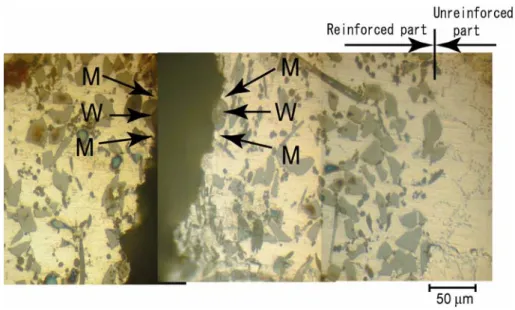
In section 3.2 we will present the experimental results of boundary effect on fracture mechanism under monotonic load condition. The fracture occurs in the reinforced part and the static fracture (monotonic loading) shows that the fracture mechanism is the combination of reinforcing particle fracture and interfacial debonding between reinforcing ceramics and metal matrix. In section 3.3 we will present the experimental results of boundary effect on fracture mechanism under cyclic load condition. Fatigue fracture is controlled by the fracture of coarse Al2O3 whisker. The critical location for
fracture is changed by the external stress level. In section 3.4 we will present the whisker orientation effect on monotonic and fatigue strength. Whisker orientated parallel to the bending stress direction gives higher monotonic and fatigue strength in the composites. Finally a summery of experimental investigation is given in section 3.5.



![Fig 3.12 Comparison of two types of fracture surface (a) locally reinforced material ( α = 90 o ) [CTP5] (b) Homogeneous MMC ( α = 0 o ~ 90 o ) [HCTP4], under](https://thumb-ap.123doks.com/thumbv2/123deta/8492466.921943/73.892.122.763.147.525/comparison-types-fracture-surface-locally-reinforced-material-homogeneous.webp)