60:351
はじめに
帯状疱疹は水痘・帯状疱疹ウイルス(varicella zoster virus; VZV)の再活性化により発症し,日常的に遭遇しうる疾患で あるが,時に脳血管炎や脊髄炎,髄膜炎など中枢神経障害を
合併することがある1)~3).高齢者や全身性エリテマトーデス
(systemic lupus erythematosus; SLE)を含む自己免疫疾患や それに対する免疫抑制薬使用,悪性腫瘍,ヒト免疫不全ウイ ルス感染などによる細胞性免疫能の低下が再活性化のリスク になると言われている3)~7).私たちは,SLE と重症筋無力症 を合併し,免疫抑制薬内服中に帯状疱疹を発症し,早期にア シクロビル(ACV)治療を開始したにも関わらず,急速に進行 する脳血管炎及び脊髄炎により死に至った症例を経験した. 病理解剖所見をもとに病態について考察を加えて報告する. 症 例 症例:40 歳,女性 主訴:右優位の下肢脱力,左下肢の感覚低下 既往歴:15 歳時に蛋白尿と血尿が出現し,腎生検にて SLE によるループス腎炎と診断され,プレドニゾロン(PSL)内 服を開始した.2006 年末より嚥下障害と構音障害が出現し, 抗アセチルコリン受容体(AChR)抗体陽性(460 nmol/l), 3 Hz反復刺激試験陽性であり,2011 年に全身型重症筋無力症 と診断された.同年 11 月に拡大胸腺摘出術を施行され,その 後 PSL 7 mg/ 日とタクロリムス 3 mg/ 日で維持されていた. 家族歴:特記事項なし. 現病歴:2017 年 2 月下旬より背中や肩の痛みが出現し,次 第に頭痛,腰部右側の帯状の疼痛,右優位の両下肢脱力感, 左下肢の感覚障害が出現し増強した.自力で歩けなくなり, 発症 5 日目に当科へ緊急入院となった. 入院時現症:身長 163.0 cm,体重 52.4 kg.体温 36.1°C,血 圧 128/76 mmHg,脈拍 66 回 / 分とバイタルサインは安定して いた.一般身体所見で右背部 Th10~12 レベルに帯状の水疱 を伴う紅斑を認めた(Fig. 1).初診時の神経学的所見では意 識は清明,脳神経,上肢に異常所見なし,右下肢に徒手筋力 テストで 4 レベルの筋力低下,腱反射は左右差なく正常,右 Babinski反射陽性,左 L1 レベル以下の表在感覚低下を認め, Brown-Séquard症候群の所見を呈していた. 検査所見:血液検査では,血沈は 19 mm/h とやや亢進して いたが,白血球数,CRP は正常範囲であった.血中の単純ヘ ルペスウイルス,VZV に対する抗体は既感染パターンであっ た.各種自己抗体検査では,抗核抗体 80 倍,抗 ds-DNA 抗体 24.70 IU/ml,抗 RNP 抗体 5.50 U/ml,抗 AChR 抗体 240 nmol/l と陽性であった.C3 32 mg/dl,C4 5 mg/dl,CH50 11.0 U/mlと 補体の低下を認めた.その他の自己抗体・感染症関連抗体は
症例報告
免疫抑制薬使用患者に生じた
重症水痘・帯状疱疹ウイルス関連脳脊髄炎の 1 剖検例
前田 泰宏
1)渡邉 充
1)前田 教寿
1)2)緒方 英紀
1)篠田 紘司
1)岩城 徹
2)吉良 潤一
1)*
要旨: 症例は 40 歳女性,全身性エリテマトーデスと重症筋無力症に対しプレドニゾロンとタクロリムスを内服 中,腰部の疼痛と右優位の下肢脱力が出現した.右腰背部の帯状疱疹及び L1 以下の Brown-Séquard 症候群を認め, 髄液中の水痘・帯状疱疹ウイルス(varicella zoster virus; VZV)-DNA 陽性であり,MRI 所見と併せ VZV 関連脳血 管炎・脊髄炎と診断した.アシクロビル治療にも関わらず多発脳出血・脳梗塞による意識障害を来し,発症 17 日 目に死亡した.病理解剖では,脊髄は横断性壊死に陥っており,神経細胞およびマクロファージが VZV 免疫染色 で陽性を示した.免疫抑制下での VZV 再活性化は致死的な転機をたどることがあり注意を要する. (臨床神経 2020;60:351-357) Key words: 帯状疱疹,水痘・帯状疱疹ウイルス,脳脊髄炎,血管炎,剖検 *Corresponding author: 九州大学大学院医学研究院神経内科学〔〒 812-8582 福岡県福岡市馬出 3-1-1〕 1)九州大学大学院医学研究院神経内科学 2)九州大学大学院医学研究院神経病理学(Received January 7, 2020; Accepted January 16, 2020; Published online in J-STAGE on April 18, 2020) doi: 10.5692/clinicalneurol.cn-001413
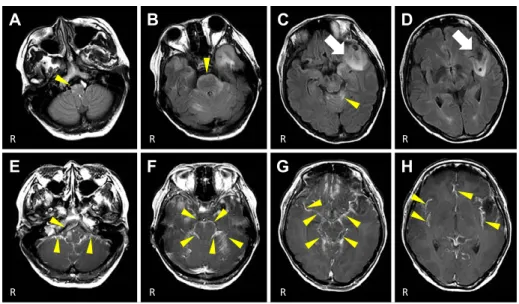
臨床神経学 60 巻 5 号(2020:5) 60:352 陰性であった. 臨床経過:特徴的な皮疹及び神経学的所見から,下位胸髄~ 腰髄レベルの VZV 関連脊髄炎と考え,ACV 500 mg × 3 回 / 日 投与を開始し,タクロリムスは中止した.同日夜に全身痙攣 が出現し,頭部 CT で左側頭極に脳出血を認め(Fig. 2A~C), レベチラセタム 1,000 mg/ 日の点滴静注を開始した.以後も JCS 2桁の意識障害が遷延したため,翌発症 6 日目朝に頭部・ 全脊椎 MRI を施行した.頭部では延髄右側を中心とした脳幹 や両側側頭葉に FLAIR 高信号域を認め,大脳や小脳,脳幹の 表面には軟髄膜に沿った増強効果を認めた(Fig. 3).脊髄で は T2 以下の髄内に T2高信号域と造影増強効果を認め,脊髄 表面に沿った造影増強効果も広汎に認めた(Fig. 4).同日日 中の神経診察では,瞳孔は 3 mm 大の正円同大で対光反射も 認めたが,下肢の筋トーヌスは低下,腱反射は消失し, Babinski反射陰性.痛み刺激に対する反応もみられなかった. 髄液検査では,初圧 200 mmH2O,黄色でキサントクロミーあ り,白血球 54/μl(単核球 42.4%,多形核球 57.6%),赤血球 1,206/μl,蛋白 1,192 mg/dl,糖 204 mg/dl(血糖 304 mg/dl)と細 胞・蛋白の増多に加え,脳出血を反映したと思われる赤血球 を多数認めた.細胞診は Class II,各種細菌・真菌・抗酸菌の 塗抹・培養検査は陰性であった.同日夕に突如心肺停止に至 り,蘇生術により 12 分後に心拍は再開したが自発呼吸は回復 せず,人工呼吸器を装着した.頭部 CT では右側頭葉に新規 の脳出血が出現し,皮髄境界は保たれているものの,脳幹は 浮腫状で低信号になっていた(Fig. 2D~F).ACV 投与を継続し たままステロイドミニパルス療法(メチルプレドニゾロン 500 mg/日 × 3 日)を開始した.併せて,誤嚥性肺炎を合併 したため抗生剤と大量免疫グロブリン静注療法を,脳浮腫予 防に抗浮腫薬を始めた.発症 7 日目には左瞳孔が散大固定し, その他の脳幹反射も消失した.同日の頭部 CT では左側頭葉 前部の出血巣が拡大するとともに,左帯状回や左海馬傍回に 低信号域が出現し新規脳梗塞が疑われた.脳幹の腫大・低信 号は増悪した(Fig. 2G~I).脳波検査では様々な周波数の波 形が混在していたものの,刺激に対する反応を認めず,聴性 脳幹反応でも 100 dB 刺激で III 波以降を認めなかったため, 脳幹死の状態と考えた.発症 10 日目には右前腕尺側にも皮疹 が出現し,播種性帯状疱疹の状態と考えた.発症 14 日目に髄 液中 VZV-IgG 陽性,VZV-DNA 陽性(9 × 10⁶ copy/ml)が判
明し,VZV 関連脳脊髄炎及び VZV 関連脳血管炎と診断した. 他のヘルペス属ウイルスの髄液中 DNA は陰性であった.次 第に全身状態が悪化し発症 17 日目に死亡した.その後御家族 の同意のもと,開頭なしの病理解剖を施行した. 肉眼所見としては,脊髄前面では前脊髄動脈のうっ血があ り,後面は脳室から流入した血液の付着を認めた.上位胸髄 は組織が柔らかく,横断性壊死に陥っていた.上位胸髄は脳 圧亢進及び人工呼吸器脳症に伴う急性期の融解壊死が顕著で Fig. 1 Shingles involving the right Th10 and Th12 dermatomes.
The images show (A) shingles in the right Th10 dermatomes, and (C) isolated skin rash in the Th12 dermatomes. (B) Magnified view of the shingles shown in (A). These images were taken the day after admission. *Umbilicus. C: caudal direction.
VZV関連脳脊髄炎の剖検例 60:353
Fig. 2 Longitudinal changes of brain CT findings.
(A–C) CT scan obtained on the evening of day 5 shows hemorrhagic changes surrounded by low density areas suggesting edema in the left temporal lobe (arrow in B). (D–F) CT scan obtained on the evening of day 6 shows new hemorrhagic changes with edema in the right temporal lobe (arrow in E), and uncal herniation with low density change in the brain stem (arrowhead). (G–I) CT scan obtained on day 7 shows multiple low density lesions (*) suggesting infarction. Uncal herniation and edematous change of brainstem developed (arrowhead in E and H).
Fig. 3 MRI findings of the brain on the morning of day 6.
(A–D) FLAIR images (3.0 T; axial, TR/TE = 10,000/120) show hyperintense areas on the surface of the brainstem and in the cerebellum (arrowhead), and a mixed hypo- and hyperintensity mass with edema in the left temporal lobe (arrow). (E–H) Gadolinium-enhanced T1-weighted
images (3.0 T; axial, TR/TE = 465/21) show diffuse meningeal enhancement along the surface of the cerebrum (especially on the frontal and temporal lobes), cerebellum, and brainstem.
臨床神経学 60 巻 5 号(2020:5) 60:354
Fig. 4 MRI findings of the spinal cord on the morning of day 6.
(A–D) T2-weighted images (3.0 T; sagittal, TR/TE = 2,500/70) show longitudinally extensive spinal cord lesions (arrow) from the level of the
second thoracic vertebral body (T2) to the lumbar spine. (C) Magnified view of the spinal cord at the level of the lower thoracic vertebrae (boxed area in (B)). Axial T2-weighted images (E–G; 3.0 T; axial, TR/TE = 3,000/64) show intramedullary hyperintensity lesions at the levels
of T2/3 (E), T8 (F) and T12 (G). (H–K) Gadolinium-enhanced T1-weighted images (3.0 T; sagittal, TR/TE = 430/13) reveal diffuse meningeal
enhancement along the surface of the spinal cord (arrowhead). Some parts of the intramedullary lesions are enhanced (arrows in I, J). (I) Magnified view of the spinal cord from the lower level of the cervical vertebrae to the upper level of the thoracic vertebrae (boxed area in (H)).
Fig. 5 Autopsied findings of spinal cord at the level of Th10.
(A) Hematoxylin and eosin staining shows transverse necrosis of the thoracic cord. (B) Axonal spheroids are present in the white matter around the anterior spinal artery. (C) Varicella zoster virus (VZV)-immunopositive structures are present in the white matter around the anterior spinal artery. (D, E) Leukocyte-common antigen (LCA)-positive lymphocytes (D) and CD68-positive macrophages (E) in the vascular walls of the anterior spinal artery and surrounding veins, consistent with the findings of vasculitis. Scale bars = 2 mm (A, D), 200 μm (B, C and E).
VZV関連脳脊髄炎の剖検例 60:355 一部残存する神経細胞も虚血性変化を認め,血管はフィブリ ノイド壊死を起こしていた.一方,下位胸髄では上位胸髄で 見られた急性期の融解壊死に加え,前脊髄動脈周囲に軸索変性 所見である axonal spheroid が観察され亜急性期の病態も伴っ ていた(Fig. 5A, B).同部位では前脊髄動脈周囲の白質内に VZV免疫染色陽性細胞を確認した(Fig. 5C).前脊髄動脈や 周囲静脈の血管壁には明らかな VZV 免疫染色陽性所見を認 めなかったが,leukocyte common antigen(LCA)ないし CD68 免疫染色陽性の単核細胞浸潤を認め(Fig. 5D, E),血管炎の 所見であった.脊髄後根神経節では神経細胞の萎縮,脱落 (Fig. 6A)と強い炎症細胞浸潤がみられ(Fig. 6B, C),VZV 免 疫染色では萎縮した神経細胞の一部に加え,周囲の衛星細胞 やマクロファージに陽性所見が確認された(Fig. 6D).他臓 器には血管炎の所見は認めなかった. 考 察 VZVは一般的に気道を通して感染し,顕性感染として水痘 を発症したり,不顕性感染を来したりする.その後,脳神経 や後根神経節,自律神経節に潜伏感染し,再活性化すると神 経支配域に一致する帯状疱疹を発症する.しかし免疫抑制薬 内服,SLE などのリスク下で VZV が再活性化すると,本症例 のように帯状疱疹にとどまらず,脳血管炎や脊髄炎などの中 枢神経合併症を来すことがある1)~3). VZV関連脳血管炎は,大血管や小血管を障害し,本症例のよ うに脳梗塞のみならず脳出血を来し,多発することもある8)9). VZV関連脊髄炎は皮疹レベルの対麻痺や感覚障害,膀胱直腸 障害を呈することが多いが,本症例のように Brown-Séquard 症候群で発症することもある10).本症例は帯状疱疹を認めた ことで,早期に診断し治療を開始できたが,血管炎発症前に 皮疹が出現するのは約 60%のみで,皮疹を呈さない例もあり 注意が必要である8)9).髄液検査では約 70%の患者で単核球 優位の細胞数増加を認める.髄液中の PCR による VZV-DNA 陽性率は 40~50%,VZV-IgG の陽性率は 90%以上と報告され ている.これは検査が遅れるに従い VZV-DNA 陽性率が下が るためと考えられる8)9).そのため VZV 関連血管炎を疑う際 は VZV-DNA と VZV-IgG 両方を測定する必要がある8)11).本 症例では発症 6 日目の髄液検査で VZV-IgG,VZV-DNA ともに 陽性であった. VZV関連脳血管炎及び関連脊髄炎では,病理学的には組織 の強い壊死と出血,脱髄に加え,血管内膜の肥厚と血管外膜 への炎症細胞浸潤が特徴である10)12)~14).HE 染色では感染し た細胞内に好酸性の Cowdry A 型核内封入体を認め,免疫染 色により感染細胞が血管壁に確認される10)12)~15).本症例で は脊髄,後根神経節において血管炎の所見に加え前脊髄動脈 周囲及び後根神経節の衛星細胞やマクロファージ内に VZV 免疫染色陽性細胞を認め,VZV 関連血管炎・脊髄炎に矛盾し ない所見であった.一方で,血管壁に VZV 免疫陽性細胞は認 めず,後根神経節から脊髄に伸展する際にまず障害される後 索10)由来の深部感覚障害や画像上の後索病変も乏しかったこ
Fig. 6 Microscopic findings of a varicella zoster virus (VZV)-infected left dorsal root ganglion at the level of L2.
(A) Hematoxylin and eosin staining shows neuronal atrophy and Nageotte nodules. (B, C) Immunohistochemistry shows that infiltrating immune cells in the lesion are positive for leukocyte-common antigen (LCA) (B) and CD68 (C). (D) VZV-immunopositive structures are present within the atrophic neurons, which are surrounded by satellite cells and infiltrating macrophages. Scale bar = 200 μm (A–C), 50 μm (D).
臨床神経学 60 巻 5 号(2020:5) 60:356 とが本例の特徴である.病理学的な VZV の検出率は高くなく9), 血管壁に VZV 抗原を認めなかったのは偽陰性の可能性もあ る.しかし,他にも後索症状を欠く VZV 関連脊髄炎の報告が あり血管障害による病態が考察されている16).このことから, 本例での脊髄障害は VZV の脊髄への直接浸潤よりむしろ免 疫応答による血管炎の影響が大きいと考えた. 治療は ACV 10~15 mg/kg の静注を 1 日 3 回,2 週間以上行 うことが推奨されている.副腎皮質ステロイド使用には賛否 両論があるものの,慣例的に使用されることも多い8)17).VZV 関連血管炎の報告例では 10~20%が死亡し8)9),脊髄炎例で も免疫抑制患者では致死的となりえる10).本症例では入院時 より ACV 静注を開始したが,病勢が強くコントロール困難で あった.そのため発症前の予防も重要と考えられる.日本で は 50 歳以上を対象に帯状疱疹の予防を目的とした弱毒化生 ワクチンが承認されているが,生ワクチンであるため本症例 のような免疫抑制薬内服中の高リスク症例へは禁忌とされて いる18).近年,生ワクチンでないサブユニットワクチンが開 発され,2018 年 3 月に 50 歳以上を対象とした帯状疱疹の予 防目的に国内製造販売が承認された19)~21).さらに 18 歳以上 の自家造血幹細胞移植施行者における安全性・有効性も示さ れたことから22)23),今後免疫抑制状態にある人全般に対する 予防効果の知見の蓄積・適応拡大が期待される. 以上,SLE と免疫抑制薬内服を背景とし,致死的な転帰を 辿った VZV 関連血管炎及び脊髄炎の 1 例について剖検所見を 含め報告した.免疫抑制下で VZV の再活性化が起きると脳血 管炎,脳脊髄炎などを合併し,急速に病状が悪化して死に至 ることがあるため,早期に VZV の関与を疑い治療を開始する ことが重要である.また近い将来には有効な予防法の確立も 期待される. ※著者全員に本論文に関連し,開示すべき COI 状態にある企業,組 織,団体はいずれも有りません. 文 献
1) Schmader KE, Dworkin RH. Natural history and treatment of herpes zoster. J Pain 2008;9:S3-9.
2) Gilden DH, Kleinschmidt-Demasters BK, Laguardia JJ, et al. Neurologic complications of the reactivation of varicella-zoster virus. N Engl J Med 2000;342:635-645.
3) Nagel MA, Gilden D. Complications of varicella zoster virus reactivation. Curr Treat Options Neurol 2013;15:439-453. 4) Thomas SL, Hall AJ. What does epidemiology tell us about risk
factors for herpes zoster? Lancet Infect Dis 2004;4:26-33. 5) Weinberg A, Lazar AA, Zerbe GO, et al. Influence of age and
nature of primary infection on varicella-zoster virus-specific cell-mediated immune responses. J Infect Dis 2010;201:1024-1030. 6) Hata A, Kuniyoshi M, Ohkusa Y. Risk of herpes zoster in
patients with underlying diseases: a retrospective hospital-based cohort study. Infection 2011;39:537-544.
7) Forbes HJ, Bhaskaran K, Thomas SL, et al. Quantification of risk factors for herpes zoster: population based case-control study. BMJ 2014;348:g2911.
8) Nagel MA, Cohrs RJ, Mahalingam R, et al. The varicella zoster virus vasculopathies: clinical, CSF, imaging, and virologic features. Neurology 2008;70:853-860.
9) González-Suárez I, Fuentes-Gimeno B, Ruiz-Ares G, et al. Varicella-zoster virus vasculopathy. A review description of a new case with multifocal brain hemorrhage. J Neurol Sci 2014;338:34-38.
10) Devinsky O, Cho ES, Petito CK, et al. Herpes zoster myelitis. Brain 1991;114:1181-1196.
11) Nagel MA, Forghani B, Mahalingam R, et al. The value of detecting anti-VZV IgG antibody in CSF to diagnose VZV vasculopathy. Neurology 2007;68:1069-1073.
12) Nagel MA, Traktinskiy I, Azarkh Y, et al. Varicella zoster virus vasculopathy: analysis of virus-infected arteries. Neurology 2011;77:364-370.
13) Nagel MA, Traktinskiy I, Stenmark KR, et al. Varicella-zoster virus vasculopathy: immune characteristics of virus-infected arteries. Neurology 2013;80:62-68.
14) Berth S, Carbunar O, Yang NS, et al. Varicella-zoster virus encephalomyelitis with a prominent demyelinating component. Neuropathology 2015;35:587-591.
15) Fukumoto S, Kinjo M, Hokamura K, et al. Subarachnoid hemorrhage and granulomatous angiitis of the basilar artery: demonstration of the varicella-zoster-virus in the basilar artery lesions. Stroke 1986;17:1024-1028.
16) 別所 恵,中嶋秀人,伊藤 巧ら.帯状疱疹後に不完全型 Brown-Séquard症候群を呈した1例.臨床神経 2010;50:175-177. 17) Gilden D, Cohrs RJ, Mahalingam R, et al. Varicella zoster virus
vasculopathies: diverse clinical manifestations, laboratory features, pathogenesis, and treatment. Lancet Neurol 2009;8:731-740. 18) 乾燥弱毒生水痘ワクチン「ビケン」添付文書[Internet].大
阪:田辺三菱製薬;2018 Nov. [cited 2019 Jul 7]. Available from: https://medical.mt-pharma.co.jp/di/file/dc/bsi.pdf
19) Lal H, Cunningham AL, Godeaux O, et al. Efficacy of an adjuvanted herpes zoster subunit vaccine in older adults. N Engl J Med 2015;372:2087-2096.
20) Cunningham AL, Lal H, Kovac M, et al. Efficacy of the herpes zoster subunit vaccine in adults 70 years of age or older. N Engl J Med 2016;375:1019-1032.
21) 帯状疱疹ワクチン「シングリックス ® 筋注用」承認取得の お知らせ[Internet].東京:ジャパンワクチン株式会社;グ ラクソ・スミスクライン株式会社;2018 Mar 23. [cited 2019 Jul 7]. Available from: https://jp.gsk.com/jp/media/press-releases/ 2018/20180323_shingrix-approval/
22) Stadtmauer EA, Sullivan KM, Marty FM, et al. A phase 1/2 study of an adjuvanted varicella-zoster virus subunit vaccine in autologous hematopoietic cell transplant recipients. Blood 2014;124:2921-2929.
23) New data supports the safety and efficacy of GSK’s Shingrix in preventing shingles in autologous haematopoietic stem cell transplant patients [Internet]. London: GlaxoSmithKline; 2017 Dec 6. [cited 2019 Jul 7]. Available from: https://www.gsk.com/ en-gb/media/press-releases/new-data-supports-the-safety-and- efficacy-of-gsk-s-shingrix-in-preventing-shingles-in-autologous-haematopoietic-stem-cell-transplant-patients/
VZV関連脳脊髄炎の剖検例 60:357
Abstract
An autopsied case of severe varicella zoster virus-associated encephalomyelitis
under immunosuppressant therapy
Yasuhiro Maeda, M.D.
1), Mitsuru Watanabe, M.D., Ph.D.
1), Norihisa Maeda, M.D., Ph.D.
1)2),
Hidenori Ogata, M.D., Ph.D.
1), Koji Shinoda, M.D., Ph.D.
1), Toru Iwaki, M.D., Ph.D.
2)and Jun-ichi Kira, M.D., Ph.D.
1)1)Department of Neurology, Neurological Institute, Graduate School of Medical Sciences, Kyushu University 2)Department of Neuropathology, Neurological Institute, Graduate School of Medical Sciences, Kyushu University