1
1) 動脈硬化関連因子が好中球の活性酸素種産生量に及ぼす影響
1
Influence of atherosclerosis-related biomarkers on neutrophil basal reactive oxygen species
2
production in the general population
3 4
2)著者:
5
和田尚子1,2,高橋一平1,佐藤 諭1,秋元直樹1,田中里奈1,渡邉清誉3,
6
平川美和子1,大圃 研1,榊原 毅1,中路重之1
7
Authors
8
Naoko Wada1,2, Ippei Takahashi 1, Satoshi Sato 1, Naoki Akimoto 1, Rina Tanaka 1, Watanabe
9
Kiyotaka3 , Miwako Hirakawa 1, Ken Ohata1, Takeshi Sakakibara 1, Shigeyuki Nakaji 1
10 11
3)所属:
12
1弘前大学大学院医学研究科社会医学講座 13
2弘前大学大学院医学研究科形成外科学講座 14
3弘前大学大学院医学研究科消化器血液内科学講座 15
Institution 16
1Department of Social Medicine, Hirosaki University Graduate School of Medicine 17
2Department of Plastic and Reconstructive Surgery, Hirosaki University Graduate School of Medicine 18
3Department of Gastroenterology and Hematology, Hirosaki University Graduate School of Medicine 19 20
4)原著
21 22
5) Running head:
23
atherosclerosis-related biomarkers on neutrophil basal ROS production
24 25
6) 責任著者:高橋一平
26
036-8562 青森県弘前市在府町5 弘前大学大学院医学研究科社会医学講座
27
TEL: 0172-39-5041, FAX: 0172-39-5038, e-mail:[email protected]
28 29
7)責任著者代理:和田尚子
30
036-8563 青森県弘前市本町53 弘前大学医学部付属病院 形成外科
31
TEL: 0172-39-5119, FAX: 0172- e-mail: [email protected]
32 33
8)希望別刷部数:50部
34 35 36 37 38 39 40 41 42 43 44 45 46 47 48 49
2 Introduction
1
Cardiovascular diseases (CVD), including myocardial infarction, angina, and stroke are the
2
leading causes of death worldwide1). According to the WHO, approximately one-third of
3
worldwide mortality in 2012 was attributed to CVD2). In addition, one-fourth of the causes of
4
long-term care is caused by CVD in Japan3). Arteriosclerosis is the pathological process that
5
causes CVD. Therefore, arteriosclerosis can be considered as the maximum risk factor for life
6
and quality of life (QOL), and its prevention and protection are important issues.
7
Dyslipidemia, diabetes, and hypertension are major risk factors for arteriosclerosis. Many
8
studies have reported on how these diseases increase the daily production of reactive oxygen
9
species (ROS) and cause oxidative stress, which result in the impairment of blood vessel
10
function 4-6). Additionally, obesity is associated with these diseases and is an independent risk
11
factor for CVD. However, no previous studies have shown how rise in obesity and serum lipid,
12
blood glucose, or blood pressure levels influence the daily ROS production in healthy adults.
13
Despite increases in the daily oxidative stress levels, the mechanisms by which these are
14
achieved still remain unclear. Therefore, adequate health promotion strategies cannot be
15
implemented, as objective measures of oxidative stress for the suppression of arteriosclerosis
16
in healthy people are still unclear.
17
While ROS are produced by almost all cells, white blood cells, especially neutrophils,
18
produce a large amount of ROS 7) as a part of reactions against foreign bodies. However, they
19
continuously produce ROS even in the absence of a foreign body in a process known as basal
20
ROS production. Basal ROS production by neutrophils increases the oxidative stress and may
21
promote atherosclerosis 8)9). Nevertheless, while previous studies have focused on ROS
22
production as a reaction against foreign bodies, there is only a limited number of studies on
23
basal ROS production. Therefore, in order to elucidate the mechanisms of initial
24
arteriosclerosis progression, it is important to investigate the relationship between
25
3
atherosclerosis-related biomarkers (i.e., obesity levels, serum lipid levels, blood glucose
1
levels and blood pressure) and basal ROS production in healthy subjects.
2
Few studies have measured basal ROS production with only several dozen of samples in
3
the past. There are other studies that had similar sample sizes as the present study 10) however,
4
we are the first research that collected and analyzed whole blood. In addition, arteriosclerosis
5
is a typical multifactorial disease, caused by various related factors. Therefore, in such studies,
6
epidemiological studies that consider the influence of various factors are more important than
7
experimental studies 11). The present study consisted approximately 1000 adults aged between
8
20 and 80 years from the general population, and the influence of atherosclerosis-related
9
biomarkers on neutrophil basal ROS production was evaluated from their basal ROS
10
production in whole blood samples.
11 12
Investigation Method
13
Participants
14
Eight hundred and nine male and female participants were included in the 2011 Iwaki
15
Health Promotion Project. This project included participants living in the Iwaki region of
16
Hirosaki City in the Aomori Prefecture in northern Japan. The purpose of this project was to
17
maintain and promote physical and mental health of the local community in order to prevent
18
lifestyle-related diseases and prolong their lifespans. Approval for the study was obtained
19
from the Ethics Committee of the Hirosaki University School of Medicine, and all subjects
20
provided their written informed consent prior to the research project.
21
A total of 378 participants (142 males and 236 females) were enrolled in the present study.
22
Participants with diabetes mellitus (diagnosed by a medical doctor), malignant tumors,
23
immune disorders, ischemic heart disease, cerebral infarction, or those who were currently
24
taking immunosuppressive agent, hypolipidemic agent, antidiabetic drug or hormones, and
25
4
those who have missing values or measurement items were excluded from the study. Those
1
with triglyceride levels of ≥ 400 mg/dL, low-density lipoprotein (LDL) cholesterol level of ≥
2
140 mg/dL, high-density-lipoprotein (HDL) cholesterol level of ≤ 40 mg/dL, HbA1c level of
3
≥ 6.1% and fasting blood glucose level of ≥ 125 mg/dL were also excluded.
4 5
Lifestyle habits and physical measurements
6
Self-reported questionnaires were sent to subjects prior to the investigation and were
7
collected after reviewing the answers during personal interviews on the day of the study. In
8
the questionnaire, subjects were asked about their age, gender, current and past illnesses,
9
menopause status, medication histories, smoking habits, alcohol use and exercise habits. Body
10
mass index [BMI, weight (kg)/height (cm)2] and waist circumference were calculated and
11
measured as an index of obesity. In addition, systolic blood pressure, diastolic blood pressure
12
and brachial-ankle pulse wave velocity (baPWV) were measured to assess arterial stiffness.
13 14
Blood parameters
15
Blood samples were collected peripherally after a period of fasting in the early morning.
16
Neutrophil counts were measured using an automated blood cell analyzer (SE9000; Sysmex,
17
Kobe, Japan). The measurements of total and HDL cholesterol, blood glucose and HbA1c
18
levels were consigned to the Mitsubishi Chemical Medience after serum was separated from
19
whole blood by centrifugation. Total cholesterol and HDL cholesterol levels were measured
20
using enzymatic methods. LDL cholesterol was calculated using Friedewald formula (LDL
21
cholesterol = Total cholesterol - HDL cholesterol - Triglyceride/5). Blood glucose level
22
was measured according to the established methods adopted by the Japan Diabetes Society
23
(JDS). The National Glycohemoglobin Standardization Program (NGSP) value conversion
24
expression stipulated by the Japan Diabetes Society was then calculated accordingly (NGSP
25
5
value = 1.02 × JDS value ( % ) + 0.25% ). We performed analyses in this study using the JDS
1
value.
2 3
ROS generation in peripheral blood neutrophils
4
Neutrophil functions and basal, nonstimulated ROS production were measured with
5
FAC-Scan (Becton Dickinson, San Jose, CA, USA) using the two-color method. ROS
6
production was measured using the ROS-reacting fluorescent agent, hydroethidine (HE;
7
Polyscience Inc., Warrington, PA, USA). In brief, 44 μL of 8 µm hydroethidine (Polyscience)
8
was added to 200 μL aliquots of heparinized whole blood and then incubated at 37°C for
9
5 min. After incubation, 1 mL of a hemolytic agent was added to each sample and mixed well.
10
After confirming hemolysis of red blood cells, 250 μL of fixative (Polyscience) was added to
11
the samples, and the solution was allowed to stand for 5 min. The samples were then washed
12
twice in phosphate-buffered saline containing sodium azide, followed by the addition of 50
13
µL of 5% paraformaldehyde.
14
Using flow cytometry, neutrophils were irradiated with a 488-nm laser beam generated
15
from a 15-mW argon laser with forward- and side-scattering emission, which was
16
simultaneously recorded. Green fluorescence generated from FITC was detected through a
17
530-nm filter, and orange fluorescence generated from HE was detected through a 585-nm
18
filter. Fluorescence intensity was measured as the value of neutrophils per 10,000 screened
19
from the forward- and side-scattering emission for each sample. Cumulative fluorescence
20
intensity (CFI), i.e., sum of the values of fluorescence intensity (FI) multiplied by the number
21
of positive cells per 10,000 (‱), was used as a quantitative index.
22 23
Statistical analysis
24
Statistical analyses were carried out after participants were divided into two groups on the
25
6
basis of gender. The relationship between neutrophil functions and the atherosclerosis-related
1
biomarkers, (i.e., BMI and waist circumference, and total cholesterol, LDL cholesterol, HDL
2
cholesterol, fasting blood glucose and HbA1c levels as well as systolic and diastolic blood
3
pressures and baPWV) were analyzed using multiple regression analysis. The statistical
4
models were adjusted for age, BMI, cigarette smoking, alcohol use, exercise frequency,
5
hypotensive drug intake and menopause status.
6
Furthermore, we categorized subjects into five groups according to HDL cholesterol levels
7
(40–54 mg/dL, 55–69 mg/dL, 70–84 mg/dL, 85–100 mg/dL, and >100 mg/dL) and compared
8
the total basal ROS production between groups using an analysis of covariance (ANCOVA).
9
We then corrected the values for age, BMI, smoking, alcohol use, exercise habits, hypotensive
10
drug intake and menopause status, and used the Bonferroni method for multiple comparisons.
11
Data analyses were performed using the Statistical Package for the Social Sciences (SPSS)
12
version 18.0 J statistical software (SPSS Inc., Chicago, IL, USA). The differences were
13
considered statistically significant when p < 0.05.
14 15
Results
16
Blood biochemical values and physical characteristics of participants and their lifestyle
17
habits are listed in Table 1. The average age was 54.9 ± 14.4 for male and 52.9 ± 14.3 for
18
female participants. Average BMI, waist circumference, blood pressure, and baPWV were
19
both significantly higher in male than in female participants. Although smoking and drinking
20
habits were more common in male participants, gender differences in exercise habits were not
21
observed. Postmenopausal female patients comprised 66.2% of the study population. Blood
22
biochemical values are listed in Table 2. The average HDL cholesterol level was significantly
23
higher in female participants than male participants, while the average fasting blood glucose
24
level was significantly higher in male than female patients. Although the average basal ROS
25
7
production per active cell was significantly higher in women, we did not identify significant
1
differences in total basal ROS production.
2 3
Influence of atherosclerosis-related biomarkers on neutrophil basal ROS production
4
Multiple regression analysis for male participants revealed the absence of correlation
5
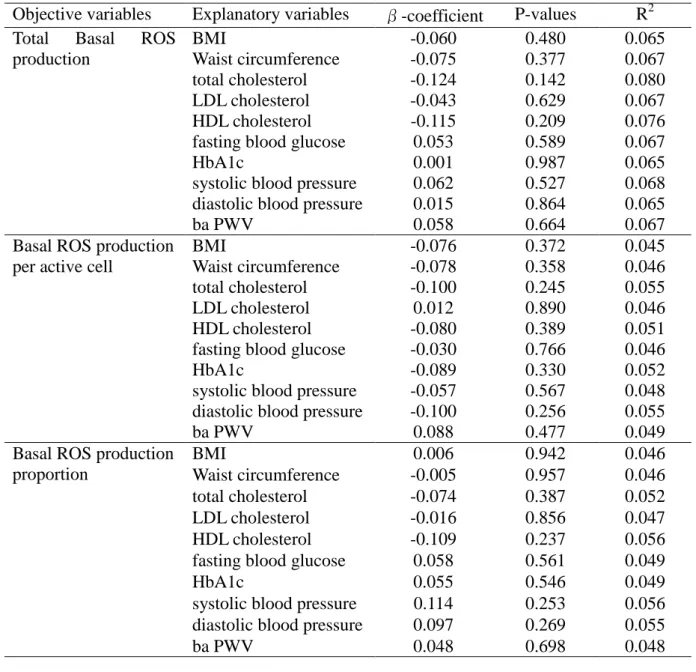
between neutrophil function and atherosclerosis-related biomarkers among males (Table 3).
6
On the other hand, a positive correlation between total basal ROS production and basal ROS
7
production per active cell for both total cholesterol and HDL cholesterol levels (for total basal
8
ROS production: total cholesterol p=0.002, HDL cholesterol p<0.001; for basal ROS
9
production per active cell: total cholesterol p=0.021, HDL cholesterol p=0.016) was
10
demonstrated among female participants. A positive correlation was also revealed between
11
basal ROS production per active cell and fasting blood glucose levels (p=0.03) (Table 4).
12
For the analysis of covariance, total basal ROS production was significantly higher in the
13
group with HDL cholesterol levels of 100 mg/dL or more than in other groups (HDL
14
cholesterol levels > 100 mg/dL: 40–54 mg/dL p=0.001, 55–69 mg/dL p=0.008, 70–84 mg/dL
15
P=0.02) (Figure 1).
16 17
Discussion
18
This is the first epidemiological study on the association between basal neutrophil ROS
19
production and obesity, serum lipid, blood glucose and blood pressure levels, among healthy
20
subjects.
21
In this study, no significant relationship was detected between obesity levels and basal ROS
22
production. Although previous studies have shown elevated neutrophil count 12)13) and
23
increased neutrophil activity among obese patients 14)15), there have been very few reports on
24
basal ROS production in obese subjects with adequate sample sizes. In addition, while there
25
8
have been reports linking obesity and ROS production among neutrophils 16), another report
1
failed to show a relationship 17), highlighting the diversity in opinions. In those studies
2
reporting neutrophil hyperactivity in obese individuals, the study populations consisted of
3
highly obese subjects (BMI ≧30kg/m2 or the average BMI of 30~35 kg/m2) 14-16). In our
4
study, because the average BMI was low (22.9±2.7 kg/m2 in male and 21.9±3.1 kg/m2 in
5
female) and more than 98% of calculated BMI were ≤30 kg/m2, we believe that correlation
6
between obesity and neutrophil function was not easily demonstrated.
7
Previous studies have reported positive correlations between basal ROS production in
8
neutrophils and LDL-C levels 18-21). In all of these studies, except those conducted in vivo
9
19)20)
, there were small sample sizes, and neutrophil function was not evaluated using whole
10
blood. The mechanism proposed involves an increase in the Ox-LDL levels generated by LDL
11
increase ROS production of neutrophils 22)23). However, since subjects with LDL-C ≥ 140
12
mg/dL were excluded from the study, generation of oxLDL was suppressed and no correlation
13
was demonstrated between LDL-C and basal ROS production of neutrophils.
14
It has been reported that HDL-C also reduces basal ROS production of neutrophils 19)24)25),
15
while some studies that have reported the absence of an association between the two 26). In
16
these studies, only the (19) basal ROS production was measured, but separating neutrophils
17
had used in this study as previously described. On the other hand, even with HDL-C
18
concentrations of up to 100 mg/dL, no correlation was demonstrated with ROS production in
19
our study. ROS production was higher with HDL-C concentrations of 100 mg/dL or more in
20
women compared to that in other groups. HDL-C also has antioxidant, anti-inflammatory
21
properties 27-29). However, it has recently been recognized that the presence of dysfunctional
22
HDL can enhance inflammation 30-32). In addition, when HDL-C levels are very high, the
23
possibility of increased production of dysfunctional HDL-C also increases 33). Patients with
24
very high HDL-C have an increased risk of atherosclerosis and cardiovascular disease 34-36). In
25
9
addition, Dysfunctional HDL-C reported increases ROS production significantly compared
1
with normal HDL-C by activating NADPH oxidase 37). Therefore, if HDL-C is more than 100
2
mg/dL in women, it also increases basal ROS production and subsequent oxidative stress.
3
Although positive correlation was observed between total cholesterol and basal ROS
4
production this was likely due to the effect of HDL cholesterol as one of the fractions of total
5
cholesterol.
6
A study investigating the relationship between blood glucose levels and basal ROS
7
production of neutrophil in non-diabetics has demonstrated positive correlation between blood
8
glucose, HbA1c and basal ROS production of neutrophils 38). Although our study has shown a
9
similar result, there was no correlation shown between ROS production and HbA1c. As this
10
factor, it was conceived the impact of the choice of subject. While Saito et al. excluded only
11
diabetics with HbA1c≥6.1% 38), we also excluded persons with fasting blood glucose levels
12
≥125 mg/dL. Therefore, correlation is difficult to demonstrate between HbA1c and basal ROS
13
production of neutrophil in patients who are in a healthier state. However, given the
14
correlation tendency between blood glucose and basal ROS production of neutrophil shown in
15
this study, blood glucose management is important in oxidative stress.
16
In this study, an association between baPWV, which is significantly related to blood
17
pressure and reflects the degree of arteriosclerosis, and basal ROS production of neutrophil,
18
has not demonstrated. No previous studies have evaluated the neutrophil basal ROS
19
production in whole blood as well as the relationship between ROS production in immune
20
cells 10)39)40). On the other hand, significant differences in ROS production between patients
21
with hypertension and without hypertension was not observed. No correlation between ROS
22
production of neutrophil and mean arterial pressure (which reflects the degree of
23
arteriosclerosis) has been reported 40). Because hypertension and arteriosclerosis are
24
phenomena caused by oxidative stress and are multi-factor in nature, correlation was difficult
25
10
to demonstrate during basal ROS production of neutrophils.
1
In this study, a significant association of the relationship between the
2
arteriosclerosis-related factors and basal ROS production of neutrophil was only seen in
3
female participants. A limitation of this study is that clear reasons for the gender differences
4
observed could not be ascertained because of the absence of sex hormones level
5
measurements. Previous studies have suggested neutrophil function activation by the female
6
hormone 41). In addition, the relationship between glucose metabolism and neutrophils basal
7
ROS production was only seen in women 38). On the other hand, there were only four male
8
participants with HDL-C of 100 mg/dL or more in this study. Therefore, we considered that a
9
significant correlation between HDL-C and basal ROS production of neutrophil was only
10
observed in female participants.
11 12
Conclusion
13
We investigated the relationship between atherosclerosis-related biomarkers and basal ROS
14
production of neutrophils among healthy subjects with normal levels of
15
arteriosclerosis-related biomarkers. Based on our results, we believe that elevated HDL-C and
16
blood glucose levels in female subjects increase oxidative stress by enhancing the basal ROS
17
production of neutrophils. In addition, when HDL-C exceeds 100 mg/dL, basal ROS
18
production of neutrophils increased significantly, which was considered to be disadvantageous
19
for biological functions. Thus, strict control of glycemic and HDL cholesterol levels are
20
extremely important in females. Also, HDL-C levels exceeding 100 mg/dL are considered
21
detrimental to health.
22 23 24 25
11 References
1
1. Taylor F, Huffman MD, Macedo AF, Moore TH, Burke M, Davey Smith G, et al. Statins
2
for the primary prevention of cardiovascular disease. Cochrane Database Syst Rev
3
2013;1:CD004816.
4
2. The top 10 causes of death. [Updated May 2014; cited 6 November ] Available from:
5
http://www.who.int/mediacentre/factsheets/fs310/en/
6
3. Kubota Katsu. Mortality of Long-Term Care Recipients in Japan: The journal of the
7
Association of Insurance Medicine of Japan 2012;110: 211-6
8
4. Singh U, Jialal I. oxidative stress and atherosclerosis. Pathophysiology 2006;13:129-42.
9
5. Jane A. Leopold, and Joseph Loscalzo. Oxidative mechanisms and atherothrombotic
10
cardiovascular disease. Drug Discov Today Ther Strateg 2008;5:5-13.
11
6. Bahorun T, Soobratte MA, Luximon-Ramma V, Aruoma OI. FREE RADICALS AND
12
ANTIOXIDENTS IN CARDIOVASCULAR HEALTH AND DISEASE. Internet Journal
13
of Medical Update 2006;1:25-41.
14
7. Roos D, van Bruggen R, Meischl C. Oxidative killing of microbes by neutrophils.
15
Microbes Infect 2003; 5:1307-15.
16
8. Matés JM. Effects of antioxidant enzymes in the molecular control of reactive oxygen
17
species toxicology. Toxicology 2000;153:83-104.
18
9. Fialkow L, Wang Y, Downey GP. Reactive oxygen and nitrogen species as signaling
19
molecules regulating neutrophil function. Free Radic Biol Med 2007;42:153-64.
20
10. Kenichi Y, Kensaku M, Munehiro N, Junichi Y. Oxidative Stress in Leukocytes Is a
21
Possible Link Between Blood Pressure, Blood Glucose, and C-Reacting Protein.
22
Hypertension 2002;39: 777-80.
23
11. Berenson GS, Srinivasan SR, Bao W, Newman WP 3rd, Tracy RE, Wattigney WA.
24
Association between multiple cardiovascular risk factors and atherosclerosis in children
25
12
and young adults. The Bogalusa Heart Study. N Engl J Med 1998;338:1650-6.
1
12. Dixon JB, O'Brien PE. Obesity and the white blood cell count: changes with sustained
2
weight loss. Obes Surg 2006;16:251-7.
3
13. Herishanu Y, Rogowski O, Polliack A, Marilus R. Leukocytosis in obese individuals:
4
possible link in patients with unexplained persistent neutrophilia. Eur J Haematol
5
2006;76:516-20.
6
14. Nijhuis J, Rensen SS, Slaats Y, van Dielen FM, Buurman WA, Greve JW. Neutrophil
7
activation in morbid obesity, chronic activation of acute inflammation. Obesity
8
2009;17:2014-8.
9
15. Trellakis S, Rydleuskaya A, Fischer C, Canbay A, Tagay S, Scherag A, Bruderek K,
10
Schuler PJ, Brandau S. Low adiponectin, high levels of apoptosis and increased peripheral
11
blood neutrophil activity in healthy obese subjects. Obes Facts 2012;5:305-18.
12
16. Zielińska-Przyjemska M, Olejnik A, Dobrowolska-Zachwieja A, Grajek W. In vitro effects
13
of beetroot juice and chips on oxidative metabolism and apoptosis in neutrophils from
14
obese individuals. Phytother Res 2009;23:49-55.
15
17. Guoda Pilkauskaite, Skaidrius Miliauskas, and Raimundas Sakalauskas. Reactive Oxygen
16
Species Production in Peripheral Blood Neutrophils of Obstructive Sleep Apnea Patients.
17
The Scientific World Journal 2013;2013:421763.
18
18. Couderc R, Bonneau C, Tissot M, Bailleul S, Roch-Arveiller M, Giroud JP. Effects of
19
plasma lipoproteins on the production of superoxide anion by human polymorphonuclear
20
leukocytes in vitro. Biofactors 1997;6:157-63.
21
19. Fernanda B. Araujo, Decio S. Barbosa, Chang Y. Hsin, Raul C. Maranhao, Dulcineia S.P.
22
Abdalla. Evaluation of oxidative stress in patients with hyperlipidemia. Atherosclerosis
23
1995;117:61-71.
24
20. Mazor R, Shurtz-Swirski R, Farah R, Kristal B, Shapiro G, Dorlechter F, et al. Primed
25
13
polymorphonuclear leukocytes constitute a possible link between inflammation and
1
oxidative stress in hyperlipidemic patients. Atherosclerosis 2008;197:937-43
2
21. Sugano R, Matsuoka H, Haramaki N, Umei H, Murase E, Fukami K, et al.
3
Polymorphonuclear leukocytes may impair endothelial function: results of crossover
4
randomized study of lipid-lowering therapies. Arterioscler Thromb Vasc Biol
5
2005;25:1262-7.
6
22. Furukawa S, Fujita T, Shimabukuro M, Iwaki M, Yamada Y, Nakajima Y, et al. Increased
7
oxidative stress in obesity and its impact on metabolic syndrome. J Clin Invest
8
2004;114:1752-61.
9
23. Ryouta Maeba, Akiko Maruyama, Osamu Tarutani, Nobuo Ueta, Hiroyuki Shimasak.
10
Oxidized low-density lipoprotein induces the production of superoxide by neutrophils.
11
FEBS Letters 1995;377(3)27: 309-312(4)
12
24. Kopprasch S, Pietzsch J, Graessler J. The protective effects of HDL and its constituents
13
against neutrophil respiratory burst activation by hypochlorite-oxidized LDL. Molecular
14
and Cellular Biochemistry 2004;258:121-7.
15
25. Fatiha Tabet, Gilles Lambert, Luisa F. Cuesta Torres, Liming Hou, Irene Sotirchos, et al.
16
Lipid-Free Apolipoprotein A-I and Discoidal Reconstituted High-Density Lipoprotein
17
Differentially Inhibit Glucose-Induced Oxidative Stress in Human Macrophages.
18
Arterioscler Thromb Vasc Biol 2011;31:1192-200.
19
26. Blackburn WD Jr, Dohlman JG, Venkatachalapathi YV, Pillion DJ, Koopman WJ, Segrest
20
JP, et al. Apolipoprotein A-I decreases neutrophil degranulation and superoxide production.
21
J Lipid Res 1991;32:1911-8.
22
27. Murphy AJ, Westerterp M, Yvan-Charvet L, Tall AR. Anti-atherogenic mechanisms of
23
high density lipoprotein: effects on myeloid cells. Biochim Biophys Acta
24
2012;1821:513-21
25
14
28. Sakuma N, Saeki T, Ito T, Hibino T, Suzuki S, Kunimatsu M, et al. HDL2 can inhibit
1
further oxidative modification of partially oxidized LDL. J Atheroscler Thromb.
2
2010;17:229-34
3
29. Umemoto T, Han CY, Mitra P, Averill MM, Tang C, Goodspeed L, et al. Apolipoprotein
4
AI and high-density lipoprotein have anti-inflammatory effects on adipocytes via
5
cholesterol transporters: ATP-binding cassette A-1, ATP-binding cassette G-1, and
6
scavenger receptor B-1. Circ Res 2013;112:1345-54.
7
30. Cogny A, Paul JL, Atger V, Soni T, Moatti N. Structural changes of
8
high-density-lipoprotein apolipoproteins following incubation with human
9
polymorphonuclear cells. Eur J Biochem 1994;222:965-73
10
31. Smith JD. Dysfunctional HDL as a diagnostic and therapeutic target. Arterioscler Thromb
11
Vasc Biol 2010;30:151-5
12
32. Ansell BJ, Watson KE, Fogelman AM, Navab M, Fonarow GC High-density lipoprotein
13
function recent advances. J Am Coll Cardiol 2005;46:1792-8.
14
33. Ansell BJ, Navab M, Hama S, Kamranpour N, Fonarow G, Hough G, et al.
15
Inflammatory/Antiinflammatory Properties of High-Density Lipoprotein Distinguish
16
Patients From Control Subjects Better Than High-Density Lipoprotein Cholesterol Levels
17
and Are Favorably Affected by Simvastatin Treatment. Circulation 2003;108:2751-6
18
34. Hirano K, Yamashita S, Nakajima N, Arai T, Maruyama T, Yoshida Y, et al. Genetic
19
cholesteryl ester transfer protein deficiency is extremely frequent in the Omagari area of
20
Japan. Marked hyperalphalipoproteinemia caused by CETP gene mutation is not
21
associated with longevity. Arterioscler Thromb Vasc Biol 1997;17:1053-9.
22
35. Nagano M, Yamashita S, Hirano K, Takano M, Maruyama T, Ishihara M, et al. Molecular
23
mechanisms of cholesteryl ester transfer protein deficiency in Japanese. J Atheroscler
24
Thromb 2004;11:110-21.
25
15
36. van der Steeg WA, Holme I, Boekholdt SM, Larsen ML, Lindahl C, Stroes ES, et al.
1
High-Density Lipoprotein Cholesterol, High-Density Lipoprotein Particle Size, and
2
Apolipoprotein A-I: Significance for Cardiovascular Risk. J Am Coll Cardiol
3
2008;51:634-42
4
37. Wang Y, Ji L, Jiang R, Zheng L, Liu D. Oxidized High-Density Lipoprotein Induces the
5
Proliferation and Migration of Vascular Smooth Muscle Cells by Promoting the
6
Production of ROS. J Atheroscler Thromb 2014;21:204-16.
7
38. Saito Y, Takahashi I, Iwane K, Okubo N, Nishimura M, Matsuzaka M, et al. The influence
8
of blood glucose on neutrophil function in individuals without diabetes. Luminescence
9
2013; 28:569-73
10
39. Fortuño A, Oliván S, Beloqui O, San José G, Moreno MU, Díez J, et al. Association of
11
increased phagocytic NADPH oxidase-dependent superoxide production with diminished
12
nitric oxide generation in essential hypertension. J Hypertens 2004;22:2169-75.
13
40. Kristal B, Shurtz-Swirski R, Chezar J, Manaster J, Levy R, Shapiro G, et al. Participation
14
of peripheral polymorphonuclear leukocytes in the oxidative stress and inflammation in
15
patients with essential hypertension. Am J Hypertens 1998;11:921-8.
16
41. Chiang K, Parthasarathy S, Santanam N. Estrogen, neutrophils and oxidation. Life Sci
17
2004;75:2425-38
18 19 20 21 22 23 24 25
16 Table 1. Characteristics of the participants
1
male n=142
female n=236
Age, years 54.9±14.4 52.9±14.3
BMI, kg/m2 22.9±2.7 21.9±3.1 **
Waist circumference, cm 82.2±7.49 79.4±9.46 **
systolic blood pressure , mmHg 133.5±18.5 127.8±19.5 **
diastolic blood pressure , mmHg 78.1±12 74.7±13 *
baPWV, cm/s 1560.6±373.2 1422.3±353.7 **
Smoker % 30.1 11.4 **
Alcohol drinker % 76.8 31.4 **
Exercise habits (1≤/week), % 32.4 25.0
Menopause, % - 66.2
2 3 4 5 6 7 8 9 10
Table 1.Characteristics of the participants
11
Data are expressed as mean ± standard deviation.
12
BMI, body mass index; ba PWV, brachial-ankle pulse wave velocity.
13
*p<0.05 vs the opposite sex. **p<0.01 vs the opposite sex.
14 15 16 17 18 19 20
17 Table 2. Characteristics of the participants
1
male n=142
female n=236 total cholesterol, mg/dL 192.2±22.8 196.8±24.2 LDL cholesterol, mg/dL 108.6±20.3 110.9±20.1
HDL cholesterol, mg/dL 62.9±14.8 70.7±16.1 *
fasting blood glucose, mg/dL 88.2±10.4 85.2±9.5 *
HbA1c, % (JDS) 5.2±0.3 5.2±0.3
HbA1c, %(NGSP) 5.6±0.3 5.5±0.3
Total Basal ROS production,
CFI 3885.6±3763.5 4508.7±4231.2
Basal ROS production
per active cell, FI 38.6±13.1 43.3±16.8 *
Basal ROS production
proportion, ‱ 101.6±102.2 100.5±79.5
2 3 4 5 6 7 8 9 10
Table 2. Characteristics of the participants
11
Data are expressed as mean ± standard deviation.
12
LDL, Low density lipoprotein; HDL, High density lipoprotein; JDS, Japan Diabetes Society;
13
NGSP, National Glycohemoglobin Standardization Program; ROS, reactive oxygen species.
14
CFI, cumulative fluorescence intensity; FI, fluorescence intensity.
15
*p<0.05 vs the opposite sex. **p<0.01 vs the opposite sex.
16 17 18
18 Table 3.
1
Multiple regression analysis with neutrophil basal ROS production (male)
Objective variables Explanatory variables β-coefficient P-values R2 Total Basal ROS
production
BMI -0.060 0.480 0.065
Waist circumference -0.075 0.377 0.067
total cholesterol -0.124 0.142 0.080
LDL cholesterol -0.043 0.629 0.067
HDL cholesterol -0.115 0.209 0.076
fasting blood glucose 0.053 0.589 0.067
HbA1c 0.001 0.987 0.065
systolic blood pressure 0.062 0.527 0.068 diastolic blood pressure 0.015 0.864 0.065
ba PWV 0.058 0.664 0.067
Basal ROS production per active cell
BMI -0.076 0.372 0.045
Waist circumference -0.078 0.358 0.046
total cholesterol -0.100 0.245 0.055
LDL cholesterol 0.012 0.890 0.046
HDL cholesterol -0.080 0.389 0.051
fasting blood glucose -0.030 0.766 0.046
HbA1c -0.089 0.330 0.052
systolic blood pressure -0.057 0.567 0.048 diastolic blood pressure -0.100 0.256 0.055
ba PWV 0.088 0.477 0.049
Basal ROS production proportion
BMI 0.006 0.942 0.046
Waist circumference -0.005 0.957 0.046
total cholesterol -0.074 0.387 0.052
LDL cholesterol -0.016 0.856 0.047
HDL cholesterol -0.109 0.237 0.056
fasting blood glucose 0.058 0.561 0.049
HbA1c 0.055 0.546 0.049
systolic blood pressure 0.114 0.253 0.056 diastolic blood pressure 0.097 0.269 0.055
ba PWV 0.048 0.698 0.048
2 3 4 5 6
Table 3.Multiple regression analysis with neutrophil basal ROS production (male)
7
There was no correlation between neutrophil function and atherosclerosis-related biomarkers
8
among males.
9
ROS, reactive oxygen species; BMI, body mass index; LDL, Low densty lipoprotein; HDL,
10
High density lipoprotein; baPWV, brachial-ankle pulse wave velocity.
11
19 Table 4.
1
Multiple regression analysis with neutrophil basal ROS production (female)
Objective variables Explanatory variables β-coefficient P-values R2 Total Basal ROS
production
BMI -0.021 0.763 0.046
Waist circumference 0.014 0.839 0.045
total cholesterol 0.214 0.002 0.084
LDL cholesterol 0.085 0.244 0.050
HDL cholesterol 0.257 0.000 0.098
fasting blood glucose 0.126 0.089 0.057
HbA1c 0.088 0.209 0.051
systolic blood pressure 0.037 0.651 0.046 diastolic blood pressure 0.031 0.665 0.046
ba PWV -0.073 0.492 0.048
Basal ROS production per active cell
BMI -0.077 0.273 0.028
Waist circumference -0.019 0.791 0.023
total cholesterol 0.089 0.207 0.035
LDL cholesterol 0.066 0.376 0.032
HDL cholesterol 0.060 0.411 0.031
fasting blood glucose -0.004 0.958 0.028
HbA1c -0.055 0.435 0.031
systolic blood pressure -0.040 0.631 0.029 diastolic blood pressure 0.093 0.872 0.028
ba PWV -0.050 0.624 0.029
Basal ROS production proportion
BMI 0.021 0.764 0.052
Waist circumference 0.048 0.488 0.054
total cholesterol 0.160 0.021 0.074
LDL cholesterol 0.100 0.171 0.060
HDL cholesterol 0.172 0.016 0.076
fasting blood glucose 0.157 0.033 0.071
HbA1c 0.122 0.081 0.065
systolic blood pressure 0.081 0.320 0.056 diastolic blood pressure 0.046 0.516 0.054
ba PWV -0.003 0.975 0.052
2 3 4 5 6 7 8 9
20
Table 4.Multiple regression analysis with neutrophil basal ROS production (female)
1
A positive correlation between total basal ROS production and basal ROS production per
2
active cell for both total cholesterol and HDL cholesterol levels (for total basal ROS
3
production: total cholesterol p=0.002, HDL cholesterol p<0.001; for basal ROS production
4
per active cell: total cholesterol p=0.021, HDL cholesterol p=0.016) was demonstrated among
5
female participants. A positive correlation was also revealed between basal ROS production
6
per active cell and fasting blood glucose levels (p=0.03)
7
ROS, reactive oxygen species; BMI, body mass index; LDL, Low density lipoprotein; HDL,
8
High density lipoprotein; baPWV, brachial-ankle pulse wave velocity.
9 10 11 12 13 14 15 16 17 18 19 20 21 22 23 24 25
21
Figure 1.Covariance analysis of HDL-C levels and basal ROS production in females
1
2 3 4 5 6 7 8 9 10 11
Figure 1. Covariance analysis of HDL-C levels and basal ROS production in females
12
Total basal ROS production was significantly higher in the group with HDL cholesterol levels
13
of >100 mg/dL compared to other groups. ( * = p < 0.05 )
14
ROS, reactive oxygen species; CFI, cumulative fluorescence intensity.
15
22
1 抄録
2
今回我々は、健常人において動脈硬化関連因子が好中球由来の酸化ストレスに及ぼす
3
影響を調査した。調査対象は、20歳以上の一般住民809名であり、生活習慣(喫煙、
4
飲酒、運動習慣)、動脈硬化関連因子(肥満度、脂質、血糖値、血圧)、平常時(非異
5
物反応時)の好中球活性酸素腫(ROS)産生量について調査を行った。その結果、女
6
性において、HDLコレステロールが100mg/dLを超える群や正常範囲内であっても空
7
腹時血糖が高い者では、平常時の好中球 ROS 産生量が高かった。したがって、好中
8
球由来の酸化ストレスを抑制するためには、正常範囲内であっても空腹時血糖の上昇
9
を抑制すること、HDLは約100mg/dLを上限閾値とする管理が重要である可能性が考
10
えられた。
11 12
キーワード
13
動脈硬化関連因子、好中球、活性酸素腫、一般住民、疫学研究
14
15 16 17 18 19 20 21 22 23 24
23 Abstract
1 2
We investigated the effects of arteriosclerosis-related factors on the oxidative stress derived
3
from neutrophil in healthy adults. Subjects were 809 males and females from the general
4
population who were over 20 years old. Life style parameters (smoking, alcohol consumption
5
and exercise habits), arteriosclerosis-related factors (obesity level, cholesterol level, blood
6
glucose level and blood pressure) and basal neutrophil (ie. not stimulated) reactive oxygen
7
species (ROS) production were measured. As a result, female subjects with HDL cholesterol
8
level of 100mg/dL or higher, or those with high normal blood glucose level showed higher
9
basal ROS production from neutrophil. Therefore, in order to suppress the oxidative stress
10
derived from neutrophils, it is important to maintain a strict control of glycemic level and the
11
control of HDL cholesterol levels to less than 100mg/dL.
12 13
Key words
14
atherosclerosis-related biomarkers, neutrophil, reactive oxygen species, general population,
15
epidemiological research
16 17 18 19 20 21 22 23 24 25