7
Report on the Annual AAAS Forum on Science and Technology Policy
KUNIKO URASHIMA Environment and Energy Research Unit
1 Introduction
Since 1976, the American Association for the Advancement of Science (AAAS) has held an annual Forum on Science and Technology Policy each spring in Washington, DC, as a venue for discussion of US science and technology policy.
This year's annual forum, the 31st, was held on April 20 and 21, 2006[1].
The themes of the annual for um are the budgets and hot topics facing the US scientific community. The agenda is set months before the meeting. It is a major science and technology policy forum in the US. This year's program i ncluded speeches by Secretar y of the US Depa r t ment of E ner g y ( DOE ), Sa muel W.
Bodman, and Science Adviser to the President, Dr.
John H. Marburger as usual.
Since the 9/11 terrorist attacks, the use of military force in Afghanistan and Iraq and major tax cuts have had profound effects on various budgets in the US. Furthermore, with the jump in crude oil prices, interest in energy is also high, and increased longevity has created interest in health insurance for the elderly. Because there is much interest in climate change and other issues related to environmental destruction, the three parallel sessions covered the themes of “energy,”
“infectious diseases,” and “homeland security.”
In addition, the theme of unethical behavior in science and technology, a topic of much recent interest, was also discussed. Over 400 people attended, including scientists from national institutes, those in charge of the conference, university faculty and scientists, analysts from
relevant think tanks, representatives of various academic societies, and people involved with science and technology policy in other countries.
This article will give an overview of forum discussions on R&D-related federal government budget requests for fiscal 2007 (October 2006 through September 2007), energy policy, and ethical problems facing scientists.
2 Opening remarks by the Chair of the AAAS Board of Directors and the Science Adviser to the President
I n h i s welcome add r e s s, D r. Gi lb e r t S.
Omenn ( Universit y of Michigan and A A AS Board of Directors) referred to several recent articles from Science and Nature on topics such as biotechnology, national energy issues, and chemistry and chemical engineering for sustai nabi l it y. He outl i ned the issues that science and technology policy should set out to solve, asking whether it will be by “science,”
“tech nolog y,” or an al l - i nclusive research and development domain. He also explained budgetary difficulties surrounding science and technology policy. When the budget for the National Institutes of Health (NIH) doubled in 2001, there was a $550 billion federal budget surplus, but in 2005 there was a $319 billion official deficit ($760 billion on an accrual basis).
Additional issues that could influence budgets over the next five years include expenditures on terrorism and homeland security, major tax cuts, and sharp rises in the price of crude oil. Because of these factors, Dr. Omenn said, “Our challenges
are tremendous. This meeting is timely![2]”
Presidential Science Advisor Dr. Marburger began by giving an overview of how the process and circumstances surrounding the federal research and development budget have changed over the past 20 years[3]. During President Bush’s first term, federal research and development expenditures increased by 45 percent, the highest rate of growth since the Apollo program of the 1960s and early 1970s. Dr. Marburger also explained the American Competitiveness Initiative (ACI)[4] announced by the Office of Science and Technology Policy (OSTP), which he heads, in February 2006 in conjunction with the budget proposal for fiscal 2007. The ACI sets forth a policy of attempting to raise US global competitiveness through federal investment i n re s e a rch, t a x bre a k s for re s e a rch a nd development, and human resources development.
Almost $6 billion is set aside for this in the fiscal 2007 budget request. The content of the ACI is as follows.
• Federal investment in cutting- edge basic resea rch t hat focuses on f u nd a ment a l d i s cove r i e s t o p r o d u c e v a l u a b l e a n d marketable technologies and processes
• Federal government investment in facilities a n d l a r g e - s c a l e e q u i p m e n t t h a t c a n promote new discoveries and research and development
• A s y s t e m o f e d u c a t i o n t h r o u g h t h e secondary level that eliminates dropping out and institutions of higher education that provide world-class education and research oppor tunities in mathematics, science, engineering, and technology
• Workforce training systems that provide the opportunity to pursue training, and other services necessary to improve skills and better compete in the 21st century
• Rational immigration policies to allow the entry of outstanding scientists from around the world and to improve their residence conditions
• Private sector investment in research and development that enables the translation of fundamental discoveries into marketable technologies
• An optimal system to protect the intellectual property resulting from public and private sector investments in research
• A business environment that stimulates and encourages entrepreneurship through free and flexible labor, capital, and product markets that rapidly diffuse new products and technologies
Dr. Marburger stated that the ACI will ensure the future economic competitiveness of the US. Various aspects of US competitiveness and innovation have been taken up by government and Congress over the past several months. The upcoming Congressional election is probably a factor underlying this.
3 Fiscal 2007 federal
government science and technology budget proposals
Four people spoke about fiscal 2007 research and development budget proposals.
First, Mr. Kei Koizumi (Director, AAAS R&D Budget and Policy Program) spoke as follows regarding fiscal 2007 research and development budget proposals. Use of military force and major tax cuts are factors with a profound influence on budgets. Federal research and development expenditure totals $136.9 billion, a 50 percent increase since President Bush took office in 2001.
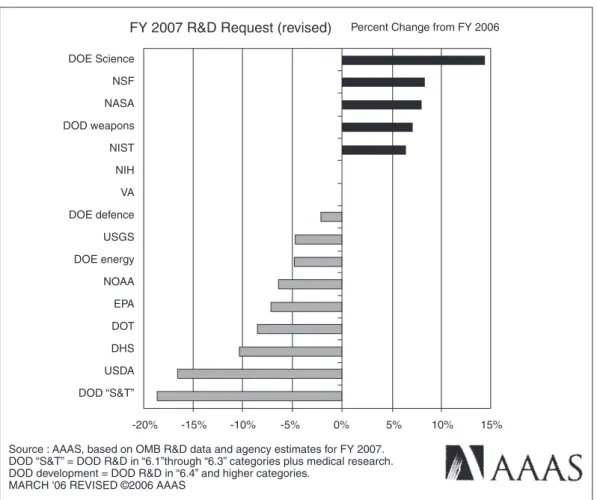
Regarding fiscal 2007 research and development budgets, however, when one looks ahead to the future of federal budget issues, one must take the pessimistic view that research and development expenditure will have to be cut due to the pressure of the budget deficit. As seen in Figure 1, compared with the previous fiscal year, requested budgets are $3.8 billion, up 14.4 percent, for DOE Office of Science; $4.5 billion, up 8.3 percent, for the National Science Foundation (NSF);
$12.2 billion, up 8.0 percent, for the National Aeronautics and Space Administration (NASA);
and $450 million, up 6.4 percent, for the National Institute of Standards and Technology (NIST). (In the ACI, the core research activities of the key agencies such as the DOE Office of Science, NSF, and NIST are priority targets for budget doubling
over the next 10 years.) Budget requests for other R&D-related agencies, however, are down from the previous fiscal year. This trend has continued for several years, as some government agencies must necessarily absorb budget cuts of 10 -30 percent. Because of this situation, it is unclear whether funding for innovative initiatives now held up by Congress will become available. It is feared that much research will stagnate[5].
Mr. G. William Hoagland (Office of the Senate Majority Leader) explained that the fiscal 2006 supplemental budget proposal is still being debated in Congress. Because Congress must discuss important topics such as a $92 billion appropriation for hurricane relief and the Iraq war, as well as the implementation of a $70 billion tax cut over five years, the time allocated for discussion of the fiscal 2007 budget is limited. Furthermore, it is clear that phased expansion of long-term costs for Social Security, the healthcare system for low-income people, and the health insurance system for the elderly, growing debt, and other expenditures will continue growing. Unless these factors are offset
by a dramatic increase in revenue, the US faces either further large deficit growth or major cuts in the discretionary budget. Defense spending is another source of federal debt. Raising taxes is one way to solve these problems, but that can affect economic growth. There is also concern that the very recent replacement of the top two officials at the Office of Management and Budget (OMB) will also exacerbate the difficult budget environment. In Mr. Hoagland's opinion, it will be very difficult under these circumstances for the fiscal 2007 science and technology budget to be approved as proposed. On the other hand, there are signs that foreign investment in the US may become active and erase debt. Based on the balance of the 2007 budget proposal, some people estimate that the federal government can eliminate all debt for Social Security, the health insurance system for the elderly, and the healthcare system for low-income people by 2035.
Mr. Hoagland said that the optimistic view that the political power of voters and political leaders can solve the dysfunctions in the US budget gives rise to such estimates[6].
Figure 1 : FY 2007 R&D budget requests from various agencies (compared with FY 2006)
-20% -15% -10% -5% 0% 5% 10% 15%
FY 2007 R&D Request (revised) Percent Change from FY 2006 DOE Science
NSF NASA DOD weapons NIST NIH VA DOE defence USGS DOE energy NOAA EPA DOT DHS USDA DOD “S&T”
Source : AAAS, based on OMB R&D data and agency estimates for FY 2007.
DOD “S&T” = DOD R&D in “6.1”through “6.3” categories plus medical research.
DOD development = DOD R&D in “6.4” and higher categories.
MARCH '06 REVISED ©2006 AAAS
4 Science and Technology Policy for the Energy
Challenges of the 21st Century
In part because gasoline prices in some areas reached $4 per gallon during the conference, there was so much interest in energy issues that the audience could not be contained within the venue. As was remarked in the opening speech, the relevance of environment and energy issues to climate change was one cause of this. During the session, five people made presentations on the theme “Science and Technology Policy for the Energy Challenges of the 21st Century.” An overview of their addresses is as follows[7-11].
Obviously, energy policy is a difficult issue when trying to balance the environment and the economy. For example, promotion of nuclear power can look like a successful strategy in terms of satisfying energy demand and reducing CO2 emissions, but the risks of accidents and ter ror ism must be considered. I ncreasi ng coal-based thermal power means an increase in problems related to CO2 emissions, air pollution, and health impacts. For renewable energ y sources such as wind and solar power, there are
still many issues to resolve, such as improving energy efficiency, before they can become major energy sources. In the case of hydrogen energy, there are infrastructure problems and it is still too expensive to be practical. As technologies for renewable energy and energy conservation improve, however, energy consumption and CO2 emissions relative to GDP can be expected to decrease. Energy policy must always be considered in light of this background. As illustrated in Figure 2, the status of energy-related research, development, and demonstration in various countries is changing, with particularly high growth in Japan. Furthermore, rapid growth in population and energy consumption in China and India means even greater consumption of cr ude oil, coal, and natural gas, with a corresponding worsening of CO2-based climate change. According to the Intergovernmental Panel on Climate Change (IPCC), average temperatures in 2100 may be 5°C higher than they are now.
While the Administration's budget requests regarding research on hydrogen energy can once again be categorized as large, Drs. Joseph Romm (Center for Energy and Climate Solutions) and John Holdren (Harvard University) argued that for now it is unrealistic. In other words,
Figure 2 : Expenditures by various countries on energy-related research, development, and demonstration
16000
14000
12000
10000
8000
6000
4000
2000
0
Million 2000 international PPP$ United States
United Kingdom Netherlands Japan Italy Germany France Canada
1975 1977 1979 1981 1983 1985 1987 1989 1991 1993 1995 1997 1999 2001
Year
Extracted from John P. Holdren, “The Economic, Environmental, & National Security Challenges of Energy Supply and the Role of Science & Technology in Addressing Them”
while investment in hydrogen energy R& D remains active, because of infrastructure and supply issues, for now its practical realization, particularly as a fuel for automobiles, is not realistic. The potential for plug-in hybrids was pointed out.
Mr. Jason Grumet (National Commission on Energy Policy) explained the social risks that will be brought about by climate change. Technology is the key to reducing those risks, but who is to invest in that technology is an important question. In order to cut CO2 emissions, he advocated the necessity of supporting domestic coal gasification, fuel - efficient automobiles, high-performance fuels, and advanced nuclear reactors, as well as doubling the federal budget for research and development to promote demonstration of clean coal technology, nuclear power, and renewable energy technology.
Dr. Kelly Sims Gallagher (Harvard University) described the details of changes in the DOE budget since 1978. The energy research and development budget has been stagnant since about 2001. For the past several years, it has been 1/3 of the 1978 budget. Figure 3 shows budget requests for government investment in renewable energy for each fiscal year. In the fiscal 2007
budget proposal, the budget request for solar power is 75 percent higher than for the previous year and 62 percent higher for biomass. Although it is not shown in Figure 3, the budget request for hydrogen and fuel cells was 23 percent higher.
The requested increase in the wind power budget was only 10 percent. On the other hand, the budget request for coal was cut by 5 percent, and research, development and demonstration (RD&D) for geothermal, hydropower, petroleum, and natural gas were cancelled. With the jump in crude oil prices, demand for coal is increasing, but the budget is too small to solve the problem of increased CO2 emissions related to coal use. Meanwhile, the budget request for the geothermal research program was zero, which Dr. Gallagher explained as an indication of a lack of DOE interest in geothermal research.
5 The situation for scientists
Three people at the forum offered presentations on ethical issues, evaluation, and the integrity of scientists. An overview is as follows[12-14].
Problems related to misuse of research funds, fabrication of data, plagiarism, falsification, and bioethics in the US, Norway, the UK, and South
Figure 3 : DOE budget requests related to renewable energy
Extracted from Kelly Sims Gallagher, “The Federal Energy R&D Portfolio”
Korea were discussed. For example, cases where data was fabricated or falsified when results unsupportive of research plans threatened the continuation or renewal of funding were described. There is often an organizational backdrop to such cases. In order to prevent f uture occurrences, the purposes, qualit y, and impartiality of peer review must improve.
Furthermore, the scientific community has an obligation to explain matters clearly to the public, and a society in which scientists are well regarded and respected by the public must be built[15]. In fact, the US has been taking measures including passing laws since the 1980s, mainly in the life science field, while in Northern Europe there are committees on improper research that carry out preventative measures and investigate alleged cases of unethical behavior. Similar initiatives are underway in the UK and Germany.
It was suggested that because there are cases in which the improper behavior of one scientist has involved other project team members, ethical education for scientists is necessary.
6 Other topics
The forum covered a number of topics that are not currently relevant to Japan (e.g., the emphasis on military research, immigration issues, etc.). The conference coincided with mass demonstrations against a proposed law that would deport as many as 10 million illegal immigrants in the US, which contributed to the formation of the discussion. Like Japan, the US is aging, and many issues related to health insurance were discussed. In addition, one presenter brought up the e-Japan Strategy*1 as an example of how the US should work strategically to construct networks[16].
T he aut hor’s per sona l ref lection s upon attending the forum are as follows.
Pol ic y on the development of f uel cel ls has been strengthen i ng si nce the Cl i nton Administration. In January 2002, the Partnership for a New Generation of Vehicles (PNGV) was canceled and FreedomCAR 9 project began. The goals of PNGV were to raise the international
competitiveness of the US automobile industry and to enable appl ication of leadi ng - edge technology to mass - produced automobiles.
The goal for fuel efficiency was 80 miles per gallon (33.4 km/l). FreedomCAR is a long-term public-private partnership involving the federal government and the US’s “Big 3” (Ford, GM, Daimler Chrysler) that will run through 2010.
It carries out high-risk technical development, with particular emphasis on technology related to hydrogen fuel-cell automobiles, and development of component technology applicable to a wide range of vehicles. For this reason, energy projects, particularly on automobile fuels, are ongoing.
Regarding climate change issues, with its emphasis on autonomy a nd tech nolog ica l r e spon s e, t he US d id not sig n t he Kyoto Protocol, but currently interest is high not just in government or within corporations and universities or among scientists, but also among the public. Regarding CO2 in particular, the government is actively engaged in addressing the issue. This author's impression is that the US is strengthening its own initiatives regarding every aspect of this issue. One cause of this movement is the increasing number of papers presenting evidence that makes it impossible to deny the connection between industrial activity and climate change. In the opinion of some people, if the major issues other than terrorism were to be listed, climate change would definitely be at the top of the list. The strengthening of the argument that climate change is behind the increasing frequency of major disasters is one reason for the increased interest.
There is no positive movement on budgets for energy conservation, which is an effective policy measure and one that is constantly taken into account in Japan. It may be difficult in the US, where automobiles are the primary means of transportation, but the spread of railways would also reduce CO2 emissions. Moreover, it is necessary to take steps to change the awareness of individual members of the public regarding energy consumption so that they will believe, as the Japanese do, that “consumption” is “wasteful,”
wh i le it is necessa r y at the sa me ti me to
disseminate energy conservation technology. The energy education for a correct understanding of energy itself is strongly needed. In addition, with prioritized research funding the norm, ethical problems will likely become even greater issues for the scientists who have to deal with it.
Acknowledgements
The author wishes to thank Mr. Hideo Shindo, Chief Representative of the Washington DC Office, the New Energy and Industrial Technology Development Organization (NEDO) for his kind assistance with this report.
Glossary
*1 e-Japan Strategy
The e-Japan Strategy is based on the Basic IT Strategy. It was adopted as a national strategy on January 22, 2001, at the first meeting of the Strategic Headquarters for the Promotion of an Advanced Information and Telecommunications Network Society (IT Strategic Headquarters). The Basic IT Strategy states that “Japan must take revolutionary yet realistic actions promptly, without being bound by existing systems, practices and interests, in order to create a ‘knowledge - emergent society,’ where everyone can actively utilize information technology (IT) and fully enjoy its benefits”
and “make Japan the world's most advanced I T nation with i n f ive yea r s.” Pr ior it y measures to accomplish this are the building of ultrahigh-speed network infrastructure, widespread dissemination and promotion of electronic commerce, realization of electronic government, and improvement of human resources.
References
[1] M. Igami, “Science and Technology Policy Trends in the United States — Report on the AAAS Annual Forum on Science and Technology Policy,” Science & Technology Trends - Quarterly Review No.13, October 2004: http://www.nistep.go.jp/achiev/ftx/e ng/stfc/stt013e/STTqr13.pdf
[2] Gilbert S. Omenn, “31st Annual AAAS Forum on S&T Policy”: http://www.aaas.org/spp/r d/Forum_2006/omenn.pdf
[3] John H. Marburger, III, “Keynote Address”:
http://www.ostp.gov/html/JHMAAASpolicyf orum.pdf
[4] “American Competitiveness Initiative” : http://www.ostp.gov/html/ACIBooklet.pdf [5] Kei Koizumi, “R&D in the FY 2007 Budget”:
http://www.aaas.org/spp/rd/prforum406.pdf [6] G. William Hoagland, “The Federal Budget
Landscape: A Congressional Perspective”:
http://www.aaas.org/spp/rd/Forum_2006/h oagland.pdf
[7] J o h n P. H o l d r e n , “ T h e E c o n o m i c , E nv i r o n m e nt a l , & N a t i o n a l S e c u r i t y Challenges of Energy Supply and the Role of Science & Technology in Addressing Them”:
http://www.aaas.org/spp/rd/Forum_2006/h oldren.pdf
[8] Jason Grumet, “Ending the Energy Stalemate:
A Bipartisan Strategy to Meet America's Energy Challenges”: http://www.aaas.org/sp p/rd/Forum_2006/grumet.pdf
[9] Kelly Sims Gallagher, “The Federal Energy R&D Portfolio”: http://www.aaas.org/spp/r d/Forum_2006/gallagher.pdf
[10] Joseph Romm, “Energy R&D&D&D in the Private Sector: Only the Third ‘D’ can Save us from The Third Degree”:
http://www.aaas.org/spp/rd/Forum_2006/r omm.pdf
[11] David Hawkins, “Coal and Climate: Hitting the Wall”: http://www.aaas.org/spp/rd/Foru m_2006/hawkins.pdf
[12] Felice J. Levine, “Attacks on Peer Review and Protecting the Integrity of Science”
[13] John Horgan, “Panel on Scientific Integrity”:
http://www.aaas.org/spp/rd/Forum_2006/h organ.pdf
[14] Nichol a s H. Steneck, “P rotect i ng t he Integrity of Science Scientific Misconduct”:
http://www.aaas.org/spp/rd/Forum_2006/st eneck.pdf
[15] K. Ur ash i ma, “T he Cu r rent A rgu ment between Scientists and Government for Science and Technology Policy in U.S.,”
Science & Technology Trends — Quarterly Review No.15, April 2005:
http://www.nistep.go.jp/achiev/ftx/eng/stfc /stt015e/STTqr15.pdf
[16] “e-Japan Priority Policy Program: Priority
Plan for the Formation of a Society with Advanced Information and Communications Networks”: http://www.kantei.go.jp/jp/sing i/it2/dai3/3siryou40.html (in Japanese)
Kuniko URASHIMA, PhD
Head, Environment and Energy Research Unit
Doctor of Engineering. Dr. Urashima assumed her current position after engaging in various research relating to the reduction of environmentally hazardous materials (exhaust gas, wastewater, waste, etc.) at university, national lab and companies in Canada, US and France.
(Original Japanese version: published in May 2006)