The Implementation of Community Policing in Indonesia
著者 インタン フィトリ メウティア
著者別表示 Intan Fitri Meutia journal or
publication title
博士論文本文Full 学位授与番号 13301甲第4470号
学位名 博士(社会環境学)
学位授与年月日 2016‑09‑26
URL http://hdl.handle.net/2297/46492
The Implementation of Community Policing in Indonesia
A thesis submitted for the degree of Doctor Philosophy in Social Environment
Intan Fitri Meutia 1321072015
Kanazawa University
Graduate School of Human and Socio-Environmental Studies 2016
n M s m
s m M
M M s m
k h h k h
B M s m M
B B M M P s m
M s m
n () ( , (, s m
M s m
M F
n s
m B M F
K M
s m B M
M B M ) ( , (,
s m a t
M FF
b
s m n mi
Abstract
This thesis formulated objectives distress on describes and analyze the community policing implementation by examining the history and the present situation towards the role of police and its relation with community neighborhood in Indonesia. It was compared and analyzed the potential problems and challenge in applying and maintaining police strategies approach and public social order.
Additionally, this study refers to community policing implementation in Japan as comparative information. Furthermore, it will examine the possibility of community policing approach in ethnic conflict resolution cases in Indonesia. This study is expected to offer as a reference for further research in analyzing the relation between police officers and community demands for the community policing implementation.
Data gaining was conducted qualitatively, in the form of ethnographic study by using interview, observation and documentary, which were done purposefully. The result of this study showed that the community policing ultimately needed active participation from both police and community. It was found that Indonesia has implemented community policing firstly by establishing bhabinkamtibmas. It is a representative of Indonesian police officer, which is assigned in each foster area due to, preemptive, preventive, and provides early warning of a threat to the community. Meanwhile, Indonesia as multiethnic differences has own challenging characteristic to prevent ethnic conflict.
Massive destruction frequently occurred because of some factors; lack of police performance, economic factors, and the difference local wisdom. I emphasize that even though policing system running well, it should be modified appropriately. Bhabinkamtibmas and FKPM approach should be harmonized with local wisdom for increasing the legal awareness and community development.
Keywords: Community policing, Indonesia, ethnic.
TABLE OF CONTENTS
Abstract ... ii
Table of Contents ... iii
List of Tables and Figures ... v
Glossary ... vii
Introduction ... ix
1. Background ... ix
2. Methodology ... x
3. Outline of Thesis ... xii
4. Literature Review ... xiii
Chapter One: An Overview of Community Policing ... 1
1.1 History of The Police ... 1
1.2 Community Policing ... 8
1.3 Acceptance of Community Policing in Society ... 13
1.4 Summary ... 17
Chapter Two: Grand Strategy: A Gateway of Civilian Police in Indonesia .. 19
2.1 Historical Survey of Indonesian National Police ... 19
2.2 Present Structure of INP ... 27
2.3 Grand Strategy of INP 2005-2025 ... 32
2.4 Community Policing in Indonesian Legal Aspect ... 37
2.5. Summary ... 44
Chapter Three: Bhabinkamtibmas (Community Order Guiding Brigadier) . 46 3.1 Bhabinkamtibmas: a studied case ... 46
3.2 Preemptive and Preventive ... 51
3.3 Sambang (Visiting – Door to Door Activities) ... 57
3.4 Problem Solving ... 62
3.5 Summary ... 76
Chapter Four: Police Community Partnership Bureau (BKPM) and Police Community Partnership Forum (FKPM) ... 79
4.1 Police Community Partnership Bureau (BKPM): Koban and Chuzaisho Alike In Indonesia ... 81
4.2 Police Community Partnership Forum (FKPM): Rembug Pekon in the Lampung Province ... 91
4.3 Community Development ... 97
4.4 Reflection on Japanese Community Policing Implementation ... 105
4.5 The Complexion of Japanese CP in Indonesia ... 115
4.6 Summary ... 120
Chapter Five: Community Policing To Resolve Ethnic Conflict In Indonesia: A Study of Lampungnese VS Balinese ... 123
5.1 Transmigration, Lampungnese and Balinese Ethnic Principles ... 126
5.2 Primordial Conflict Between Lampungnese and Balinese ... 133
5.3 Case Analysis ... 140
5.4 Mediation in Community Policing Strategy ... 144
5.5 Community Policing as Solution and Prevention ... 149
5.6 Summary ... 155
Chapter Six: Conclusion ... 157
Bibliography ... 160
LIST OF TABLES AND FIGURES
List of Tables:
Table 1. The Three Eras of Policing ... 10
Table 2. Principles Between POP and CP ... 40
Table 3. Community Policing Movement Between Japanese and Indonesia ... 119
List of Figures: Figure 1. The Indonesian National Police Structure ... 29
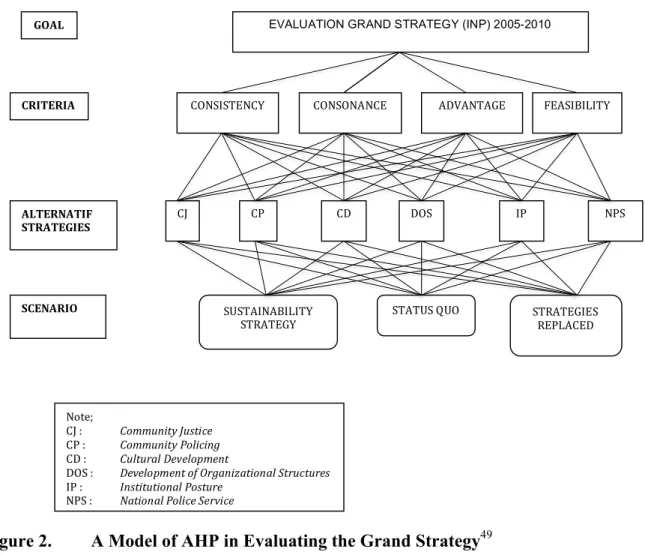
Figure 2. A Model of AHP in Evaluating the Grand Strategy. ... 36
Figure 3. Western Tanjung Karang Police Sector ... 48
Figure 4. Binmas unit room’ at Western Tanjung Karang Police Sector ... 48
Figure 5. Map of Bhabinkamtibmas distribution in Western Tanjung Karang Police Sector ... 48
Figure 6. Bhabinkamtibmas of Western Tanjung Karang Police Sector on the morning meeting ceremony ... 49
Figure 7. Operational vehichles of bhabinkamtibmas ... 50
Figure 8. A Community Policing Model in Indonesia ... 50
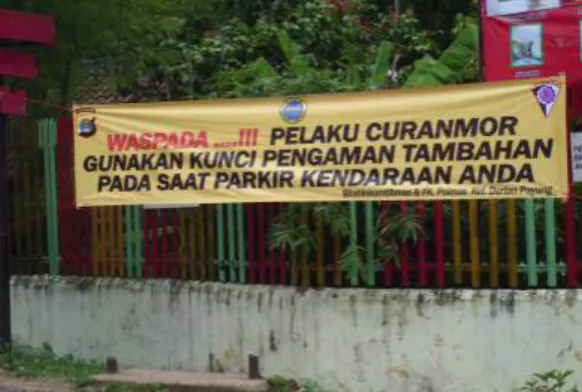
Figure 9. Warning the danger of vehicle stolen in the main road ... 52
Figure 10. The profile picture of bhabinkamtibmas with warning the danger of vehicle stolen in the front of convenience store ... 52
Figure 11. Consolidation in Ketua RT (Leader of neigbourhood group) house .... 54
Figure 12. Bhabinkamtibmas with main contact person at kelurahan (village government office) ... 55
Figure 13. Bhabinkamtibmas gathering the information from contact person, ojek-motorcycle taxi driver ... 55
Figure 14. Bhabinkamtibmas conseling session attends by housewives only at Kelurahan (village government office) ... 59
Figure 15. Bhabinkamtibmas conseling session at Kelurahan in the weekend so all men in the community available to come ... 60
Figure 16. Bhabinkamtibmas as the Inspector of ceremony in Senior High School ... 60
Figure 17. Bhabinkamtibmas counseling about drugs issue at Senior High School ... 61
Figure 18. Bhabinkamtibmas counseling about ISIS issue at Junior High School ... 61
Figure 19. Bhabinkamtibmas counseling for private security guard ... 62
Figure 20. Bhabinkamtibmas report book cover and inside ... 68
Figure 21. Binmas unit meeting coordination ... 72
Figure 22. Bhabinkamtibmas visiting banana chips: data colleting of SMEs workers ... 74
Figure 23. The youth making and selling banana chip ... 74
Figure 24. Small police post (4m2) in front of shopping center ... 80
2
Figure 27. BKPM Mekar Sari ... 83
Figure 28. BKPM Mega Mall ... 83
Figure 29. BKPM Pondok Ungu ... 84
Figure 30. BKPM Kranji... 85
Figure 31. BKPM Citra Grand ... 85
Figure 32. BKPM Komsen ... 86
Figure 33. BKPM Mutiara Gading Timur ... 87
Figure 34. Front and Close Up of BKPM Pengasinan ... 87
Figure 35. Sketch Room of BKPM Pengasinan (chuzaisho alike) ... 88
Figure 36. The map of BKPM distribution in Bekasi ... 89
Figure 37. FKPM Meeting in Western Tanjung Karang Sector Police ... 92
Figure 38. FKPM socialization meeting results as local law that must be obey by the community neighborhoods ... 93
Figure 39. Tagami Koban, Kanazawa ... 105
Figure 40. Kanazawa Naka police officers badge ... 108
Figure 41. Tagami Koban Dayori February 2016 ... 112
Figure 42. Inuwashi-kun and Inuwashi-chan at 110 Emergency Call Seminars . 113 Figure 43. Map of South Lampung, Lampung Province, Indonesia ... 137
Figure 44. Lampungnese house in Agom villagers, South Lampung ... 138
Figure 45. Balinese Resident Area in Balinuraga, South Lampung ... 140
Figure 46. Pig in neighborhood aroun Agom and Balinuraga village ... 140
Figure 47. Rembug pekon in Agom - Lampungnese village ... 152
Figure 48. Police officers equipped with gun in the border of Balinuraga Village ... 153
GLOSSARY
Term Definition
Adat Adat or custom is local customary law
especially of Islamic-Malay tradition in Indonesia
Anjau Silau Patrol activity done by
bhabinkamtibmas in Lampung, Indonesia
Beats Patrols activity in England done by
Bobbies
Bhabinkamtibmas Police officer who implement community policing
Bhayangkara Indonesian Police officer
Bobbies British Police officer
Bohan kaigi Meeting with the chonaikai held by the koban
Chonaikai Community neighborhood unit in Japan
Chuzaisho Police Box for rural area in Japan, inhabited by one officers in charge with his family
Community Policing Police strategies in preventing crime through collaboration with community members
Foster village Village that under bhabinkamtibmas
territory, one bhabinkamtibmas in charge for one village
Gotong Royong Gotong royong or Communal work is cooperation among many people to attain a shared goal on the core of Indonesian philosophy
Junkai renraku Visiting notes of police when doing
patrols and give a caution
Koban Police Box for urban area in Japan
Koban Dayori Pamphlet as news or information from koban
Paramilitary Police is not an official army but that operates and is organized like an army Pecalang Adat or custom guard in Bali, Indonesia
Polmas Community policing in Indonesian
Problem Oriented Policing Police strategies in solving the crime problem as the priority
Rembug Pekon Partnership meeting between police and community to prevent or solving
certain problem in the neighborhood community
Ronda Siskamling Patrol done by the communities in their neighborhood environment in order to prevent crime at night
RT Community neighborhood unit in
Indonesian
Sambang Patrol activity in Indonesian done by bhabinkamtibmas
Tachiban Watching around while stand or stay in the post
Transmigration Indonesian government policy to ease
overpopulation by moving people from the core area to the less populated area.
INTRODUCTION
1. Background
A policing style can be reckoned as sophisticated as long as it avoids the idea of generalizing about people or applying general assumptions to any particular individual. In 2004, Adrianus Meliala raised concerns on the research question about “What is sensitive policing and how does it work in theory?”. This is followed by “To what extent is sensitive policing a feature of existing policing practice in Indonesia National Police and what are the problems and prospects associated with the introduction of such a model of policing in Indonesia?”. This research took place during a period of reform and political tension in Indonesia.
While political activity and aspirations of democracy had been widespread during this time, the police force and its policing activity had also changed. The public also had looked for an identity changing in the Indonesian police, which had been the object of both scrutiny and expectation. This previous research provide discussion analysis on a never-ending debate between the conventional policing style (and its roots) and community-oriented style with another form of policing that could be regarded as “middle way”; called sensitive policing. The results were complex that in one way, many sensitivity-related policies, either in the form of rights or procedures, had been announced. However, insensitivity, in a broad sense, could also be seen. Despite this, the need to be responsive to meet public demand (as a prerequisite for sensitive policing) seemed growing consideration.
In Indonesia, community policing is being implemented since Indonesian Police Chief Legal Letter No.Pol.: Skep/737/X/2005, October 13, 2005 about Community Policing Implementation Policy and Strategy in Police Function.
According to Indonesian Central Agency of Statistics, in 2011-2013, the number of criminal act or incidents of crime in Indonesia fluctuated. In 2011, as many as 347.605 cases were recorded, then they declined to as many as 341.159 cases in 2012 but increased in 2013 recording 342.084 cases that means one crime occurred every one minutes 32 seconds in Indonesia at this time. Thus, effective implementation of community policing is urgently needed. Indonesia surely was taking some parts on Japanese community policing system as references for improving its implementation.
This research aimed to explore the implementation of community policing in Indonesia. Specifically, it was sought to answer the following question:
1. How does the spread of community policing concept around countries, especially in Indonesia?
2. What are the possibilities, challenges, obstacles and goals in implementation of community policing in Indonesia?
3. What are the good points from Japanese community policing approach for Indonesia?
4. How successful is community-policing approach in ethnic conflict resolution case?
The objectives of this thesis is to present the detailed description of the implementation of community policing with using the rich field data collected and to analyze it by examining the history and the present situation towards the role of police and its relation with community neighborhood especially in Indonesia. Due to huge scope of community policing, the limitation was made concerning with archives, reports, interviews and observation on the community policing implementation. The study compared and analyzed the potential problems and challenge in applying police strategies approach to maintain public and social order. This is expected to offer a foundation for further research in the development of community policing implementation in the future.
2. Methodology
The field research for this thesis was conducted qualitatively which was in the phenomenological theory. This view attempts to understand human behavior from the framework and follow behavior of the people themselves. In the form of ethnographic study, the interview and observation are done to learn the behavior of police officers as an ethnic group in the anthropological research. Ethnographic researchers do elaborate venture (Ryle cited in Geertz, 1973: 6), insert themselves into observation of the culture and sub-culture in his research and try to see the world from a cultural standpoint. Data collection is done through interviews and participant observation especially by observing daily attitude and social situations related to material collection in a participative way with depth interview.
Documentary data comprises recording and notes and photo taking by using documentary technique. They used to compare the perception of 'etic' itself and dig up the difference of the perception of the informants 'emic'. Researchers describe, analyze and interpret the culture and perception of 'emic'. Finally, the researchers write a detailed report in the form of the writing life stories, either in the form of micro-ethnography (focus on setting small) or macro-ethnography (cultural grouping).
This study focused on Indonesia as an object of research and the Japanese as comparison material for analysis. I conducted field trip to three regions in Indonesia, the city of Bandar Lampung, South Lampung regency and Bekasi City.
In Bandar Lampung, firstly, I did Focus Group Discussion (FGD) with eight bhabinkamtibmas officers in Binmas Unit of Western Tanjung Karang Sector Police. Based on this FGD, I obtained the main task and function of bhabinkamtibmas. Next depth observation was following one bhabinkamtibmas officer (Brigpol. Kadim) did his activities. Hence, I could see how bhabinkamtibmas interacted with the community and what kind of interaction happened between this two parties. The public appreciation and acceptance of police officers’ action were also clearly delineated.
Lampung province was purposively chosen deliberately on the grounds that Bandar Lampung itself could be regarded as the representation of mini Indonesia.
The province is known as the area of early transmigration program in Indonesia.
This has an impact on the variety of ethnic groups in the province of Lampung.
One district in Lampung province, South Lampung regency is an example of an area affected by the ethnic diversity. In 2012, inter-ethnic conflicts happened between the Balinese as the immigrants and the Lampungnese as the natives, which resulted in massive damage. That is one of the reasons why Bandar Lampung and South Lampung regency was chosen as the study site as representation of the implementation of community policing in Indonesia. In South Lampung regency, the research was done to see the continuation of the peace efforts between the two ethnics, namely the Lampungnese and the Balinese.
It could represent how community policing can prevent repetitive conflicts between the two parties, and what effort can police do in approaching both ethnic communities which had different local wisdoms.
Another research location chosen was Bekasi City, close to Jakarta, the capital city of Indonesia. Bekasi was selected since the first pilot project of BKPM (Balai Kemitraan Polisi dan Masyarakat or Police and Community Partnership Bureau) was built there. The BKPM is the smallest unit of the police station in Indonesia, which is adapted from Koban and Chuzaisho in Japan. As a comparison study, the interview and observation was also conducted in the city of Kanazawa, Ishikawa, Japan to see what kind of community policing services has been implemented in Japan.
The map of Indonesia
Source: http://www.mapsofworld.com/indonesia/
The location of Tagami Koban
Source:
https://www.google.co.jp/maps/place/Police+box/@36.5452547,136.6895201,17.
69z/data=!4m8!1m2!2m1!1sThe+map+of+kanazawa+city,+tagami+korban!3m4!
1s0x0000000000000000:0xe312cf83c07b959b!8m2!3d36.545382!4d136.690493 7?hl=id
3. Outline of Thesis
The first chapter tries to survey the historical background of the arising of the idea of community policing through the documentary analyses of the published books, journals, and some reading materials from online sources. This chapter provides theories, which have been developed in the area of community policing implementation among countries. First section examines the historical context of police from terminology and modern law enforcement. Section 2 discusses on the nature of community policing as an important reform for police. In particular, it examines the role of police in the prevention and detection of crime and sustaining local social order peacekeeping. Section 3 describes the implementation of community policing in several states. Finally, the conclusion shows the role of the police in public society until nowadays.
The second chapter describes the beginning process of Community Policing in Indonesia through the Grand Strategy for Indonesian National Police (INP).
Section 1 explains the history behind INP institutions starting from Majapahit until Reformation Era. The second section summarizes the organizational structure of INP. Section 3 discusses on the reform process of INP through Grand Strategy 2005-2025 design. The first five year (2005-2010) is known as trust building, the second five-year (2011-2015) is known as partnership building, and the last ten-year (2016-2025) is strict for excellent. Section 4 shows the work of INP reform through community policing approach.
Third chapter discuses on Bhabinkamtibmas, the police officer whose duty is to maintain public security and order and act as the executing part in implementing community policing tasks. This chapter is fully based on the author’s own field observation, interview and documentary analysis. Section 1 explains the stage
action of normative police task and describes how it is undertaken in daily duties of police officers. The following section 2 describes how the public service is done directly by the police presence in the middle of community neighborhood.
Section 3 presents the relationship built by Bhabinkamtibmas in order to resolve cases through stages in community policing approach. Section 4 presents the example of community participation in creating public and security order, which allows the bhabinkamtibmas to develop alternative activities as innovation in implementing community policing.
The fourth chapter describes the implementation of community policing in Indonesia, which has been adapted from Japanese community policing. The first section presents the Police Community Partnership Bureau (BKPM), which is directly learned from koban and chuzaisho in Japan. Section 2 explains about the Police Community Partnership Forum (FKPM) as the meeting forum among police and community, local government and community, which is also well known as rembug pekon in Lampung province. Section 3 aims to analyze the function of community policing as top-down approach and its connection to Neighborhood Association unit (RT) in order to build community development in Indonesia. Section 4 presents the implementation of community policing in Japan nowadays.
The fifth chapter aims to present the effectiveness of community policing approach to solve ethnic conflicts through analyzing the actual case of such conflict occurred in Lampung province, Indonesia in 2012 and the current situation when this research was conducted in 2015. The following section 1 specifically describes the historical and ethnological background of the ethnic conflict occurred in Lampung province, Indonesia, in 2012. The section 2 discusses the dynamics of ethnic conflict and presents the actual case of conflict between the Balinese and the Lampungnese in Lampung province. The section 3 traces the peace-making process of the Lampung conflict and summarizes the effectiveness of community policing approach in solving such conflict. Section 4 presents the general discussion about the importance of mediation in a social process and the idea of community policing, particularly in the context of recent Indonesian social reform. The section 5 describes how the implementation of CP as solution and conflict prevention in Balinuraga village nowadays.
Sixth chapter tries to summarize the findings of this study from the previous entire chapter. It also tries to answer the question of this research through data collection analysis.
4. Literature Review
The definition of police work broad mandate involves many different functions including peacekeeper (Kelling&Moore, 1988), problem solver, crime fighter and force that protect the citizen as service delivery. These definitions of police work led to the argument whether the characteristic of police work is their ability to use force to enforce the law or not. In 1970, Bittner published The Functions of the
Police in Modern Society, which explains that the capacity to use forces is the core of the police work. It is declared that perhaps in future time policemen able to compel the desired outcome of any problem without ever resorting to physical force. Robert Reiner on the Politics of the Police (2000) tries to update the recent changes in the law, policy and organization of policing. He believed that policing with consent reflected a public consensus about the police instrument. It led to the change of public’s opinion of the police in recent years, by giving current research into police working practices and proposals for reform. Furthermore, the policing itself depends on the community demands and the current situation nowadays.
Basically, the functions of police around countries are similar including Indonesia. Creating peace and security are its best goal. However, it takes different approaches relying on its nation characteristic. In America, Kelling&Moore said politics and liberal approach were required to create public security. On the other hand, I assumed that it might not be applicable in Indonesia because of Indonesian condition. It would be better to use cultural and local wisdom approach. Based on Bitner, the uses of police force in urban society were needed for law enforcement especially for criminal offences. For Indonesian cases, forces approach remains to be done without neglecting cultural approach. I preferably agree with Reiner, who stated that police policing is adjusted with pubic demands. However, it should be underlined that police has own strategies to solve the society problems. Hence the best way is collaboration between the police and the community. The law enforcement approach in Indonesia has just started changing from traditional policing to community policing as the reform in the police service works.
Another research about community policing had done in 1976 by Walter L. Ames.
It was anthropological research about police and community in Japan. He used participant observation and the case study method by working directly with police officers in the police station of the Tokyo suburb of Fuchu for five months as a preliminary study, and in the Kurashiki and Mizushima police stations in the city of Kurashiki, Okayama prefecture, for the year-long main study. He conducted survey to obtain data and examined how the police had developed their approach in different kind of communities and in response to various problems and complexities in Japanese society. It, then, examined the technique of policing urban areas in which the rural ideal of police-community intimacy was more difficult to attain because of greater social complexity, and the problems that the police encountered as they adjusted to a rapidly changing and evolving society.
Currently, some countries implement community-policing approach as the police reform strategies. Japan has been implementing its approach for a long time and has admitted well performance for public security. Indeed, Indonesia adopts Japanese system like koban as community policing ways. Responding Ames, whom describes the differences of policing technique in urban and rural area, I agreed that relationship between police and community in rural area would be effective comparing to big cities’. It may be influenced by the kinship among community based on cultural background.
The concept of congruent relationship between police and community (Trojanowicz, 1972: 411) through involvement, participation, and cooperative action could be more effective than programs that are conflict oriented. The police might not be the only actor of problem solver and planners in the neighborhood.
Therefore, this study will be conducted to investigate the relation between police and community in community policing strategies in Indonesia. Additionally, I analyze local wisdom perspective in managing its partnership.
Chapter I
An Overview of Community Policing
This chapter tries to survey the historical background of the arising of the idea of community policing through the documentary analyses of the published books, journals, and some reading materials from online sources, and presents some theories developed in the area of community policing implementation among countries.
1. 1 History of The Police
The term police can be marked out from the Greek politeia, which refers to all the affairs affecting the survival and the order of the state1. Until the eighteenth century, military and paramilitary police forces were the rule of the government.
By the 1700s, European states started to use the term ‘gendarmerie’, that is military police force units, and then ‘la police’ in French, and ‘die Polizei’ in German. These referred to the internal administration of government managing safety, protection, and surveillance of a territory. At the beginning the English eschewed the term “police” because of the meaning, it gained increasing currency in France during the Napoleonic era. The term was probably imported into English from French at the beginning of the eighteenth century2 and referred to good government concerning sanitation, street safety and lighting, and so on.
1 Roth, M.P., Historical Dictionary of Law Enforcement (Greenwood Press 2000) 273.
2 Tadsad, Kamalaxi G., and Ramaswamy, Harish. Human Rights and Police Administration (Concept Publishing company 2012) 35
In 1285, England's Statute of Winchester3 prescribed a variety of time-tested notions about the beginning of early law enforcement4. These kinds of law enforcement had been developing for decades but had not been formally introduced by any statute yet. This policing was the system of watch and ward activity, which introduced the town watchman, a fixture in urban life until six centuries later as the birth of modern policing. According to the Statute of Winchester, most of towns in England were required to maintain a watch consist of up to sixteen men. They were to be stationed at the walled gates of town between the hours from sunset until sunrise and all strangers coming inside within their jurisdiction (city limits) were to be confined during the hours of darkness. It was described that watchmen involving the unpaid, unprofessional position and all ambulatory men were required to participate as volunteers.
In 1829, Sir Robert Peel5 (Home Secretary of England) introduced the Bill (Metropolitan Police Act6) for Improving the Police in and Near the Metropolis to Parliament with the goal of creating a police force to manage the social conflict
3 The Statute of Winchester of 1285 (13 Edw. I, St. 2; Law French: Statutum Wynton), also known as the Statute of Winton, was a statute in England by King Edward I of England that reformed the system of Watch and Ward (watchmen) of the Assize of Arms of 1252, and revived the
jurisdiction of the local courts. For more details, see Stubbs, William, Select Charters and Other Illustrations of English Constitutional History from the Earliest Times to the Reign of Edward the First (Clarendon Press 1870) 459 and Tout, Thomas Frederick, The Political History of England:
The History of England from the Accession of Henry III to the Death of Edward III, 1216-1377 (AMS Press 1905) 154.
4 Roth (n 1) 381.
5 Peel, Sir Robert (1788-1850) born into a wealthy manufacturing family, Peel served in Parliament in 1809 and then as chief secretary for Ireland from 1812 to 1818. While serving as home secretary in the 1820s, Peel championed the reform of the English judicial system. However, Peel is best remembered in the criminal justice realm for the police reforms that culminated in Parliaments passage of the Metropolitan Police Act of 1829. For more details, please see Roth (n 1) 259.
6 Lyman, J. L., The Metropolitan Police Act of 1829: An Analysis of Certain Events Influencing the Passage and Character of the Metropolitan Police Act in England. (The Journal of Criminal
resulting from rapid urbanization and industrialization taking place in the city of London. Peel’s efforts resulted in the creation of the London Metropolitan Police on September 29, 1829. Historians and scholars alike identify the London Metropolitan Police as the first modern police department. Sir Robert Peel is often referred to as the father of modern policing, as he played an integral role in the creation of London Metropolitan department. Several basic principles envisioned in it are well known as those that guided the formation of police departments in the United States and many others countries. In establishing the principles upon which most modern police forces operate in the western world, Peel created a police force along military lines. The Metropolitan Police were better trained and disciplined than any previous police organization and were expected to maintain a good rapport with their constituents. Prior to Peel, peacekeeping was carried out responding to a certain crime after it had been committed. The new force introduced preventive policing to the peacekeeping of the streets of London, as uniformed officers patrolling streets rather than lounging around the police station waiting for a crime to be committed. According to Wright, the modern police developed in the 19th century as the specific response of the state to the problems of crime and security7.
Past and current police officers working in the London Metropolitan Police Department are often dubbed as bobbies or peelers to honor the efforts of Sir Robert Peel8. Peel believed that the function of the London Metropolitan Police
7 Wright, Alan. Policing: An Introduction to Concepts and Practice (Willan Publishing 2002) 6.
8 In London, the policemen were so identified with the politician who created them that they were referred to as “Peelers” or—more memorably—“Bobbies,” after the popular nickname for Robert
should have focused primarily on the prevention of any crime—how to prevent crime from occurring instead of detecting after it had already occurred and triggered victims9. To do this, the police had to work in a coordinated and centralized manner, by providing large coverage designated for beat areas, and also to be available to the public at day and night. During this time the preventive patrol first emerged as a way to potentially deter criminality to happen. The idea was that citizens would think twice about committing crimes if they noticed a strong police presence in their community. His approach to implement policing would be vastly different from the early watch groups that patrolled the streets in an erratic manner and unorganized. The public did not view the watchmen as an effective legitimate source of protection prior to the creation of the London Metropolitan Police10. It was important to Sir Robert Peel that the newly created London Metropolitan Police Department would be viewed as a legitimate organization in the eyes of the public, unlike the earlier watch groups. To realize it, he identified several principles that were believed to obtain credibility among citizens11. The principles stressed that the police must have been under government territory and had a military-like organizational structure. They also included the use of crime rates to determine the effectiveness of the police, the establishment of police headquarters accessible for the public, and the necessity of
<http://www.history.com/news/ask-history/why-are-british-police-officers-called-bobbies> last accessed Mei 15, 2016.
9 For more details, please refers to The History of Police
<http://www.sagepub.com/sites/default/files/upm-binaries/50819_ch_1.pdf> last accessed Mei 15, 2016.
10 Lyman, J. L. (n 5) 141–154.
11Although Peel discussed the spirit of some of these principles in his speeches and other
communications, the historians Susan Lentz and Robert Chaires found no proof that he compiled a formal list. For more details, please refer to Lentz, Susan A. and Chaires, Robert H. The Invention of Peel's Principles: A Study of Policing "Textbook" History. (Journal of Criminal Justice 35 -1, 2007) 69–79.
proper recruitment, selection, and training. Peel also thought that the quality of men that were chosen to be police officers would further contribute to the legitimacy of organization. In other words, he believed that men who could show the appropriate discipline to citizens would become the best police officers. It was also important to Peel that his men wore appropriate uniforms, and display numbers (badge numbers) so they could easily be identified, not carry firearms, and receive appropriate training in order to be effective at their work as police officers12. Recently, people debate on whether Peel really espoused the previously mentioned ideologies and principles, or they were the result of historical reconstruction of English policing13.
However, perhaps “beats” is the most enduring and influential innovation introduced as regular patrol areas. In 1829, the police--whether military or civilian--only responded to the committed crime after it had been reported. Any crime deterrence or apprehension of criminals in the act of committing crimes happened almost by accident because apparently patrols occurred on a sporadic basis. Peel assigned his Bobbies to specific geographic zones and held them responsible for preventing and suppressing crime within the boundaries of theirs14. I summarizes that this strategy was based on his belief that the police patrol would15:
12 Bickman, L. Social roles and uniforms. Psychology Today, Vol 7 (11)(1974), 49-51.
13 Cooke, C. A., Issues concerning visibility and reassurance provided by the new ‘policing family’. (J. Community. Appl. Soc. Psychol 15, 2005) 15: 229–240.
14 Galvin, Gerald Thomas. California Commission on Peace Officer Standards and Training, and United States of America. Community Based Policing. California Commission on Peace Officer Standards and Training, (1987) 1-4.
15 ibid, 79
1) Become known to the public, and citizens with information about criminal activity would be more likely to tell a familiar figure than a stranger
2) Become familiar with people and places and thus better be able to recognize suspicious persons or criminal activity, and
3) Be highly visible on their posts; deter criminals from committing crimes in the immediate vicinity.
To implement fully the beat concept, Peel initiated his second most enduring innovation: The paramilitary command structure16. Not only he believed that the overall civilian control should be essential, but also that only military discipline would ensure that constables of beats and enforced the law on London's, something their nonmilitary predecessors, such as the watchmen, had failed to do before.
According to Reiner17, police is identified primarily as a body of people patrolling public places in uniforms, with a broad mandate for the crime actions control, the maintenance of the order and some negotiable social service functions. Policing implies a set of processes with specific social functions18. A state-organized specialist ‘police` organization of the modern kind is only one example of policing. Policing is aimed at securing social order, but its effectiveness is always debatable. The example of policing is regular uniform patrol (police) of public space coupled with post hoc investigation of reported or discovered crime or
16 <http://www.lectlaw.com/files/cjs07.htm> by Patterson, Jeffrey last accessed on February 15, 2015).
17 Reiner, Robert. The Politics of the Police (4th Edition). (St. Martin Press. 2010) 15
disorder. Policing may be done by a variety of agents. Police in the sense of a specialized armed force used partially or wholly for norm enforcement was found in only twenty of the fifty-one societies in the sample. Police is usually preceded by other elements of a developed legal system like mediation and damages. The development of specialized police is linked to economic specialization and differential access to resources that occur in the transition from a kinship to a class dominated society. Communal policing forms are converted in incremental stages to state dominating ones during this transition, which begin to function as agents of class control in addition to more general social control19. A new international body of technocratic police experts responsible for the diffusion of police thinking is emerging, as the community policing strategies is spreading over the world20. It is problematic to define contemporary police mainly in terms of their supposed functions21. The police staffs are called upon routinely to perform a bewildering miscellany of task, from controlling traffic to controlling terrorism22. This does not imply that all policing uses force. On the contrary, good policing has often been seen as the craft of handling trouble without resort to coercion, usually by skillful verbal tactics.
1. 2 Community Policing
When Sir Robert Peel established the London Metropolitan Police, he set forth a number of principles, one of which could be considered as the seed of community
19 Robinson, Scaglion, and Olivero (1994) cited in Reiner (n 17) 6
20 Skolnick and Bayley (1988); Fielding (1995, 2002, 2009); Skogan (2003, 2006); Brogden (1999); Brogden and Nijhar (2005) cited in Reiner (n 17) 7
21 Kloackars (1985) cited in Reiner (n 17) 7
22 Bittner (1970, 1974); Brodeur (2007) cited in Reiner (n 17) 7
policing: (point 7)“…the police are the public and the public are the police”23. As time went , however, for a number of reasons, the police lost sight of this relationship with the public as the central organizing concept for police service.
The reform era in government began in the early 1900’s24, coupled with a nationwide move toward professionalization, including police. The Police managers assigned officers to rotating shifts and moved them frequently from one geographical location to another to eliminate corruption. Management for police also instituted a policy of centralized control in headquarters, designed to ensure compliance with standard operating procedures and to encourage a professional aura of police officers impartiality. There were a lot of protests and arguments during the 1960’s and 1970’s, which mushroomed into a full-scale social movement. Antiwar protestors, civil rights activists, and other society groups began to demonstrate in order to be heard. Overburdened and poorly prepared police came to symbolize what these groups sought to change in their government and community. Focusing attention on police policies and practices became an effective way to draw attention to the need for wider reform. The institutions became the targets of hostility, which ultimately led police leaders to concerned reflection and analysis.
23 Braiden, Chris. Enriching Traditional Police Roles. Police Management: Issues and Perspectives (Washington, D.C.: Police Executive Research Forum 1992) 108
24 For more details, please see Kelling, George L. and Moore, Mark H. The Evolving Strategy of
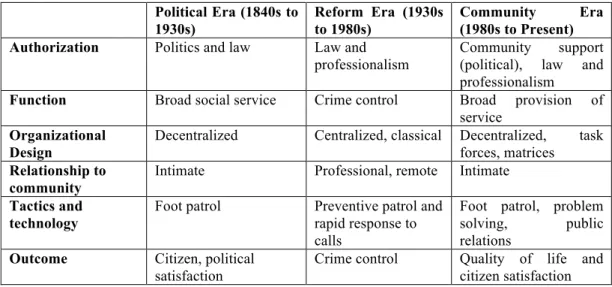
Community policing has been evolving slowly since the civil rights movement in the 1960s exposed the weaknesses of the traditional policing model25. It has been developed over the past three decades and continues into the 21st. Community policing is used widely as a term of police philosophies, strategies, and tactics, and is also known as neighborhood-oriented policing26, or community-oriented policing. Community policing promises to change radically the relationship between the police and the public, to handle the community problems, and to improve the living conditions in neighborhoods27. Its origin can be traced to the crisis in police-community relations, which has been influenced by a wide variety of factors over the past forty years. Roseunbaum described community policing as plastic concept, meaning different things to different people. Many perspectives on community policing are made only by assumptions and partially supported by empirical evidence. I tries to summarize the interpretation of police history in strategies of policing as the following Table 1 below, which includes how the police were authorized by government, the police function, organizational design, external relationship, principal programs and technologies, and the measured outcomes demanded.
25 Rosenbaum, D.P. The Challenge of Community Policing: Testing the Promises. (Sage Publication 1994) 5.
26Kelling (n 24) 11
27 Kelling (n 24) 3
Table 1. The Three Eras of Policing28
Political Era (1840s to 1930s)
Reform Era (1930s to 1980s)
Community Era (1980s to Present) Authorization Politics and law Law and
professionalism
Community support (political), law and professionalism Function Broad social service Crime control Broad provision of
service Organizational
Design
Decentralized Centralized, classical Decentralized, task forces, matrices Relationship to
community
Intimate Professional, remote Intimate Tactics and
technology
Foot patrol Preventive patrol and rapid response to calls
Foot patrol, problem solving, public relations
Outcome Citizen, political satisfaction
Crime control Quality of life and citizen satisfaction
Patterson stated that community policing is rooted in the belief that the traditional officer on the beat will bring the police and public closer. Instead of merely responding to emergency calls and arresting criminals, community-policing officers are considered to perform social work creatively toward the problem solution on their beats. The following task is how they make personal contacts to individual, both inside and outside their agencies. This is the face of a police culture that values crime fighting and a paramilitary chain of command as the standard operating procedures29.
From the discussion above it becomes clear that the community policing era is characterized by close working relationships between the police and community, giving attention to problem solving and creating quality of life in the community.
Policing is generally viewed to have become far more attentive to community
28 Braiden (n 23) 2-13
concerns during this period and police organizations have become more decentralized.
Community policing is emerging as a democracy in action. Active participation from community, i.e., participation of local government, public and private agencies, civic and business leaders, is required. The parties who share a concern for the welfare of the neighborhood should bear responsibility for safeguarding its own welfare. In addition, it has been suggested that community policing will play a primary role in changing the way of all government services provided at the community level. The implementation of community policing requires fundamental changes in the structure and management of police organizations.
Community policing transforms traditional policing in how the community perceived and in its expanded policing goals. These strategies use a wide variety of methods to control the crime actions and prevention of it as central goals. The police and the community become partners in addressing problems of disorder (e.g., gang activity, abandoned cars, and broken windows) and in preventing it before eventually leading to serious crime. Links between the police and the community are strengthened over time, so that the partnership will better be able to mitigate the main causes of crime. Police finds that crime-control tactics need to be augmented with strategies that prevent crime, reduce the fear, and improve the quality of life in neighborhoods. Fear of crime has become a significant problem in itself. A highly visible police presence helps reduce fear within the community, fear which has been found to be “…more closely correlated with
disorder than with crime”30. However, because fear of crime can limit activity, it pushes residents to keep in their homes, and contribute to empty streets. This climate of decline can result in even greater numbers of crimes, which can be predicted previously. Getting the community involved will make police has more available resources for crime-prevention activities, instead of being forced into response to a crime.
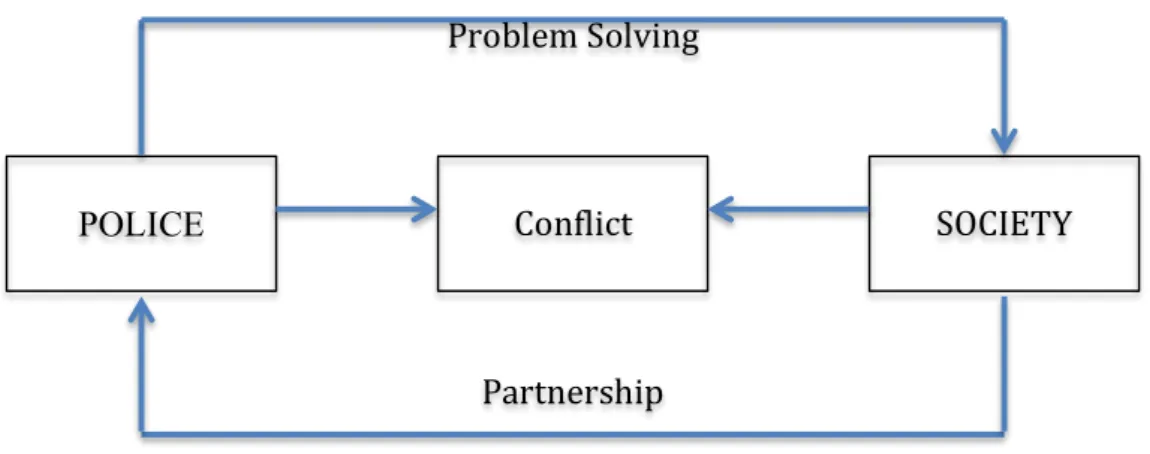
Community policing focuses on crime and social disorder through the delivery of police services that includes aspects of traditional law enforcement, crime prevention, and partnership through problem solving. These policing model take balance between responses to call for service with proactive problem solving centered on the causes of crime and disorder. Community policing requires an active movement from police and citizens to work together as partners in creating safety in the neighborhood.
There are several internal factors31, which become serious challenges for the police in their attempt to implement community policing. Those are such as the variety of size, structure, and quality of personnel and also paramilitary in structure with bureaucratic managerial orientations. Successful implementation of community policing will depend on how well mid-level police managers, most of whom have based their careers on traditional policing as he change agents directly connected to the community.
30 Kelling, George L., and Moore, Mark H. (1988) 8 based on The Network Foot Patrol Experiment (Washington DC 1981) cited in US Dept. of Justice, Bureau of Justice Assistance Monograph. Understanding Community Policing A Framework for Action (Diane Publishing 1995)
1. 3 Acceptance of Community Policing in Society
Those as follows are some examples of what is going on in many different places around the world under the rubric of community policing32:
USA
New York City has a program called C-POP, Community Police Officer Program, involving 900 officers out of a patrol force of approximately 16,000. In each of New York's seventy-five precincts, there are about ten C-POP officers, each of whom has been given a territory in which they are responsible for policing, supported by an overlay of rapid response patrol vehicles. C-POP officers do more or less what they want. Their injunction is to get to know the community and to find out how police resources might be used in order to meet policing requirements, not as generated by the Police Department, but as suggested by local communities. This is a very popular program, began in 1986, which shows no sign of flagging.
JAPAN33
Japan created modern community policing but did not call it so until very recently. The Japanese system, reformulated after World War II but resting on older traditional elements, is based on 15,500 Koban, or mini police stations, scattered all over Japan. There are 6,500 of them in cities and towns and 10,000 in rural areas. There is a neighborhood police station of this sort within six or seven
32 David Bayley on The Police and The Community in The 1990s
<http://www.aic.gov.au/media_library/publications/proceedings/05/bayley.pdf> last accessed on May 15, 2016
33 See Chapter 4 Section 4 for more description about community policing in Japan nowadays
blocks of every urban resident in Japan. It is still the case that just fewer than 50 per cent of all people requiring police service to come to the police in person rather than calling over the telephone. Personnel in these Koban and Chuzaiso do several things. They regularly patrol on foot and respond to citizen requests for service. They also make twice-yearly visits to every home and business in their area, knocking on doors and asking what problems people have. They use these occasions to promote crime prevention and to offer security inspections. Although this appears to be the most wall-to-wall community policing system in the world, the Japanese are not complacent about it. They are now involved in fine-tuning their system-two aspects in particular. The Japanese police have never developed programs of systematic liaison with the community. As a consequence, they are now asking all of their Koban to create formal community advisory boards in order to obtain feedback. Furthermore, they are now adopting a more problem- oriented approach. Previously, although the police were deployed pervasively, their emphasis was on discretionary law enforcement-impounding improperly equipped bicycles, enforcing laws against speeding motor vehicles, catching drunk drivers, and generally keeping the streets orderly. Now they are changing their priorities to emphasize matters the public is concerned with, as opposed to the matters of concern to police.
AUSTRALIA
Community policing in Australia is primarily an add-on crime prevention program. Hardly any attempts have been made to have community policing penetrate into general duties patrol work, with one major and exciting exception.
At the same time the crime prevention programs of Australian police forces are very rich, varied, and show improvements in some instances over similar program in other countries. For example, the Victorian Police sent officers to the United States to study Neighborhood Watch, who liked what they saw but found ways for maintaining the activity and enthusiasm of members, a problem that had be devilled and undermined American efforts. It seems that the only instance in Australia of a serious attempt to change the delivery of police services by general duties officers, could be found in New South Wales that Commissioner John Avery and his staff created community policing 'beats', which was started in Surry Hills, Sydney. There are now over 200 community police officers assigned to such beats in many larger towns in New South Wales. Each officer is responsible for his own area in which they establish community liaison, discover persistent order problems troubling to the community, and construct solutions to those problems. In effect they are to become the 'village bobby' for their areas.
INDONESIA34
In 21st country, the concept of humanist police has began to be socialized since autonomy (non-combat) of Indonesian Police took place in April 1999. Having initiated by the separation of the Indonesian National Police (INP) with the Armed Forces, the reformation process conducted by The INP could be considered and addressed as a considerable phase to actualize the Police force as professional civilian servants which is close to the community, to change the livelihood of civil society towards national democratic, secure, orderly, fair and
34 The next chapters (chapter 3,4 and 5) will more discussing about the implementation of community policing in Indonesia.
prosperous. Changes in the cultural aspect have encouraged police to made Grand Strategy 2005-2025. The first five years (2005-2010) is known as the phase of trust building, in 2011-2015 as partnership building, then in 2016-2025 as strict for excellent. Police in the structure of the police organization is spearheading.
The strongest spearhead of service is Polsek (Sector Police), which implements community policing directly to the community. In service position, strong police station is divided into 3 categories, namely Urban Police Commissioner consisted of 50 personnel, and then 40 personnel of Rural Police led by the AKP (Captain), Pre-rural police personnel consist 25 officer led by the Iptu (Lieutenant). Sector Police is the gateway community service, that receives reports from the public and keeps public security order at the district level, builds the security system at the level of spontaneous communities sub district, district patrol, cases investigation/Intel, handles and traffics reports, gives counselling, fosters associations and youth organizations and associations.
INDIA
A movement for community policing called "Friends of Police Movement" - FOPs was started in 1993 in Ramnad District of Tamilnadu, India. The FOP is a holistic and pro-active concept that lends a psychological approach to implement policing. It is a true example of police-public partnership in which citizens have been empowered with the help of the police. It provides opportunities for ordinary citizens to effectively contribute to the prevention and detection of crime. Any member of the public, male or female who is not involved in civil or criminal case can become a member of FOP. The members of FOP can provide useful
information leading to solving of crimes. FOP members can also prevent any abuse of Police power because of easy accessibility to the station house officer and other senior personnel. The movement has been well received not only among FOPs but also in the wider public and voluntary associations. Within a few months of its inception, nearly 1000 members of the public from all walks of life volunteered to become FOPs in Ramnad district.
1. 4 Summary
This chapter presents the general outline of the history of police institution in the world, introduces the concept of ‘community policing’ as one of recent policing strategies, and describes the several cases of the implementation of policing in the police law enforcement concept.
Police as part of the state government acquires several functions including maintaining security and public order, law enforcement, and giving services to the community. Indeed, the presence of civilian police has become a progressing demand. This means that if the police institutions still hold on to the old values of violence, they might be left behind and run over time. Having these as facts, the presence of civilian police is considered to be one of the ideal models for the police’s new paradigm. This might happen since the new paradigm takes the moral values, belief, and behaviour into account, which are hoped to stimulate a more caring police personality. Hence, this new paradigm could reflect the characteristics of the civilian police, which are more humanist with minimum use of force.
The discussing points of community policing can be summarized as follows:
1) Two of the key elements of community policing are police and community- partnership relation. Establishing and maintaining mutual trust are the central goals of the first core components of community policing.
2) The public put several hopes to police nowadays. They ask if the police are effective at carrying out their function. This is also primarily concerned with the effectiveness of police services, instead of whether these services can be equitably distributed or not. Furthermore, the effectiveness should be achieved at minimal costs, which means the efficiency concerns.
3) Community policing is affected mostly by decentralization and permanent assignments. Solving problems or reducing crime rate is done at the place where it happens and still on the task of law enforcement. Police administrators should acknowledge that crime is a natural condition of community. They must recognize that changes in their operations and their organizations are inevitable, but that few, if any, of these changes will be completely unprecedented journeys into uncharted territory.
The next chapter explains about the beginning process of Community Policing in Indonesia through the history of Indonesian National Police and the Grand Strategy for Indonesian National Police (INP) in the reform era.
Chapter II
Grand Strategy: A Gateway of Civilian Police in Indonesia
This chapter tries to describe the background history of Indonesian National Police (INP) institutions, starting from Majapahit kingdom until recent Reformation Era with the explanation about Grand Strategy 2005-2025. It also illustrates the organizational structure of INP and the legal aspect of community policing implementation in Indonesia.
2. 1 Historical Survey of Indonesian National Police
a. Before Independence (~1945)
In the era of Majapahit Kingdom, The famous Vizier Gajah Mada set up the security forces, Bhayangkara, whichwas in full charge of protecting the king and the kingdom34. Coedes state that Under Gajah Mada's command (1313–1364)35, Majapahit conquered large territories to become the regional power, including several states in Sumatra, Malay Peninsula, Borneo, Sulawesi, Nusa Tenggara islands, Maluku, New Guinea, and some parts of Philippines islands. In Sanskrit terminology “Bhayangkara” meant the great and powerful guardian. Based on this history, the word “Bhayangkara” derived from the Gajah Mada force’s is also use to name the Indonesia National Police forces nowadays.
34 Gunawan, M., Astuty, E.K., & Ginting, R.F.W. 2009. Buku Pintar Calon Anggota dan Anggota Polri (Jakarta: Visi Media Pustaka 2009) 5
35 Cœdès, George. The Indianized states of Southeast Asia (University of Hawaii Press 1968) 234
In the Dutch colonial period of Indonesia, the establishments of security forces initiated by the formation of guard troops were taken among the native people to maintain assets and wealth of the Europeans in the Dutch East Indies at that time.
In 186736, a number of European citizens in Semarang recruited 78 native peoples to maintain their security. The operational authority head of the police was on the resident and resident assistant. Rechts politie (law police) was counted for prosecutor or general attorney. During the Dutch East Indies period there were various forms of policing, such as veld politie (police court), stands politie (city police), cultur politie (agricultural police), bestuurs politie (police civil service), and others. In line with the state administration at the time the police also applied distinctive posts for Dutch and indigenous peoples. Basically a native shall not have served as hood agent (brigadier), inspector and commissaries of police. The created positions in the police for natives were only as police orderlies, assistant district officer and district officer police. Modern policing of the Indies set up between 1897-1920 was the forerunner formation of the existing Indonesian National Police37.
In Japanese occupation period, many police officers of native Indonesian were repositioned in the new organization, which differed from the Dutch one before.
The central police office in Jakarta was named Keisatsu bu, while the head of the office was named Keisatsu shocho. Furthermore, Japan divided Indonesian police into Java - Madura Police based in Jakarta, Sumatra Police based in Bukittinggi, Eastern Indonesia police based in Makassar and Kalimantan Police based in
36 Bloembergen, Marieke. 2011. Polisi Zaman Hindia Belanda. Dari kepedulian dan ketakutan (Jakarta: PT Kompas Media Nusantara 2011) 27