Significance of Research in Realistic Optimism and Its Future Prospect in School Education
Hideo KATO Aneesah NISHAAT Haruo MAGARI
Abstract
This study describes the concept of new realistic optimism, and also discusses how the concept of new realistic optimism will be applied into school education. Many studies have been conducted in optimism and several studies found the tendency of people to be unrealistically optimistic about future life events. The author defined realistic optimism as “a way of thinking and a way of life that can give good prospects for the future, even if people encounter various difficulties”. Then, The authors attempted to create the new realistic optimism scale, with considering the philosophical views, which were explained by Alain (1953), Keller (1904), Mandela (2012), and Ikeda (2016). The concept of realistic optimism seems to play a critical role to contribute to supporting children in terms of fostering their social, mental, and emotional developments. The study discusses how important it is to apply the new concept into educational activities, and also discuss its future prospect.
1 Overview of optimism studies
Many studies have been conducted in measuring optimism and pessimism, and these showed the differences in its concept, factors and approaches to measure optimism and pessimism. Some researchers believed that optimism is diametrically opposite to pessimism, and also there are several different styles to measure optimism and pessimism. For example, Weinstein (1980) developed an “unrealistic optimism scale”, which investigated the tendency of people to be unrealistically optimistic about future life events. This scale was designed to investigate people’s optimistic views in terms of their biased and unbiased views (the perspective error of judgments). The scale was composed of 42 worded statements of both the positive and negative life events (18 positive and 24 negative statements) and participants were asked to compare themselves with others to fulfill these evaluation items. The positive life events include “Liking postgraduation job”, “Owning your own home”, “Starting salary over
$10,000”, etc, while the negative life events include “Having a drink problem”, “Attempting suicide”, “Divorced a few years after married”, etc. The results showed that people have tendencies to think positive life events happen to them more than others, and negative life events happen to others more than themselves. Weinstein (1980) stated that people tend to think others will be the victims of misfortune but not themselves. Scheier and Carver (1985) created the Life Orientation Test (LOT) from the viewpoint of dispositional optimism. LOT was designed to measure how much people expect things in future optimistically. Generally, dispositional optimists have a tendency to expect positive outcomes rather than negative outcomes. In short, people who have dispositional optimism think that good things will happen to them more than bad things (Scheier & Carver, 1985). In Japan, Togasaki and Sakano (1993) and Nakamura (2000) attempted to create the Japanese version of LOT. The original version of LOT (Scheier & Carver, 1985) was designed to measure using a single factor, which means optimism is assumed to be diametrically opposite to pessimism. However, Nakamura’s Japanese interpretation of LOT was composed of two factors, which measures optimism and pessimism respectively. For example, Optimistic items include the following statement, “I am always optimistic about my future” and pessimistic items include “Things never work out as I expect”. Later on, Scheier, Carver and Bridges (1994) revised LOT, and this is called Life Orientation Test Revised (LOT-R). The original LOT was composed of 12 items, but the new version (LOT-R) was composed of 10 items, where two items were removed which included inadequate expressions from the original version (LOT). LOT-R was composed of 6 items regarding optimism/pessimist, and 4 filler items. Subsequently, Sakamoto and Tanaka (2002) created the Japanese version of LOT-R.
Chang, Maydeu-Olivers and D’Zurilla (1997) also believed that optimism is not diametrically opposite to pressimism, and these need to be treated as separate concepts to be measured respectively. Then, they created Expand Life Orientation Test (ELOT), which were composed of 20 items (6 items for optimism, 9 items for pessimism, and 5 filler items).
However, Toyama (2013) stated that ELOT had a low level of internal consistency, and considering this, she created the optimism and pessimism scale. This scale was made in Japanese, and the scale was composed of 20 items (10 optimism and 10 pessimism). As Scheier and Carver (1985) mentioned, the scales such as LOT and ELOT, were generally designed to examine personal views in terms of dispositional optimism. Also, Dember and his colleagues (1989) created the Optimism/Pessimism Instrument (OPI), which measures optimism and pessimism respectively. The OPI was designed in terms of both the perspective error of judgments (Weinstien, 1980) and expectation for future (Scheier & Carver, 1985). The OPI was composed of 10 optimism items, 18 pessimist items and 20 filler items (in total 52
items). Interestingly, Seligman and his colleagues (1979) applied a different approach to measure optimism/pessimism to other studies. Seligman and his colleagues (1979) explained optimism from the viewpoint of cognitive aspect, with using “learned helplessness” (Seligman
& Maier, 1967). In the reformation of the learned helplessness model, the pattern of causes people attribute to good or bad events in their lives, is assumed to be described by attribution theory (Weiner 1985, 1986).
People’s habitual way of looking at their experience, is assumed to give strong influences to how they explain an event they have experienced, and to their cognitive expectations of the future (Abramson, Seligman, & Teasdale, 1978). Seligman and his colleagues used this attributional style to measure people’s optimism and pessimism, and they created Attributional Style Questionnaire (ASQ). The ASQ was composed of three-dimensional factors, which are
“Internal - External”, “Permanent - Temporary”, and “Universal - Specific”. For example, when people face a problem, people who have optimistic views, tend to think the cause of the problem is “temporary” (it does not last long), “specific” (it happens only in certain cases) and
“external” (it happens because of external causes, but not personal causes). On the other hand, people who have pessimistic views tend to think the cause of the problem is “permanent”,
“universal” and “internal” (Seligman, 1991). Sawamiya and Tagami (1997) stated that the Japanese version of ASQ which was translated into Japanese, has low reliability, and considering Japanese cultural background, they created the optimistic attributional style questionnaire. This questionnaire was designed to measure both optimism and pessimism by three-dimensional factors using 23 items. Through factor analysis, they produced 3 factors,
“negative event – (permanent & universal)”, “negative event – (internal)”, and “positive event – (permanent & universal)”, however, “positive event – (internal)” was not created, because its factor was not stable (Sawamiya & Tagami, 1997). From the above, there is a clear difference between Dispositional optimism which was used by Scheier and Carver (1985) and Attributional (explanatory) style which was used by Seligman and his colleagues (1979).
Scheier and Carver’s approach “Dispositional optimism” was aimed to focus on personal tendency, which shows how much a person positively expects things for the future, while Seligman’s approach ‘Attributional style’ was aimed to focus on personal cognitive aspect, which explains a person’s characters and views as an optimist and/or a pessimist. Considering these approaches, Ando and his colleagues (2000) created the Multidimensional Optimism Assessment Inventory (MOAI). MOAI was composed of 6 factors with 30 items and these factors were “optimistic evaluation for ability”, “easy switching”, “optimistic expectancy for external resources”, “optimistic expectancy for luck”, “groundless optimism” and “optimistic expectancy for future”.
2 Realistic optimism and philosophical viewpoints
Through a review of previous studies in optimism and pessimism, Schneider (2001) discussed about its concept of “realistic optimism”. She believed that optimism needs to be realistic, which means it should not take an extreme in internalizing good events and externalizing negative events. Previous studies indicated that the nature of optimism had been used to express groundless optimistic expectancy. In short, people who have optimistic views, tend to have their groundless optimistic outlook. Schneider (2001) explained that three core concepts of realistic optimism, which are 1) Leniency for the past, or the “benefit of the doubt”
principle, 2) Appreciation for the present, or the “appreciate the moment” principle, 3) Opportunity-seeking for the future, or the “windows of opportunity” principle. Based on the idea of Schneider (2001), Magari (2014) proposed to define realistic optimism as “a way of thinking and a way of life that can give good prospects to the future even if a person encounters various difficulties”. Magari believed that realistic optimism highlights human strength, which could be explained as “even when a person faces the difficulties and hardships, by his willpower and flexibility, the person overcomes the difficulties and creates his own future”. In this regard, he found realistic optimism has the conceptual similarities in philosophical viewpoints and outlooks of life, which were explained by Alain (1953), Keller (1904), and Mandela (2012). For example, a French philosopher, Alain (1953) stated that
“Pessimism comes from the temperament, optimism comes from the will.”; “Pessimism is a matter of mood; optimism is a matter of will”. This implies that “will” is an important factor for optimism in terms of the philosophical viewpoint. Also, an American author, Keller (1904), who faced her illness, known as a “deaf, dumb and blind person” to contribute to the social welfare activity, stated that “As I stand in the sunshine of a sincere and earnest optimism, my imagination paints yet more glorious triumphs on the cloud-curtain of the future”. Similarly, a former president of South Africa, Mandela (2012) stated that “Part of being optimistic is keeping one’s head pointed toward the sun, one’s feet moving forward”. In addition, the founder of SOKA University and a Buddhist, Dr Ikeda (2016) stated as follows, “Nichiren Buddhism is deeply rooted in the idea of optimism. Nichiren has a profound view of optimism beating within him. Based on this profound and passionate view, Nichiren kept advancing for the happiness of all human beings”. This statement indicates that the profound and passionate view of optimism is assumed to be the very core of realistic optimism. In terms of philosophical viewpoints which are derived from their own life experiences, their views of optimism are assumed to be future oriented, and to keep holding hope even in facing various difficulties and hardships. In this vein, Magari found the realistic optimism has the conceptual similarities in philosophical viewpoints and outlooks of life, which are explained by Alain
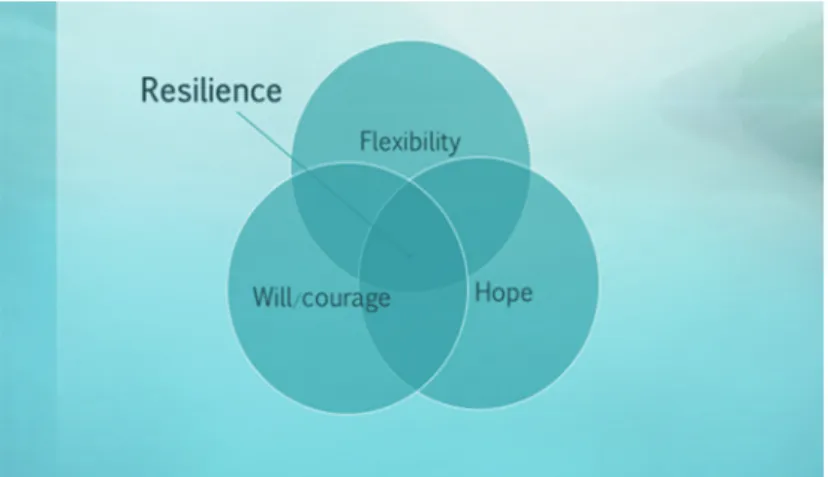
(1953), Keller (1904), Mandela (2012), and Ikeda (2016). Then, by applying Seligman’s attributional style, Magari (2018) assumed that realistic optimism is composed of three- dimensional factors, “flexibility”, “will and courage’, and “future orientation and hope”, including the idea of “resilience”’ at the core of them. Subsequently, Nishaat and Magari (2018) attempted to create the realistic optimism scale.
Figure 1 ; Three core factors of realistic optimism and resilience
3 Realistic optimism scale with Resilience
As mentioned, based on the idea of Schneider (2001), Magari (2014) defined the realistic optimism as “a way of thinking and a way of life that can give good prospects to the future even if a person encounters various difficulties”. Also they found the realistic optimism has the conceptual similarities in philosophical viewpoints and outlooks of life, which were explained by Alain (1953), Keller (1904), Mandela (2012) and Ikeda (2016). By applying Seligman’s attributional style, Nishaat and Magari (2018) assumed that the concept of realistic optimism is composed of three-dimensional factors, “flexibility”, “will and courage”, and “future orientation and hope” including the idea of “resilience” at the core of them, and they proposed the new concept of realistic optimism. Resilience is the ability to cope with a crisis or to return to pre-crisis status quickly (Stephen et al, 2014). It is often used as an innate ability of humans to endure against hardships and/or return as a stronger person than ever before (Magari, 2015).
Magari placed resilience as a core concept among these three factors, and he believed this idea is in accordance with the idea of Schneider (2001), which is to be future oriented, and to keep holding hope even if facing various difficulties. In this sense, Magari mentioned that resilience can be used as an external criterion to check a criterion related validity in creation of optimism
and pessimism scale. Considering these viewpoints, Nishaat and Magari (2019) attempted to create a realistic optimism scale, which has three factors with 12 items.
4 The new concept of realistic optimism and its practical uses in school education
The creation of the new realistic optimistic scale which considers philosophical views, seems to give a significant influence to various further studies and its practical uses. Especially, it is assumed to play a significant role to apply the concept of optimism to school education in terms of fostering children’s emotional well-being. Its two significant contributions are explained as below.
The first point is that, with paying attention to their similarities between realistic optimism and the philosophical views, these concepts were integrated with using the three-dimensional factors. The concepts of optimism which were rooted in the philosophical views of an experienced person, represented by Keller, Mandela, Alan, and Ikeda, seemed to be hardly used in the creation of the optimism scale, and this is an innovative attempt. Because of the three-dimensional factors, “flexibility”’, “‘will and courage”, and “future orientation and hope”, and “resilience” which is placed on the focus of the three factors, the features of the realistic optimism were concretely described. As Nishaat and Magari (2018) mentioned, realistic optimism, which was integrated with the philosophical views, seems to emphasize the differences between the new concept of realistic optimism and conventional optimism in the following four points. Firstly, “having unrealistic expectation for the future events”, vs.
“having positive views for the future events, with facing up to the reality”, secondly, “not emphasising the importance of willpower at all”, vs. “emphasising the importance of the willpower”, thirdly, “not emphasising the importance of resilience”, vs. “emphasising the importance of resilience”, and fourthly, “not relating to efforts to achieve the aim”, vs. “making efforts to achieve the aim”. Because “resilience” was placed as a core concept among three factors, it highlights that the new concept of realistic optimism is strongly related to one’s willpower to overcome hardships and make efforts to achieve the aims. The new concept seems to be strongly related to the philosophical views of experienced persons such as Keller, Mandela, Alan and Ikeda. Therefore, by learning their philosophical views, attitudes, and behaviours, the new concept of realistic optimism is assumed to be concretely described as a form of role models. In terms of supporting children’s psychological and emotional well-being in moral education, this seems to support children to easily contrast themselves with the role models and give more opportunities to them to deepen their own thoughts and attitudes.
In moral education, lessons are often designed to make children think about characters’
feelings and attitudes through reading a textbook. In this regard, Yamada (2019) mentioned that instead of merely focusing on understanding characters’ thoughts and feelings, it is more meaningful for children to ask themselves “what should I do if I were him/her?”. In this sense, the new concept of realistic optimism seems to be utilised to describe characters’ thoughts and behaviours and support children to easily contrast themselves with the characters. This is assumed to help children to develop their moral standards and emotional well-being. Some lessons from other subjects, such as Japanese and social studies also provide children with opportunities to deepen their own thoughts through learning characters’ attitudes and behaviours, while considering the moral values, which were learned from lessons of moral education. Even though, there are some different types of optimism which were derived from previous studies, it seems to be highly expected to increase the opportunities to apply the concept of optimism into educational activities in school. For example, several studies (e.g., Fujii, 2017a, 2017b) have been conducted to investigate the relations between the ways of children’s optimistic thinking and their school performance. Though these studies are not directly related to children’s emotional well-being issues, there are signs of increasing the opportunities in the further studies related to optimism in the educational field.
The second point is that, because the features of the realistic optimism were clearly described by the three factors, it provided more opportunities to utilise the realistic optimism in various ways in terms of fostering children’s inner strength. As mentioned above, it was emphasized that the new concept of realistic optimism is strongly related to one’s willpower to overcome hardships and making efforts to achieve the aims. It seems that the realistic optimism shares its common goals with the educational objectives (e.g. zest for living) of children’s emotional well-being and moral education. The three factors, “future orientation and hope”, “flexibility”, and “will and courage”, may be possible to be applied into educational activities such as educational indexes and evaluation criteria. For instance, the three factors could be applied to in the following ways, 1) “to be used as supplementary criterions and/or expressions of evaluation in the educational evaluation”, 2) “to be used as standards to select the course and material contents in moral education”, and 3) “to be used as tips for guidance methods and student counselling in school education”. In 2019, according to the new national course of study, “moral education” as a special subject, was introduced to all primary and lower-secondary schools in Japan, where the objectives and contents of its curriculums were amended (Central Council for Education, MEXT, 2019). Moral education has four key areas for fostering children’s altruistic attitudes and their moral senses, which are A) “relation to
oneself ”, B) “relation to others”, C) “relations to group and society”, and D) “relation to life, nature and the sublime”. The contents of the four key areas are aimed to give directions and a clue for fostering children’s moral senses and altruistic attitudes, but not to merely make children acquire knowledge of the contents of the four areas. As many researchers mentioned, one of longstanding issues in moral education was conventional teaching style which encouraged children to merely understand character’s feelings in the textbook (Akahori, 2018;
Nakayama 2020; Sonoya 2016). In the new national course of study, it is stated that lessons in moral education should never be limited to encourage children to merely understand characters’ feelings and urge them to speak and/or fill in desired answers (MEXT, 2019). In the national course of study, the purpose of moral education is designed to foster children’s inner strength/abilities, which is required to enable them to make suitable decisions for both oneself and others, allowing them to make a judgment based on their own moral standards when they face issues. In short, a core objective of moral education is to foster children’s independence of mind and their abilities to cope with issues in the future. This seems to indicate that the objective of moral education coincides with the concept of realistic optimism. In moral education, numerical evaluation method is not permitted; schoolteachers are required to make assessments by using a description method, which makes short sentences to evaluate and/or explain children’s psychological and emotional developments. In this vein, it could be possible that the assessments are written in terms of the three factors, “future orientation and hope”,
“flexibility”, and “will and courage”. It seems to be an effective way to describe children’s attitudes and their emotional developments using the three factors, because the objectives of moral education coincide with the concept of realistic optimism. Also, for the similar reason, the three factors could be used as standards to select the course and material contents in moral education. The Ministry of Education, Culture, Sports, Science and Technology (2012) conducted a survey of the operational situation of moral education and the survey indicated that school teachers face the following challenging issues and problems; “struggling to know effects of teaching” (primary school 48.3%, lower secondary school 42.7%), “struggling to know effective teaching methods” (primary school 33.2%, lower secondary school 38.9%), and “struggling to get appropriate teaching materials” (primary school 28.1%, lower secondary school 37.3%). Since 2019, moral education was put into operation as a special subject, and this makes it easier for schoolteachers to obtain teaching materials and textbooks. However, schoolteachers still seem to have some difficulties selecting the contents of lessons and to improve their teaching methods and instructional approaches. Each school is in a different situation, and occasionally schoolteachers need to utilize the regional characteristics and consider the school environment in order to give effective lessons. In this sense, using the concept of realistic optimism as standards for selection of study materials as well as for
improving their teaching methods, seem to help schoolteachers to manage their planning and preparations. Also, the three factors may be applied into some other ways in supporting children’s educational activities, such as anti-bullying methods, peer support, social skill training and special activities.
Finally, the creation of the new realistic optimism, which is integrated with the philosophical views, seems to be a significant process to deepen the interpretations of optimism. The realistic optimism seems to share similar concepts with resilience, but it clearly shows new directions of further studies. Also, the creation of the new realistic optimism seems to be expected to promote some practical uses of the concept of optimism not only for children, but also for anyone living in society. In the future, further research is necessary to improve the precision of the realistic optimism scale and its factors. Also, the relationship between the realistic optimism and resilience is one of the issues that should be resolved because their concepts are partially overlapped.
Reference
Akahori, H. (2018). A study of utilizing study materials in moral education. Moral education and education. Japanese society for moral education. 336, 107-117.
Ando, F., Nakanishi, Y., Kodaira, H., Esaki, M., Harada, I., Kawai, K., Ogawa, K., Sakihama, H. (2000). Construction of Multidimensional Optimism Assessment Inventory. Bulletin of the Graduate School of Education and Human Development, Nagoya University (Psychology and Human Development Sciences). 47, 237-245.
Chang, E. C., Maydeu-Olivares, A. & D’Zurilla, T. J. (1997). Optimism and pessimism as partially independent constructs: Relationships to positive and negative affectivity and psychological well-being. Personality and Individual Differences. 23, 433-440.
Chartier, E. (1953). Définitions. Paris: Les Éditions Gallimard
Dember, W. N., Martin, S. H., Hummer, M. K., Howe, S. R. & Melton, R. S. (1989). The measurement of optimism and pessimism. Current Psychology: Research & Reviews, 8(2), 102-119.
Ikeda, D. (2016). Towards tomorrow -SGI president’s dialogue III-. Seikyo Press. 2016, 02, 25.
Keller H. (1904). My Key of Life Optimism: An Essay. London: Isbister & Company 15 & 16 Tavistock st. Covent Garden 58.
Nakamura, Y. (2000). Psychological personal differences at meeting. P37-54. Brain press.
Magari, H. (2018). Psychology for joyful child-rearing. P115-117. Daisan Bunmei Press.
Magari, H. (2015). Psychology for joyful social relationship. P146-161. Daisan Bunmei Press.
Magari, H. (2014). Optimism as a key for being healthy. P222-229. Daisan Bunmei Press.
Mandela N. (1994). The Long Walk to Freedom: The Autobiography of Nelson Mandela. New York: Little Brown and Company, 341-342
Nakayama, K. (2018). My view of a lesson of moral education for morality special subject- isation, The Hakuoh University Journal, 32 (2), 151-178.
Nishaat, A., & Magari, H. (2018). Optimism and Realistic Optimism. Bulletin of The Faculty of Education, Soka University 70, 201-213.
Schneider S.L. (2001). In search of realistic optimism: Meaning knowledge and warm fuzziness. American Psychologist 56 (3) 250-263.
Sakamoto. S., & Tanaka, E. (2002). A study of the Japanese version of revised Life Orientation Test. Japanese Journal of Health Psychology. 15(1), 59-63.
Sawamiya, Y. & Tagami, F. (1997). Construction of an optimistic attributional style questionnaire. Japanese Journal of Educational Psychology, 45, 355-362.
Seligman, M. E. P. (1991). Learned Optimism. New York: Alfred A. Knopf.
Seligman, M. E. P., Abramson, L. Y., Semmel, A. & von Baeyer, C. (1979). Depressive attributional style. Journal of Abnormal Psychology, 88(3), 242-247.
Seligman, M. E. P., & Maier, S. F. (1967). Failure to escape traumatic shock. Journal of Experimental Psychology, 74, 1-9.
Scheier, M. F., & Carver, C. S. (1985). Optimism, coping, and health: Assessment and implications of generalized outcome expectancies. Health Psychology, 4(3), 219–247 Scheier, M. F., Carver, C. S. & Bridges M. W. (1994). Distinguishing optimism from
neuroticism (and trait anxiety, self-mastery, and self-esteem): A reevaluation of the Life Orientation Test. Journal of Personality and Social Psychology, 67 (6), 1063–1078.
Schneider S. L. (2001). In search of realistic optimism: Meaning knowledge and warm fuzziness. American Psychologist 56 (3) 250-263.
Soyano, T. (2016). The present circumstance of moral education and subject of morality, About the future of “special subject of moral” -Through the revision of course of study- The Journal of Matsumoto University 14, 13-28.
Suzuki, T. (2018). Teaching guidance and evaluation on “Special Mental Morality of Junior High School Course of Study” Hachinohe Gakuin University departmental bulletin paper (56), 17-32,
Togasaki, Y., & Sakano, Y. (1993). Is an Optimist in Good Health? The Japanese Journal of Health Psychology. 6(2) 1-11.
Toyama, M. (2013). Development of the Japanese Optimism and Pessimism Scale: Reliability and validity. The Japanese Journal of Psychology. 84(3), 256-266.
Weinstein, N, D. (1980). Unrealistic optimism about future life events.Journal of Personality and Social Psychology, 39, 806–820.
Yamada, S. (2019). Contrasting oneself with characters in study material for leading. Sogo Kyoiku Gijutsu. 73(13). 44-48.
現実的楽観主義研究の意義と教育現場での応用
加藤 秀男 ニシャート アニーシャ 鈎 治雄
要約
本研究では現実的楽観主義の新しい概念を考察し、この新しい概念がどのように教育 現場で応用できるかについて検討する。これまで楽観主義について多くの研究が行わ れ、人々は非現実的にものごとを楽観視する傾向があることが示されている。シュナ イダー(2001)は、楽観主義は現実的であるべきであり、良い出来事を過度に内在化 させたり、悪い出来事を過度に外在化すべきではないと述べている。鈎(2014)は、
楽観主義を、「様々な困難に遭遇したとしても,将来に対して良い見通しをつけられ るような考え方,生き方」と定義した。そして、アニーシャと鈎(2018)は、アラン やケラー、マンデラ、池田等に見られる人生経験に基づいた哲学的な楽観主義の考え をふまえて、新しい現実的楽観主義の考え方を提示している。新しい楽観主義の概念 は、子どもたちの情緒的発達をサポートするという観点から、重要な役割を果たすよ うに思われる。本研究では、この新しい楽観主義の概念を、教育活動に応用すること の意義について検討した。