REFUGEE EDUCATION IN ANOTHER PERSPECTIVE:
THE CURRENT STATE IN MALAYSIA AND ITS WAY FORWARD
文学研究科教育学専攻修士課程修了 ク ウェイチェン Koo Wei Qian
Abstract
With Malaysia being a non-signatory country to the 1951 Refugee Convention, refugee children in the country are denied access to the national education system and could only obtain informal education through community-based learning centres, established by local refugee community or NGOs. While the current provision of education aims to help refugee children to gain basic knowledge and skills to survive in the country, they seem to live a different lifestyle in isolation and remain “invisible” to the vast majority of the Malaysian citizens. Efforts to promote integration of refugees into the society are very important as the sense of belonging is one crucial factor to help them regain dignity and hope. Thus, there is a need to look at the term
“refugee education” from another perspective, which is, “education about refugees” for the Malaysian citizens.
The founder of Soka University, Dr. Daisaku Ikeda, mentioned in his speech at Teachers College in 1996 that one key element to global citizenship education is “the wisdom to perceive the interconnectedness of all life and living”. Therefore, global citizenship education plays a vital role in promoting harmonious co-existence among people of different ethnicities and backgrounds, and the issue of refugee education could be a stepping stone towards the introduction of global citizenship education in the country.
Keywords: Refugee education, Malaysia, Integration, Global citizenship education
1. Introduction
By the end of 2016, the number of displaced people in the world marks its highest level on record than any other time with an unprecedented 65.6 million people being forcibly driven away from home due to war, persecution, conflict, violence, or human rights violation. The Convention relating to the Status of Refugees, also known as “1951 Convention”, defines a refugee as “a person who is outside his or her country of nationality or habitual residence; has a well-founded fear of being persecuted because of his or her race, religion, nationality, membership of a particular social group or political opinion; and is unable or unwilling to avail him— or herself of the protection of that country, or to return there, for fear of persecution” (UNHCR, 2011).
Currently, being the largest refugee-hosting country in the region of South East Asia, Malaysia is hosting some 152,420 refugees and asylum seekers as of November 2017. Around 25 percent are children below the age of 18 (UNHCR, 2017b). These refugees and asylum seekers were “allowed” to remain in Malaysia with the assumption that their stay will be temporary, pending resettlement to a third country.
However, resettlement is never a promising solution for a vast majority of the refugees and asylum seekers in Malaysia. Many of them have been in Malaysia for more than 20 years and remained undocumented to date, especially the Filipino refugees in East Malaysia. With reference to this situation, it is without doubt that efforts towards the solution of local integration should be prioritised to help these refugees and asylum seekers to sustain their livings in the country. In his interview with The Star newspapers, the UNHCR representative in Malaysia, Richard Towle stated, “If you allow people self-sufficiency, autonomy and empower them with work opportunities and better education, their capabilities will be strengthened and they can contribute to the community and (adopted) country.” (Azizan, 2017).
With regards to the empowerment of refugees, the role of education is crucial. Education is a basic human right and ensuring that all children, without discrimination, have the right to education must be of top priority in finding long-lasting solutions to help refugees rebuild their lives and to be able to live with dignity.
Considering the critical consequences of education being disrupted, the Inter-Agency Network for Education in Emergencies (INEE), an open, global network of practitioners and policy makers, was established in Geneva in November 2000 to ensure all persons the right to quality education and a safe learning environment in emergencies through to recovery. In its guidebook—“Minimum Standards for Education: Preparedness, Response, Recovery” (2012), it was stated that,
Education in emergencies ensures dignity and sustains life by offering safe spaces for learning, where children and youth who need other assistance can be identified and supported. Quality education saves lives by providing physical protection from the dangers and exploitation of a crisis environment. When a learner is in a safe learning environment, he or she is less likely to be sexually or economically exploited or exposed to other risks, such as forced or early marriage, recruitment into armed forces and armed groups or organised crime. (p. 2)
2. Literature Review
a. Refugees in Malaysia
Malaysia is not a signatory to the 1951 Refugee Convention and its 1967 Protocol; nor have they established a system for providing protection to refugees considering the consequences of it becoming a drawing factor for refugees to come to the country due to its strategic geographical location in the region (Kaur,
THE CURRENT STATE IN MALAYSIA AND ITS WAY FORWARD
2007). In addition, the government had also indicated that providing protection to the refugees might impose heavy financial burden upon the country as well as the problem of national security due to the huge presence of refugees or asylum-seekers (UNICEF, 2015). Therefore, refugees are not legally recognised in the country.
Without specific policies to address the issue of identification and protection of refugees in the country, refugees and asylum seekers in Malaysia are not only denied refuge, but also left vulnerable to additional human rights abuses (Palmgren, 2011; Kaur, 2007).
As of end November 2017, there are some 152,420 refugees and asylum seekers registered with UNHCR in Malaysia. Among them, 90 percent are from Myanmar, comprising some 65,250 Rohingyas, 34,140 Chins and other ethnicities. There are also some 18,830 refugees and asylum seekers from other countries, including Pakistanis, Yemenis, Syrians, Somalis, Sri Lankans, Iraqis, Afghans, Palestinians etc (UNHCR, 2017a). As there are no refugee camps in Malaysia, the majority of the refugees are concentrated around the capital, Kuala Lumpur and the surrounding Klang Valley. They live within the local community, in crammed low-cost flats in the city, as invisible as they could. In fact, a huge number of Rohingya children are born in the country. However, most of the Malaysians are not aware of the existence of refugees in the country and often mistaken them for illegal immigrants (Letchamanan, 2013).
b. The current state of refugee education in Malaysia
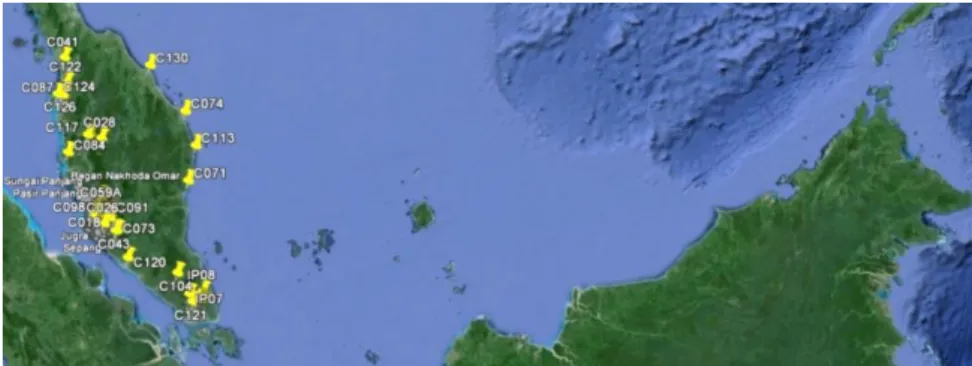
Among the refugees and asylum seekers in Malaysia, 40,470 are under the age of 18. However, only 30 percent are enrolled in community learning centres and the enrolment rate in primary and secondary education were reported at 44 percent and 16 percent respectively (UNHCR, 2017c). Given that Malaysia is a non-signatory to the 1951 Refugee Convention, refugee children in the country are denied access to the national education system. However, the government has welcomed initiatives by the private sector, NGOs and individuals in providing these children with an education (UNICEF, 2015). Thus, refugee children can only obtain education via an informal parallel system of more than 130 community-based learning centres,s established either by the local refugee community, local NGOs, or a partnership of both, supported by UNHCR.
Figure 1: 133 learning centres located in the capital of Malaysia, Kuala Lumpur and 10 other states (Source: UNHCR, 2017)
UNHCR Malaysia is currently working with six implementing partners in the sector of education to provide refugee children with better access to education and to ensure that education delivered is of quality. The main activities of UNHCR Malaysia listed as follow are conducted based on several objectives:
Objective 1: Improve learning achievement for refugee children in primary school
• As of September 2017, 128 of some 700 teachers are compensated under the Teachers’ Compensation Programme.
• Regular monitoring of learning centres done by staff members.
Objective 2: Ensure that schools are safe learning environments for refugee girls and boys and young people
• Provision of grants based on needs for rental, renovation, materials, etc. to ensure a more conducive learning environment at the learning centres.
• Peacebuilding activities by means of sports, art, music and other extracurricular activities explored with various parties such as PJ Live Arts, Dignity for Children Foundation and etc.
• “Children’s Safety Programme” sessions are conducted by ICMC (International Catholic Migration Commission) for learning centres located in Kuala Lumpur, Selangor and Pulau Pinang.
Objective 3: Improve access to formal secondary education opportunities for refugee young people
• 21 learning centres offer Secondary Level education with 2 being specifically secondary education centres.
Objective 4: Improve access to higher education opportunities for refugee young people
• UNHCR has signed Memorandum of Understanding (MoU) with the University of Nottingham Malaysia Campus, International University of Malaya-Wales (IUMW), Limkokwing University of Creative Technology, Brickfields Asia College, International Innovative College and HELP University to provide access to higher education courses for refugee young people.
• Currently 48 refugees are pursuing their further studies.
THE CURRENT STATE IN MALAYSIA AND ITS WAY FORWARD
Objective 5: Ensure opportunities for education are live long and available according to need
• Early Childhood Development is further enhanced with the Toy Box programme which is implemented at 12 learning centres.
• About 576 refugee youths have graduated from Project Self-HELP since its implementation in 2011.
Project Self-HELP is a skills training programme by HELP College of Arts and Technology.
Table 1: The main activities of UNHCR Malaysia (Source: UNHCR, 2017c)
The above table shows some encouraging results under the efforts of UNHCR Malaysia together with some NGOs or educational institutions. Nevertheless, there are much more to do in order to ensure that refugee children in the country are receiving quality education in terms of facilities and relevancy of the content for students to excel into the future. Refugee learning centres are mostly located in rented, crammed flats or shop lots.
They normally operate between four to six hours a day for five days a week. Research had revealed that many of these learning centres are severely underfunded and heavily reliant on UNHCR’s assistance for teacher compensation and training, are overcrowded and lacked proper classrooms. They also do not have sufficiently trained teachers whereby many of the teachers are refugees themselves with little teaching experience or knowledge of pedagogy. Moreover, students often had little or no exposure to sports or other recreational activities integral for childhood development. While many of the learning centres use the Malaysian national syllabus as their core materials to make it easier for children to integrate if the Government changes its policy, there is generally no formal certification of learning and no recognition of studies by any authority. However, there are some other who opted to use the North American curriculum, books from Singapore and UK or the Canadian Ontario curriculum to prepare children for resettlement in these countries (UNICEF, 2015).
3. Methodology
With the purpose to discover more about the current state of refugee education in Malaysia, fieldwork was conducted in two refugee learning centres located near the capital of Malaysia— Kuala Lumpur in August 2017. Semi-structured interviews with one teacher and one administrative staff from each learning centre were conducted to find out more about the establishment of the learning centres, their vision and development, how are they being funded, the problems and challenges they are facing etc. While there were guidelines to the interview questions asked during the semi-structured interviews, a more flexible approach was employed to discover more about the working experiences and visions of the teachers and administrative staff relating to refugee education.
Prior to the start of each interview, the purpose of the study was explained to the participants and
informed consent was obtained. In addition to that, classroom observations were conducted for four days to observe the process of teaching and learning, including the instructions given by teachers, students’ attitudes toward learning, interactions between teachers and students, as well as interactions among the students themselves. However, the observation was only done in one of the learning centres due to constraints such as time and the distance of the school.
The two learning centres are namely El-Shaddai Refugee Learning Centre and Pusat Ilmu Muslim Aid (PIMA, in English, Muslim Aid Knowledge Centre) which are located at Klang and Ampang respectively.
El-Shaddai Refugee Learning Centre is considered as one of the largest refugee learning centres in Malaysia, accommodating around 600 refugee children from twelve different countries with the provision of education ranging from kindergarten to Year 8 (post-primary education). It was initially founded in 2008 as an implementing partner with UNHCR Malaysia under the effort of a Christian Organisation. PIMA, on the other hand, is a learning centre founded under the effort of Muslim Aid Malaysia Humanitarian Foundation in 2014, to provide refugee children who are staying around the area of Ampang a chance to basic education, to become more competitive in the society and eventually a better life. It is currently providing primary education to around 60 Rohingya students living in that area. The selection of learning centres, however, might not represent the current states of refugee education in Malaysia as a whole.
4. Findings
• Demographic diversity. Malaysia is a host country to refugees and asylum seekers from more than 10 different countries including Myanmar, Sri Lanka, Pakistan, Somali, Syria, Iraq, Iran, Palestine, Afghanistan, Yemen and Sudan. The demography of refugee population with such diversity is thus reflected in most of the learning centres. In one learning centre, there are students from 12 different countries, with the majority from Myanmar and Pakistan. This gives students a chance to learn in an environment of multi races, cultures and backgrounds which allows them to gain soft skills, such as respect and tolerance. It is a merit for them if they were to continue staying or to integrate into the multiracial Malaysian society in the future. However, there also exists some learning centres established by the refugee communities themselves and thus only accommodate refugee children from their own community.
• Syllabus and curriculum. While UNHCR encourages learning centres to follow the Malaysian curriculum to make the case stronger for the government to unconditionally open the doors of public schools to refugee children and to make it easier for children to integrate when the government changes its policies (UNICEF, 2015), it still very much depends on the nature and purpose of the learning centres to decide their syllabus and curriculum. For instance, learning centres which aim to
THE CURRENT STATE IN MALAYSIA AND ITS WAY FORWARD
help students resettle in third countries such as the United States or Australia chose to use syllabus of higher level and English as the medium of teaching to prepare students for resettlement.
• Problems and challenges. Many of the learning centres are severely underfunded and heavily reliant on UNHCR’s assistance for teacher compensation and training, overcrowded and lacked proper classrooms. They also do not have sufficiently trained teachers and the qualifications of teachers are very diverse whereby some are university graduates, while some only complete high school. Language barrier is also one of the problems in most learning centres which hinders students from learning or slowing down their learning process. 90 percent of the refugees and asylum seekers in Malaysia are from Myanmar, and they can speak neither English nor Bahasa Malaysia.
Sometimes, teachers who are from same refugee background will need to do extra explanation to the students in their native language. However, in many cases, these refugee teachers are with little teaching experience or knowledge of pedagogy. Parents’ attitude towards education is also one challenge faced by most learning centres. In general, most refugee parents see education as an important mean for a better future of their children. However, refugee parents from a more traditional and conservative background, for example refugees from the Rohingya community, do not put much emphasis on the importance of education especially when it comes to education for girls.
•
5. Refugee education in another perspective
Overall, even though there exist some sort of access to education for refugee children, the educational environments that they are in seem to be an isolated space where there are very limited interactions with the outside world. With the aim of preparing refugee children for local integration, some learning centres are using the Malaysian syllabus and curriculum as their teaching materials, as well as teaching the children the Malay language and English which is helpful in terms of communication within the society. Even so, that does not seem to close the gap between the refugee communities and the Malaysian society. This creates an ironic phenomenon whereby, on one hand, refugee children are receiving education which can be their source of hope for a better future while on the other hand, the reality of the society is full of discrimination, rejection, exclusion and violation of rights. They grow up witnessing the marginalisation of their parents, their exploitation by local employers or police, their worries about health care, the lack of basic safety and security. Low (2013) further stated, “This [phenomenon] makes us wonder what sense of self these children grow up with and what kind of values the whole educational and social environment bestows on them?” (p. 26)
While much more needs to be done to improve the quality and accessibility of the provision of education for refugee children, this paper suggests a different perspective of looking at the issue of refugee
education. It is without doubt that education plays a very important role in providing refugees with the basic skills and knowledge to survive in the society. But on top of that, we need to take into consideration their psychological needs, to help them in terms of gaining a sense of belonging in the society and to become resilient.
The recent outbreak of the persecution of Rohingya ethnic in Myanmar during end of August last year had revealed the narrow-mindedness and intolerance of majority of the Malaysian society despite being a multiracial and multicultural country. The condemns and critics toward refugees from the public very much reflected the flaw in the Malaysian education system.
The Malaysia Ministry of Higher Education has introduced the “Ethnic Relations Module” as a compulsory course in all public and private universities in 2005 to promote national unity, appreciation of diversity and harmony among citizens of different ethnicities. Likewise, many subjects taught in primary and secondary schools include the principle of learning to live together, for example the Islamic religious education for Muslim students teaches the value of promoting a caring and cooperative society; moral education for non-Muslim students teaches values relating to human rights and the value of living together in harmony; while local studies teaches about the neighbourhood, society, nation etc. (International Bureau of Education, n.d.)
Syllabus and curriculum could of course be designed in the most perfect ideas possible, but it remained a question as to how much have they been put into practice. “Given that the curriculum from elementary all the way through to tertiary education includes teaching values such as caring, tolerance, inclusion, harmonious co-existence etc, how far has it achieved in terms of promoting a caring and a more civilised society? How effective are we in creating unity among people of different races and cultures? While national unity is undoubtedly important, where are we standing in terms of fostering citizens who value diversity, and are capable of fitting into a globalised and fast-changing era?” These are some of the questions that we have to ponder.
While the word “refugee education” has been widely used to refer to the provision of “education for refugee children”, I would like to divert the attention to looking at the word of “refugee education” from another perspective, which is “education about refugees”. All these while, the issue of refugees is barely being discussed in the classrooms and most of the Malaysians are not aware of their existence in the country. One reason of that could be the loose foreign labour policy which attracts the flows of migrant workers into the country, making it a common phenomenon that refugees are often being mistaken, or generalised by concept, as foreign workers.
With the issue of refugee crises now becomes one global concern and the fact that there exists a large number of refugees and asylum seekers in the country, with majority of them are living in the urban areas (there is no refugee camp in Malaysia), citizens of Malaysia should start learning and become aware about the issue.
As much as it is important for refugees to learn about the cultures and norms of the host country, citizens of the host country need to know about the background and cultures of refugees, as well as to listen to the journey of
THE CURRENT STATE IN MALAYSIA AND ITS WAY FORWARD
them seeking refuge. It is only through the initiative trying to achieve mutual understanding through dialogues and exchanges that allows a harmonious co-existence of both parties in the society.
Therefore, the role of education is vital not only in terms of educating the refugees, but to also educate the Malaysian citizens about refugees and to cultivate an open-minded attitude which allows them to embrace the “newcomers” in the country. Schools should take initiative to introduce topics such as migrants and refugees into classrooms, as well as to organise community projects to enable students to have a better understanding of the plight of refugees.
6. Conclusion—The way forward
While we are looking into the problems and challenges surrounding on the provision of education for refugee and trying to find solutions for its betterment, it is of equal importance to look at educating the society about refugees to ensure that members of the community could embrace refugees with an open heart. After all, the core problem underneath the xenophobic attitudes toward refugees, in my opinion, is the lack of mutual understanding and the consciousness that all of us are living on the same Earth and we are all citizens of the world.
In his speech at Teachers College, Columbia University in 1996, Dr. Daisaku Ikeda, the founder of Soka University, spoke on the three essential elements of global citizenship: “First, the wisdom to perceive the interconnectedness of all life and living; second, the courage not to fear or deny difference, but to respect and strive to understand people of different cultures and to grow from encounters with them; and third, the compassion to maintain an imaginative empathy that reaches beyond one’s immediate surroundings and extends to those suffering in distant places” (p. 112-113). We need to understand the fact that no one is a refugee by choice and to embrace them as people who have no difference from us.
Global citizenship education is very much needed to tackle the issues of xenophobia and hate speeches that are filling our world today. I would like to, therefore, suggest that global citizenship education should from now on be introduced in the Malaysian school curriculum, and the idea of global citizenship by Dr. Daisaku Ikeda should serve as the fundamental philosophy to produce more global citizens with compassion and empathy, and together we create a society of greater solidarity for refugees.
References
Azizan, H. (2017, January 1). Education is the Key Empowering. The Star Online. Retrieved from https://www.thestar.com.my/news/nation/2017/01/01/education-is-the-key-empowering-rohingya-refug ee-children-in-malaysia-through-education-can-allow-th/
Idris, F., Yaacob, M. & Taha, M. (2012). Teaching and Learning Methods of Ethnic Relations Course:
Interactive or Destructive? Procedia Social and Behavioral Sciences, Issue 59, pp. 105-109.
Ikeda, D. (2010). Education Toward Global Citizenship (Lecture at Teachers College, Columbia University, 1996). In: Soka Education—For the Happiness of the Individual. Santa Monica, CA: Middleway Press.
INEE. (2012). Minimum Standards for Education: Preparedness, Response, Recovery. New York, NY: INEE.
International Bureau of Education. (n.d.). Development of Education: National Report Malaysia. Retrieved from http://www.ibe.unesco.org/International/ICE/natrap/Malaysia.pdf
Kaur, A. (2007). Refugees and Refugee Policy in Malaysia. UNEAC Asia Papers No. 18. Retrieved from https://www.scribd.com/document/96131329/Refugees-and-Refugee-Policy-in-Malaysia
Letchamanan, H. (2013). Myanmar’s Rohingya Refugees in Malaysia: Education and The Way Forward.
Journal of International and Comparative Education, 2013, Volume 2, Issue 2.
Low, S.K. (2013). Dreams & Participation in Education: A Narrative Inquiries into the Life Experience of Myanmar Refugees in Malaysia. Retrieved from https://www.researchgate.net/publication/264325305 Palmgren, P. (2011). Navigating a Hostile Terrain: Refugees and Human Rights in Southeast Asia. Sociology
Compass 5/5, pp. 323-335.
UNHCR. (2011). The 1951 Convention Relating to the Status of Refugees and its 1967 Protocol. Geneva:
UNHCR.
UNHCR. (2012). Education Strategy 2012 -2016. Geneva: UNHCR.
UNHCR. (2015). Global Trends: Forced Displacement in 2015. Geneva: UNHCR.
UNHCR. (2016). Missing Out: Refugee Education in Crisis. Geneva: UNHCR.
UNHCR & Global Education Monitoring. (2016). No more excuses: Provide education to all forcibly displaced people. Paris: UNESCO.
UNHCR. (2017a). Figures at a Glance: Statistical Yearbooks. Geneva: UNHCR.
UNHCR. (2017b). Education in Malaysia. Geneva: UNHCR.
UNHCR. (2017c). Education in Malaysia. Geneva: UNHCR.
UNICEF. (2015). Mapping Alternative Learning Approaches, Programmes and Stakeholders in Malaysia.
Kuala Lumpur: UNICEF.
Zakaria, H.A. (2000) Educational Development and Reformation in the Malaysian Education System:
Challenges in the New Millennium. Journal of Southeast Asian Education. Vol. I, No. 1, pp. 113-13
THE CURRENT STATE IN MALAYSIA AND ITS WAY FORWARD Appendix
Profiles of Refugee Learning Centres
1. El-Shaddai Refugee Learning Centre
• One of the largest refugee learning centres in Malaysia with around 600 students. The learning centre was established in 2008 by ElShaddai Centre (faith-based organisation) as an implementing partner with UNHCR in Malaysia to help refugees and asylum seekers, not only by providing education, but also primary health care, shelter as well as setting up simple sustainable social enterprises. They also receive children of migrant workers who do not possess documents to enrol in Malaysian national schools.
• Vision: Honour and dignity, holistic health, hope for a better future for all migrants and refugees in Malaysia.
• Mission: (1) Rescue – migrants and refugees who are homeless, cheated or in danger of being trafficked and enslaved; (2) Relief – provide relief to migrants and refugees who are suffering, deprived or sick; (3) Restore – traumatised migrants and refugees to holistic physical, mental and spiritual health; (4) Rehabilitate – migrants and refugees needing education, livelihood skill, social life and dignity.
• Demography: Around 600 students from 12 different countries including Myanmar, Pakistan, Sri Lanka, India, Indonesia etc.
• Grades and ages: Children of 4–16 years old studying in Pre-school to Form 2 (Year 8) classes.
• Syllabus and curriculum: Currently using Singaporean syllabus and textbooks.
• Subjects taught: English, Bahasa Malaysia (Malay language), Mathematics, Science, Reading
& Writing, Moral/Character Building, Arts & Craft, Music & Movement, Physical Education
• Typical school day: 9am–2pm. Each class is 40 minutes and lunch break is at 12.20pm for 50 minutes.
• Fees charged: RM50 for UNHCR Cardholder; RM80 for non-UNHCR Cardholder
• Meals and transportation: Provided. An additional fee of RM20 is charged for those who use the transportation service.
• Number of teachers: 45 teachers. 31 of them are working full time and 14 volunteers.
• Education level and background of teachers: Some teachers and volunteers hold bachelor degree or currently undergraduate students while some teachers are members of the church who volunteered themselves to help out with the learning centre. There are also teachers from refugee background, mostly from the Chin ethnic.
• Facilities and infrastructure: Classes for elementary level are held in buildings belong to a church while classes for secondary level are held at an old shop house nearby. There is a small field within the compound of the church’s premises which serves as the place for Physical Education.
A: Administration office B: Classrooms for Year 3-6 (Church building) C: One of the classrooms for kindergarten level
A
B
C
THE CURRENT STATE IN MALAYSIA AND ITS WAY FORWARD
Picture of the upper elementary class (Source: El-Shaddai Refugee Learning Centre)
Picture of lower elementary classes during lunch break (Source: El-Shaddai Refugee Learning Centre)
2. Pusat Ilmu Muslim Aid (Ampang, Selangor)
• The learning centre was set up by the Muslim Aid Malaysia Humanitarian Foundation (Muslim Aid) in 2014 with the underlying philosophy of developing the potential of individuals and to produce individuals who are knowledgeable, responsible and contribute to the society, regardless of religion, race and nationality. Hence, the institution aims to help the kids by providing them chance for gaining basic education, a better life and competitive. The organisation is currently running three learning centres in the state of Selangor, Kelantan and Terengganu respectively.
• Vision: To become a knowledge centre that can produce students who are able to master basic learning.
• Mission: To provide curriculum and co-curriculum to enable students to master reading, writing, counting, and reasoning.
• Demography: Around 60 Rohingya students from Myanmar.
• Grades and ages: Primary education for children from 6–14 years old. Pre-school and secondary education are in planning stage and expected to launch in 2018.
• Syllabus and curriculum: Malaysian syllabus
• Subjects taught: English, Bahasa Melayu (Malay language), Mathematics, Science, Local Studies, Islamic Studies (twice a week), Arts, Moral and Sports (once a week)
• Typical school day: 2 sessions per day. Morning session for upper primary (Year 4-6):
8.30am–12noon. Afternoon session for lower primary (Year 1-3): 12.30pm–3.30pm. Each class is one hour.
• Fees charged: RM10
• Meals and transportation: Not provided
• Number of teachers: 3 full time teachers.
• Education level and background of teachers: All three teachers are Malaysian graduated from University of Malaya.
• Facilities and infrastructure: The learning centre is set up in a rented low-cost house with a few rooms that serve as classrooms. There is empty space within the compound of the house for Physical Education and students could play there during recess.
THE CURRENT STATE IN MALAYSIA AND ITS WAY FORWARD
Picture of students and teachers having activity in the compound of the centre (Source: Pusat Ilmu Muslim Aid)
Disclaimer:
This research was reviewed and approved in advance by Soka University Institutional Review Board.