• 検索結果がありません。

Dopant-Free Organic and Inorganic Hole Transport Materials for Perovskite Solar Cells

N/A
N/A
Protected

Academic year: 2021

シェア "Dopant-Free Organic and Inorganic Hole Transport Materials for Perovskite Solar Cells"

Copied!
162
0
0

読み込み中.... (全文を見る)

全文

(1)

Dopant-Free Organic and Inorganic Hole Transport Materials

for Perovskite Solar Cells

(ペロブスカイト太陽電池のための添加剤フリー有機・無機正孔輸送材料)

January, 2020

Materials and Applied Chemistry Major Graduate School of Science and Technology

Doctoral Course Nihon University

Ryuji Kaneko

(2)

Abstract

Perovskite solar cells (PSCs) are first reported in 2009 by Professor Miyasaka in Toin University of Yokohama, in which power conversion is performed using halide perovskite crystals instead of dyes in dye-sensitized solar cells (DSSCs)-based device architecture. On the other hand, the DSSCs-based device architecture requires an electrolyte that decreases conversion efficiency to about 4% due to the decomposition of the perovskite crystal. However, in 2012, an all-solid-state PSCs using a hole transport material (HTM) based on a solid organic semiconductor were reported, which showed a power conversion efficiency (PCE) of 9.7%. In 2019, the conversion efficiency of 25%

was reported, attracting attention as a next-generation photovoltaic technology. On the other hand, conventional HTM requires some additives to ensure high conductivity.

However, oxidizability, corrosiveness and hygroscopicity of the additive caused degradation and decomposition of functional layers including the perovskite layer.

Therefore, in recent years, HTMs that does not use these additives are considered as one of the choices to achieve high efficiency and long-term stability of PSCs.

This thesis is focused on the study of organic and inorganic semiconductors without

dopants for HTMs of PSCs (Figure 1). The purpose of this study is to elucidate the

relationship between the material design, their electronic properties, and the photoelectric

conversion characteristics of PSCs using these materials, and to provide a basic

understanding of HTM design and further improvements in photovoltaic performance. To

achieve the development of dopant-free organic and inorganic HTMs, I focused on

intermolecular interactions and molecule-nanoparticle interaction. Important points for

the development of dopant-free HTMs are control of electronic interactions between

HTMs and modification of interface between a perovskite layer and a hole transport layer

(HTL). In this thesis, I developed a series of electro-active organic semiconductor-based

supramolecules with intermolecular interaction sites, surface-modified inorganic

nanoparticles covered by a self-assembled monolayer (SAM) of small molecules.

(3)

In Chapter 1, I have summarized the fundamental information for the PSCs and HTMs and described the motivation and purpose of this thesis.

In Chapter 2, I have synthesized hydrogen-bonding and non-hydrogen-bonding tetrathiafulvalene (TTF) derivatives and clarified the relationship between their intermolecular interactions and their electronic properties in solution. The formation of mixed-valence states of hydrogen-bonding derivative has been observed by cyclic voltammetry and spectroelectrochemical measurements. It was suggested that supramolecular aggregates were formed by concerted intermolecular interactions, which proved that electronic interactions appeared in the intermolecular TTF skeleton.

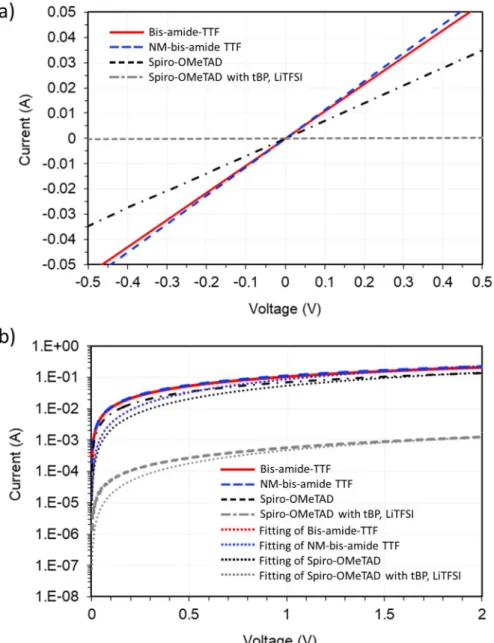
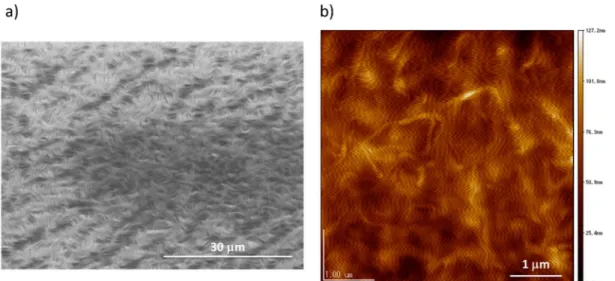
In Chapter 3, the TTF derivatives discussed in Chapter 2 were applied as HTMs for PSCs and their electronic properties and the photovoltaic performance using supramolecular TTF-based nanofibers were discussed. The nanofibers of TTF derivatives constructed by intermolecular interactions including hydrogen bonds, forming organogels in nonpolar organic solvents and a three-dimensional network in a thin film. Nanofiber- based thin films without dopants showed high conductivity and PSCs using nanofiber- based hole transport layers (HTLs) showed 14.5% photoelectric conversion efficiency.

Moreover, it was suggested that the current-voltage characteristics from different scan directions have small hysteresis and high reproducibility.

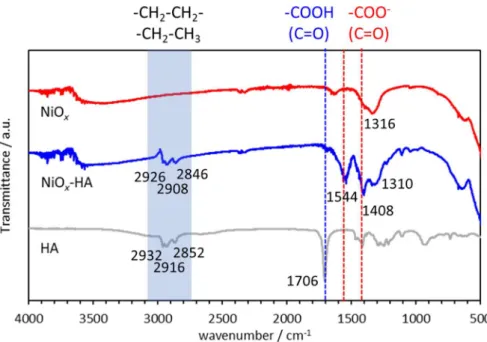
In Chapter 4, I have developed a surface modification of NiO x nanoparticles (NPs) using an interaction between a molecule and NP and suggested suitability of densely- packed and smooth NiO x thin films as HTLs prepared using spin-coating of surface- modified NiO x NP suspensions in nonpolar solvents to improve photoelectric conversion efficiency. The conductivity of the NiO x thin film (1.20×10 -5 S cm -1 ) was found to be approximately twice as high as that of a typical organic HTM film (5.18×10 -6 S cm -1 ).

The smooth and pinhole-free NiO x thin film suppresses recombination between the perovskite layer and the electrode, so the photoelectric conversion efficiency is improved from 5.5% to 13.1% by using the surface-modified NiO x .

In Chapter 5, I have synthesized NiO x nanoparticles with various concentrations of

cobalt(II) ions (0.5 mol%-10 mol%) as HTLs in PSCs and investigated their electronic

properties. It was suggested that the conductivity of the cobalt-doped NiO x thin film was

improved from 3.83×10 -6 S cm -1 to 6.20×10 -6 S cm -1 by cobalt-doping up to 5 mol%. By

investigation of the energy levels of cobalt-doped NiO x and exciton behaviour at HTL-

(4)

perovskite layer interface, it was suggested that cobalt-doping in NiO x has two effects:

improvement of conductivity and reducing valence band energy. In the case of cobalt- doped NiO x -based HTMs, the improvement in conductivity outweighs the effect of decreasing hole extraction performance, resulting in the highest PSCs of 14.5% was shown in the case of perovskite solar cells using 1 mol% cobalt-doped NiO x .

In Chapter 6, I have concluded the results for each chapter and suggested the further development for organic and inorganic HTMs to achieve the high efficiency and long- term stability of PSCs through the development of HTMs which is considered not only their chemical properties but also device fabrication processes of the PSCs.

Figure 1. Summary of the researches in this thesis.

(5)

Symbols and Abbreviations

AFM atomic force microscope

AM1.5G reference solar spectral irradiance (100 mW/cm 2 )

Abs absorbance

BCP bathocuproine

C concentration

CB conduction band

CIGS copper indium gallium selenide CTM charge transport material

CV cyclic voltammetry

CZTS copper zinc tin sulphide

DCC N,N’-dicyclohexylcarbodiimide

DEPT distortionless enhancement by polarization transfer DFT density functional theory

DLS dynamin light scattering

DMAP N,N’-dimethyl-4-aminopyridine DMF N,N-dimethylformamide

DMSO dimethyl sulfoxide DSSC dye-sensitized solar cell

E potential

EDX energy dispersive X-ray spectrometry EQE external quantum efficiency

ETL electron transport layer

F4TCNQ 2,3,5,6-tetrafluoro-7,7,8,8-tetracyanoquinodimethane

FA formamidinium cation

FE-SEM field emission scanning electron microscope

FF fill factor

FK209 tris(2-(1H-pyrazol-1-yl)-4-tert-butylpyridine)cobalt(III) tri[bis(trifluoromethane)sulfonimide]

FTO fluorine doped tin oxide

(6)

Fc ferrocene

HA hexanoic acid

HJ heterojunction

HOMO highest occupied molecular orbital

HR high resolution

HTL hole transport layer HTM hole transport materials IBC interdigitated back contact

ICBA indene-C60 bisadduct

IPA isopropanol

IPCE incident photon-to-current conversion efficiency

IR infrared

IRF instrumental response function ITO indium doped-tin oxide

IVCT inter valence charge transfer J sc short-circuit current density K c comproportionation constant LHE light harvesting efficiency

LUMO lowest unoccupied molecular orbital LiTFSI lithium bis(trifluoromethanesulfonyl)imide

MA methylammonium cation

MALDI matrix-assisted laser deposition/ionization

MS mass spectrometry

NBu 4 PF 6 tetrabutylammonium hexafluorophosphate NHE normal hydrogen electrode

NMR nuclear magnetic resonance

NP nanoparticle

OPV organic photovoltaics

PC 61 BM [6,6]-phenyl-C61-butyric acid methyl ester PC 71 BM [6,6]-phenyl-C71-butyric acid methyl ester PCE power conversion efficiency

PEDOT:PSS poly(3,4-ethylenedioxythiophene): poly(4-styrenesulfonate)

(7)

PL photoluminescence PSC perovskite solar cell

PTAA poly[bis(4-phenyl)(2,4,6-trimethylphenyl)amine]

PYS photoemission yield spectrometry P in incident light power

P max maximum power output

R s series resistance

R sh shunt resistance

SAM self-assembled monolayer SCE saturated calomel electrode SCLC space-charge limited current SEC spectroelectrochemical

STEM scanning transmission electron microscope

Spiro-OMeTAD 2,2’,7,7’-tetrakis(N,N-di-p-methoxyphenylamine)-9,9’- spirobifluorene

TCO transparent conductive oxide TEM transmission electron microscopy

THF tetrahydrofuran

TOF time of flight

TRPL time-resolved photoluminescence TTF tetrathiaflulvalene

UV-vis ultraviolet-visible absorption spectroscopy

VB valence band

V oc open-circuit voltage

XPS X-ray photoelectron spectroscopy

XRD X-ray diffraction

a-Si amorphous silicon

c speed of light in vacuum

c-Si crystalline silicon

hv photon energy

rms root mean square

ss-DSSC solid-state dye-sensitized solar cell

(8)

tBP 4-tert butylpyridine

 absorption coefficient

  molar absorption coefficient 

 0 vacuum permittivity

 r dielectric constant

   conversion efficiency

  wavelength

   carrier mobility

 wavenumber

  electrical resistivity

  conductivity

 lifetime

(9)

Contents

Chapter 1 Introduction ... 1

1-1 Motivation ... 2

1-1-1 Electricity Generation System ... 2

1-1-2 Photovoltaic Energy Conversion ... 2

1-2 Perovskite Solar Cells ... 4

1-2-1 Organic-Inorganic Hybrid Perovskites ... 4

1-2-2 Device Structure and Working Mechanism ... 5

1-2-3 Components ... 7

1-3 Device Characterization ... 10

1-3-1 Current Density-Voltage Characterization ... 10

1-3-2 Incident Photon-to-Current Conversion Efficiency ... 11

1-3-3 Electrical Conductivity and Carrier Mobility Measurements ... 12

1-3-4 Photoluminescence and Time-Resolved Photoluminescence ... 13

1-4 Hole Transport Materials ... 14

1-4-1 Organic Semiconductors ... 14

1-4-2 Inorganic Semiconductors ... 17

1-5 Aim and Outline of this Thesis ... 18

1-6 References ... 19

Chapter 2 Electronic Communication in Hydrogen-Bonding Tetrathiafulvalene Derivatives with Amide Units ... 24

2-1 Abstract ... 25

(10)

2-2 Introduction ... 25

2-3 Results and Discussion ... 26

2-3-1 Design and Synthesis ... 26

2-3-2 Electronic Properties ... 27

2-3-3 Spectroelectrochemical Properties ... 30

2-4 Conclusion ... 33

2-5 Experimental Section ... 33

2-5-1 General ... 33

2-5-2 Synthesis ... 34

2-6 References ... 36

2-7 Appendix ... 38

Chapter 3 Tetrathiafulvalene-Based Electro-Active Nanofibers as Dopant-Free Hole Transport Materials for Perovskite Solar Cells ... 61

3-1 Abstract ... 62

3-2 Introduction ... 62

3-3 Results and Discussion ... 65

3-3-1 Supramolecular Structure of Bis-amide-TTF ... 65

3-3-2 Electronic Properties of Nanofibers ... 65

3-3-3 Photovoltaic Performance ... 67

3-4 Conclusion ... 72

3-5 Experimental Section ... 72

3-5-1 Materials ... 72

3-5-2 Solar Cell Fabrication ... 72

3-5-3 Hole-Only Device Fabrication and Conductivity Measurement ... 72

3-5-4 Characterization ... 73

(11)

3-6 References ... 73

3-7 Appendix ... 76

Chapter 4 Surface Modified NiO

x

Nanoparticles as Hole Transport Materials for n-i-p Structured Perovskite Solar Cells ... 79

4-1 Abstract ... 80

4-2 Introduction ... 80

4-3 Results and Discussion ... 82

4-3-1 Characterization of Modified NiO

x

NPs ... 82

4-3-2 Characterization of Modified NiO

x

Film ... 85

4-3-3 Photovoltaic Performance for Modified NiO

x

-based PSCs ... 89

4-4 Conclusion ... 92

4-5 Experimental Section ... 93

4-5-1 Materials ... 93

4-5-2 Synthesis and Modification of NiO

x

NPs ... 93

4-5-3 Device Fabrication ... 93

4-5-4 Characterization ... 94

4-6 References ... 94

4-7 Appendix ... 98

... 98

Chapter 5 Cobalt-Doped NiO

x

Nanoparticles as Hole Transport Materials for p-i-n Structured Perovskite Solar Cells ... 108

5-1 Abstract ... 109

5-2 Introduction ... 109

5-3 Results and Discussion ... 110

5-3-1 Characterization Cobalt-Doped NiO

x

NPs ... 110

(12)

5-3-2 Morphological, Optical and Electronic Property of Cobalt-Doped NiO

x

Films .... 113

5-3-3 Photovoltaic Performance of PSCs with Cobalt-Doped NiO

x

-Based HTL ... 117

5-4 Conclusion ... 120

5-5 Experimental Section ... 121

5-5-1 Materials ... 121

5-5-2 Synthesis of Pristine NiO

x

and Cobalt-Doped NiO

x

NPs ... 121

5-5-3 Device Fabrication ... 121

5-5-4 Characterization ... 122

5-6 References ... 123

5-7 Appendix ... 126

Chapter 6 Conclusion ... 141

Acknowledgement ... 144

Curriculum Vitae ... 146

(13)

1

Chapter 1 Introduction

(14)

2

1-1 Motivation

1-1-1 Electricity Generation System

Fossil fuels are limited energy generation sources and they will not be able to power the growing energy demand of the world economy for longer. Since the world reserves of oil and gas are expected to be depleted within several decades, renewable energy sources are needed instead of fossil fuels. Hence, the strategy to solve global warming focuses on substituting fossil fuel energy with carbon-neutral sources such as nuclear, hydro, wind, geothermal, biomass, and solar. Especially, solar energy is considered to substitutional renewable energy sources instead of fossil fuel, which safe environmental damage. It has own disadvantages such as a relatively high cost and intermittent sunlight, which is not available on demand. Despite this weakness, solar power will attractive as one of the renewable energy sources to supply the most energy in the future. In this thesis, I focus on one of the photovoltaic energy conversion systems, which directly convert sunlight to electricity.

1-1-2 Photovoltaic Energy Conversion

The photovoltaic cells have been developed, in which several semiconductors are used such as silicon, III-V elements, chalcogenides, organic compounds, and metal complexes.

Silicon (Si) solar cell

Si solar cells are made of n-type and p-type silicon substrates, which has low

bandgap (1.12 eV) corresponding to a wide absorption from 1100 nm to 400 nm. The

developments of device construction and surface/interface engineering have improved its

photovoltaic performance. High power conversion efficiencies (PCEs) have been

reported due to mainly development of two technologies which is the interdigitated back

contact (IBC) and the passivated contact. 1 The heterojunction (HJ) technique using an

amorphous Si (a-Si) solar cell to passivate a crystalline Si (c-Si) surface was reported in

2000. 2 An Si solar cell using IBC design was developed at 1977. 3 Recently, Si solar cell

with high efficiency of 26.3 % with a large area of 180 cm -2 was reported, in which c-Si

solar cell with an IBC structure combined with an a-Si/c-Si HJ. 4

(15)

3 III-V solar cell

III-V semiconducting materials composed of aluminium (Al), germanium (Ge), gallium (Ga), arsenic (As), indium (In), and phosphorus (P) atoms have advantages such as high absorption coefficient by a direct transition, good stability against high-energy ray in space. Also, it is easy to tune the bandgap changing the element components. For examples, the bandgap of AlInGaP, GaAs, and Ge is 1.6, 1.4, 0.7 eV, respectively. 5 The efficiency of multijunction III-V cells have been improved and recorded over 40 % for the small-area cells. 6

Thin-film chalcogenide solar cell

The representative thin-film compound semiconductors, notably cadmium telluride (CdTe), copper indium gallium disulphide/diselenide (CIGS), and copper zinc tin sulphide (CZTS), are alternatives to Si, which are composed of VI group elements such as sulfur (S), selenium (Se), and tellurium (Te) with the combination of I elements such as copper (Cu), silver (Ag), gold (Au) and III elements such as Al, Ga, In. The bandgap of the semiconductors is tuned by the combination and composition ratio of the elements.

The conversion efficiency of Cu(In, Ga)(Se, S) 2 solar cells have been reached 22.9% in 2018, which its bandgap are estimated at 1.13 eV. 7

OPV (Organic photovoltaic)

Organic photovoltaics (OPVs) using organic semiconducting materials is attractive

for one of the third-generation photovoltaic cells due to the synthetic variability, low-cost

fabrication process. 8 Much investigation has been done to understand the photovoltaic

mechanisms by modifying a chemical structure and designing a device structure, leading

to a remarkable enhancement of the conversion efficiency from 3 % to over 15%. 9 To

improve the performance of the OPV, different device architectures have been developed

following a single layer device, a double active-layer device, and a bulk heterojunction

device. 10 The first OPVs were based on a single organic layer sandwiched between two

different metal electrodes. The double active-layer device is composed of donor and

acceptor molecules, which are stacked on a planar substrate to form the classical p-n

junction. A highest occupied molecular orbital (HOMO) energy of a donor molecule and

a lowest unoccupied molecular orbital (LUMO) energy of an acceptor molecule are

(16)

4

adjusted to extract the corresponding charge carriers, hole and electron, respectively. To increase the interface of donor and acceptor materials, bulk heterojunction device is developed, where charge separation effectively occurs. Generally, these devices are fabricated by vapour deposition or solution casting of the donor and acceptor pigments, which are small molecules or polymers.

DSSC (Dye-sensitized solar cell)

In 1991, dye-sensitized solar cells (DSSCs) were developed, which are consist of nanocrystalline mesoporous TiO 2 layer, light absorber as the sensitizer (typically organic compounds and ruthenium complexes), redox electrolyte (I - /I 3- ), and the counter electrode. 11 The mechanisms are briefly described follows: the excited electrons in sensitizers are injected into the TiO 2 layer and holes are move to redox electrolyte. The HOMO level of the sensitizer is located below redox electrolyte and the LUMO level is placed above the conduction band edge of TiO 2 . 12 The PCE of 13% has been recorded using a liquid electrolyte-based DSSCs. 13 However, leakage and corrosion problems have directly influenced on the instability of the devices due to the iodide the electrolyte including iodide. To overcome them, all-solid-state DSSCs in which the liquid electrolyte is replaced by a solid-state organic hole transport materials (HTMs), resulting in solid- state DSSCs is reached an efficiency of 7.2%. 14

1-2 Perovskite Solar Cells

1-2-1 Organic-Inorganic Hybrid Perovskites

A breakthrough in DSSCs has been achieved by replacing dyes such as ruthenium

complexes and porphine derivatives with organic-inorganic hybrid perovskites as a light

absorber. Since the first report in 2009 by Prof. Miyasaka in Toin University of Yokohama,

perovskite solar cells (PSCs) have rapidly attracted many researchers in photovoltaics

due to their excellent optical and electrical properties for photovoltaics. 15 Rapid

development of materials and device configuration engineering leads to record PCE from

3.8% to 25.2% within ten years. 16 The organic-inorganic hybrid perovskites were

researched for the application of transistor and light-emitting diode in the 1990s due to

their optoelectronic properties and simple processability. 17-19 The organic-inorganic

hybrid perovskites are described by the general formula ABX 3 , where A is a small

(17)

5

monovalent organic cation such as methylammonium cation (MA, CH 3 NH 3 + ) and formamidinium cation (FA, CH(NH 2 ) 2 + ) or inorganic Rb + or Cs + , B is a divalent cation (Pb 2+ or Sn 2+ ), and X is halide anion (Cl - , Br - , or I - )(Figure 1-1). 20-22

Figure 1-1. The structure of organic-inorganic hybrid perovskite used in the solar cells.

1-2-2 Device Structure and Working Mechanism

The first architecture of PSCs is based on DSSCs architecture and perovskites

((CH 3 NH 3 ) + PbI 3 ) is used as a sensitizer instead of Ru complexes, which the conversion

efficiency is 3.8%. 15 It was the breakthrough that all-solid-state architecture made the

efficiency improved to 9.7%. 23 There are mainly four kinds of configuration, which are

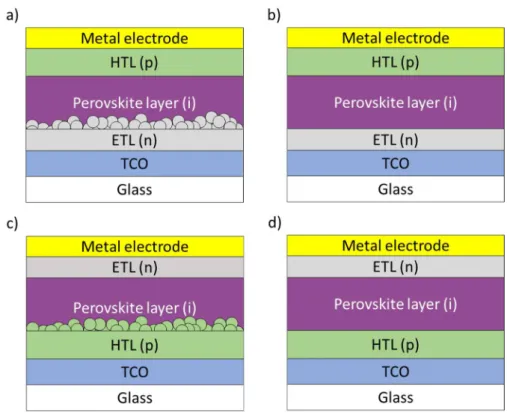
planar and mesoporous n-i-p and planar and mesoporous p-i-n structure (Figure 1-2). 24,25

The n-i-p structure are composed of transparent conductive oxide (TCO) layer, n-type

semiconducting electron transport layer (ETL), perovskite layer, p-type semiconducting

hole transport layer (HTL), and metal electrode. In a p-i-n structure, the position of ETL

and HTL is the opposite. Since the perovskites have been known as an ambipolar

semiconductor, device architectures of PSCs with only one charge transport layers such

as ETL-free or HTM-free have been reported. 26-31

(18)

6

Figure 1-2. Illustrations of the four kinds of PSC architecture. a) n-i-p mesoporous structure. b) n-i-p planer structure. c) p-i-n mesoporous structure. d) p-i-n planer structure.

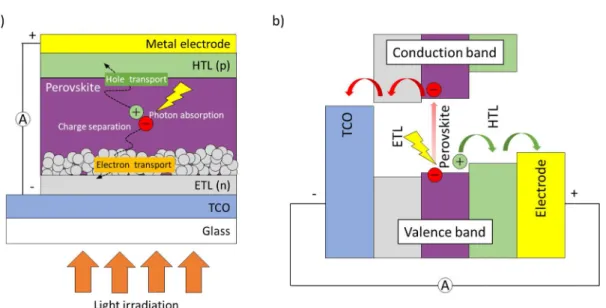
General working principle of PSCs which are composed of photon absorption, charge separation, charge transport, and charge collection is as following: (i) photon absorption, (ii) charge separation, (iii) charge transport (Figure 1-3). The photons are absorbed by the perovskite layer, which leads to excitation of electrons from valence band of perovskite and then creation of electron-hole pairs. The charge dissociates due to the low exciton binding energy and they are move across the corresponding charge correction layers. The perovskites have an efficient hole and electron transporting properties such as relatively high carrier mobility (electron mobility and hole mobility is 101 cm V s and 72.2 cm V s , respectively) and long charge diffusion length over ~100 nm. 32-34 Electron can diffuse through perovskite to the ETL.

Subsequently, the electrons are collected at the electrode. On the other hand,

photogenerated holes diffuse through perovskite to the HTL, from where they are

collected at the electrode.

(19)

7

Figure 1-3. Working principles of the PSCs. a) Schematics of n-i-p mesoporous structured PSCs. b) Energy diagram of the PSCs.

1-2-3 Components

In most of the researches, the improvement and modification of materials have been reported, in which perovskite layer, HTL, and ETL are developed.

Perovskite Absorber

PSC is one of the third-generation solar cells based on organic-inorganic

semiconductors described as an ABX 3 perovskite-type structure. The perovskite

structures are composed of a limited number of ions to form the ABX 3 structure. The A-

site cation can be occupied by organic CH 3 NH 3 + , CH(NH 2 ) 2 + cations or inorganic Cs + ,

Rb + cations. The B site cation can be occupied by divalent Pb 2+ or Sn 2+ cations. The

halogen anions (Cl - , Br - , or I - ) can be used as X site anions. The most representative

perovskite is (CH 3 NH 3 ) + PbI 3 , which has wide absorption onset at the edge of the near-IR

region (800 nm) corresponding to 1.55 eV bandgap. 35 This optimum bandgap for solar

cells allows to theoretically reach 31 % of power conversion efficiency. 36 The properties

of perovskite layer such as carriers transport, bandgap, and thermal and chemical stability

are tuned by the combination and proportion of changing of A site, B, and X site ions. 37,38

In Figure 1-4, the photographs for the perovskites with the different composition are

summarized. 35 The perovskites using iodine cation as the halide ion become dark brown,

(20)

8

which means that the bandgap of the perovskite is small. When the bromine concentration increases, it successively will become orange or red. When the bromine concentration gets close to 80%, the film is a yellow colour. The change of halogen composition makes it drastically change not only these changes but also the shape of absorption spectra, which are corresponding to the change of bandgap for perovskites. (Table 1-1)

Figure 1-4. Optical properties of the various perovskites. a) Photographs of the fabricated cells with the spiro-MeOTAD and the gold electrode. b) Absorption spectra for the perovskite layer corresponding to FA 5/6 MA 1/6 PbBr x I (3-x) where the I/Br-ratio is changed.

c) Absorption spectra for the perovskite layer corresponding to FA x MA (1-x) PbBr 5/2 I 1/2

where the MA/FA-ratio is changed. Reproduced from ref. 35 with permission from the

Royal Society of Chemistry.

(21)

9

Table 1-1. Bandgap (eV) changes depends on the composition for the perovskites. 35 Pb I 3 Br 0.5 I 2.5 Br 1 I 2 Br 1.5 I 1.5 Br 2 I 1 Br 2.5 I 0.5 Br 3

FA 1.52 1.97 2.27 1.91 1.97 2.10 2.27

FA 5/6 MA 1/6 1.53 1.63 1.68 1.87 1.98 2.11 2.28 FA 4/6 MA 2/6 1.53 1.64 1.68 1.85 1.97 2.11 2.28 FA 3/6 MA 3/6 1.55 1.61 1.75 1.85 1.96 2.14 2.28 FA 2/6 MA 4/6 1.56 1.67 1.76 1.86 1.97 2.14 2.29 FA 1/6 MA 5/6 1.59 1.63 1.76 1.86 1.99 2.15 2.30

MA 1.59 1.66 1.70 1.87 2.03 2.16 2.31

Hole Transport Layer

The efficient hole transport and extraction properties of HTL are important in the device. The HTM showing a high photovoltaic performance would be injected the holes from the perovskite layer efficiently and the holes are transported quickly toward the electrode, in which hole-electron recombination is suppressed between interfaces of HTL and perovskite layer. The HTM is classified by organic-based and inorganic-based semiconductors. The organic HTMs for PSCs based on electronically conducting small molecules and polymers were commonly used. 39 The inorganic HTM is used such as CuSCN, NiO x , and graphene oxide due to their good chemical and thermal stability, high hole mobility, and suitable valence band alignment. 40

Electron Transport Layer

TiO 2 as an ETL has been most frequently used in n-i-p structured PSCs. The electron injection process from the perovskite layer to TiO 2 layer is fast. 41,42 This device structure exhibits the highest PCE of the PSCs. The compact TiO 2 layer is deposited on fluorine- doped tin oxide (FTO) substrate using spray pyrolysis or a spin-coating to block a carrier quenching following the mesoporous TiO 2 layer is fabricated by spin-coating of TiO 2

paste. For p-i-n architecture, fullerene and its derivatives are the most widely used n-type

materials for ETLs deposited on top of the perovskite layer. Fullerene and its derivatives

such as PC 61 BM, ICBA and PC 71 BM are moderate candidates as efficient electron

extraction materials due to their suitable energy level alignment and high electron

mobility. 43

(22)

10

1-3 Device Characterization

The PCE of PSCs is measured to be monitored carrier dynamics such as charge separation, charge injection, and charge transfer. Furthermore, the device characterization techniques such as current density-voltage (J-V) characterization, incident photon-to- current conversion efficiency (IPCE), hole conductivity and hole mobility measurement, and photoluminescence measurements are established.

1-3-1 Current Density-Voltage Characterization

The photovoltaic performance of PSCs is mostly investigated by the J-V measurement under standard AM 1.5G illumination (100 mW cm -2 ) as shown in Figure 1-5. The conversion efficiency (  ) of the solar cell can be determined as a ratio of the maximum power output (P max ) to the incident light power (P in ), which this relationship is described as following equations.

𝜂 = 𝑃

𝑃 = 𝐽 𝑉 𝐹𝐹 𝑃 (i) 𝐹𝐹 = 𝑃

𝐽 𝑉 = 𝐽 𝑉

𝐽 𝑉 (ii)

, where J sc , V oc , FF indicates a short-circuit current density, an open-circuit voltage, and fill factor, respectively.

Figure 1-5. Schematics of photovoltaic performance. a) J-V curve of a solar cell under

illumination. b) Power output as a function of voltage.

(23)

11

The J sc indicates the maximum current density of the device, which is determined by the incident light-harvesting efficiency (LHE), charge injection, and charge collection at the interfaces. To enhance the J sc value, energy band arrangement between functional layers such as an absorber and charge transport materials and the optical characteristic of the light absorber is significant. The V oc is determined by differences between Fermi levels of the ETL and the HTL. The FF expressed as a ratio of the maximum obtained power to the product of the J sc and V oc is determined by the series resistance (R s ) and the shunt resistance (R sh ). The R s is influenced by the resistance of the functional layer such as the absorber, ETL, HTM, electrode, and TCO. The R sh is influenced by recombination processes at the interfacial defects in the functional layers, for example, a HTL deposited on the perovskite layer penetrated and attached directly to ETL. The generated excitons are recombined at the interface between the ETL and the HTL.

1-3-2 Incident Photon-to-Current Conversion Efficiency

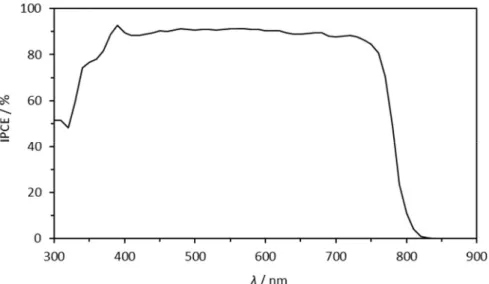
The IPCE, called as external quantum efficiency (EQE), is one of the common measurements for determining the EQE of incident photons converted to currents to the external circuit at each wavelength of monochromatic light. The IPCE measurement is used to calculate the generated J sc by irradiating monochromatic light (300 nm-900 nm in case of the lead-based PSC). The IPCE can be calculated from the LHE, electron injection efficiency from the perovskite layer to TiO 2 ( 𝜙 ), and the charge collection efficiency (𝜙 ) following the equation:

𝐼𝑃𝐶𝐸 = 𝐿𝐻𝐸 × 𝜙 × 𝜙 (iii)

(24)

12

Figure 1-6. IPCE spectra of PSC with the configuration of FTO/TiO 2 /MAPbI 3 /spiro- OMeTAD/Au.

1-3-3 Electrical Conductivity and Carrier Mobility Measurements

The vertical electrical conductivity of the HTL against the substrate is obtained by J-V measurement using the hole-only device with the configuration of ITO/PEDOT:PSS/HTM/Au. The measurement is performed applying a voltage from -2.0 V to 2.0 V. The conductivity is calculated by the following equations:

𝑅 = 𝑉

𝐼 (iv) 𝜌 = 𝑅 ∙ 𝐴

𝐿 (v) 𝜎 = 1

𝜌 (vi)

where R is the resistance, V and I are the voltage and current obtained from J-V measurement, 𝜌 is electrical resistivity, A is the active area, L is the thickness, and 𝜎 is the conductivity of the HTM.

Carrier mobility of the charge transport material (CTM) is important for efficient

charge transport in the photovoltaics. Thus, high carrier mobility is one of the required

characteristics for the CTM. The carrier mobility (𝜇) is measured by the space-charge

(25)

13

limited current (SCLC) method using device configuration of ITO/PEDOT:PSS/HTM/Au in case of the HTM. 44 The SCLC measurement is carried out by applying a voltage from -5.0 V- to 5.0 V of the hole-only device and measuring the current. By applying a high voltage, a spatial current occurs in the semiconductor near the electrode interface, and carrier mobility is estimated from the spatial current limited current generated by the accumulated carriers flowing, which is described as follows 44 :

𝐽 = 9

8 𝜇𝜀 𝜀 𝑉

𝑑 (vii)

where J, 𝜇 , 𝜀 , 𝜀 , V, and d are the current density, the hole mobility, the vacuum permittivity (8.85×10 -12 F/M), the dielectric constant (generally, 𝜀 = 3 is used for organic semiconductors), applied voltage and film thickness, respectively.

1-3-4 Photoluminescence and Time-Resolved Photoluminescence

To analyse a carrier dynamics of the interfaces between the CTM and the perovskite layer and carrier quenching of the defects in the perovskite polycrystalline film, photoluminescence (PL) is performed, which excitation wavelength is ~600 nm, and the device configuration of glass substrate/perovskite/HTM in the case of mesoporous n-i-p architecture is used. Figure 1-7 shows PL and time-resolved PL (TRPL) spectra of the perovskite layer with HTL and without HTL (glass/perovskite and glass/perovskite/HTM, respectively). In the case of the p-i-n structured device, the architecture of glass substrate/HTM/perovskite is used. After deposition of HTL, the PL intensity is decreased.

This result indicates that the hole injection from the perovskite layer to the HTM occurred.

From the combination of PL and TRPL measurements, the detailed carrier dynamics in

the interfacial charge transfer could be provided.

(26)

14

Figure 1-7. PL characterization of perovskite layer with HTM (black) and without HTM red). a) PL. b) TRPL.

1-4 Hole Transport Materials

An ideal HTMs required some characteristics to work in PSCs following mainly five factors: (i) good hole mobility, (ii) an appropriate energy level of the HOMO, (iii) a good solubility, (iv) thermal and chemical stability, and (v) low manufacturing cost. Manifold organic and inorganic semiconductors have been reported for PSCs. The organic HTMs are categorized into three kinds: small-molecule-based, polymer-based, and metal complex-based HTMs. For the inorganic HTMs, transition metal oxides and some copper derivatives are used. Generally, most electron transport materials (TiO 2 , ZnO, and SnO 2 ) have a conduction band (CB) energy of ~4 eV. 45 The difference between the valence band energy level of the HTMs could be directly affected to V oc value of the PCEs. The theoretical maximum V oc of MAPbI 3 -based PSCs is estimated as ~1.3 V 46 , which is still one of the challenges to improve the V oc by optimizing the energy levels of the CTMs.

1-4-1 Organic Semiconductors

Organic semiconductors such as small molecules, polymers, and metal complexes

are widely used, which are in favour of fabrication of smooth film, low-cost synthesis,

and high PCEs. For the small molecule-based HTMs, 2,2’,7,7’-tetrakis(N,N-di-p-

methoxyphenylamine)-9,9’-spirobifluorene (spiro-OMeTAD) is mostly chosen to

achieve high performance PSCs, which records PCE over 25%. 47 Spiro-OMeTAD (Figure

1-8) is developed for HTMs in solid-state DSSCs (ss-DSSCs) in 1998. 48 However, the

(27)

15

PCE of the spiro-OMeTAD-based ss-DSSCs has been limited to 7.2% 49,50 , which is approximately half of the liquid electrolyte-based DSSCs (14.3%). 51 This is mainly due to low hole mobility of spiro-OMeTAD (~10 −6 cm 2 V −1 s −1 ) and thick HTL, which depends on the thickness of mesoporous TiO 2 layer (~2 m). 52 The first report of PSCs in 2009, in which the liquid electrolyte-based DSSC architecture was employed, showed immediate device degradation due to a decomposition of the perovskite layer (MAPbI 3 ) by dissolve in the liquid electrolyte. The liquid electrolyte in the PSCs was replaced by organic molecule-based HTM, spiro-OMeTAD, which not only improved the device stability but also remarkably increased the PCE from 3.9% to 9.7%. 53 To date, spiro- OMeTAD is employed to the most high-performance PSCs with a PCE over 20 % (Figure 1-9). The HTM of PSCs needs p-type dopants to improve their hole mobility and conductivity. Some p-type dopants have been reported such as 2,3,5,6-tetrafluoro-7,7,8,8- tetracyanoquinodimethane (F4TCNQ) 54 , and several cobalt(III) complexes 55,56 . The combination of lithium bis(trifluoromethanesulfonyl)imide (LiTFSI) and tris(2-(1H- pyrazol-1-yl)-4-tert-butylpyridine)cobalt(III) tri[bis(trifluoromethane)sulfonimide]

(FK209) 57 with 4-tert-butylpyridine (tBP) as a morphology controller is used to achieve the high conductivity and high PCE of the PSCs (Figure 1-10). However, dopants cause stability problems due to ion migration and oxidation procedure. Furthermore, the hygroscopic property of LiTFSI shows negative influence towards chemical degradation of the perovskite layer and tBP interacts with perovskite layer and decompose it like as a corrosion. 58-60

Figure 1-8. The structure of spiro-OMeTAD. a) chemical structure. b) optimized 3D

structure without hydrogen atoms obtained by density functional theory (DFT)

calculation (B3LYP/6-31G(d)).

(28)

16

Figure 1-9. Development of PSC architectures.

Figure 1-10. The chemical structure of common dopants.

(29)

17 1-4-2 Inorganic Semiconductors

Despite the organic HTMs such as spiro-OMeTAD and poly[bis(4-phenyl)(2,4,6- trimethylphenyl)amine] ( PTAA) achieved the high-performance PSCs over 20%. These materials are (i) destabilized by the oxidizability of dopants, (ii) induce the decomposition of the perovskite layer by humidity due to addition of dopants (typically hygroscopic Li- salts) and (iii) are much expensive (1 g of sipro-OMeTAD cost ~500 $).

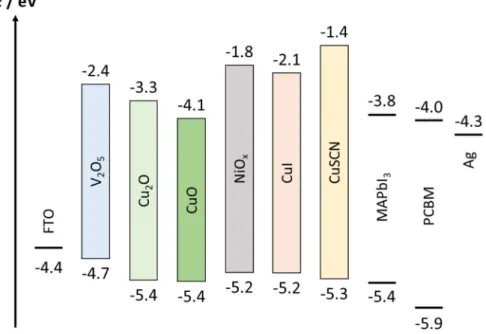
A variety of inorganic HTMs has been developed and applied to the PSCs such as V 2 O 5 61 , CoO x 62 , NiO x 63-66 , CuI 67 , and CuSCN 68,69 to replace organic HTMs due to the expected stability against heat and undesired chemical reactions and the high electric conductivity (Figure 1-11). Some of the inorganic HTMs-based PSCs showed high performance. The NiO x -based HTM has recorded a PCE over 20% using inverted structured PSCs. 65 CuO x -based inverted PSC showed a PCE of 19%. 62 In mesoporous normal structured PSCs, a PCE of 20.4% was reported using CuSCN as HTM, which is comparable to spiro-OMeTAD-based PSC (20.9%). 69 From these researches, the usability of inorganic HTM has been showed due to their stability against high temperature and high conductivity, leading to further development of inorganic HTM-based PSCs. 70

Figure 1-11. Energy diagram of p-i-n structured PSC components and representative

inorganic HTMs (V 2 O 5 , Cu 2 O, CuO, NiO x , CuI, CuSCN). 61-70

(30)

18 1-5 Aim and Outline of this Thesis

One of the renewable energy technologies, photovoltaics is attractive to the researcher on an abundant and clean source. PSCs are considered a promising technology for electricity generation, which is recorded the PCE currently exceeding 25%. Efficient and cost-effective energy conversion of PSCs would be led to a low carbon society.

Although PSCs have reached high PCE, there are still challenges on stability and manufacturing production. One of the bottlenecks for an application is instability, where dopants-induced degradation of perovskite layer would be significantly contributed.

Representative hole transport material, spiro-OMeTAD, employed in PSCs to obtain highest conversion efficiencies. However, almost HTMs including spiro-OMeTAD require several chemical dopants to increase the electric conductivity and tune the energy level. The use of dopants leads to chemical degradation of the device by undesired oxidation reaction of functional layers, corrosive, and deliquescence of a dopant. Thus, one promising challenge to stabilize PSCs could be dopant-free HTMs, showing high hole mobility. To solve this problem, in this thesis I have focused on the design and synthesis of dopant-free organic molecule-based and inorganic nanoparticle-based HTMs to investigate the relationship among chemical structure, electrical conductivity, and photovoltaic performance, leading to a fundamental understanding for the HTMs and further improvement of the PCEs.

To develop the organic HTM, I have focused on a redox-active organic

semiconductor, tetrathiafulvalene (TTF), which shows a reversible redox property. In

Chapter 2, I have designed and synthesized a series of TTF derivatives with one and two

amide units in a molecule to investigate detailed electronic properties of them in organic

solvents, which can be potentially used as the HTM in the PSCs. Intermolecular

interactions such as hydrogen bonds, van der Waals force, and  interactions induce a

formation of supramolecular structures. Electronic interaction derived from the formation

of the supramolecular structures is investigated. The hydrogen-bonding TTF derivative

applied to the HTMs in PSCs is described in Chapter 3. The hydrogen-bonding derivative

forms supramolecular assemblies in a film prepared by a spin-coating method. The

electronic properties such as hole mobility, electric conductivity, and energy levels of

these derivatives and the photovoltaic performance of dopant-free TTF derivatives-based

PSCs are investigated.

(31)

19

One of the approaches for the dopant-free HTMs is the use of inorganic nanoparticles (NPs), which have high conductivity and a chemical and thermal stability. In Chapter 4, the methodology to be applied the inorganic NPs to deposit on top of the perovskite layer is researched. Generally, the inorganic NP is not applicable to HTM in n-i-p structured PSCs due to mismatched solvents of NPs and perovskite layer. By an inspiration from the construction of assembled structures using intermolecular interactions, I have developed the surface engineering of the NPs using molecule-NP interactions to solve the solvent problem and investigated the effects of the surface modification on conductivity and photovoltaic performance. In Chapter 5, to improve the conductivity of the inorganic NPs, a series of NPs with different concentration of divalent cobalt cation is developed as a HTM in PSCs. The relationships among the concentration of cobalt ions, their electronic properties, and the photovoltaic performance are systematically investigated. I have revealed the two effects of the cobalt-doping to the NPs on the conductivity and an energy level tuning.

1-6 References

1. C. Battaglia, A. Cuevas, S. D. Wolf, Energy Environ. Sci. 2016, 9, 1552-1567.

2. M. Taguchi, K. Kawamoto, S. Tsuge, T. Baba, H. Sakata, M. Morizone, K. Uchihashi, N. Nakamura, S. Kiyama, O. Oota, Prog. Photovolt. 2000, 8, 492-502.

3. M. D. lammert, R. J. Scwartz, IEEE Trans. Electron Devices 1977, 24, 337-341.

4. K. Yoshikawa, H. Kawasaki, W. Yoshida, T. Irie, K. Konishi, K. Nakano, T. Uto, D.

Adachi, M. Kanematsu, H. Uzu, K. Yamamoto, Nature Energy, 2017, 2, 17032.

5. K. Tanabe, Energies 2009, 2, 504-530.

6. M. A. Green, Y. Hishikawa, E. D. Dunlop, D. H. Levi, J. H.-Ebinger, A. W. Y. H.- Baillie, Prog. Photovolt. Res. Appl. 2018, 26, 427-436.

7. T. Kato, J.-L. Wu, Y. Hirai, H. Sugimoto, V. Bermudez, IEEE Journal of Photovoltaics 2018, 99, 1-6.

8. A. W. Hains, Z. Linhg, M. A. Woodhouse, B. A. Gregg, Chem. Rev. 2010, 110, 6689- 6735.

9. J. Yu, Y. Zheng, J. Huang, Polymers 2014, 6, 2473-2509.

10. H. Hoppe, N. S. Sariciftci, J. Mater. Res. 2004, 19, 1924-1945.

11. B. O’Regan, M. Grätzel, Nature 1991, 353, 737-740.

(32)

20

12. A. Hagfeldt, G. Boscloo, L. Sun, L. Kloo, H. Pettersson, Chem. Rev. 2010, 110, 6595- 6663.

13. S. Mathew, A. Yella, P. Gao, R. H. Baker, B. F. E. Curchod, N. A. Astani, I. Tavernelli, U. Rothlisberger, M. K. Nazeeruddin, M. Grätzel, Nat. Chem. 2014, 6, 242-247.

14. J. Buescka, A. Dualeh, F. Kessler, E. Baranoff, N. L. Ha, C. Yi, M. K. Nazeeruddin, M. Grätzel, J. Am. Chem. Soc. 2011, 133, 18042-18045.

15. A. Kojima, K. Teshima, Y. Shirai, T. Miyasaka, J. Am. Chem. Soc. 2009, 131, 6050- 6051.

16. NREL, Best Research Cell Efficiencies, https://www.nrel.gov/pv/assets/pdfs/best- research-cell-efficiencies.190802.pdf (accessed: November 2019).

17. D. B. Mitzi, C. A. Felid, W. T. A. Harrison, A. M. Guloy, Nature 1994, 369, 467-469.

18. D. B. Mitzi, S. Wang, C. A. Felid, C. A, Chess, A. M. Guloy, Science 1995, 267, 1473-1476.

19. C. R. Kagan, Science 1999, 286, 945-947.

20. S. J. Yoon, K. G. Stamplecoskie, P. V. Kamat, J. Phys. Chem. Lett. 2016, 7, 1368- 1373.

21. C. C. Stoumpos, M. G. Kanatzidis, Adv. Mater. 2016, 28, 5778-5793.

22. H. S. Junk, N.-G. Park, Small 2015, 11, 10-25.

23. H. S.-Kim, C.-R. Lee, J. H.-Im, T. Moehl, A. Marchioro, S.-J. Moon, R. H.-Baker, J.- H. Yum, J. E. Moser, M. Grätzel, N.-G. Park, Sci. Rep. 2012, 2, 591.

24. C. C. Stoumpos, M. G. Kanatzidls, Adv. Mater. 2016, 28, 5778-5793.

25. K.-C. Wang, J.-Y. Jeng, P.-S. Shen, Y.-C. Chang, E. W.-G. Diau, C.-H. Tsai, T.-Y.

Chao, H.-C. Hsu, P.-Y. Lin, P. Chen, T.-Fang, Guo, T.-C. Wen, Sci Rep. 2014, 4, 4756.

26. L. Etgar, P. Gao, Z. Xue, Q. Peng, A. K. Chandiran, B. Liu, M. K. Nazeeruddin, M.

Grätzel, J. Am. Chem. Soc. 2012, 134, 17396-17399.

27. W. A. Laban, L. Etgar, Energy Environ. Sci. 2013, 6, 3249-3253.

28. D. Liu, J. Yang, T. L. Kelly, J. Am. Chem. Soc. 2014, 136, 17116-17122.

29. W. Ke, G. Fang, J. Wan, H. Tao, Q. Liu, L. Xiong, P. Qin, J. Wang, H. Lei, G. Yang, M. Qin, X. Zhao, Y. Yan, Nat. Commun. 2015, 6, 6700.

30. P. Zhao, M. Han, W. Yin, X. Zhao, S. G. Kim, Y. Yan, M. Kim, Y. J. Song, N.-G. Park, H. S. Jung, ACS Appl. Mater. Interfaces 2018, 10, 10132-10140.

31. L. Zhou, Y. Zuo, T. K. Mallick, S. Sundaram, Sci. Rep. 2019, 9, 8778.

(33)

21

32. S. D. Stranks, G. E. Eperon, G. Gracini, C. Menelaou, M. J. P. Alcocer, T. Leijtens, L. M. Herz, A. Petrozza, H. J. Snaith, Science 2013, 342, 341-344.

33. T. Zhao, W. Shi, J. Xi, D. Wang, Z. Shuai, Sci. Rep. 2016, 6, 19968.

34. L. M. Herz, ACS Energy Lett. 2017, 2, 1539-1548.

35. T. J. Jacobsson, J.-P. C.-Baene, M. Pazoki, M. Saliba, K. Schenk, M. Grätzel, A.

Hagfeldt, Energy Environ. Sci. 2016, 9, 1706-1724.

36. W. Shockley, H. Queisser, J. Appl. Phys. 1961, 32, 510.

37. L. K. Ono, E. J. J.-Perez, Y. Qi, ACS Appl. Mater. Interfaces 2017, 9, 30197-30246.

38. H. F. Zarick, N. Soetan, W. R. Erwin, R. Bardhan, J. Mater. Chem. A 2018, 6, 5507- 5537.

39. L. Calió, S. Kazim, M. Grätzel, S. Ahmad, Angew. Chem. Int. Ed. 2016, 55, 2-26.

40. Z. Yu, L. Sun, Small Methods 2018, 2, 1700280.

41. T. Leijtens, S. D. Stranks, G. E. Eperon, R. Lindblad, E. M. J. Johansson, I. J.

McPherson, H. Rensmo, J. M. Ball, M. M. Lee, H. J. Snaith, ACS Nano 2014, 8, 7147-7155.

42. G. Yang, H. Tao, P. Qin, W. Ke, G. Fang, J. Mater. Chem. A 2016, 4, 3970-3990.

43. K. Mahmood, S. Sarwar, M. T. Mehran, RSC Adv. 2017, 7, 17044-17062.

44. J. A. Röhr, X. Shi, S. A. Haque, T. Kirchartz, J. Nelson, Phys. Rev. Appl. 2018, 9, 044017.

45. J. Lian, B. Lu, F. Niu, P. Zeng, X. Zhan, Small Methods 2018, 2, 1800082.

46. W. E. I. Sha, X. Ren, L. Chen, W. C. H. Choy, Appl. Phys. Lett. 2015, 106, 221104.

47. N. J. Jeon, H. Na, E. H. Junk, T. Y. Yang, Y. G. Lee, G. Kim, H. W. Shin, S. I. Seol, J. Le, J. Seo, Nat. Energy 2018, 3, 682-689.

48. U. Bach, D. Lupo, P. Comte, J. E. Moser, F. Weissörtel, J. Sabbeck, H. Spreitzer, M.

Grätzel, Nature 1998, 395, 583-585.

49. N. Cai, S.-J. Moon, L. C.-Ha, T. Moehl, R. H.-Baker, P. Wang, S. M. Zakkeruddin, M. Grätzel, Nano Lett. 2011, 11, 1452-1456.

50. K. Kakiage, Y. Aoyama, T. Yano, K. Oya, J. Fujisawa, M. Hanaya, Chem. Commun.

2015, 51, 15894.

51. I. Ding, N. Téreault, J. Brillet, B. E. Hardin, E. H. Smith, S. J. Rosenthal, F. Sauvage, M. Grätzel, M. D. McGehee, Adv. Funct. Mater. 2009, 19, 2431-2436.

52. H.-S. Kim, C.-R. Lee, J.-H. Im. K.-B. Lee, T. Moehl, A. Marchioro, S.-J. Moon, R.

(34)

22

H.-Baker, J.-H. Yum, J. E. Moser, M. Grätzel, N.-G. Park, Sci. Rep. 2012, 2, 591.

53. M. Cheng, Y. Li, M. Safdari, C. Chen, P. Liu, L. Kloo, L. Sun, Adv. Energy Mater.

2017, 7, 1602556.

54. J. Luo, C. Jia, Z. Wan, F. Han, B. Zhao, R. Wang, J. Power Sources 2017, 342, 886- 895.

55. N. O.-Komatsuzaki, T. Funaki, T. N. Murakami, S. Kazaoui, M. Chikamatsu, K.

Sayama, Electrochemistry 2017, 85, 226-230.

56. J. Burschka, A. Dualeh, F. Kessler, E. Baranoff, N. L. C.-Ha, C. Yi, M. K.

Nazeeruddin, M. Grätzel, J. Am. Chem. Soc. 2011, 133, 18042-18045.

57. J. Burschka, F. Kessler, M. K. Nazeeruddin, M. Grätzel, Chem. Mater. 2013, 25, 2986-2990.

58. A. Magomedov, E. Kasparavičius, K. Rakstys, S. Paek, N. Gasilova, K. Genevičius, G. Juška, T. Malinauskas, M. K. Nazeeruddin, V. Getautis, J. Mater. Chem. C 2018, 6, 8874-8878.

59. G. Niu, X. Guo, L. Wang, J. Mater. Chem. A 2015, 3, 8970-8980.

60. T. Leijtens, T. Giovenzana, S. N. Habisreutinger, J. S. Tinkham, N. K. Noel, B. A.

Kamino, G. Sadoughi, A. Sellinger, H. J. Snaith, ACS Appl. Mater. Interfaces 2016, 8, 5981-5989.

61. H. Rao, S. Ye, W. Sun, W. Yan, Y. Li, H. Peng, Z. Liu, Z. Bian, Y. Li, C. Huang, Nano Energy 2016, 27, 51-57.

62. J. You, L. Meng, T.-B. Song, T.-F. Guo, Y. Yang, W.-H. Chang, Z. Hong, H. Chen, H.

Zhou, Q. Chen, Y. Liu, N. D. Marco, Y. Yang, Nat. Nanotechnol. 2016, 11, 75-81.

63. W. Chen, Y. Wu, Y. Yue, J. Liu, W. Zhang, X. Yang, H. Chen, E. Bi, A. Islam, M.

Grätzel, L. Han, Science 2015, 350, 944-948.

64. W. Chen, F.-Z. Liu, X.-Y. Feng, A. B. Djurišić, W. K. Chan, Z.-B. He, Adv. Energy Mater. 2017, 1700722.

65. S. Sajid, A. M. Elseman, H. Huang, J. Ji, S. Dou, H. Jiang, X. Liu, D. Wei, P. Cui, M.

Li, Nano Energy 2018, 51, 408-424.

66. J. A. Christians, R. C. M. Fung, P. V. Kamat, J. Am. Chem. Soc. 2014, 136, 758-764.

67. V. E. Madhavan, I. Zimmermann, C. R.-Carmona, G. Gracini, M. Buffiere, A. Belaidi, M. K. Nazeeruddin, ACS Energy Lett. 2016, 1, 1112-1117.

68. N. Arora, M. I. Dar, A. Hinderhofer, N. pellet, F. Schreiber, S. M. Zakeeruddin, M.

(35)

23 Grätzel, Science 2017, 358, 768-771.

69. S. Yue, K. Liu, R. Xu, M. Li, M. Azam, K. Ren, J. Liu, Y. Sun, Z. Wang, D. Cao, X.

Yan, S. Qu, Y. Lei, Z. Wang, Energy Environ. Sci. 2017, 10, 2570-2578.

70. J. Chen, N.-G. Park, J. Phys. Chem. C 2018, 122, 14039-14063.

(36)

24

Chapter 2 Electronic Communication in Hydrogen-Bonding Tetrathiafulvalene

Derivatives with Amide Units

(37)

25

2-1 Abstract

As a basis for the design of electroactive materials, novel mono- and bis-TTF derivatives with one and two amide units were prepared to investigate how hydrogen- bonding induces electronic communication. The bis-TTF compound exhibited a mixed- valence state due to electronic interactions among the TTF units. Comparison with non- hydrogen-bonding N-methylated analogues indicated that the electronic interaction observed occurs between intermolecular TTF units owing to the formation of supramolecular assemblies induced by hydrogen bonds.

2-2 Introduction

Electronic communication between two or more electroactive units is an important feature for electronic functional materials such as organic semiconductors and charge transport materials. 1,2 Organic compounds and metal complexes which show electronic communication between electroactive units have been reported. 1 Among the organic compounds, TTF and its derivatives are particularly interesting on account of their forming stable oxidation states such as radical cation and dication, leading to organic metals and organic semiconductors. 3 The electronic communication is manifested in a mixed-valence state, in which orbital levels are altered due to electronic interactions between the electroactive units. To exhibit a mixed-valence state, two TTF units have to be brought into close proximity. As attempts to realize this situation with intramolecular interactions, TTF dimers or oligomers in which TTF units are conjugated with flexible alkyl chains or bridged by a 1,8-naphthalene spacer have been reported. 4-6 On the other hand, intermolecular electronic communication between the TTF units in solutions has been less studied. For instance, the inclusion of TTF molecules in a self-assembled cage and self-associable molecular clips bearing TTF units were reported. 7,8 In the meantime, mixed-valence states of TTF derivatives with intermolecular hydrogen-bonding units were also studied in gel states. 9-11 In the case of the latter hydrogen bonding TTF derivatives, it is not certain whether the hydrogen binding interaction is strong enough for the mixed-valence species to exist in solution. The detection of a mixed-valence species in solution would allow us to quantitatively analyse the behaviours of these species by means of electrochemistry and spectroelectrochemistry.

The intermolecular hydrogen-bonding interaction has been utilized for the

(38)

26

association of molecules taking advantage of its directionality and reversibility. 12 Amide- type intermolecular N–H···O=C hydrogen-bonding interactions have been widely applied to construct functional supramolecular assemblies. Benzene derivatives with hydrophobic alkyl amide units form 1-D nanofiber induced by the intermolecular hydrogen bond formation. 13 To investigate the electrochemical properties of TTF derivatives with hydrogen-bonding amide units, we have designed and synthesized TTF derivatives 1 and 2, which are shown in Scheme 2-1. We also prepared non-hydrogen- bonding N-methylated analogues 1* and 2* for comparison purposes. We present herein the synthesis, electrochemical, and spectroelectrochemical results of these TTF derivatives. Taking advantage of the formation of assemblies in solution, we were able to analyse the electronic interaction in a quantitative manner.

Scheme 2-1. Molecular structures of hydrogen-bonding and non-hydrogen-bonding TTF derivatives.

2-3 Results and Discussion

2-3-1 Design and Synthesis

The bis-TTF amide 2 was obtained by amide bond formation from 1,4- diaminobenzene and two equivalents of a carboxy TTF derivative using dicyclohexylcarbodiimide (DCC) with N,N-dimethyl-4-aminopyridine (DMAP) in 48%

yield (Scheme 2-2). The N-methylated 2* was obtained by methylation of 2 with CH 3 I in the presence of NaH according to a reported procedure. 14 Mono-TTF amides 1 and 1*

were prepared similarly.

(39)

27

Scheme 2-2. Synthetic route of bis-TTF amide 2 and 2*.

2-3-2 Electronic Properties

The formal potential values of these TTF derivatives obtained by cyclic voltammetry (CV) in CH 2 Cl 2 are listed in Table 2-1. The first and second oxidation processes are assigned to the formation of TTF •+ and TTF 2+ , respectively. The first oxidation wave of bis-TTF amide 2 was split into two, which represents the oxidation processes (TTF2) •+ /TTF 2 and (TTF •+ ) 2 /(TTF 2 ) •+ occurring at different potentials and suggests the presence of electronic interaction between the TTF units (Figure 2-1a). 15,16 Since the splitting of the corresponding oxidation wave was not observed for bis-TTF amide 2*, which has the same structure but without hydrogen-bonding ability, the split wave observed for bis-TTF amide 2 can be attributed to interaction, not between intramolecular but intermolecular TTF units. The split oxidation disappeared when 1% of N,N- dimethylformamide (DMF) was added to the CH 2 Cl 2 solution as shown in Figure 2-1b.

This result suggests that DMF interferes with the hydrogen bonds between the amide units and disrupt the intermolecular interaction between the TTF units. As mixed-valence state is not observed for mono-TTF amide 1, at least two hydrogen-bonding amide units are needed to form supramolecular assemblies.

The splitting into two peaks indicates the formation of a mixed-valence state in

which the hole is delocalized over two TTF units, although more extended hydrogen-

bonded assembly is possible structurally. The value of the comproportionation constant

(K c ) is correlated to the magnitude of electronic coupling in the mixed-valence state. The

comproportionation reaction of a two-TTF system is represented by formula (i) and K c is

estimated from equation (ii). 17

(40)

28 (TTF − TTF) + (TTF − TTF)

𝐾

⇄ 2(TTF − TTF) (i)

𝐾 = exp ∆𝐸 (ii)

where F, R, and T indicates Faraday constant, gas constant, and kelvin temperature, respectively. The value of the difference in formal potentials (  E 1/2 ) was obtained as 107 mV from the CV, 18 which gave a value of 65 for K c at 293 K. This value of K c is on the same order of magnitudes as those observed for TTF units which are fixed to be very close by covalently attached to the 1,8-positions of a naphthalene ring. 6

Table 2-1. Redox properties of TTF-C12, 1, 1*, 2, and 2*.

Compound E

ox1

/ V vs. NHE E

ox2

/ V vs. NHE

TTF-C12 +0.76 +1.12

1 +0.79 +1.25

1* +0.76 +1.17

2 +0.723, +0.871 +1.20

2* +0.76 +1.15

Figure 2-1. Cyclic voltammograms. [2] = [2*] = 1 mM, [NBu 4 PF 6 ] = 0.1 M, 293 K, scan

rate 100 mV/s. a) Bis-TTF amide 2 and 2* in CH 2 Cl 2 . b) 2 in CH 2 Cl 2 and

CH 2 Cl 2 +DMF(1%) solution.

(41)

29

The second oxidation of the TTF •+ unit into the TTF 2+ unit in the bis-TTF amide 2 exhibits an acute peak (at +1.27 V) than common diffusion-limited peaks in cyclic voltammetry. Further, the reduction of the TTF 2+ back into TTF •+ is accompanied by a large sharp peak (at +1.13 V) which probably originates from desorption of the PF 6 + salts of 2 4+ deposited on the electrode upon oxidation. 19 Interestingly, these sharp peaks also disappear upon addition of DMF, which suggests that the deposition on the electrode is also facilitated by the formation of intermolecular hydrogen bonding. As the concentrations decreases (1 - 0.05 mM), the peak separation between the split peaks for (TTF) 2 into (TTF) 2 •+ decreases (Figure A2-1). At 0.05 mM, the split peaks almost coalesce into one. At the same time, the line shape of the second oxidation wave for the TTF •+ unit into the TTF 2+ unit approaches that of the diffusion-limited wave and, more prominently, the large reduction peak for the TTF 2+ unit back into the TTF •+ unit disappeared. These results are fully consistent with the oxidation-induced intermolecular interactions and aggregate formation.

Scheme 2-3. Schematic redox processes of bis-TTF amide 2. The number of electrons per

molecule is indicated on the reaction arrows.

(42)

30

The most likely processes associated with the redox reactions are summarized in Scheme 2-3. In the initial neutral state, molecules of bis-TTF amide 2 exist in solution as monomer species as indicated by the linear dependence of absorption on concentration (Figure A2-2). During one-electron oxidation of the TTF unit, a dimer or oligomer forms through intermolecular hydrogen bonds, accompanied by electronic communication between intermolecular adjacent TTF units. Further oxidation to doubly-oxidized TTF units results in the adsorption of the hydrogen-bonded assemblies on the electrode surface, which are desorbed upon reduction back to singly-oxidized TTF units. These processes are repeatable as shown in Figure A2-3.

2-3-3 Spectroelectrochemical Properties

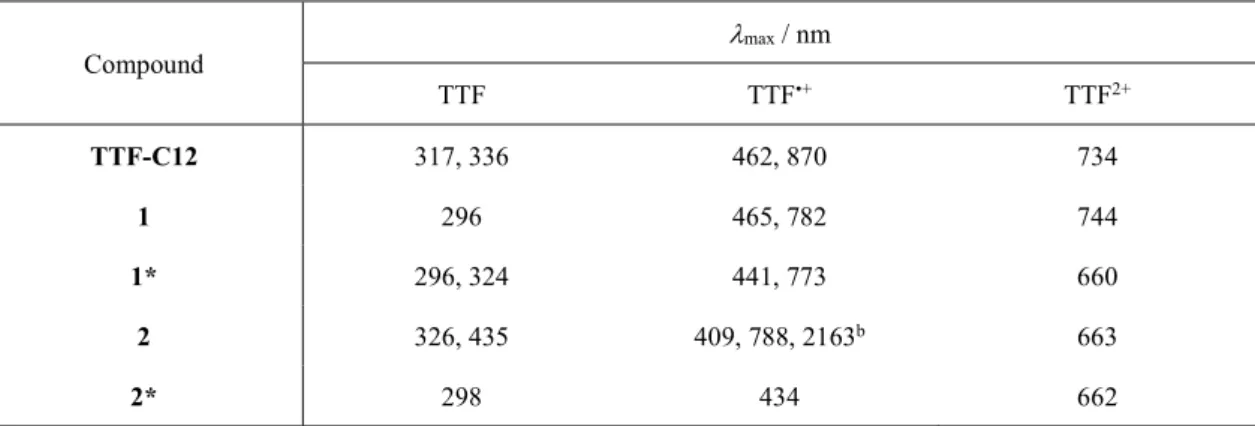
We performed the spectroelectrochemical (SEC) measurements to investigate the absorption spectra of various oxidation states of these TTF derivatives. The results are summarized in Table 2-2 and the absorption spectra for each compound in a neutral state are in Figure 2-2. Compounds with one-electron oxidized TTF units in these derivatives show two large peaks at 409-465 nm and 782-870 nm in CH 2 Cl 2 containing NBu 4 PF 6 and those with two-electron oxidized TTF units show a single peak at 660-744 nm. 20 In the case of bis-TTF amide 2, a broad, weak absorption band appeared, which was centred at 2160 nm in addition to the peaks at 409 nm and 788 nm during the process of the one- electron oxidation of the TTF units (Figure 2-3). The broad absorption passed through a maximum and disappeared when the peaks at 409 nm and 788 nm reached the maxima.

The absorption band at 2163 nm was thus assigned to the inter-valence charge-transfer

(IVCT) absorption derived from the formation of supramolecular assemblies consisting

of (TTF 2 ) •+ . 6

(43)

31

Figure 2-2. Absorption spectra of TTF derivatives (TTF-C12, 1, 1*, 2, and 2*) in CH 2 Cl 2 at 293 K.

Figure 2-3. Absorption spectra for oxidized 2 in CH 2 Cl 2 . [2] = 1 mM, [TBAPF 6 ] = 0.1

M, 293 K, scan rate 100 mV s -1 . The voltages of 0.5 V, 0.7 V, and 1.1 V vs. Ag wire

were applied to form the cation, dication, and tetracation states, respectively.

(44)

32

The matrix element |𝐻 | for the interaction is given by the parameters obtained from the IVCT absorption band as in equation (iii). 21

| |

= ( )

( )

/

(iii)

Here, 𝜀 (700 M –1 cm –1 ) is the molar absorption coefficient at 𝜈̅ (4800 cm –1 ),

∆𝜈̅ (2160 cm –1 ) is the full-width at half-maximum of the absorption band in a wavenumber scale, r is the charge transfer distance (4.1 Å), and 𝑁 is the Avogadro constant. The other symbols are as commonly used. The spectral parameters were obtained from the difference of spectra between the mixed-valence state and the neutral state. The value of the charge transfer distance was set to be the stacking distance between the TTF units, which was estimated from the XRD measurement for the film prepared by spin-coating a CHCl 3 solution of 2 (Figure A2-4). 22,23 With these parameter values, the magnitude of the matrix element was obtained to be |𝐻 | ℎ𝑐 ⁄ = 430 cm .

Finally, we mention about the stability of the oxidized species. As far as the monocationic species is concerned, all these compounds are stable and could be used in elaborate systems that utilize the mixed-valence state. However, the dicationic species of the TTF amide derivatives are unstable; the absorption of the dicationic TTF in these amide compounds did not persist during the course of the SEC experiments (Figure A2-5), in contrast to TTF-C12 of which the dication is stable.

Table 2-2. Absorption band maxima of neutral and oxidized TTF derivatives. a

Compound 

max

/ nm

TTF TTF

•+

TTF

2+

TTF-C12 317, 336 462, 870 734

1 296 465, 782 744

1* 296, 324 441, 773 660

2 326, 435 409, 788, 2163

b

663

2* 298 434 662

a) CH

2

Cl

2

, TBAPF

6

. b) Mixed-valence absorption (TTF-TTF

•+

).

Figure  1-2.  Illustrations  of  the  four  kinds  of  PSC  architecture.  a)  n-i-p  mesoporous  structure
Figure 1-3. Working principles of the PSCs. a) Schematics of n-i-p mesoporous structured  PSCs
Figure 1-5. Schematics of photovoltaic performance. a) J-V curve of a solar cell under  illumination
Figure  1-6.  IPCE  spectra  of  PSC  with  the  configuration  of  FTO/TiO 2 /MAPbI 3 /spiro- /spiro-OMeTAD/Au
+7

参照

関連したドキュメント

Size Inset Hole P.C.D... Hub

Keywords: generalized Fokker – Planck; deterministic method; radiotherapy; particle transport; Boltzmann equation; Monte Carlo.. AMS Subject Classification: 35Q20; 35Q84; 65C05;

Also, a complex variable method have been applied to deduce exact expressions for Gaursat functions for the first and second fundamental problems of an infinite plate weakened by a

The (GA) performed just the random search ((GA)’s initial population giving the best solution), but even in this case it generated satisfactory results (the gap between the

In this paper, we extend the results of [14, 20] to general minimization-based noise level- free parameter choice rules and general spectral filter-based regularization operators..

Step 2: Reconstruction of the signal from the derived trace data by deconvolution (ill-posed)...

Based on sequential numerical results [28], Klawonn and Pavarino showed that the number of GMRES [39] iterations for the two-level additive Schwarz methods for symmetric

Motivated by ongoing work on related monoids associated to Coxeter systems, and building on well-known results in the semi-group community (such as the description of the simple