環境水温と魚類の性分化との関係
誌名
誌名 Bulletin of Fisheries Research Agency. Supplement = 水産総合研究セン ター研究報告. 別冊
ISSN
ISSN 13469894
著者
著者 山下, 倫明
川口, 奈々美 巻/号
巻/号 4号別冊
掲載ページ
掲載ページ p. 13-17 発行年月
発行年月 2006年3月
農林水産省 農林水産技術会議事務局筑波産学連携支援センター
Tsukuba Business-Academia Cooperation Support Center, Agriculture, Forestry and Fisheries Research Council Secretariat
1.魚類の性分化
魚類における生殖腺の性分化は性染色体に規定され る遺伝的プログラムによるだけでなく,性ホルモンの 投与などの内分泌的な刺激や,水温などの環境条件に 大きく影響されることが知られているが,このような 性分化に関する特徴は,魚種ごとに大きく異なってお り,魚類の性分化機構に関する研究は魚類生理学の大 きな課題である(Chan and Yeung, 1983; Shapiro, 1990; Devlin and Nagahama, 2002)。メダカ,ゼブ ラフィッシュ,ニジマス,ティラピアなど多くの魚種 で,エストロゲン(17β-エストラジオール)の投与に よりメス化が生じる (Janz and Van Der Kraak, 1997; Nakamura and Takahashi, 1973; Yamamoto,
1953),一方,高水温条件での飼育によりオス化する現 象が知られている(Chardard et al., 1995; Kitano et al., 1999; Korpelainen, 1990; Struussmann et al., 1998)。地球温暖化に伴って海水温の上昇が予測されて いるが,生育可能な上限域に生息する魚種では高水温 によって性分化に影響する可能性が考えられる。わが 国沿岸に分布する,マアジ,サンマなどの海産魚類で も性分化が環境水温の影響を強く受け,性分化期に高 水温条件に置かれることにより, 生殖腺の退行変性
(不妊化)あるいは著しいオス化(単性化)が生じるこ とも考えられる。その結果,高水温は魚類の資源量の 変動や種の絶滅をもたらす可能性がある。このように,
魚類資源への地球温暖化の影響を予測する上で,高水 温による魚類の性転換と生殖細胞の退行変性の現象お
環境水温と魚類の性分化との関係
山下 倫明*・川口奈々美*
Relationship between Environmental Temperature and Sex Differentiation in Fish
Michiaki YAMASHITA
* and Nanami KAWAGUCHI*Abstract Heat stress and other environmental factors influence the determination of phenotypic sex in fish in addition to genetic sex determination. In this review, we focused on sex differentiation and sex reversal under high temperature and other stress condi- tions in fish. Heat-induced germ cell deficiency was found in males and females of the South American atherinid fish Odontesthes bonariensis and Patagonia hatcheri.
Zebrafish are also sensitive to environmental factors that may influence sex determina- tion, and oocyte apoptosis has been characterized in spermatogenesis during sex differen- tiation. Since heat shock and other environmental stresses induce apoptosis in various cell types, such stress conditions may induce oocyte apoptosis in the gonads during sex differentiation, followed by spermatogenesis and testicular formation, leading to sex- reversed phenotypic males. Therefore, temperature elevation by global climate change in the ocean may affect sex differentiation and sex reversal in various fish species during early life stages.
Key words: sex differentiation, temperature, environmental stress, apoptosis, zebrafish, spermatogenesis
2006年1月6日受理(Accepted on January 6, 2006)
* 中央水産研究所 236-8648横浜市金沢区福浦2-12-4 (National Research Institute of Fisheries Science, Fukuura, Kanazawa, Yokohama 236-8648, Japan).
よびそのメカニズムの解明は極めて重要な研究課題で ある。そこで,まず重要魚類資源を対象として,各魚 種の性分化の分子メカニズムを解明するとともに,水 温など環境条件が性分化に強く影響する発育段階を確 認する必要がある。
2.生殖細胞の生化学的マーカー
魚類の生殖腺は,将来,配偶子となる生殖細胞と,
生殖細胞の分化および維持に関わる体細胞の二種類の 細胞から構成される。生殖腺における生殖細胞の同定 は,生殖腺の横断面の組織切片を顕微鏡観察すること によって,細胞の形態から判断することが可能である。
また,性分化期以降の生殖腺における生化学的マーカー と し て で は チ ト ク ロ ムP450ア ロ マ タ ー ゼ (Chiang et al., 2001; Kishida and Callard, 2001a,b; Trant et al., 2001; Young et al., 1983)や,エストロゲン レセプター(Pakdel et al., 1989)などが発現してい ることから,これらを生化学的マーカーとして免疫組 織化学染色法によって生殖腺の分化と発達の様子を観 察することができる。胚期の未分化の生殖細胞の同定 は,細胞の形態観察だけでは体細胞との判別が困難で あるが,最近,生殖細胞に特異的に発現するvasa遺 伝子が,ゼブラフィッシュ,ニジマス,ティラピア等 の魚類から単離され,RNAプローブによるin situハ イブリダイゼーション法によって特異的に検出するこ とが可能となってきた(Yoon et al., 1997; Yoshizaki et al., 2000; Kobayashi et al., 2000)。
マアジ,サンマ等の海産魚類についても,生殖腺特 異的な遺伝子を単離同定することにより,これらに対 する遺伝子プローブまたは遺伝子産物に対する抗体を 用いて,未分化の生殖細胞および性分化後の生殖腺の 各細胞を組織化学的に分離同定することが可能である。
そのため,アロマターゼ,vasaなどの遺伝子ホモログ を単離するとともに,生殖細胞特異的な新たな遺伝子 を同定するため,生殖腺からcDNA遺伝子ライブラリー を作製し,EST解析,ディファレンシャルスクリーニ ングなどの遺伝子解析手法により生殖腺における発現 遺伝子のカタログ化が必要である。マイクロアレイ手 法の活用によって,性分化の各ステージおよび発達の 異常を計測する技術開発も可能となる。
3.性決定メカニズム
哺乳類ではXY染色体による遺伝的な性決定の機構 が明らかにされており,オスの個体では発生の過程で Sry精巣決定遺伝子の作用によって精巣の分化が誘導
されることが知られている(Sinclair et al., 1990; 中 山,1997)。一方,魚類にはSry遺伝子は存在しない。
最近,メダカのY染色体が同定され,オス化を誘導す る 遺 伝 子 と し て , DMY遺 伝 子 が 同 定 さ れ た
(Matsuda et al., 2002))。このDMY遺伝子はメダカ の近縁種にしか分布しておらず,XY染色体による遺 伝的性決定様式をもつ他の魚種での遺伝的性決定機構 は依然不明のままである(Volff et al., 2003)。しか しながら,生殖腺の分化および発達のパターンは,脊 椎動物の種間で保存される点も多いことから,XY染 色体による遺伝様式を示す魚種では,精巣の分化に関 わる哺乳類SRY遺伝子・メダカDMY遺伝子と類縁の 遺伝子あるいは同様の細胞内機構を有する関連遺伝子 が,性決定遺伝子として機能するものと推測される。
メダカ,サケ科魚類などXY染色体による遺伝的性 決定に対して,ペヘレイなど環境水温に依存して性分 化が誘導される例は,温度依存型性決定として知られ るが,その分子および細胞レベルでのメカニズムも不 明である(中山,1997)。ペヘレイでは飼育水温が17℃
で全個体がメス化するが,水温に依存してオスの比率 が高まり,24℃では50〜70%がオス化し,29℃では全 個体がオス化する現象が知られている(Strüssmann et al., 1998)。また,ヒラメでは通常は遺伝的な性決 定に従うが,温度の影響も受け(温度感受性型性決定), ヒラメにおいても20℃以下ではメスが多いが,高水温 ではオス化する現象が報告されている(Kitano et al., 1999; 山本, 1999)。
ゼブラフィッシュの性分化過程を観察した例では,
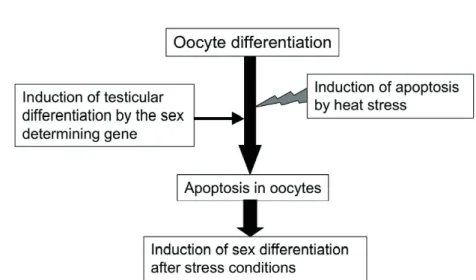
はじめ,すべての個体の生殖腺中の生殖原細胞の多く は卵母細胞へ分化する。孵化後3週間後に生殖腺の性 分化が始まり,オスでは卵母細胞がアポトーシスによっ て消失したのち,精巣が形成され,メスでは卵母細胞 が充実して卵巣に発達する(Takahashi, 1977; Uchida et al., 2002)。この性分化時期に高水温で処理すると,
オス化が誘導されることから,性分化期の高温ストレ スは分化期にある生殖細胞または体細胞のアポトーシ スを過剰に誘導するため,卵母細胞が消失して卵巣の 形成が阻害され,エストロゲンの合成を抑制すること が刺激となり,精巣形成が誘発される機構が推定され る(Fig. 1)。
性決定の様式に関わらず,多くの魚種で17β-エスト ラジオールの投与によりメス化する。一方,メチルテ ストステロンの投与によって未分化生殖腺が精巣に分 化する。また,高温処理によってもオス化が誘導され ることが知られており,生殖腺におけるアロマターゼ によるエストロゲンの生合成の経路および高温ストレ スによって誘導されるアポトーシスの経路が,魚類の 山下倫明・川口奈々美
14
生殖腺の性分化に大きな役割を果たしている (Janz and Van Der Kraak, 1997; Nakamura and Takahashi, 1973; Yamamoto, 1953; Kitano et al., 1999; D'Cotta et al., 2001)。
このことから,マアジ,サンマ等海産魚類の性分化 における高水温の影響を明らかにするためには,水温 の異なる条件で飼育管理された実験魚を用いて,生殖 腺の性分化を組織化学的に観察するとともに,生殖腺 におけるアロマターゼの発現パターン,エストロゲン レベルおよびアポトーシスの発現の魚種毎の相違を調 べる必要がある。
4.ストレスによる生殖腺異常
高温ストレスによるアポトーシスの発現は,胚また は生殖腺組織切片のTUNEL染色法(細胞核における 分解したDNA断片の特異的染色法)で観察することが できる(Yabu et al., 2001)。また,生化学的手法と して,生殖腺抽出物におけるアポトーシス誘導性酵素 カス パー ゼ の活 性を 測定 す るこ とが でき る (Yabu et al., 2001)。ストレス誘導性HSP70遺伝子の発現パ ターンをRT-PCR,ノーザンブロット等によって測定 する実験手法も利用可能である。このようにして観察 できるアポトーシスおよびストレス応答は,ストレス 刺激の度合いに依存して,強く生じることから,カス パーゼ活性,HSP70mRNAなどを定量的に計測するこ とによって,高水温条件によるストレスの度合いと生 殖腺の異常発現を対比して観察する研究手法が期待で きる。
文 献
Chan S. T. H. and Yeung W. S. B., 1983. : Sex control and sex reversal in fish under natural condi- tions. In Fish Physiology, vol. 9 Part B,(ed. W.
S. Hoar, D. J. Randall, and E. M. Donaldson), pp. 171-222. New York, Academic Press.
Chardard D., Desvages G., Pieau C., and Dournon C., 1995. : Aromatase activity in larval gonads of Pleurodeles waltl(Urodele Amphibia)during normal sex differentiation and during sex rever- sal by thermal treatment effect. Gen. Comp.
Endocrinol.99, 100-107.
Chiang E. F., Yan Y. L., Guiguen Y., Postlethwait J., and Chung B. C., 2001: Two Cyp19(P450 aromatase)genes on duplicated zebrafish chro- mosomes are expressed in ovary and brain.Mol.
Biol. Evol.18, 542-550.
D'cotta H., Fostier A., Guiguen Y., Govoroun M., and Baroiller J.-F., 2001: Aromatase plays a key role during normal and temperature-induced sex differentiation of tilapia Oreochromis niloticus.
Mol. Reprod. Dev.,29, 265-276.
Devlin R. H. and Nagahama Y., 2002: Sex determina- tion and sex differentiation in fish: an overview of genetic, physiological, and environmental in- fluences.Aquaculture,208, 191-364.
Janz D. M. and Van Der Kraak G., 1997: Suppression of apoptosis by gonadotropin, 17β-estradiol, and epidermal growth factor in rainbow trout
Fig. 1. Sex differentiation model under heat stress conditions in temperature- dependent sex determination mechanism in zebrafish.
preovulatory ovarian follicles. Gen. Comp.
Endocrinol.,105, 186-193.
Kishida M. and Callard G. V., 2001a: Distinct cytochrome P450 aromatase isoforms in zebrafish(Danio rerio)brain and ovary are dif- ferentially programmed and estrogen regulated during early development. Endocrinology, 142, 740-750.
Kishida M., McLellan M., Miranda J. A., and Callard G. V., 2001b: Estrogen and xenoestrogens upregulate the brain aromatase isoform(P450arom B)and perturb markers of early development zebrafish (Danio rerio). Comp. Biochem. Physiol.,129B, 261-268.
Kitano T., Takamune K., Kobayashi T., Nagahama Y., and Abe S. I., 1999: Suppression of P450 aromatase gene expression in sex-reversed males produced by rearing genetically female larvae at a high water temperature during a period of sex differentiation in the Japanese flounder Paralichthys olivaceus. J. Mol. Endocrinol., 23, 167-176.
Kobayashi T., Kajiura-Kobayashi H., and Nagahama Y., 2000: Differential expression of vasa homologue gene in the germ cells during oogenesis and spermatogenesis in a teleost fish, tilapia, Oreochromis niloticus. Mech. Dev., 99:
139-142.
Korpelainen H., 1990: Sex ratios and conditions re- quired for environmental sex determination in animals. Biol. Rev. Camb. Philos. Soc.,65, 147- 184.
Matsuda M., Nagahama Y., Shinomiya A., Sato T., Matsuda C., Kobayashi T., Morrey C. E., Shibata N., Asakawa S., Shimizu N., Hori H., Hamaguchi S., and Sakaizumi, M., 2002: DMY is a Y-specific DM-domain gene required for male development in the medaka fish. Nature, 417, 559-563.
Nakamura M. and Takahashi H., 1973: Gonadal sex differentiation in tilapia, with special regard to the time of estrogen treatment effective in in- ducing complete feminization of genetic males.
Bull. Fac. Fish Hokkaido Univ.,24, 1-13.
中山一郎, 1997:性決定に関連するDNA/遺伝子.「魚 類のDNA(青木宙,隆島史夫,平野哲也編)恒星 社恒星閣, p.391-413.
Pakdel F., Le Guellec C., Vaillant C., Le Roux M. G., and Valotaire Y., 1989: Identification and estro- gen induction of two estrogen receptors(ER)
messenger ribonucleic acids in the rainbow trout liver: sequence homology with other ERs. Mol.
Endocrinol.,3, 44-51.
Shapiro D. Y., 1990: Sex-changing fish as a manipulable system for the study of the deter- mination, differentiation, and stability of sex in vertebrates.J. Exp. Zool.,Suppl. 4, 132-136.
Sinclair A., H., Berta P., Palmer M., S., Hawkins J., R., Griffiths B., L., Smith M., J., Foster J., W., Frischauf A., M., Lovell-Badge R., and Goodfellow P., N., 1990: A gene from the human sex-determining region encodes a protein with homology.Nature,346, 240-244.
Strüssmann C. A., Saito T., and Takashima F., 1998:
Heat-induced germ cell deficiency in the teleosts Odontesthes bonariensis and Patagonia hatcheri. Comp. Biochem. Physiol., 119A, 637- 644.
Takahashi H., 1977: Juvenile hermaphroditism in the zebrafish Brachydanio rerio. Bull. Fac. Fish.
Hokkaido Univ.,28, 57-65.
Trant J. M., Gavasso S., Ackers J., Chung B. C., and Place A. R., 2001: Developmental expression of cytochrome P450 aromatase genes(CYP19a and CYPb)in zebrafish fry(Danio rerio). J. Exp.
Zool.,15, 475-483.
Uchida D., Yamashita M., Kitano T., and Iguch T., 2002: Oocyte apoptosis during the transition from ovary-like tissue to testes during sex dif- ferentiation of juvenile zebrafish. J. Exp. Biol., 205, 711-718.
Volff J., N., Kondo M., and Schartl M., 2003.
Medaka dmY/dmrt1Y is not the universal pri- mary sex-determining gene in fish. Trends.
Genet.,19, 196-199.
Yabu T., Todoriki S., and Yamashita M., 2001:
Stress-induced apoptosis by heat shock, UV and γ-ray irradiation in zebrafish embryos detected by increased caspase activity and whole mount TUNEL staining.Fish. Sci.,67, 333-340.
Yamamoto T., 1953: Artificial induced sex-reversal in genotypic males medaka(Oryzias latipes).J.
Exp. Zool.,123, 571-594.
山本栄一. 1999:ヒラメの全雌およびクローン魚作出技 山下倫明・川口奈々美
16
術開発に関する研究.日水誌,64, 638-641.
Yoshizaki G., Sakatani S., Tominaga H., and Takeuchi T., 2000. : Cloning and characteriza- tion of avasa-like gene in rainbow trout and its expression in the germ cell lineage. Mol. Rep.
Devl.,55, 364-371.
Yoon C., Kawakami K., and Hopkins N., 1997. : Zebrafish vasa homologue RNA is localized to
the cleavage planes of 2 - and 4-cell-stage em- bryos and is expressed in the primordial germ cells.Development,124, 3157-3165.
Young G., Kagawa H., and Nagahama Y., 1983: Evi- dence for a decrease in aromatase activity in the ovarian granulosa cells of amago salmon
(Oncorhynchus rhodurus)associated with final oocyte maturation.Biol. Reprod.,29, 310-315.