END-TO-END FEEDBACK LOSS IN SPEECH CHAIN FRAMEWORK VIA STRAIGHT-THROUGH ESTIMATOR
Andros Tjandra 1,2 , Sakriani Sakti 1,2 , Satoshi Nakamura 1,2
1 Nara Institute of Science and Technology, Japan
2 RIKEN, Center for Advanced Intelligence Project AIP, Japan {andros.tjandra.ai6,ssakti,s-nakamura}@is.naist.jp
ABSTRACT
The speech chain mechanism integrates automatic speech recogni- tion (ASR) and text-to-speech synthesis (TTS) modules into a single cycle during training. In our previous work, we applied a speech chain mechanism as a semi-supervised learning. It provides the abil- ity for ASR and TTS to assist each other when they receive unpaired data and let them infer the missing pair and optimize the model with reconstruction loss. If we only have speech without transcrip- tion, ASR generates the most likely transcription from the speech data, and then TTS uses the generated transcription to reconstruct the original speech features. However, in previous papers, we just limited our back-propagation to the closest module, which is the TTS part. One reason is that back-propagating the error through the ASR is challenging due to the output of the ASR being discrete tokens, creating non-differentiability between the TTS and ASR.
In this paper, we address this problem and describe how to thor- oughly train a speech chain end-to-end for reconstruction loss us- ing a straight-through estimator (ST). Experimental results revealed that, with sampling from ST-Gumbel-Softmax, we were able to up- date ASR parameters and improve the ASR performances by 11%
relative CER reduction compared to the baseline.
Index Terms— speech chain, end-to-end feedback loss, straight- through estimator, ASR, TTS
1. INTRODUCTION
A speech chain [1] is a viewpoint that describes the speech com- munication process in which the speaker produces words and gen- erates speech sound waves, transmits the speech waveform through a medium (i.e., air), and creates a speech perception process in a listeners auditory system to perceive what was said. The hearing process is critical, not only for the listener but also for the speaker herself. By simultaneously listening and speaking, the speaker can monitor her volume, articulation, and the general comprehensibility of her speech. Based on those observations, we simulated the speech chain mechanism by coupling ASR and TTS and formed a machine speech chain [2, 3], so that the machine can learn, not only to lis- ten (by way of ASR) or speak (by way of TTS) but also listen while speaking.
In our previous paper [2], we utilized the speech chain idea for semi-supervised learning using paired and unpaired data. First, we pretrained both ASR and TTS with a small amount of paired speech and text data. Then, we subsequently used both the pretrained mod- ules to complete the missing pair from the unpaired data. For ex- ample, if we only have speech without transcription, ASR generates the most likely transcription from the speech data with greedy or beam-search decoding, and TTS uses the generated transcription to reconstruct the original speech features. In this case, we trained the TTS module with the reconstruction loss. For the reverse case, if
we only have text without any corresponding speech, TTS generates speech, whose features ASR uses to reconstruct the original text. In this case, we updated the ASR module with the reconstruction loss.
In Fig. 1(a), we illustrate a multispeaker speech chain loop between the ASR and TTS modules.
However, the auditory feedback in a human speech chain hap- pens almost constantly, not only during semi-supervised learning.
Furthermore, the close-loop feedback is also done end to end. But, to simulate our speech chain mechanism to provide the ability to help each other even during the supervised learning and perform a com- pletely end-to-end feedback reconstruction loss, the main challenge is to utilize TTS to improve our ASR module. One reason is that back-propagating the error from the reconstruction loss through the ASR module is challenging due to the output of the ASR discrete to- kens (grapheme or phoneme), creating non-differentiability between the TTS and ASR modules (Fig. 1(b)).
We address this problem using a straight-through estimator [4, 5]
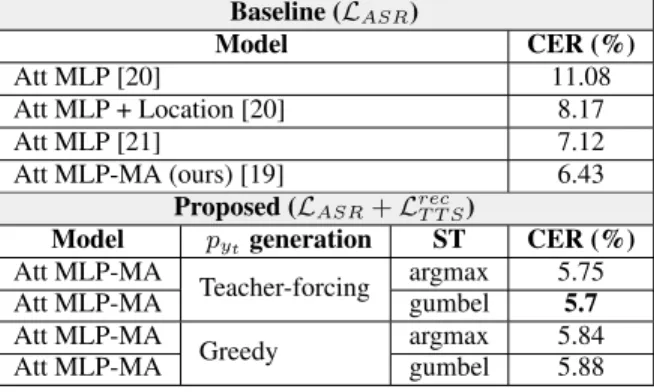
to predict the gradient through discrete variables (Fig. 1(c)). We mainly focus on describing how to thoroughly train a speech chain end-to-end by adding a reconstruction term from the TTS module and backpropagated the gradient through the ASR. Experimental re- sults revealed that, with teacher-forcing and sampling from Gumbel- Softmax, we are now able to updated ASR parameters and improved the ASR performances significantly by 11% relative CER reduction compared to the baseline.
2. SPEECH CHAIN AND END-TO-END FEEDBACK LOSS In the speech chain mechanism, given speech features x = [x
1, .., x
S] (e.g., Mel-spectrogram) and text y = [y
1, .., y
T], we feed the speech to the ASR module, and the ASR decoder generates contin- uous vector h
dtstep-by-step. To calculate probability vector p
y= [p
y1, .., p
yT], we apply the softmax function p
yt= softmax(h
dt) to decoder output h
dt. For each class probability mass in p
yt, p
yt[c]
was defined as:
p
yt[c] = exp(h
dt[c]/τ) P
Ci=1
exp(h
dt[i]/τ) , ∀c ∈ [1..C]. (1) Here C is the total number of classes, h
dt∈ R
Care the logits pro- duced by the last decoder layer, and τ is the temperature parame- ters. Setting temperature τ using a larger value (τ > 1) produces a smoother probability mass over classes [6].
For the generation process, we generally have two different methods:
1. Conditional generation given ground-truth (teacher-forcing):
If we have paired speech and text (x, y), we can generate p
ytfrom autoregressive ASR decoder Dec
ASR(y
t−1, h
e), con-
ditioned to ground-truth text y
t−1in the current time-step and
Fig. 1. a) Multispeaker machine speech chain mechanism; b) Baseline ([3]): feedback loss from TTS is only backpropagated through the TTS module, and the ASR module is not updated because variable y ˆ is non-differentiable; c) Proposal: feedback loss from TTS is backpropagated through discrete variable y, and ASR modules are updated based on the estimated gradient from the TTS module by a straight-through ˆ estimator.
encoded speech feature h
e= Enc
ASR(x). At the end, the length of probability vector p
yis fixed to T time-steps.
2. Conditional generation given previous step model prediction:
Another generation process to decode ASR transcription uses its own prediction to generate probability vector p
yt. There are many different generation methods, such as greedy de- coding (1-best beam-search) ( y ˜
t= argmax
c
p
yt[c]), beam- search, or stochastic sampling (˜ y
t∼ Cat(p
yt)).
After the generation process, we obtained probability vector p
yand applied discretization from continuous probability vector p
ytto y ˜
teither by taking the class with the highest probability or sam- pling from a categorical random variable. After getting a single class to represent the probability vector, we encode it into vec- tor [0, 0, .., 1, ..,0] with one-hot encoding representation and give it to the TTS as the encoder input. The TTS reconstructs Mel- spectrogram ˆ x with the teacher-forcing approach. The reconstruc- tion loss is calculated:
L
recT T S= 1 S
S
X
s=1
(x
s− x ˆ
s)
2, (2) where x ˆ
sis the predicted (or reconstructed) Mel-spectrogram and x
sis the ground-truth spectrogram at s-th time-step.
We directly calculated the gradient from the reconstruction loss w.r.t TTS parameters (∂L
recT T S/∂θ
T T S) because all the operations inside the TTS module are continuous and differentiable. However, we could not calculate the gradient from the reconstruction loss w.r.t ASR parameters (∂L
recT T S/∂θ
ASR) because we have a discretiza- tion operation from p
yt→ onehot(˜ y
t). Therefore, we applied a straight-through estimator to enable the loss from L
recT T Sto pass through discrete variable y ˜
t.
2.1. Straight-through Argmax
The straight-through estimator [4, 5] is a method for estimating or propagating gradients through stochastic discrete variables. Its main idea is to backpropagate through discrete operations (e.g., argmax
c
p
yt[c] or sampling y ˜
t∼ Cat(p
yt)) like an identity func- tion. We describe the forward process and the gradient calculation with a straight-through estimator in Fig. 2.
In the implementation, we created a function with different for- ward and backward operations. For argmax one-hot encoding func- tion, we formulated the forward operation:
Fig. 2. Straight-through estimator on arg max function. Given input x and model parameters θ, we calculate categorical proba- bility mass P (x; θ) and apply discrete operation argmax. In the backward pass, the gradient from stochastic node y to P (x; θ),
∂y/∂P (x; θ) ≈ 1 is approximated by identity.
˜
z
t= argmax
c
p
yt[c] (3)
˜
y
t= onehot(˜ z
t). (4) Here we describe y ˜
tas a one-hot encoding vector with the same length as the p
ytvector. When the loss is calculated and the gra- dients are backpropagated from loss L
recT T S, we formulate the back- ward operation:
∂ ˜ y
t∂p
yt≈ 1. (5)
Therefore, when we back-propagate the loss from Eq. 2 with the straight-through estimator approach, we calculate the TTS recon- struction loss gradient w.r.t θ
ASR:
∂L
recT T S∂θ
ASR=
T
X
t=1
∂ L
recT T S∂ y ˜
t· ∂ y ˜
t∂p
yt· ∂p
yt∂θ
ASR(6)
≈
T
X
t=1
∂ L
recT T S∂ y ˜
t· 1 · ∂p
yt∂θ
ASR. (7)
2.2. Straight-through Gumbel Softmax
Besides taking argmax class from probability vector p
yt, we also
generated a one-hot encoding by sampling with the Gumbel-Softmax
Fig. 3. Given speech feature x, ASR generates a sequence of proba- bility p
y= [p
y1, p
y2, ..., p
yT]. If we have a ground-truth transcrip- tion, we can calculate L
ASR(Eq. 16). TTS module generates speech features, and we calculate reconstruction loss L
recT T S(Eq. 2). After that, the gradients based on L
ASRare propagated through the ASR module, and the gradients based on L
recT T Sare propagated through the TTS and ASR modules by a straight-through estimator.
distribution [7, 8]. Gumbel-Softmax is a continuous distribution that approximates categorical samples, and the gradients can be calcu- lated with a reparameterization trick. For Gumbel-Softmax, we re- placed the softmax formula for calculating p
yt(Eq. 1):
p
yt[c] = exp((h
dt[c] + g
c)/τ ) P
Ci=1
exp((h
dt[i] + g
i)/τ ) , ∀c ∈ [1..C]. (8) where g
1, .., g
Care i.i.d samples drawn from Gumbel(0, 1) and τ is the temperature. We sample g
cby drawing samples from the uniform distribution:
u
c∼ Uniform(0, 1) (9) g
c= − log(− log(u
c)), ∀c ∈ [1..C]. (10) To generate a one-hot encoding, we define our forward operation:
˜
z
t∼ Categorical(p
yt[1], p
yt[2], ..., p
yt[C]) (11)
˜
y
t= onehot(˜ z
t). (12) At the backpropagation time, we use the same straight-through es- timator (Eq. 5) to allow the gradients to flow through the discrete sampling operation from Eq. 11.
2.3. Combined Loss for ASR
Our final loss function for ASR is a combination from negative likeli- hood (Eq. 16) and TTS reconstruction loss (Eq. 2) by sum operation:
L
FASR= L
ASR+ L
recT T S. (13) To summarize our explanation in this section, we provide an illus- tration in Fig. 3 that explains how sub-losses L
ASRand L
recT T Sare backpropagated to the rest of the ASR and TTS modules.
3. SEQUENCE-TO-SEQUENCE MODEL FOR ASR A sequence-to-sequence model is a neural network that directly models conditional probability p(y|x), where x = [x
1, ..., x
S] is the sequence of the (framed) speech features with length S and y = [y
1, ..., y
T] is the labels sequence with length T .
The encoder task processes input sequence x and generating rep- resentative information h
e= [h
e1, ..., h
eS] for the decoder. The atten- tion module is an extension scheme that assists the decoder to find relevant information on the encoder side based on the current de- coder hidden states h
dt[9, 10]. Attention modules produce context information c
tat time t based on the encoder and decoder hidden states:
c
t=
S
X
s=1
a
t(s) ∗ h
es(14)
a
t(s) = Align(h
es, h
dt)
= exp(Score(h
es, h
dt)) P
Ss=1
exp(Score(h
es, h
dt)) . (15) There are several variations for score functions [11] such as Score(h
es, h
dt): dot product (hh
es, h
dti), bilinear (h
e|sW
sh
dt), where Score : ( R
M× R
N) → R , M is the number of hidden units for the encoder and N is the number of hidden units for the decoder.
Finally, the decoder task predicts target sequence probability p
ytat time t based on previous output and context information c
t. The loss function for ASR can be formulated:
L
ASR= − 1 T
T
X
t=1 C
X
c=1
1 (y
t= c) ∗ log p
yt[c], (16)
where C is the number of output classes. Input x for the speech recognition tasks is a sequence of feature vectors like a Mel-scale spectrogram. Therefore, x ∈ R
S×D, where D is the number of features and S is the total frame length for an utterance. Output y, which is a speech transcription sequence, can be either a phoneme or a grapheme (character) sequence.
4. SEQUENCE-TO-SEQUENCE MODEL FOR TTS Speech synthesis can be viewed as a sequence-to-sequence task where a model generates speech given a sentence. We directly model the conditional probability p(x|y) with a sequence-to-sequence model, where y = [y
1, ..., y
T] is the sequence of characters with length T and x = [x
1, ..., x
S] is the sequence of (framed) speech features with length S. From the sequence-to-sequence ASR model perspective, TTS is the reverse case where the model reconstructs the original speech given the text.
In this work, our core architecture is based on Tacotron [12] with several structural modifications [3]. The main difference between our modified Tacotron and the default Tacotron is that we added an additional speaker embedding projection layer into our decoder to enable multispeaker training and generation. We also have an addi- tional output layer to generate binary prediction b
s∈ [0, 1] (1 if the s-th frame is the end of speech, otherwise 0).
For training the TTS model, we used the following loss function:
L
T T S= 1 S
S
X
s=1
![Fig. 1. a) Multispeaker machine speech chain mechanism; b) Baseline ([3]): feedback loss from TTS is only backpropagated through the TTS module, and the ASR module is not updated because variable y ˆ is non-differentiable; c) Proposal: feedback loss from T](https://thumb-ap.123doks.com/thumbv2/123deta/7300613.2418696/2.918.207.715.114.305/multispeaker-mechanism-baseline-feedback-backpropagated-variable-differentiable-proposal.webp)
![Fig. 3. Given speech feature x, ASR generates a sequence of proba- proba-bility p y = [p y 1 , p y 2 , ..., p y T ]](https://thumb-ap.123doks.com/thumbv2/123deta/7300613.2418696/3.918.138.386.107.544/given-speech-feature-generates-sequence-proba-proba-bility.webp)