• 検索結果がありません。

Academia Arena 2017;9(12) http://www.sciencepub.net/academia 52 Effects of Varying Fermentation Period on the Chemical Properties of Tropical Sikcle Pod (Senna obtusifolia) Seed Meal Augustine, C

N/A
N/A
Protected

Academic year: 2021

シェア "Academia Arena 2017;9(12) http://www.sciencepub.net/academia 52 Effects of Varying Fermentation Period on the Chemical Properties of Tropical Sikcle Pod (Senna obtusifolia) Seed Meal Augustine, C"

Copied!
5
0
0

読み込み中.... (全文を見る)

全文

(1)

Effects of Varying Fermentation Period on the Chemical Properties of Tropical Sikcle Pod (Senna obtusifolia) Seed Meal

Augustine, C

1

., Waba, Y.E

2

., Abdullahi I.A

3

and Nyalas, B.P

4

1.

Department of Animal Production, Adamawa State University, Mubi, Nigeria.

2.

Federal Polytechnic Bali, Taraba State, Nigeria

3.

Modibbo Adama University of Technology, Yola, Nigeria

4.

Ministry of Livestock, Adamawa State, Nigeria [email protected]

Abstract: A study was conducted to evaluate the proximate composition, amino acid profile and levels of anti- nutritional factors of Senna obtusifolia seeds subjected to varying fermentation periods. The seeds of Senna obtusifolia were naturally fermented for 0, 3, 5, 7 and 9 days, respectively. Each representative sample was analysed in triplicates in a complete randomized design for dry matter, crude protein, crude fibre, ether extract, nitrogen free extract, amino acids and levels of anti-nutritional factors using standard laboratory procedure. The results indicated an increasing trend as the fermentation period progresses for the protein (26.95 to 28.29%), ash (4.50 to 5.31%) and some amino acid content. Lysine and methionine increased from 1.19 to 2.97g/100g and 2.20 to 2.88g /100g. As the fermentation period progressed, the crude fibre, nitrogen free extract, ether extract and anti-nutritional factors were observed to decrease. Crude fibre decreased from 11.17 to 4.23%, NFE 41.85 to 37.31% and ether extract 3.65 to 1.98%. Similarly, Tannins and oxalates decreased from 5.42 to 1.17 g/100 g and 1.95 to 0.36 g/100 g, respectively. It can be concluded that fermenting Senna obtusifolia seeds for up to 9 days has significantly reduced the levels of ant-nutritional factors and improved the protein and amino acid profile of Senna obtusifolia with less depreciation in some of the proximate components. There is need to conduct further studies to investigate the effect of fermenting Senna obtusifolia seeds beyond nine (9) days. Furthermore, studies should be conducted using fermented Senna obtusifolia seed meal in a feeding trial with a view to evaluating its feeding value.

[Augustine, C., Waba, Y.E., Abdullahi I.A and Nyalas, B.P. Effects of Varying Fermentation Period on the Chemical Properties of Tropical Sikcle Pod (Senna obtusifolia) Seed Meal. Academ Arena 2017;9(12):52-56].

ISSN 1553-992X (print); ISSN 2158-771X (online). http://www.sciencepub.net/academia. 9.

doi:10.7537/marsaaj091217.09.

Keywords: Sickle pod, chemical properties, varying fermentation period.

Introduction

The utilization of lesser-known legumes will go a long way in addressing the feed crises that has engulfed the Nigerian livestock industry. Adegbenro et al.

(2011) further buttressed the need to exploit some under-utilized seeds which could argument the costly conventional feed resources. One of such under- exploited legumes is Senna obtusifolia seeds. Senna obtusifolia is a pantropical weed that belongs to the family leguminosae caesapinioideae. It is an erect bushy annual shrub that grows up to 90 cm tall and propagates through seed. The leaves are obovate and the flowers are yellow in colour (Akobundun and Agyakwa, 1998). Most seeds of legumes contain toxic components which may limit their utilization (Parul, 2014; Adebowale and Maliki, 2011). The chemical composition of the seeds as revealed by Ingweye et al.

(2010) and Ismaila et al. (2011) indicated that they have good nutritional properties (29.54 and 18.46% crude protein) but also contained some anti-nutritional factors (tannins 388.50 mg/100g, phytates 240.50 mg/100g and oxalate 83.25 mg/100g) which may adversely affect the performance of animals that may consume the seed

meal. Processing treatments have been known to reduce

anti-nutritional factors and improve nutrient utilization

(Effiong et al., 2011; Tuleun et al., 2011; Emiola,

2013). Fermentation has been reported to modify some

physical characteristics of cereals and legumes,

increase the level of some nutrients, digestibility and

bioavailability of nutrients (Brown et al., 1998),

decrease levels of anti-nutrients, increase nutrient

density (Tomkins et al., 1987; Nnam, 1998), and

imparts some antimicrobial properties (Mensah et al.,

1990; Mensah et al., 1991). Fermentation holds

promise as a food processing method that can be used

to diversify the food uses of some under-exploited plant

foods (Anthony and Babatunde, 2014). Fermentation

period has been documented to influence the chemical

properties of seeds (Yashim et al., 2009 Adebowale and

Maliki, 2011). At the moment, base-line information on

the effects of varying fermentation periods on the

proximate composition, amino acid profile and levels

of anti-nutritional factors of Senna obtusifolia seeds

seems to be meager. Therefore, more studies are needed

to bridge such information gap. It was in of view of the

above that this study was conducted to investigate the

(2)

effects of varying fermentation periods on the chemical properties of Senna obtusifolia seeds.

Materials and methods Seed collection and processing

The seeds were harvested from bushes around Mubi area of Adamawa State, Nigeria. The plant and seeds were authenticated at the Department of Biological Sciences, Adamawa State University, Mubi, Nigeria. The seeds were boiled, washed, drained and placed in an air tight container and allowed to naturally ferment for 3, 5, 7, and 9 days, respectively. At the end of each respective fermentation period, each representative sample was removed from the fermenting container and properly sun-dried, ground to meal and used for the chemical analysis.

Chemical analysis

The proximate composition of the seed meal and levels of the anti-nutritional factors were determined in triplicates in a complete randomized design using the standard procedure of Official Association of Analytical Chemists [AOAC] (2004). The dry matter content was determined using the oven-dry method and crude protein was determined using the Kjeldahl procedure. Soxhlet extraction method was used for the determination of ether extract, while the fibre content was evaluated using the trichloroacetic method. The ashing procedure was used to determine the ash content, while nitrogen free extract (NFE) was computed using the formula:

NFE = 100 – (% Moisture + CP + CF +EE +ASH) Where:

CP = Crude Protein CF = Crude Fibre EE = Ether Extract

Similarly, the energy values were computed using the formula of Pauzenga (1985) which is expressed as ME= 37 × %CP + 81 × % EE + 35.5 × % NFE. The energy values obtained in Kcal/kg were converted to mega joules per kilogram (MJ/kg). The amino acid profile was analyzed using High Performance Liquid Chromatograph (HPLC) Buck Scientific BLC 10/11 model equipment.

Data analysis

Data obtained were subjected to Analysis of Variance (ANOVA) of the completely randomized design (CRD). Duncan Multiple Range Test (DMRT) was used to separate the treatment means where significant difference occurred. The results were expressed as means with their standard error of the means of triplicate determinants.

Results and discussion

The proximate composition of Senna obtusifolia seeds subjected to varying fermentation periods is presented in Table 1. The proximate composition were significantly (P<0.05) affected by the different treatments. The crude protein was observed to increase with progressive increase in fermentation period.

Fermentation period on the 9

th

day recorded the highest crude protein content. The crude protein content was observed to increase from 26.95 to 28.79%. An increase in the protein content after fermentation was attributted to the activities and increase number of lactic acid bacteria present during fermentation. The increase in protein contents agreed with the finding of Afoakwa et al. (2004). This finding is also in line with the report of Adebowale and Maliki (2011) who obtained similar results for pigeon pea (Cajanus cajan) seed flour. They attributed such increase in protein content to net synthesis of protein by fermenting seeds which might have resulted in the production of some amino acids during protein synthesis (Uwagbute et al., 2000). Some Researchers (El Hag et al., 2002; Ali et al., 2003) reported that fermentation can be effectively used to improve the nutritional quality of cereal grains by increasing protein content and digestibility which is in line with the findings of this study.

The ash content was observed to significantly (P<0.05) increase with increase in the fermentation period. The ash content increase from 4.50 to 5.31%

from day 0 to 9. This result concurred with the findings of Adebowale and Maliki (2011) and Anthony and Babatunde (2014). The latter explained that the increase in the ash content after fermentation could be due to the incomplete utilization of minerals by the fermenting organisms during their metabolism.

The ether extract and nitrogen free extract (NFE) significantly (P<0.05) decreased as the fermentation period advances. The decrease in the ether extract was due to the breakdown of fatty acids and glycerol by lipolitic organisms during fermentation (Anthony and Babatunde, 2014). The NFE decreased from 41.85 to 37.31% with fermentation at the 9

th

day, recording the lowest value of 40.18%. This was due to the utilization of sugars in the seeds by the fermenting microbial mass which is in line with the report of Anthony and Babatunde (2014).

The crude fibre similarly indicated a decreasing

trend with progressive increase in the fermentation

period. Fermentation at the 9

th

day recorded the least

crude fibre content of 4.23% which is in agreement with

the findings of Anthony and Babatunde (2014) who

attributed such decrease to the enzymatic breakdown of

fibre by the fermenting microbes which utilized them

as carbon source and convert them to microbial biomass

thereby reducing the fibre content (Rainbault, 2001).

(3)

Table 1: Proximate Composition of Senna obtusifolia Seeds Subjected to Varying Fermentation Period Fermentation period (days)

Nutrients (%) (T1) T2(3) T3(5) T4(7) T5(9) SEM

Dry matter 90.72 90.33 90.27 90.18 90.23 21.43

NS

Crude protein 26.95

c

26.49

c

27.34

b

27.19

ab

28.79

a

3.74*

Crude fibre 11.17

a

8.64

b

8.51

b

6.41

c

4.23

d

1.66*

Ether extract 3.65

a

3.42

b

3.39

b

2.52

c

1.98

d

0.32*

Ash 4.50

b

4.54

b

5.01

a

5.11

a

5.31

a

0.44*

NFE 41.85

a

40.99

a

40.92

a

39.89

b

37.31

c

5.94

*

*Energy (MJ/Kg) 10.40 10.20 10.32 10.30 10.01 3.15

NS

a, b, c, d = Means in the same row with different superscripts are significantly different (P<0.05) * = Significant at 5% level of probability, SEM = standard error of mean.

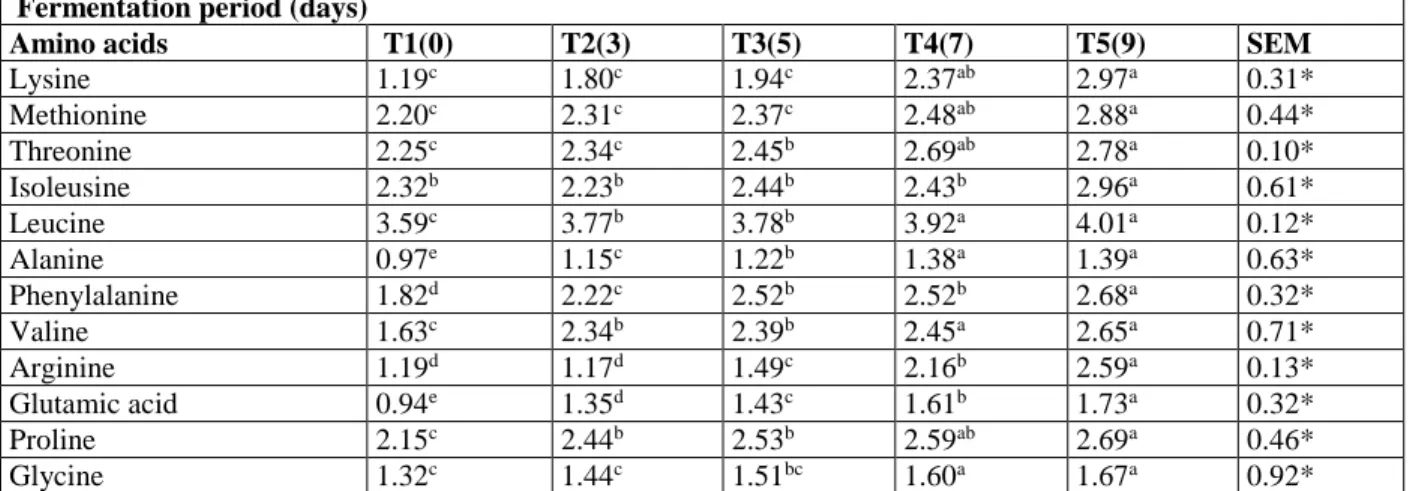
The amino acid profile (Table 2) also indicated a significant (P<0.05) increasing trend as the fermentation period progresses. Fermentation was reported to cause biological enrichment of food substrate with protein, essential amino acids and vitamins (Skeinkraus, 1998) which is in agreement with

the finding of this study. The highest lysine (2.97g/100g) and methionine (2.88g/100g) contents were recorded in the seeds fermented for 9 days. Net synthesis of protein by fermenting seeds resulted in the production of some amino acids during the protein synthesis (Marero et al. 1989; Uwagbute et al., 2000).

Table 2: Amino acid Profile of Senna obtusifolia Seeds Subjected to Varying Fermentation Periods (g/100g) Fermentation period (days)

Amino acids T1(0) T2(3) T3(5) T4(7) T5(9) SEM

Lysine 1.19

c

1.80

c

1.94

c

2.37

ab

2.97

a

0.31*

Methionine 2.20

c

2.31

c

2.37

c

2.48

ab

2.88

a

0.44*

Threonine 2.25

c

2.34

c

2.45

b

2.69

ab

2.78

a

0.10*

Isoleusine 2.32

b

2.23

b

2.44

b

2.43

b

2.96

a

0.61*

Leucine 3.59

c

3.77

b

3.78

b

3.92

a

4.01

a

0.12*

Alanine 0.97

e

1.15

c

1.22

b

1.38

a

1.39

a

0.63*

Phenylalanine 1.82

d

2.22

c

2.52

b

2.52

b

2.68

a

0.32*

Valine 1.63

c

2.34

b

2.39

b

2.45

a

2.65

a

0.71*

Arginine 1.19

d

1.17

d

1.49

c

2.16

b

2.59

a

0.13*

Glutamic acid 0.94

e

1.35

d

1.43

c

1.61

b

1.73

a

0.32*

Proline 2.15

c

2.44

b

2.53

b

2.59

ab

2.69

a

0.46*

Glycine 1.32

c

1.44

c

1.51

bc

1.60

a

1.67

a

0.92*

a, b, c, d, e = Means in the same row with different superscripts are significantly different (P<0.05) * = Significant at 5% level of probability, SEM = standard error of mean

The levels of anti-nutritional factors (Table 3) showed a decreasing pattern as the fermentation period increases. Tannins and oxalates decreased from 5.42 to 2.02% and 1.95 to 0.28%, respectively. Anthony and Babatunde (2014) made similar observation for soya bean (Glycine max) flour; Magdi (2011) for pearl millet; Lasekan and Shabnam (2013) for Rambutan (Nephelium lappaceum). This reduction may be due to some enzymatic reaction in addition, microorganisms’

breakdown the carbon and nitrogen sources and use them for production of energy and their activity during fermentation (Hemingway, 1988). The decrease in tannin has been associated to microbial activity during fermentation (Dhankher and Chauhan, 1987;

Ikemefuna et al., 1991; Elhag et al., 2002) or to abstraction of hydride ions and rearrangement of the phenolic structures due to the acidic environment

caused by the fermenting microbes (Towo et al., 2006).

The decrease in oxalate content was linked to reasons

reported by Simpson et al. (2009) that a reduced pH

caused by microbes during fermentation, can change

insoluble oxalate bound ions to soluble oxalate content

which will be used as energy source by oxalotrophic

bacteria. The phytates level was similarly observed to

decrease as the fermentation period progresses with

fermentation period at the 9

th

day indicating the lowest

level of phytate. This reduction might be due to low pH

caused by fermenting microbes which has enhanced

phytase activity resulting to lowering of the phytate

content. The reduction in pH of fermented foods caused

by the production of various organic acids such as lactic

acid and acetic acid favours the activity of the enzymes

phytase which is able to dephosphorylate phytate

effectively. (Marfo et al., 1990; Sanberg and Andlid

(4)

2002; Reale et al., 2007; Ab-deland et al., 2011). This might be responsible for the reduction of the phytates content of Senna obtusifolia seed meal.

Table 3: Levels of Ant-nutritional Factors of Senna obtusifolia Seeds Subjected to Varying Fermentation Periods

Fermentation period (days)

Anti-nutrients (100g/100g) T1(0) T2(3) T3(5) T4(7) T5(9) SEM

Oxalates 1.95

a

1.28

b

1.01

b

0.36

c

0.28

c

0.06*

Tannins 5.42

a

3.21

b

2.73

b

2.02

c

1.17

d

0.07*

Flavonoids 3.86

a

3.13

b

1.28

c

0.30

d

0.01

e

0.05*

Phytates 4.61

a

3.41

b

2.52

bc

1.71

d

0.25

e

0.01*

Saponins 2.37

a

1.78

b

1.90

b

1.94

b

0.35

c

0.10*

a, b, c, d, e = Means in the same row with different superscripts are significantly different (P<0.05) * = Significant at 5% level of probability, SEM = standard error of mean.

Conclusion

In conclusion, fermenting Senna obtusifolia seeds for up to 9 days has effectively detoxify and improved the protein and amino acid content of the seeds with little depreciation in some of the proximate composition. There is need to conduct further studies to investigate the effect of fermenting Senna obtusifolia seeds beyond nine (9) days. The fermented seeds should be used in a feeding trial with a view to evaluating its feeding value.

References

1. Adegbenro, M., Onibi, G.E., Agbede, J.O., Aletor, V.A., Aro, S.O and Adeyeye, S.A. Evaluation of the nutrients and anti-nutritional factors in some under- utilized seeds. Proceedings. of the 16

th

Annual Conference of Animal Science Association of Nigeria (ASAN) September, 12

th

- 15

th

, 2011, Kwara State University, Anyigba, Nigeria. 2011; 96-98.

2. Akobundu IO and Agyakwa CW. A Handbook of West African Weeds 2

nd

ed. Published by INTEC printers, Ibadan 1998; 306 Pp.

3. Parul, B. Anti-nutritional factors in foods and their effects. Journal of Academic and Industrial Research 2014; 3(6):285-290.

4. Adebowale, O.J and Maliki, K. Effect of fermentation period on the chemical composition and functional properties of pigeon pea (Cajanus cajan) seed flour. International Food Research Journal 2011); 18(4):1329-1333.

5. Ingweye, J.N., Kalio, G.A., Ubua, J.A and Umoren E.P.. Nutritional evaluation of wild sickle pod (Senna obtusifolia) seeds from Obanliku, South–

Eastern, Nigeria. American Journal of Food Technology 2010; 5:1-12.

6. Ismaila,Y.S., Denban, M.K., Emmanuel, K.M and Augustine, C. Nutritional and phytochemical screening of Senna obtusifolia indigenous to Mubi Adamawa State, Nigeria. Advances in Applied Science Research 2011; 22 (3):432-437.

7. Effiong, O.O. and Umoren, U.E. Effects of multi- processing techniques on the chemical composition of horse eye bean (Mucuna urens). Asian Journal of Animal Scienc 2011; 5:340-348.

8. Tuleun, C.D., Adenkola, A.Y. and Orayaga, K.T.

Naturally fermented mucuna seed meal based diets:

effect on performance and carcass characteristics of broiler chickens. Research Journal of Poultry Science 2011; 4(4):50-55.

9. Emiola, I.A., Ojediran, T.K and Ayaji, J.A.

Biochemical and haematological indices of broiler chickens fed differently processed legume seed meals. International Journal of Applied Agriculture and Apiculture 2013; 1 & 2: 140-149.

10. Brown, K., Dewey, K. and Alhen, L.

Complementary feeding of young children in developing Countries. A Review of Current Scientific knowledge. Geneva World Health Organization; 1998.

11. Tomkins, A., Alnwick, D. and haggerty, P.

Fermented foods for improving young child feeding in Eastern and Southern Africa. In improving young child feeding in Eastern and Southern Africa, edited by Alnwick, D., Moses, S., and Schmidt, O.G.

Household level food Ottawo: International Development Research Centre; 1987.

12. Nman, N.M. Chemical and organoleptic evaluation of complementary foods formulated from maize, cowpea and plantain flours. Nigerian Journal of Nutrition and Sciences 1991; 20:35-40.

13. Mensah, P.P.A., Tomkins, A.M., Draser, B.S and Harrison, T.J. Fermentation of cereals for reduction of bacterial contamination of weaning foods in Ghana. Lancet 1990; 336:140-143.

14. Mensah, P.P.A., Tomkins, A.M., Draser, B.S and Harrison, T.J. Anti-nutritional effect of fermented Ghanain maize-dough. Journal of Applied Bacteriology 1991; 70:203-210.

15. Anthony, O and Babatunde B. Effect of fermentation

on nutrient and anti-nutrient composition of millet

(Pennisetum glaucum) and soya bean (Glycine max)

(5)

blend flours. Journal of Life Sciences 2014; 8:668- 675.

16. Yashim, S.M., Abdu, S.B., Alphonsus, C. and Adenniyi, A. (2009). Proximate and mineral composition of castor seed (Ricinus communis) cake as influenced by duration of fermentation.

Proceedings of the 14

th

Annual conference of Animal Science Association of Nigeria (ASAN) held on September, 14

th

-17

th

2009 at Ladoke Akintola University of Science and Technology, Ogbomoso, Nigeria Pp233-239.

17. AOAC. Association of Official Analytical Chemists.

Official Methods of Analysis 18

th

Edition, Washington D.C., USA. 2004; 275 – 293.

18. Pauzenga, U.. Feeding parent stock. Journal of Zootecnica Technology International. 1985, 22- 25.

19. Afoakwa, E.O., Sefa-Deheh, S., Kluvitse, Y. and Sakyi-Dawson, E.O.The influence of fermentation and cowpea fortification on the quality characteristics of maize-based weaning foods.

Presented at the second international workshop on food-based approaches for healthy nutritional in West Africa: The role of food Technologists and Nutritionists Ouagadougou, Burkina Faso; 2004.

20. Uwagbute, A.C., Iroegbu, C.U and Eke, O. Chemical composition and sensory evaluation of germinated cowpea (Vigna unguicululata) and their product.

Food Chemistry 2000; 68:141 – 146.

21. El-Hag, M.E., El Tinay, A.H and Yousif, N.E. Effect of fermentation and dehulling on starch, total polyphenols, phytic acid content and invitro protein digestibility of pearl millet. Food Chemistry 2002;

77:193-196.

22. Ali, N.M.M., El Tinay, A.H. Elkalifa, A.E., Salih, O.A., Yousif, N.E. Effect of alkaline pre-treatment and cooking on protein fraction of high-tannins sorghum cultivar. Food Chemistry 2003; 114:649- 651.

23. Rainbault, M.M. General and microbiological aspect of solid substrate fermentation electronic. Journal of Biotechnology 2001; 1:314.

24. Steinkraus, K.H. Handbook of indengenous fermented foods. New York Marcel Dekker. Incs.

1995.

25. Magdi, A.O. Effect of traditional fermentation process on the nutrient and anti-nutrient contents of pearl millet during preparation of Lohoh. Journal of the Saudi Society of Agriculture 2011; 10(1):1-6.

26. Lasekan, O.O. and Shabnam, M. Effect of traditional fermentation as a pretreatment to decrease the anti- nutritional properties of Rambutan seed (Nephelium lappaceum L). International Conference on Food and Agricultural Sciences 2013; 55: 13. IPCBEE 55(2013) at 2013/ACSIT press, Singapore DOI:107763/IPCBEE.

27. Hemingway, R.W., Joseph, J.K and Susan, J.B.

Chemistry and significance of condensed tannins. 1

st

North American tannin Conference, Port Angeles, Washington (USA) 1988; Plenum Press 1989.

28. Dhankher, N. and Chauhan, B.M. Effect of temperature and fermentation time on phytic acid and polyphenol content of rabadi, a fermentation pearl millet food. Journal of Food Science 1987;

52:828-829.

29. Ikemefuna, Obizoba, C., and Atii, J.U. Effect of soaking, sprouting, fermentation and cooking on nutrient composition and some anti-nutritional factors of sorghum seeds. Plant Food for Human Nutrition (Formerly Qualitas Plantarum) 1991;

45:23-34.

30. Towo, E., Matuschek, E. and Svanberg, U.

Fermentation and enzyme treatment of tannins sorghum gruels: effects on phenolics compound, phytates and invitro accessible ion. Food Chemistry 2006; 94:369-376.

31. Simpson, T.S., Savage, G.A., Sherlock, R., Vanhanen, L.P. Oxalate content of silver beet leaves (Beta vulgaris var. cicla) at different stages of maturation and the effect of cooking with different milk sources. Journal of Agriculture and Food Chemistry 2009; 57:10804-10808.

32. Marfo, E.K., Simpson, B.K., Idowu, J.S. and Oke, O.L. Effect of local food processing on phytates levels in cassava, cocoyam, yam, maize, sorghum, rice, cowpea and soyabean. Journal of Agricultural and Food Chemistry 1990; 38:1580-1585.

33. Sandberg, A.S and Andlid, T. Phytogenic and microbial phytates in human nutrition. International Journal of Food Science and Technology 2002;

37:823-833.

34. Reale, A., Konietzny, U., Coppola, R., Sowentino, E.

and Greiner, R. The importance.

35. Abdelseed, B.H., Abdelwahab, H.A., Abu ElGasin, A.Y., Isam, A.M and Babiker, E.E. Some nutritional attributes of selected newly developed lines of sorghum after fermentation. Journal of Agricultural Science and Technology 2011; 13:399-409.

12/25/2017

Table 2: Amino acid Profile of Senna obtusifolia Seeds Subjected to Varying Fermentation Periods (g/100g)   Fermentation period (days)
Table  3:  Levels  of  Ant-nutritional  Factors  of  Senna  obtusifolia  Seeds  Subjected  to  Varying  Fermentation     Periods

参照

関連したドキュメント

If condition (2) holds then no line intersects all the segments AB, BC, DE, EA (if such line exists then it also intersects the segment CD by condition (2) which is impossible due

Let X be a smooth projective variety defined over an algebraically closed field k of positive characteristic.. By our assumption the image of f contains

This gives a quantitative version of the fact that the edges of Γ contracted to a point by Φ p are precisely the bridges (which by Zhang’s explicit formula for μ Zh are exactly

Indeed, if we use the indicated decoration for this knot, it is straightforward if tedious to verify that there is a unique essential state in dimension 0, and it has filtration

In Section 3, we show that the clique- width is unbounded in any superfactorial class of graphs, and in Section 4, we prove that the clique-width is bounded in any hereditary

In this paper, under some conditions, we show that the so- lution of a semidiscrete form of a nonlocal parabolic problem quenches in a finite time and estimate its semidiscrete

Keywords: continuous time random walk, Brownian motion, collision time, skew Young tableaux, tandem queue.. AMS 2000 Subject Classification: Primary:

Classical definitions of locally complete intersection (l.c.i.) homomor- phisms of commutative rings are limited to maps that are essentially of finite type, or flat.. The