Japan Advanced Institute of Science and Technology
JAIST Repository
https://dspace.jaist.ac.jp/
Title
逐次型戦略に基づくTRSコンパイラの構築Author(s)
関, 康夫Citation
Issue Date
1997‑03Type
Thesis or DissertationText version
authorURL
http://hdl.handle.net/10119/1072Rights
Description
Supervisor:酒井 正彦, 情報科学研究科, 修士Yasuo Seki
Scho ol of Information Science,
Japan Advanced Institute of Science and Technology
February 14, 1997
Keywords: term rewriting systems
,
functionallanguage,
compiler,
normalizing strategy.Recently, practical systems, Elan, Sml-NJ, Gofer, OBJ and so on, of functional lan-
guageshavebeendeveloped. These systemshavespecialfeatures,i.e., delaiedevaluation,
higher-order functions, polymorphic type, etc. Other than these systems, there is a sim-
ple system, Cdimple, which generates programs written in procedural language C that
execute TRS eciently. Programs generated by Cdimple reduce terms givenby user, in
innermost strategy and outputs terms (normal form) having noreduces. Cdimple allows
user denedC program together with input TRS. If is not garanteed that it caluculates
the normalformeveniftheinput termhasa normalform, becauseofinnermost strategy.
Thispapertries ecientimplementationofTermRewritingSystems(TRS)byimproving
Cdimple based onnormalizing strategy.
In a class called Orthogonal, a term having normal form can be reduced to normal
form by rewriting the position called index. G. Huet and J.-J. Le'vy have intro duced
a class of strong sequentiality (SS) that is subclass of orthogonal. They also show an
automaton for searching for index of a given term. Althorgh an index of a given term t
can be found eciently by this artomaton, we always have to go back to root position
of t after reductions. It is inecient in case that repeatedly reducation are needed. Tus
Copyrightc 1997byYasuoSeki
continuesearching index withoutgoing back to the root p osition.
In this paper, we construct a TRS compiler that generate C program by unfolding
FB index automaton into Cprocedures. Termsare represented as dag structure. Hence,
redices are not duplicated by copying rules. Gabage collection is implemented by using
reference counter. Since garbage collections are taken plase in real time, there is a little
problem of overheadinoperating onreference counters.
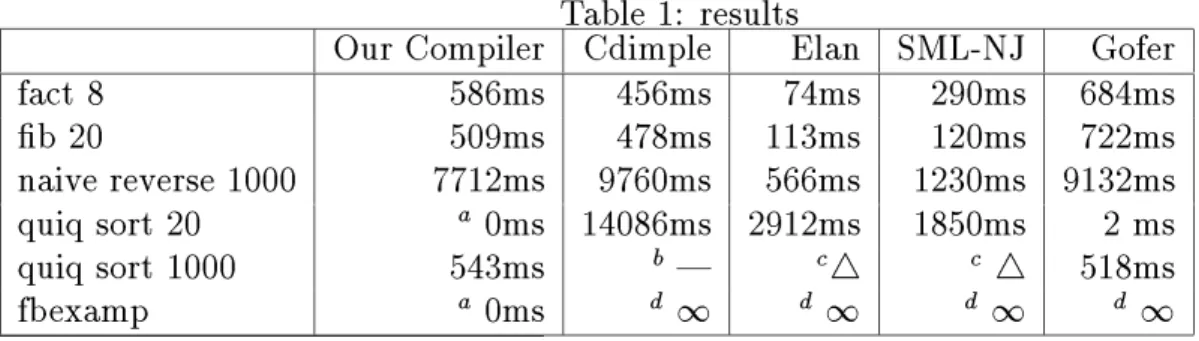
We compare our TRS-compilerwith other systems (Cdimple, Elan compiler, Sml-NJ
compiler, Gofercompiler).(See gure)
Cdimple, Elan compiler and Sml-NJ compiler adapt innermost reduction strategy.
Gofer is based on leftmost outermost strategy. For some TRS's (factorial, bonatch,
naive reverse), our compiler generates several times slower code than systems based on
innermost strategy. Our compiler pro ducea little fasterprogram thanGofer.
Forquicksort, our compilertakesmuchfasterthan Cdimple andElan, Sml-NJ.How-
ever,ours isalmost program that same speed as Gofer's. for the last TRS, the programs
generated byour compiler get the answer,while others, are not terminate.
Table 1: results
OurCompiler Cdimple Elan SML-NJ Gofer
fact 8 586ms 456ms 74ms 290ms 684ms
b20 509ms 478ms 113ms 120ms 722ms
naive reverse 1000 7712ms 9760ms 566ms 1230ms 9132ms
quiq sort 20
a
0ms 14086ms 2912ms 1850ms 2 ms
quiq sort 1000 543ms
b
|
c
4
c
4 518ms
fbexamp
a
0ms
d
1
d
1
d
1 d
1
a
0<1ms
b
memoryerror
c
longtime<1,terminate
d
nonterminate