Using profit information for production
management: evidence from Japanese factories
著者
Arai Kohei, Kitada Hirotsugu, Oura Keisuke
journal or
publication title
Journal of Accounting & Organizational Change
volume
9
number
4
page range
408-426
year
2013-10-28
権利
(c) Emerald Group Publishing Limited. This AAM
is provided for your own personal use only. It
may not be used for resale, reprinting,
systematic distribution, emailing, or for any
other commercial purpose without the
permission of the publisher.
URL
http://hdl.handle.net/10466/00017181
Using Profit Information for Production Management:
Evidence from Japanese Factories
Kohei Arai
Lecturer of AccountingKonan University Hirao School of Management, Japan 8-33, Takamatsu, Nishinomiya,
Hyogo 663-8204, Japan E-mail: arai @ center.konan-u.ac.jp
Phone: 81-798-63-5788
Hirotsugu Kitada
Ph.D. Candidate Kobe University, Japan 2-1, Rokkodai, Nada, Kobe,
Hyogo 657-8501, Japan
Keisuke Oura
Associate Professor of Accounting Shiga University, Japan
1-1-1, Banba, Hikone, Shiga 522-8522, Japan
Abstract
Purpose – This study investigates the relative weight of financial and non-financial
performance measures used to evaluate production managers (such as shop floor managers or foremen) in a modern manufacturing setting.
Design/methodology/approach – Using survey data from Japanese factories, we
examine the association between the choice of profit, cost, and non-financial performance measures with two characteristics of manufacturing systems: interdependence and multi-tasking.
Findings – The results indicate that interdependence has a significant and positive
association with the importance of profit information, while multi-tasking is associated negatively with the importance of profit information, and positively with non-financial information for performance evaluation.
Originality/value – In recent years, a significant shift has been observed in Japanese
production management with many companies now focusing on profit information instead of cost information. For example, past studies show that large Japanese manufacturing companies are now using micro-profit centres and include profit information when evaluating factories. However, little empirical evidence is available on performance measurement at the shop floor foreman level, and even less is known about the importance of profit information in the evaluation of these lower level managers.
Keywords Production management, Performance measurement, Foremen, Micro-profit
centers, Japan
Paper type Research paper
______________________________________________________________________ This paper is based partly on the Kohei Arai's Ph. D. thesis at Kobe University. We wish to thank Yutaka Kato (the guest editor of this issue), Tetsuo Kobayashi, Takeyuki Tani, Katsuhiko Kokubu, Hiroshi Miya, Takami Matsuo, Takehisa Kajiwara, Eisuke Yoshida, Shinji Horiguchi and seminar participants at Kobe University and the 2010 EAA conference in Istanbul, Turkey for beneficial comments on an early draft of this paper. The authors also thank Chris Akroyd’s (the guest editor of this issue) for his outstanding help and support and two anonymous reviewers for excellent and insightful comments. This article is dedicated to Professor Yutaka Kato on the occasion of his Kanreki celebration.
1. Introduction
The purpose of this study is to investigate the use of financial and non-financial performance measurements in a modern manufacturing setting. Determining suitable management accounting systems and practices within modern manufacturing settings has been the subject of recent research. To complement the existing literature we conduct a survey of performance measurement at the production management level (e.g. lower level shop floor managers which we call ‘foremen’ in this study) in a manufacturing setting.
Research on performance measurement in manufacturing settings has paid little attention to the informativeness view of performance management. Although many studies have employed an informativeness view to analyse performance measurement design in decentralized organizations (see for example, Bushman et al., 1995; Keating, 1997; Nagar, 2002; Abernethy et al., 2004; Bouwens and van Lent, 2007), no study that we are aware of has focused on foremen at the production manufacturing level. Moreover, there is little empirical evidence that shows how profit information is used to evaluate lower level managers such as foremen.
Cooper (1995) conceptualized the unique Japanese management practice of a micro-profit centre (MPC), in which lower level shop floor managers were evaluated and rewarded for their performance using profit information. In addition, recent studies have shown that MPC’s have been adopted by many Japanese manufacturing companies. For example, a survey by Kijima et al. (2006) study of Japanese manufacturing companies listed on the First Section of the Tokyo Stock Exchange showed that MPC’s have been adopted by 42.4% (39 of 92 companies surveyed). Similarly Yoshida et al.'s (2009) study of Japanese manufacturing companies listed on the First Section of the Tokyo Stock
Exchange showed that 40.4% (61 of 151 of companies surveyed) had adopted some form of MPC. These recent survey-based studies reported that a large portion of Japanese manufacturing companies have implemented MPC systems that allow them to evaluate performance based on profit. The adoption of MPC indicates that the original way of viewing factories as cost centres has been changing with many companies now treating them as profit centres. However, it is not clear what factors influence the shift from cost centre to profit centre, nor the choice of performance measurement at lower management levels.
This study tests the effect that manufacturing systems have on the choice of financial (profit or cost information) or non-financial performance measurements. Drawing from prior research, we focus on two characteristics of manufacturing systems: (i) interdependencies among production line processes, and (ii) multi-tasking. This enables management accounting research at the level of production management to use ‘traditional’ ideas of operational (or task) control (e.g. Anthony, 1965) which reflects modern production settings.
This research contributes to the performance management literature in three ways. First, the study provides empirical evidence on the use of profit information to evaluate and reward foremen in modern manufacturing settings, and on the relative weights of financial and non-financial information. Second, it analyses the influence of interdependencies and multi-tasking in manufacturing processes related to the use of financial information, especially profit, and non-financial information in order to evaluate the performance of foremen. Finally, the study investigates performance measure choices, including profit information, based on incentives.
The paper is structured as follows. Section two reviews previous literature on performance evaluation and MPCs, while section three develops the hypotheses to be tested based on predictions from the theory of incentives. Model and estimation procedures are described in section four, followed by the empirical results in section five, with conclusions presented in section six.
2. Literature review
2.1 Traditional performance measurement in production management
Research on performance measurement has provided empirical evidence at organizational and business unit levels (e.g. Bouwens and van Lent, 2007) and the worker level (e.g. Ittner et al., 2003). However, little evidence (for an exception, see van Veen-Dirks, 2010) is available on performance measurement at the production level. Moreover, most of the available research has not answered questions related to the influence of innovative operational management practices such as just-in-time production and total quality management on the design of performance measurement systems, especially at the level of production management.
A factory and its subunits are usually viewed as a production level cost centre, and management accounting practices there focus mainly on cost accounting and cost management. By considering the lower factory units as a cost centre, research on management accounting practices at the level of production management often solely focus on standard costing and budgetary control, as portrayed in the cybernetic model (Atkinson et al., 2007; Merchant and van der Stede, 2004).
Cost management at the factory level has been considered through financial measurement techniques, such as variance analysis. Traditionally, managers in production management have been evaluated and rewarded for managerial performance using cost information. However, these traditional cost based financial measures have been criticized as only partially reflecting the effect of current managerial activities (Johnson and Kaplan, 1988). Thus we review the research which examines the use of non-financial and profit based performance measurement.
2.2 Non-financial performance measurement in production management
For more than two decades, the role of management accounting and its techniques have been subject to many manufacturing changes. New manufacturing systems and forms of organization, including just-in-time (JIT) production, lean manufacturing, total quality management (TQM), theory of constraints (TOC) and supply chain management (SCM) have also changed the role of accounting (Chenhall and Langfield-Smith, 2007). However, these innovative changes in operational management are not considered in financial performance measurement research at the level of production management.
In response to these innovative changes research on non-financial performance measurement has increased. The studies that focus on performance measurement in manufacturing settings take into account non-financial performance measurement, such as time, quality, operating efficiency, in order to moderate the adverse effects of measuring performance using cost information (Banker et al., 1993; Bromwich and Bhimani, 1989; Chenhall, 1997; Foster and Horngren, 1988; Mia, 2000). The significant
diffusion of balanced scorecards (BSC) shows that an increasing number of companies are now focusing on non-financial information in performance measurement analysis.
From a modern production management viewpoint, innovative production management systems, such as JIT and TQM models of control, increase interdependencies among sequential subunits or processes in a factory, and the use of non-financial performance metrics has been shown to be preferable for managing these interdependencies (Young and Selto, 1993; Abernethy and Lillis, 1995; Perera et al., 1997).
In summary, to supplement financial measures, which are thought to less accurately reflect modern manufacturing practices, research indicates that using non-financial information to evaluate and reward managers will increase the effectiveness of performance measurement. Thus, an emphasis on non-financial information such as productivity, production quality, and lead time is said to be a means to control operations. For example, the ultimate aim of JIT production, whose philosophy drives customer-oriented production systems, is to eliminate waste by doing away with unnecessary inventory. JIT production systems thus respond flexibly to changes in customer demand, enabling manufacturing to match demand and prevent excess inventory and excess backlogs. To provide saleable quantities of high quality products on a timely basis, this type of production management system requires more interdependent factory processes; moreover, such inter-process dependency incentivizes manufacturing managers to use non-financial measures.
In addition to employing non-financial information to overcome production management limitations caused by cost information, some Japanese companies developed MPCs which are evaluated using profit information. Several case studies of Japanese companies who implemented MPCs have described the use of profit-based performance measurements in manufacturing settings (Hamada and Monden, 1989; Cooper, 1995; Tani and Miyawaki, 1996; Kaplan and Cooper, 1997; Miya, 1998; Tani and Miya, 1998; Ito, 1998; Yoshida and Matsugi, 2001; Sugamoto and Ito, 2003; Miya, 2003; Kubota et al., 2004; Hiki, 2007).
Before Cooper (1995) conceptualized the use of profit information to evaluate small units such as MPC, the Japanese literature (e.g. Hamada and Monden, 1989) had already described unique management practices in production management systems in Japanese factories. Hamada and Monden (1989) found that factories divided product line processes into small units composed of 3 to 50 members, with each unit having its own profit calculating system. In addition to organizational uniqueness, the accounting system also represented important aspects of a MPC. Instead of setting each factory process as a cost centre, which was responsible solely for production costs, the MPC enabled firms to recognize each process as a profit centre. Production lines established as MPCs were responsible for both their revenues and their costs. Cooper (1995) divides MPCs into two categories based on their accounting systems for recognizing profit: pseudo-MPCs and real MPCs. Real MPCs recognize profits by selling products or output (an intermediate product) to both internal and external customers. On the other hand, pseudo-MPCs only sell intermediate output to internal customers (Cooper, 1995).
The performance evaluation of MPC managers includes profit information. An example of this is Kyocera corp., which is one of the most famous companies to have adopted the MPC system in Japan, has been studied in depth by both academics and practitioners. Kyocera called this type of management system an ‘amoeba system’ and ‘added value per labour hour’ is used as a performance measurement (Miya, 1998; Monden, 2002). This measurement is simple and understandable for lower level workers in production management (Monden, 2002) because “each category of the accounting report indicates the impact on the bottom line, and because amoebas are small organizations, leaders can fully grasp the situation of their amoebas and point out the problems confronting them” (Miya, 1998, p.109).
Thus, the MPC provides benefits by motivating organizational members to earn more profit autonomously or to improve their profitability. MPCs also have the advantage of fostering the entrepreneurial spirit of the group leader, as if he/she were the president of the company, through the use of profit information as a performance measurement indicator. According to Miya (1998) motivational effects are an important part of MPC systems.
Using profit information to manage production in the factory is becoming more typical in Japanese manufacturing companies (Kijima et al., 2006; Yoshida et al., 2009). Empirical evidence suggests that many Japanese companies now use ‘profit’ information for production management in their factories.
In this section, we have examined performance measurement at the level of production management from three streams of research: traditional cost-based, non-financial and profit-based performance measurement in flexible production environments.
The use of accounting systems and information follows the changes in production management systems. JIT or TQM systems and BSC require us to pay more attention to non-financial performance measurements. On the other hand, recent research on MPCs and empirical data from Japanese companies indicates a tendency toward a greater use of financial (in particular, profit) information for measuring performance. Interestingly, MPCs and both JIT and TQM are similarly characterized through their propensity to create inter-process dependencies.
3. Theory development
From the literature review it can be seen that MPC field studies suggest that profit information can be used to evaluate shop floor foremen (Miya, 2003; Watanabe, 2004). In this section we first show why this cannot be explained by the controllability principle. Then, using Holmstrom’s (1979) informativeness principles we develop hypotheses for the choice of different performance measures for our two manufacturing characteristics (i) interdependencies among production line processes, and (ii) multi-tasking.
3.1 Controllability
The controllability principle states that an individual (the ‘foreman’ in this study) should be accountable only for what he or she can control. In other words, the principle suggests that a foreman should not be held accountable for performance that he or she cannot control (Simons, 2005). Recently, in management accounting research, the controllability principle has been discussed as a basic concept for designing performance measurement systems and has been examined using theoretical, positive, and field-based
research. In the 1950s and 1960s, the basic ideas of controllability were discussed within responsibility accounting, although the term ‘controllability principle’ was not used at that time. In this study, the controllability aspect of performance measurement at the level of production management is analysed; therefore, we review research on responsibility accounting.
Responsibility accounting is a management accounting system that charges costs to a business unit according to the responsibility of the manager. This kind of accounting system is based on a hierarchical organization where responsibility is delegated from top management to shop floor workers (Brown, 1947). In this type of organization, responsibility is equivalent to authority. Therefore, any costs charged to a foreman must be within his or her authority within the responsibility accounting system.
Responsibility accounting controls members of an organization through the budgeting and the standard costing processes (Ferrara, 1964). Therefore, controllability at the foreman level is often discussed when defining the responsibility of deviations from the standard in a process. In addition, responsibility accounting deals with controllable and uncontrollable elements that are only attributed to internal factors. External elements have not been considered in traditional responsibility accounting. This suggests that using profit information at the level of production management is inconsistent with the traditional controllability principle. Therefore, in the next section, using the informativeness principle, we investigate the factors that influence using profit information to control foreman at the shop floor level.
3.2 Informativeness
Based on Holmstrom’s (1979) informativeness principles prior performance measurement studies on decentralized organizations suggest that interdependencies and delegation influence the design of performance measurement systems (Bushman et al., 1995; Keating, 1997).
Interdependencies
In modern factories, manufacturing processes have become increasingly dependent on each other. An example is the Toyota Production System, where an incident during one process influences following processes throughout the manufacturing flow as a result of an interruption in the ANDON system (Monden, 2006). This example indicates that a shop floor’s specific metrics (i.e. costs, defect rate, etc.) are useful in capturing the influences on another shop floor’s performance as noise. From an informativeness view, the agency model suggests that the relative weighting of performance metrics depends on sensitivity and the noise captured (Lambert and Larcker, 1987; Banker and Datar, 1989; Abernethy et al., 2004; Bouwens and van Lent, 2007). These studies suggest that if one measure captures certain actions within the focal process and is influenced by another process, the foreman evaluated by this measure is motivated to cooperate and optimize to achieve kaizen (continuous improvement) between the processes.
At the level of production management, profit information is more likely to be influenced by the actions of other processes through intra-transfer than by cost information. In other words, evaluation using aggregated information, namely profit
information, is useful in the case of high interdependence between processes for motivating foremen to cooperate and coordinate, even if such information includes noise. On the other hand, evaluation and rewards for foremen through disaggregated metrics, namely detailed cost information, in the same situation may result in sub-optimization of each process, and could inhibit co-operation between processes. Some field-based studies support this view. For example, Kubota et al. (2004) show that the MPC is a management method that coordinates interdependencies, while Chenhall and Morris (1986) argue that high interdependency is associated with aggregate metrics. Therefore, we expect the following relationship between the use of profit information and interdependencies.
H1: The weighting of profit measures in the evaluation of shop floor foremen is positively associated with the degree of interdependency between processes.
We also investigate the relationship between interdependency and the relative weightings of financial and financial measures. Hirsh (1994) suggests that non-financial measures can demonstrate the best direction to take to achieve the goals and objects of companies instead of optimizing local measures, and Baiman and Baldenius (2006) indicate that non-financial measures can be signals for managers to act in a cooperative fashion. Based on these discussions, Bouwens and van Lent (2007) suggest that non-financial measures can reduce the noise in accounting measures, so the weighting of non-financial accounting measures is positively associated with the degree of interdependency. Therefore, we hypothesize as follows.
H2: The weighting of non-financial measures in the evaluation of a foreman on the shop floor is positively associated with the degree of interdependencies between processes.
Delegated multi-tasking
In modern manufacturing processes such as JIT production and TQM, a factory worker tends to be responsible for multiple tasks (Monden, 2006). It is difficult for modern manufacturing practices to work effectively if individual workers have single tasks. When a foreman is delegated multi-tasking duties, Feltham and Xie (1994) indicate that using additional measures to evaluate the foreman is efficient. This means that workers with multiple tasks in JIT and TQM can be evaluated not only by single measures (e.g. standard costs) but also by a variety of measures (e.g. quality or efficiency measures). Non-financial measures seem to be more suited than financial measures in a multi-task setting, because financial measures are often too aggregated to give specific understanding of the setting. Therefore, we expect a negative association between the weighting of profit measures and the degree of multi-tasking in the process, and a positive association between the weighting of non-financial measures and the degree of multi-tasking.
H3: The weighting of profit measures in the evaluation of a shop floor foreman is negatively associated with the degree of multi-tasking of in the process.
H4: The weighting of non-financial measures in the evaluation of a foreman on the shop floor is positively associated with the degree of multi-tasking of in the process.
4. Research design 4.1 Sample
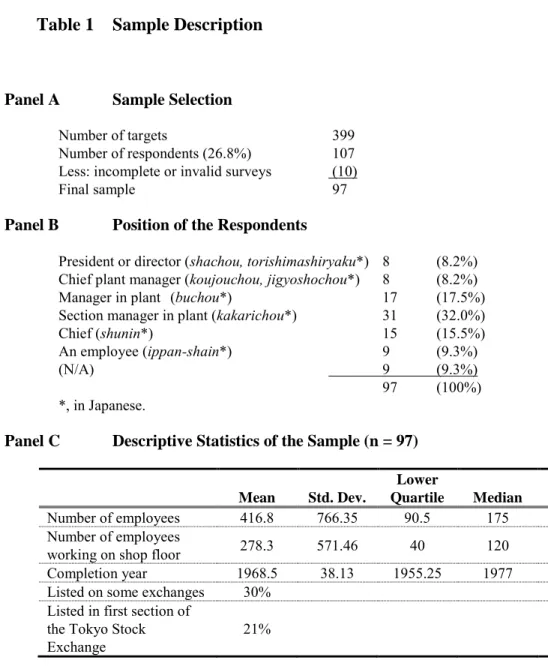
We randomly selected a sample of manufacturing factories listed in the ‘Koujou Gaido Nishi-Nihon I Kaitei Dai 2 Han’ (guidebook of factories in West Japan I, 2nd ed.) with the following conditions: factories had to be in the Hanshin manufacturing industrial area (this includes Kobe-city, Akashi-city, Ashiya-city, Nishinomiya-city and Amagasaki-city) and employ at least 100 employees. In 2008 we sent out questionnaires to 399 factories and received 107 responses giving us response rate of 26.8%. Ten unsuitable responses were eliminated (see Table 1, Panel A), and 97 completed surveys were utilized in the analysis. In most cases, the respondent was a middle manager (see Table 1, Panel B). Table 1, Panel C shows that 30% of the factories belonged to companies listed on a stock exchange and 21% of the factories belonged to companies listed in the first section of the Tokyo Stock Exchange.
While conducting the survey, we used the following three tools to improve the response rate. First, we enclosed a 500-yen book token with the questionnaire. Second, we sent both paper questionnaires and CD-ROMs that contained electronic questionnaires in Microsoft Excel. Respondent answers in Excel files were sent as attachments through e-mail. We received 66 hardcopies and 31 e-mails with an Excel file attached. Third, we
employed a follow-up procedure. Fifty-eight cases were received immediately, and 39 cases were received during follow-up after the initial mailing.
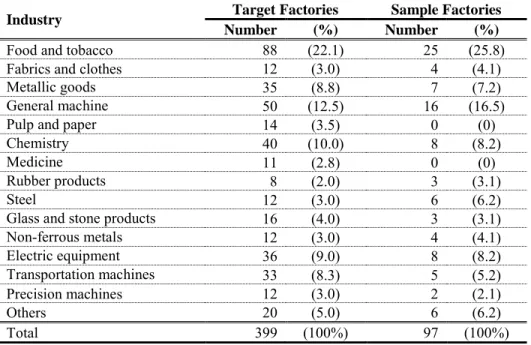
In terms of industry composition, a Chi-square test showed that the sample of respondent firms was not significantly different from the target population (see Table 2, Panel A). Similarly, we found no evidence of differences in size and completion year among cases that responded immediately and cases that responded after follow-up (see Table 2, Panel B). Thus, we assumed that there was no non-response bias.
4.2 Measures
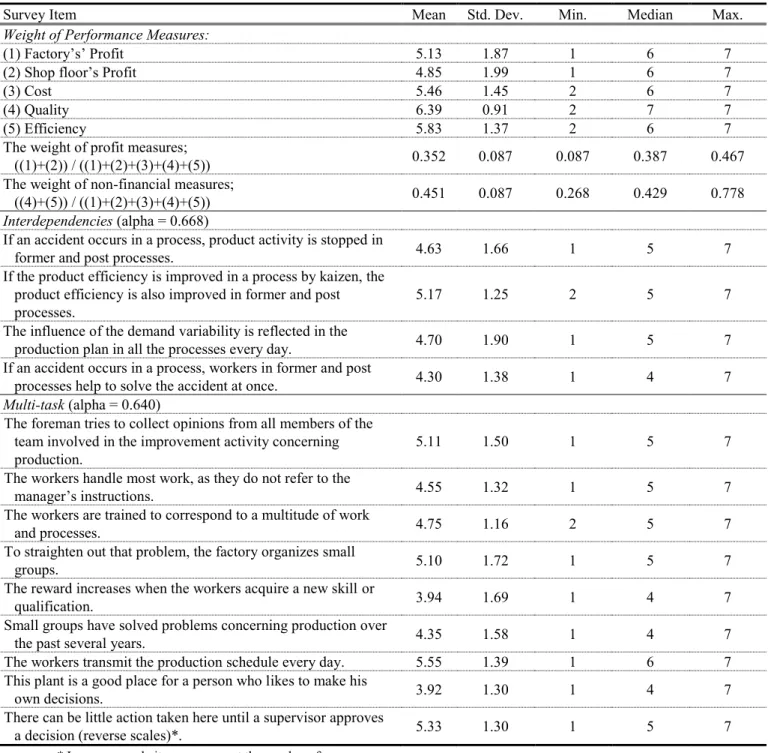
Table 3 contains descriptive statistics of the performance measures based on a seven-point Likert Scale.
Measurement of the weight of performance measures
We asked respondents to report the weight assigned to their foreman of a range of possible performance measures in the context of their performance evaluation. We used five different categories of performance measures on a seven-point Likert Scale: (1) factory profit, (2) shop floor profit, (3) cost, (4) quality, and (5) efficiency. We used the relative weight of (1) + (2) to the total value from (1) to (5) in our empirical tests of H1 and H3, and the relative weight of (4) + (5) to the total value in our empirical tests of H2 and H4.
Unlike Bouwens and van Lent (2007), we did not use actual weights when measuring these variables but rather used a Likert Scale. Although measurement using the actual rate is more difficult (Ittner and Larcker, 2001), we used the Likert Scale to
avoid a higher number of non-responses to our questions. In our pre-survey interviews, some interviewees suggested that evaluation is often implicit in the context of shop floor production management. Thus, if we had used actual rates, some respondents may not have answered.
Measurement of interdependencies
We obtained data on interdependencies by asking respondents about factory situations, namely: (i) the degree of inter-process effects of an accident, (ii) the degree of inter-process effects of kaizen, (iii) the degree of effects on a production plan of demand variability, and (iv) the degree of non-routine tasks between processes during an accident. We computed the interdependencies by summing and averaging the scores of the four items giving us a Cronbach’s alpha of 0.668.
Measurement of multi-tasking on the shop floor
Using Banker’s (1993) instrument to measure new manufacturing practices (JIT, teamwork, decentralization scale), we measured the degree of multi-tasking on the shop floor by asking respondents about their practices. Although Banker’s (1993) questions are designed to be answered by foremen, our questions are designed to be answered by other staff members (e.g. the controller at the plant) or by the plant manager. After omitting three items that decreased the Cronbach’s alpha, we computed the degree of multi-tasking constructed by summing and averaging the scores of the nine items giving us a Cronbach’s alpha of 0.640. We infer from "bandwidth-fidelity trade-off" (Cronbach and Gleser, 1965) that the Cronbach’s alpha is low. The concepts of "interdependencies" and
"multi-tasking" involve large bandwidths in this study's sample setting. Thus, we assume these measures are valid in this study.
Control variables
We control for the potentially confounding effects of size, listing on a stock exchange and labour intensity. Size is measured as the natural logarithm of the number of employees on a shop floor. The variable for being listed on a stock exchange is a dummy variable equal to 1 if a firm owning a factory is listed on a stock exchange and 0 otherwise. Labour intensity is calculated by the number of employees on the shop floor divided by total factory floor area.
4.3 Econometric issues
According to Nagar (2002), a simultaneity bias is generated if the multi-tasking variable is endogenous, like a delegation variable. Therefore, we test whether multi-tasking is an endogenous variable using Wooldridge’s test for endogeneity (Wooldridge, 2002, p. 118). We find no evidence that multi-tasking is an endogenous variable in each dependent variable (t-test on the error of the multi-tasking variable: dependent variable is (i) the weight of profit information, t = 0.15, p = 0.88, (ii) the weight of financial information, t = –0.94, p = 0.35) and consequently report OLS results.
5. Empirical results
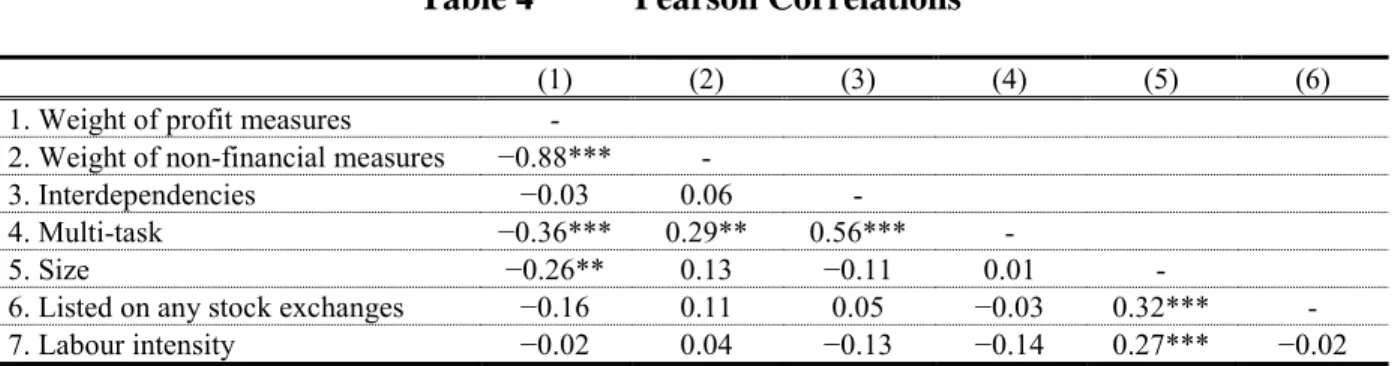
Table 4 reports the Pearson correlations among variables. We find that multi-tasking is strongly positively associated with the weight of profit measures, and
negatively associated with the weight of non-financial measures. In contrast, interdependency is not significantly associated with the weight of performance measures.
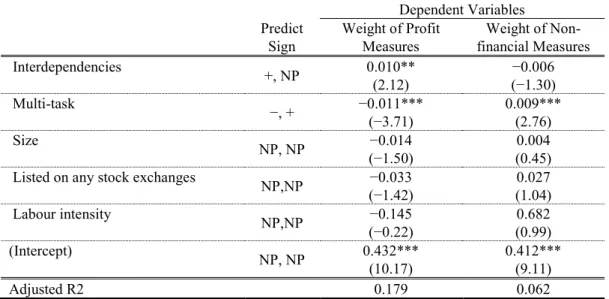
Table 5 presents the results of each of the dependent variables. H1 predicts that profit measures are used more when interdependencies increase. Table 5 shows that our evidence is consistent with this prediction (coefficient value = 0.0097, t = 2.12, p = 0.037). This finding is generally consistent with prior research such as Abernethy et al. (2004) and Bouwens and van Lent (2007) which focused on the divisional manager. This indicates that at the lower level of production management as well as at divisional level, aggregated information is likely to be used for encouraging foremen to take cooperative action in highly interdependent situations.
H2 predicts that the more interdependencies between manufacturing processes exist, the higher the use of non-financial measures. However, we found no significant relationship between non-financial measures and interdependencies, and this result was inconsistent with our expectation (coefficient value = –0.0064, t = –1.30, p = 0.198).
H3 predicts that the weight of profit measures is negatively associated with multi-tasking. We found strong evidence consistent with this hypothesis (coefficient value = – 0.011, t = –3.71, p < 0.001). In H4, we argued that non-financial measures receive more weight when multi-tasking is more important. Our evidence in Table 5 significantly supports this hypothesis (coefficient value = 0.0088, t = 2.76, p = 0.007). Consistent with H3 and H4, delegated multi-tasking significantly contributes to explaining the usage of performance metrics, namely increased variety of non-financial performance measures at the level of production management.
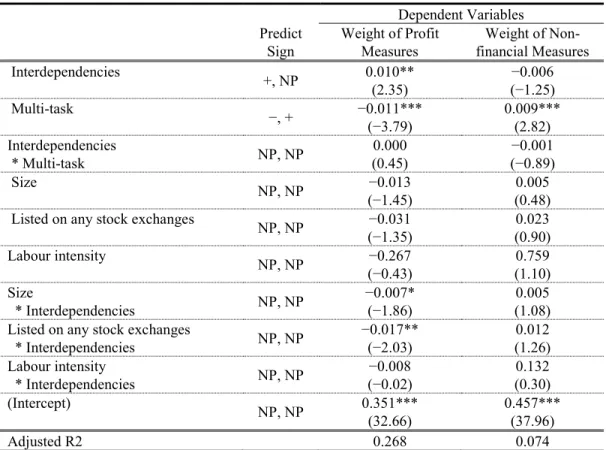
In relation to H2, we carried out additional OLS analysis, including interactive effects of interdependency and control variables. Table 6 presents the results of these analyses. Ultimately, we were not able to determine a significant sign of interdependency including these interactive effects. This insignificant effect of interdependency on the weight of non-financial measures could have two possible reasons.
First, this contradictory result shows the difference of the level of analysis. Bouwens and van Lent (2007) assert that non-financial performance measures are less affected by interdependencies across divisions than financial performance measures. This is why non-financial performance measures are more likely to be used in highly interdependent situations for evaluating divisional managers. In contrast, our result shows the possibility that even non-financial information used to evaluate a foreman contains noise when manufacturing processes are highly interdependent, while prior research (e.g. Bouwens and van Lent, 2007) asserts that non-financial information reduces the noise for evaluating divisional managers.
Second, just as Bushman et al. (1995) and Keating (1997) suggest, the use of aggregated measures to evaluate division managers increases with interdependencies between processes. Our empirical results indicate that use of profit measures is positively associated with the degree of interdependencies, even in production settings. The relative importance of non-financial measures might be diluted with the use of profit measures and may not strongly affect the choice of the weight of financial/non-financial measures.
6. Conclusions and implications
Though many Japanese companies have employed a MPC for defining their process, MPCs had been assumed to be cost centres, and antecedents to the adoption of MPCs were not explored in prior research. A key feature of a MPC is that foremen are evaluated based on profit information at the production level. Using Holmstrom’s (1979) informativeness view, we explored this issue in relation to the use of profit information in relation to interdependence and multi-tasking.
Our study setting was the production department of factories in Japan. Previous management control system studies were based on cost information at the product level. However, introducing an MPC system required profit information from the shop floor. Therefore, this study sought to develop a better understanding of the determinants of management control design. The evidence from Japanese factories presented here is generally consistent with our expectations.
This study has contributed to the MPC literature. Prior MPC literature contained mostly field studies that clarified the calculation and management mechanism (e.g. Cooper, 1995; Miya, 1998;Monden, 2002). Using a survey method, we find that MPC is a general, rather than special, management accounting system in Japanese factories where interdependency high and multi-tasking is low.
With this study we also contribute to the literature that examines the choice of the weights of financial and non-financial information. Prior research in this area, that used an informativeness view, targeted the divisional manager or middle manager (Bushman et al., 1995; Keating, 1997). Our additional analysis shows that the informativeness view is extendable even to the relationship between the plant manager and shop floor foremen.
Our results indicate that factories that evaluate shop floor foremen use profit information more intensively when interdependency is high and multi-tasking is low. This is consistent with earlier empirical work that investigates information choices through an informativeness view. Prior studies indicate that even if aggregated information captures noise and is influenced by interdependencies, using aggregated information, for example profit information, motivates and encourages a foreman to take cooperative action. This is actually applicable to the discussion of the MPC. Considering that MPCs are primarily cost centres foreman, evaluated by profit information, are responsible for many things that are beyond his/her span of control. In addition, an MPC that divides organizational units into smaller groups has an inherently highly interdependent nature. Moreover a factory that is divided into MPCs has an increased need to cooperate and coordinate their activities as this is an important aspect of internal control (Otley 2003). Our study offers theoretical reasons and empirical evidence on the consistency of performance measurement systems in the MPC.
Our study is subject to several limitations. Our empirical results are based on just a few respondents. Furthermore, our sample was based only on factories in the Hanshin area of Japan. While this is one of the largest industrial areas in Japan, there is still the possibility that a regional bias was an issue in our sample. The features of our setting potentially limit the ability to generalize our findings. Future research could investigate these generalizable characteristics in two ways. First, by testing the generalizability of our findings with empirical research based on a higher number of respondents would overcome the two biases of scarcity and regionality. Second, other variables could have been included in this research to control biases. Additional research could be conducted
to remove the bias by using variables employed in previous studies, such as information asymmetry.
References
Abernethy, M.A., Bouwens, J. and van Lent, R. (2004), “Determinants of control system design in divisionalized firms”, The Accounting Review, Vol. 79 No. 3, pp. 545-570. Abernethy, M.A. and Lillis, A.M. (1995), “The Impact of manufacturing flexibility on
management control system design”, Accounting, Organizations and Society, Vol. 20 No. 4, pp. 241-258.
Anthony, R.N. (1965), Planning and Control Systems: A Framework for Analysis, Harvard University Press, Boston, MA.
Atkinson, A.A., Kaplan, R.S., Matsumura, E.M. and Young, S.M. (2007), Management
Accounting 5th International Edition, Pearson Education, Upper Saddle River, NJ.
Banker, R.D. and Datar, S.M. (1989), “Sensitivity, precision, and linear aggregation of signals for performance evaluation”, Journal of Accounting Research, Vol. 27 No. 1, pp. 21-39.
Banker, R.D., Potter, G. and Schroeder, R.G. (1993), “Reporting manufacturing performance measures to workers: an empirical study”, Journal of Management
Accounting Research, Vol. 5 Fall, pp. 33-55.
Bromwich, M. and Bhimani, A. (1989), Management Accounting: Evolution not
Revolution, CIMA, London.
Bushman, R.M., Indjejikian, R.J. and Smith, A. (1995), “Aggregate performance measures in business unit manager compensation: the role of intra- firm
interdependencies”, Journal of Accounting Research, Vol. 33 Supplement, pp. 101-134.
Brown, A. (1947), Organization of Industry, Prentice-Hall, Inc., Englewood Cliffs, N.J. Chenhall, R.H. (1997), “Reliance on manufacturing performance measures, total quality
management and organizational performance”, Management Accounting Research, Vol. 8 No. 2, pp. 187-206.
Chenhall, R.H. and Langfield- Smith, K. (2007), “Multiple perspectives of performance measures”, European Management Journal, Vol. 25 No. 4, pp. 266-282.
Chenhall, R.H. and Morris, D. (1986), “The impact of structure, environment, and interdependence on the perceived usefulness of management accounting systems”,
The Accounting Review, Vol. 61 No. 1, pp. 16-35.
Cooper R. (1995), When Lean Enterprises Collide, Harvard Business School Press, Boston, MA.
Cronbach, L. J. and Gleser, G. (1965), Psychological Tests and Personnel Decisions, 2nd
ed., University of Illinois Press, Urbana, IL.
Cronbach, L. J. (1987), "Statistical tests for moderator variables: flaws in analyses recently proposed", Psychological Bulletin, Vol. 102 No. 3, pp. 414-417.
Feltham, G. and Xie, J. (1994), “Performance measure congruity and diversity in multi-task principal/agent relations”, The Accounting Review, Vol. 69 No. 3, pp. 429-453. Ferrara, W.L. (1964), “Responsibility accounting - a basic control concept”, N.A.A.
Foster, G. and Horngren, C. (1988), “Flexible Manufacturing systems: cost management and cost accounting implications”, Journal of Cost Management, Vol. 2 No. 3, pp.16-24.
Grice, G.W. and Harris, R. (1998), “A Comparison of regression and loading weights for the computation of factor scores”, Multivariable Behavioral Research, Vol. 33 No. 2, pp. 221-247.
Hamada, K. and Monden, Y. (1989), “Profit management at Kyocera Corporation: the amoeba system”, in Y. Monden and M.Sakurai (Eds.), Japanese Management
Accounting: A World Class Approach to Profit Management, Productivity Press,
Cambridge, MA, pp. 197-210.
Hiki F. (2007), Kanrikaikei no Shinka: Nihon Kigyo nimiru Shinka no Katei
(Investigating the evolution of management accounting in Japanese firms),
Chuokeizaisha, Tokyo.
Holmstrom, B. (1979), “Moral hazard and observability”, Bell Journal of Economics, Vol. 10 No 1, pp. 74-91.
Ito, K. (1998), “Giji purofitto senta nikansuru kosatsu” (Investigating pseudo micro-profit centres), Sangyokeiri (Industrial Management and Accounting), Vol. 33 No. 1, pp. 63-92.
Ittner, C.D. and Larcker, D.F. (1995), “Total quality management and the choice of information and reward systems”, Journal of Accounting Research, Vol. 33 Supplement, pp. 1-34.
Ittner, C.D. and Larcker, D.F. (2001), “Assessing empirical research in managerial accounting: a value-based management perspective”, Journal of Accounting and
Economics, Vol. 32 No. 1-3, pp. 349-410.
Johnson, H.T. and Kaplan, R.S. (1987), Relevance Lost: The Rise and Fall of
Management Accounting, Harvard Business School Press, Boston, MA.
Kajiwara T. (2008), Hinshitsu Kosuto no Kanrikaikei (Investigating quality cost
management in Japanese firms), Chuokeizaisha, Tokyo.
Kaplan, R.S. (1983), “Measuring manufacturing performance: a new challenge for
managerial accounting research”, The Accounting Review, Vol. 58 No. 4, pp. 686-705. Kaplan, R.S. and Cooper, R. (1997), Cost and Effect, Harvard Business School Press,
Boston, MA.
Keating, A.S. (1997), “Determinants of divisional performance evaluation practices”,
Journal of Accounting and Economics, Vol. 24 No. 3, pp. 243-273.
Kijima, Y., Sano, Y., Watanabe, T., Kawai, H., Narita, H., Sakurai, Y., Horiuchi, S., Tahiro, K., Manabe, N. and Kishida, T. (2006), Soshikibunka to Kanrikaikei
Shisutemu, (Investigating the relationship between management accounting and organization culture), Chuodaigaku Shuppanbu, Tokyo.
Kubota, Y., Shima, Y. and Yoshida, E. (2004), “Mini-purofitto senta no Sougoizonkankei heno Yakudachi (The impact of pseudo mini profit- centre implementation on interdependent relationships: findings from a longitudinal field study)”,
Genkakeisankenkyu (Journal of Cost Accounting Research), Vol. 28 No. 2, pp. 27-38.
Merchant, K. and van der Stede, W. (2007), Management Control Systems: Performance
Mia, L. (2000), “Just-in-Time manufacturing, management accounting systems and profitability”, Accounting, Organizations and Society, Vol. 30 No. 2, pp. 137-151. Miya, H. (1998), “Micro-profit center system for empowerment: a case study of the
amoeba system at the Kyocera Corporation”, Gakushuin Economic Papers, Vol. 35 No. 2, pp. 105-115.
Miya, H. (2003), Ameba Keieiron (Investigating “Amoeba” systems) Toyokeizaishinpousha, Tokyo.
Monden, Y. (2002), “The relationship between mini profit-center and JIT system”,
International Journal of Production Economics, Vol. 80 No. 2, pp.145-154.
Monden, Y. (2006), Toyota Purodakusyon Shisutemu: Sono Riron to Taikei (Investigating
the Toyota production system), Daiyamondosha, Tokyo.
Nagar, V. (2002), “Delegation and incentive compensation”, The Accounting Review, Vol. 77 No. 2, pp. 379-395.
Perera, S., Harrison, G. and Poole, M. (1997), “Customer-focused manufacturing strategy and the use of operations-based non-financial performance measures: a research note”, Accounting, Organizations and Society, Vol. 22 No. 6, pp. 557-572. Simons, R. (2005), Levers of Organization Design, Harvard Business School Press,
Boston, MA.
Sugamoto, E. and Ito, K. (2003), “Kukurino Chiisana Giji Purofitto Senta to Kanri Kaikei: Jireikenkyu, Sumitomo Denko gurupu no rain kanpanisei” (A case study of pseudo micro-profit centres, called “Line Companies”, in Sumitomo Electric
Industries, Ltd.), Sangyokeiri (Industrial Management and Accounting), Vol.62 No.4, pp. 42-61.
Tani, T. and Miyawaki, H. (1996), “Kaikei Jouhou niyoru Enpawamento” (Investigating empowerment through accounting information), Kigyoukaikei (Corporate
Accounting), Vol.48 No.12, pp. 17-23.
Turney, P.B. (1993), “Beyond TQM with workforce activity- based management”,
Management Accounting, September, pp. 28-31.
van Veen-Dirks, P. (2010), “Different uses of performance measures: the evaluation versus reward of production managers”, Accounting, Organizations and Society, Vol. 35 No. 2, pp. 141-164.
Yoshida, E. and Matsugi, S. (2001), “Giji purofitto senta no enpawamento: Sumitomo Denki Kogyo no kesu wo tujite” (A case study of pseudo micro-profit centres in Sumitomo Electric Industries, Ltd.: investigating empowerment through
management accounting information), Shoukeigakuso (The Journal of Business
Administration and Marketing Strategy), Vol. 43 No. 3, pp. 171-190.
Yoshida, E., Fukushima, K. and Senoo, T. (2009), “Nihon Kigyo niokeru Kanrikaikei (2): Seizougyou no Jittaichousa (Management accounting on Japanese firms: a
descriptive study)”, Kigyoukaikei (Corporate Accounting), Vol. 61 No. 10, pp. 134-140.
Young, S.M. and Selto, F.H. (1991), “New manufacturing practices and cost
management: a review of the literature and directions for future research”, Journal of
Accounting Literature, Vol. 10, pp. 265-298.
Young, S.M. and Selto, F.H. (1993), “Explaining cross-sectional workgroup performance differences in a JIT Facility: a critical appraisal of a field-based study”, Journal of
Watanabe, T. (2004), “Rain kanpanisei ga kanpanirida no naihatsutekidoukiduke ni oyobosukouka: Sumitomo Denko, Ltd. Gurupu ni okeru rain kanpanisei no jisshoteki kenkyu (The effects of the line company system on a leader’s intrinsic motivation: an empirical study on the line company system in Sumitomo Electric Industries Group)”, Genkakeisankenkyu (Journal of Cost Accounting Research), Vol. 28 No. 2, pp. 12-26.
Wooldridge, J.M. (2002), Introductory Econometrics 2nd Revised Edition, South-Western, Thomson Learning, Mason, OH.
Table 1 Sample Description
Panel A Sample Selection
Number of targets 399
Number of respondents (26.8%) 107 Less: incomplete or invalid surveys (10)
Final sample 97
Panel B Position of the Respondents
President or director (shachou, torishimashiryaku*) 8 (8.2%) Chief plant manager (koujouchou, jigyoshochou*) 8 (8.2%)
Manager in plant (buchou*) 17 (17.5%)
Section manager in plant (kakarichou*) 31 (32.0%)
Chief (shunin*) 15 (15.5%)
An employee (ippan-shain*) 9 (9.3%)
(N/A) 9 (9.3%)
97 (100%) *, in Japanese.
Panel C Descriptive Statistics of the Sample (n = 97)
Mean Std. Dev. Lower Quartile Median Upper Quartile Number of employees 416.8 766.35 90.5 175 335 Number of employees
working on shop floor 278.3 571.46 40 120 200
Completion year 1968.5 38.13 1955.25 1977 1990.5
Listed on some exchanges 30% Listed in first section of
the Tokyo Stock
Table 2 Non-response Bias
Panel A Industry Composition
Industry Target Factories Sample Factories
Number (%) Number (%)
Food and tobacco 88 (22.1) 25 (25.8)
Fabrics and clothes 12 (3.0) 4 (4.1)
Metallic goods 35 (8.8) 7 (7.2)
General machine 50 (12.5) 16 (16.5)
Pulp and paper 14 (3.5) 0 (0)
Chemistry 40 (10.0) 8 (8.2)
Medicine 11 (2.8) 0 (0)
Rubber products 8 (2.0) 3 (3.1)
Steel 12 (3.0) 6 (6.2)
Glass and stone products 16 (4.0) 3 (3.1)
Non-ferrous metals 12 (3.0) 4 (4.1) Electric equipment 36 (9.0) 8 (8.2) Transportation machines 33 (8.3) 5 (5.2) Precision machines 12 (3.0) 2 (2.1) Others 20 (5.0) 6 (6.2) Total 399 (100%) 97 (100%)
Chi-Square Test: χ2 = 19.911, Degrees of Freedom = 14, Pr > χ2 = 0.133
Panel B Differences Between Before/After Follow-up in Factories
Mean for Difference in Means t-Test (Pr > t) Wilcoxon Test (Pr > Z) Immediately Respondent Factories After Follow-up Factories Number of employees 470.55 333.89 136.66 0.336 0.934 Number of employees on shop floor 324.54 210.89 113.65 0.297 0.920 Completion year 1968.5 1968.5 –0.04 0.995 0.358
Table 3 Summary Statistics for Questionnaire Items Used to Construct Variables
Survey Item Mean Std. Dev. Min. Median Max.
Weight of Performance Measures:
(1) Factory’s’ Profit 5.13 1.87 1 6 7
(2) Shop floor’s Profit 4.85 1.99 1 6 7
(3) Cost 5.46 1.45 2 6 7
(4) Quality 6.39 0.91 2 7 7
(5) Efficiency 5.83 1.37 2 6 7
The weight of profit measures;
((1)+(2)) / ((1)+(2)+(3)+(4)+(5)) 0.352 0.087 0.087 0.387 0.467
The weight of non-financial measures;
((4)+(5)) / ((1)+(2)+(3)+(4)+(5)) 0.451 0.087 0.268 0.429 0.778
Interdependencies (alpha = 0.668)
If an accident occurs in a process, product activity is stopped in
former and post processes. 4.63 1.66 1 5 7
If the product efficiency is improved in a process by kaizen, the product efficiency is also improved in former and post
processes. 5.17 1.25 2 5 7
The influence of the demand variability is reflected in the
production plan in all the processes every day. 4.70 1.90 1 5 7
If an accident occurs in a process, workers in former and post
processes help to solve the accident at once. 4.30 1.38 1 4 7
Multi-task (alpha = 0.640)
The foreman tries to collect opinions from all members of the team involved in the improvement activity concerning
production. 5.11 1.50 1 5 7
The workers handle most work, as they do not refer to the
manager’s instructions. 4.55 1.32 1 5 7
The workers are trained to correspond to a multitude of work
and processes. 4.75 1.16 2 5 7
To straighten out that problem, the factory organizes small
groups. 5.10 1.72 1 5 7
The reward increases when the workers acquire a new skill or
qualification. 3.94 1.69 1 4 7
Small groups have solved problems concerning production over
the past several years. 4.35 1.58 1 4 7
The workers transmit the production schedule every day. 5.55 1.39 1 6 7 This plant is a good place for a person who likes to make his
own decisions. 3.92 1.30 1 4 7
There can be little action taken here until a supervisor approves
a decision (reverse scales)*. 5.33 1.30 1 5 7
Table 4 Pearson Correlations
(1) (2) (3) (4) (5) (6)
1. Weight of profit measures -
2. Weight of non-financial measures −0.88*** -
3. Interdependencies −0.03 0.06 -
4. Multi-task −0.36*** 0.29** 0.56*** -
5. Size −0.26** 0.13 −0.11 0.01 -
6. Listed on any stock exchanges −0.16 0.11 0.05 −0.03 0.32*** -
7. Labour intensity −0.02 0.04 −0.13 −0.14 0.27*** −0.02
Size is the natural logarithm of the number of employees on a shop floor. The variable for being listed on a stock exchange is a dummy variable equal to 1 if a firm owning the factory is listed on a stock exchange, and 0 otherwise. Labour intensity is calculated based on the number of employees on the shop floor divided by the total floor area of the factory.
Table 5 Results of Ordinary Least Squares Estimations (1)
Dependent Variables Predict
Sign Weight of Profit Measures financial Measures Weight of
Interdependencies +, NP 0.010** (2.12) (−1.30) −0.006 Multi-task −, + −0.011*** (−3.71) 0.009*** (2.76) Size NP, NP −0.014 (−1.50) (0.45) 0.004 Listed on any stock exchanges NP,NP −0.033
(−1.42) (1.04) 0.027 Labour intensity NP,NP −0.145 (−0.22) (0.99) 0.682 (Intercept) NP, NP 0.432*** (10.17) 0.412*** (9.11) Adjusted R2 0.179 0.062
Size is the natural logarithm of the number of employees on a shop floor. The variable for being listed on a stock exchange is a dummy variable equal to 1 if a firm owning the factory is listed on a stock exchange, and 0 otherwise. Labour intensity is calculated based on the number of employees on the shop floor divided by the total floor area of the factory.
Table 6 Results of Ordinary Least Squares Estimations (2)
Dependent Variables Predict
Sign Weight of Profit Measures financial Measures Weight of
Interdependencies +, NP 0.010** (2.35) (−1.25) −0.006 Multi-task −, + −0.011*** (−3.79) 0.009*** (2.82) Interdependencies * Multi-task NP, NP (0.45) 0.000 (−0.89) −0.001 Size NP, NP −0.013 (−1.45) (0.48) 0.005 Listed on any stock exchanges NP, NP −0.031
(−1.35) (0.90) 0.023
Labour intensity NP, NP −0.267
(−0.43) (1.10) 0.759 Size
* Interdependencies NP, NP −0.007* (−1.86) (1.08) 0.005 Listed on any stock exchanges
* Interdependencies NP, NP −0.017** (−2.03) (1.26) 0.012 Labour intensity * Interdependencies NP, NP (−0.02) −0.008 (0.30) 0.132 (Intercept) NP, NP 0.351*** (32.66) 0.457*** (37.96) Adjusted R2 0.268 0.074
Following the recommendation of Cronbach (1987), the independent variables were mean-centred to reduce their collinearity with their interaction terms. Maximum VIF for these models is 1.85.
Size is the natural logarithm of the number of employees on a shop floor. The variable for being listed on a stock exchange is a dummy variable equal to 1 if a firm owning the factory is listed on a stock exchange, and 0 otherwise. Labour intensity is calculated based on the number of employees on the shop floor divided by the total floor area of the factory.