Journal of t h e Operations Research Society of J a p a n
Vol. 43, No. 1, March 2000
A LINEAR TIME ALGORITHM FOR THE GENERALIZED STABLE SET PROBLEM ON TRIANGULATED BIDIRECTED GRAPHS
Daishin Nakamura Akihisa Tamura
University of Electro- Communications Kyoto University
(Received November 30, 1998; Revised May 19, 1999)
Abstract The generalized stable set problem is an extension of the maximum weight stable set problem for undirected graphs t o bidirected graphs. This paper shows that the problem on triangulated bidirected graphs is solvable in linear time. We also propose an exact branch and bound algorithm for the general problem by applying the linear time algorithm.
1. Introduction
In this paper we examine 0-1 integer programming problems with two variables per in- equality. Each non-redundant inequality of the integer program can be represented by one of the following forms:
Hence, the problem can be formulated as follows: for a given finite set V, sets P, N , I
2
V X V and a weight vector W ERV
(we denote the zth element of W by W;),[GSSP] maximize
wixi
subject t oxi
+
xj
<^
1
for (2, j) G P, &V- x i - x . <
3 - -1 for ( z , j ) G N ,xi
-xj
0 for (2, j ) I,xi
G {O, l} for i G V.Here we call this problem the generalized stable set problem (GSSP) because this is the maximum weight stable set problem (MWSSP) if N = I =
0.
The generalized set packing problem equivalent to the GSSP has also been studied in [2, 3, 71.To deal with the GSSP, a 'bidirected' graph is useful.
A
bidirected graph G = (V, E) has a set of vertices V and a set of edges E, in which each edge e E E has two vertices i , j G V as its endpoints and two associated signs (plus or minus) a t z and j . The edges are classified into three types: the(+,
+)-edges with two plus signs a t their endpoints, the(-,
-)-edges with two minus signs, and the(+,
-)-edges (and the(-,
+)-edges) with one plus and one minus sign. Undirected graphs may be interpreted as bidirected graphs wit h only (+, +)- edges. Given an instance of the GSSP, we obtain a bidirected graph by making (+, +)-edges, ( - -)-edges and (+, -)-edges for vertex-pairs of P, N and I respectively. Conversely, for a given bidirected graph with a weight vector on the vertices, by associating a variablexi
with each vertex z, we obtain the GSSP. We call a 0-1-vector satisfying the inequality system arising from a bidirected graph G , a solution of G, and also call a subset of verticesa solution of G , if its incidence vector is a solution of G . The GSSP is an optimization problem over the solutions of a bidirected graph.
It is well known t h a t the MWSSP is NP-hard for general undirected graphs, and hence, the GSSP is also NP-hard. However, for several classes of undirected graphs, e.g., for perfect graphs [6] and claw-free graphs [10], the MWSSP is polynomially solvable. Particularly it can be solved in linear-time for triangulated graphs [4, 51 by applying the lexicographic breadth- first search [12]. On the other hand, there are several polynomial-time transformations from the GSSP t o the MWSSP (see [13, 141). Since these transformations preserve perfectness, the GSSP on perfect bidirected graphs can be solved in polynomial time [14]. Unfortunately, these transformations preserve neither claw-freeness nor triangulated-ness. The authors [ll], however, proved that the GSSP on claw-free bidirected graphs is polynomially solvable.
In this paper, we propose a linear time algorithm for solving the GSSP on triangulated bidirected graphs. Moreover, by combining the linear time algorithm and the idea of Balas- Yu's algorithm [l] for the maximum weight clique problem, we will give an exact branch and bound algorithm for the GSSP.
2. Preliminaries
Since several distinct bidirected graphs may have the same set of solutions, it is convenient t o deal with some kind of 'standard' bidirected graph. A bidirected graph is said t o be
transitive, if whenever there are edges el = ( 2 , j ) and 6 2 = ( j , A;) with opposite signs a t j, then there is also an edge e3 = (i, k ) whose signs a t i and A; agree with those of el and 62. Obviously, any bidirected graph and its transitive closure have the same solutions. A bidirected graph is said t o be simple if it has no loops and if it has a t most one edge for each pair of distinct vertices. Johnson and Padberg [g] showed that any transitive bidirected graph can be determined t o have no solution or reduced t o a simple one without essentially changing the set of solutions. They proved that a transitive bidirected graph has no solution if and only if i t has a vertex with both a
(+,
+)-loop and a(-,
-)-loop. For any bidirected graph, the associated simple and transitive bidirected graph can be constructed in time polynomial in the number of vertices. Although this construction cannot be done in linear time, we assume that a bidirected graph of any instance of the GSSP is simple and transitive because, in the application of Section 6, our linear time algorithm is applied t o several triangulated subgraphs of a given instance of the GSSP, time after time.Let G = (V, E) be a simple and transitive bidirected graph and W be a weight vector on V. For a given subset U V, we define the reflection of G a t U by the transformation which reverses the signs of the U side of all edges incident to each U E U and we denote
it by
G:U.
(For example, for G2 in Figure 3 and U = {v2, vs}, G2:U is equal t o G' in Figure 2.)
Obviously, reflection preserves simplicity and transitivity. Let W: U denote the vector defined by (w:U), = -W, if i E U; otherwise (w:U), = W,. For two subsets X and Y of V, let X A Y denote the symmetric difference of X and Y.Lemma 2.1. Let
X
be any solution of G. Then, X / \ U is a solution of G:U. The GSSP for (G, W) is equivalent to the GSSP for (G:U, w:U).Proof. The first assertion is trivial from the definition of G:U. The second assertion follows from EiexAu(w:U). = S i e x v / wi
+
'&u\x(-w,) =xiEX
W. -Zieu
wà (the lastterm is a constant). I
D. Nakamura & A. Tamura
is called a biclzque of G if
( B l ) there is a n edge between any two vertices in C^ U C , and
(B2) for any edge e of the vertex-induced subgraph G[C+ U
C-]
of G byC+
UC-,
if an endpoint 2 of e is inC^
then e has a plus sign a t z ; otherwise e has a minussign a t i .
We call
C+
andC
the positive part and negative part of [C"',C ] ,
respectively. Any solution ofG
satisfies the following inequality which is called the biclzque inequality:associated with a biclique [C+, C ] . On the other hand, any edge of G corresponds to a biclique and any vertex i implies two bicliques
[{i},
01
and[0,
{ z } ] which are associated with inequalities xi<
1 and X,>
0, respectively. Hence, the GSSP can be formulated asmaximize
5"
W ~ X , subject to xi+
(l - xi)<
1 for [C', C - ] EB,
i<-V i€ %C-
xi â 10, l} for z C V,
where
B is the set of all bicliques of G. For perfect bidirected graphs which we will define
later, Sewell [l31 proved that the LP-relaxation of the above formulation has an integral optimal solution for any weight vector (Guenin [7], and Ikebe and Tamura [B] also proved equivalent statements, independently). The dual problem of the LP-relaxation of the above formulation isSince triangulated bidirected graphs are perfect as we will define later, the GSSP and the dual problem have the same optimal value. We call a feasible solution of the dual problem a
fractional biclique cover, or shortly, a biclzque cover. Our algorithm for the triangulated case finds a maximum weight solution and a minimum weight biclique cover having the same weight.
Here we represent a biclique cover by a set C including the bicliques of positive weights and a weight function y : C -+
X.
Let (C, y) be a biclique cover for an instance (G, W). For any fixed subset U V, let Cu = [C+^\Uc, C-/\Uc] and yu(Cu) = y(C) for each C = [C^,C-]
E C, and Cu = {Cu : C E C} where Uc = Un
(C+
U C-).Lemma 2.2. (Cu, yu) is a biclique cover for (G:U, w:U). T h e difference of weights between
(Cu, yu) and (C, y) is -
zcu
W^ a constant.Proof. Obviously, each Cu is a biclique for G:U. The assertions follow from
This lemma says that a minimum weight biclique cover for (G:U, w:U) can be obtained from a minimum weight biclique cover for (G, W), and vice versa.
Given a bidirected graph G , its underlying graph, denoted by
G,,
is defined as the undi- rected graph obtained from G by changing all the edges to(+,
+)-edges. A bidirected graph is said t o have a property P if it is simple and transitive and if its underlying graph has the property P. For example, a perfect (or claw-free or triangulated) bidirected graph is a simple and transitive bidirected graph whose underlying graph is perfect (or claw-free or triangulated). An undirected graph is called triangulated (or chordal) if it has no chordless cycle of length a t least four, t h a t is, every simple cycle of length a t least four has an edge joining non-consecutive vertices in the cycle. Since triangulated undirected graphs are per- fect, triangulated bidirected graphs are also perfect. It is known that an undirected graph G = (V, E) is triangulated if and only if there is a vertex-ordering TT :V
-+ {l,- ,
n} where n =\V\
such t h a t for each 2 E {l,,
n}, the set consisting of U = r l ( i ) and the vertices adjacent t o U in { r l ( i+
l ) ,,
TT1(n)} forms a clique, t h a t is, any two vertices of the set are adjacent (see, for instance, [12]). Such an ordering is called a perfect vertex elimination s c h e m e (PVES) and can be found in a linear time for any triangulated undirected graph [121.We say t h a t a vertex is positive (or negative) if all edges incident to it have plus (or minus) signs a t it, and that a vertex is mixed if it is neither positive nor negative. If a bidirected graph has no
(-,
-)-edge, it is said t o be pure. We note t h a t the negative part of any biclique of a pure bidirected graph has a t most one vertex. We call a bidirected graph canonical if it is simple, transitive and pure, and if it has no negative vertices. For any instance (G, W ) of the GSSP, we can transform it to a n equivalent one whose bidirected graph is canonical as follows. Johnson and Padberg [g] proved that if G is simple and transitive,G
has a t least one solution UC
V and that a solution can be found in O(lVl+1
E1)
time. From Lemma 2.1, G:U has the solution U N =0,
that is, G:U must be pure. Let W be the set of negative vertices of G:U. Then G:U:W has no negative vertex, and furthermore, it is pure because any edge (U, W ) of G:U with W G W must be a(+,
-)-edge. Since this transformation can be done in linear time, we assume that a given bidirected graph of the GSSP is canonical in the sequel.3. Transformations from GSSP to MWSSP
In this section, we briefly introduce transformations from the GSSP t o the MWSSP.
Given a simple and transitive bidirected graph
-
-
G
= (V, E ) and a weight vector W G R V , let us define the undirected graph6
= (V, E) and the weight vectorG
G R^ byD. Na kamura & A. Tamura
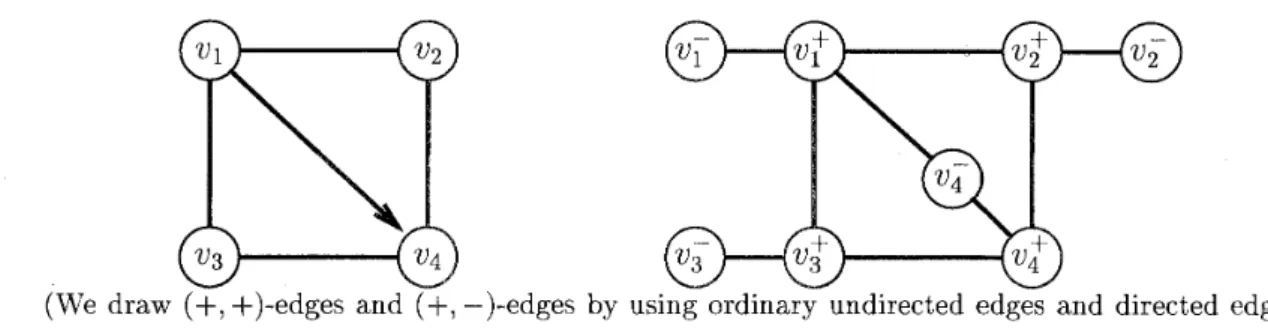
(We draw (+, +)-edges and (+, - edges,
respectively. The head of an arrow means a minus sign and the tail means a plus sign.) Figure 1: G is triangulated but
6
is not.E
= {(ia, ) ((a, p)-edge incident to 2 and j in G} U,
'
z
(
{
i-)1
i G V}, Gi+ = max{wi, O} (i G V) and G,- = max{-W,,O}
(i G V).It is known that if a maximum weight stable set S+ U S (S+
C
V+, SC
V ) is maximal with respect t o set-inclusion among all the stable sets ofG
then S^ is a maximum weight solution of G (see, [7, 151). That is, the GSSP for (G, W ) can be transformed t o the MWSSP for(G,
G). Other transformations proposed in [13, 141 are essentially equivalent to the above one since undirected graphs constructed by these are obtained from U.G' by deleting all zero-weight vertices for some U V. Since these transformations preserve perfectness [13, 14, 151, we can solve the GSSP in polynomial time on perfect bidirected graphs, rightfully on triangulated bidirected graphs, by applying the celebrated algorithm in [6]. Unfortunately, we cannot apply the linear time algorithm for the MWSSP on triangulated graphs in the above approach because all known transformations may not preserve triangulated-ness. For example, in Figure 1 the right-hand graph6
is not triangulated even though the left-hand graphG
is triangulated. If W>
0, then transformations in [13, 141 construct a chordlesscycle of length 4. Hence, it seems difficult t o develop a linear time algorithm for the GSSP on triangulated bidirected graphs by adopting the above approach.
4. A Linear Time Algorithm on Triangulated Bidirected Graphs
Let G = (V, E) be a canonical triangulated bidirected graph and W be a weight vector on V. A vertex-ordering TT : V -+ { l , . . .
,
n} is said to be topological if ~ ( u )<
~ ( v ) for each (-, +)-edge (U, v)-If TT is a PVES, in addition, then we call TT a topological PVES (T-PVES). Here we suppose t h a t we have already found a T-PVES TT for G. In this section, we consider how to
find a minimum weight biclique cover and a maximum weight solution of G by using TT. We will describe how to find a T-PVES in the next section.
We denote u e v if there is a (+, +)-edge (U, v), and U ~ or v& V if there is a (+, -)-
edge ( U , v). For a T-PVES TT and a vertex U , we define
N,(v)
gf
{U 6 V1
TT(V)<
TT(U), U is adjacent to U}, N A v ) %if {U G N,(v)1
v z u } andN-(v)
ef
{ue
N,(v)G}.
Note that any two distinct vertices in N ( v ) are adjacent to each other since TT is a PVES,
and N,(v) = Nf (v) U N; (v) because TT is topological and G has no (-, -)-edges. We define
C;(v)
gf
{ v } U {U G N^{v)I
there is no vertext
G N A v ) with uL-t}.From the definitions, both [ C ^ ( v ) ,
01
and [C;(v)\
{ v } , { v } ] are bicliques.Lemma 4.1. For any vertex U G N f ( v ) \ C m , there uniquely exists
t
6 C}[v)\
{ v } suchthat uct. For any vertex U N; ( v )
\
C;
( v ) , there uniquely existst
G C;(v)
\
{ v } such that u k t .Proof. For U G Nf ( v )
\
C f ( v ) , lett
G N:(v) be the smallest vertex in the order TT such that ubt. Suppose to the contrary thatt
G N f ( v )\
C $ ( v ) . There is a vertexs G N f f v ) such t h a t t k - s by the definition of C $ ( v ) . Since v is topological and
G
is transitive, v ( s )<
v ( t ) anduL-S,
a contradiction. Thereforet
G C f ( v )\
{v}.
For any vertex r in C a v )\
{ v ,t } ,
r v t holds, and hence, r*u by the transitivity. Thus such a vertex is unique. Similarly we can prove the statement for U G N ( v )\
C ( v ) .W
We will assign values to bicliques [ C a v ) ,
01
and [C;(v)\
{ v } , { v } ] by Procedure I below so that they form a biclique cover for(G,
W ) . After Procedure I , Procedure I1 constructsa solution of
(G,
W ) . These are extensions of the algorithm for finding a minimum clique cover and a maximum stable set for triangulated undirected graphs [4, 51.[Procedure I]
& = W ;
C : = @ ;
X : = @ ;for
i
:= 1 to n do beginV := TT-l
( i ) ;
if i&
>
0 then begin-
~ ( [ C f ( v ) ,01)
:=wv; C:=C U { [ C + ( v ) , 0 ] } ; for 'du G C f ( v )\
{ v } do Wu.-
W .- WU - W",; X : = X u { v } ;end else begin
y([C;(v)
\
{ v } , { v } ] ) := - wv;C
:=C U {[C.(v)\
{ v } , { v } ] } ;for 'du G C ; ( v )
\
{ v } do W u :=Wu+
I&,;
end if end for [Procedure 111
for
i
:= n downto 1 do beginv := v-1
(4;
if W v
>
0 then beginfor 'du E C D )
\
{ v } do W u :=Wy
+
W v ;if X
n
( C m\
{ v } )#
0
then X : = X\
{ v } ;end else begin
for V u G C;(v)
\
{ v } do Wu--
wu-
- w V ;if X
n
(C;(v)\
{ v } )#
0
then X : = X U { v } ;end if end for
168 D. Nakamura & A. Tam ura
After executing Procedure I, (C, y ) is a biclique cover. Its weight &z\c+,c-lec(l- \ C 1)-y(C)
is the sum of all values y ( [ C f ( v ) ,
g ] ) ,
because [C;(v)\
{ v } , { v } ] has exactly one vertex in its negative part and none of the values y([C;(v)\
{ v } , { v } ] ) are concerned. Hence the weight of ( C , y ) is equal tozcx
6.7,. On the other hand, X may not be a solution of G . Procedure II modifies X so that it forms a solution.emma 4.2. T h e following claims hold at the end of each iteration i n Procedure II. T h e value W i is preserved, i.e. i t
is
equal t o the weight of( C ,
y).X
n
V ,
i s a solution o n the subgraph G[V,] induced by V,, where V , g { u\
7 r 1 ( u )2
i } .induction on i. The claims hold for i = n. Suppose that the claims hold 1 with
i
<^
n - 1. Let v = T T ' ( z ) . We consider the case that G,,>
0. If,.,
\X
n
(C'+ (v )\
{ v } )1
= 0 , thenEiex
W i is preserved. If IXn
(C: ( v )\
{ v } )1
= 1, thenxiex
W ,reserved since v is deleted from X but Wy is added to Gu, where X (Cf ( v )
\
{ v } ) = therwise lett
and U be distinct vertices in Xn
( c ( v )\
{ v } ) . Then t v u andn
V;+i. This contradicts the second claim for i+
1. The case wv<:
0 can be proved similarly. Thus the first claim holds for z . The second claim does not hold fori
only in the following four possible cases:(Case 1)
G,,
>
0 ,X
n
(C+(v)\
{ v } )#
0
and Xn
N;(v)#
0.
(Case 2)
6&
>
0, X f l ( Q ( v )\
{ v } ) =0
and X f~ N $ ( v )#
9.
(Case 3) W y
5
0 , X (C;(v)\
{ v } )#
0
and Xn
N${v)#
0.(Case 4 ) G,
5
0, Xn
(C;
( v )\
{ v } ) =0
and Xn
N; ( v )#
0.
In Case 1, let X be any element in X
n
N;(v). Then by the transitivity of G, x e y for ally E C f i v ) \ { v } . This means that X ft (C'+(v)\{v}) =
0,
thus Case 1 does not occur. In Case 2, let U be any element in ( X ft N: ( v ) )\
C'+ ( v ) . Then there exists a vertext
E C: ( v )\
{ v }such that u k t by Lemma 4.1. This means that t E
X,
and thus Case 2 does not occur. Similarly neither Case 3 nor Case 4 occurs. Hence the second claim holds for i. Iemma 4.3. Given a l'-PVES for ( G , W ) , a m i n i m u m weight biclique cover and a maxi-
mum weight solution can be found i n linear time.
Proof. At the end of Procedure 11, X is a solution and G& is equal t o the weight of the biclique cover
(C,
y) by Lemma 4.2. Moreover, a t this point, W = G. Hence( C ,
y ) is a minimum weight biclique cover and X is a maximum weight solution for (G, W ) .We now consider the time complexity. We assume t h a t N*) and N;(v) are sorted in the order TT for each vertex v. This can be done in linear time by re-constructing adjacency
lists. Let us show that (?'+(v) and C;(v) can be found for a given v in time proportional to
1
N ( v )1 ,
and this completes the proof.From Lemma 4.1, we can easily show that N f ( v )
\
C f ( v ) =Uuec+!v)
N; ( U ) and thatN
( t )
fl N ( U ) =0
for any distinct vertices t , U E C: ( v ) . Thus the following procedurefinds C $ ( v ) in time proportional to
1
N:(v)1.
C := { v } U N $ ( v ) ;comment N:(v) = { ~ i , - - 1 u l N f ( v ) l } , ~ ( u i )
<
+ a<
~ ( u l N ~ ( v ) l ) ;for i : = l to lN'+(v)l do if U , E C then C : = C
\
N;(ui); comment C = C m ;Analogously, C ( v ) can be found in O(1 N; ( v )
1 )
time.I
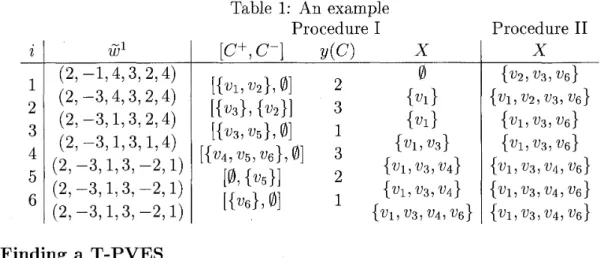
Example 4.4. Let us consider a triangulated bidirected graph G1 in Figure 2. The vertex order TT defined by ~ ( v , ) = z ( z = 1 ; - - , 6 ) is a T-PVES for G'. Let wl = ( 2 , - 1 , 4 , 3 , 2 , 4 ) be a given weight vector on { v i ,-
,
ve}. Procedures I and I1 find a biclique cover and aFigure 2: A triangulated bidirected graph G'.
solution as Table 1. The biclique cover selected by Procedure I and the solution {vf13? u6} constructed by Procedure I1 have the same weight 7.
Table 1: An example Procedure I
[C+7C-l Y(C) X
5 . Finding a T-PVES
For a vertex v in a canonical triangulated bidirected graph G, we call v bad if there exist distinct vertices a and b such that a k v . b k v , and a is not adjacent to b. Clearly, G has no T-PVES if G has a bad vertex.
We first consider the case that G has no bad vertex. At the last of this section we will examine the case that
G
has bad vertices.First of all, let us review the lexicographic breadth-first search (LEX-BFS) [l21 to find a PVES K for a given triangulated undirected graph.
Initially all vertices are unnumbered. During an execution of LEX-BFS, for each un- numbered vertex X , the label L(x) of X is the set of numbered vertices which are adjacent to X. The lexicographic order of labels is defined by
At the ?-th step (i = 1 , . . .
, n ) , LEX-BFS selects an unnumbered vertex v which has the
largest label in the lexicographic order, and let K ( U ) = n -i
+
1. It can be proved that this algorithm finds a PVES K correctly.A special data-structure is used to find a PVES in linear time. Unnumbered vertices are partitioned into sets C = { S o 7 . . . S,+}. Here each Sj is the non-empty set of unnumbered vertices having the same label, and C is a doubly-linked list sorted in the lexicographic order. The set So is the set of unnumbered vertices having the largest label. At the z-th step LEX-BFS extracts a vertex v E So, lets ~ ( u ) = n -
i
+
1, and modifies the structure C. The algorithm is described as follows.1 70 D. N a k a m ura & A. T a m ura
[Lexicographic breadth-first search (LEX-BFS)] ^ : = { V ; (*l)
for z := n downto 1 do begin
comment
So
means the set a t the head of v := any element ofSo;
(*2)~ ( v ) := i ;
So
+-So
\
{v}; if So =0
then delete So from C;M:=^
for each unnumbered vertex U that is adjacent t o v (*3) do begin
comment S[u] means the set in
C
which contains U;if S[u]
M
then begininsert {U} into C just before S[u] ;
M
:=M
U {S[u]}; end else begincomment
S[u]
means the set in C just before S[u]; S[u] := S [ u ] U {U};(*4)
end if
S[u] := S[u]
\
{U}; if S[u] =0
then delete S[u] from C; end forend for
Now we return to our discussion. LEX-BFS finds a PVES in linear time for a triangulated bidirected graph, but this may not be a T-PVES. Hence we slightly modify LEX-BFS t o find a T-PVES in the case that G has no bad vertex.
Before an execution of LEX-BFS, find a topological order r : V Ñ> { l , . . .
,
n} so thatr ( u )
<
r ( v ) for any &. Since G is simple and transitive, there is no directed cycle consisting of(+,
-)-edges. Hence such a topological order always exists. Next sort adjacency lists in the order r for each vertex. This can be done in linear time by re-constructing adjacency lists.At ( * l ) , represent V by a doubly-linked linear list sorted in the order r . At (*2), select the vertex v from
So
t h a t is the largest in the order r , i.e., select the tail vertex v from the doubly-linked linear list representing So. At (*3), select unnumbered vertices that are adjacent to v in the order r , i.e., in the order of the adjacency list of v . At (*4), insert u att the tail of the doubly-linked linear list representing S[u]. Note t h a t U is the largest in S[u] in the order r from the modification a t (*3). During an execution of LEX-BFS, each setS
in C is sorted in the order r .
Lemma 5.1. T h e modified version of L E X - B F S finds a T - P V E S in linear t i m e if there is n o bad vertex.
Proof. Let us consider the time when v is selected a t (*2) in the modified version.
Suppose t o the contrary that there is an unnumbered vertex U such that u%v. Because r
is topological, r ( u )
>
r ( v ) . This means t h a t USo,
since v is the largest vertex in So in the order r. Hence u has a smaller label than that of v l becauseSo
is the set of unnumbered vertices having the largest label.Let X be a vertex that is adjacent to v but X
#
U. If vL+x, then u e x from the transitivity. Similarly if v ^ x , then u k x . Otherwise, v e x , then U is adjacent t o xthe set of numbered vertices which are adjacent t o v, i.e., the label of
u
is not smaller thanthe label of v, a contradiction.
I
We finally deal with the case t h a t G has bad vertices. We will show that bad vertices can be converted into non-bad vertices by reflection.
Lemma 5.2. Let B be the set of all the bad vertices of a canonical triangulated bidirected graph G . Then G : B is a canonical triangulated bidirected graph having no bad vertex. Proof. Let v be a vertex. If v is not bad in G , then it is not bad in G : B because
G
has no
(-,
-)-edge. Then let v be a bad vertex in G , and a and b be distinct vertices such t h a t a*v, b k v , and a is not adjacent to b. Assume t h a t there are distinct vertices c and d such that (c^v or c*v), ( d e v or d d v ) , and c is not adjacent to d. From the transitivity of G , {a, b, c, d} induces a chordless cycle of length 4. This contradicts the fact that G is triangulated. Therefore G : B has no bad vertex.If v c u for some u in G then a k u and bku from the transitivity, thus u is also bad. Suppose t h a t v v t for some t. Then a ^ t and b% from the transitivity. In this case t is not bad, since otherwise there exists a chordless cycle of length 4 by the same discussion above. Therefore G : B has no (-, -)-edge. Hence G : B is canonical.
I
Next we consider how to find the set of all the bad vertices B in linear time. Let TT : V -+ { l , . . .
,
n } be a PVES of G. This can be found in linear time by LEX-BFS. For a vertex v, let us define N-(V)%~{X\
X+^-v}. If IN-(v)\<
1, them; is not bad. If IN-(v11>
2. let X be the smallest vertex in N ( v ) in the order TT. Then v is bad if and only if there exists a vertex y E N ( v )\
{X} such t h a t X is not adjacent to y, since TT is a PVES. To check whether X is adjacent t o y or not in constant time, we use the following procedure because we do not have the adjacency matrix.[Bad-Vertices]
for Vx
e
V do S ( x ) : = 0 ; for Vv E V do beginif IN-(v}\
>
2 then beginX := the smallest vertex of N ( v ) in the order TT; for Vy G N-(v)
\
{X} do S ( x ) := S ( x ) U {(y, v)}; comment If X is not adjacent t o y, then v is bad;end if end for
B :=0; for Vv E V do a[v] : = 0 ; for Vx E V do begin
for each y that is adjacent to X do a[y] := 1;
for each (y, v) 6 S(x) do if a[y] = 0 then B : = B U {v}; for each y that is adjacent t o X do a[y] :=0;
end for
Theorem 5.3. For a given canonical triangulated bidirected graph G and any weight vector W on the vertices, a minimum weight biclique cover and a maximum weight solution can be found in linear time.
Proof. First find t h e set of all the bad vertices B by the procedure above. Next find a T-PVES of G :B, see Lemmas 5.1 and 5.2. Then find a minimum weight biclique cover and
D. N a k a m ura & A. Tarn ura
Figure 3: A triangulated bidirected graph G 2
a maximum weight solution for ( G : B , W : B ) , see Lemma 4.3. Finally convert them into a minimum weight biclique cover and a maximum weight solution for (G, W), see Lemmas 2.1 and 2.2. All the procedures can be done in linear time. I Example 5.4. Let us consider a triangulated bidirected graph G2 in Figure 3. The vertex order TT defined by TT(^) = i (i = 1, +
- . ,
6) is a PVES for G 2 , but not a T-PVES. Theprocedure Bad-Vertices verifies t h a t B = {vh vs} is the set of bad vertices of G2. Then, the bidirected graph G2:I3 has a T-PVES, e.g., TT. We note that G 2 : B is equivalent to G' in Example 4.4. Let w2 = (2,1, - 4 , 3 , 2 , 4 ) be a given weight vector on the vertices {vl, m
,
u6}of G2. As in Example 4.4, we obtain an optimal biclique cover and an optimal solution:
for (G1, W') = (G2:Bl w2:B). From Lemmas 2.1 and 2.2, we can easily construct an optimal biclique cover and an optimal solution for (G2, w2) as follows:
These have the same weight 4.
6. An Application: An Exact Algorithm for the GSSP
In this section, we extend the branch and bound algorithm of Balas and Yu [l] for the maximum clique problem to the GSSP.
1. Given an instance ( G = (V, E), W ) of the GSSP, find a maximal triangulated induced subgraph G[T] of G by using the linear time algorithm proposed in [l] which uses a lexicographic breadth-first search described in [12].
2. By using our algorithm, find a maximum weight solution X and a minimum weight biclique cover (C, y) in G [T] .
3. Let Y = {v E V
\
X\
there is X E X withXL-!)}.
Then X U Y is a solution of G because of the transitivity. If there is a vertex i Y such that W,>
0 and X U Y U{g
is a solution of G , add i to V ; and repeat this while such a vertex exists.4. Partition Y into two parts Y> =
{z
E Y\
W,>
O} and Y< = {i E Y\
wi<
O}. For each i E Y>, add [{i},01
to C and y ([{i},01)
= wj. Then (C, y) is a biclique cover of G[T U Y>]. - Since X U Y> - and (C, y) have the same weight, they are a maximum weightFigure 4: A bidirected graph G3.
5. For each biclique
[C+,
C-]
G C, if there is a vertex i such that [C^ U {i},C ]
is a biclique of G then replace [C+,C-]
by [C+ U {i},C-]
and y([C+
U {i}, C-]) = y([C+,C-])
;and repeat this extension while such a vertex exists. Let U = {i E V
\
(T U V>)1
d(i) = Y,c+^y{C) - Ec-^(C) - wi>, O}. For each i E U, add[@,{a
toC
and g([@, {t}]) = d(i). Then (C, y) is a biclique cover of G[T U Y> - U U]. Furthermore, X U Y> is a maximum weight solution of G[T U Y> - U U], because they have the same weight.6. For disjoint subsets I = {?l,
- ,
G}
and 0 = {oi,,
om} of V, let (G, W; I, 0 ) denote the problem of finding a maximum weight solution subject t o I X and Xn
0
=0.
Obviously, we can find a maximum weight solution of (G, W ) by solving (t+rn+l) sub- problems: (G, w;
0,
{&}),(G,
w; {il}, {22}),-
*.,
(G, w; {?l,-
.
-
,
^-l},{$),
(G, W ; I U{oi},
@),
(G, W; J U{Q},
{oi}),.
.,
(G, W ;J u
{om}, {oi,. om-l}) and (G, W ; J , O ) . If I =Y<
\ U and0
= V \ ( T U Y U U),X
U Y is an optimal solution for (G, W; I,0).
Hence we can find an optimal solution for (G, W) by solving another (!+m) subproblems by recursively using the above steps.T h e merit of the branch and bound algorithm is that Steps from 1 through 5 can be executed very fast. In order t o decrease the number of subproblems in Step 6, Steps 3, 4 and 5 extend a current solution and biclique cover. We remark that several subproblems in Step 6 may have no solution. For solving each (G, W , I,
O ) ,
we should reduce the problem by deleting vertices i whosexi
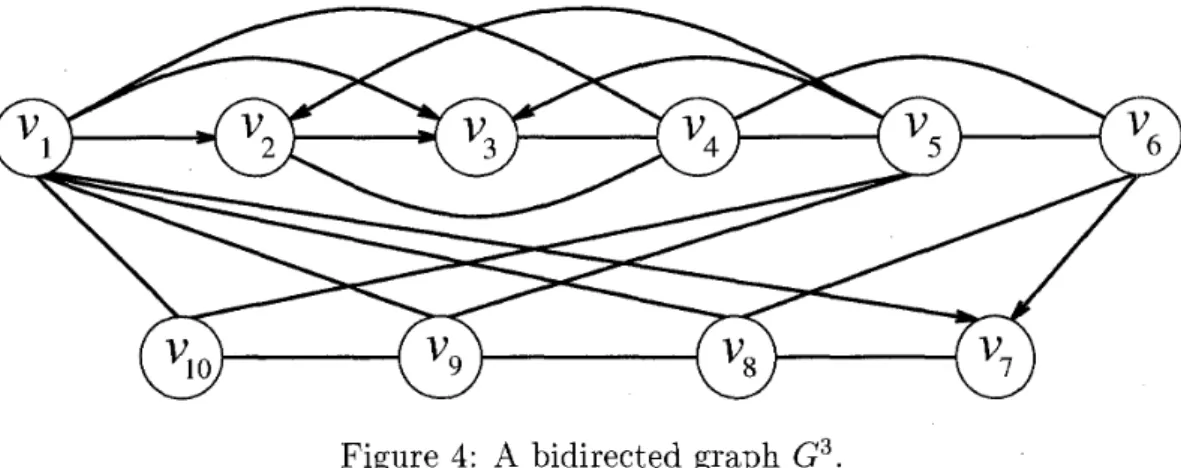
is fixed t o 0 or 1.Example 6.1. Let us consider a bidirected graph G3 in Figure 4. Suppose that w3 =
2 , 1 , - 4 , 3 , 2 , 4 , -5,3,2,1) describes weights on the vertices {vl,
,
vlo} of G3.1. Since G3 is not triangulated, we must find a maximal triangulated subgraph of G3. Here we assume t h a t G3 [T] with = {vl, ~ 2 , 7 1 3 , ~ 4 , 7 1 5 , vQ} is found.
2. Since (G3 [T]
,
W;) is equivalent to the instance (G2, w2) in Example 5.4, we obtain the following biclique cover C and solution X:3. Vertex v7 is induced by VQ. In addition, vg of weight 2 can be added t o the current
174 D. Nakamura & A. T a m ura
4. Add [{vg},
01
toC
and y([{vg},01)
= 2.5. We can extend two bicliques [{v6},
01
and [{vg},01
t o [{VG, vs},01
and [{US, v9},
01. Thenv s } can be covered by such bicliques, and hence
V
= {vs}.6. X U Y = {v6, v7, vg} is an optimal solution of weight 1 for (G3, w3; I={v7}, 0={vM}). It is enough t o solve two subproblems (G3, w3;
0,
{v7}) and (G3, w3; {v7, v& 0). In the first case, we can reduce G3 to G3 [{v2, v3, U ^ , u 5 , V S ) V ~ , uIo}] becausexv,,
xv6 must be 0. Since the bidirected graph is triangulated, in the same way as above, we obtain an optimal solution {v4, v g 7 vlO} of weight7.
In the second case, we can reduce G3 to G3 [{v2 vs, v4, v6}], and obtain an optimal solution {v6, v7, vlo} of weight 0. Hence {v4, V8, vlO) is an optimal solution for(R
w3).Acknowledgements
The authors wish t o thank referees for their helpful comments. References
E. Balas and C. S. Yu: Finding a maximum clique in an arbitrary graph. SIAM Journal on Computing, 15 (1986) 1054-1068.
E. Boros and 0 . eepek: On perfect 0, ± matrices. Discrete Mathematics, 165/166 (1997) 81-100.
M. Conforti, G. Cornukjols and C. De Francesco: Perfect 0, & l matrices. Linear Algebra and its Applications, 253 (1997) 299-309.
A. Frank: Some polynomial algorithms for certain graphs and hypergraphs. In C. St. J . A. Nash-Williams and J . Sheehan (eds.): Proceedings of the 5th British Combinato- rial Conference (Congressus Numerantium No. XV, Utilitas Mathematica, Winninpeg, 1975) 211-226.
F. Gavril: Algorithms for minimum coloring, maximum clique, minimum covering by cliques, and maximum independent set of a chordal graph. SIAM Journal on Comput-
(1972) 180-187.
M. Grotschel, L. Lovasz and A. Schrijver: The ellipsoid method and its consequences in combinatorial optimization. Combinatoriaq 1 (1981) 169-197.
B. Guenin: Perfect and ideal 0, h1 matrices. Mathematics of Operations Research, 23 (1998) 322-338.
Y. T o Ikebe and A. Tamura: Perfect bidirected graphs. Report CSIM96-2, De- partment of Computer Science and Information Mathematics (University of Electro-
Communications, Tokyo, 1996).
E. L. Johnson and M. W. Padberg: Degree-two inequalities, clique facets, and biperfect graphs. Annals of Discrete Mathematics, 16 (1982) 169-187.
G. J . Minty: On maximal independent sets of vertices in claw-free graphs. Journal of Combinatorial Theory. Series B, 28 (1980) 284-304.
D. Nakamura and A. Tamura: The generalized stable set problem for claw-free bidi- rected graphs. In R. E. Bixby, E. A. Boyd and R. Z. Rios-Mercado (eds.): Integer Programming and Combinatorial Optimization (Lecture Notes in Computer Science 1412, Springer, 1998) 69-83.
D. J . Rose, R. E. Tarjan and G. S. Lueker: Algorithmic aspects of vertex elimination on graphs. SIAM Journal on Computing, 5 (1976) 266-283.
E. C. Sewell: Binary integer programs with two variables per inequality. Mathematical Programming, 75 (1996) 467-476.
[l41 A. Tamura: The generalized stable set problem for perfect bidirected graphs. Journal of the Operations Research Society of Japan, 40 (1997) 401-414.
[l51 A. Tamura: Perfect (0, &l)-matrices and perfect, bidirected graphs. To appear in T h e - oretical C o m p u t e r Science
A.
Daishin NAKAMURA
Department of Computer Science University of Electro-Communications Chofu-shi, Tokyo, 182-8585, Japan E-mail: daishinaim. uec