Title
Rapid Separation of Inorganic Anions by Capillary Ion
Chromatography Using Monolithic Silica Columns Modified with
Dilauryldimethylammonium Ion( 本文(Fulltext) )
Author(s)
SUZUKI, Atsushi; LIM, Lee, Wah; TAKEUCHI, Toyohide
Citation
[Analytical sciences : the international journal of the Japan
Society for Analytical Chemistry] vol.[23] no.[9]
p.[1081]-[1084]
Issue Date
2007-09-10
Rights
The Japan Society for Analytical Chemistry (社団法人日本分析
化学会)
Version
出版社版 (publisher version) postprin
URL
http://hdl.handle.net/20.500.12099/31896
Introduction
The determination of trace ions contained in seawater is one of the most difficult tasks in ion chromatography owing to the effect of a high concentration of matrix ions. Various stationary phases have been reported for ion chromatographic determination of trace ions in seawater samples, involving low-capacity anion-exchange columns as well as C18 reversed-phase columns coated with cetyltrimethylammonium ion,1 a semi-microcolumn (35 × 1 mm i.d.) packed with styrene-divinylbenzene copolymer,2conventional-size monolithic ODS columns coated with cetyltrimethylammonium ion,3a reversed-phase C18 packed column modified with Zwittergent-3-14 micelles,4and reversed-phase C30 stationary phase coated with poly(ethylene glycol).5
We have found that monolithic silica capillary columns dynamically modified with cetyltrimethylammonium ion also allowed the determination of bromide in seawater without tedious pretreatments.6 The stability of the retention time of analyte anions could be improved by adding 0.1 mM cetyltrimethyl-ammonium chloride (CTAC) into the eluent. Monolithic silica capillary columns achieved rapid separation at lower inlet pressures owing to the unique pore structures. However, when the eluent contained no cetyltrimethylammonium ion in the eluent, the retention time of anions gradually deceased. More hydrophobic modifiers are preferred to obtain more stable stationary phases.
Using a dilauryldimethylammonium bromide (DDAB) coated short (30 × 4.6 mm) ODS analytical column (3-μm particle size) and a 5 mM phthalate eluent (pH 7.5), the isocratic separation of nine common anions in 160 s was possible.7 A reversed-phase monolithic ODS column was permanently coated with
DDAB to perform ultrafast separations of iodate, chloride, nitrite, bromide, nitrate, phosphate, and sulfate in as little as 30 s.8 Separations were performed using 6 mM o-cyanophenol (pH 7.0) at flow rates of up to 10 mL/min and suppressed conductivity detection. It is reported that columns coated with DDAB were stable for up to 12 h of continuous use at 5 mL/min when a DDAB-coated guard column was placed upstream from the injector.8 Very short silica-based monolithic columns (0.5 – 1 cm) coated with DDAB were also used for achieving rapid low-pressure ion chromatographic separations of inorganic anions.9
The present work tried to obtain stable stationary phases for ion chromatography. DDAB was examined for the modification of monolithic silica gel to obtain an anion-exchange stationary phase. The prepared columns were applied to the rapid determination of bromide in seawater samples.
Experimental
Apparatus
An eluent was supplied by applying pressure from a nitrogen gas cylinder, or by using a Model MF2 Microfeeder (Azumadenki Kogyo, Tokyo, Japan) equipped with a 0.5-mL MS-GAN050 gas-tight syringe (Ito, Fuji, Japan). In the former case the eluent was filled in a 0.8-mL loop attached to a Model 7000 6-way switching valve (Rheodyne, Cotati, CA, USA). A sample was loaded by using a CN4-4344-.02 nanovolume sample injector with an injection volume of 20 nL (VICIAG, Schenkon, Switzerland) without split. A Model CE-1570 UV/VIS Detector (Jasco, Tokyo, Japan) was used, and analytes were visualized by on-column detection.
Reagents
Reagents were of reagent grade and were obtained from Wako Pure Chemical Industries (Osaka, Japan), unless otherwise 2007 © The Japan Society for Analytical Chemistry
Rapid Separation of Inorganic Anions by Capillary Ion
Chromatography Using Monolithic Silica Columns
Modified with Dilauryldimethylammonium Ion
Atsushi S
UZUKI, Lee Wah L
IM, and Toyohide T
AKEUCHI†Department of Chemistry, Faculty of Engineering, Gifu University, 1-1 Yanagido, Gifu 501–1193, Japan
The rapid separation of inorganic anions was determined by capillary ion chromatography using monolithic silica capillary columns modified with dilauryldimethylammonium bromide. The stability of the modified stationary phase was satisfactory owing to a strong hydrophobic interaction between the lauryl groups of the reagent, even if the eluent did not contain dilauryldimethylammonium ion. Bromide in seawater samples could be determined by the present system. The repeatability of a retention time of bromide for six successive measurements was around 1.8% when a 500 mM sodium chloride aqueous solution was used as the eluent. Seawater samples were directly injected onto the prepared column without any interference of matrix ions, because an aqueous solution of high-concentration sodium chloride could be used as the eluent. Bromide in seawater samples could be determined within 2 min.
(Received June 8, 2007; Accepted July 2, 2007; Published September 10, 2007)
†To whom correspondence should be addressed. E-mail: [email protected]
noted. The reagents were used as received. Tetramethoxysilane (TMOS) and DDAB were purchased from Tokyo Chemical Industry (Tokyo, Japan). PEG 10000 was purchased from Sigma-Aldrich Japan (Tokyo, Japan). Purified water was produced in the laboratory by using a GS-590 water distillation system (Advantec, Tokyo, Japan).
Preparation of monolithic capillary columns
Monolithic silica was in situ prepared in a fused-silica capillary with 0.1 mm i.d. according to the sol–gel method previously reported.6,10 Fused-silica capillary tubes with 0.1 mm i.d. (GL Sciences, Tokyo, Japan) were treated with 1 M sodium hydroxide at 60˚C for 2 h, followed by washing with 1 M hydrochloric acid and methanol. The fused-silica capillary tubes were then dried at 120˚C in a stream of nitrogen for 30 min. Sol–gel solution was prepared by dissolving 0.53 g of PEG 10000 in a mixture of 2 mL of TMOS and 5 mL of 0.01 M acetic acid, followed by agitation in an ice water-bath for 40 min. The solution was then degassed under a vacuum for 10 min before filling the solution into the above-mentioned pretreated capillary. The fused-silica capillary tubes filled with the sol–gel solution were kept at 40˚C for 20 h, and nitrogen was passed to remove the reagent from the column after the reaction, followed by washing with water and 0.1 M ammonia aqueous solution. The monolithic silica capillary columns were then filled with a 0.1 M ammonia aqueous solution and kept at 60˚C for 45 h, followed by washing with a 60% ethanol aqueous solution. The capillary columns were finally heated at 330˚C for 5 h. A 0.5-mL volume of aqueous solution of 1, 3 or 5 mM DDAB was passed into the prepared monolithic capillary column at a flow rate of 0.69 μL/min to prepare the stationary phase for anion-exchange chromatography, followed by washing with the eluent. A few centimeters of the inlet of the prepared column were finally cut off before use.
Results and Discussion
Effect of the modification condition on the retention of analyte ions
The effect of the concentration of DDAB as the modifier on the retention of analyte anions was examined. A 0.5-mL volume of aqueous solution of DDAB with different concentrations (1, 3 or 5 mM), was passed into each monolithic silica capillary column (200 × 0.1 mm i.d.) at a flow rate of 0.69
μL/min before measurements. The eluent was aqueous solution of 50 mM sodium chloride containing no dilauryl-dimethylammonium ion and supplied at a flow rate of 2.1 μL/min. Figure 1 shows the chromatograms obtained by the columns modified with different concentrations of DDAB solutions. The retention times observed in Fig. 1 were nearly the same, independent of the modification concentration. Since the difference in the retention factor was not very different for the modification with 1, 3 and 5 mM DDAB aqueous solutions, a 3 mM DDAB solution was employed for the modification in the following experiments.
It is well-known that silica gel columns dynamically modified with a quaternary ammonium ion, such as cetyltrimethyl-ammonium ion, can work as the stationary phase for anions.11 These columns can be prepared by just passing an aqueous solution containing cetyltrimethylammonium or dilauryldimethyl-ammonium ion into the column. The first layer of the modifier was introduced by an electrostatic interaction between silanol groups and quaternary ammonium ions, whereas the second layer was introduced by a hydrophobic interaction. The latter layer worked as anion-exchange sites. It is expected that the ion chromatographic properties of both ODS and silica-gel columns modified with the above-mentioned surfactants are similar. Since the ODS bonding reaction process can be omitted for monolithic silica capillary columns, the preparation of ion chromatographic columns is easier and more reproducible if the surfactants are directly introduced onto the silica gel.
It can be seen that the retention factors observed in Fig. 1 were ca. twice those observed for the columns modified with cetyltrimethylammonium ion.6 This result shows that more ammonium groups on the second layer are introduced onto the monolithic silica capillary column modified with DDAB than that modified with cetyltrimethylammonium ion. The ion-exchange capacity of 100 × 0.1 mm modified with DDAB could be measured by using an aqueous solution of 50 mM nitrate. It was found that the ion-exchange capacity was 2.2 × 10⁻⁷ mol/column.
Stability of the stationary phase
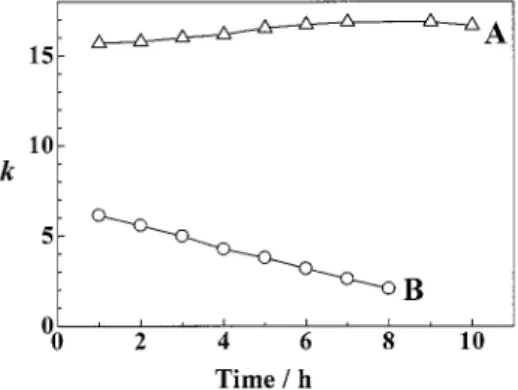
The stability of the prepared modified monolithic silica capillary columns (200 mm × 0.1 mm i.d.) was examined by using 50 mM sodium chloride as the eluent. Figure 2 shows the results for columns modified with dilauryldimethylammonium ion or cetyltrimethylammonium ion. It can be seen from the
Fig. 1 Effect of the concentration of DDAB as the modifier on the retention of anions. Column, monolithic silica capillary column (200 × 0.1 mm i.d.) modified with DDAB; eluent, 50 mM sodium chloride aqueous solution (pH 5.8); flow rate, 2.1 μL/min; wavelength of UV detection, 210 nm; analyte, 0.5 mM each of iodate (1), bromate (2), nitrite (3), bromide (4) and nitrate (5).
Fig. 2 Stability of monolithic silica capillary columns modified with dilauryldimethylammonium ion or cetyltrimethylammonium ion. Columns, monolithic silica capillary columns (200 × 0.1 mm i.d.) modified with a dilauryldimethylammonium ion (A) or a cetyltrimethylammonium ion (B); eluent, aqueous solution of 50 mM sodium chloride (pH 5.8); flow-rate, 2.1 μL/min; analyte ion, nitrate.
figure that the retention factor of nitrate is almost constant for the column modified with dilauryldimethylammonium ion, whereas it decreases with the running time for the column modified with cetyltrimethylammonium ion. The retention factor of nitrate for the former column was almost constant after 100-h of operation with 500-mM sodium chloride as the eluent at 2.1 μL/min. These results indicate that the monolithic silica capillary columns modified with DDAB are more stable than those modified with cetyltrimethylammonium ion. It should be noted that the retention of the analyte ions is stable as long as the eluent containing salt is used, but the modifier is washed out of the column when pure water is passed through the column. This may be because of a salting-out effect.
Effect of eluent concentration
The effects of the eluent concentration on the retention factor of the analyte anions were examined by using sodium chloride as the eluent. Linear relationships between log k and the eluent concentration were observed in the region between 50 and 500 mM, as shown in Fig. 3. The slopes of the linear curves observed for the monovalent analyte anions were 1.0 to 1.2. These values almost coincide with the corresponding theoretical value, 1. In other words, ion exchange is involved in the retention of the analyte anions on the present stationary phase.
In order to apply the present stationary phase to the determination of bromide in seawater samples, the eluent concentration should be increased to around 500 mM, so that the effects of matrix ions can be minimized. The present stationary phase still retained bromide when such a higher concentration eluent was used.
Validation
The operating condition for the determination of bromide in seawater samples was validated, where a 20-cm column was employed in order to improve the resolution. Table 1 shows the repeatability of the retention time and peak signals using 500 mM sodium chloride as the eluent. The relative standard deviation (RSD) values for six successive measurements were less than 1.9% for the retention time, whereas those for the peak height and peak area were less than 3.9%.
The detection limit and the quantitation limit for bromide under the conditions in Table 1 were 1.6 mg/L at S/N = 3 and 5.3 mg/L at S/N = 10, respectively. The peak height was linear to the bromide concentration up to 2 mM with a correlation factor of 0.999 (r2). The sensitivity was improved by a factor of 2.8 compared with the previous work6 because the eluent did not contain any modifier.
Determination of bromide in seawater samples
Figure 4 demonstrates the separation of an authentic mixture of five anions and bromide in a seawater sample on a monolithic silica capillary column modified with DDAB. It can be seen that the retention time of bromide for the seawater sample is the same as for the standard sample. This indicates that the matrix ions’ effects are negligible for the present separation system. The concentration of bromide in the seawater sample was determined to be 66 mg/L (0.82 mM). This value is consistent with the reported values, 58.4 – 71.3 mg/L.12 In addition, the seawater sample was filtrated with a 0.45-μm membrane filter before injection. The recovery was found to be 100% by measuring spiked samples.
Conclusion
It was proved that monolithic silica capillary columns modified with DDAB retained anions and allowed the determination of bromide in seawater without tedious pretreatments. The stability of the retention time of analyte anions on the monolithic capillary columns modified with DDAB was better than in the case for cetyltrimethylammonium ion. The sensitivity of the present method was also improved by a factor of 2.8 compared with previous work with the columns modified with cetyltrimethylammonium ion. The determination of bromide in seawater could be carried out within 2 min.
Fig. 3 Effects of the concentration of the eluent concentration on the retention factor. Analyte anions as indicated. Other operating conditions as in Fig. 2.
Table 1 Repeatability of the retention time, peak area and peak height Retention time 1.8 1.6 1.6 1.9 Peak area 2.3 2.9 3.5 3.9 Peak height 1.7 1.2 2.3 1.8 RSD, % (n = 6) Nitrite
Bromate Bromide Nitrate
Column, monolithic silica capillary column (200 × 0.1 mm i.d.) modified with DDAB; eluent, 500 mM sodium chloride (pH 6.0); flow-rate, 2.1 µL/min; wavelength of UV detection, 210 nm; analyte, 0.5 mM each of bromate, nitrite, bromide and nitrate; injection volume, 20 nL.
Fig. 4 Separation of an authentic mixture of five anions and bromide in a seawater sample on a monolithic silica capillary column modified with DDAB. Column, 200 × 0.1 mm i.d.; eluent, 500 mM sodium chloride (pH 6.0); flow rate, 2.1 μL/min; injection volume, 20 nL; samples, 0.5 mM each for the upper trace; seawater for the lower trace; wavelength of UV detection, 210 nm.
Acknowledgements
This work was partially supported by the Ministry of Education, Culture, Sports, Science and Technology, Japan, Grant-in-Aid for Scientific Research (C), No. 16550071, 2005.
References
1. K. Ito, E. Shoto, and H. Sunahara, J. Chromatogr., 1991,
549, 265.
2. K. Ito, J. Chromatogr., A, 1999, 830, 211.
3. K. Ito, Y. Takayama, N. Makabe, R. Mitsui, and T. Hirokawa, J. Chromatogr., A, 2005, 1083, 63.
4. W. Hu, P.-J. Yang, K. Hasebe, P. R. Haddad, and K.
Tanaka, J. Chromatogr., A, 2002, 956, 103.
5. L. Rong and T. Takeuchi, J. Chromatogr., A, 2004, 1042, 131.
6. A. Suzuki, L. W. Lim, T. Hiroi, and T. Takeuchi, Talanta,
2006, 70, 190.
7. D. Connolly and B. Paull, J. Chromatogr., A, 2002, 953, 299.
8. P. Hatsis and C. A. Lucy, Anal. Chem., 2003, 75, 995. 9. S. Pelletier and C. A, Lucy, J. Chromatogr., A, 2006, 1118,
12.
10. T. Takeuchi, S. Tatsumi, S. Masuoka, K. Hirose, H. Uzu, J.-Y. Jin, C. Fujimoto, K. Ohta, K.-P. Lee, J.-J. Ryoo, and S.-H. Choi, J. Chromatogr., A, 2003, 1021, 55.
11. T. Takeuchi and E. S. Yeung, J. Chromatogr., 1986, 370, 83.