78
Running head : A NEW PERSPECTIVE ON THE PREVENTION OF CERVICAL CANCER
Abstract
Cervical cancer is caused by the human papillomavirus. In recent years, the human papillomavirus vaccine has been used for the prevention of cervical cancer. In this study, we showed such a new prevention strategy of cervical cancer, and its applicability in terms of health education in Japan. The vaccines have been licensed not only in Western countries but also in Asian countries including Japan, and it is recommended that the vaccine should be administered before the onset of sexual activity.
Based on these previous findings, girls around the age of 15 years may be the most effective target population for this vaccine; however, further studies are required to support the human papillomavirus vaccination policy in Japan.
Introduction
In Japan, cancer is one of the important issues that need to be urgently tackled by the government. This is because cancer has been the leading cause of death in Japan since 1981. In 2007, the Cancer Control Act was implemented.
The Japanese government now aims to tackle the problem of cancer with the cooperation of diverse participants such as patient groups, academic associations, medical and welfare facilities, pharmaceutical companies, and mass media. On a practical level, the Cancer Control Act has provisions for (1) the early detection and prevention of cancer (e.g., promotion of cancer prevention initiatives and improvement of the
quality of cancer screening tests), (2) the equalization of cancer medical services (e.g., improvement in the quality of life of cancer patients and establishment of a system for disseminating information on cancer medical services), (3) the promotion of cancer research (e.g., utilization of research results, promotion of clinical trials, improvements in the clinical research environment (Foundation for Promotion of Cancer Research).
Cervical cancer is the second leading cause of female cancer mortality worldwide with 288,000 deaths reported every year. In Japan, it is estimated that approximately 8,000 cases of cervical cancer are diagnosed each year, and approximately 2,500 cervical cancer related deaths per year are reported. In recent years, there has been an ongoing debate on the efficacy of vaccines against human papillomavirus (HPV).
The reason for that is that HPV, especially types 16 (HPV-16) and 18 (HPV-18), is responsible for approximately 70% of the cases of cervical cancer (Clifford, Smith, Plummer, Muñoz, & Franceschi, 2003; Clifford, Franceschi, Diaz, Muñoz, & Villa, 2006). At present, HPV vaccines have been licensed in over 90 countries, and in Japan also licensed since this year.
The aims of this study are as follows: (1) to introduce the current new trends in prevention strategies for uterocervical cancer, and (2) to discuss the applicability for future vaccinate strategy in Japan.
A New Perspective on the Prevention of Cervical Cancer: Prevention Strategies in Collaboration with Health Education
Yasuko Tsukamoto1 and Tsuyoshi Hamano2 Key words : Cervical cancer, Health education, Vaccination program, Japan
1 Corresponding author: Yasuko Tsukamoto, Niigata University of Health and Welfare 950-3198, 1398 Shimami, Kita-ku, Niigata Japan. E-mail: [email protected] Phone: +81-25-257-4600, Fax: +81-25-257-4600
2 Shimane University
79 The Niigata Journal of Health and Welfare Vol. 9, No. 1
New trend in human papillomavirus vaccine strategy
As mentioned above, the leading cause of cervical cancer is persistent HPV infection;
therefore, it is suggested that vaccination against HPV could be one of the efficacious strategies in the prevention of cervical cancer. HPV vaccines have currently been licensed not only in Western countries, such as the United States (US), the United Kingdom (UK), and Canada, but also in Asian countries, such as Taiwan, Korea, and Japan. In recent years, it has been recommended that the HPV vaccine should be administered before the onset of sexual activity because HPV is sexually transmitted. However, there has been an ongoing debate on the appropriate target population for vaccination against HPV.
For instance, in Australia, the HPV vaccine is included in the cervical cancer prevention program. Since 2007, the inclusion of the HPV vaccine has been recommended in routine school immunization programs for 12-13-year-old girls.
For young women who were not in school and aged under 27 years, general practitioners (GPs) and community immunization clinics provided the vaccine free of cost until the end of June 2009, as a catch-up program (Australian Institute of Health and Welfare). In the UK, the HPV vaccine was introduced in the immunization program for girls aged 12-13 years (school year 8) from autumn 2008. A 2-year catch-up program will be initiated in autumn 2009 (National Health Service). Furthermore, the Canadian government approved the use of the vaccine in 2007.
Current and future strategies for managing cervical cancer in Japan
Current strategies in the prevention of cervical cancer
In recent years, there has been an increase in the incidence rate of cervical cancer in women in their twenties. Therefore, in 2004, the Ministry of Health, Labour and Welfare stipulated that the
screening tests for cervical cancer in women should be initiated at the age of 20 or more.
Although cervical screening programs aimed at early detection are currently conducted, the participation rate (23.7%) in these programs is lower than that in other Western countries, such as the US (82.6%), the UK (69.8%), Australia (60.5%), and the Netherlands (69.6%). One of the main aims of the Basic Plan to Promote Cancer Control Programs, which covers the years 2007- 2011, is to improve the participation rate in screening programs; however, presently there is no clear solution to the current situation.
Furthermore, there are important issues regarding the actual efficacy of such a screening program in the prevention of cervical cancer. As mentioned earlier, HPV is sexually transmitted;
therefore, it is important to ensure the immunization of the female population before the onset of sexual activity. Compared to the situation in Japan a few decades ago, women nowadays start becoming sexually active at an early age (Kume, M., & Iijima, H. 2007), and Japanese teenage girls sometimes seem to have a number of sexual partners. If these observations are a true reflection of the actual lifestyle of Japanese adolescents, then the recent trend of focusing on vaccination of adolescents may be one of good strategies for prevention of cervical cancer prevention programs in Japan.
Possibilities for future vaccination programs in Japan
Most studies suggested that the target population for routine immunization should be adolescents who are approximately 12 years of age (Kim & Goldie 2008; Markowitz, Dunne, Saraiya, Lawson, Chesson, & Unger, 2007;
Saslow, et al. 2007). Another program, which
involves the use of cytology-based screening, is
conducted for females 3 years after the first
episode of sexual intercourse and no later than 21
years of age (Kim & Goldie, 2008; Markowitz, et
80
Running head : A NEW PERSPECTIVE ON THE PREVENTION OF CERVICAL CANCER
al., 2007; Saslow, et al., 2007). Australia and the UK have free school-based vaccination programs.
In order to promote vaccination programs in Japan, certain issues need to be addressed. One of them is the assessment of vaccine efficacy, and the other one is the development of a feasible vaccination program (e.g., school-based program). The former issue is beyond the scope of this paper; however recently, multiple groups are conducting trials for the HPV vaccine and studying its efficacy. In the present study, we focused on the second issue, that is, how to develop new vaccinate strategies collaborate with health education.
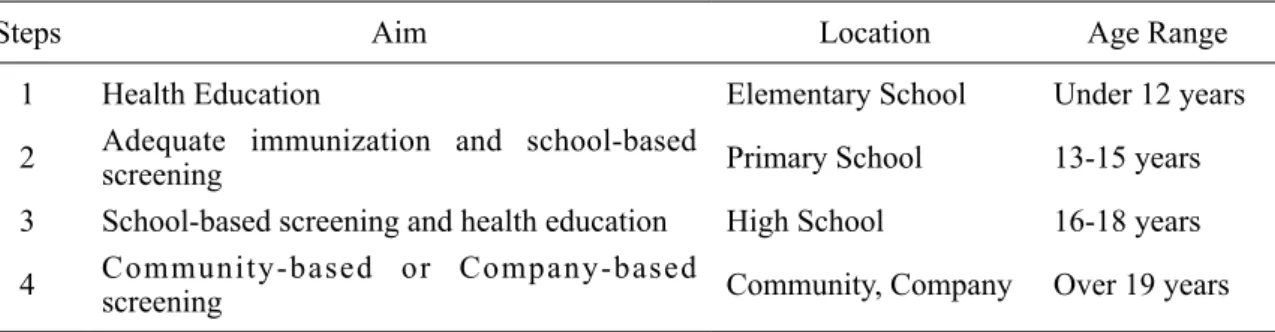
Table 1 showed the draft of a vaccination strategy that can be conducted in collaboration with health education; this strategy is based on previous trials conducted in Western countries.
Health education in elementary schools provides students with adequate knowledge regarding sexual intercourse (Step 1). Primary school girls are vaccinated and also screened in the third grade (Step 2). Furthermore, screening programs are carried out and health education regarding sexually transmitted diseases is provided in high school (Step 3). After graduating from high school, they are screened as a part of health check-ups conducted by municipality (Step 4).
Of course, we are not certain about the success of this strategy. There are various impediments in the implementation of this strategy; for example, it is difficult for teachers to impart age-
appropriate sex education in elementary school.
There is some debate that sex education for HPV vaccination might sometime lead to misunderstandings about issues such as the advocation of condom distribution. Moreover, parents might not give their consent for administering a cervical cancer vaccine to their children. The most important point that arises is that we should work towards generating a great deal of interest in both girls and their parents regarding the prevention or early detection of cervical cancer, from a young age.
Conclusion
Cervical cancer is one of the important issues concerning women’s health. Screening programs for cervical cancer are being carried out in Japan;
however, screening rate is lower than that in other countries. Given this background, the motivation of this study is to present a new strategy for cervical cancer prevention. HPV vaccination has proven to be an effective strategy for cervical cancer prevention in other countries such as the UK and Australia. We think that implementing HPV vaccination programs will be an effective strategy for cervical cancer prevention in Japan.
Further research is needed to develop a suitable strategy for cervical cancer prevention, which can be implemented in collaboration with the current school-based or community-based health education programs in Japan.
Table 1 Draft of a vaccination strategy
Steps Aim Location Age Range
1 Health Education Elementary School Under 12 years
2 Adequate immunization and school-based
screening Primary School 13-15 years
3 School-based screening and health education High School 16-18 years 4 Community-based or Company-based
screening Community, Company Over 19 years
81 The Niigata Journal of Health and Welfare Vol. 9, No. 1