• 検索結果がありません。

福島県立医科大学 学術機関リポジトリ

N/A
N/A
Protected

Academic year: 2021

シェア "福島県立医科大学 学術機関リポジトリ"

Copied!
12
0
0

読み込み中.... (全文を見る)

全文

(1)

Fukushima Medical University

This document is downloaded at: 2021-11-08T00:20:28Z

Title

Psychological distress after the great East Japan earthquake and fukushima daiichi nuclear power plant accident: results of a mental health and lifestyle survey through the fukushima health management survey in fy2011 and fy2012

Author(s) Yabe, Hirooki; Suzuki, Yuriko; Mashiko, Hirobumi;

Nakayama, Yoko; Hisata, Mitsuru; Niwa, Shin-Ichi; Yasumura, Seiji; Yamashita, Shunichi; Kamiya, Kenji; Abe, Masafumi Citation Fukushima Journal of Medical Science. 60(1): 57-67

Issue Date 2014-08-08

URL http://ir.fmu.ac.jp/dspace/handle/123456789/404

Rights © 2014 The Fukushima Society of Medical Science

DOI 10.5387/fms.2014-1

Text Version publisher

(2)

Vol. 60, No. 1, 2014

[Original Article]

PSYCHOLOGICAL DISTRESS AFTER THE GREAT EAST JAPAN EARTHQUAKE AND FUKUSHIMA DAIICHI NUCLEAR POWER PLANT ACCIDENT : RESULTS OF A MENTAL HEALTH AND LIFESTYLE SURVEY

THROUGH THE FUKUSHIMA HEALTH MANAGEMENT SURVEY IN FY2011 AND FY2012

HIROOKI YABE 1,2) , YURIKO SUZUKI 3,4) , HIROBUMI MASHIKO 1,2) , YOKO NAKAYAMA 1,5) , MITSURU HISATA 1,6) , SHIN - ICHI NIWA 1,7) , SEIJI YASUMURA 1,4) , SHUNICHI YAMASHITA 1,8) ,

KENJI KAMIYA 1,9) , MASAFUMI ABE 1) , ON BEHALF OF THE MENTAL HEALTH GROUP OF THE FUKUSHIMA HEALTH MANAGEMENT SURVEY

1) Radiation Medical Science Center for the Fukushima Health Management Survey and 2) Department of Neuropsychiatry, School of Medicine, Fukushima Medical University, Fukushima, Japan, 3) Department of Adult Mental Health, National Institute of Mental Health, National Center of Neurology and Psychia- try Japan, 4) Department of Public Health, School of Medicine, Fukushima Medical University, Fukushi- ma, Japan, 5) Faculty of Nursing, University of Kochi, Kochi, Japan, 6) Faculty of Human Sciences, Sophia University, Tokyo, Japan, 7) Department of Psychiatry, Aizu Medical Center, Fukushima Medical Univer- sity, Fukushima, Japan, 8) Atomic Bomb Disease Institute, Nagasaki University, Japan, 9) Research Insti- tute for Radiation Biology and Medicine, Hiroshima University, Hiroshima, Japan

(Received January 21, 2014 accepted April 1, 2014)

Abstract : [Background] On 11 March 2011, the Great East Japan Earthquake followed by a gigan- tic tsunami hit the Pacific coast of Northeast Japan (Tohoku) and damaged Tokyo Electric Power Company’s Fukushima Daiichi Nuclear Power Plant, causing a radiation hazard in the entire Fuku- shima Prefecture. The radiation dose exposed either externally and internally in Fukushima resi- dents have been evaluated to be low so far and it is hardly believed that they may have any direct ra- diation risk on physical condition. The purpose of this report is, therefore, to describe results of a mental health and lifestyle survey intended to facilitate adequate care for residents who are at a higher risk of developing mental health problems after the complicated accident. [Participants and Methods] The target population of this survey is the residents of evacuation zones including Hirono Town, Naraha Town, Tomioka Town, Kawauchi Village, Okuma Town, Futaba Town, Namie Town, Katsurao Village, Minamisoma City, Tamura City, Yamakiya district of Kawamata Town, and Iitate Village. The targeted population was 210,189 in fiscal year 2011 (FY2011) and 211,615 in fiscal year 2012 (FY2012). Questionnaires have been mailed since January 2012, and subsequently, Janu- ary 2013, 10 and 22 months after the disaster. Among of them, children 63.4%, adults 40.7% for FY2011, and children 41.0%, adults 29.7% for FY2012 responded to the questionnaires mailed.

[Results] Sociodemographic data showed that many evacuee households were separated after the disaster and had to move several times. K6 was used in this survey to estimate general mental health. The proportion (14.6% in FY2011 and 11.9% inFY2012) of adults who scored above the K6 cut

-

off (≥13) for general mental health was higher than usual, indicating severe mental health prob- lems among evacuees. The proportion (21.6% in FY2011 and 18.3% inFY2012) of adults who scored above the cut

-

off (≥44) of PTSD checklist (PCL), reflecting traumatic symptoms, was almost equal to that of the workers after the 9.11 World Trade Center attacks. These results also indicate the presence of severe traumatic problems among evacuees. The proportions of children (4

-

6

Corresponding author : Hirooki Yabe MD, PhD E

-

mail : [email protected] https://www.jstage.jst.go.jp/browse/fms http://www.fmu.ac.jp/home/lib/F

-

igaku/

57

(3)

years old) and children of primary school age (6

-

12 years old) who scored above the cut

-

off (≥16) of Strengths and Difficulties Questionnaire (SDQ) reflecting the mental health status in children, 24.4%

and 22.0% in the survey of FY2011, were double the usual state respectively, whereas 16.6% in chil- dren of 4

-

6 years old and 15.8% in children of 6

-

12 years old in FY2012 were 1.5 times. These findings also disclosed the presence of severe mental difficulties in children, with relative improve- ment year by year. [Conclusion] As revealed by the present mental health survey, the earthquake and tsunami followed by the nuclear accident caused psychological distress among residents in Fu- kushima prefecture. Continuous survey and mental care programs are required.

Key words : Earthquake, Tsunami, Nuclear Accident, Mental Health, Survey

Chernobyl study showed that diagnoses of mental disorders increased in the aftermath of the incident, which suggests that the observed anxiety issues may represent legitimate disorders when they per- sist. Another issue observed in Fukushima and learnt from previous nuclear power plant accidents is the loss of control that the affected people experi- enced over their lives and their powerlessness as victims. Rather than simply offer services or health check - ups, a better solution would support them in making their own decisions based on sound information.

Fukushima prefecture started the Fukushima Health Management Survey to monitor its residents’

long - term health, to promote their future wellbeing, and to determine whether long - term low - dose radi- ation exposure affects health. This multifaceted survey includes a basic survey for the general popu- lation and a more targeted detailed survey. Mental health is a focal point of the detailed survey, and a mail - based, self - administrated survey was conduct- ed in January 2012, and subsequently, January 2013, 10 and 22 months after the disaster. The present report briefly describes the results of the survey and compares the results in two time points 6

-

8) .

Participants

The target population consists of officially reg- istered residents of any age from the nationally des- ignated evacuation zones including Hirono Town, Naraha Town, Tomioka Town, Kawauchi Village, Okuma Town, Futaba Town, Namie Town, Katsurao Village, Minamisoma City, Tamura City, Yamakiya district of Kawamata Town, and Iitate Village. The target population was 210,189 in fiscal year 2011 (FY2011), and 211,615 in fiscal year 2012 (FY2012).

The survey response rates were : children 63.4%, adults 40.7% for FY2011, and children 41.0%, adults 29.7% for FY2012.

INTRODUCTION

The Great East Japan Earthquake hit mainly the Pacific coast of three prefectures (Miyagi, Iwate and Fukushima) in Northeast (Tohoku area) Japan at 14 : 46 on 11 March 2011. The earthquake was fol- lowed by a gigantic tsunami which, to make matters worse, damaged the Tokyo Electric Power Compa- ny’s (TEPCO) Fukushima Daiichi Nuclear Power Plant (NPP), causing a radiation hazard in Fukushi- ma Prefecture. Although the exposure dose exter- nally and internally just after the accident itself is estimated to be very low and it is very difficult to confirm the direct effect of radiation exposure on any physical condition for the residents in Fukushi- ma 1) , the TEPCO - Fukushima Daiichi NPP accident has cast a wide - ranged shadow on the mental health of inhabitants who fear radioactive contamination.

Unfortunately it was very difficult for the Japanese mental health community to immediately respond to this crisis in comparison with the past experience with purely natural disasters in Japan. This is ex- actly unexpected and unprecedented worst nuclear accident.

According to a review of the existing literature on mental health after the previous nuclear power plant accidents, psychological reactions observed in the Three Mile Island and Chernobyl accidents also occurred in Fukushima 2,3) . That is, the affected people experienced confusion, distrust, mental health problems, and stigma. Twenty years after the Chernobyl accident, WHO concluded that mental health is the most serious public health problem 4,5) as a result of that nuclear accident and the same problems might be observed in Fukushima as well.

These mental health problems can be devastat-

ing. Based on clinical observation, the primary

problem seems to be anxiety regarding the effects of

radiation on health (especially for children), commu-

nity, lifestyle, and the economy. Although these are

rational concerns that we should not dismiss, a post -

(4)

Methods

The primary purposes of the Fukushima Health Management Survey are to monitor the long - term health and daily lives of residents of Fukushima and to provide them proper care. The entire protocol of this survey is published elsewhere 9) . We send the self - administrated mental health questionnaire to the target population.

Socioeconomic and disaster - related variables were asked, including age, gender, current living sit- uations such as change in work, income, number of times moving, number of cohabitants, and experi- ence related to the earthquake, tsunami, and NPP accident, specifically, witnessing or hearing any hy- drogen explosion at the NPPs.

To assess mental health status of residents over 15 years old, Kessler’s K6 10) , PTSD Checklist Stressor - Specific Version (PCL - S) 11) were used.

Additionally, CAGE was used to assess problem drinking in the survey in FY2012.

We measured non - specific mental health dis- tress as a primary outcome by K6. In the K6, par- ticipants were asked if they had the following symp- toms during the past 30 days : feeling so sad that nothing could cheer you up, feeling nervous, hope- less, restless or fidgety, feeling everything was an effort, and feeling worthless. Each question was rated on a 5 - point Likert scale from zero (none of the time) to four (all of the time), with higher scores signifying worse mental health status (range : 0 - 24). The Japanese version of the K6 has been validated 12,13) .

PCL - S was used to measure traumatic symp- toms, and we specified the event as the experience of the Great East Japan Earthquake and the disaster.

We summed up the responses to the 17 Likert - like items in the PCL and classified a responder as hav- ing probable PTSD if the total score was ≥44 11) , where each item was scored as 1 - 5 (corresponding respectively to not at all, a little bit, moderately, quite a bit, or extremely).

In the survey of FY2012, other measures were added, which include the CAGE questionnaire for al- cohol abuse 14) , the Sheehan Disability Scale to esti- mate the extent to which emotional problems dis- rupted work, social life, and family and home responsibilities 15,16) , and Lubben’s Social network 17,18) .

Regarding the risk perception of radiation health effect, three items on perceptions of immedi- ate, delayed, and genetic effects were asked 19) . The items were translated forward and subsequently backward and modified after the discussion with the

authors, with the 4 - point Likert scale ranging from very unlikely, to very likely.

To assess children’s mental health status, Strength and Difficulties Questionnaire (SDQ) was used 20,21) , which consists of 25 questions to the par- ents con cerning both positive and negative behavior of their child. There is one subscale for prosocial behavior (social strength ; up to 10 points) and four subscales for difficult behaviors (emotional symp- toms, conduct problems, hyperactivity/inattention, and peer relationship problems ; up to 40 points in total). For SDQ - prosocial behavior, higher scores indicate more positive behavior, and for SDQ-difficult behavior, higher scores indicate more problematic behavior.

This survey was approved by the ethics review committee of Fukushima Medical University (No.

1316).

RESULTS

Demographic and current living situation data are presented in Table 1. With regard to current living situation in FY2012, 14,923 people (39.2%) answered that they live separately from any family member who used to live with them before the di- saster. The number of cohabitants before the di- saster varied from 0 (meaning living alone) among 57 people (0.2%), one among 2,341 people (6.6%), two among 7,882 people (22.1%), to more than three among 25,401 people (71.1%). At the survey, the current number of cohabitants were from 0 (meaning living alone), 85 people (0.2%) ; one, 5,130 people (13.8%) ; two, 12,956 people (34.9%) ; and more than three, 18,925 people (51.1%). Regarding the number of times moving, 3,619 people (10.1%) re- ported zero, 3,998 people (11.2%) once, 4,656 people (13.0%) twice, 6,366 people (17.8%) three times, 6,085 people (17.0%) four times, and 11,090 people (30.9%) moved more than 5 times (Table1).

General mental health

Among the valid responses (n =59,807 in

FY2011, n=32,508 in FY2012), the overall mean

score of K6 was 6.3 (5.5 in males and 6.8 in females)

in FY2011, and 5.7 (5.1 in males and 6.3 in females)

in FY2012. Those who scored 13 and above on K6

were 8,717 (14.6%) in total, 3,133 (11.9%) among

males and 5,584 (16.7%) among females in FY2011,

versus 3,865 (11.9%), 1,468 (10.0%) and 2,397

(13.5%), respectively in FY2012. The distribution

of K6 in FY2011 and FY2012 is presented in Figure

(5)

Table 1. Participants’ sociodemographic information and living situations in survey FY2011 and FY2012 (Adults)

FY2011 FY2012

n %/mean n %/mean

Age (mean) 55.5 59.0

Gender 73,433 39,495

Males 32,301 44.0 17,624 44.6

Females 41,132 56.0 21,871 55.4

Living place

In Fukushima prefecture 59,435 80.9 31,965 80.9

Out of Fukushima prefecture 13,998 19.1 7,530 19.1

Experience of disaster (multiple answer)

Earthquake 69,700 35,346

Tsunami 14,757 7,563

Nuclear Power Plant Accident 38,392 34,954

None 1,095 307

Living arrangement

Evacuation Shelter 734* 1 1.3 15,727* 2

Temporary housing 6,896* 1 12.0 7,295* 2

Rental house, apartment 22,947* 1 40.0 19, 059* 2

Relative’s home 2,460* 1 4.3 16,156* 2

Own home 21,459* 1 37.5 10,442* 2

Other 2,778* 1 4.9 3,442* 2

Living separately from

any family member 14,923 39.2

Number of cohabitants Before the disaster

0 (Living alone) 57 0.2

1 2,341 6.6

2 7,882 22.1

3+ 25,401 71.1

Current

0 (Living alone) 85 0.2

1 5,130 13.8

2 12,956 34.9

3+ 18,925 51.1

Number of times moving

0 3,619 10.1

1 3,998 11.2

2 4,656 13.0

3 6,366 17.8

4 6,085 17.0

5+ 11,090 30.9

Change of work 36,507 54.0 16,652 50.7

Current living circumstances

Poor off 6,110 17.1

Relatively poor off 10,990 30.7

Normal 17,443 48.7

Relativel well off 929 2.6

Well off 332 0.9

*1 Number of people living there at the time of survey

*2 Number of people having lived there

(6)

1. Regarding social disability due to mental health problems, the number of those who responded as

“none of the time” was 19,173 (56.8%), “a little of the time” was 8,351 (24.8%), “some of the time”

was 4,015 (11.9%), “most of the time” was 985 (2.9%), and “all of the time” was 1,213 (3.6%) in FY2012.

Traumatic symptom

Among the valid responses (n =60,704 in FY2011, n=32,246 in FY2012), the overall mean score of PCL - S was 33.0 (31.2 in males and 34.4 in female) in FY2011, and 31.7 (30.6 in males and 32.6 in females) in FY2012. Those who scored 44 and above on PCL were 13,111 (21.6%) in total, 4,864 (18.2%) among males and 8,247 (24.3%) among fe- males in FY2011, versus 5,892 (18.3%), 2,420 (16.6%) and 3,472 (19.6%), respectively in FY2012.

The distribution of PCL - S in FY2011 and FY2012 is presented in Figure 2. Regarding social disability due to traumatic symptoms, those who responded yes were 8,127 (25.0%) and those who responded no were 24,443 (75.0%).

Alcohol problem (CAGE)

Among those who drink alcohol, 5,690 (21.1%) felt the need to cut down on drinking, 1,819 (6.8%) reported to be annoyed by criticism of their drinking behavior, 2,522 (9.4%) felt guilty about drinking, and 1,642 (6.1%) felt the need of drink as eye - open- er. (Table 2)

Risk perception of radiation

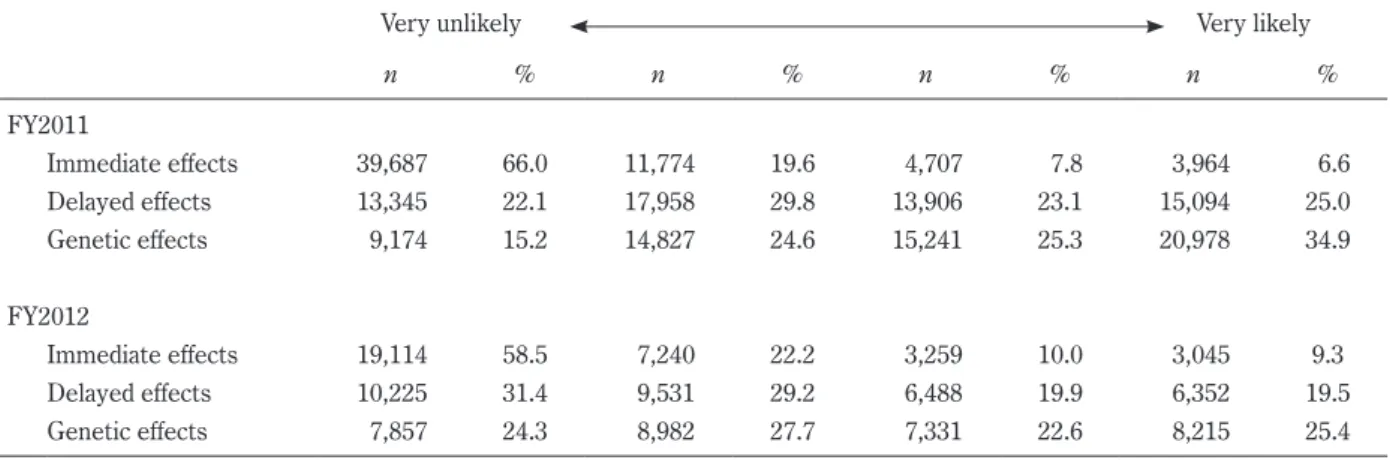
Regarding the degree of risk perception of radi- ation health effects in FY2012 survey, 3,045 (9.3%) respondents reported an immediate effect is very Fig. 1. Distribution of score of non

-

specific mental health problems measured by K6 in survey of FY2011 and

FY2012.

(7)

likely, 6,352 (19.5%) reported delayed effects, and 8,215 (25.4%) reported genetic effects due to expo- sure of the radioactive materials from the Fukushima Nuclear Power Plant. Details are presented in Ta- ble 3.

Children’s mental health status

Demographics of children who returned the surveys are presented in Table 4. The prevalence difficulties above the cut - off (>=16) on SDQ in the survey of FY2011 was 24.4% in children of 4 - 6 year - old, 22.0% in children of primary school age (6 - 12 years old), and 16.2% in children of junior high school age (12 - 15 years old). Those in the survey of FY2012 were 16.6% in children of 4 - 6 year - old, 15.8% in children of primary school age, and 12.8%

in children of junior high school age. The compari- son of the mean total difficulties scores and propor- tion of above - cut - off results in FY2011 and FY2012 by different age groups are presented in Table 5.

DISCUSSION

The mental health and lifestyle survey was con- ducted twice (10 and 22 months after the disaster) to provide adequate mental care and lifestyle sup- port for evacuees who are at a higher risk of devel- oping mental health and lifestyle problems. It was one of four detailed surveys in a large - scale cohort study of the Fukushima Health Management Sur- vey 9) .

As shown in the sociodemographic information of evacuees, many people (39.2%) were compelled to live separately from their usual household mem- bers after the disaster and had to move several times. Two or more moves and suddenly living alone likely provoke substantial mental burdens as evidenced by previous report from Chernobyl 1,2) .

K6 was employed in this survey to estimate general mental health of evacuees. The percentage of adults who scored above the cut - off points of 13 Fig. 2. Distribution of score of traumatric symptoms measured by PTSD checklist (PCL), specific version in survey

of FY2011 and FY2012

(8)

Table 2. Results of mental health assessments in survey FY2011 and FY2012 (Adults)

FY2011 FY2012

n %/mean n %/mean

Non

-

specific mental health (K6)

Mean (n=59,807 in FY2011, n=32,508 in FY2012) 6.3 5.7

Males (n=26,321 in FY2011, n=14,710 in FY2012) 5.5 5.1

Females (n=33,486 in FY2011, n=17,797 in FY2012) 6.8 6.3

>=13 8,717 14.6 3,865 11.9

Males 3,133 11.9 1,468 10.0

Females 5,584 16.7 2,397 13.5

Traumatic symptoms (PCL)

Mean (n=60,704 in FY2011, n=32,246 in FY2012) 33.0 31.7

Males (n=26,752 in FY2011, n=14,543 in FY2012) 31.2 30.6

Females (n=33,952 in FY2011, n=17,703 in FY2012) 34.4 32.6

>=44 13,111 21.6 5,892 18.3

Males 4,864 18.2 2,420 16.6

Females 8,247 24.3 3,472 19.6

Problem drinking (CAGE)

Cut down

-

yes (n=26,981) 5,690 21.1

Annoyed

-

yes (n=26,744) 1,819 6.8

Guilty

-

yes (n=26,761) 2,522 9.4

Eye

-

opener

-

yes (n=26,862) 1,642 6.1

Social network (LSNS

-

6)

Mean (n=34,400) 13.1

Males (n=15,306) 12.9

Females (n=19,093) 13.3

<12 13,618 39.6

Males 6,308 41.2

Females 7,310 38.3

Abbreviations : K6 ; Kessler’s 6, PCL ; PTSD Checklist, CAGE ; CAGE Alcohol Screening Test, LSNS

-

6 ; Lubben Social Network Scale 6.

Table 3. Results of risk perception of radiation health effects in survey FY2011 and FY2012

Very unlikely Very likely

n % n % n % n %

FY2011

Immediate effects 39,687 66.0 11,774 19.6 4,707 7.8 3,964 6.6

Delayed effects 13,345 22.1 17,958 29.8 13,906 23.1 15,094 25.0

Genetic effects 9,174 15.2 14,827 24.6 15,241 25.3 20,978 34.9

FY2012

Immediate effects 19,114 58.5 7,240 22.2 3,259 10.0 3,045 9.3

Delayed effects 10,225 31.4 9,531 29.2 6,488 19.9 6,352 19.5

Genetic effects 7,857 24.3 8,982 27.7 7,331 22.6 8,215 25.4

(9)

for K6 was 14.6% in in FY2011 and 11.9% in FY2012, respectively. Those values are substan- tially higher than 3% for K6 in the usual state as re- ported previously 22) . The proportion above K6 cut - off (≥13) was higher among females than males.

These results suggest the severity of mental health problems in adults from the evacuation zones.

PCL was used to evaluate traumatic symptoms of evacuees. The percentage of adults who scored above the cut - off of 44 for PCL, reflecting traumatic response, was 21.6% in FY2011 and 18.3% in FY2012, respectively. Although gender ratio, age structure and survey time after a disaster is different, those percentages are almost equal to 20.1% reported in the previous study concerning the rescue and clean- up workers after the 9.11 World Trade Center At-

tacks 23) . Furthermore, Our results are comparable to those og the previous research in that, L. Di- Grande et al. showed that the prevalence of probable PTSD using the DSM - IV diagnostic criteria (16.1%) was similar to the prevalence based on the PCL cut - off score 44 or < (15.1%) among lower Manhattan residents 2 - 3 years after the September 11, 2001 terrorist attacks 24) . The proportion above PCL cut - off (≥44) was higher among females than males.

These results also indicate the presence of severe traumatic problems in adults from the evacuation zones.

There is no paper published in Japan that re- ports the prevalence of alcohol problems using CAGE, even though the clinical utility of the CAGE is recognized. After the major natural disaster, al- Table 4. Participants’ sociodemographic information and living situations in survey FY2011 and FY2012 (Children)

FY2011 FY2012

n % n %

Age (mean) 0

-

3 years old

3.1 2.0

4

-

6 years old 4.8

Primary school age 9.5 9.4

Middle school age 14.0 13.9

Gender 0

-

3 years old

Total : 7,818 Boys : 3,969 Girls : 3,849

Boys : 50.8 Girls : 49.2

1,804

Boys 876 48.6

Girls 928 51.4

4

-

6 years old 1,905

Boys 963 50.6

Girls 942 49.4

Primary school age 7,464 3,974

Boys 3,815 51.1 2,037 51.3

Girls 3,649 48.9 1,937 48.7

Middle school age 3,411 1,796

Boys 1,717 50.3 891 49.6

Girls 1,694 49.7 905 50.4

Living place 0

-

3 years old

In Fukushima pref : 5,083 Out of Fukushima

pref : 2,735

In Fukushima pref : 65.0 Out of Fukushima

pref : 35.0

1,804

In Fukushima prefecture 1,194 66.2

Out of Fukushima prefecture 610 33.8

4

-

6 years old 1,905

In Fukushima prefecture 1,316 69.1

Out of Fukushima prefecture 589 30.9

Primary school age 7,476 3,974

In Fukushima prefecture 5,404 72.4 2,885 72.6

Out of Fukushima prefecture 2,060 27.6 1,089 27.4

Middle school age 3,411 1,796

In Fukushima prefecture 2,734 80.2 1,436 80.0

Out of Fukushima prefecture 677 19.8 360 20.0

(10)

cohol use may increase to cope with stressed life, and only limited proportion of people reportedly de- velop alcohol use disorder 25) . However, in the con- text of persisting lifestyle change after a NPP acci- dent, careful monitoring on alcohol problems is required.

SDQ was employed in this survey to assess children’s mental health status. The proportion of children (4 - 12 years old) above 16 on SDQ (usual community setting) was 9.5%. 24.4% in children of 4 - 6 year - old and 22.0% in children of primary school age (6 - 12 years old) were estimated in the survey of FY2011 were double the values of a usual state, whereas 16.6% in children of 4 - 6 year - old and 15.8%

in children of primary school age in the survey of FY2012 was 1.5 times than the usual 21) . These re- sults also suggest the presence of severe mental dif- ficulties in children from the evacuation zones.

However, those are relatively improved year by year.

This survey was not conducted purely for sci- entific research ; rather, it was conducted for needs analysis of the affected people and for provision of better services. On the basis of the survey re- sponse, the Mental Health Support Team of Fuku-

shima Medical University, consisting of clinical psy- chologists and public health nurses, attempted to make contact via telephone with the respondents who required support, and provided them with ad- vice and information about mental health issues.

The written materials providing the telephone num- ber of the Mental Health and Lifestyle Survey helpline for consultation were sent to the respon- dents who could not be reached for telephone sup- port due to absence or other reasons. In order to provide them with telephone counseling, the written materials included a response card for them to write down any changes of general condition. The infor- mation of the respondents who definitely required continuous support was shared with municipal gov- ernments, which worked with the Fukushima Centre for Disaster Mental Health as needed.

The survey team worked closely with service providers by providing training for mental health and radiation issues to create a better liaison system in the community. The team also worked with local mental health care (‘kokoro no kea’ in Japanese) cen- tres by referring follow - up cases in the community to the centres. However, more dialogue and collab- Table 5. Results of mental health assessments in survey FY2011 and FY2012 (Children)

FY2011 FY2012

n %/mean n %/mean

SDQ total difficulties score

4

-

6 years old (n=3,427 in FY2011, n=1,898 in FY2012)

Mean 11.7 10.2

Boys (n=1,755 in FY2011, n=957 in FY2012) 12.1 10.8

Girls (n=1,672 in FY2011, n=941 in FY2012) 11.2 9.7

>=16 836 24.4 316 16.6

Boys 476 27.1 180 18.8

Girls 360 21.5 136 14.5

Primary school age (n=7,450 in FY2011, n=3,967 in FY2012)

Mean 11.0 9.7

Boys (n=3,808 in FY2011, n=2,034 in FY2012) 11.5 10.3

Girls (n=3,642 in FY2011, n=1,933 in FY2012) 10.4 9.1

>=16 1,637 22.0 627 15.8

Boys 935 24.6 372 18.3

Girls 702 19.3 255 13.2

Middle school age (n=3,332 in FY2011, n=1,785 in FY2012)

Mean 9.7 8.8

Boys (n=1,681 in FY2011, n=888 in FY2012) 9.5 8.9

Girls (n=1,651 in FY2011, n=897 in FY2012) 9.8 8.7

>=16 539 16.2 228 12.8

Boys 266 15.8 119 13.4

Girls 273 16.5 109 12.2

Abbreviations : SDQ ; Strength and Difficulties Questionnaire.

(11)

oration with residents is required for the research- ers to effectively conduct the survey and the mental care.

As revealed by the present mental health sur- vey, the earthquake and tsunami followed by the nu- clear power plant accident caused psychological dis- tress among residents in Fukushima prefecture. As described above, this survey is not purely for aca- demic purpose, but for needs assessment and priori- tizes those who have probable mental health prob- lem for mental health care. Although the target population of the survey is large, at the same time, better response rate and validation of the cut - off in use of this specific disaster warrants further ef- fort. In addition, continuous survey and proper mental health care programs are strongly required.

ACKNOWLEDGMENTS

This survey was conducted as part of Fukushi- ma Prefecture’s post - disaster recovery plans and was supported by the national “Health Fund for Children and Adults Affected by the Nuclear Inci- dent.” Conflicts of interest : None declared. We thank Professor Kenneth E. Nollet (Director, De- partment of International Cooperation) for helpful advice.

The authors declare no conflict of interest.

APPENDIX

The Fukushima Health Management Survey Group Chairpersons : Masafumi Abe (Director General, Radiation Medical Center for the Fukushima Health Management Survey), Shunichi Yamashita (Vice Di- rector, Radiation Medical Center for the Fukushima Health Management Survey), Kenji Kamiya (Vice Director, Radiation Medical Center for the Fukushi- ma Health Management Survey), Seiji Yasumura (Vice Director, Radiation Medical Center for the Fu- kushima Health Management Survey), Makoto Akashi (National Institute of Radiological Sciences), Kazunori Kodama, and Kotaro Ozasa (The Radiation Effects Research Foundation), Hirooki Yabe (Chair- man of Mental Health Survey, Radiation Medical Science Center for the Fukushima Health Manage- ment Survey).

Participating Other Expert Committee Members, Advi- sors, and Staffs in Mental Health and Lifestyle Survey of the Fukushima Health Management Survey : Ohtsura Niwa, Akira Ohtsuru, Shiro Matsui, Shinichi Niwa, Tetsuya Ohira, Yasuto Kunii, Shuntaro Itagaki,

Tetsuya Shiga, Hajime Iwasa, Yoko Nakayama, Misao Ohta, Aya Goto, Mitsuru Hisata, Norito Kawakami, Mitsuaki Hosoya, Mayumi Harigane, Akiko Yagi, Yu - ichi Oikawa, Yuki Ueda, Noko Horikoshi, Yu - ya Kashiwazaki, Tsuyoshi Takeda, Tetsunobu Hata, Hi- royuki Sugimoto, Yukiko Itoh, Yuko Hino, Keisuke Hiyamizu, Kuni Sugano, Suzuko Yasuhara, Shidu Iga- rashi, Ai Kawamura. Aiko Matsuda, Mariko Hara, Yuriko Kimura, Yuki Kumasaka, Natsumi Sasaki, Miho Otoji, Ryoichi Kurosawa, Fumiko Mori.

REFERENCES

1. Nagataki S, Takamura N, Kamiya K, Akashi M. Measurements of individual radiation doses in residents living around the Fukushima Nuclear Power Plant. Radiat Res, 180 : 439

-

447, 2013.

2. Bromet EJ. Emotional consequences of nuclear power plant disasters. Health Phys, 106 : 206

-

210, 2014.

3. Bromet EJ, Havenaar JM. Psychological and per- ceived health effects of the Chernobyl disaster : a 20

-

year review. Health Phys, 93 : 516

-

521, 2007.

4. WHO (World Health Organization) 2005a. Health Effects of the Chernobyl Accident and Special Health Care Programmes. Available : http://

www.who.int/ionizing_radiation/a_e/chernobyl/

-

EGH%20Master%20file%202005.08.24.pdf [ac- cessed 20 December, 2013].

5. WHO (World Health Organization) 2005b.

Chernobyl : The True Scale of the Accident ; 20 Years Later a UN Report Provides Definitive An- swers and Ways to Repair Lives [Press Release].

Available : http://www.who.int/mediacentre/news/

releases/2005/pr38/en/print.html [accessed 20 De- cember, 2013].

6. Radiation Medical Science Center for the Fukushi- ma Health Management Survey, Fukushima Medi- cal University.

http://www.fmu.ac.jp/radiationhealth/ [accessed 20 December, 2013].

7. Proceedings of the 11th Fukushima Prefectural Oversight Committee Meeting, Mental health and Lifestyle Survey, 5 Jun 2013, Japanese version.

http://www.pref.fukushima.jp/imu/kenkoukanri/

250605siryou4.pdf [accessed 20 December, 2013]

8. Proceedings of the 12th Fukushima Prefectural Oversight Committee Meeting, Mental Health and Lifestyle Survey, 20 Aug 2013, Japanese version, http://www.pref.fukushima.jp/imu/kenkoukanri/

250820siryou4.pdf [accessed 20 December, 2013]

9. Yasumura S, Hosoya M, Yamashita S, Kamiya K,

Abe M, Akashi M, et al. Study Protocol for the

Fukushima Health Management Survey. J Epide-

(12)

miol, 22 : 375

-

383, 2012.

10. Kessler RC, Barker PR, Colpe LJ, Epstein JF, Gfro- erer JC, Hiripi E, et al. Screening for serious mental illness in the general population. Arch Gen Psychiatry, 60 : 184

-

189, 2003.

11. Blanchard EB, Jones

-

Alexander J, Buckley TC, Forneris CA. Psychometric properties of the PTSD Checklist (PCL). Behav Res Ther, 34 : 669

-

673, 1996.

12. Furukawa TA, Kessler RC, Slade T, Andrews G.

The performance of the K6 and K10 screening scales for psychological distress in the Australian National Survey of Mental Health and Well

-

Being.

Psychol Med, 33 : 357

-

362, 2003.

13. Sakurai K, Nishi A, Kondo K, Yanagida K, Kawaka- mi N. Screening performance of K6/K10 and oth- er screening instruments for mood and anxiety dis- orders in Japan. Psychiatry Clin Neurosci, 65 : 434

-

441, 2011.

14. Ewing JA. Detecting alcoholism. The CAGE questionnaire. JAMA, 252 : 1905

-

1907, 1984.

15. Sheehan DV. The Anxiety Disease. Charles Scribner and Sons, New York, 1983.

16. Yoshida T, Ohtsubo T, Tsuchida H. Study of reli- ability and validity of a Japanese version of Shee- han Disability Scale (SDISS) (in Japanese). Japa- nese Journal of Clinical Psycho pharma cology, 7 : 1645

-

1653, 2004.

17. Lubben, JE. Assessing social networks among el- derly populations. Family & Community Health, 11 : 42

-

52, 1988.

18. Kurimoto A, Awata S, Ohkubo T, Tsubota

-

Utsugi M, Asayama K, Takahashi K, et al. Study of reliability and validity of a Japanese brief version of Lubben Social Network Scale (LSNS

-

6) (in Japanese). Ni- hon Ronen Igakkai Zasshi, 48 : 149

-

157, 2011.

19. Lindell MK, Barnes VE. Protective response to technological emergency : risk perception and be-

havioral intention. In : Silver EG, editor. Nu- clear Safety ; College Station, TX, USA : Hazard Reduction and Recovery Center ; 1986. p. 457

-

467.

20. Goodman R. Psychometric properties of the strengths and difficulties questionnaire. J Am Acad Child Adolesc Psychiatry, 40 : 1337

-

1345, 2001.

21. Matsuishi T, Nagano M, Araki Y, Tanaka Y, Iwasaki M, Yamashita Y, et al. Scale properties of the Jap- anese version of the Strengths and Difficulties Questionnaire (SDQ) : A study of infant and school children in community samples. Brain Dev, 30 : 410

-

415, 2008.

22. Kawakami, N. National survey of mental health measured by K6 and factors affecting mental health status (in Japanese) in Research on Applied Use of Statistics and Information, Health Labour Sciences Research Grant 2006/2007.

23. Stellman JM, Smith RP, Katz CL, Sharma V, Char- ney DS, Herbert R, et al. Enduring mental health morbidity and social function impairment in World Trade Center rescue, recovery, and cleanup workers : the psychological dimension of an envi- ronmental health disaster. Environ Health Per- spect, 116 : 1248

-

1253, 2008.

24. DiGrande L1, Perrin MA, Thorpe LE, Thalji L, Murphy J, Wu D, Farfel M, Brackbill RM. Post- traumatic stress symptoms, PTSD, and risk factors among lower Manhattan residents 2

-

3 years after the September 11, 2001 terrorist attacks. J Trau- ma Stress, 21 : 264

-

273, 2008.

25. North CS, Ringwalt CL, Downs D, Derzon J, Gal-

vin D. Postdisaster course of alcohol use disor-

ders in systematically studied survivors of 10 di-

sasters. Arch Gen Psychiatry, 68 : 173

-

180,

2011.

Table 1.  Participants’ sociodemographic information and living situations in survey FY2011 and FY2012 (Adults) FY2011 FY2012 n %/mean n %/mean Age (mean) 55.5 59.0 Gender 73,433 39,495 Males 32,301 44.0 17,624 44.6 Females 41,132 56.0 21,871 55.4 Living p
Table 3.  Results of risk perception of radiation health effects in survey FY2011 and FY2012

参照

関連したドキュメント

金沢大学大学院 自然科学研 究科 Graduate School of Natural Science and Technology, Kanazawa University, Kakuma, Kanazawa 920-1192, Japan 金沢大学理学部地球学科 Department

[r]

Operators attempted to use the diesel-driven fire pump, which was developed for use as a so-called AM measure in order to further enhance plant safety, to inject water into

Fukushima Daiichi Unit 5 was restored and achieved cold shutdown by getting access to power from the emergency DG of Unit 6 and installing a temporary underwater pump to replace

It is found out that the Great East Japan Earthquake Fund emphasized on 1) caring for affected residents and enterprises staying in temporary places for long period, 2)

Alluvium Talus – Alluvial fan sediment Terrace sediment Sand rock (Tomioka layer) Sandy mudrock (Tomioka layer) Granodiorite Strata boundary Fault (dash line :

2011 off the Pacific coast of Tohoku Earthquake Earth, Planets and Space 47 活断層