This document is downloaded at: 2021-11-08T00:31:29Z
Title Survival and recovery of apheresis platelets stored in a polyolefin container with high oxygen permeability
Author(s) Ezuki, Shoji; Kanno, Takahiro; Ohto, Hitoshi; Herschel, Louise; Ito, Takatoshi; Kawabata, Kinuyo; Seino, Osamu;
Ikeda, Kazuhiko; Nollet, Kenneth E Citation Vox Sanguinis. 94(4): 292-298
Issue Date 2008-05
URL http://ir.fmu.ac.jp/dspace/handle/123456789/18
Rights Journal compilation © 2008 Blackwell Publishing Ltd. The definitive version is available at www.blackwell-synergy.com
DOI 10.1111/j.1423-0410.2008.01042.x
Text Version author
Survival and recovery of apheresis platelets stored in a polyolefin container with high oxygen permeability
A running short title: High oxygen permeable platelet storage container
Shoji Ezuki
1,2, Takahiro Kanno
1, Hitoshi Ohto
1, Louise Herschel
3, Takatoshi Ito
2, Kinuyo Kawabata
1, Osamu Seino
4, Kazuhiko Ikeda
1, and Kenneth E. Nollet
11
Division of Blood Transfusion and Transplantation Immunology, Fukushima Medical University Hospital, Fukushima, Japan,
2
Kawasumi Laboratories, Inc., Tokyo, Japan,
3
Cell Labeling Laboratory, Dartmouth-Hitchcock Medical Center, Lebanon, New Hampshire, USA,
4
Department of Radiology, Fukushima Medical University School of Medicine, Fukushima, Japan.
Address correspondence to: Hitoshi Ohto, MD, PhD, Division of Blood Transfusion and Transplantation Immunology, Fukushima Medical University Hospital, Hikariga-oka, Fukushima City, Fukushima 960-1295, Japan
Telephone: +81-24-547-1536; Fax: +81-24-549-3126; e-ma
Conflict of interest statement
Shoji Ezuki is an employee of Kawasumi Laboratories, Inc., Tokyo, Japan. We declare
that we have no conflict of interest.
Abstract
Background and Objectives Oxygen permeability is important in platelet storage media. We compared a new polyolefin container with enhanced oxygen permeability (PO-80, Kawasumi, Tokyo, Japan) to a widely used alternative (PL2410, Baxter Healthcare, Illinois, USA).
Materials and Methods In vitro characteristics of paired platelet concentrates (PCs, mean 4.2×10
11/250 ml plasma/bag) stored in PO-80 or PL2410 were assessed through nine days of storage. In vivo recovery and survival of seven-day-old autologous PCs
were assessed according to the Murphy method.
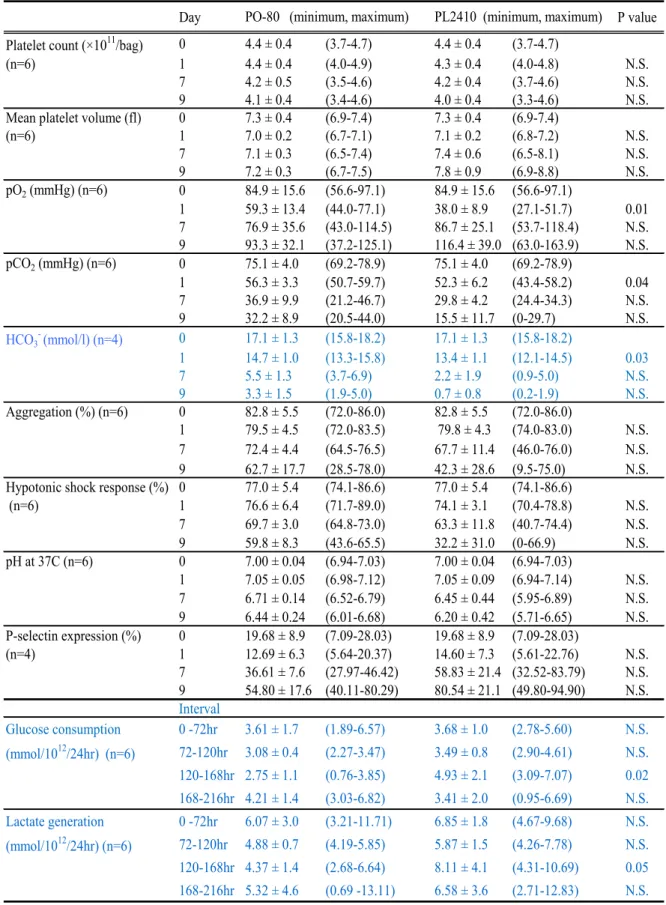
Results Laboratory assessment of platelet quality favored PO-80 during nine days of storage with statistically significant differences in glucose consumption (2.75 vs. 4.93 mmol/10
12/24hrs in the interval 120-168 hrs), lactate generation (4.37 vs. 8.11 mmol/10
12/24hrs in the interval 120-168 hrs), pO
2(59.3 vs. 38.1 mmHg at day 1), and HCO
3-(14.7 vs. 13.4 mmol/L at day 1). Statistically significant differences were not seen in aggregation, hypotonic shock response, or pH. In vivo assessment of autologous platelets stored seven days in the PO-80 container revealed that recovery was 82.1% and survival was 81.0% of fresh control. Seven-day-stored PCs in PO-80 were shown in vivo to be noninferior to fresh platelets, with upper confidence limits (UCL
95) in recovery and survival of stored PCs below the maximum acceptable difference (MAD);
15.3% UCL
95< 20.4% MAD and 2.1 days UCL
95< 2.1 days MAD.
Conclusions The in vitro characteristics of PCs stored in a highly oxygen-permeable
container were stable at least seven days. The in vivo study supports the suitability of
PO-80 for seven-day platelet storage.
Keywords: platelet storage, in vitro platelet quality, in vivo platelet recovery, platelet
survival, kinetics
Introduction
Modern medical practices have increased the demand for platelet transfusion. Moreover, the ageing population of many developed countries tends to increase the demand for platelets while decreasing the potential supply. In concert with more effective donor recruitment and increased collections, it seems prudent to extend the storage period of platelets, provided that safety and efficacy are not compromised. In some countries, the widely accepted five-day storage time has been extended to seven days with the introduction of bacterial screening systems [1, 2]. The threat of episodic platelet shortages provides a strong motivation to investigate technologies that might safely and efficaciously extend platelet shelf life.
If the pH of platelet concentrates (PCs) at 20-24 ºC falls below 6.2, viability in vivo significantly decreases [3]. Thus, a European standard is to maintain pH at or above 6.4 [4]. Hypoxic metabolism provokes a fall in pH due to lactic acidosis; lactic acid displaces bicarbonate and an efflux of CO
2occurs [5]. Since CO
2is produced both as a product of oxidative metabolism and as a result of disappearance of bicarbonate buffer, too low a level of pCO
2may diminish the buffer capacity. Therefore, better oxygen and adequate carbon dioxide gas exchange may slow the platelet storage lesion and improve PC shelf life. However, multi-laboratory examinations show no correlation between high pH and in vivo recovery [6].
Our laboratory previously demonstrated that a polyolefin container with high
oxygen and adequate carbon dioxide permeability (PO-80, Kawasumi Laboratories,
Tokyo, Japan) can preserve in vitro characteristics of platelets, including pH, pCO
2, and
lactate, better than an alternative container (KBO-PO, Kawasumi) during storage for 7
days [7]. Here, we report in vitro effects of platelet storage for up to 9 days, comparing
PO-80 with another polyolefin, PL2410 (Baxter Healthcare, Deerfield, Illinois, USA).
Next, to assess the clinical utility of PO-80, we recruited healthy volunteers to compare in vivo survival and recovery of autologous platelets stored in PO-80 for 7 days with fresh platelets manually separated from whole blood [8] and radiolabelled with either
111
In or
51Cr. This is one of only a few platelet studies to date in which the Murphy
method [9] has been properly executed, analyzed, and reported.
Materials and methods
Donors
Following a protocol approved by the Institutional Review Board of Fukushima Medical University, healthy donors were enrolled after informed consent was obtained and documented. Donor health histories were unremarkable and none had taken any medication known to affect platelet function within 10 days of donation.
In vitro assay
Apheresis PCs were collected from 12 healthy donors using the Amicus cell separator (Baxter Healthcare) configured for double-needle access. PCs collected from two donors with the same ABO blood type were pooled using a sterile connecting device (TSCD; Terumo, Tokyo, Japan) and divided equally into PO-80 and PL2410 (n=6).
Each bag contained 250 mL of plasma and a mean of 4.2 × 10
11platelets. The oxygen permeabilities of PO-80 and PL2410 were, by our measurements, 2.660 L/m
2/day/atm and 2.024 L/m
2/day/atm, respectively. The capacity of each bag was 1.0L.
The characteristics of platelets stored for up to 9 days at 20-24 ºC with agitation
at 50–60 strokes/minute on a flat shaker (PC900i with PF48i, Helmer, Noblesville,
Indiana, USA) were evaluated on days 0, 1, 3, 5, 7 and 9 of storage. Each bag was
sampled with a syringe 6 times (7 mL per sample) during 9 days of storage. Platelet
counts and mean platelet volume (MPV) were determined using an electric cell counter
(Sysmex K-2000; TOA, Kobe, Japan). Hypotonic shock response (%HSR) and the
degree of aggregation were determined as previously written [7]. The pH, pO
2, pCO
2,
and HCO
3-of the PCs were measured at 37 ºC using a pH/blood gas analyzer (ABL3,
Radiometer, Copenhagen, Denmark). The pH measured at room temperature was
automatically calculated as the pH at 37ºC. Swirling degree was estimated visually with a light source and graded from 0 (no swirling) to 2+ (optimal swirling).
To confirm sterility, all PCs were cultured on day 9 for bacteria and fungi in two liquid media, namely, BACTEC Plus Aerobic/F and Plus Anaerobic/F (Becton Dickinson, Sparks, Maryland, USA).
In vivo assay
A minimum sample size of 7 has been required to demonstrate noninferiority of stored PCs to fresh platelets [8]. In this study, 8 healthy donors gave PCs by apheresis: 5 using the Amicus and 3 using the COBE Spectra (Gambro, Lakewood, Colorado, USA).
Both cell separators were configured for double-needle access. PCs were collected in PL2410 and ELP bags. Within 2 hours of collection, products were transferred into PO-80 bags and stored for 7 days in the same manner as the in vitro study. Two systems (eBDS, Pall Corporation, East Hills, New York; and BacT/ALERT, bioMerieux, Marcy I’Etoile, France) were used to detect the presence of bacteria. The BacT/ALERT system was used for sampling 24 hours after collection, and sample bottles (aerobic and anaerobic) were taken from each aliquot to ensure sterility. The eBDS system was used for sampling 48 hours before the end of storage, and its sample pouches were connected to the tubing of the PC bags with a TSCD. All the samples were double-checked using both bacterial detection systems. The platelets in PO-80 were labeled with radioisotopes on day 7.
To prepare fresh platelets [8, 10], whole blood was drawn into an ACD-A bag.
Carefully prepared fresh platelet pellet was gently resuspended in ACD saline before
labeling. Fresh (within 6 hours of collection) and stored (7 day) platelets were
radiolabeled using standard techniques before reinfusion into the original donor [10].
The radiolabel Na
251CrO
4(Daiichi Radioisotope Laboratories, Tokyo, Japan) or
111