• 検索結果がありません。

Do Negative Perceptions of Certified Public Accountants Drive Students’ Career Aspirations? — A Japanese Study

N/A
N/A
Protected

Academic year: 2021

シェア "Do Negative Perceptions of Certified Public Accountants Drive Students’ Career Aspirations? — A Japanese Study"

Copied!
24
0
0

読み込み中.... (全文を見る)

全文

(1)

Accountants Drive Students’ Career Aspirations?

— A Japanese Study

Satoshi Sugahara Kazuo Hiramatsu Gregory Boland

(Received on September 13 , 2007)

Abstract

The purpose of this study is twofold. Firstly we intend to investigate perceptions of the Certified Public Accountants (CPA) held by students studying at graduate accounting schools in Japan. Secondly we explore how these perceptions may affect their career inten- tion as a CPA. Data was collected via a questionnaire completed by tertiary students who were studying at 13 accounting schools in Japan. This survey was undertaken at the end of first semester and during the first week of second semester 2006. These accounting schools were chosen for the study because they consist of two types of students – those who wanted to become a CPA and those who merely wanted to brush up on their accounting skills and do not wish to sit for the CPA entrance exams. Findings indicated that students’ percep- tions of the CPA were crucial predictors in their career aspirations.

Keywords: Accounting Profession, Negative Perception, Certified Public Accountants

Introduction

Following recent serious accounting failures in Japan involving suspect audit

professionals, drastic reforms within the Certified Public Accountants (CPA)

have been undertaken to ensure quality control and reinforce the effectiveness of

auditing practices. To help achieve this goal, a reform action plan, driven by the

Financial Service Agency (FSA) of Japan, focused on increasing the annual num-

bers of CPA examinees. It was argued that a fair and competitive labor market

would force the CPA to engage itself in self-improvement, which in turn would

(2)

lead to transparent and effective auditing practices. For this to occur, the FSA amended the CPA examination scheme in 2003 to make it more “examinee- friendly” particularly for people with little or no accounting background. With such reform, the FSA expects the number of CPAs to more than double by 2018 (Financial System Council, 2002). However, official figures released so far have shown that the number of CPA examinees have in fact declined over the past two years.

1)

Attracting people from other backgrounds into the accounting profession is likely to be difficult due to various factors influencing career choice and major choice of study. Literature has been particularly interested in investigating the perceived image toward accounting and the accounting profession. Historically, the profession has continually suffered negative public perceptions. Images such as accounting being mechanical, repetitive, number crunching, introverted, methodical and tedious are common (Cory, 1992; Cohen & Hanno, 1993; Fisher

& Murphy, 1995; Friedlan, 1995; Saudagaran, 1996; Mladenovic, 2000).

Other researchers have pointed out that such negative images could be the main reason why the brightest students are reluctant to major in accounting at tertiary institutions in the US (Albrecht & Sacks, 2000). More recent studies in the United Kingdom (Marriott & Marriott, 2003), Ireland (Byrne & Willis, 2005), Australia (Jackling, 2002) and New Zealand (Tan & Laswad, 2006) have also confirmed this unfavorable trend. These studies reported commonly that the perceptions held by accounting students seeking an accounting career do not meet the new challenges of the profession brought about by the changing work environment.

Among these countries, Japan has not been insulated from this worldwide

1) The number of applicants for the CPA exam in Japan was 15,322 and 16210 in 2005

and 2006 respectively, while it was 16,310 in 2004 (See the website of the Financial

Service Agency, http://www.fsa.go.jp).

(3)

Drive Students’ Career Aspirations?— A Japanese Study

trend of negativity toward the accounting profession. The accounting profession in Japan had required CPA candidates to pass very competitive exams with lim- ited preparation. This examination system was biased toward mechanical memo- rization and technical knowledge and so is now considered inadequate in the selection process of suitable CPA professionals. It was also believed that the negative image toward the profession assisted in attracting only those students who did not possess the diverse competencies required in today’s rapidly chang- ing financial environment (Financial System Council, 2002).

In response to these negative images, new accounting education institutes were introduced to Japan in 2002. These are professional graduate schools known as

“accounting schools”. Their aim is to attract and educate as many CPA candi- dates as possible from a wide variety of backgrounds and personalities and who have developed certain levels of well balanced generic competencies. (Financial System Council, 2002). In order to attract such well rounded competent students to a CPA pathway, applicants are granted advanced standing toward the CPA examination where appropriate. This CPA reform is quite unique. It was intro- duced in conjunction with the amendment of the CPAs Law in 2003 after con- sideration of the entry requirements prescribed by the International Education Standards (IES). This process was unique because it incorporated the IES into the domestic CPA scheme rather than directly introducing the IES itself.

Identifying the CPA perception by students studying in these accounting

schools and investigating whether these students will pursue an accounting career

(in particular a CPA career), is important if the CPA reform scheme is to prove

satisfactory. To date, there has been little investigation into such perception and

the possible impacts that these perceptions may have on the career aspirations of

Japanese students. The current challenging experiences of this CPA reform in

Japan will have great impact on the neighbouring countries in Asia. Countries

such as China and Korea are considering introducing similar schemes and pro-

(4)

posals set down by the IES body and so will be very interested in the outcomes and implications of the Japanese reform.

This study aims to investigate graduate business students’ perceptions of the CPA in Japan and how these perceptions affect students’ career intentions under the new tertiary accounting scheme in Japan. The next two sections of this paper review literature in this area and discuss the research methodology used for our empirical analyses. Preliminary statistical analysis is then presented to support our research hypotheses. Following these results and discussion, the conclusion summarizes our findings and outlines important limitations of this study.

Literature Review

Stereotypes and examining perceptions toward the accounting profession is not new in accounting literature. Research commenced with the trait and factor theory, in psychological studies (Parsons, 1909). Other accounting researchers found that the primary reason for students to aspire to become accountants was their perception and stereotype held of the profession (e.g. Holland, 1973;

Aranya et al., 1978). According to these studies, individuals try to perceive just how well they would fit into the stereotype or perception of a certain profession when they initially set out to choose a career path. Stereotype and perception have therefore been reported as being the key factors influencing a person’s career choice.

Studies in the US investigated various factors influencing students’ career

choices and discovered significant differences in the factor profiles between stu-

dents who want to become accounting professionals (accounting students) and

those who do not (non-accounting students) (e.g. Paolillo & Estes, 1982; Felton

et al., 1994; Hermanson et al., 1995; Lowe & Simons, 1997). The determining

factors discovered in these studies included nature of the job, earning potential,

required study duration, influences from others such as teachers and so on. Their

(5)

Drive Students’ Career Aspirations?— A Japanese Study

findings confirmed the existence of differences in students’ perceptions from various personal and psychological points of views. Other studies commonly found that the image portrayed by accountants was somewhat negative. Inman et al. (1989), Cohen & Hanno (1993) and Felton et al. (1995) for example studied non-accounting students and found that they perceived an accounting career as boring. Together, these findings have left an unfavorable message in accounting literature that “wrong” perceptions of accounting may drive the “right” person to choose a non-accounting career. Jackling (2002) recently examined Australian undergraduate students and discovered that these students generally perceived accounting as a discipline that is highly oriented to numerical skills and tech- niques. This study confirmed that such a skewed image toward the accounting profession failed to attract students with creative and people-oriented skills that are so desperately sought. More recently, Byrne & Willis (2005) explored the perceptions of the accounting professions held by Irish secondary school stu- dents. They found these students basically view accounting and its profession with the traditional stereotypical images of it being boring, definitive, precise and with a sense of conformed dimensions. It is interesting to note in this Irish study that even though accounting students were more interested in professional accounting careers than non-accounting students, they also held these negative views.

Findings applying alternate research methods within accounting literature also affirmatively supported this trend. Booth and Winzar (1993) and Ramsay et al.

(2000) for example, used the Myer-Briggs Type Indicator (Myers & McCauley,

1985) and found that students were initially attracted to accounting due to their

individual cognitive style. This was reflected in their preference for structured

learning experiences using rules and concepts that enables them to think logically

and objectively. This outcome was also consistent with the findings from other

studies that applied the Kirton Adaption-Innovation Inventory (Kirton, 2003),

(6)

which basically indicated that accounting students tend to be less innovative in terms of their problem solving styles (Gul, 1986; Wolk & Cates, 1994; Sweeny et al., 2000).

In contrast, existing stereotypes of the accounting profession may also lead to the “wrong” people choosing an accounting career. Earlier studies examining this relationship was conducted by Oswick et al.(1994), where tertiary students in the UK were asked their perceptions towards the work of accounting professionals.

Their study used a self-developed inventory containing 23 adjectives that described the accounting profession and also investigated predictive factors that may lead to a student’s interest in the accounting profession. The results of this empirical study discovered that students’ images of accountants having a solitary existence, with poor interpersonal skills and a convergent thinking style were sig- nificantly and negatively associated with their interest in the profession.

Subsequently, Saemann & Crooker (1999) developed their own instrument to measure respondents’ perceptions of the accounting profession (PAPI). Applying the PAPI, they statistically found that the traditional images of accounting using structured problem solving methods and having a solitary work environment had a negative relationship with students’ interest toward the profession. An addi- tional t-test analysis in Saemann & Crooker (1999) study also found that students who were interested in an accounting career didn’t care about the typical image of the profession, but tended to be less creative people.

However, few prior studies have been undertaken to examine students’ percep-

tions of the accounting profession in Japan. Of these Sugahara & Boland (2006)

replicated an overseas study investigating possible relationships of vocational

factors between students who wanted to become a CPA compared to those who

did not. Their findings revealed that non-CPA students tend to view the CPA as

a profession possessing low communication skills, poor career prospects and with

high masculinity. Despite its research limitation where this study simply

(7)

Drive Students’ Career Aspirations?— A Japanese Study

compared differences statistically in perceptions of the CPA between the CPA students and non-CPA students, this exploratory study provided important impli- cations to our understanding of this dichotomy whereby influential factors deter- mined a CPA career. This study left open opportunities to further examine the role of one’s perceptions on his/her aspirations and interest in becoming a CPA in Japan.

Research Methodology

Data Collection

The purpose of this current study is twofold. Firstly this study intends to investigate perceptions of the CPA held by students studying at accounting schools in Japan. Secondly this study also explores how these perceptions may affect their career intentions as a CPA. Data used in this study was collected via a questionnaire completed by graduate students who were studying at 13 accounting schools in Japan. These accounting schools have been developing in Japan since 2003 as the new professional graduate schools. They provide stu- dents with a specialized high quality accounting education. Our questionnaires were administered in the classroom at these accounting schools at the end of first semester and during the first week of second semester in 2006.

The samples collected from these accounting schools were matched to our

research purpose according to future career aspirations. There were basically two

groups of students. One group was preparing themselves for the CPA exam so

they could become a CPA while the other group of students was striving for

additional professional knowledge and fine-tune their practical skills. These lat-

ter students wanted to work in areas other than the accounting sector. Accord-

ingly, our study focused on the differences in perceptions between students who

want to become a CPA (CPA students) and the other students who did not (non-

CPA students).

(8)

Table 1 : Descriptive Information CPA

Other Students (non CPA students)

Other Finance Business Others n/a Total Students

Accounting Year

1

st

year 132 44 9 15 12 7 219

2

nd

year 73 17 8 4 6 3 111

n/a 9 4 2 0 3 1 19

Total 214 65 19 19 21 11 349

Gender

Male 154 46 16 15 20 8 259

Female 60 19 3 4 1 3 90

n/a 0 0 0 0 0 0 0

Total 214 65 19 19 21 11 349

Age

Mean 27.54 30.56 28.22 33.05 30.13 37.11 28.86

Less than 30 153 38 12 7 9 3 222

30-39 31 15 5 7 4 1 63

40-49 16 8 1 5 3 5 38

More than 50 4 2 0 0 0 0 6

n/a 10 2 1 0 5 2 20

Total 214 65 19 19 21 11 349

The 366 questionnaires were distributed and responses collected from the

classrooms at each accounting school. After extracting unusable questionnaires,

our study effectively used 349 responses (95.35% effective response rate). The

majority of unusable responses were due to the incompletion of important sec-

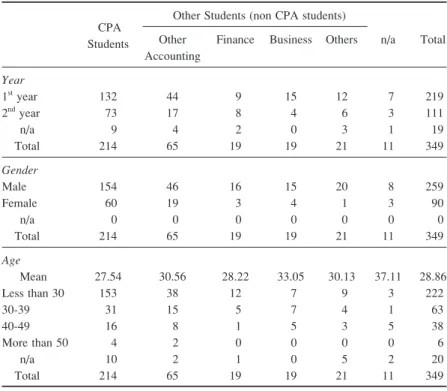
tions of the questionnaire. Table 1 exhibits the descriptive information for our

sample. This table also categorizes students’ career aspirations. Our sample com-

prised 259 males (74.21%) and 90 females (25.79%). Of the total students, 214

wanted to become a CPA (61.31%) while from the remaining students 65 sought

an accounting career other than a CPA (18.62%); 19 sought a finance career

(5.44%); 19 a business career (5.44%) and others made up the remaining 21

(6.01%). There were 11 n/a data recorded (3.15%). Data collection was anony-

(9)

Drive Students’ Career Aspirations?— A Japanese Study

Preliminary Statistical Analysis

As mentioned above, this current study employed similar analysis techniques to those used by Saemann & Crooker (1999). This study conducted a principle component analysis applying to raw data using 36 opposing adjective type ques- tions of the PAPA. This statistical technique is usually applied to condense any underlying pattern of relationships among large numbers of variables. It also enables us to refine the significant linear combination of items within each dimension of perception when there are a large number of variables. Saemann &

Crooker (1999) found four dimensions of perceptions relating to the accounting profession. These included interest (INT), solitary-orientation (SOL), precision or thoroughness (PRE) and structure or rule-orientation (STR). This model has also been used by other researchers who have generally found similar results (Worthington & Higgs, 2003; 2004) although the study by Byrne & Willis (2005) found slightly different dimensions using the same statistical technique. Our cur- mous with respondents not required to record their names or ID. To maintain this anonymity, the surveys were administrated by academics who were not respon- sible for the course delivery.

Questionnaire Development

Students were initially asked demographic questions such as their gender, age, academic year and career aspirations. The second section asked respondents to complete a 36 five-point scale using opposing adjectives based on their percep- tions toward Certified Public Accountants (see Appendix). This instrument, known as “the PAPA” was originally developed by Saemann & Crooker (1999).

It was designed to measure students’ perceptions of the accounting profession.

This same inventory measure has also been used in several other accounting stud-

ies (e.g., Worthington & Higgs, 2003; Byrne & Willis, 2005).

(10)

rent study also applied this principle component analysis to a set of 36 adjectives.

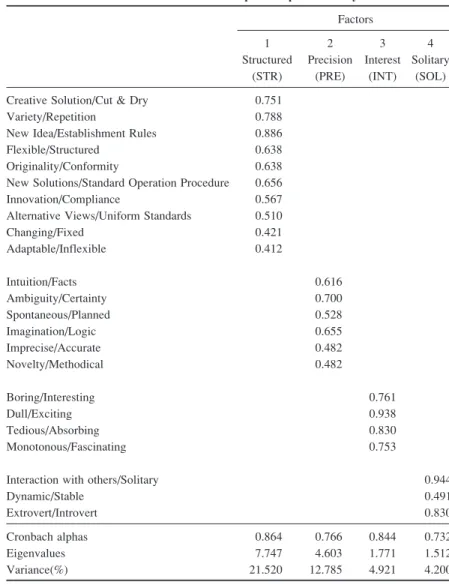
Table 2 displays the results of our principle component analysis. It contains details of the extracted components, eigenvalues, percentage of variance for each factor and component scores for all factors allocated in each perceived dimen- sion. As the result of analysis, Cattell’s screen test allowed us to pick up four factors. The resulting factor scores produced a total 43.426% of cumulative per- centage of variance in this model.

Each score of component attribute was refined by principle component analy- sis from observed variables measured on a five-point Likert scale. Using this scale a one describes a strong disagreement while a five describes strong agree- ment. The latent constructs with a greater than 0.4 score were used to provide appropriate labels for each component factor. These labels are also reported in Table 2.

Our principle component analysis was undertaken using the Promax rotation technique to assist with the interpretation of potential influential factors. This method has also been widely used in previous studies in accounting literature (e.g. Ahmadi et al., 1995). The Kaiser Meyer Olkin (KMO) adequacy value was calculated as 0.874, which indicated that the correlation matrix was appropriate for factor analysis.

To interpret each component factor, our study compared all attributes allocated in the factor groups with the outcomes from Saemann & Crooker (1999). The component factors obtained in this current study were labeled as “structure”

(STR) for the first factor, “precision” (PRE) for the second factor, “interest”

(INT) for the third factor and “solitary” (SOL) for the fourth factor in accordance with those used by Saemann & Crooker (1999).

It was found that the attributes in the third and fourth factors correspond exactly to Saemann & Crooker’s (1999) “interest” (INT) and “solitary-orientation”

(SOL). The first factor of “structure” (STR) contains two different attributes that

(11)

Drive Students’ Career Aspirations?— A Japanese Study

Table 2: The Results of Principle Component Analysis Factors

1 2 3 4

Structured Precision Interest Solitary

(STR) (PRE) (INT) (SOL)

Creative Solution/Cut & Dry 0.751

Variety/Repetition 0.788

New Idea/Establishment Rules 0.886

Flexible/Structured 0.638

Originality/Conformity 0.638

New Solutions/Standard Operation Procedure 0.656

Innovation/Compliance 0.567

Alternative Views/Uniform Standards 0.510

Changing/Fixed 0.421

Adaptable/Inflexible 0.412

Intuition/Facts 0.616

Ambiguity/Certainty 0.700

Spontaneous/Planned 0.528

Imagination/Logic 0.655

Imprecise/Accurate 0.482

Novelty/Methodical 0.482

Boring/Interesting 0.761

Dull/Exciting 0.938

Tedious/Absorbing 0.830

Monotonous/Fascinating 0.753

Interaction with others/Solitary 0.944

Dynamic/Stable 0.491

Extrovert/Introvert 0.830

Cronbach alphas 0.864 0.766 0.844 0.732

Eigenvalues 7.747 4.603 1.771 1.512

Variance(%) 21.520 12.785 4.921 4.200

Extraction method, Principle Component Analysis

Rotation method, Promax technique with Kaiser normalization

Factor loadings > 0.4 reported

(12)

did not appear in Saemann & Crooker’s (1999) study. These two attributes were

“variety/repetition” and “originality/conformity”, which were synchronized with the factor label “structure” (STR). The second factor of our study comprised three attributes that corresponded to the “precision (PRE)” factor of Saemann &

Crooker (1999). The remaining three of the original six attributes were “intuition/

facts”, “ambiguity/certainty” and “imagination/logic”. Together, these are likely to become components that could reinforce the meaning of “precision”.

Additionally, the internal reliabilities of the response to the four component factors were measured in terms of Cronbach alphas. Basically, a score greater than 0.7 of Cronbach alphas is regarded as acceptable to indicate sufficient inter- nal reliability. Our alpha scores of 0.864, 0.766, 0.844 and 0.732 for STR, PRE, INT and SOL respectively, compared favorably with the range of 0.64–0.89 achieved by Saemann & Crooker (1999) and the range of 0.71–0.81 obtained in the Byrne & Willis (2005) study.

Hypotheses Development

From our preliminary analysis above, our study progressed to investigate the primary research purpose by examining the relationships between accounting school graduate students’ perceptions of the CPA and their career aspirations.

This was achieved through the application of a regression analysis. In this model, students’ interest (INT) in the CPA was used as the surrogate of students aspira- tion, and then this factor was regressed with students’ other perceptive factors of STR, PRE and SOL. As mentioned this method was also employed by Saemann

& Crooker (1999). Accordingly, the first hypothesis, described in null form is as follows.

H1: A students’ view of the CPA as being interesting has no relation to one’s

perceptions of the CPA in Japan.

(13)

Drive Students’ Career Aspirations?— A Japanese Study

The following regression model was created to investigate this hypothesis.

INT = a + b

1

STR + b

2

PRE + b

3

SOL + e i

In addition, this study examined differences in the mean scores of regression variables to ensure the existence or not of any significant differences under the linear relationship with students’ career aspirations. The sample was categorized into five groups according to whether students desire to work as a CPA, in accounting other than the CPA, in a finance area, a business management area or other areas. The t-test and ANOVA test was used to explore the following hypothesis, again in null form.

H2: There are no significant differences in perceptions of the CPA in Japan regardless of a student’s career aspiration.

Results

The Regression results

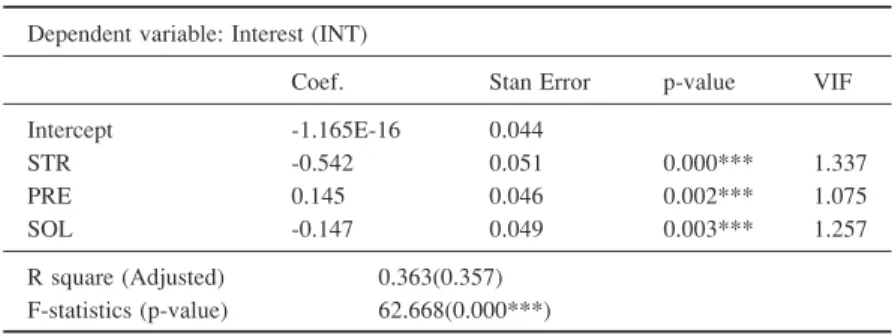
Table 3 reports the results of our regression analysis for students’ interests

(INT) in the CPA using the three independent variables of their perceptions

(STR, PRE and SOL). The results indicated that INT had a significant and posi-

tive relationship with the PRE at the level of less than 0.01. Conversely, the INT

showed significant but negative relationships with the STR and the SOL at the

level of less than 0.01. The R square and the adjusted R square of this model

were 0.363 and 0.357 respectively. The F-statistic and p-value were calculated as

62.668 at the level of less than 0.01. This study also explored the Variance Infla-

tion Factors (VIF) to identify any possible multicollinearity issues. The largest

VIF in our study was 1.337 indicating that our analysis model was free from any

multicollinearity problems. The evidence produced by this regression was suffi-

(14)

Table 3: Regression Result Dependent variable: Interest (INT)

Coef. Stan Error p-value VIF

Intercept -1.165E-16 0.044

STR -0.542 0.051 0.000*** 1.337

PRE 0.145 0.046 0.002*** 1.075

SOL -0.147 0.049 0.003*** 1.257

R square (Adjusted) 0.363(0.357) F-statistics (p-value) 62.668(0.000***)

*** significant at the less 0.01 level

ciently strong enough to provide reliability for our hypothesis H1 to be rejected.

The t-test and ANOVA Results

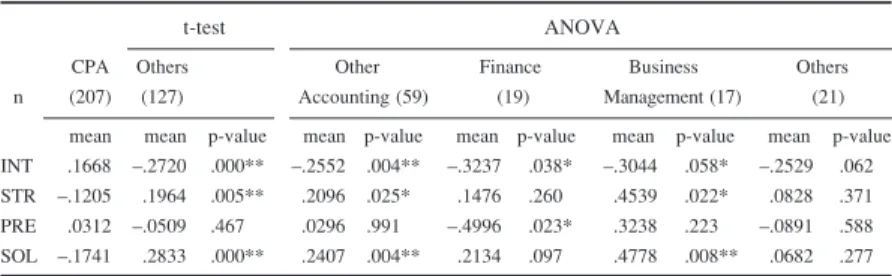
A t-test and an ANOVA test were applied to test possible differences in the mean scores of the four variables used in the regression analysis between CPA students and others (ie non CPA students). Table 4 reports the outcomes of this analysis. Firstly, the results of the t-test indicated that CPA students perceived the CPA as a significantly more interesting job than Other Students did. In con- trast, the results also confirmed that non CPA students viewed the CPA as a sig- nificantly more structured and solitary job than CPA students did.

Further, the ANOVA test was conducted with the Ordinal Least Squares

(OLS) method to explore statistical differences in the four perceptive variables

between CPA students and students who have different career aspirations. These

four student groups were empirically compared to students who sought a CPA

career. From this statistical evidence it was found that CPA students perceived

the CPA as being a significantly more interesting job compared to other account-

ing students, finance or business management students. Conversely, other

accounting students and business management students regarded the CPA as

being a more significantly structured and solitary job than CPA students did. The

(15)

Drive Students’ Career Aspirations?— A Japanese Study

Table 4: The t-test and ANOVA Results

t-test ANOVA

CPA Others Other Finance Business Others

n (207) (127) Accounting (59) (19) Management (17) (21)

mean mean p-value mean p-value mean p-value mean p-value mean p-value INT .1668 –.2720 .000** –.2552 .004** –.3237 .038* –.3044 .058* –.2529 .062 STR –.1205 .1964 .005** .2096 .025* .1476 .260 .4539 .022* .0828 .371 PRE .0312 –.0509 .467 .0296 .991 –.4996 .023* .3238 .223 –.0891 .588 SOL –.1741 .2833 .000** .2407 .004** .2134 .097 .4778 .008** .0682 .277

** significant at the level of less than 0.01, * significant at the level of less than 0.05

results also discovered that finance students perceived the CPA as a significantly less precise job than the CPA students did. These results were all obtained at the less than 0.01 or 0.05 significance levels. Accordingly, it was also safe to reject our second hypothesis H2.

Interpretations

The primary finding from our regression analysis was that the more likely stu- dents perceived the CPA as a profession with structure and solitary characteris- tics, the less likely they were attracted to it. The t-test results added a further dimension that CPA students perceived their profession as having less structure and being less lonely than non-CPA students. In other words CPA students who were more interested in becoming the CPA regard its profession with a less traditional image compared to the non-CPA students who view the profession in the traditional negative way being structured and quite lonely.

This result is consistent with the outcomes from several studies conducted overseas. These included the discovery that students who were not interested in the CPA career viewed its profession as being isolated (Oswick et al., 1994 in UK: Saemann & Crooker, 1999 in US) and being structured (Saemann &

Crooker in US; Ramsay et al., 2000 in Australia). This finding was also sup-

ported in a recent Australian study by Jackling (2006) who discovered that nega-

(16)

tive views of the accounting profession were less likely to be held by students who intended to undertake an accounting career compared to students who didn’t.

It is also interesting to note that the t-test results revealed that Japanese stu- dents conform to the stereotypical image of the CPA as being a career with high precision. This was supported by the fact that the static score for PRE was rated relatively high for both the CPA and non-CPA student groups. This result is also consistent with the prior studies by Saemann & Crooker (1999) in the US and Byrne & Willis (2005) in Ireland. Both these studies found that while there was no significant difference in the perceived image of job precision between accounting and non-accounting students, both groups rated its score relatively high. Students from these two prior studies also regarded this stereotype as being one of the limiting aspects of pursuing a CPA career.

Our ANOVA test discovered that the precision (PRE) score for finance major students was significantly lower than all other student groups, indicating that they have a perception of the CPA being a profession with less precision. This find- ing is supported by the findings from a previous Australian study produced by Worthington & Higgs (2003). Their study empirically confirmed that finance students hold a stronger image regarding the high levels of precision required in finance subjects compared to students from other majors. This image of low pre- cision perceived by finance students may in fact devalue their rating of the preci- sion required in the CPA profession. So following on from this, it is likely that these finance major students won’t perceive the CPA as one requiring higher lev- els of precision relative to other student groups.

Accordingly, it was found that the perception of the CPA by Japanese students

was very similar to the findings reported from overseas countries. Similarly and

although not unique, there also exists the perception that non-CPA students per-

ceive the profession with a negative stereotype. Some prior studies conversely

(17)

Drive Students’ Career Aspirations?— A Japanese Study

Conclusion

The purpose of this study was to examine the perceptions toward the CPA by Japanese tertiary business students in an attempt to identify its role in the process of career aspiration under the latest reform of the CPA scheme. Our study col- lected samples from accounting schools, which have been recently established to provide a professional accounting education. The results of our empirical analy- ses revealed that CPA students who study at the accounting school were less likely to perceive the CPA as a profession with the traditional negative image.

Our findings were very similar to studies conducted by Jackling (2006) in Australia, where students’ positive perceptions of the CPA would be crucial pre- dictors on their career intentions toward the CPA.

Although the CPA/IES reform in Japan is unique in that it still has a domestic flavour embedded, our current study has found the new challenges have achieved more positive outcomes in relation to CPA candidates. In a recent report some accounting schools in Japan (e.g. Tohoku University Graduate School of Accounting) have actually incorporated special units into their curriculum in order to develop different aspects of student learning. These include developing generic skills, professional ethics and IT skills in addition to the traditional tech- nical skills. According to our results this new trend in curriculum offering will place these Japanese accounting schools in good stead to produce well-qualified CPAs who meet the demands of our current society.

However it should be noted that accounting education research has not been active in Japan. Academia must play its role in curriculum development to ensure found that the impact of factors affecting one’s career choice would diversify across nations or cultural groups (e.g. Auyeung & Sands, 1997; Danziger &

Eden, 2006). Our study found that negative perceptions of the CPA existed in the

minds of tertiary students regardless of their country of origin.

(18)

the new CPA scheme continues to be successful. It must expand away from its technical focus. Using educational research, accounting educators in Japan must develop curricula that inspires and motivates the new age CPA candidates. The same applies to undergraduate studies where more effective programmes are required in order to attract new candidates earlier into a CPA career.

The CPA reform in Japan can be contrasted with other Asian countries such as Malaysia and Hong Kong. In these latter countries the intention is to inherit the IES accounting professional standards directly as they are stipulated. However, there are other Asian countries such as Korea and China who are still consider- ing how to incorporate the IES into their domestic educational programs (Joo et al., 2007). Asian countries usually address such issues according to their social systems and often this method is quite unique compared to that existing in west- ern countries. Consequently, the experience of the Japanese CPA reform will be keenly watched, evaluated and any implications addressed by neighbouring coun- tries before any decision will be made to implement such reforms.

Our results also revealed that some of the students in the accounting schools who had no intention of becoming a CPA tended to still view the profession negatively. These findings raise questions as to the validity of the actual strate- gies used by the FSA in achieving the CPA reform in Japan. Even introducing specialized accounting schools and amending the CPA law to encourage non- accounting students to obtain CPA qualifications, via advanced standing etc, has failed to increase the current number of CPA applicants. Our study implies this is because accounting policy makers in Japan frequently ignore the impact of stu- dents’ perceptions toward the CPA particularly among non-CPA students. These students should still be considered as potential candidates for a CPA pathway in tertiary institutions and so receive appropriate attention.

It should be noted that in Japan both the accounting professional body and aca-

demics have not had a good record in attracting people to the CPA. In contrast,

(19)

Drive Students’ Career Aspirations?— A Japanese Study

western countries such as the US and Australia have taken on this challenge and make effective use of the media and special activities in an attempt to improve the negative images of accounting and improve the numbers entering the profes- sion (Jackling, 2006). Compared to these western countries, there has also been a lack of accounting research in this important area, which could help explain the predicament that Japan now finds itself in. Even simple studies on demographic details of CPA applicants are lacking in Japan.

It is hoped that the contribution of our current study will provide the account- ing profession in Japan a better understanding on the perceptions that tertiary stu- dents have on the CPA. This study will provide other researchers an opportunity to follow on and in so doing attempt to provide better and more effective strate- gies to address the downward trend of numbers currently entering the profession.

This study does have limitations. Firstly, it investigated simple statistical asso- ciations among students’ perceptions. Studies overseas have extended this line of research and have found significant relationships between student perceptions and their cognitive styles and learning styles. Our study failed to incorporate such advanced psychological factors into the research model. Secondly, the sample for our study was quite limited. It was collected only from students studying in accounting schools. Even though these students make up the majority of CPA candidates, large numbers of CPA examinees and other non CPA students com- ing from alternate pathways were ignored in this study. Similarly, while the Japanese accounting society is providing new entry options for non CPA students who may not be interested in the auditing aspect, we still must not ignore their perceptions of the CPA if we are to successfully address this serious issue. Such comparative analyses between these groups of students will further enhance our understanding on the strengths and weaknesses in the CPA career market of Japan and so establish effective strategies.

Despite these limitations, this study has successfully provided accounting

(20)

research with a new point of view regarding the perceptions of the CPA by students studying in accounting schools in Japan.

Acknowledgement

The authors would like to acknowledge considerable support for collecting data by 13 participating schools in this study: Aichi University, Aoyama Gakuin University, Chuo University, Chiba University of Commerce, Hokkaido Univer- sity, Hosei University, Kansai University, Kwansei Gakuin University, Konan University, LEC Graduate School of Accounting, Meiji University, Tohoku Uni- versity, Waseda University. We also great appreciate assistance on processing data by anonymous students of Kwansei Gakuin University. In providing finan- cial support for this research project, the authors would like to thank the assis- tance of the research grant awarded in 2006 by the Research Institute of Hiroshima Shudo University.

Bibliography

Albrecht, W. S. and R. J. Sack (2000) Accounting Education: Charting the Course Through a Perilous Future, Accounting Education Series, No.16, Sarasota Florida: American Accounting Association.

Ahmadi, M., M. M. Helms and P. Nodouchani (1995) A factor-analytic approach profiling job selection differences of male and female accountants, Managerial Auditing Journal, 10(7), pp.17–24.

Aranya, N., E. I. Meir and A. Bar-Ilan (1978) An Empirical Examination of the Stereotype Accountant Based on Holland’s Theory, Journal of Occupational Psychology, 51 (1), pp.139–145.

Auyeung, P. and J. Sands (1997) Factors influencing accounting students’ career choice: a cross-cultural validation study, Accounting Education: an international journal, 6(1), pp.13–23.

Booth, P. and H. Winzar (1993) Personality Biased of Accounting Students: Some Impli- cations for Learning Style Preferences, Accounting and Finance, 33(2), pp.109–120.

Byrne, M. and P. Willis (2005) Irish Secondary Students’ Perceptions of the Work of an

(21)

Drive Students’ Career Aspirations?— A Japanese Study Accountant and the Accounting Profession, Accounting Education: an international Journal, 14(4), pp.367–381.

Cohen, J and Hanno. D. M. (1993) An Analysis of the Underlying Constructs Affecting the Choice of Accounting As a Major, Issues in Accounting Education, 8(2), pp.219–

238.

Cory, S. (1992) Quality and quantity of accounting students and the stereotypical accoun- tant: is there a relationship? Journal of Accounting Education, 10, pp.1–24.

Danziger, N. and Y. Eden (2006) Student Career Aspirations and Perceptions: The Case of Israeli Accounting Students, Accounting Education: an international journal, 15(2), pp.113–134.

Felton, S., N. Buhr and M. Northey (1994) Factors Influencing the Business Student’s Choice of a Career in Chartered Accountancy, Issues in Accounting Education, 9(1), pp.131–141.

Felton, S., T. Dimnik and M. Northey (1995) A Theory of Reasoned Action Model of the Chartered Accounting Career Choice, Journal of Accounting Education, 13(1), pp.1–19.

Financial System Council (2002) A Report of Subcommittee on Certified Public Accoun- tants System: Vitalizing the Certified Public Accountants Audit System, Financial Service Agency, December 17th.

Fisher, R and Murphy, V. (1995) A Pariah Profession? Some students’ perceptions of accounting and accountancy, Studies in Higher Education, 20(1), pp.45–58.

Friedlan, J. M. (1995) The Effects of Different Teaching Approaches on Students’ Percep- tions of the Skills Needed for Success in Accounting Courses and by Practicing Accountants, Issues in Accounting Education, 10(1), pp.47–63.

Gul, F. A. (1986) Adaption-innovation as a factor in Australian accounting undergraduates’

subject interests and career preferences, Journal of Accounting Education, 4(1), pp.203–209.

Hermanson, D. H., R. H. Hermanson and S. H. Ivancevich (1995), Are America’s Top Business Students Steering Clear of Accounting? Ohio CPA Journal, 54(2), pp.26–

30.

Holland, J. L. (1973) Making Vocational Choice: A Theory of Career, Englewood Cliffs, N. J., Prentice Hall.

Inman, B. C., A. Wenzler, and P. D. Wickert (1989), Square Pegs in Round Holes: Are Accounting Students Well-Suited to Today’s Accounting Profession?, Issues in Accounting Education, 4(1), pp.29–47.

Jackling, B. (2002) Are Negative Perceptions of the Accounting Profession Perpetuated by

(22)

the Introductory Accounting Course? – an Australian Study, Asian Review of Accounting, 10(2), pp.62–80.

Jackling, B (2006) Influences on Undergraduate Students’ Intentions to become Qualified Accountants: Evidence from Australia, Accounting Education: an international jour- nal, 15(4), pp.419–438.

Joo, I., S. Kwon, L. Hwang, T. Shim, T. Sugimoto (2007), International Education Stan- dards and Their Implications for Accounting Edcuation and CPA Certification in Korea, Business & Accounting Review; Kwansei Gakuin University, 2, pp.67–95.

Kirton, M. J. (2003) Adaption-Innovation – In the Context of Diversity and Change, New York; Routledge.

Lowe, D. and Simons, K. (1997) Factors influencing choice of business majors – some additional evidence: a research note, Accounting Education: an international jour- nal, 6(1), pp.39–45.

Marriott, P. and N Marriott (2003) Are we turning them on? A longitudinal study of under- graduate accounting students’ attitudes towards accounting as a profession, Accounting Education: an international journal, 12(3), pp.113–133.

Mladenovic, R. (2000) An investigation into ways of challenging introductory accounting students’ negative perceptions of accounting, Accounting Education: an interna- tional journal, 9(2), pp.135–155.

Myers, I. B. and M. H. McCauley (1985) Manual: A guide to the development and use of the Myers Briggs Type Indicator, Palo Alto, CA: Consulting Psychologists Press.

Oswick, C., P. Barber and R. Speed (1994) A study of the perception of public accounting skills held by UK students with accounting and non-accounting career aspirations, Accounting Education: an international journal, 3(4), pp.283–294.

Paolillo, J. G. P. and R. W. Estes (1982) An Empirical Analysis of Career Choice Factors Among Accountants, Attorneys, Engineers, and Physicians, The Accounting Review, 57(4), pp.785–793.

Parsons, F. (1909), Choosing a vocation, Boston: Houghton Mifflin.

Ramsay, A., D. Hanlon and D Smith (2000) The association between cognitive style and accounting students’ preference for cooperative learning: an empirical investigation, Journal of Accounting Education, 18, pp.215–228.

Saemann, G. P. and K. J. Crooker (1999) Student perception of the profession and its effect on decisions to major in accounting, Journal of Accounting Education, 17(1), pp.1–22.

Saudagaran, S. M. (1996) The first course in accounting: an innovative approach, Issues in

Accounting Education 11(1), pp.83–94.

(23)

Drive Students’ Career Aspirations?— A Japanese Study Sugahara, S. and G. Boland (2006) Perceptions of the Certified Public Accountants by

accounting and non-accounting tertiary students in Japan, Asian Review of Account- ing, 14(1/2), pp.149–167.

Sweeny, J., C. Wolk, S. Summers and J. Kurtenbach (2000) Problem-solving style and suc- cess in accounting curricula, Advances in Accounting Education, 2, pp.219–234.

Tan, L. M. and F. Laswad (2006) Students’ beliefs, attitudes and intentions to major in accounting, Accounting Education: an international journal, 15(2), pp.167–187.

Wolk C. M. and Cates, T. A. (1994) Problem-solving styles of accounting students: are expectations of innovation reasonable? Journal of Accounting Education, 12(4), pp.268–281.

Worthington, A. C. and H. Higgs (2003) Factors explaining the choice of a financial ma- jor: the role of students’ characteristics, personality and perceptions of the profes- sion, Accounting Education: an international journal, 12 (3), 261–281.

Worthington, A. C. and H. Higgs (2004) Factors explaining the choice of an economics

major: the role of students’ characteristics, personality and perceptions of the pro-

fession, International Journal of Social Economics, 13 (5/6), 593–592.

(24)

Appendix

Each row in the following table (a)-(aj) shows pairs of words. Think of them as opposites.

Consider each pair and select either one in terms of how best you feel it describes the accounting profession. Please circle only one response for each question to express the strength of your opinion.

a Creative Solution 1 2 3 4 5 Cut & Dry

b Repetition 1 2 3 4 5 Variety

c New Ideas 1 2 3 4 5 Established Rules

d Boring 1 2 3 4 5 Interesting

e Challenging 1 2 3 4 5 Easy

f Dull 1 2 3 4 5 Exciting

g Flexible 1 2 3 4 5 Structured

h Solitary 1 2 3 4 5 Interaction With Others

i Conformity 1 2 3 4 5 Originality

j Dynamic 1 2 3 4 5 Stable

k Standard Operating Procedures 1 2 3 4 5 New Solutions

l Extrovert 1 2 3 4 5 Introvert

m Conceptual 1 2 3 4 5 Analytical

n Innovation 1 2 3 4 5 Compliance

o Intuition 1 2 3 4 5 Facts

p Ambiguity 1 2 3 4 5 Certainty

q Planned 1 2 3 4 5 Spontaneous

r People-Oriented 1 2 3 4 5 Number Crunching

s Practical 1 2 3 4 5 Theoretical

t Tedious 1 2 3 4 5 Absorbing

u Fascinating 1 2 3 4 5 Monotonous

v Abstract 1 2 3 4 5 Concrete

w Effectiveness 1 2 3 4 5 Efficiency

x Imagination 1 2 3 4 5 Logic

y Thorough 1 2 3 4 5 Superficial

x Unpredictable 1 2 3 4 5 Routine

aa Details 1 2 3 4 5 Overview

ab Accurate 1 2 3 4 5 Imprecise

ac Alternative Views 1 2 3 4 5 Uniform Standards

ad Changing 1 2 3 4 5 Fixed

ae Methodical 1 2 3 4 5 Novelty

af Record Keeping 1 2 3 4 5 Decision Making

ag Benefits Society 1 2 3 4 5 Profit-Driven

ah Prestigious 1 2 3 4 5 Ordinary

ai Adaptable 1 2 3 4 5 Inflexible

aj Mathematical 1 2 3 4 5 Verbal

Table 1 : Descriptive Information CPA
Table 2: The Results of Principle Component Analysis Factors
Table 3: Regression Result Dependent variable: Interest (INT)
Table 4: The t-test and ANOVA Results

参照

関連したドキュメント

This paper analyzes the relationship between the level of citizen participation,the degree of citizen's satisfaction with PI, and the degree of recognition of the plan, by using

【Details of the study】Surveys were conducted for a wide range of interviewees, including doctors, Japanese students, foreign students studying abroad in Japan, stakeholders of

This paper aims to study the history of Chinese educational migration and state policies which influence overseas Chinese students, to explore the mobility tendency of

  The number of international students at Kanazawa University is increasing every year, and the necessity of improving the international students' Japanese writing skills,

国際会計基準審議会(International Accounting Standards Board: IASB)の前身である国際 会計基準委員会(International Accounting Standards Committee:

 The present study examined the infl uence of empathy and contextual understanding on the performance of social skills in university students. Seventy-one university students

and German Cost Accounting Methods”, Management Accounting Quarterly ,Volume 8,Issue

Manufacturing techniques Determination of basic material properties Performances Accounting for long-term degradation Adhesive bonding Design allowable strength