独立行政法人医薬基盤研究所薬用植物資源研究セン
ター(〒3050843 茨城県つくば市八幡台 12)
e-mail: kawahara@nibio.go.jp
本総説は,日本薬学会第 130 年会シンポジウム S45 で
発表したものを中心に記述したものである.
―Review―
生薬・薬用植物における国際調和の動向―「生薬・薬用植物に関する国際調和のための
西太平洋地区討論会(FHH)」 の取り組み―
川 原 信 夫
Recent Progress of International Harmonization of Crude Drugs and Medicinal Plants
―Activity of FHH (The Western Paciˆc Regional Forum for the
Harmonization of Herbal Medicines)―
Nobuo K
AWAHARA
Research Center for Medicinal Plant Resources, National Institute of Biomedical Innovation (NIBIO),
12 Hachimandai, Tsukuba, Ibaraki 3050843, Japan
(Received September 30, 2010)
The Western Paciˆc Regional Forum for the Harmonization of Herbal Medicines (FHH) was established in 2002.
The general proposed objective of the FHH is to promote public health by recognizing and developing standards and
technical guidelines that aim to improve the quality, safety and e‹cacy of herbal medicines. At a sub-committee meeting
of FHH nomenclature and standardization held in Tokyo, all the participants recognized the importance of comparing
the descriptions of herbal medicines contained in member countries' pharmacopoeias or monograph standards as the
ˆrst step in the harmonization of nomenclature and standardization. It was agreed to set up ˆve expert working groups
(EWG) to carry out the following speciˆc tasks: 1) Nomenclature, 2) Testing Methods in Monographs, 3) List of
Chemical Reference Standards (CRS) and Reference of Medicinal Plant Materials (RMPM), 4) List of Analytically
Validated Methods, and 5) Information on General Tests. In this review, we report four topics of FHH activities from
2002
2009 as follows: 1) Comparative study on testing methods and speciˆcation values for crude drugs used in
mono-graphs among four Western Paciˆc regional countries (Japan, China, Korea and Vietnam), 2) Comparative study on
TLC conditions for identiˆcation, chemical assay conditions for component quantiˆcation used in monographs among
the four countries, 3) Comparative study on general testing methods for crude drugs among the four countries, 4)
Com-parative study on TLC identiˆcation for crude drugs used in monographs among the four countries considering
har-monization and clean analysis.
Key words―pharmacopoeia; crude drug; medicinal plant; FHH (The Western Paciˆc Regional Forum for the
Har-monization of Herbal Medicines)
1.
はじめに
近年,代替医療として漢方薬あるいは生薬への関
心が高まる中で,名称の類似,同名異物等の問題が
表面化してきている.生薬の安全性を確保し,有効
利用を考える上で,生薬の正しい認識と理解が必須
であり,各国で使用されている生薬に関する情報を
収集,整理し,共通認識を得ることは生薬,薬用植
物の国際調和の観点からも非常に重要と考えられ
る.このような背景から 2002 年 3 月に北京におい
て「生薬・薬用植物に関する国際調和のための西太
平洋地区討論会(FHH)」設立のための国際会議が
開催された.本フォーラムでは,西太平洋地区の 6
ヵ国 7 地域(日本,中国,韓国,ベトナム,シンガ
ポール,オーストラリア,香港)の生薬・薬用植物
の規制に関する関係者が一堂に会し,生薬・薬用植
物の安全性,有効性及び品質に関する技術的な記録
とコンセンサスを提供することが目的に掲げられ
た.日本はその下部組織である Nomenclature and
Standardization に関する Sub-Committee 会議を主
催することを受諾し,2002 年 5 月,FHH 東京会議
が開催された.本会議において以下の 5 つの専門部
会(Expert working group, EWG)が設立された.
Mono-Table 1.
Pharmacopoeias Used in Preparation of
Compara-tive Tables
日本薬局方 (JP)
第 15 改正日本語版,英語版
日本薬局方外生薬規格
1989 年日本語版
中華人民共和国葯典 (CP)
2005 年版中国語版,英語版
大韓民国薬局方 (KP)
2002 年第 8 版韓国語版,
英語版
ベトナム薬局方 (VP)
2005 年第 3 版英語版
graphs, 3) List of Chemical Reference Standards
(CRS) and Reference of Medicinal Plant Materials
(RMPM), 4) List of Analytically Validated Method,
5) Information on General Test
これらの専門部会では,それぞれの分野における
各国薬局方の比較表を作成することが課題事項とし
て議決された.EWG 2 (Testing Method in
Mono-graphs)の責任者となった筆者は,試験法及び規格
値に関する比較表の作成について担当することとな
った.
今回の総説では,主として筆者が FHH の専門部
会において取り組んできた各種比較表の作成に関す
る内容並びに作成の際に得られた知見について報告
する.
2.
西太平洋地区 4 ヵ国(日本,中国,韓国,ベ
トナム)の薬局方収載生薬の比較に関する研究
2-1.
各種試験法並びに規格値の比較
1)EWG
2 では将来的な国際調和を踏まえ,各国の薬局方収
載生薬について共通点と相違点を認識すること目的
として,日本,中国,韓国,ベトナム 4 ヵ国の薬局
方に収載された生薬の試験法並びに規格値について
比較表を作成し,比較検討を行った.比較表は,
EWG 1 (Nomenclature)の責任者である酒井博士
が作成した共通生薬(103 種)の比較表を基に各国
の確認試験,純度試験,乾燥減量,灰分,酸不溶性
灰分,エキス含量及び定量法の各項目について試験
法の設定の有無,試験方法,規格値について作成し
た.
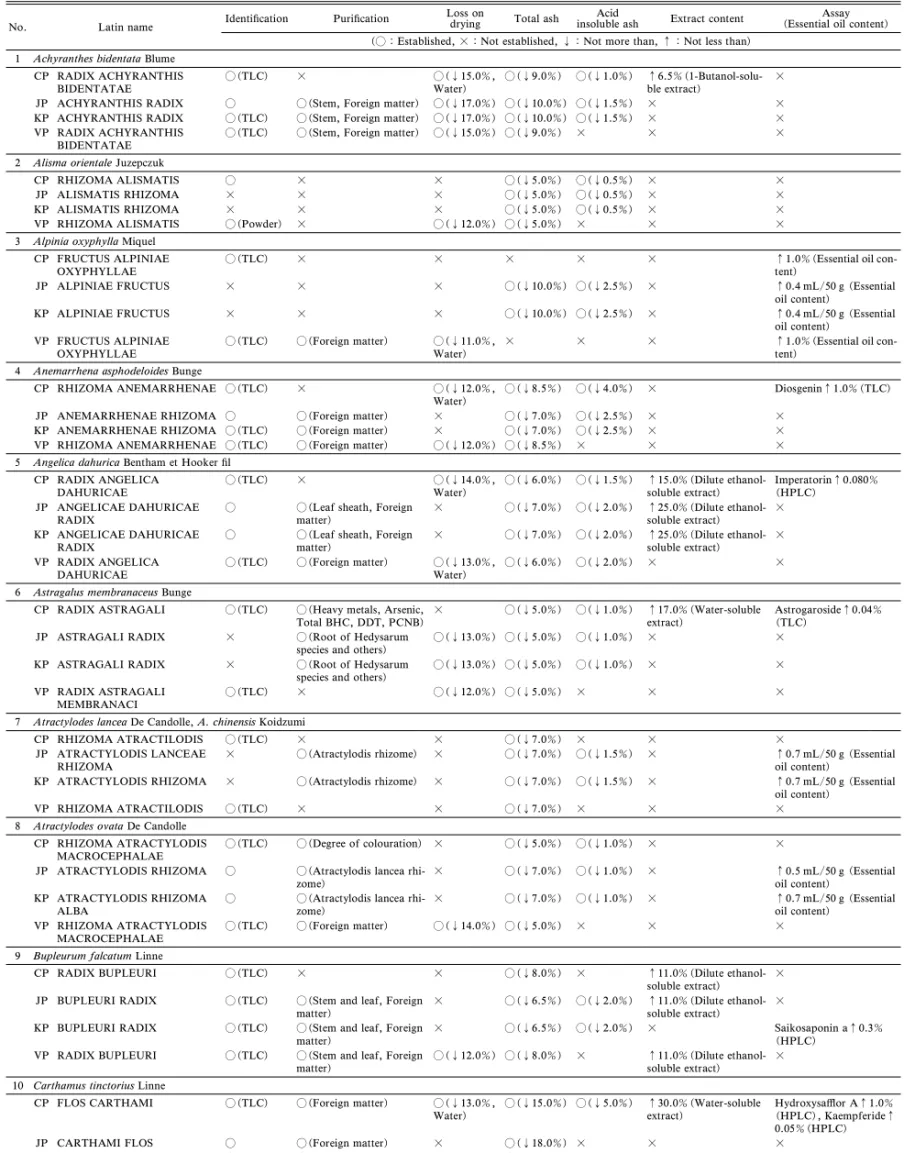
比較検討に用いた各国薬局方を Table 1 に示す.
また,各国の各種試験法の比較に関して作成した表
の一部を Table 2 に示す.この結果,4 ヵ国局方すべ
てにおいて共通の基原植物に由来する生薬は 57 種
であった.4 ヵ国共通生薬 57 種に関して比較を行っ
た場合,確認試験,純度試験,灰分の 3 項目につい
てはすべての局方においてほぼ設定がなされてお
り,特に TLC 法を用いた確認試験が普及している
ことが明らかとなった.サイコ,ケイヒ,サンシシ,
カンゾウ,コウボク,シャクヤク,ボタンピ,ニン
ジン,ダイオウ,ゴミシ,インヨウカク,ウコンの
12 生薬はすべての局方に TLC 法による確認試験が
設定されている.これら 12 生薬のうちサイコ,ケ
イヒ,サンシシ,カンゾウ,ボタンピ,ダイオウ,
ウコンはすべての局方で灰分の設定もなされてお
り,さらにケイヒ,サンシシは灰分の規格値がすべ
ての局方で同一であった.一方,乾燥減量,酸不溶
性灰分,エキス含量等は設定されていない国が多か
った.また定量法に関してはカンゾウ(glycylrrhi-zinic
acid),ボタンピ(paeonol),ホミカ(strych-nine)において共通の指標成分が各局方に設定され
ていたが,試験法や規格値に相違点が認められた.
本比較表より,東アジア地区 4 ヵ国の薬局方の共
通点,相違点が明らかとなった.特にベトナム薬局
方(VP)と中華人民共和国葯典(CP),また日本
薬局方( JP)と大韓民国薬局方(KP)との間には
それぞれ共通点が多かった.これは局方作成に当た
り,VP は CP を KP は JP をそれぞれ参考にして
作成されているため,このような結果が得られたも
のと推測された.また定量法に関して KP 及び JP
は HPLC を用いた試験法が設定されているのに対
し,CP 及び VP では TLC 法,吸光度法及び滴定
法を用いた試験法も多く設定されていた.
2-2.
確認試験における TLC 条件及び定量法に
おける分析条件の比較
2)本研究では前述の比較
研究において対象とし た共通生薬 103 種に,CP
2005 年版において基原植物の変更,追加等が確認
されたモクツウ,ケイガイ,ソボクの 3 生薬を加え
た 106 種を対象生薬とした.これらの生薬を基に各
国の確認試験における TLC 条件(展開溶媒,検出
方法,呈色,指標成分)並びに各種試験法を用いた
定量法における分析条件(試験方法,溶出溶媒,検
出方法)の詳細について比較表を作成した.
確認試験の比較に関して作成した表の一部を
Ta-ble 3 に示す.TLC 法を用いた確認試験が設定され
ている生薬は 106 種の共通生薬のうち 89 種で,こ
れらのうち 4 ヵ国局方すべてにおいて設定されてい
る生薬はサイコ,ケイヒ,サンシュユ,マオウ,サ
Table 2.
Comparative Table on Testing Methods and Speciˆcation Values for Crude Drugs in CP, JP, KP and VP (partly)
No. Latin name Identiˆcation Puriˆcation
Loss on
drying Total ash insoluble ashAcid Extract content (Essential oil content)Assay (◯:Established, ×:Not established, ↓:Not more than, ↑:Not less than)
1 Achyranthes bidentataBlume CP RADIX ACHYRANTHIS BIDENTATAE ◯(TLC) × ◯(↓15.0%, Water) ◯(↓9.0%) ◯(↓1.0%) ↑6.5%(1-Butanol-solu-ble extract) ×
JP ACHYRANTHIS RADIX ◯ ◯(Stem, Foreign matter) ◯(↓17.0%) ◯(↓10.0%) ◯(↓1.5%) × × KP ACHYRANTHIS RADIX ◯(TLC) ◯(Stem, Foreign matter) ◯(↓17.0%) ◯(↓10.0%) ◯(↓1.5%) × × VP RADIX ACHYRANTHIS
BIDENTATAE
◯(TLC) ◯(Stem, Foreign matter) ◯(↓15.0%) ◯(↓9.0%) × × ×
2 Alisma orientaleJuzepczuk
CP RHIZOMA ALISMATIS ◯ × × ◯(↓5.0%) ◯(↓0.5%) × × JP ALISMATIS RHIZOMA × × × ◯(↓5.0%) ◯(↓0.5%) × × KP ALISMATIS RHIZOMA × × × ◯(↓5.0%) ◯(↓0.5%) × × VP RHIZOMA ALISMATIS ◯(Powder) × ◯(↓12.0%) ◯(↓5.0%) × × × 3 Alpinia oxyphyllaMiquel
CP FRUCTUS ALPINIAE OXYPHYLLAE
◯(TLC) × × × × × ↑1.0%(Essential oil con-tent)
JP ALPINIAE FRUCTUS × × × ◯(↓10.0%) ◯(↓2.5%) × ↑0.4 mL/50 g (Essential oil content)
KP ALPINIAE FRUCTUS × × × ◯(↓10.0%) ◯(↓2.5%) × ↑0.4 mL/50 g (Essential oil content)
VP FRUCTUS ALPINIAE OXYPHYLLAE
◯(TLC) ◯(Foreign matter) ◯(↓11.0%, Water)
× × × ↑1.0%(Essential oil con-tent)
4 Anemarrhena asphodeloidesBunge
CP RHIZOMA ANEMARRHENAE ◯(TLC) × ◯(↓12.0%, Water)
◯(↓8.5%) ◯(↓4.0%) × Diosgenin↑1.0%(TLC)
JP ANEMARRHENAE RHIZOMA ◯ ◯(Foreign matter) × ◯(↓7.0%) ◯(↓2.5%) × × KP ANEMARRHENAE RHIZOMA ◯(TLC) ◯(Foreign matter) × ◯(↓7.0%) ◯(↓2.5%) × × VP RHIZOMA ANEMARRHENAE ◯(TLC) ◯(Foreign matter) ◯(↓12.0%) ◯(↓8.5%) × × × 5 Angelica dahuricaBentham et Hooker ˆl
CP RADIX ANGELICA DAHURICAE ◯(TLC) × ◯(↓14.0%, Water) ◯(↓6.0%) ◯(↓1.5%) ↑15.0%(Dilute ethanol-soluble extract) Imperatorin↑0.080% (HPLC) JP ANGELICAE DAHURICAE RADIX
◯ ◯(Leaf sheath, Foreign matter) × ◯(↓7.0%) ◯(↓2.0%) ↑25.0%(Dilute ethanol-soluble extract) × KP ANGELICAE DAHURICAE RADIX
◯ ◯(Leaf sheath, Foreign matter) × ◯(↓7.0%) ◯(↓2.0%) ↑25.0%(Dilute ethanol-soluble extract) × VP RADIX ANGELICA DAHURICAE ◯(TLC) ◯(Foreign matter) ◯(↓13.0%, Water) ◯(↓6.0%) ◯(↓2.0%) × ×
6 Astragalus membranaceusBunge
CP RADIX ASTRAGALI ◯(TLC) ◯(Heavy metals, Arsenic, Total BHC, DDT, PCNB)
× ◯(↓5.0%) ◯(↓1.0%) ↑17.0%(Water-soluble extract)
Astrogaroside↑0.04% (TLC)
JP ASTRAGALI RADIX × ◯(Root of Hedysarum species and others)
◯(↓13.0%) ◯(↓5.0%) ◯(↓1.0%) × ×
KP ASTRAGALI RADIX × ◯(Root of Hedysarum species and others)
◯(↓13.0%) ◯(↓5.0%) ◯(↓1.0%) × ×
VP RADIX ASTRAGALI MEMBRANACI
◯(TLC) × ◯(↓12.0%) ◯(↓5.0%) × × ×
7 Atractylodes lanceaDe Candolle, A. chinensis Koidzumi
CP RHIZOMA ATRACTILODIS ◯(TLC) × × ◯(↓7.0%) × × × JP ATRACTYLODIS LANCEAE
RHIZOMA
× ◯(Atractylodis rhizome) × ◯(↓7.0%) ◯(↓1.5%) × ↑0.7 mL/50 g (Essential oil content)
KP ATRACTYLODIS RHIZOMA × ◯(Atractylodis rhizome) × ◯(↓7.0%) ◯(↓1.5%) × ↑0.7 mL/50 g (Essential oil content)
VP RHIZOMA ATRACTILODIS ◯(TLC) × × ◯(↓7.0%) × × × 8 Atractylodes ovataDe Candolle
CP RHIZOMA ATRACTYLODIS MACROCEPHALAE
◯(TLC) ◯(Degree of colouration) × ◯(↓5.0%) ◯(↓1.0%) × ×
JP ATRACTYLODIS RHIZOMA ◯ ◯(Atractylodis lancea rhi-zome)
× ◯(↓7.0%) ◯(↓1.0%) × ↑0.5 mL/50 g (Essential oil content)
KP ATRACTYLODIS RHIZOMA ALBA
◯ ◯(Atractylodis lancea rhi-zome) × ◯(↓7.0%) ◯(↓1.0%) × ↑0.7 mL/50 g (Essential oil content) VP RHIZOMA ATRACTYLODIS MACROCEPHALAE ◯(TLC) ◯(Foreign matter) ◯(↓14.0%) ◯(↓5.0%) × × ×
9 Bupleurum falcatumLinne
CP RADIX BUPLEURI ◯(TLC) × × ◯(↓8.0%) × ↑11.0%(Dilute ethanol-soluble extract)
×
JP BUPLEURI RADIX ◯(TLC) ◯(Stem and leaf, Foreign matter)
× ◯(↓6.5%) ◯(↓2.0%) ↑11.0%(Dilute ethanol-soluble extract)
×
KP BUPLEURI RADIX ◯(TLC) ◯(Stem and leaf, Foreign matter)
× ◯(↓6.5%) ◯(↓2.0%) × Saikosaponin a↑0.3% (HPLC)
VP RADIX BUPLEURI ◯(TLC) ◯(Stem and leaf, Foreign matter)
◯(↓12.0%) ◯(↓8.0%) × ↑11.0%(Dilute ethanol-soluble extract)
×
10 Carthamus tinctorius Linne
CP FLOS CARTHAMI ◯(TLC) ◯(Foreign matter) ◯(↓13.0%, Water) ◯(↓15.0%) ◯(↓5.0%) ↑30.0%(Water-soluble extract) HydroxysaŒor A↑1.0% (HPLC), Kaempferide↑ 0.05%(HPLC) JP CARTHAMI FLOS ◯ ◯(Foreign matter) × ◯(↓18.0%) × × ×
KP CARTHAMI FLOS ◯ ◯(Foreign matter) × ◯(↓18.0%) × × × VP FLOS CARTHAMI TINCTORII ◯(TLC) ◯(Change of colouration,
Foreign matter)
◯(↓13.0%,
Table 3.
Comparative Table on TLC Conditions of Identiˆcation for Crude Drugs in CP, JP, KP and VP (partly)
No. Latin name TLC condition
(1) developing solvent (2) detection (3) color tone on TLC (4) marker compounds 1 Achyranthes bidentataBlume
CP RADIX ACHYRANTHIS BIDENTATAE chloroform/methanol (40:1) phosphomolybdic acid TS, 110° oleanoic acid KP ACHYRANTHIS RADIX chloroform/methanol/water
(8:2:0.5)
1) UV 254 nm 2) sulfuric acid TS 20-hydroxyecdison
VP RADIX ACHYRANTHIS BIDENTATAE chloroform/methanol (40:1) phosphomolybdic acid in ethanol, 110°, 10 min
oleanoic acid
2 Aconitum carmichaeliDebeaux
JP PROCESSI ACONITI RADIX ethyl acetate/ethanol (99.5)/ ammonia water (28) (40:3:2)
DragendorŠ's TS yellow-brown benzoylmesaconone hydrobromide 3 Alpinia oxyphyllaMiquel
CP FRUCTUS ALPINIAE OXYPHYLLAE n-hexane/ethyl acetate (9:1) 1) UV 254 nm
2) dinitrophenylhydrazine dilute TS
1) dark spot 2) orange-red
VP FRUCTUS ALPINIAE OXYPHYLLAE n-hexane/ethyl acetate (9:1) UV 254 nm 4 Anemarrhena asphodeloidesBunge
CP RHIZOMA ANEMARRHENAE benzene/acetone (9:1) 8% vanillin in ethanol/sulfuric acid (0.5:5), 100°
sarsasapogenin
KP ANEMARRHENAE RHIZOMA chloroform/methanol/water (52:28:8)
sulfuric acid TS anemasaponin B
VP RHIZOMA ANEMARRHENAE benzene/acetone (9:1) 8% vanillin in ethanol/sulfuric acid (0.5:5), 100°, 5 min
sarsasapogenin
5 Angelica dahuricaBentham et Hooker ˆl
CP RADIX ANGELICA DAHURICAE petroleum ether/ether (3:2) UV 365 nm imperatorin, isoimperatorin VP RADIX ANGELICA DAHURICAE benzene/ethyl acetate (9:1) UV 365 nm blue ‰uorescent
6 Astragalus membranaceusBunge
CP RADIX ASTRAGALI chloroform/methanol/water (13:7:2)
1) 10% sulfuric acid in ethanol, 105° 2) UV 365 nm
1) brown 2) orange-yellow astragloside IV
VP RADIX ASTRAGALI MEMBRANACEI chloroform/methanol/water (65:35:10)
10% sulfuric acid in ethanol, 105°, 5 min
astragloside IV
7 Atractylodes lanceaDe Candolle, A. chinensis Koidzumi
CP RHIZOMA ATRACTILODIS petroleum ether/ethyl acetate (20:1)
p-dimethyaminobenzaldehyde ethanol in 10% sulfuric acid
muddy green atractydin
VP RHIZOMA ATRACTILODIS petroleum ether/ethyl acetate (20:1)
p-dimethyaminobenzaldehyde ethanol in 10% sulfuric acid
8 Atractylodes ovataDe Candolle CP RHIZOMA ATRACTYLODIS
MACROCEPHALAE
petroleum ether/ethyl acetate (50:1)
5% vanillin in sulfuric acid pink atractylon
VP RHIZOMA ATRACTYLODIS MACROCEPHALAE
petroleum ether/ethyl acetate (50:1)
1% vanillin in 5% sulfuric acid, 60° pink
9 Bupleurum falcatumLinne
CP RADIX BUPLEURI ethyl acetate/ethanol/water (8:2:1)
2% p-dimethyaminobenzaldehyde in 40% sulfuric acid 60°, 365 nm
yellow saikosaponin a, d
JP BUPLEURI RADIX chloroform/methanol/water (30:10:1)
sulfuric acid/ethanol (95) (1:1), 50°, 5 min
blue to blue-purple saikosaponin a
KP BUPLEURI RADIX chloroform/methanol/water (30:10:1)
sulfuric acid/ethanol (95) (1:1), 50°, 5 min
blue to blue-purple saikosaponin a
VP RADIX BUPLEURI ethyl acetate/ethanol/water (8:2:1)
5% p-dimethyaminobenzaldehyde in 40% sulfuric acid 60°, 365 nm 10 Carthamus tinctoriusLinne
CP FLOS CARTHAMI ethyl acetate/formic acid/water/ methanol (7:2:3:0.4) VP FLOS CARTHAMI TINCTORII ethyl acetate/formic acid/water
(8:1:1)
put in a chamber pre-saturated with the vapour of ammonia
1) 4 brownish-yellow spots 2) 2 greenish-yellow spots 11 Cimicifuga heracleifoliaKomarov
CP RHIZOMA CIMICIFUGAE benzene/ethyl acetate/formic acid (6:1:0.5)
UV 365 nm isoferulic acid
12 Cinnamomum cassiaBlume
CP CORTEX CINNAMOMI petroleum ether/ethyl acetate (17:3)
ethanolic 2,4-dinitrophenylhydrazine TS
cinnamaldehyde
JP CINNAMOMI CORTEX hexane/ethyl acetate (2:1) 1) UV 254 nm
2) 2,4-dinitrophenylhydrazine TS
1) purple 2) yellow orange KP CINNAMOMI CORTEX hexane/ethyl acetate (2:1) 1) UV 254 nm
2) 2,4-dinitrophenylhydrazine TS
1) purple 2) yellow orange VP CORTEX CINNAMOMI n-hexane/chloroform/ethyl
acetate (4:1:1)
2,4-dinitrophenylhydrazine 5 orange spots cinnamic aldehyde
13 Cornus o‹cinalisSiebold et Zuccarini
CP FRUCTUS CORNI toluene/ethyl acetate/formic acid (20:4:0.5)
1) 10% sulfuric acid in ethanol, 110° 2) UV 365 nm
1) purplish-red
2) yellow orange ‰uorescent
ursolic acid
JP CORNI FRUCTUS ethyl acetate/water/formic acid (6:1:1)
4-methoxybenzaldehyde-sulfuric acid TS, 90°, 3 min
red-purple loganin
KP CORNI FRUCTUS ethyl acetate/water/formic acid (6:1:1)
p-anisaldehyde-sulfuric acid TS, 90°, 3 min
red-purple loganin
VP FRUCTUS CORNI OFFICINALIS cyclohexane/chloroform/ethyl acetate (20:5:8)
10% sulfuric acid in ethanol, 110°, 57 min
purplish-red ursolic acid
14 Curcuma longaLinne
CP RHIZOMA CURUCUMAE LONGAE chloroform/methanol/formic acid (96:4:0.7)
UV 365 nm curcumin
JP CURCUMAE RHIZOMA ethyl acetate/hexane/acetic acid (100) (70:30:1)
yellow
KP CURCUMAE LONGAE RHIZOMA chloroform/methanol/formic acid (96:4:0.7)
curcumin
VP RHIZOMA CURUCUMAE LONGAE chloroform/acetic acid (9:1) 3% boric acid/10% oxalic acid (3:1) 3 spots 1) brick red 2) orange 3) yellow
ンシシ,カンゾウ,コウボク,シャクヤク,ボタン
ピ,ニンジン,キョウニン,ダイオウ,ゴミシ,イ
ンヨウカク,ウコンの 15 種であった.これら 15 生
薬のうち,インヨウカクは JP を除くすべての局方
においてほぼ同一の TLC 条件が設定されていた.
また,サイコ,マオウ,サンシシ,コウボク,ボタ
ンピ,ニンジン,キョウニン,ゴミシの 8 生薬につ
いては CP と VP,並びに JP と KP においてそれ
ぞれほぼ同一の TLC 条件が設定されていた.さら
にケイヒ,サンシュユ,カンゾウ,ダイオウでは
JP と KP が,シャクヤクでは CP と VP が,ウコ
ンでは CP と KP においてほぼ同一の TLC 条件が
設定されていた.TLC の指標成分に関しては,72
生薬になんらかの指標成分が設定されており,特に
インヨウカク(icariin),サンシシ(geniposide),
シャクヤク(paeoni‰orin),ボタンピ(paeonol)
の 4 生薬は 4 ヵ国局方すべてにおいて同一の指標成
分が設定されていた.さらに TLC の展開溶媒では
43 生薬において,いずれかの国の展開溶媒にベン
ゼン及びクロロホルム等の有害試薬が使用されてい
た.
一方,定量法の比較に関して作成した表の一部を
Table 4 に示す.定量法が設定されている生薬は
106 種の共通生薬のうち 69 種で,これらのうちマ
オウ,カンゾウ,ボタンピ,オウゴン,ホミカの 5
生薬は,4 ヵ国すべての局方に定量法が設定されて
いた.しかし,試験方法に関しては CP, JP 及び
KP において HPLC 法が用いられているのに対し,
VP では滴定法,重量法,吸光度法等が設定されて
いた.なお,VP において定量法の設定されている
生薬は上記 5 種のほかはキョウニン及びアロエのみ
であった.他方,CP では 65 種の生薬に定量法が
設定されており,チモ,オウギ,バイモ,ヨクイニ
ンの 4 生薬の検出方法において,JP の一般試験法
には設定されていない蒸発光散乱(ELSD)法が用
いられていた.またケイヒ,サンシュユ,クコシは
CP と KP のみ,トウニン及びショウキョウは KP
のみ,サンシシ,ニンジン及びサフランは CP と
JP のみ,さらにブシは JP のみ定量法が設定され
ていた.全般的に JP と KP はほぼ同一の分析条件
が設定されていた.
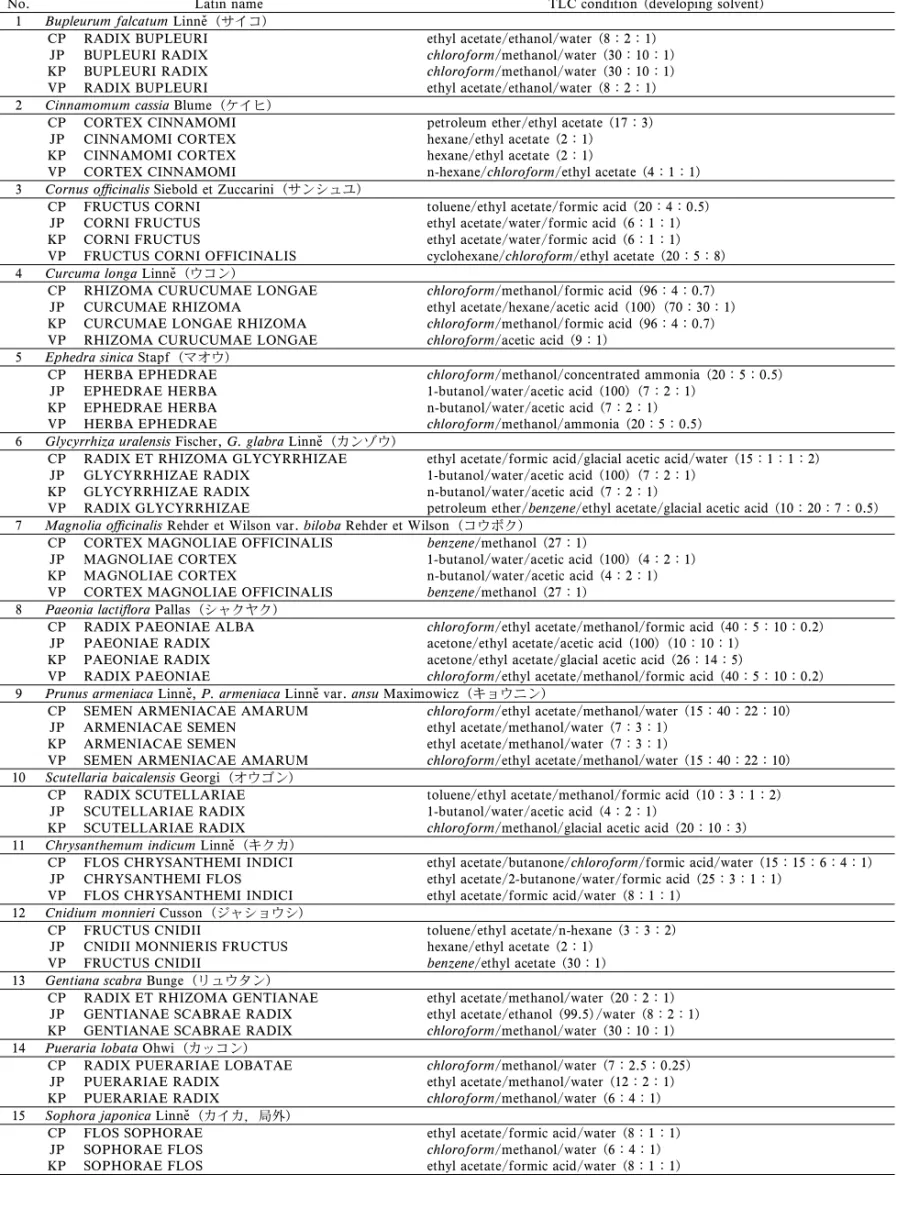
確認 試 験に お ける TLC 条 件 に関 して CP 及 び
VP では TLC 法に使用する溶媒の種類が非常に多
く,かつ多成分系の条件が設定されているのが特徴
であ ると 考えら れた .TLC の展 開溶媒 に関 して
は,例えばサイコでは CP 及び VP において有害試
薬が使用されていないのに対し,JP 及び KP では
クロロホルムが使用されていた.他方,マオウでは
逆に JP 及び KP では有害試薬が使用されていない
のに対し,CP 及び VP ではクロロホルムが使用さ
れていた.このように生薬により各国における有害
試薬の使用状況が明らかに異なっていた.クリーン
アナリシスにおける国際調和の観点から,わが国も
含め有害試薬を使用している国は,本比較表を基
に,他国の有害試薬を使用しない試験法を参考とし
て自国の試験法を変更する努力を行うことが重要と
考えられた.
定量法に関しては,VP ではいまだに HPLC に
よる分析法が確立されておらず,また定量法が設定
されている生薬も少なかった.しかし,FHH 会議
では,次の VP 改正第 4 版において HPLC 法の導
入を含め,多くの点で変更が行われる旨,報告がな
されている.CP 2005 年版では 2000 年版と比較し
て HPLC 法を設定した生薬が飛躍的に増加してお
り,さらに ELSD 法等,新たな検出機器の導入が
認められ,中国政府の生薬の規格設定に関する強い
意気込みが感じられた.また KP ではケイヒ,サン
シュユ,キョウニン,トウニン,ショウキョウ,ク
コシに関して HPLC を用いた試験法が設定されて
いるのに対し,JP ではいまだに設定がなされてい
ない状況であった.今後 JP では,KP に収載され
ている上記 6 生薬の定量法の検討並びに CP におい
て導入された ELSD 法等,新規検出法の検討が重
要な課題と考えられた.
2-3.
生薬関連一般試験法の比較
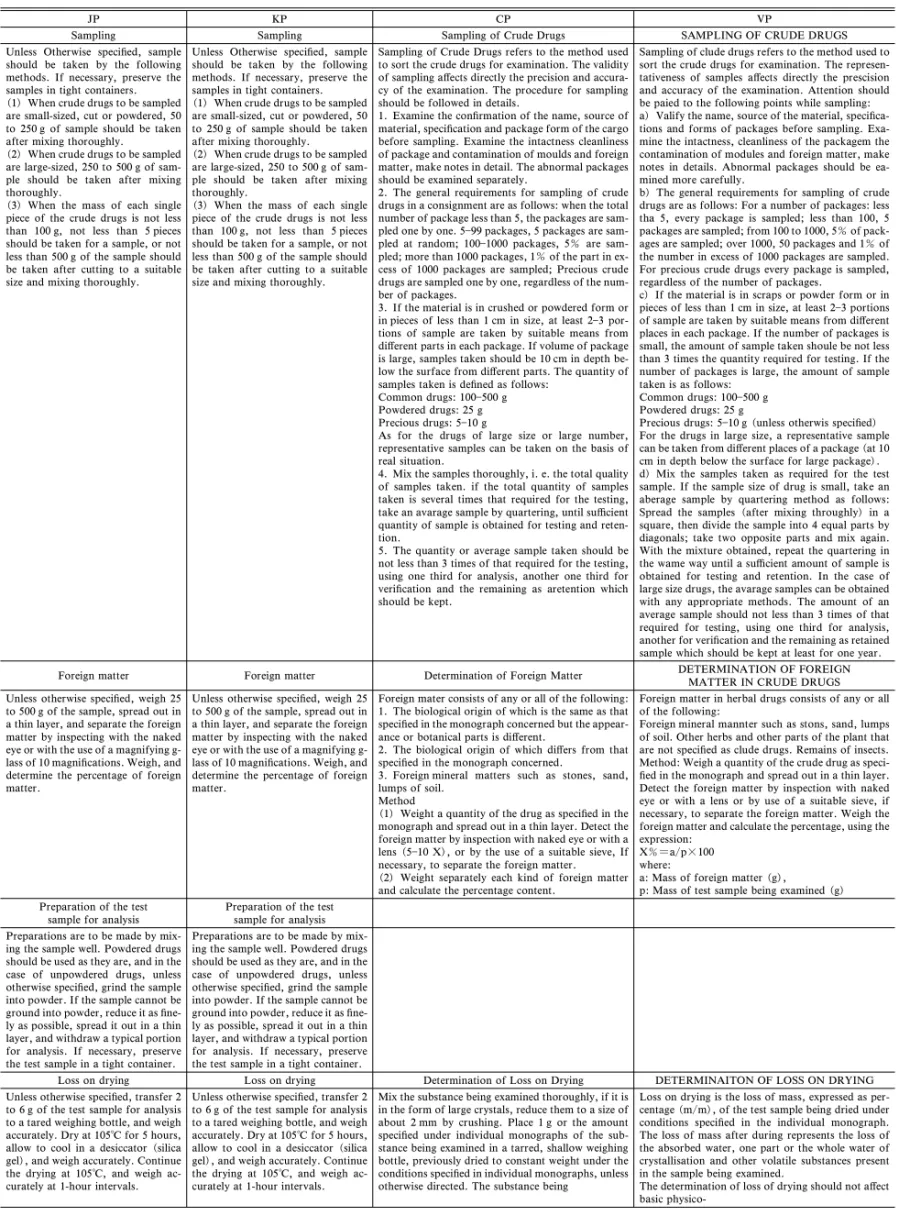
3)われわれ
はさらに EWG 5 (Information on General Tests)の
課題事項である日本,中国,韓国,ベトナム 4 ヵ国
の薬局方に収載された生薬関連一般試験法を精査
し,各国の生薬試験法(試料の採取,異物,分析用
試料の作成,乾燥減量,灰分,酸不溶性灰分,エキ
ス含量,精油含量,鏡検,重金属,ヒ素等)の各項
目について試験法の設定の有無,試験方法について
比較表を作成し,比較検討を行った.
生薬関連一般試験法の比較に関して作成した表の
一部を Table 5 に示す.この結果,JP と KP の試
験項目,記載内容は,重金属試験法において JP で
Table 4.
Comparative Table on Assay Conditions for Crude Drugs in CP, JP, KP and VP (partly)
No. Latin name Assay
(↑:Not less than) (1) method (2) developing solvent (3) detection 1 Aconitum carmichaeliDebeaux
JP PROCESSI ACONTI RADIX Total Alkaloids 0.71.5% (Type 1), 0.10.6% (Type 2), 0.50.9% (Type 3)
Titration
2 Anemarrhena asphodeloidesBunge
CP RHIZOMA ANEMARRHENAE Diosgenin↑1.0% HPLC (ODS column) methanol/water (95:5) Evaporative Light Scattering method 3 Angelica dahuricaBentham et Hooker ˆl
CP RADIX ANGELICA DAHURICAE Imperatorin↑0.080% HPLC (ODS column) methanol/water (55:45) UV 300 nm 4 Astragalus membranaceusBunge
CP RADIX ASTRAGALI Astrogaroside IV↑0.04% HPLC (ODS column) acetonitrile/water (32:68) Evaporative Light Scattering method 5 Bupleurum scorzonerifoliumWilld.
JP BUPLEURI RADIX Saikosaponin a+d↑0.35% HPLC (ODS column, I.D. 4.6 mm×15 cm, 5 mm)
1) acetonitrile/water (2:3) 2) 50° 3) adjust ‰ow rate to elute Saikosaponin d at ca. 8 min
UV 206 nm
KP BUPLEURI RADIX Saikosaponin a↑0.3% HPLC (ODS column, I.D. 4 6 mm×1525 cm, 510 mm)
1) acetonitrile/water (35:65) 2) 20° 3) 0.8 mL/min
UV 203 nm
6 Carthamus tinctoriusLinne
CP FLOS CARTHAMI HydroxysaŒor A↑1.0%, Kaempferide↑0.05%
HPLC (ODS column) HydroxysaŒor A [methanol/acetonitrile/0.7% phosphoric acid (26:2:72)], Kaempferide [methanol/0.4% phosphoric acid (52:48)]
HydroxysaŒor A (UV 403 nm), Kaempferide (UV 367 nm) 7 Cimicifuga heracleifoliaKomarov
CP RHIZOMA CIMICIFUGAE Ferulic acid↑0.1% HPLC (ODS column) acetonitrile/0.1% phosphoric acid solution (13: 87)
UV 316 nm
8 Cinnamomum cassiaBlume
CP CORTEX CINNAMOMI Cinnamic acid↑1.5% HPLC (ODS column) acetonitrile/water (35:75) UV 290 nm KP CINNAMOMI CORTEX Cinnamic acid↑0.03% HPLC (ODS column, I.D. 4
6 mm×1525 cm, 510 mm)
1) methanol/water/glacial acetic acid (12:88:1) 2) 20° 3) 2.0 mL/min
UV 280 nm
9 Cornus oŠcinalisSiebold et Zuccarini
CP FRUCTUS CORNI Loganin↑0.60% HPLC (ODS column) acetonitrile/water (15:85) UV 240 nm KP CORNI FRUCTUS Loganin↑0.5% HPLC (ODS column, I.D. 4
6 mm×1525 cm, 510 mm)
1) methanol/water (30:70) 2) 20° 3) 1.0 mL /min
UV 240 nm
10 Curcuma longaLinne CP RHIZOMA CURUCUMAE
LONGAE
Curcumin↑1.0% HPLC (ODS column) acetonitrile/4% glacial acetic acid solution (48: 52)
UV 430 nm
11 Ephedra sinicaStapf
CP HERBA EPHEDRAE Ephedorine hydrochloride↑1.0 %
HPLC (ODS column) acetonitrile/0.1% phosphoric acid solution (9:87) UV 207 nm
JP EPHEDRAE HERBA Total alkaroids↑0.7% HPLC (ODS column, I.D. 4 6 mm×1525 cm, 510 mm)
1) sodium lauryl sulfate (1 in 128)/acetonitrile/ phosphoric acid (640:360:1) 2) 45° 3) adjust ‰ow rate to elute ephedrine at ca. 14 min
UV 210 nm
KP EPHEDRAE HERBA Total alkaroids (Ephedrine+ Psheudoephedrine)↑0.7%
HPLC (ODS column, I.D. 4 6 mm×1525 cm, 510 mm)
1) sodium lauryl sulfate (1 in 128)/acetonitrile/ phosphoric acid (640:360:1) 2) 45° 3) adjust ‰ow rate to elute ephedrine at ca.14 min
UV 210 nm
VP HERBA EPHEDRAE Total alkaroids↑0.8% Titration 12 Epimedium koreanumNakai
CP HERBA EPIMEDII Total ‰avonoids↑5.0%, Icariine↑0.50%
Total ‰avonoids (Absorption) Icariine [HPLC (ODS column)]
Total ‰avonoids (methanol), Icariine [acetonitrile/ water (30:70)]
UV 270 nm
13 Eucommia ulmoidesOliver
CP CORTEX EUCOMMIAE Pinoresinol-di-glucopyranoside ↑0.1%
HPLC (ODS column) methanol/water (25:75) UV 277 nm
14 Evodia rutaecarpaBentham
CP FRUCTUS EVODIAE Evodiamine+Rutaecarpine↑ 0.15%
HPLC (ODS column) acetonitrile/0.04% octanesulfonic acid sodium salt (43:57)
UV 225 nm
15 Forsythia suspensaVahl
CP FRUCTUS FORSYTHIAE Forsythin↑0.15% HPLC (ODS column) acetonitrile/water (25:75) UV 277 nm 16 Fritillaria thunbergiiMiq.
CP BULBUS FRITILLAIAE THUNBERGII
Peimine+Peiminine↑0.080% HPLC (ODS column) acetonitrile/water/ethylenediamine (70:30:0.3) Evaporative Light Scattering method 17 Gardenia jasminoidesEllis
CP FRUCTUS GARDENIAE Geniposide↑1.8% HPLC (ODS column) acetonitrile/water (15:85) UV 238 nm JP GARDENIAE FRUCTUS Geniposide↑3.0% HPLC (ODS column, I.D. 6
mm×15 cm, 5 mm)
1) water/acetonitrile (22:3) 2) 30° 3) adjust ‰ow rate to elute Geniposide at ca. 15 min
UV 240 nm
18 Glycyrrhiza uralensisFisher, G. glabra Linne
CP RADIX GLYCYRRHIZAE Glycyrrhizinic acid↑2.0%, Liquiritin↑1.0%
HPLC (ODS column) Glycyrrhizinic acid [methanol/0.2 mol/L ammoni-um acetate/glacial acetic acid (67:33:1)], Li-quiritin [acetonitrile/0.5%gracial acetic acid (1: 4)]
Glycyrrhizinic acid (UV 250 nm), Li-quiritin (UV 276 nm) JP GLYCYRRHIZAE RADIX Glycyrrhizinic acid↑2.5% HPLC (ODS column, I.D. 4
6 mm×1525 cm, 510 mm)
1) dilute acetic acid/acetonitrile (3:2) 2) 20° 3) adjust ‰ow rate to elute glycyrrhizic acid at ca. 10 min
UV 254 nm
KP GLYCYRRHIZAE RADIX Glycyrrhizinic acid↑2.5% HPLC (ODS column, I.D. 4 6 mm×1525 cm, 510 mm)
1) dilute acetic acid/acetonitrile (3:2) 2) 20° 3) adjust ‰ow rate to elute glycyrrhizic acid at ca. 10 min
UV 254 nm
Table 5.
Comparative Table on General Testing Methods for Crude Drugs in JP, KP, CP and VP (partly)
JP KP CP VP
Sampling Sampling Sampling of Crude Drugs SAMPLING OF CRUDE DRUGS Unless Otherwise speciˆed, sample
should be taken by the following methods. If necessary, preserve the samples in tight containers. (1) When crude drugs to be sampled are small-sized, cut or powdered, 50 to 250 g of sample should be taken after mixing thoroughly. (2) When crude drugs to be sampled are large-sized, 250 to 500 g of sam-ple should be taken after mixing thoroughly.
(3) When the mass of each single piece of the crude drugs is not less than 100 g, not less than 5 pieces should be taken for a sample, or not less than 500 g of the sample should be taken after cutting to a suitable size and mixing thoroughly.
Unless Otherwise speciˆed, sample should be taken by the following methods. If necessary, preserve the samples in tight containers. (1) When crude drugs to be sampled are small-sized, cut or powdered, 50 to 250 g of sample should be taken after mixing thoroughly. (2) When crude drugs to be sampled are large-sized, 250 to 500 g of sam-ple should be taken after mixing thoroughly.
(3) When the mass of each single piece of the crude drugs is not less than 100 g, not less than 5 pieces should be taken for a sample, or not less than 500 g of the sample should be taken after cutting to a suitable size and mixing thoroughly.
Sampling of Crude Drugs refers to the method used to sort the crude drugs for examination. The validity of sampling aŠects directly the precision and accura-cy of the examination. The procedure for sampling should be followed in details.
1. Examine the conˆrmation of the name, source of material, speciˆcation and package form of the cargo before sampling. Examine the intactness cleanliness of package and contamination of moulds and foreign matter, make notes in detail. The abnormal packages should be examined separately.
2. The general requirements for sampling of crude drugs in a consignment are as follows: when the total number of package less than 5, the packages are pled one by one. 599 packages, 5 packages are pled at random; 1001000 packages, 5% are sam-pled; more than 1000 packages, 1% of the part in ex-cess of 1000 packages are sampled; Precious crude drugs are sampled one by one, regardless of the num-ber of packages.
3. If the material is in crushed or powdered form or in pieces of less than 1 cm in size, at least 23 por-tions of sample are taken by suitable means from diŠerent parts in each package. If volume of package is large, samples taken should be 10 cm in depth be-low the surface from diŠerent parts. The quantity of samples taken is deˆned as follows:
Common drugs: 100500 g Powdered drugs: 25 g Precious drugs: 510 g
As for the drugs of large size or large number, representative samples can be taken on the basis of real situation.
4. Mix the samples thoroughly, i. e. the total quality of samples taken. if the total quantity of samples taken is several times that required for the testing, take an avarage sample by quartering, until su‹cient quantity of sample is obtained for testing and reten-tion.
5. The quantity or average sample taken should be not less than 3 times of that required for the testing, using one third for analysis, another one third for veriˆcation and the remaining as aretention which should be kept.
Sampling of clude drugs refers to the method used to sort the crude drugs for examination. The represen-tativeness of samples aŠects directly the prescision and accuracy of the examination. Attention should be paied to the following points while sampling: a) Valify the name, source of the material, speciˆca-tions and forms of packages before sampling. Exa-mine the intactness, cleanliness of the packagem the contamination of modules and foreign matter, make notes in details. Abnormal packages should be ea-mined more carefully.
b) The general requirements for sampling of crude drugs are as follows: For a number of packages: less tha 5, every package is sampled; less than 100, 5 packages are sampled; from 100 to 1000, 5% of pack-ages are sampled; over 1000, 50 packpack-ages and 1% of the number in excess of 1000 packages are sampled. For precious crude drugs every package is sampled, regardless of the number of packages.
c) If the material is in scraps or powder form or in pieces of less than 1 cm in size, at least 23 portions of sample are taken by suitable means from diŠerent places in each package. If the number of packages is small, the amount of sample taken shoule be not less than 3 times the quantity required for testing. If the number of packages is large, the amount of sample taken is as follows:
Common drugs: 100500 g Powdered drugs: 25 g
Precious drugs: 510 g (unless otherwis speciˆed) For the drugs in large size, a representative sample can be taken from diŠerent places of a package (at 10 cm in depth below the surface for large package). d) Mix the samples taken as required for the test sample. If the sample size of drug is small, take an aberage sample by quartering method as follows: Spread the samples (after mixing throughly) in a square, then divide the sample into 4 equal parts by diagonals; take two opposite parts and mix again. With the mixture obtained, repeat the quartering in the wame way until a su‹cient amount of sample is obtained for testing and retention. In the case of large size drugs, the avarage samples can be obtained with any appropriate methods. The amount of an average sample should not less than 3 times of that required for testing, using one third for analysis, another for veriˆcation and the remaining as retained sample which should be kept at least for one year. Foreign matter Foreign matter Determination of Foreign Matter DETERMINATION OF FOREIGNMATTER IN CRUDE DRUGS Unless otherwise speciˆed, weigh 25
to 500 g of the sample, spread out in a thin layer, and separate the foreign matter by inspecting with the naked eye or with the use of a magnifying g-lass of 10 magniˆcations. Weigh, and determine the percentage of foreign matter.
Unless otherwise speciˆed, weigh 25 to 500 g of the sample, spread out in a thin layer, and separate the foreign matter by inspecting with the naked eye or with the use of a magnifying g-lass of 10 magniˆcations. Weigh, and determine the percentage of foreign matter.
Foreign mater consists of any or all of the following: 1. The biological origin of which is the same as that speciˆed in the monograph concerned but the appear-ance or botanical parts is diŠerent.
2. The biological origin of which diŠers from that speciˆed in the monograph concerned.
3. Foreign mineral matters such as stones, sand, lumps of soil.
Method
(1) Weight a quantity of the drug as speciˆed in the monograph and spread out in a thin layer. Detect the foreign matter by inspection with naked eye or with a lens (510 X), or by the use of a suitable sieve, If necessary, to separate the foreign matter. (2) Weight separately each kind of foreign matter and calculate the percentage content.
Foreign matter in herbal drugs consists of any or all of the following:
Foreign mineral mannter such as stons, sand, lumps of soil. Other herbs and other parts of the plant that are not speciˆed as clude drugs. Remains of insects. Method: Weigh a quantity of the crude drug as speci-ˆed in the monograph and spread out in a thin layer. Detect the foreign matter by inspection with naked eye or with a lens or by use of a suitable sieve, if necessary, to separate the foreign matter. Weigh the foreign matter and calculate the percentage, using the expression:
X%=a/p×100 where:
a: Mass of foreign matter (g), p: Mass of test sample being examined (g) Preparation of the test
sample for analysis
Preparation of the test sample for analysis Preparations are to be made by
mix-ing the sample well. Powdered drugs should be used as they are, and in the case of unpowdered drugs, unless otherwise speciˆed, grind the sample into powder. If the sample cannot be ground into powder, reduce it as ˆne-ly as possible, spread it out in a thin layer, and withdraw a typical portion for analysis. If necessary, preserve the test sample in a tight container.
Preparations are to be made by mix-ing the sample well. Powdered drugs should be used as they are, and in the case of unpowdered drugs, unless otherwise speciˆed, grind the sample into powder. If the sample cannot be ground into powder, reduce it as ˆne-ly as possible, spread it out in a thin layer, and withdraw a typical portion for analysis. If necessary, preserve the test sample in a tight container.
Loss on drying Loss on drying Determination of Loss on Drying DETERMINAITON OF LOSS ON DRYING Unless otherwise speciˆed, transfer 2
to 6 g of the test sample for analysis to a tared weighing bottle, and weigh accurately. Dry at 105°C for 5 hours, allow to cool in a desiccator (silica gel), and weigh accurately. Continue the drying at 105°C, and weigh ac-curately at 1-hour intervals.
Unless otherwise speciˆed, transfer 2 to 6 g of the test sample for analysis to a tared weighing bottle, and weigh accurately. Dry at 105°C for 5 hours, allow to cool in a desiccator (silica gel), and weigh accurately. Continue the drying at 105°C, and weigh ac-curately at 1-hour intervals.
Mix the substance being examined thoroughly, if it is in the form of large crystals, reduce them to a size of about 2 mm by crushing. Place 1 g or the amount speciˆed under individual monographs of the sub-stance being examined in a tarred, shallow weighing bottle, previously dried to constant weight under the conditions speciˆed in individual monographs, unless otherwise directed. The substance being
Loss on drying is the loss of mass, expressed as per-centage (m/m), of the test sample being dried under conditions speciˆed in the individual monograph. The loss of mass after during represents the loss of the absorbed water, one part or the whole water of crystallisation and other volatile substances present in the sample being examined.
The determination of loss of drying should not aŠect basic