Academia Arena , 2010;2(5)
15
DOES ENERGY AND IMPULSE ARE INTER CONVERTABLE
Manjunath R [email protected]
Abstract:Consider a photon of relativistic mass ‘m’ moving with speed ‘c’ is associated with the wavelength ‘λ’
is given by the relation λ=h/mc, Where h=planck’s constant (6.625*10^-34 JS). According to wave theory, speed of the photon wave is given by c = λ /T, where T= time period. By substitution of value of ‘c’ in the equation λ = h/mc, we get the expression m λ^2 = hT. According to wave theory, as frequency of photon wave is given by f=1/T. [Academia Arena, 2010;2(5):15‐18] (ISSN 1553‐992X).
Keywords: photon; relativistic mass; wavelength; wave theory
Consider a photon of relativistic mass ‘m’ moving with speed ‘c’ is associated with the wavelength ‘λ’ is given by the relation λ=h/mc, Where h=planck’s constant (6.625*10^-34 JS).
According to wave theory, speed of the photon wave is given by c = λ /T, where T= time period.
By substitution of value of ‘c’ in the equation λ = h/mc, we get the expression m λ^2 = hT.
According to wave theory, as frequency of photon wave is given by f=1/T.
Then the equation m λ^ 2 = hT becomes f=h/mλ^2
De Broglie wavelength associated with the photon is given by λ= h/p, thus the equation f=h/mλ^2 becomes f=p/mλ.
Angular frequency associated with the photon is given by ω= 2 πf.
By putting the value of f=p/mλ. in the above equation we get ω= 2 πp/mλ.
The above equation ω= 2 πp/mλ. can be applied to both photons and material particles like electron in motion.
Debroglie wavelength associated with the electron is given by λ=h/mv Where v=velocity of electron in motion
Then the equation ω= 2 πp/mλ becomes ω= 2 πpmv/mh i.e ω= 2 πpv/h.
Part : 2
Consider a electron of mass “me”at rest, total energy associated with the electron is given by “me c^2”. Suppose radiation of energy hf is incident on this electron at rest. Part of energy hf” is absorbed by electron and part of
Academia Arena , 2010;2(5)
16
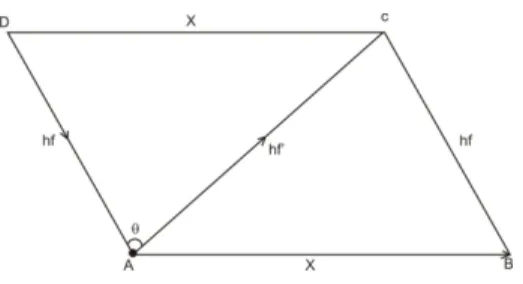
energy hf’ is scattered by electron . Absorbed energy hf” is converted to motion of electron, hence electron travels a distance ‘x’ in time ‘t’. let θ is the scattering angle.
Figure :1 –schematic diagram of scattering of energy of photon by electron x= Linear displacement of electron
hf = Energy of incident radiation hf’ = Energy of scattered radiation θ = scattering angle
Consider a parallelogram ABCD constructed as shown in the figure 1.
Let AB=CD=x, AD=BC=hf, AC=hf’(opposite sides in parallelogram are equal)
Law of cosine is given by a^2=b^2+c^2-2bc cos θ. Let a = x, b=hf, c=hf’, cos A = cosθ.
By applying the law of cosine to the triangle ADC, we get X^2=(hf)^2+(hf’)2-2(hf)(hf’) cos θ = 1
By law of conservation of momentum of photon.
We get
→
→
→= +
'
" y
y y
p p
p where
→
→
→ '
"
, ,
y y y
p p
p be the momentum of incident, absorbed and scattered photon respectively.
Let us assume absorbed momentum of photon = momentem of electron
i.e.
→
→p= p
y"
Thus
→
→
→= +
' y y
p p
p where
→
p = momentum of electron
→
→
→= −
' y y
p p
p Squaring on the both sides we get
Academia Arena , 2010;2(5)
17
P^2= ⎟
⎠
⎜ ⎞
⎝⎛ −→ →
' y y
p
p ^2, as (a-b)^2=a^2+b^2-2ab
Thus the above equation becomes p ^2=py ^2+py’ ^2-2 |
→
py
.
→py’|According to dot product rule |
→
→•b
a |= |a||b|cosθ Then we get p^2= py ^2+ py’ ^ 2-2| py | | py’ | cos θ Let us multiply the above equation by c ^ 2we get Where c = speed of light in vaccum (3* 10 ^ 8 m/s) P ^2 c ^2 = py ^ 2c ^2 +py’ c^2-2| py | | py’ |c^2 cos θ
As we know frequency of photon is directly proportional to it’s momentum i.e hf = pc thus the below equation is obtained
p ^2 c ^ 2= =(hf)^2+(hf’)2-2(hf)(hf’)cos θ = 2 By comparison of 1 and 2 we get x ^ 2 = p ^2 c^ 2
i.e x = pc (position of electron is defined as the function of it’s momentum) As told earlier position of electron is defined as a function of it’s momentum i.e x = pc
Small change in momentum of electron causes small change in it’s position i.e. dx = dpc hence, dp = dx/c
Newton second law of motion is mathematically represented by equation F=dp/dt Where F = force exerted by photon
dp = Small change in momentum of electron with respect to time As dp = dx/c then the above equation becomes F= dx/dtc.
as velocity of electron is defined as v = dx/dt.
Then F =v/c is obtained
Force exerted by photon is defined as function of velocity of electron As impulse exerted by photon is mathematically given by I = F dt.
then the equation F= dx/dtc becomes Fdt = dx/c i.e I =dx/c
Impulse exerted by photon is defined as function of change in position of electron At point A and B mass of electron is mei.e total energy assosiated with electron is mec^2. (as electron is at rest at
Academia Arena , 2010;2(5)
18
point Aand B) But in between point A and B mass of electron is mc^2 (since electron is in motion in between point A and B ) Hence total energy of electron in motion is mathematically given by E= mec^2+hf’
(As absorbed energy adds up to rest mass energy ) where E= total energy of electron in motion hf’=absorbed energy of photon
mec^2=rest mass energy of electron As absorbed momentum of photon equals the momentum of electron i.e py’’= p As x=pc (position of electron is defined as the function of it’s momentum) then x= py’c py’c=hf’then x=hf’ then the equation E= mec^2+hf’ becomes equation E= mec^2+x=3 According to Einstein equation E= mec^2+Ek=4 By camparison of 3and 4 we get Ek = x i.e kinetic energy of electron = position of electron Small change in kinetic energy of electron causes small change in it’s position i.e d Ek = dx i.e I =dx/c
i.e I= d Ek/c i.e d Ek=Ic According to workenergy theorm
Work done on particle equals change in kinetic energyof particle i.e W= d Ek i.e W= Ic Work done on particle involves storage of energy in particle i.e W=Ea where Ea= Energystored in particle.
Ea =Ic ,energy stored in particle is defined as a function of impulse applied Thus Ea a I (as c is constant ) i.e impulse and energy are interconvertable.
2) Proof for Einstein predicted formula E=tc
As x = pc (position of electron is defined as the function of it’s momentum)
As momentum of electron can be given by p=mv then the equation x = pc becomes x=mvc i.e x/v=mc
According to newton v=x/t i.e equation x/v=mc becomes t=mc According to Einstein E=mc^2 hence E=mcc becomes E=tc
1/20/2010