巻頭言
「農学国際協力」誌に期待すること 山内 章 1
総 説
Enhancing Human Resource Capacities in International Agricultural Research:
Lessons and Options for Young Japanese Researchers Editha C. Cedicol 3
途上国における能力開発と教育の役割 北村 友人 13
原 著
ミャンマー連邦共和国グエサウン沿岸部における漁村の実態調査
―エビ流通と観光漁業活動を中心に― 高木 映・他 23
Dual Role of Irrigation Schemes for NERICA Diffusion in the Central Highlands
in Kenya: Sources of Supplemental Water and Technology Information Akiko Nasuda, et al. 29 バングラデシュにおけるICTを用いた農業情報支援による貧困層農家の所得向上 尾﨑 彰則・他 38
タンザニアの稲作における新技術の収益性 徳田 進平・他 55
ケースレポート
Trial on Hybrid Method of Rice Cultivation (HYMERIC) in Mwea, Kenya Hikaru Niki, et al. 69
海外研修
東南アジア漁業開発センターの実施する大学生研修プログラムへの学生派遣 岡本純一郎 75
東京大学農学国際専攻における海外実地研修について 佐藤 雅俊 78
インドネシア海外実地研修について(2011 年度) 佐藤 達雄・他 81
東海大学海外研修航海における農学教育 村田 浩平 85
鹿児島大学国際協力農業体験講座─東南アジアファームステイ─ 津田 勝男 92
企画・編集 JISNAS 発 行 ICCAE
農学国際協力
農 学 国 際 協 力 JICAD Vol. 13
Vol. 13 March 2014
ISSN 1347-5096
2014
Journal of International Cooperation for Agricultural Development
March
「農学国際協力」編集委員会
編集委員長:
緒方 一夫(九州大学熱帯農学研究センター・教授)
副編集委員長:
安中 正美(国際農林水産業研究センター・理事)
編集委員:
浅沼 修一(名古屋大学農学国際教育協力研究センター・教授)
石川 智士(総合地球環境学研究所・准教授)
柏木 純一(北海道大学大学院農学研究院・講師)
北中 真人(国際協力機構農村開発部・部長)
小山 修 (国際農林水産業研究センター研究戦略室・室長)
前多 敬一郎(東京大学大学院農学生命科学研究科・教授)
山内 章 (名古屋大学大学院生命農学研究科・教授)
編集事務局:
名古屋大学農学国際教育協力研究センター
編集幹事:犬飼 義明(名古屋大学農学国際教育協力研究センター・准教授)
Journal of
International Cooperation for Agricultural Development
J Intl Cooper Agric Dev 2014; 13: 1–2
巻頭言
「農学国際協力」誌に期待すること
山内 章
名古屋大学農学国際教育協力研究センター長
わが国にとって、国内の農業生産に加えて、海外における安全な食料の安定した生産はきわめて重要 な位置を占めている。アメリカ、中国、オーストラリアなどに加えて、アジアやアフリカなど、多くが 熱帯地域にある発展途上国における食料生産は、わが国の食料確保にとって非常に大きな位置を占めて いる。日本国内だけでは、将来にわたって食料を十分に確保できないことは明らかである。一方、地球 規模での気候変動に伴う降水量や農業用水の減少や砂漠化などの環境の劣化に伴って持続的農業生産が 危機にさらされている。このような条件のなかで人類全体の食料を確保することも非常に重要である。
それだからこそ、日本に留まらず海外での農業生産向上のための研究や実際の農業に取り組むことの できる能力を有する人材が重要となる。日本がこれまで蓄積してきた集約農業の先進技術に比べれば、
とくに途上国の農業技術は粗放的・初歩的な発展段階にあるが、ここに日本の既存技術と今後の研究に よって開発される技術を適用することによって、農業の生産性は着実に向上することが期待される。そ の際には、その国の経済条件や農業生態条件に適応できるように技術を改良し、あるいは独自の技術を 作っていくことが重要である。したがって、世界には日本の研究者が活躍できる、また活躍が期待され ている現場がある。しかし、実際に国際的な現場で研究に従事している研究者の数は期待されているレ ベルより遙かに少なく、ここにわが国の若い研究者の人材育成が必要な理由がある。
今後、農業研究者・技術者、実務者には、環境制御された条件下(たとえば実験室内)と、生物が機 能を実際に発揮するフィールド、あるいは社会における現象の双方に深い関心と理解があり、学際的視 野を有した人材がますます求められる。そこで、わが国は国内において研究するだけでは不十分で、海 外に出てそのような研究に取り組む研究者や実務者の育成を行わなければならない。すなわち、国際的 視野を持った日本の農学研究者、農業技術者、海外の農学研究者、農業技術者の人材育成(学際的農業 研究者)を強化する必要がある。
そのためには、研究室で「基礎」研究をやっている人たちを、いかに、とくに海外も含めた現場に目 を向けて研究の出口を本気で見据えてもらうか、このきっかけをどうつくるか、この人たちを「このまま」
どう巻き込むか、という視点も重要である。明治以来,欧米に追いつけ追い越せで進めてきた科学研究 をさらに発展させる中で,みずからの内発的な基礎科学としての研究課題が、途上国を含めた農業生産、
消費、流通の現場ではなく、欧米の一流学術雑誌からしか見つかってこないすれば、とくに農学にとっ ては致命的である。
そのような現場には、解決すべき地球規模の課題や新たな学術的知見の創出が見込まれる研究シーズ が多くあり、「農学国際協力」誌は、農学の学問分野の統合を試行し、課題解決と研究成果の現場への 適用を実現する「場」として機能しうる。農学領域の学問分野を統合した新たなアプローチの開発と実
践およびそのための教育・人材育成の場として活用していきたい。そのことによって、「農学国際協力」
誌が、若い研究者・技術者をどう育てていくかについて経験交流をし、そしてそのような本来総合的学 問である新たな農学の創造の場となることを期待したい。
Journal of
International Cooperation for Agricultural Development J Intl Cooper Agric Dev 2014; 13: 3–12
Review
Enhancing Human Resource
Capacities in International Agricultural Research: Lessons and Options for
Young Japanese Researchers 1
Editha C. Cedicol
Graduate Scholarship Department, SEAMEO SEARCA, College, Laguna 4031, Philippines
1 Paper presented at the International Symposium on Human Resource Development in Agricultural Science on the theme, “Toward Fostering Japanese Researchers to Play an Active Part in International Agricultural Research, held at ESSAM Head Office, Chiyoda-ku, Tokyo, Japan
Introduction
The world’s food supply depends so much on agricul- ture. Thus sustained agricultural production is synonymous to food security. However, recent findings reveal that the situation of agriculture supply worldwide has worsened and if food production is not improved to meet demands, the food shortages would affect not only the prices of ag- ricultural goods and services, but also would have impacts on the environment and more so on people living in abject poverty. Many studies by different organizations (IFAD, FAO, UN Task Force, and WFP) reveal the following key facts (IFAD, 2012):
• There are an estimated 925 million hungry people in the world.
• Around 1.4 billion people live on less than US$1.25 a day.
• The world population is expected to reach 9.1 billion by 2050.
• Food production will need to nearly double by 2050 in developing countries.
• About 40 per cent of the world’s arable land is de- graded to some degree and will be further affected by climate change.
• There are about half a billion small farms in the world, supporting around 2 billion people.
• GDP growth generated by agriculture is up to four times more effective in reducing poverty than growth generated by other sectors.
• Poor people spend between 50 and 80 per cent of their income on food
According to a research team of the University of Minnesota, U.S.A. and McGill University, Montreal the demand for food globally is expected to double by 2050 due to increasing population and living standards. The team posits that with seriousness and dedication, solving the world’s food supply problem and at the same time taking care of the environment can be done. The team’s research revealed initial findings that by combining information from crop records and satellite images gathered around the world, new models of agricultural systems and environmental impacts can be created, which then showed patterns from which they based their recommendations on approaches on how to confront the problem and help policy makers in making decisions (University of Minnesota, 2012).
To meet the increasing demand for food over time, agriculture productivity needs to be substantially increased through improved agricultural practices, development and promotion of innovative technologies, and efficient and effective scientific agricultural research. And of course, this should not be done at the expense of the environment.
Researchers at McGill University came up with a plan that laid down recommendations on approaches that can provide solutions to the problem confronting global food supply with less impact on the environment. The 5-point plan is quoted hereunder from the Science Daily, October 2011:
1. Halting farmland expansion and land clearing for agri- cultural purposes, particularly in the tropical rainforest.
This can be achieved using incentives such as payment for ecosystem services, certification and ecotourism.
This change will yield huge environmental benefits without dramatically cutting into agricultural production or economic well-being.
2. Improving agricultural yields. Many farming regions in Africa, Latin America and Eastern Europe are not living up to their potential for producing crops— something known as “yield gaps.” Improved use of existing crop varieties, better management and improved genetics could increase current food production nearly by 60 per cent.
3. Supplementing the land more strategically. Current use of water, nutrients and agricultural chemicals suffers from what the research team calls “Goldilocks’ Problem”:
too much in some places, too little in others, rarely just right. Strategic reallocation could substantially boost the benefit we get from precious inputs.
4. Shifting diets. Growing animal feed or biofuels on prime croplands, no matter how efficiently, is a drain on human food supply. Dedicating croplands to direct human food production could boost calories produced per person by nearly 50 per cent. Even shifting nonfood uses such as animal feed or biofuel production away from prime cropland could make a big difference.
5. Reducing waste. One-third of the food produced by farms ends up discarded, spoiled or eaten by pests. Eliminating waste in the path that food takes from farm to mouth could boost food available for consumption another 50 per cent.
Given the aforementioned projections and the possible solutions presented, can one just sit back, relax and adopt a wait-and-see attitude? Can governments, especially in developing countries, just put off for tomorrow what they should start doing today, adopt a business-as-usual stance, and wait if these will really happen in 2050? Or should the best human resources involved in agriculture development be mobilized to proactively address this bleak scenario?
II. Challenges in agricultural human resource development
Application of technological advances in agriculture development necessitates the development of qualified human resources to conduct scientific researches to improve agricultural production. The commercialization of agricultural systems, increasing trade liberalization, changes in the role of public and private sectors, technological advancements, and a whole new world of challenges have strongly affected the capacity development needs of the agricultural workforce. These require policy and institutional reforms and the need to review agricultural education systems, and institution of innovative approaches to strengthen the knowledge and enhance the skills of agriculture personnel.
Capacity building is an important key to improving the capability of agricultural researchers, research managers
and extension workers in identifying priority research and development issues, formulating research projects to address these issues, and disseminating research findings for use by scientists, academicians, trainers, extension workers, and policy makers. Capacity building takes the form of formal degree, short term training, participation in study tours, conferences, seminar-workshops, on-the-job training, field work, hands-on practice, academic mobility, and exchange programs. There are a number of training institutes and organizations that provide these types of capacity building programs. However, universities and training institutions that are mandated to provide formal and non-formal training must keep pace with the fast changing global needs by equipping students and research staff with the up-to-date knowledge, skills and the right attitudes to help them compete and be responsive to new challenges.
Recent studies reveal the following top challenges to agricultural HRD:
• Aging agriculture research/scientific and academic staff
This happens when there is no well-defined and institutionalized medium to long-term succession and replacement plan under the human resource development program of the university system.
• High staff turnover
Fast staff turnover is normally due to low incentive system, lack of opportunities for advancement or promotion, low morale among the staff, absence of career development program for the staff, and attractive offers outside the organization.
• Wide age and qualifications gap in the succession hierarchy
A well-designed and well-planned succession hierarchy should spell out clearly the chain of command and delegation of authority within the organization. It should define the qualifications needed for a certain level of responsibility and authority. The problem arises when the very senior supervisor (in age, qualifications and experience) has a very junior staff next in line that cannot make firm decisions or recommendations in behalf of the supervisor for lack of experience. This is an issue that should be earlier addressed at the recruitment stage.
However, if there are no highly qualified applicants, some organizations resort to hiring very young staff with a plan to train the staff when already on board. Unfortunately for some, the learning curve takes longer, and training takes a while for the young staff.
• Low budget for research and training activities This is often experienced by government-funded institutions. This is an issue that needs to be addressed by governments that recognize the importance of research and training activities as vital to the enhancement of skills of those comprising the agricultural workforce.
• Outdated curricula not addressing agricultural HRD needs of the times
This is an ongoing concern among agricultural higher education institutions. The agriculture curriculum needs to be reviewed and modified to address the needs of the job market. Every curriculum must be designed with the students and learners in mind, that is, what kind of skills should this curriculum teach, what learning outcomes, and what kind of students is the university expected to produce for which sector. The curriculum must reflect the vision and mission of the university. In addition, agricultural education must include dimensions of broad-based agro- ecological systems (R.J. Salvador, et al, 1994).
• Outmoded research and academic facilities
New or modified curricular programs attuned to the times must be matched with up-to-date research and academic facilities in order to compete with or complement those available in other universities offering the same programs. Sufficient budget is needed to upgrade the laboratory, experimental stations, IT facilities for teaching and learning, etc.
• Agriculture as a profession not attractive to students
This has been a continuing problem everywhere. The review of the agriculture curricula starting from the high school to the graduate school level to incorporate practical projects in agriculture has been recommended by some universities in selected countries in the African (FARA, 2011) and Asian (2010) regions. This is because the proponents believe that cultivating appreciation for agriculture as a profession and connecting it to food and nutrition should start at least with students at a young age. In the Philippines, projects on school gardening and nutrition-sensitive agriculture are being introduced at the elementary and high school levels.
It is also worth looking at the reasons why agriculture has lost its luster and what other courses related to agriculture are now in demand. A study conducted in the Philippines on the supply and demand for agriculture, forestry and natural resources graduates projected the decline of traditional agriculture courses (agricultural education, agriculture, forestry) by 2020 but identified growth centers in the
nontraditional courses such as agribusiness/agribusiness management, food technology, agricultural engineering, and veterinary medicine (Briones, 2010). August Temu of the World Agroforestry Center (ICRAF) who chaired a panel session in a conference on development of human resources in Africa in December 2011 said that
“agriculture is not popular with young people, and most students only come to agriculture when they fail to get into other programs and that most agriculture graduates do not get access to jobs. (FARA, 2011).
• Agriculture graduates are not well-equipped with knowledge, skills and attitudes to compete globally Agriculture students must be able to develop skills to solve problems in multiple-goal situations (Salvador, 1994). On the other hand, universities and faculties teach- ing agriculture must be aware of the current issues and problems confronting agriculture development and what knowledge, skills and attitudes are necessary in order to prepare the students to face these challenges. Programs for continuous training and upgrading of student and staff competencies must be institutionalized in the university.
There are a number of training service providers and agencies that offer short courses for skills enhancement.
Examples of these agencies in Japan are the Japan Interna- tional Cooperation Agency (JICA), the Japan Society for the Promotion of Science (JSPS), the Japan International Research Center for Agricultural Sciences (JIRCAS), and the Ministry of Education and Training, which provide training scholarships and grants for research fellowships.
III. Initiatives to address agricultural HRD challenges: the SEARCA way In most developing countries in Southeast Asia, skills mismatch is an attendant problem in education service delivery. Thus, to ensure that the right people are trained for the right jobs, it is highly important for each country to carefully identify the appropriate critical skills necessary in mapping out development plans for agricultural and rural development (Cedicol, 2010).
How do we address these challenges at SEARCA?
SEARCA believes that the capacity of the human resource base to broadly articulate and respond to the changing demands of the global economy largely influences the development directions of any country. Human resources serve as catalysts in ensuring that development reforms and initiatives are effectively implemented and managed.
SEARCA operates on the basis of a five-year strategic plan. Thus, for its Ninth Five-Year Plan, covering fiscal years 2009/2010 to 2013/2014, a task force on external analysis was created to find out the needs of SEARCA’s
clients in the SEAMEO region and how SEARCA could serve them to the utmost. A quick survey was then con- ducted in October-December 2008 on agricultural human resource development needs for graduate study (Table 1).
The survey also included focal priority areas in research as well as customized training for scholars as input to its 9th 5-year development plan. Respondents of the survey were Ministries of Education, Agriculture and Forestry and Rural Development, agricultural technical agencies, the University Consortium, and agricultural colleges and uni- versities in Southeast Asia countries, namely: Cambodia, Lao PDR, Vietnam, Myanmar, Indonesia, the Philippines, Thailand, Malaysia, Singapore, and Brunei Darussalam.
Results of the external analysis pointed to the following specific needs (grouped by subject matter):
1. Natural Resource Management
○ Strengthen NRM portfolio
○ Watershed management
○ Forest/agro-forest resource management
○ Marine/water resource management
○ Climate change and adaptation/mitigating measures to address them
○ Land utilization and conversion to non-food production
○ Management of green/open spaces 2. Agricultural Competitiveness
○ Impact of increases in commodity process on agricultural transformation
○ Commercialization of agriculture
○ Improvement of livelihood
○ Value chain analyses
○ Market enhancement: value adding/food processing
3. Cross-cutting themes
○ Biofuel-net gain, impact on land use and agricultural produce
○ Rural-urban linkages; urban agriculture
○ Diversification of farming systems
○ Food security and safety
○ Real issues in agricultural science need to increase crop production, reduce poverty
SEARCA’s vision is to be a leading enabler in the science and practice of agriculture and rural development for Southeast Asia. Its mission is to “build the capacities of Southeast Asian institutions working toward agricultural and rural development through graduate scholarship, research and development, and knowledge management.
For SEARCA to continuously and effectively do this in the face of complex global challenges, it has to vigorously look for ways to support young and highly qualified nationals to acquire excellent graduate education that will not only buffer the impact of a graying workforce and fill in the skills gap, but also take on the cudgels of leadership as their more senior colleagues leave the workplace upon retirement.
Among the strategies to achieve the objectives of the SEARCA Graduate Scholarship Program are: 1) provision of more graduate scholarships and grants; 2) exploration and implementation of new scholarship program modalities; 3) provision of opportunities to scholars for customized training; 4) dissemination of scholars’ research outputs and achievements; and 5) matching of suitable academic programs of scholars with the needs of member countries. Based on a percentage of the identified needs in Table 1 and within the limits of SEARCA’s resources, 169 scholarship slots have been allocated for nationals Table 1. Estimated number of agricultural graduate scholarship needs of SEAMEO from FY 2009/2010 to FY
2013/2014 Country
Fiscal year
Total 2009/2010 2010/2011 2011/2012 2012/2013 2013/2014
MS PhD MS PhD MS PhD MS PhD MS PhD MS PhD
Brunei Darussalam 10 3 10 3 10 3 10 3 10 3 50 15
Cambodia 15 5 15 5 15 5 15 5 15 5 75 25
Indonesia 25 15 25 15 25 15 25 15 25 15 125 75
Lao PDR 20 12 18 14 16 16 14 18 12 20 80 80
Malaysia 10 15 10 15 10 15 10 15 10 15 50 75
Myanmar 19 7 19 7 17 7 17 7 17 7 89 35
Philippines 170 59 180 61 190 66 190 66 200 72 930 324
Singapore 1 1 1 1 1 1 1 1 1 1 5 5
Timor-Leste 15 2 15 2 15 2 15 2 15 2 75 10
Thailand 10 15 10 15 10 15 10 15 10 15 50 75
Vietnam 25 15 25 15 25 15 25 15 25 15 125 75
Total 320 149 328 153 334 160 332 162 340 170 1654 794
of SEARCA member countries in different priority fields as identified by the respective ministries of education (Table 2). The total number of scholarships over the five- year period may increase depending on availability of partnership funding from other collaborators of SEARCA that are interested in helping these countries.
Other program modalities and schemes to enhance student’s and staff’s skills
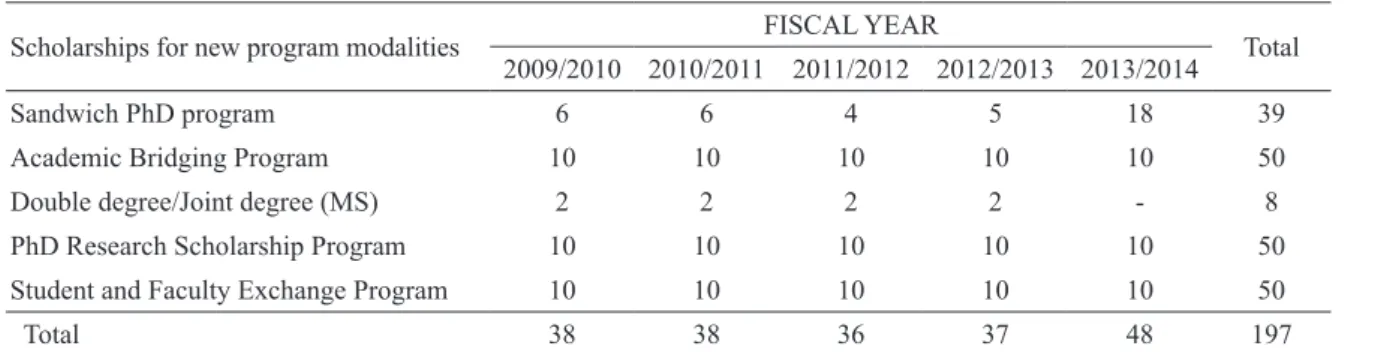
Table 3 presents the estimated number of SEARCA scholarships for other program modalities to enhance a student or faculty’s skills such as sandwich program, PhD research, academic bridging, and joint and double degree program, and student/faculty exchange program.
Members of SEARCA’s University Consortium (UC) are tapped to host students and faculty who visit other Table 2. Distribution of new scholarship slots per country and proposed priority fields of specialization from 2009/2010 to
2013/2014
Country No. of slots Priority Fields of Specialization
Brunei Darussalam 4 Agronomy; Agribusiness; Agricultural Extension and ICT in Agriculture; Community Development; Development Communication; Aquaculture; Halal food production and processing
Cambodia 7 Agronomy; Plant Breeding; Land and Water Resources Management; Agricultural Economics;
Climate Change and Risk Management; Biodiversity Conservation; Agro-forestry Management;
Agricultural Entrepreneurship; Veterinary Science; Fisheries and Aquatic Resources; Irrigation Technology
Indonesia 14 Agribusiness; Agricultural Extension; Land and Water Resources Management; Environmental Management; Biodiversity Conservation; Climate Change and Risk Management; Natural Resources Management and ICT; Animal Nutrition; Agricultural Economics; Development Communication; Public Administration and Governance; Food Science and Technology;
Farming Systems; Rural Development; Crop and Livestock Production; Forestry Resources Management
Lao PDR 11 Animal health and nutrition; Agronomy; Agricultural Engineering; Land and Water Resources Management; Irrigation Engineering; Agribusiness; Food Science and Technology; Food Processing and Postharvest Technology; Farm Management; Farming Systems, Community Development; Development Communication
Malaysia 9 Agricultural biotechnology; ICT in agriculture; biodiversity conservation; food science and technology; postharvest technology; production of high value crops; nanotechnology
Myanmar 8 Agricultural policy development; rural development and governance; food safety standards;
agricultural economics; agronomy; soil science; biofuels development; agribusiness; supply chain management; trade and investment; agricultural biotechnology
Philippines 86 Agronomy; food and nutrition; animal health; agricultural economics; development economics;
land and water resources engineering; environmental management; veterinary medicine; public management and governance; strategic leadership; climate change and risk management;
environmental economics; biotechnology and microbiology; animal breeding; agro-forestry;
agribusiness; agricultural entrepreneurship; food processing and marketing;
Singapore 1 Nanotechnology; urban agriculture
Thailand 9 Agricultural biotechnology; trade and investment; Environment and natural disaster management;
biodiversity conservation and management; agricultural economics; communication technology;
Timor Leste 6 Agronomy; Animal Science; Veterinary Medicine; Fisheries and Aquatic Resources; Agricultural Economics; Forestry and Natural Resources Conservation; Environmental Science; Land and Water Resources Management; Community Development; Development Communication and ICT; Public Administration and Governance
Vietnam 14 Agricultural biotechnology; Food Processing; Postharvest Technology; Rural Development;
Research Management; Integrated Water Resource Management; Climate Change Risk Management; agribusiness; agricultural economics; animal science; veterinary medicine
Total 169
universities under the UC student and faculty exchange program. For students who attend courses in another UC member for a semester or two, the tuition waiver and credit transfer arrangement are applicable. Bilateral arrangements may be explored with the UC members for the sandwich program and joint/double degree program.
Established in 1989 through the auspices of SEARCA, the UC is a network of leading agricultural universities in Southeast Asia, Australia, Canada, Germany and Japan whose aim is to enhance graduate education and research in agriculture and natural resources in Southeast Asia.
Members of the UC are Institut Pertanian Bogor (IPB) and Universitas Gadjah Mada (UGM) in Indonesia; Kasetsart University (KU) in Thailand, Universiti Putra Malaysia (UPM) in Malaysia; University of the Philippines Los Baños (UPLB); University of British Columbia (UBC) in Canada, University of Queensland (UQ) in Australia;
University of Goettingen (UG) in Germany; and Tokyo University of Agriculture (TUA) in Japan. Other partner universities that may serve as host institutions of scholars for short-term program modalities and where SEARCA has signed memoranda of understanding include the University of Hohenheim in Germany; Nagoya University in Japan; National Taiwan University, Republic of China;
Montpellier SupAgro in France; Maejo University in Thailand, and University of Hawaii at Manoa, Hawaii.
Customized training
SEARCA also provides opportunities for customized training to its scholars in order to: 1) enhance their technical knowledge and skills while undergoing rigorous academic and research tasks as graduate students; and 2) to prepare them for leadership and management roles when they return to their respective institutions upon completion of graduate studies. Aside from the priority topics for customized training for SEARCA scholars identified in the survey and presented in Table 4, the new scholars are required to attend the following basic training courses:
1) Intensive English Course for International Graduate
Students; 2) Technical Writing Course; and 3) Training on Research Methodologies.
To enhance the SEARCA scholars’ capacities to do research and extension work, the Center provides grants for re-entry projects for new alumni in order for them to immediately apply what they learn from the university upon their return to their respective home institutions.
The re-entry grant provides start-up money for small research or extension projects with counterpart funds from the alumni’s home institution and local government or community.
To provide opportunity to outstanding/excellent faculty of partner universities or advisers of SEARCA scholars, the Visiting Fellows/Senior Fellows Program allows the faculty members to carry out their researches while enjoying their sabbaticals. On the same tone, SEARCA also offers sabbatical leave for its technical and academic staff within the supervisory/managerial level after 7 years of continuous service to the Center to spend 6 months to one year in another institution (partner or otherwise) for the purpose of 1) rest and renewal, which is a much needed break for intellectual and physical “re-charging; or 2) to do research or write and produce a publication. In both, SEARCA provides research funds, and salary for a maximum of 6 months.
Learning Events and Executive Forum on various topics such as Leadership Excellence in Academe Program for Southeast Asia; Research Management for Executives, Round Table Meetings on current issues in agriculture development, and a range of other topics on food security and safety, impacts of climate change on agriculture, climate change vulnerability assessment, etc. provide avenues for discussion, exchange of ideas, and expression of opinions that challenge the students and young faculty to engage in intellectual discourse.
Table 3. Number of scholarships for new program modalities for FY2009/2010 to FY 2013/2014 Scholarships for new program modalities FISCAL YEAR
Total 2009/2010 2010/2011 2011/2012 2012/2013 2013/2014
Sandwich PhD program 6 6 4 5 18 39
Academic Bridging Program 10 10 10 10 10 50
Double degree/Joint degree (MS) 2 2 2 2 - 8
PhD Research Scholarship Program 10 10 10 10 10 50
Student and Faculty Exchange Program 10 10 10 10 10 50
Total 38 38 36 37 48 197
Institutional development assistance to selected universities in Cambodia, Lao PDR, and Myanmar
Recently, SEARCA initiated an institutional development assistance program focused on capacity-building and curriculum enhancement in three universities in Lao PDR (Savannakhet University), Cambodia (Royal University of Agriculture), and Myanmar (Yezin Agricultural University). After the initial phases of the project starting with the reconnaissance visits to each of the three universities, SEARCA mapped out the plan for assistance within the limits of SEARCA’s resources but helping out in tapping other sources of funds to implement a three to five - year project in each of the university. The dearth of agricultural human resources to teach and do research is strongly felt in Savannakhet University (SKU), which is a very new university established only in 2009. SEARCA initially responded to this by providing scholarships for academic bridging and master’s program to five young faculty of SKU. The need to field experts to SKU in the areas of irrigation engineering, agronomy, plant breeding, soil science, veterinary science, environmental science,
curriculum development, and university management is also urgent.
In Royal University of Agriculture (RUA), the issues to be addressed urgently are the aging faculty, fast staff turnover, and lack of agricultural manpower for teaching, research and extension. In response to the request of RUA, SEARCA recently conducted a mentoring workshop for RUA strategic planning attended by RUA top executives in charge of university management, curriculum development, research and development, financial administration, and linkages and international program. This mentoring workshop was intended to guide them through the process of visioning, direction and goal setting, as well as in assessing their strengths, weaknesses, opportunities available and threats to their existence. The top executives are expected to do their own strategic planning exercise together with key personnel at the university after completing the mentoring workshop.
SEARCA also provided graduate scholarships to three young faculty members of RUA.
In Yezin Agricultural University, the immediate concern
· Agribusiness/enterprise development
· Agricultural credit and microfinance
· Agricultural knowledge management and ICTs for poverty alleviation
· Agricultural Policy Formulation
· Agricultural Systems for Poor Communities
· Agriculture Technology Management
· Agroforestry management
· Avian influenza/ transboundary animal-borne diseases
· Biodiversity conservation and rural livelihoods
· Biofuel development and financing
· Bioinformatics
· Community-based natural resources management
· Cross-border trade arrangements
· Disaster Risk Management
· Dynamics of land use change
· Economic and legal aspects of GE applications/GMOs
· Environment & climate change
· Environment Biotechnology
· Food safety and phyto-sanitary measures
· Good Agriculture Practices
· Good Governance
· Impact assessment and poverty alleviation
· Knowledge Management
· Knowledge systems and biodiversity management
· Leadership and management in academe and R and D
· Managing risks for sustainable agriculture in response to climate change
· Natural Resource Management
· Natural Resource Management
· Options for clean development activities in agriculture
· Participatory methodology
· Planning and project management
· Plant Biotechnology
· Policies on commodity markets
· Policy and regulatory issues, including capacity building and biosafety implementation
· Program Management
· Public-private sector partnership in technology management
· Research management
· Resource Generation
· Re-thinking agricultural extension
· Small farmers and their integration in the supply chain
· Socio-cultural, ethical, and political issues in GE applications/GMOs
· Strategic Leadership
· Strengthening rural institutions
· Transition Management
· Use of ICT in agricultural development
· Various application areas for genetic engineering Table 4. Customized training needs in agriculture of SEAMEO member countries (2009–2014)
to be addressed is the review of the agriculture curriculum as well as the need for training on delivery of extension services to farmers and development of programs for responding to the 9-point agenda for reform of the Ministry of Agriculture, namely: Reform for Land Management and Administration; Reform for Advanced Agricultural Practices and Seed Industry; Reform for Water Resource Management; Reform for Agricultural Mechanization;
Reform for Advanced Agro-based Industry; Reform for Human Resource Development; Reform for Research and Technology Development; Reform for Credit Services;
and Reform for Market Information Service.
IV. Developing the next generation of Japanese agricultural scientists and researchers: How?
There is no perfect recipe for this. However, there are lessons that can be gleaned from the experiences of other human resource development organizations like SEARCA, as discussed in the previous Section, on strategies and modalities to enhance the capacities of agriculture personnel to increase their chances of getting employed and involved in international agricultural research. SEARCA’s ongoing projects on institutional development assistance to other universities could serve as windows of opportunities for young Japanese researchers to practice their profession by being attached to these institutions with funding from the Japanese government. As well, there are options for young Japanese agricultural scientists and researchers in crafting their career paths towards contributing to finding solutions to the world’s food supply problems starting with the East Asian region.
There are two issues in this Section. One is the observation that there are very limited agricultural human resources in Japan that could play active roles in the international agricultural research. The other is the employability of Japanese agriculture graduates.
The first issue should be directed to higher education institutions, policy makers and organizations concerned with developing manpower for the agriculture workforce.
The following may be taken into consideration with the aim of increasing enrolment in agriculture and producing more agriculture graduates:
1. Improvement of the agriculture curriculum at the col- lege and graduate school levels to include problem- based experiential teaching and learning to help develop the problem-solving and critical thinking skills of agriculture students. The curriculum must teach appropriate methods of inquiry, and systems analysis. More coursework must be introduced to provide the theoretical foundation to support research
applications. New areas of major specialization at the graduate level must be introduced to cater to cur- rent needs and problems.
A recent SEARCA study (Arboleda, 2012) on Enhance- ment and Strengthening of Graduate Agriculture Educa- tion Curricula in Southeast Asia revealed that...
“ASEAN universities typically offer the traditional major specializations (for example: animal science, agronomy, entomology and plant pathology, soil science, and agricultural economics) at the MS and PhD levels.
However, they differ largely in the range of new areas of major specialization offered by their graduate school.
Some universities tend to offer major specialization at the disciplinal level such as agricultural biotechnology, plant breeding and genetics, animal reproductive physi- ology, and so on. Others, however, tend to offer major specialization at the commodity level like, plantation management, poultry production, swine production, water management and so on. At the PhD level emphasis tend to be at the disciplinal more than the commodity orientation. Consequently, there are significantly wider varieties of major specializations offered at the MS than at the PhD level. This is understandable since at the PhD level, students are expected to focus more on deeper un- derstanding of as well as finding new knowledge about the discipline through scientific research.
2. New schemes or other modalities of learning such as North-South and South-South mobility for students and faculty, practicum or hands-on experiences through on-the-job training activities, field visits/
study tours, sandwich programs, exchange programs with transferrable credits must be designed and em- bedded into the curriculum. Through these modali- ties, students are expected to open up, adjust socially, speak up, learn other people’s cultures, understand other people’s perspectives, and start thinking out of the box.
3. Have a manpower plan. Coordinate with industry, non-government organizations, private companies, international research agencies that are potential employers of agriculture graduates; find out their manpower needs, and set target numbers to match graduates with the job market needs. This would then set the enrolment and graduation targets for each school year.
4. Provide opportunities for training in leadership, agribusiness management, entrepreneurship, project development and management, resource generation, ICT, computer skills, data banking, language training, technical writing, as add-on to the academic program of the students.
5. Provide sabbaticals to faculty and research staff/
scientists for a period of six months to one year to allow them to upgrade their knowledge and skills,
expand their horizon, establish contacts and explore opportunities for joint projects with other universities or institutions. Whatever new knowledge and skills that these faculty and research staff will gain from doing sabbaticals outside the country will redound to the benefit of the students and the university in Japan.
6. Monitor and track down the alumni. They can be partners in training and development of would-be scientists and researchers. They can be an addition to the pool of short-term staff that can be tapped as consultants, experts, mentors, and student advisers.
7. Provide support for career counseling and the conduct of job fairs. Graduating students must be taught how to write their resumes, construct application letters, present themselves properly during interviews, and answer interview questions. An office at the univer- sity devoted to scouting for job opportunities must be set up to coordinate with domestic and international companies in providing work for agriculture alumni and young researchers.
For all of the above strategies, sufficient budget and policy support are essential.
The second issue is both a concern of the higher education institutions and the student. The student must first ascertain his/her career choice by answering the question: WHAT DO I WANT TO BE? For this, the student has several career options: to be a researcher, scientist, academician, entrepreneur, manager, administrator, farmer, agriculturist, economist, extension worker, etc. Whatever it is, the student must aim to be a well-rounded person, who knows how to perform multiple tasks, and a person who values man and nature. The student’s career choice would then be his/her basis for seriously considering the road to take towards achieving his goal—academic program, specialization, training and other learning tools, what type of skills to develop, and plans for international exposure.
A survey conducted by a team of experts among potential employers of agriculture graduates in the Philippines (de Vera, et al, 2010) reveal the preferences of employers to candidates that have the following skills: excellent written and verbal communication; organizational development; critical thinking; advanced computer skills;
customer relations and people skills; teamwork; English proficiency; leadership skills; business orientation; project development management; negotiation skills; proficiency in another foreign language; monitoring and evaluation;
coaching/mentoring; planning and organizing; goal setting and resource allocation; ability to translate theory into practice; data analysis; mathematical/statistical skills;
proposal writing and technical report writing.
On the other hand, the recent SEARCA study led by Arboleda, et al (2012) revealed the following findings from respondent- employers in the ASEAN region:
“When hiring applicants, the employers consider the following qualifications as most important: academic performance records (96%), record of accomplishments (72%), graduated from highly prestigious institution (72%), and overall personal character (60%). For the employers, the most desirable sets of abilities that the graduate degree holders in their staff to have are:
technical knowledge (82%), leadership skills (60%) and communication skills (47%). When asked which combination of abilities and skills that were character- istic of their employees possessed, the overwhelming majority of them indicated that those with high field specific knowledge and skills as well as those that a good balance of field specific skills and the skills com- mon to related disciplines – communication, leadership, computer literacy – contributed most to the attainment of their organizational goals and objectives. And more than just academic records, the other abilities that the respon- dents indicated as most preferred include: ability to take leadership roles in opportunities that are related to his/
her field (80%), ability to work professionally with oth- ers (76%) and ability to bring bright ideas on appropriate situations (76%).”
In the study, Arboleda emphasized that in the practice of any profession in agriculture and related disciplines, it is imperative that skills that could sharpen the awareness and ability of students to common challenges and opportunities in their career be acquired, such as communication, management and entrepreneurship and accounting skills (e.g., applied statistics and scientific method, principles of management, leadership, ethics and entrepreneurship, international agriculture and trade and policy, among others).
V. The Way Forward
Universities, government agencies, private companies concerned with agriculture, and even the parents must work together to craft the future of agriculture students, graduates, and young Japanese researchers if they are expected to play a significant role in fighting global hunger. A scenario-building exercise on world food and agriculture may spark the interest of Japanese students and young researchers on their “rightful place” in the interplay of actors in this interesting planet.
References
Arboleda, Cecilio, and Blanda M. Sumayao. Enhancement and Strengthening Agriculture Graduate Education Curricula in Southeast Asia. Initial results of study
funded by SEARCA (with participation by Rita P.
Laude and Editha C. Cedicol), October 2012.
Briones, Roehlano M. Projecting the supply of and de- mand for AFNR graduates in the Philippines: model, descriptions, projections and simulations. Philippine Institute of Development Studies, Manila, November 2010.
Capacity development in Africa, www.oecd.org/dataoecd/
17/20/48165511.pdf, accessed 10/13/2012.
Cedicol, Editha C. SEARCA Agricultural Human Re- source Development Plan for SEAMEO: Focus on Graduate Scholarship Program (FY 2009/2010 to FY 2013/2014), SEARCA, College, Laguna, September 2010.
De Vera, Prospero III, Rizalino B. Cruz, and Ledivina V. Cariño. Policy Research on the State and Future Supply of and Demand for AFNR Graduates in the Philippines (Human Resource Inventory and Environ- mental Scanning), Philippine Institute of Development Studies, Manila, November 2010.
hrd.sagepub.com/content/7/4/374.full.pdf, accessed 10/13/2012
McGill University (2011, October 12). Feeding the world while protecting the planet: Global plan for sustainable agriculture. Science Daily. Retrieved October 17, 2012, from http://www.sciencedaily.com/
releases/2011/10/111012151720.htm
http://www.ifad.org/hfs/index.htm, accessed 17 Oct 2012 Salvador, R.J, D.W. Countryman, and B.E. Miller. In-
corporating Problem-based Experiential Teaching in the Agriculture Curriculum. J. Nat. Resour. Life Sci.
Educ. 24 (1): 58–63. Iowa State University College of Agriculture, 1994.
Science Daily. Retrieved October 17, 2012, from http://www.
sciencedaily.com /releases/2011/10/111012151720.htm Temu, August. Conference on Agricultural R&D in Africa.
Ghana, Africa, 5–7 December 2011 in Agricultural Science and Technology Indicators, facilitated by IF- PRI
University of Minnesota (2012, August 29). Hope of greater global food output, less environmental impact of agriculture. Science Daily. Retrieved October 17, 2012, from http://www.sciencedaily.com / releases/2012/08/120829151241.htm
Journal of
International Cooperation for Agricultural Development J Intl Cooper Agric Dev 2014; 13: 13–22
総 説
途上国における能力開発と教育の役割
北村 友人
東京大学大学院教育学研究科
論文受付2013年6月14日 掲載決定2013年6月21日
はじめに
開発途上国(以下、途上国)の国造りを考えるうえで、
多様な専門性をもった人材を育成することの重要性は 自明のことである。とりわけ、グローバル化が進むな かで、いわゆる知識基盤社会や知識基盤経済といった 考え方が一般化した今日、より高度な専門性を有する 人材の育成が多くの途上国においても喫緊の課題となっ ている。しかしながら、そうした高度専門職業人とも 呼ばれるような人材を育成する基盤となる教育(とく に高等教育)が脆弱であることも、広く途上国にみら れる現状であることは否めない。したがって、途上国 自身だけでは十分な資源を有することの少ない教育セ クターの状況に対して、国際的な支援を提供すること が求められている。
そのような途上国の教育が抱える問題は多岐にわた り、その脆弱性はさまざまな問題に起因している。な かでも、しばしば指摘される問題は、物的・人的・財 的な資源が少ないことである。しかし、それと並ん で大きな問題が、少ないならば少ないなりの資源を 最大限に活用するための「能力(capacity)」を十分に備 えていないことである。ここで言う「能力」とは、個 人、組織、社会が全体として問題を上手に管理する力 のことを意味する。そして、それらの個人、組織、社 会が、全体として自らの能力を発揮、強化、構築、適 用、維持していく過程のことを「能力開発(capacity
development)」と捉える。こうした能力開発は、途上
国が自立的な開発を進めていくうえで、さまざまなセ
クターにおいて必要とされている。なかでも教育セク ターは、教育セクター自体の能力を向上させるとともに、
他のセクターの能力開発に貢献する人材を育成すると いう役割を担っている。
こうした問題意識を念頭に置きながら、本稿は次の 2つの問題について検討することを目指している。第 一に、教育セクターのなかでも、とくに高度専門職業 人の育成に大きな役割を果たすべき高等教育に焦点を あて、途上国の高等教育の質を高めていくために、ど のような国際協力のあり方が必要であるのかについて 考えたい。第二に、高等教育に限らず教育セクター全 体を考えたときに、途上国で導入される教育改革の多 くが新自由主義的な思想の影響を色濃く受けているこ とに気づく。そこで、先進国・途上国の別を問わず、
今日の教育改革に対する新自由主義の影響について検 討を加えたうえで、とくに途上国の教育改革において はどのような影響が出現しているのかについて考えて みたい。これら2つの問題について検討することによって、
途上国における能力開発のあり方と教育の役割につい て筆者なりの見解を提示することが、本稿の目的である。
1. 能力開発と教育の関係i
開発の現場では、この十数年にわたり「能力開発
(capacity development)」の重要性がしばしば指摘され ている。ここでいう「能力」とは、「個人、組織、社会 が全体として問題を上手に管理する力」のことであり、
それらの「個人、組織、社会が全体として自らの能力
を発揮、強化、構築、適用、維持していくプロセス」
のことを、一般的に「能力開発」と呼んでいる(OECD/
DAC, 2006)。また、とくに途上国の文脈で能力開発を
考えると、途上国自身の主体的な努力によって、「途上 国の課題対処能力が、個人、組織、社会などの複数レ ベルの総体として向上していくプロセス」として捉え ることも可能である(国際協力機構、2006)。ここでは、
能力開発の内発性が重視されており、仮に開発援助や 国際協力といった途上国の外部からの働きかけがあっ たとしても、能力開発そのものは基本的に途上国自身 の意思によって実現されることが期待されている。こ れは、開発される能力の妥当性、必要性、持続可能性 などの観点から考えると、極めて重要な視点である。
こうした能力開発がどのように実現されていくべき であるかについて、とくに人材育成の主たる領域であ る教育分野に即して具体的に考えてみたい。基本的に 能力開発が促進される対象としては、個人と組織に加 えて、制度を考えることができる。すなわち、個々の 教育行政官や教師といった教育関係者の能力が開発さ れることは重要であるが、それだけでは教育分野の総 体としての能力は向上していかない。個人に加えて、
教育省や学校といった教育に関わる諸組織の能力が向 上することが不可欠である。これは、たとえば教育省 であれば、個々の教育行政官が研修等を通じて自己の 能力を高めたとしても、それらの行政官が人事異動な どで当該部署を離れてしまうと、その部署のパフォー マンスが低下してしまうことは往々にしてみられる。
そのようなことを防ぐためには、個々の能力を個人レ ベルにとどめておくのではなく、それを組織内に制 度化していくことが欠かせない。さらに、そうした個 人ならびに組織の能力を社会的なレベルで発揮してい くための制度が整備されることが、非常に重要である
(OECD/DAC, 2011)。
たとえば、教育分野における重要な取り組みとして、
教育行財政の地方分権化が多くの途上国でも進められ ている。国際的な教育改革の潮流のなかで分権化が大 きく取り扱われていることに加え、開発援助において も教育分野のみならず公共セクターにおける重要課題 として焦点化されていることもあり、さまざまな途上 国の教育省もこうした政策を導入している(Grauwe, 2004; Winkler, D.R. and Yeo, B-L., 2007)。しかしながら、
地方行政の組織的な能力が十分に開発されていないこ とに加え、制度的にも中央から地方へ財源を適切に委 譲するシステムが構築されておらず、権限だけは地方 に移っても、実施段階においては十分な教育予算を確
保できないといった問題が散見される。
これらの点を要約すると、能力開発には、「人づくり」
に加えて「組織づくり」と「制度づくり」が欠かせないこ とがわかる。とくに「組織づくり」に関しては、個人を 活かすような組織のあり方を検討するとともに、でき るだけ効果的かつ効率的に個人の能力を組織として制 度化することが必要である。また、「制度づくり」に関 しては、個人や組織の働き方を規定する雇用制度を充 実させ、組織内でのコミュニケーションが十分に行える ような環境を整備することに加え、個別セクターの枠 を超えた公共セクター全体の行政改革を推進すること が求められている。
このことを、人数の点から言えば、ほとんどの国で 最大規模の公務員を抱える教育分野で考えると、そう した公務員の多数を占める「教員」の養成・訓練・雇 用などに関する能力開発を進めることが、極めて重要 である。また、非常に大きなセクターであるが故に、
資金調達や財政マネジメントも容易ではない(Dove, 1986; ILO, 1991: OECD, 2005)。
こうした課題のみならず、教育分野において取り扱 われる「知識」にかかわる制度整備や管理(マネジメント)
について考えることも、忘れてはならない。すなわち、
たとえば学校教育においてどのような「知識」をいかに して次世代に伝達するのかという問題を考えてみると、
実は非常に複雑な要素を含んでいることに気づく。な ぜなら、とりわけ植民地時代を経験している多くの途 上国では、「知の正統性」そのものが明確ではなく、伝 えるべき「知識」は何なのかということに関して、社会 的な合意を形成することが難しいためである(とくに 歴史や国語などの教科において、どの民族や氏族の視 点からみるのかといった問題は、多くの国で極めて繊 細な対応が求められることは、想像に難くない)。さらに、
どのように伝えるのかという点についても、どの言語(公 用語、母語、国際語[英語や仏語など])を使用すべきか、
また男女は共学か別学か、等々、考えなければならな い要素が非常に多いことは明らかである。
これらの課題を踏まえたうえで、途上国社会の需要 にもとづき、持続可能な効果を期待できる能力開発を 行う必要がある。そのためにも、常に学校や共同体な どの教育現場の環境を改善し、個々人の知識や技能(ス キル)の習得を支援するような、制度や組織の改革を 行っていかなければならない。
また、教育分野の能力開発を考える際には、以下の 2つの側面があることも忘れてはならない。すなわち、
教育分野そのものに関する能力開発とともに、他の分