自然環境と生態リスク 第6回
海洋環境と生物,そして地球環境
2016年11月14日6限17:50∼ @理工A107 担当:下出 1今週の講義概要
•
海洋の基礎生産•
海洋生態系の特徴•
植物プランクトン•
海洋の生産構造•
生物ポンプと炭素循環•
アルカリポンプと溶解ポンプ•
海洋酸性化 2引用図書
I : Levinton, J.S. (1995) Marine biology -Function, biodiversity, ecology- ISBN: 0195085736 II:Okumura, T. et al. (2012)Marine Phytoplankton of the Western Pacific ISBN:476991282X III: Valiela, I. (1995) Marine ecological processes ISBN: 0387943218
IV: Nybakken, J.W. (2001) Marine biology -An ecological approach- 5th ed. ISBN: 0-321-03076-1 V : Thurman, V.H. & Burton, E.A. (2001) Introductory Oceanography 9th ed. ISBN: 0-13-857061-2 VI: Morrissey, J.F. & Sumich, J.L. (2010) Introduction to the Biology of Marine Life ISBN:0763781606 VII:有賀祐勝・井上勲・田中次郎・横濱康継・吉田忠生 編 (2000) 藻類学 -実験・実習- ISBN: 4-06-154249-4 VIII:多田 隆治 (2013) 気候変動を理学する ISBN: 4622077493
IX: 井上勲 (2007) 藻類30億年の自然史―藻類からみる生物進化・地球・環境 ISBN:4486017773 X:白尾元理(写真)清川昌一(解説)(2012)地球全史-写真が語る46億年の軌跡 ISBN: 9784000062466 XI: Pinet, R.P. (2011) Invitation to Oceanography ISBN: 1449648029
3
海=70%
陸=30%
海洋生態系から人は様々な恩恵を享受している
食糧供給、有毒物質の分解、
栄養塩循環・文化的・精神的な基盤の提供など
4海洋における基礎生産者
・基礎生産(一次生産という場合も)とは「光合成」 ・基礎生産者とは、光合成を行う生物種のこと陸上生態系の基礎生産者は何?
5海洋における基礎生産者
・基礎生産(一次生産という場合も)とは「光合成」 ・基礎生産者とは、光合成を行う生物種のこと陸上生態系の基礎生産者は何?
木や草など維管束植物
6海洋における基礎生産者
・基礎生産(一次生産という場合も)とは「光合成」 ・基礎生産者とは、光合成を行う生物種のこと海洋生態系の基礎生産者は何?
7海洋における基礎生産者
・基礎生産(一次生産という場合も)とは「光合成」 ・基礎生産者とは、光合成を行う生物種のこと http://ulocal.ksbw.com/ 西海区水研 山田博士 提供海藻
海草
藻類:コンブ 種子植物:アマモ 海底まで光りが届く、 ごく浅い海域に限定 =岸近くだけ 8海洋における基礎生産者
・基礎生産(一次生産という場合も)とは「光合成」 ・基礎生産者とは、光合成を行う生物種のこと I珊瑚(褐虫藻)
9海洋における基礎生産者
・基礎生産(一次生産という場合も)とは「光合成」 ・基礎生産者とは、光合成を行う生物種のこと 植物プランクトン:微小な単細胞藻類 II 10各海域の基礎生産(植物の生産)
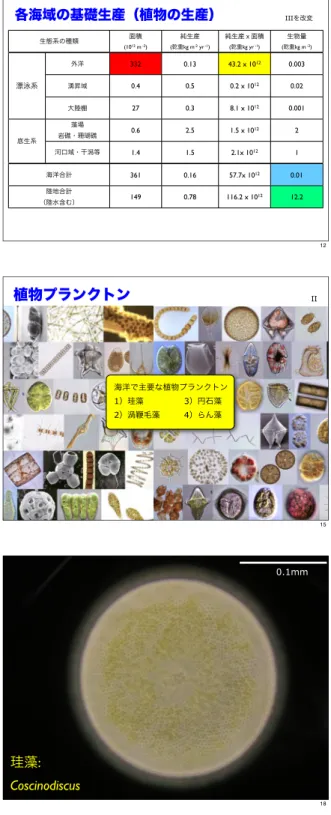
生態系の種類 生態系の種類 面積 (1012 m -2) 純生産 (乾重kg m-2 yr -1) 純生産x面積 (乾重kg yr -1) 生物量 (乾重kg m -2) 漂泳系 外洋 332 0.13 43.2 x 10¹² 0.003 漂泳系 湧昇域 0.4 0.5 0.2 x 10¹² 0.02 漂泳系 大陸棚 27 0.3 8.1 x 10¹² 0.001 底生系 藻場 岩礁・珊瑚礁 0.6 2.5 1.5 x 10¹² 2 底生系 河口域・干潟等 1.4 1.5 2.1x 10¹² 1 海洋合計 海洋合計 361 0.16 57.7x 10¹² 0.01 陸地合計 (陸水含む) 陸地合計 (陸水含む) 149 0.78 116.2 x 10¹² 12.2 IIIを改変 11各海域の基礎生産(植物の生産)
生態系の種類 生態系の種類 面積 (1012 m -2) 純生産 (乾重kg m-2 yr -1) 純生産x面積 (乾重kg yr -1) 生物量 (乾重kg m -2) 漂泳系 外洋 332 0.13 43.2 x 10¹² 0.003 漂泳系 湧昇域 0.4 0.5 0.2 x 10¹² 0.02 漂泳系 大陸棚 27 0.3 8.1 x 10¹² 0.001 底生系 藻場 岩礁・珊瑚礁 0.6 2.5 1.5 x 10¹² 2 底生系 河口域・干潟等 1.4 1.5 2.1x 10¹² 1 海洋合計 海洋合計 361 0.16 57.7x 10¹² 0.01 陸地合計 (陸水含む) 陸地合計 (陸水含む) 149 0.78 116.2 x 10¹² 12.2 IIIを改変 12生態系:海洋の特徴
IV 13 光合成有効放射: 400∼700nm ほぼ可視光と一致 1%程度まで減衰 (≒
光合成の補償深度) 外洋の透明度の高い海域で、 海面光量を100%とすると 水深100mでは・・・ ・基礎生産はごく浅い層に限定 ・表層に留まる必要性光合成の制限要因:光
V 14植物プランクトン
海洋で主要な植物プランクトン 1)珪藻 2)渦 毛藻 3)円石藻 4)らん藻 II 15Fig. 3.9 Scanning electron micrograph of Thalassiosira, a coastal diatom, clearly showing the epitheca, hypotheca, and
a connecting girdle of cell wall material. Fig. 3.10 A scanning electron micrograph of a centric
diatom, Asteromphalus heptacles.
珪藻類:電顕写真
VI❖
単細胞の藻類❖
10万種以上❖
非結晶二酸化ケイ素の被殻❖
珪藻土の起源 16珪藻類:殻の構造
VII 17珪藻:
Coscinodiscus
0.1mm 18珪藻: Chaetoceros
0.3mm 19 0.3mm珪藻:
Thalassiothrix
20渦鞭毛藻:電顕写真
VI Fig. 3.16 Scanning electron micrographs of some common marine dinoflagellates: (a)Gonyaulax polygramma, (b) Dinophysis rapa,
(c) Gonyaulax sp., and (d) Ceratochoris
horrida. All are 10-100 microns in diameter.
❖
赤潮の原因となる主要なグループ❖
セルロースの殻を持つか、あるいは無殻❖
2,000種程度(海産・淡水産含め) 21 0.1mm渦 毛藻: Ceratium
22 0.3mm渦 毛藻: Ceratium
23渦 毛藻: Gymnodinium
VI 24海洋環境:炭素循環
VIII 平衡状態 25海洋環境:炭素循環
平衡状態6CO
2+ 12H
2O
炭素の固定1:生物ポンプ
C
6H
12O
6+ 6O
2+ 6H
2O
石油 VIII 26 20µm円石藻類
V 炭酸カルシウムの”円石”を持つ 石灰岩(チョーク)の原料の一つ 2億年前に出現し 白亜紀、 ジュラ紀に最も繁栄 IX 2720µm
円石藻類
V 炭酸カルシウムの”円石”を持つ 石灰岩(チョーク)の原料の一つ 2億年前に出現し 白亜紀、 ジュラ紀に最も繁栄 X 28海洋環境:炭素循環
平衡状態2HCO
3-+ Ca
2+CaCO
3+ H
2O + CO
2炭素の固定2:アルカリ-炭酸塩ポンプ
VIII 石灰石 29植物プランクトン
II生産性が短い時間スケールで変化する
=環境変動への応答が速い
基礎生産者が微小な単細胞藻類
30Phytoplankton can grow explosively over a few days or weeks. This pair of satellite images shows a bloom that formed east of New Zealand between October 11 and October 25, 2009. (NASA images by Robert Simmon and Jesse Allen, based on MODIS data.)
ローカルスケール・短時間での変化
http://earthobservatory.nasa.gov/Features/Phytoplankton/ 31
ローカルスケール・短時間での変化
Phytoplankton can grow explosively over a few days or weeks. This pair of satellite images shows a bloom that formed east of New Zealand between October 11 and October 25, 2009. (NASA images by Robert Simmon and Jesse Allen, based on MODIS data.)
http://earthobservatory.nasa.gov/Features/Phytoplankton/ 32
細胞組織, DNA, RNA, ATP, etc. 海水中では無機の溶存態
制限要因:光、栄養塩、微量元素、水温、pH
N(硝酸塩・亜硝酸塩・アンモニウム塩)・P(リン酸塩)・Si(ケイ酸塩)光合成の制限要因
光
色素
6CO
2+ 12H
2O
C
6H
12O
6+ 6O
2+ 6H
20
33植物プランクトン(基礎生産)の時空間変異
http://earthobservatory.nasa.gov/Features/Phytoplankton/ 34•
衛星画像から クロロフィル蛍光を測定植物プランクトンの量と分布
11-year averages of the surface chl-a (mg m-3) observed by the SeaWiFS Satellite.
35
•
衛星画像から クロロフィル蛍光を測定植物プランクトンの量と分布
11-year averages of the surface chl-a (mg m-3) observed by the SeaWiFS Satellite.
高緯度と沿岸域:高生産
低緯度:低生産
http://www.nodc.noaa.gov/OC5/woa13f/index.html
栄養塩の鉛直分布(N):水深0m
37 http://www.nodc.noaa.gov/OC5/woa13f/index.html栄養塩の鉛直分布(P):水深0m
38 http://www.nodc.noaa.gov/OC5/woa13f/index.html栄養塩の鉛直分布(Si):水深0m
39漁獲量
Figure'14.08:'Loca2on'of'world's'major'commercial'fisheries'and'the'tonnage' (in'millions)'of'the'total'fish'catch'for'2002. IX 40漁獲量
海洋生物の生産や高次の生物量は 植物プランクトンの基礎生産によって支えられている Figure'14.08:'Loca2on'of'world's'major'commercial'fisheries'and'the'tonnage' (in'millions)'of'the'total'fish'catch'for'2002. IX 41海洋環境:炭素循環
大気 CO2 = 750 Gt CH4 = 3.7 Gt 海洋 溶存態無機炭素 = 39300 Gt 溶存有機炭素 < 700 Gt 海洋生物圏 = 3 Gt 海底堆積物 = 150 Gt 陸上 陸上生物圏 = 610 Gt 土壌(有機物) = 1500 Gt VIII 42海洋環境:炭素循環
大気 CO2 = 750 Gt CH4 = 3.7 Gt 海洋 溶存態無機炭素 = 39300 Gt 溶存有機炭素 < 700 Gt 海洋生物圏 = 3 Gt 海底堆積物 = 150 Gt 陸上 陸上生物圏 = 610 Gt 土壌(有機物) = 1500 Gt VIII 43海洋環境:炭素循環
大気 CO2 = 750 Gt CH4 = 3.7 Gt 海洋 溶存態無機炭素 = 39300 Gt 溶存有機炭素 < 700 Gt 海洋生物圏 = 3 Gt 海底堆積物 = 150 Gt 陸上 陸上生物圏 = 610 Gt 土壌(有機物) = 1500 Gt どちらも原料はプランクトンが関与 VIII 44海洋環境:炭素循環
平衡状態6CO
2+ 12H
2O
炭素の固定1:生物ポンプ
C
6H
12O
6+ 6O
2+ 6H
2O
石油 VIII 45海洋環境:炭素循環
平衡状態2HCO
3-+ Ca
2+CaCO
3+ H
2O + CO
2炭素の固定2:アルカリ-炭酸塩ポンプ
石油 石灰石 VIII 46深層
海底
光合成 6CO2+ 12H2O C6H12O6 + 6H2O + 6O2 6CO2+ 12H2O C6H12O6 + 6O2 + 6H2O 生物ポンプ CO2 O2 呼吸海洋環境:炭素循環
炭素の埋没 有機物表層
47深層
海底
光合成 6CO2+ 12H2O C6H12O6 + 6H2O + 6O2 6CO2+ 12H2O C6H12O6 + 6O2 + 6H2O 生物ポンプ CO2 O2 呼吸海洋環境:炭素循環
炭素の埋没 有機物表層
酸性化 CO2 湧昇 48 Figure'06.16B:'(b)'This'model'portrays'the'exchange'of'surface'and'deep'water'across'the'ocean'basins'as'a'conveyor'belt. XI深層循環
49湧昇域
Fig. 3.37 Principal regions of coastal upwelling (blue) and down-current areas of increased primary productivity (green). VI 50
表層
深層
海底
光合成 6CO2+ 12H2O C6H12O6 + 6H2O + 6O2 6CO2+ 12H2O C6H12O6 + 6O2 + 6H2O 生物ポンプ 炭酸塩ポンプ CO2 O2 呼吸 アルカリポンプ CaCO3 + H2O + CO2 2HCO3- + Ca2+ 2HCO3- + Ca2+ CaCO3 + H2O + CO2 石灰海洋環境:炭素循環
炭素の埋没 有機物 CO2 51表層
深層
海底
光合成 6CO2+ 12H2O C6H12O6 + 6H2O + 6O2 6CO2+ 12H2O C6H12O6 + 6O2 + 6H2O 生物ポンプ 炭酸塩ポンプ CO2 O2 呼吸 アルカリポンプ CaCO3 + H2O + CO2 2HCO3- + Ca2+ 2HCO3- + Ca2+ CaCO3 + H2O + CO2 石灰海洋環境:炭素循環
中和反応 炭素の埋没 有機物 湧昇 酸性化 CO2 52vivorship and seed mass over two generations. Biomass was almost always greater in the first-generation offspring of crosses involv-ing foreign material, but declined in the second generation. Mortality was higher in both generations. Seed weight, like biomass, was generally higher in the first generation and lower in the second generation of foreign crosses. So it seems that, in the long term, the introduction of foreign genes into these weed populations is likely to make them less fit — that is, less able to survive and repro-duce effectively. Relative reductions in fit-ness were estimated to be between 8% and 23%. The overall message is that the intro-duction of genes from distant populations is likely to do lasting harm to the native weed flora of an area.
These findings have broader implica-tions. The introduction of fresh breeding stock into fragmented and isolated popula-tions is often seen as a way of increasing genetic diversity, and has been attempted in organisms ranging from butterflies to birds2. The merits of such a policy can vary with the geographical distance from which intro-duced material is obtained and with the spatial variability in the genetic constitution of the species concerned. Geographical distance might not always correspond to genetic distance: it will also vary with the type of organism involved.
The effects of genetic distance have been tested on a Californian shrub, Lotus
scopar-ius, the deerweed3, using degrees of enzyme variation as the genetic measure. Deerweed is a variable shrub of the coastal sage com-munity of the west coast of North America, being found in both arid and well-watered habitats. In an experiment involving 12 populations, there was only weak correla-tion between geographical and genetic dis-tances. But in transplant experiments the cumulative fitness of plants showed an inverse relationship to genetic distance. The closer the relationship is, the more likely it is that the individual will survive well in similar situations. So the introduction of this shrub should be determined by an analysis of genetic or ecological similarity (or both): geographical proximity of a seed source will not necessarily provide the most appropriate material for translocation.
A further complication with flowering plants arises from their different breeding strategies. The corncockle, for example, often self-pollinates, so its genetic constitu-tion is likely to be patchy on a local scale. Deerweed is pollinated by insects, which might also restrict the distances over which outbreeding is possible.
How does this relate to wind-pollinated, outbreeding plants such as birch, poplar, alder and elm? A modelling exercise, based on data concerning the timing of flowering and its response to climate4, has shown that there is little evidence of local genetic
news and views
NATURE|VOL 407|12 OCTOBER 2000|www.nature.com 685 Figure 1 The ‘biological pump’ is a collective property of a complex phytoplankton-based food web.
Together with the ‘solubility pump’ (right), which is driven by chemical and physical processes, it maintains a sharp gradient of CO2between the atmosphere and the deep oceans where 38!1018g of
carbon is stored. Using sunlight for energy and dissolved inorganic nutrients, phytoplankton convert CO2to organic carbon, which forms the base of the marine food web. As the carbon passes through
consumers in surface waters, most of it is converted back to CO2and released to the atmosphere. But
some finds its way to the deep ocean where it is remineralized back to CO2by bacteria. The net result
is transport of CO2from the atmosphere to the deep ocean, where it stays, on average, for roughly
1,000 years. The food web’s structure and the relative abundance of species influences how much CO2
will be pumped to the deep ocean. This structure is dictated largely by the availability of inorganic nutrients such as nitrogen, phosphorus, silicon and iron. Iron is the main limiting nutrient in the Southern Ocean, which is why the SOIREE experiment1–3was conducted there. (Figure modified from
a graphic by Z. Johnson.)
variation in these and other tree species across Europe. The production of large amounts of pollen and the potential for distant dispersal in these species ensures rapid gene flow and little opportunity for local isolation and adaptation. In such outbreeding species, one could argue, the problems of selecting appropriate stock for sowing or transplanting in new locations are less serious.
The history of plant and animal intro-ductions is littered with catastrophes5. These reports concerning the implications of
mov-ing genes between populations suggests that caution is needed here also. ■
Peter D. Moore is in the Division of Life Sciences, King’s College London, Franklin–Wilkins Building, 150 Stamford Street, London SE1 8WA, UK. e-mail: [email protected]
1. Keller, M., Kollmann, J. & Edwards, P. J. J. Appl. Ecol. 37, 647–659 (2000).
2. Evans, E. I. et al. Br. Birds 90, 123–138 (1997). 3. Montalvo, A. M. & Ellstrand, N. C. Conserv. Biol. 14, 1034–1045
(2000).
4. Chiune, I., Belmonte, J. & Mignot, A. J. Ecol. 88, 561–570 (2000). 5. Macdonald, I. A. in Biodiversity and Global Change (eds Solbrig, O. T., van Emden, H. M. & van Oordt, P. G. W. J.) 199–209 (CABI, Wallingford, Oxon, 1994).
A
lmost half of the photosynthesis on Earth is carried out by phytoplankton in the sea. So these tiny cells play a huge part in the global carbon cycle, and in regu-lating climate by controlling the amount ofthe greenhouse gas CO2in the atmosphere. Phytoplankton are the engine of the ‘biologi-cal pump’ (Fig. 1) that helps maintain a steep gradient of CO2between the atmosphere and deep ocean. It has been suggested that we
Bacteria Bacteria Deep ocean Surface ocean Zooplankton Large phytoplankton Small phytoplankton Microzooplankton Or ganic carbon Sea floor Deep consumers
Deep water formation
Ventilation (upwelling) ~ 3,700 m ~ 100 m CO2 CO2 CO2 CO2 CO2 Oceanography
Stirring times in the Southern Ocean
Sallie W. Chisholm © 2000 Macmillan Magazines Ltd
二酸化炭素と炭素循環
炭酸塩・アルカリポンプによる中和反応 湧昇による OC2の大 気への回帰 を緩やかに Chisholm (2000) Nature 407: 685-687 溶解ポンプ 53海洋の酸性化
Doney (2006) Scientific American, March p.58
海洋の酸性化
Doney (2006) Scientific American, March p.58
55
海洋の酸性化
Doney (2006) Scientific American, March p.58
諏訪ら(2010)海の研究19(1)
56
海洋の酸性化
Doney (2006) Scientific American, March p.58 藤井・石田(2013)海洋と生物 207 57
http://www.cmarz.org/galleries.html Doney (2006) Scientific American, March p.58
Ruttimann (2006) Nature Digest, October 3, p16-19
海洋の酸性化
58海洋の酸性化
•
プランクトンだけでなく、石灰質をもつ生物が影響を受ける 写真:Discover Blue I 写真:Discover Blue 59炭酸カルシウムの溶解度の変化予測
http://www.cger.nies.go.jp/ja/library/qa/6/6-1/qa_6-1-j.html•
産業革命以前のpHは8.17•
現在は8.05程度まで低下•
温度はpHに影響しないが、 炭酸カルシウムは低温・高圧 で溶解度が高い•
極域で強く影響でると予測 60炭酸カルシウムの溶解度の変化予測
Doney (2006) Scientific American, March p.58