Differentiated Use of Small Business Credit Scoring by Relationship Lenders and
Transactional Lenders : Evidence from Firm‑Bank Matched Data in Japan
著者 Hasumi Ryo, Hirata Hideaki, Ono Arito
出版者 Institute of Comparative Economic Studies, Hosei University
journal or
publication title
比較経済研究所ワーキングペーパー
volume 175
page range 1‑54
year 2013‑03‑14
URL http://hdl.handle.net/10114/7986
Differentiated Use of Small Business Credit Scoring by Relationship Lenders and Transactional Lenders: Evidence from Firm-Bank Matched Data in Japan
†Ryo Hasumi Economist
Economic Research Department Japan Center for Economic Research
Hideaki Hirata Professor
Faculty of Business Administration Hosei University
Arito Ono‡ Senior Economist Research Department Mizuho Research Institute [email protected]
March 2013
† We would like to thank Allen Berger, Robert DeYoung, Giuseppe Gramigna, Ryuichi Nakagawa, Katsutoshi Shimizu, Mototsugu Shintani, Shigenori Shiratsuka, seminar participants at the Bank of Japan, the Research Institute of Capital Formation of the Development Bank of Japan, the U.S. Small Business Administration, participants of the 2010 Regional Finance Conference, the 2010 Autumn Annual Meeting of the Japan Society of Monetary Economics, the 2011 Eastern Economic Association Conference, the 2011 Summer Workshop on Economic Theory, the 2012 European Central Bank, Kelley School of Business - Indiana University, Center for Economic Policy Research, and Review of Finance jointly organized conference on “Small Business Financing,” and especially the members of the Study Group on Changes in Financial and Industrial Structures at the Research Institute of Economy, Trade, and Industry (RIETI) for helpful comments. Any remaining errors are our responsibility. Ono gratefully acknowledges that the paper was prepared in part while he was a senior economist at the Institute for Monetary and Economic Studies, Bank of Japan. Permission to use RIETI surveys and TSR data, the Keio/Kyoto Joint Global COE Program’s Shinkin and Shinso data, and Moody’s KMV RiskCalc is also gratefully acknowledged. The views expressed in this paper are ours and do not necessarily reflect those of any of the institutions with which we are affiliated.
‡ Corresponding author: Research Department, Mizuho Research Institute, 1-2-1 Uchisaiwaicho, Chiyoda-ku, Tokyo 100-0011, Japan. Tel: +81-3-3951-1306, Fax: +81-3-3591-1397, Email: [email protected]
Differentiated Use of Small Business Credit Scoring by Relationship Lenders and Transactional Lenders: Evidence from Firm-Bank Matched Data in Japan
Ryo Hasumi a, Hideaki Hirata b, and Arito Ono c
Abstract
This paper examines the ex-post performance of small and medium enterprises (SMEs) that obtained small
business credit scoring (SBCS) loans by using a unique Japanese firm-bank matched dataset. The ex-post
probability of default after the SBCS loan was provided significantly increased for SMEs that obtained an
SBCS loan from a transactional lender. Also, the lending attitude of relationship lenders during the recent
global financial crisis was more severe if a transactional lender had extended an SBCS loan to a firm. These
findings suggest that SBCS loans by a transactional lender are more prone to type II errors and detrimental to a
relationship lender’s incentive to provide “liquidity insurance”.
JEL classifications: G21, G32
Keywords: small business credit scoring, lending technology, relationship lending
_____________________________
a Economist, Economic Research Department, Japan Center for Economic Research, [email protected]
b Professor, Faculty of Business Administration, Hosei University, [email protected]
c Corresponding author, Senior Economist, Research Department, Mizuho Research Institute, 1-2-1
Uchisaiwaicho, Chiyoda-ku, Tokyo 100-0011, Japan. Tel: +81-3-3951-1306, Fax: +81-3-3591-1397, Email:
1. Introduction
Loans to small businesses have traditionally been based on intimate relationships between borrower firms and
lenders, because many of these firms are much more informationally opaque than large firms and thus lenders
primarily rely on “soft” information gathered through long-lasting transaction relationships with small
businesses. However, advances in information technology over the past decades have considerably transformed
the landscape of small business lending, and a number of transaction-based lending technologies that rely on
quantifiable and verifiable “hard” information have become available for small businesses. In particular, small
business credit scoring (SBCS) has expanded rapidly in many countries and has attracted a fair amount of
research interest.1 It has been argued that SBCS is effective in increasing the availability of credit to small
businesses (Agarwal and Hauswald, 2008; Berger et al., 2011; Berger et al., 2005a; Frame et al., 2004; Frame
et al., 2001) and/or improving the accuracy of risk-based pricing of loans to them (Berger et al., 2005a).
However, the recent contraction in small business lending in the United States, where the use of SBCS is the
most advanced, has cast some doubts on the predictive power of SBCS.2 The recent global financial crisis has
also raised concerns that, in cases where relationship lending plays an important role, transactional loans such
as SBCS loans may have adverse effects on the provision of credit by relationship lenders during the crisis.
1 See Berger and Frame (2007) for a survey.
2 See, for instance, “When Business Credit Scores Get Murky,” Wall Street Journal, March 18, 2010. Mester (1997) cautioned the accuracy of SBCS models needed to be assessed based on their performance during an economic downturn.
Against this background, the present paper, focusing on Japan, examines how firms that received
SBCS loans have weathered the financial crisis that erupted after the failure of Lehman Brothers in September
2008. In particular, the paper examines whether the ex-post performance of firms that received an SBCS loan
before the crisis depends on the bank’s strategies of implementing SBCS. Previous studies suggest that there
are two potential benefits for a lender to adopt SBCS: cost-saving in the screening of loan applications, and the
mitigation of informational opacity of prospective borrowers (Berger and Frame, 2007). We develop this
argument and hypothesize that transactional lenders tend to use SBCS based on the cost-saving motive,
whereas the motive of relationship lenders in adopting SBCS is to make more efficient lending decisions. We
argue that the differentiated use of SBCS by relationship lenders and transactional lenders would affect firms’
ex-post performance as well as the relationship lenders’ willingness to provide rescue finance when firms face
difficulties during crisis.
The analysis in this paper relies on a unique firm-bank matched dataset on SBCS in Japan. Our
dataset is based mainly on firm surveys conducted by the Research Institute of Economy, Trade, and Industry
(RIETI) during 2008-2009. The virtue of these surveys is that we can identify SBCS loan user firms and
non-user firms as well as firms’ primary bank, that is, the bank that has the largest amount of loans outstanding
to a particular firm. Moreover, we can identify whether a primary bank (relationship lender) or a non-primary
bank (transactional lender) has extended SBCS loans to a particular firm. Thus, we can make inferences on
how a bank’s strategy of implementing SBCS differs depending on whether the bank is a relationship lender or
a transactional lender.
Focusing on the period of financial turmoil after the failure of Lehman Brothers, we perform two
exercises and find the followings. First, we examine how the provision of SBCS loans, either by a primary
bank or a non-primary bank, affected borrowing firms’ performance during the crisis. Existing studies find
mixed evidence on whether SBCS loans may be associated with more type II errors (approving loans that will
default) than relationship loans (see, for example, Agarwal and Hauswald (2008) and DeYoung et al. (2008)
that find positive result, and Berger et al. (2011b) that find no effects). We conjecture that if a transactional
lender uses SBCS for cost-saving, then it is likely that SBCS loans have a higher PD than non-SBCS loans,
because credit scores are based on a limited set of quantifiable information and thus the scores alone are
imperfect indicators of borrower quality. In contrast, if a relationship lender uses SBCS discretionally in order
to evaluate the creditworthiness of opaque small businesses more accurately, then it is likely that SBCS loans
are associated with a lower likelihood of default.
Consistent with the first part of the above hypothesis, we find that, on average, the ex-post PD of
firms that have obtained SBCS loans from non-primary banks is higher than that of non-SBCS loan user firms,
conditional on the ex-ante PD and other covariates. In contrast, we find that the ex-post PD of firms that have
obtained an SBCS loan from their primary bank becomes smaller than that of non-SBCS loan user firms.
Second, we investigate whether the use of transactional loans such as SBCS loans adversely affected
a relationship lender’s incentive to provide assistance to its client-firms during the financial crisis. In particular,
we examine whether the lending attitude of a primary bank worsened more in the midst of the crisis if a firm
obtained SBCS loans. We conjecture that the provision of SBCS loans is detrimental to a firm-bank
relationship if it is provided by a transactional lender for the following reasons. First, a higher indebtedness of
a borrowing firm as a result of loans from another lender will exacerbate its moral hazard incentives and
reduces the relationship lender’s willingness to provide credit (Degryse et al., 2012). Second, standard theory
of adverse selection argues that, in the presence of informational asymmetry, a low quality firm would tend to
self-select to banks that are more prone to type II errors in anticipation of being mistaken for a high quality
borrower (Ergungor and Moulton, 2011; Gropp et al., 2012). This suggests that a low quality firm chooses to
obtain SBCS loans from transactional lenders that adopt SBCS for the cost-saving motive. But then, the
relationship lender would infer that the firm’s credit prospect has worsened and would reduce its credit supply
in the midst of crisis. On the other hand, we predict that such negative spillover effects will not appear if an
SBCS loan has been extended by a relationship lender itself.
Consistent with the first part of the second hypothesis above, we find that the lending attitude of a
firm’s primary bank worsened during the financial crisis if the firm had obtained an SBCS loan from a
non-primary bank. In contrast, when SBCS loans were provided by the primary bank itself, we do not find
such detrimental effects of SBCS loans on primary banks’ lending attitude.
Overall, our findings suggest that the main motive of extending SBCS loans for a transactional
lender is to expand the customer base via the cost-saving effect generated by SBCS. The cost associated with
this strategy of implementing SBCS is that these loans are more prone to type II errors and that it induces
borrower adverse selection problems. For a relationship lender, the virtue of SBCS is that it improves the
accuracy of lending decisions in that the credit score represents one of many inputs. From borrowers’
viewpoint, SBCS loans from transactional lenders appear to be beneficial in that – at least in normal times –
they increase the availability of credit. However, such loans may also have their drawbacks in that the use of
SBCS loans from transactional lenders may be detrimental to the close ties borrowers have with their
relationship lender, which may be particularly crucial for small businesses during times of crisis.
Our contributions to the literature on SBCS are as follows. First, despite its growing relevance in
small business loan markets, there is little empirical research on SBCS in countries other than the U.S. We fill
this gap by utilizing a unique firm-bank matched dataset in Japan.
Second, our analyses show that relationship and transactional lenders have different motives in
extending SBCS loans. While understanding this point is important, it has not been explored much in the
literature. This is due to the data limitations previous empirical studies faced, namely that they were based on
bank-level datasets and thus were not able to distinguish whether banks extending SBCS loans are a
relationship lender for the particular firms to which they extend such loans.3 It should also be noted that this
3 Most studies are based on a survey of the largest U.S. banks conducted by the Federal Reserve Bank of Atlanta in January 1998. On the other hand, Bergeret al. (2011b) recently used a survey of U.S. community banks conducted by the U.S. Small Business Administration.
paper is closely related to Berger et al. (2005a), which find that the primary motive of “rules” banks that use
SBCS to automatically make lending decisions is cost-saving, while “discretion” banks that utilize credit
scores as one of several inputs in making credit decisions aim to reduce the opaqueness of potential borrowers.
While our findings are consistent with the use of SBCS by “rules” banks vs. “discretion” banks by Bergeret al.
(2005), the key contribution of this paper to the literature is that it sheds light on the reasons why banks adopt a
particular strategy in implementing SBCS.
Third, this paper empirically examines, for the first time to our knowledge, how the role of a
relationship lender as a provider of liquidity insurance during financial crises is affected by the use of SBCS,
and finds that SBCS loans by transactional lenders have negative externalities.
The remainder of the paper is organized as follows. Section 2 briefly describes the development of
the SBCS loan market in Japan. Section 3 then develops our empirical hypotheses on how the use of SBCS
loans affects the ex-post performance of borrower firms and the lending attitude of their relationship lenders
during times of crisis. Next, Section 4 describes the data and variables used in the paper and explains our
empirical models, while Section 5 presents the results of our empirical analysis. Section 6 summarizes the
paper’s findings.
2. The Development of Small Business Credit Scoring in Japan
Credit scoring is a quantitative method to evaluate the credit risk (PD) of loan applications. Using both
qualitative and quantitative data and statistical techniques, credit scoring produces a “score” for a loan
applicant that forms the basis of credit decisions such as whether or not to provide a loan and the loan contract
terms. Following Berger and Udell (2006), we define SBCS loans as loans where the primary lending decision
is based on numerical credit scores. Note that this definition does not rule out the use of other information (for
instance, soft information that is primarily used in relationship lending) as a secondary source.4
In the United States, credit scoring has been used for underwriting consumer credit for some time,
but it was not used for small business credit until the mid-1990s because of the heterogeneity of small
businesses. The development of credit scoring models for small business loans in the 1990s was motivated by
the casual observation that repayments of small business loans depended less on the business itself than on the
credit history of the business owner (Mester, 1997; Allen et al., 2004). Since then, many U.S. banks have been
using the consumer credit score of small business owners to evaluate small business loan applications (Cowan
and Cowan, 2006).
SBCS has been rising in popularity among Japanese banks as well since the early 2000s. Although
there is no official aggregate data on the volume of SBCS loans in Japan, the outstanding amount of SBCS
loans for the three largest banks was 5 trillion yen (about 50 billion dollars) at the end of 2005, about 5 percent
4 Whether SBCS is a substitute or complement to other lending technologies is one of the key issues in the literature (Berger et al., 2005a) that will be discussed below. Uchida et al. (2008b) investigate the relationship among different lending technologies in Japan. However, they do not include SBCS in their analysis.
of their entire loans outstanding to small businesses.5 SBCS has also spread among regional banks and
cooperative financial institutions, who originated more than 8 trillion yen of SBCS loans in total during
FY2003 – FY2006.6 Many scoring models adopted by Japanese banks use only firms’ attributes such as
financial ratios and do not take into account most, or any, of the business owners’ personal attributes, because
banks do not have sufficient access to databases on the personal credit histories of business owners7 (Ono,
2006). In essence, SBCS loans by Japanese banks are based on business credit scores.
The expansion of SBCS among regional banks and cooperative financial institutions in the early
2000s was partly due to regulatory pressure from the Financial Services Agency (FSA) to provide small
business loans that did not require small business borrowers to pledge real estate collateral.8 However, growth
in the SBCS loan market has stagnated since the mid-2000s, in part because the default rates of SBCS loans
5 Nikkei Newspaper, September 20, 2006.
6 Financial Services Agency (FSA), “Progress Report on the Action Program Concerning Enhancement of Relationship Banking Functions,” July 12, 2007.
7 Note, however, that Japanese banks usually collect information of the business owners’ personal attributes manually when extending non-scoring loans including relationship-based loans.
8 In March 2003, the FSA released the “Action Program Concerning Enhancement of Relationship Banking Functions.” The action program urged regional banks and cooperative financial institutions to “utilize methods such as the credit scoring model […] from the perspective of promoting lending activities, placing emphasis on cash flow from business operations and avoiding an excessive reliance on collateral and personal guarantees”
(p.4, authors’ translation).
have been higher than expected.9 This suggests that the predictive power of SBCS models based on business
credit scores is relatively weak. Worried by the fact that some banks were accumulating non-performing loans,
the FSA has ceased to promote the use of SBCS in its Action Program since 2007. Thus, we can infer that
during the period of SBCS loan extension that we focus on – before the onset of the global financial crisis that
erupted after the failure of Lehman Brothers in September 2008, but after the FSA had stopped actively
promoting the use of SBCS – there was little regulatory pressure to extend SBCS loans, so that the decision
whether or not to extend such loans at most banks was based on economic motives. This situation provides us
with a good opportunity to examine the empirical hypotheses described below.
3. Empirical Hypotheses
To examine how the use of SBCS affects the performance of loans to small businesses and their ties with
relationship lenders in times of crisis, we put forward empirical hypotheses that are based on the existing
theoretical and empirical literature.
3.1. Strategies of Implementing SBCS
9 A typical example is the failure of Shin Ginko Tokyo. The bank was established in 2004 at the initiative of the Tokyo metropolitan government, but by the end of 2007 the bank had lost nearly 80 percent of its capital because of the extremely high default rate on its SBCS loans. See Hasumi and Hirata (2010) for details.
There may be several reasons for lenders to adopt SBCS, and the strategies of implementing SBCS
(and the associated effects on loan contract terms and ex-post loan performance) may differ across banks.
Previous studies suggest that there are two potential benefits for lenders of adopting SBCS: (i) cost-saving in
screening loan applications, which would help to expand small business lending, and (ii) the mitigation of the
borrower-opacity problem, which would contribute to more efficient lending decisions and/or setting contract
terms more accurately (Mester, 1997; Berger et al., 2005a; Berger and Frame, 2007). Berger and Frame (2007)
argue that cost-saving is likely to be the key motive for “rules” banks that use scores to automatically approve
or reject loan applications, as this greatly reduces the human resource expenses associated with loan processing.
In contrast, banks that use scores as a supplementary factor in making credit decisions are termed as
“discretion” banks. For discretion banks, the key incentive for adopting SBCS is to improve the precision of
their information about the creditworthiness of prospective borrowers and make correct lending decisions.
3.2. The Effect of SBCS on Borrower Performance
Regarding the effect of SBCS on loan performance, DeYoung et al. (2008) point out three potential
effects on a bank’s risk taking and loan performance. First, SBCS may make the loan production process more
efficient and reduce associated costs. As a result, the bank will be more willing to extend loans to marginally
riskier borrowers (risk-taking effect), because, with increased efficiency, the bank has greater capacity to
absorb losses. This effect would increase the ex-post default rate, all else equal. Second, if used in isolation,
SBCS may be informationally inferior to traditional relationship lending, as credit scores – because they are
based on a limited set of quantifiable information – are an imperfect indicator of the creditworthiness of
prospective borrowers. This effect of SBCS makes both type I errors (rejecting good loans) and type II errors
(approving loans that will default) more frequent and will result in a higher default rate.10 This being the case,
lenders will use SBCS only if the cost-saving effect of credit scoring outweighs the deterioration in expected
loan performance. In contrast, and finally, by combining the hard information obtained from the credit scoring
model and the soft information gathered through an existing firm-bank relationship and the traditional loan
screening process, SBCS may improve the lender’s information set and result in a smaller default rate. The
first and second effects correspond to the cost-saving motive underlying the adoption of SBCS, while the third
effect is likely to be found for banks that use SBCS to reduce the borrower opacity problem.
The performance of SBCS loans would be affected not only by banks’ lending strategies but also by
borrowers’ self-selection. A standard theory of adverse selection suggests that, in the presence of informational
asymmetry, a low quality borrower will apply to uninformed lender in anticipation of being mistaken for a high
quality borrower (type II error). Thus, it is likely that a low quality borrower will select a bank that uses SBCS
for cost-saving, while a high quality borrower will select a bank that uses SBCS for the reduction of
borrower-opacity problem (Shaffer, 1998). Consistent with the reasoning, empirical studies by Ergungor and
Moulton (2011) and Gropp et al. (2012) find that a creditworthy borrower will choose to apply credits to
10 For the sake of brevity, we will only refer to type II errors hereafter.
relationship banks or local banks that are deemed to have accumulated the borrower’s soft information.
Turning to empirics, previous studies find mixed evidence on the association between SBCS loans
and ex-post loan performance.11 Using U.S. SBA loans data, DeYoung et al. (2008) report that the default rate
for SBCS loans is higher than that for non-scoring loans. Agarwal and Hauswald (2008) also find that the
credit delinquency of online scoring loans is higher than that of relationship-based in-person loans. On the
other hand, Berger et al. (2011b) report that the use of SBCS does not materially affect the non-performing
loan ratio of U.S. community banks.
We posit below that relationship lenders and transactional lenders have different motives for
adopting SBCS, and the differentiated use of SBCS by these lenders will result in contrasting ex-post
performance of SBCS-loan user firms.
On extending an SBCS loan to a prospective borrower, a transactional lender does not have sufficient
access to soft information on the borrower. Thus, the likely motive for employing SBCS for a transactional
lender is cost-saving. On the other hand, employing SBCS solely based on the cost-saving motive is likely to
exacerbate the borrower opacity problem, resulting in more frequent type II errors. A deterioration in the
performance of loans after the adoption of SBCS may also occur as a by-product of more ex-ante risk-taking if
11 Regarding the ex-ante riskiness of borrowers, Berger et al. (2005a) find that the average risk rating of loans issued by “rules” banks is higher (i.e., such loans are riskier) than that by non-scoring banks, while the average risk rating of loans issued by “discretion” banks is lower than that by non-scoring banks. Thus, the empirical results by Berger et al. (2005a) suggest that the risk-taking effect of SBCS is limited to “rules” banks.
SBCS is useful for a transactional lender in reducing loan origination costs, and/or as a by-product of adverse
self-selection by low quality borrowers. It should also be noted that SBCS loans by Japanese banks are mostly
based on business credit scores, and thus they may be more prone to type II errors than those based on
consumer credit scores.
In contrast, using the credit score as a complement to the soft information that has been accumulated,
a relationship lender may be able to evaluate the creditworthiness of small businesses more accurately. If that
is the case, the default rate of SBCS loans provided by a relationship lender should be smaller than that of
non-scoring loans.12 In addition, a high quality borrower with positive soft information is more likely to
self-select to its relationship bank.
In summary, we put forward the following hypothesis:
Hypothesis 1 (The effect of SBCS on borrower performance)
The average ex-post performance of SBCS loan user firms deteriorates more than that of non-scoring loan
user firms if SBCS loans are extended by a transactional lender that implements SBCS for the cost-saving
motive.
12 Another potential benefit of SBCS for a relationship lender is the creation of uniform and objective loan underwriting criteria across borrowers (Mester, 1997). That is, SBCS is likely to mitigate uneven credit decisions by loan officers, which are inherent in traditional relationship lending.
In contrast, the average ex-post performance of SBCS loan user firms improves more than that of non-scoring
loan user firms if SBCS loans are provided by a relationship lender that adopts SBCS in order to more
accurately evaluate the creditworthiness of prospective borrowers.
Note that cost-saving may be the main motive also for a relationship lender if it is relatively costly
for the lender to reproduce (update) soft information. In this case, SBCS loans by a relationship lender are
qualitatively the same as those by a transactional lender, and we would expect the average performance of
SBCS-loan borrowers to deteriorate more than that of non-scoring loan borrowers.
3.3. The Effect of SBCS on Liquidity Provision by a Relationship Lender in Times of Crisis
Previous studies on relationship lending suggest that firms, especially small firms that are
informationally opaque, tend to suffer from credit rationing during financial crises, but that firms that have a
close relationship with a relationship lender are less likely to be affected by such crises than other similar firms
(see, for instance, Section 4.3.2.7 of Degryse et al. (2009) and references therein). The reason is that
relationship lenders can provide a kind of implicit liquidity insurance in situations where borrowing firms
experience a temporary adverse shock, as the proprietary information accumulated through intimate
relationships produces rents that allow lenders to offset temporary losses (Boot, 2000). The empirical literature
on main banks (relationship lenders) in Japan in particular suggests that main banks tend to play a critical role
when their client firms fall into distress (Aoki, 1994; Hoshi et al., 1990; Kang and Shivdasani, 1995; Sheard,
1989; 1994; Suzuki and Wright, 1985).13 However, empirical evidence that relationship lenders provide
liquidity in times of financial distress is not limited to Japan but has also been found for other countries such as
Germany (Elsas and Krahnen, 1998), Korea (Ferri et al., 2001; Jiangli et al., 2008), Italy (De Mitri et al., 2010),
and the United States for the 19th-century (Bodenhorn, 2003).
What has not been explored in the literature is how the use of transactional lending such as SBCS
affects relationship lenders’ incentives to provide liquidity insurance during financial crisis. We hypothesize
that the effect of SBCS on the liquidity provision by a relationship lender also depends on whether the bank
that extends an SBCS loan is the relationship lender itself or another, transactional lender.
On the one hand, if a small business borrower obtains an SBCS loan from a transactional lender, this
is likely to lower a relationship lender’s willingness to lend during a period of crisis for the following two
reasons. First, a higher total indebtedness by obtaining SBCS loans from a transactional lender reduces the
borrower’s incentive to repay the debt as well as the relationship lender’s willingness to provide credit.14 For
instance, Degryse et al. (2012) find that a creditor reduces its credit supply when a borrower obtains loans from
another creditor. The argument is further supported by empirical studies on Japanese main banks that show that
13 In this context, a number of empirical studies suggest that main banks charge their borrowers higher interest margins to compensate for the provision of liquidity insurance. See, for instance, Kawai et al. (1996), Nemoto et al. (2011), Osano and Tsutsui (1985), and Weinstein and Yafeh (1998).
14 Note, however, that this argument applies not only to SBCS loans but also to any type of loans.
distressed firms with a smaller dependence on their main bank in their total debt outstanding are less likely to
receive rescue finances and other assistance from the main bank, resulting in a higher probability that such
firms go bankrupt (Suzuki and Wright, 1985) and lower sales and investment afterwards (Hoshi et al., 1990).
Second, we argued in the previous subsection that a low quality firm would apply to SBCS loans provided by
transactional lenders that are more prone to type II errors. Then, the relationship lender of the firm would infer
that the creditworthiness of the firm has worsened, and becomes less willing to provide rescue finance
afterwards.
On the other hand, SBCS loans obtained from a relationship lender do not create such negative
externalities and therefore are likely to leave the provision of liquidity by a relationship lender during financial
crisis unaffected. Moreover, if a relationship lender uses the numerical credit score as one of many inputs in
making a credit decision, then it is likely that the relationship lender will be better informed about the
borrowing firm than when not using credit scores. In this case, the use of SBCS will reduce the informational
opacity problem with regard to borrowing firms and strengthen the incentive for a relationship lender to
provide credit to client firms in distress.
In summary, we put forward the following hypothesis:
Hypothesis 2 (The effect of SBCS on liquidity provision by a relationship lender in times of crisis)
A relationship lender is less willing to provide liquidity insurance during a period of crisis to client firms that
have obtained SBCS loans from other, transactional lenders than to firms that have not obtained SBCS loans.
In contrast, a relationship lender is more willing to provide liquidity insurance during a period of crisis to
client firms that have obtained SBCS loans from the same relationship lender than to firms that have not
obtained SBCS loans from it.
Note that the latter part of Hypothesis 2 again rests on the assumption that a relationship lender
adopts SBCS in order to reduce the information opacity of a borrower firm. If, on the other hand, the lender
uses SBCS as a substitute for relationship lending, it will lose, at least partially, soft information that is needed
to evaluate the creditworthiness of the firm in times of distress, and effectively becomes a transactional lender.
Under this scenario, the positive effect of SBCS on liquidity provision by a relationship lender during financial
crisis is likely to be muted. Another implicit assumption in the latter part of Hypothesis 2 is that firms that need
financial assistance from a relationship lender face a shortage of liquidity but not a solvency problem. If a firm
faces a solvency problem, then a more informed relationship lender that utilize SBCS has no incentive to
provide liquidity to such a firm in permanent distress.
4. Data, Variables, and Empirical Approach
4.1. Data
The two main sources of our dataset are the “Survey on Transactions between Enterprises and Financial
Institutions under the Financial Crisis” conducted in February 2009 and the “Survey on Transactions between
Enterprises and Financial Institutions” conducted in February 2008, both by the Research Institute of Economy,
Trade and Industry (RIETI). Based on a sample drawn from the Financial Information Database of Tokyo
Shoko Research (TSR), a commercial credit research firm that compiles information on more than 1.2 million
firms, the 2008 survey questionnaire was sent to 17,018 firms, of which 6,059 responded. The 2009 survey
questionnaire was sent to 5,979 firms out of the 6,059 respondents to the 2008 survey. The number of
respondent firms for the 2009 survey is 4,103.
These RIETI surveys ask a variety of questions on corporate financing, including, in the 2009 survey,
whether firms have obtained SBCS loans or not and, if they have, from which financial institutions (for the
sake of convenience, we call them “banks” hereafter). Banks are categorized as “primary bank,” “second-
primary bank,” and “other bank.” The primary bank is defined as the bank with the largest amount of loans
outstanding to the firm, while the second-primary bank is the bank with the second-largest amount of loans
outstanding to the firm. Firms were asked to identify their primary and second-primary banks both in the 2008
and the 2009 survey. In addition, we tried to identify other SBCS banks by sending follow-up questionnaires to
firms that reported using SBCS loans in the 2009 survey (RIETI, “Survey on Small Business Credit Scoring,”
November 2009).15 Thus for each firm, we are able to identify its primary and second-primary banks, and
15 The questionnaire was sent to 418 firms that responded to the 2009 survey and answered that they had obtained SBCS loans. The number of respondent firms to the follow-up survey is 284.
whether these banks have extended an SBCS loan. As for the other banks, we are able to identify them only if
they have extended an SBCS loan to the firm.
In addition to the information on the usage of SBCS loans, we collect information on firm
characteristics, primary bank characteristics, and firm-primary bank relationship variables in order to test our
hypotheses. Firm variables are taken from the RIETI surveys as well as from the TSR Financial Information
Database, which contains the financial statements of firms surveyed. Firms whose latest financial statements
are prior to March 2006 are excluded from our sample. In addition, because the focus of the paper is on small
business credit scoring, we exclude firms whose annual gross sales exceed 5 billion yen.
Data for primary bank financial variables come from several sources: data for most variables are
from the Nikkei Financial Quest Database. We then try to supplement missing data from the website of the
Financial Services Agency (FSA),16 which contains information on regional banks and cooperative financial
institutions, from “Kinyu Map,” which is published annually by Kinyu Journal Company, from the Shinkin
Bank and Credit Cooperatives (Shinyo Kumiai) database supplied by Keio University, and from banks’ annual
reports. Because we are primarily concerned with private banks’ usage of SBCS, we drop observations from
our dataset if a firm has transactions with government-sponsored financial institutions or finance companies
(non-banks).
Information for firm-primary bank relationship variables is taken from the 2008 RIETI survey. The
16 http://www.fsa.go.jp/policy/chusho/shihyou.html.
2008 survey asks several questions on the relationship between a firm and its primary bank, including the
duration of the relationship, the frequency of meeting, the physical distance between the firm and the bank
branch, and the amount of loans outstanding.17 In order to maintain consistency with regard to the identity of
firms’ primary bank between 2008 (the year for which firm-bank relationship variables are constructed) and
2009 (the year for which the use of SBCS loans is identified), we drop observations of firms whose primary
bank changed between 2008 and 2009.
Matching the data on the usage of SBCS with firm characteristics, primary bank characteristics, and
firm-primary bank relationship variables, we have a maximum of 819 observations for the empirical analysis.
The number of observations differs depending on which dependent variable we use and on the estimation
strategy that we employ to test our hypotheses below. The reduction in the number of observations from the
original RIETI surveys (4,103 firms) is due to missing data as well as the exclusion of some firms and
financial institutions for the reasons explained above.18
17 These firm-bank relationship variables are also available for second-primary banks, and we will use this information in Table 4 below.
18 To be more precise, the number of observation falls from 4,103 to 2,837 by excluding firms whose annual gross sales exceed 5 billion yen in order to focus on small businesses. Among these 2,837 firms, the number of observation we can obtain information on (i) whether a firm has obtained SBCS loans, (ii) firm characteristics, (iii) primary bank characteristics, and (iv) firm-primary bank relationships are 2,002, 2,738, 2,005, and 1,257, respectively. The intersection of these four sets of information makes up our sample of 819 observations.
4.2. Variables
A list of variables and their definitions is provided in Table 1, while Table 2 presents summary statistics for all
sample firms, for firms that have obtained SBCS loans, and for firms that have not obtained any SBCS loans.
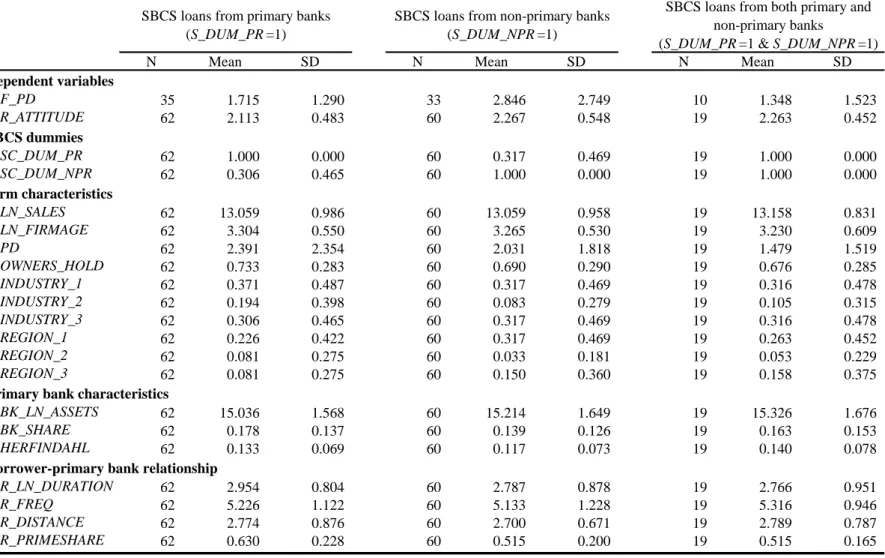
Finally, Table 3 presents summary statistics for firms that have obtained SBCS loans from a primary bank, a
non-primary bank (a second-primary or other bank), and both primary and non-primary banks.
In our analysis below, we assume that primary banks act as relationship lenders, while non-primary
banks act as transactional lenders. First, given that one of the intrinsic features of the main bank system in
Japan is that firms’ main bank – typically the bank with which a firm has the largest amount of loans
outstanding – acts as a relationship lender, this assumption is likely to be valid for the large majority of firms.
Second, apart from whether a bank is a firm’s main bank, several other proxies have been used in the literature
to identify relationship lenders, such as the duration of a firm-bank lending relationship, the frequency of
firm-bank meeting, the firm-bank distance, and the share of loans obtained from a bank (Degryse et al., 2009;
Ono and Uesugi, 2009). Table 4 compares the mean values of these proxies for firm-primary bank and
firm-non-primary bank pairs in our sample of 819 firms. The results indicate that the intimacy of firm-bank
relationships measured by these proxies is, on average, stronger for primary banks than for non-primary banks,
underpinning that our assumption that firms’ main bank acts as a relationship lender is valid.19
19 In Table 4, firms’ relationship with non-primary banks is measured in terms of the relationship with their secondary bank.
The variables of key interest in our empirical analysis are two dummy variables indicating whether a
firm had SBCS loans outstanding as of February 2009. Specifically, we construct the following dummy
variables: whether a firm obtained SBCS loans from a primary bank (SC_DUM_PR) and whether it obtained
SBCS loans from a non-primary bank (SC_DUM_NPR). In the RIETI surveys, SBCS loans are defined as
“loans that are quickly processed (loan approval/denial is usually decided within a few days) and are easy to
apply for, that, in general, do not require collateral and/or third-person guarantees, and that are often referred to
as ‘business loans’ and/or ‘quick loans’” (authors’ translation). The last part reflects the casual observation that,
in Japan, many banks have specific names for their SBCS loan products, so that firms can judge whether they
are applying for an SBCS loan. Furthermore, in order to avoid any misclassification, the answer “do not know”
is allowed in the survey questionnaire. Roughly 20 percent of survey respondent firms selected this choice, and
these observations are dropped from our dataset. Table 2 indicates that 12.6 percent of firms (103 out of the
819 firms) in our dataset obtained SBCS loans. Specifically, Table 3 indicates that the ratio of firms that
obtained an SBCS loan from their primary bank is 7.6 percent (62/819), while that of firms that obtained an
SBCS loan from a non-primary bank (or banks) is 7.3 percent (60/819). 2.3 percent of sample firms (19/819)
obtained SBCS loans from both their primary and a non-primary bank.
4.2.1. Variable for Testing Hypothesis 1: Ex-post Performance of Borrower Firms
As a proxy for ex-post performance to examine Hypothesis 1, we employ the borrower firm’s probability of
default in year 2009 (F_PD), that is, the PD of a firm estimated based on its financial statement after the SBCS
(or non-SBCS) loan was extended.20 As a proxy for the observable riskiness of a firm, we employ the
annualized probability of default within 3 years calculated using the scoring model of Moody’s RiskCalc.21
Table 2 shows that, on average, F_PD is higher for SBCS loan user firms than for non-user firms. In addition,
Table 3 shows that, among the former, the mean value of F_PD is higher for firms that obtained SBCS loans
from a non-primary bank (2.8 percent) than for firms that obtained SBCS loans from their primary bank (1.7
percent).
4.2.2. Variable for Testing Hypothesis 2: Liquidity Provision by a Relationship Lender during the Financial
Crisis
To examine Hypothesis 2, we use firms’ answers in the RIETI survey to the question whether the lending
20 Ideally, we would like to use actual default events as a proxy for the ex-post performance of borrowing firms. However, because our ex-post data span only a one-year period, the number of firms in our sample that defaulted is very limited (9 out of 826 firms) and thus it is difficult to examine Hypothesis 1 empirically by using actual default events.
21 RiskCalc v3.2 Japan is created using pooled data on 201,000 SMEs for the period 1992 to 2005. Released in 2009 by Moody’s KMV, it is one of the most widely used “third-generation” credit scoring models for evaluating the creditworthiness of unlisted companies in Japan. RiskCalc employs probit regressions whose independent variables are inventory to net sales, trade receivables to net sales, EBITDA to interest expense, net sales growth, total liabilities less cash to total assets, retained earnings to total liabilities, cash to total assets, gross profit to total assets, previous year income to previous year net sales, and real net sales.
attitude of their primary bank improved, remained unchanged, or worsened after the failure of Lehman
Brothers in September 2008. We use these answers to construct an index variable, R_ATTITUDE (1: improved,
2: remained unchanged, 3: worsened), that we employ to examine whether relationship lenders were less likely
to act as providers of liquidity insurance in times of financial distress if a firm had obtained an SBCS loan
from a transactional lender and whether they became more likely to act in such a manner if the firm had
obtained an SBCS loan from the relationship lender itself. It should be noted that as a proxy for a relationship
lender’s willingness to lend during the financial crisis, R_ATTITUDE is superior to the actual amount of credit
supplied because the latter is contaminated by loan demand factors.22
Tables 2 and 3 show that the mean value of R_ATTITUDE is 2.27 for firms that have obtained SBCS
loans from non-primary banks, 2.11 for firms that have obtained SBCS loans from primary banks, and 2.02 for
firms that have not obtained SBCS loans. That is, primary banks exhibit the severest lending attitude toward
firms that have obtained SBCS loans from non-primary banks, on average.
4.2.3. Other Control Variables
To control for other covariates that may affect the ex-post performance of a borrowing firm and the
22 Degryse et al. (2012) in their empirical analysis on loan contracts in Sweden employ a different approach and use banks’ internal lending limit for each specific firm as a proxy instead. Banks’ internal lending limits indicate the maximum amount that they are willing to lend to a particular firm and therefore represent a proxy that is also immune to the effect of loan demand.
lending attitude of its primary bank, we include the following variables.
First, regarding firm characteristics, we include a firm’s probability of default before SBCS loans are
extended (PD), because the ex-post probability of default (F_PD) is likely to be positively correlated with the
ex-ante PD. Consistent with this conjecture, we find that the average probability of default before the SBCS
loan is extended is higher for firms that obtained SBCS loans than for firms that did not obtain SBCS loans
(Table 2).
In addition to PD, we also include the logarithm of annual gross sales (LN_SALES) as a proxy for
firm size and the logarithm of firm age (LN_FIRMAGE). Further, we control for the share of equity holdings
by a business representative (OWNERS_HOLD), as such holdings carry the risk of a commingling of a firm’s
business assets and a representative’s personal assets.
Second, to control for the characteristics of a firm’s primary bank, we use the logarithm of the bank’s
asset size (BK_LN_ASSETS) and the bank’s share of branches within the prefecture of the borrowing firm
(BK_SHARE). The primary bank’s asset size may be an important determinant of the firm-bank relationship,
since studies on relationship lending generally find that small banks have a comparative advantage in
relationship lending (Berger and Black, 2011; Berger et al., 2005b; Uchida et al., 2008a). The market share of
the bank is included as a covariate to control for the degree of competition in a local loan market. In addition,
we use the Herfindahl Index in each prefecture (HERFINDAHL). HERFINDAHL is calculated based on the
share of banks’ branches within the prefecture in which a borrowing firm is located. BK_SHARE and
HERFINDAHL may also be important for firm-bank relationships, although the existing empirical literature is
ambiguous on whether market concentration (competition) is conducive or detrimental to relationship lending
(Elsas, 2005; Degryse and Ongena, 2007, Presbitero and Zazzaro, 2011).
Finally, we use a set of variables to measure the strength of the relationship between a firm and its
primary bank, as this is likely to affect the ex-post performance of a firm as well as the bank’s lending attitude
in the midst of a crisis. Specifically, we use the logarithm of the duration of the firm-bank relationship
(R_LN_DURATION), an index variable representing the frequency of meeting (R_FREQ), and an index
variable for the physical distance between a firm and the primary bank’s branch (R_DISTANCE). We also
construct a variable that measures the percentage share of the primary bank in a firm’s loans outstanding
(R_PRIME_SHARE). Table 2 shows that, on average, the intimacy of relationships measured by these proxies
is stronger for firms that have not obtained SBCS loans than for firms that have obtained SBCS loans.
4.3. Empirical Approach
4.3.1. Baseline Estimations
To examine our hypotheses, we begin by estimating the following linear-regression models:
i i i i
i SC DUM PR SC DUM NPR
PD
F_ 01 _ _ 2 _ _ X'β (1)
i i i i
ij SC DUM PR SC DUM NPR u
ATTITUDE
R_ 0 1 _ _ 2 _ _ X'γ (2)
where vector Xicontains the set of covariates for firm i described in Section 4.2.3.
The dependent variable F_PDi represents the expected default probability of firm i as of year 2009,
that is, after any SBCS loans were extended. R_ATTITUDEij is an index variable representing the lending
attitude of firm i’s primary bank j as of February 2009. The two dummy variables for SBCS loans indicate
whether a firm had SBCS loans outstanding from either its primary bank (SC_DUM_PR) or a non-primary
bank (SC_DUM_NPR) as of February 2009. Because most SBCS loans to our sample firms were provided
before February 2009,23 F_PDi and R_ATTITUDEij measure the probability of default and the lending attitude
of a firm’s primary bank after the firm had obtained an SBCS loan or loans. Regarding the other covariates Xi,
firm variables are taken from the 2009 RIETI survey and firms’ most recent financial statement, dates for
which range from March 2006 to December 2008. For bank variables, BK_LN_ASSETS is as of the end of
March 2008. BK_SHARE and HERFINDAHL are calculated using the “Nihon-Kinyu-Meikan 2008” published
by Kinyu Journal Company (the data are as of October 2007) and the Keio/Kyoto Joint Global COE Program’s
Shinkin and Shinso data. Finally, firm-primary bank relationship variables are constructed from the 2008
RIETI survey, i.e., they are for one year prior to the 2009 survey. In essence, we examine how SBCS loans
extended by either a primary bank or a non-primary bank affect a user firm’s ex-post performance and the
lending attitude of the firm’s primary bank, conditional on the firm’s and its primary bank’s ex-ante
23 For a limited number of firms (221 firms), we can identify the date at which an SBCS loan was provided.
Only 3 firms out of the 221 answered that they obtained an SBCS loan in February 2009.
characteristics and the strength of the firm-primary bank relationship.
4.3.2. Treatment Effects Estimations
Whether a firm obtains an SBCS loan – be it from its primary bank or a non-primary bank – is not a random
event. Also, as explained above, borrowers will choose for which banks to apply based on their prospect for
successfully obtaining credits. Hence, even if we find that the two SBCS loan dummy variables have a
significant effect on firms’ ex-post performance and their primary bank’s lending attitude in linear-regression
models, there may be several possible causal interpretations.
For instance, suppose we obtain a significantly positive coefficient for SC_DUM_NPR in equation
(1): SBCS loans extended by a firm’s non-primary bank are associated with an increase in the future
probability of default F_PD, conditional on ex-ante characteristics of the firm (such as its ex-ante riskiness)
and of the primary bank. One possible explanation for the result would be that SBCS loans by non-primary
banks are more prone to type II errors and/or the borrower adverse selection when such banks are screening
loan applications (ex-ante selection effect). However, an alternative possible explanation is that such firms’
performance deteriorated as a result of less intensive monitoring by both the non-primary bank that provided
the SBCS loan and the primary bank (ex-post treatment effect). In a similar vein, the provision of an SBCS
loan by a non-primary bank may be associated with a tightening of the primary bank’s lending attitude during
the financial crisis either because the firm-primary bank relationship became less intimate after the firm
obtained an SBCS loan from a non-primary bank and the primary bank perceived such a loan to have increased
the credit risk of the firm (ex-post treatment effect), or because firms that obtain an SBCS loan from a
non-primary bank had a less intimate relationship with their primary bank in the first place (ex-ante selection
effect).
In order to make sharper inferences on the mechanisms underlying the empirical results obtained
from linear regression models (1) and (2), we need to distinguish the selection effect (selection bias) and the
treatment effect of SBCS loans. Guo and Fraser (2010) present several models that can consistently estimate
treatment effects, and we employ propensity score matching. The basic idea of propensity score matching is to
compare the average performance of firms that have obtained SBCS loans (treatment group) to the average
performance of treatment firms’ identical “twins” that have not obtained SBCS loans (control group). By
matching treatment firms to appropriate benchmark firms that have the “closest” propensity scores, we create a
sample that is akin to the one generated by randomization. The exact procedure of propensity score matching is
described in the Appendix.
5. Results
5. 1. Baseline Estimations
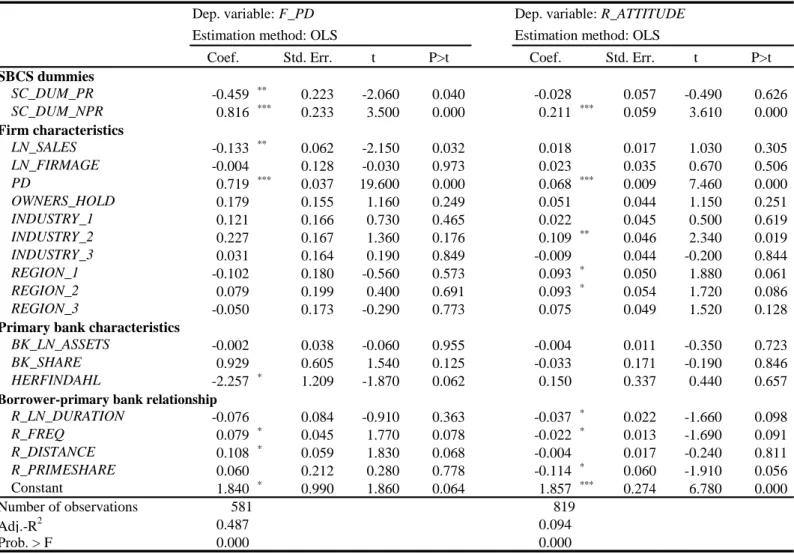
Table 5 presents the ordinary least square regression results of equations (1) and (2). Regarding the effect of
SBCS on ex-post borrower performance, the coefficient on S_DUM_NPR in the F_PD regression is
significantly positive, indicating that the probability of default during the financial crisis increased by as much
as 0.82 percentage points for borrowers that obtained an SBCS loan from a non-primary bank. This result is
consistent with the first part of Hypothesis 1, which states that the provision of SBCS loans by transactional
lenders is associated with a deterioration in borrower ex-post performance, because the transactional lender
adopts SBCS for the cost-saving motive and thus is more prone to committing type II errors. In contrast, the
coefficient on S_DUM_PR is significantly negative and indicates that obtaining an SBCS loan from the
primary bank is associated with a reduction of the probability of default by 0.46 percentage points. The result
is consistent with the second part of Hypothesis 1, which states that the average ex-post performance of SBCS
loan user firms improves in comparison with non-scoring loan user firms, since primary banks adopt SBCS in
order to evaluate the creditworthiness of prospective borrowers more accurately.24
Turning to other covariates, the coefficient on PD is positive and significant, indicating that an
observably riskier borrower ex-ante is likely to be riskier ex-post as well. The coefficient on R_DISTANCE is
also positive, although only statistically significant at the 10 percent level. The positive coefficient is consistent
with the finding in previous empirical studies (Agarwal and Hauswald, 2010; DeYoung et al., 2008) that a
24 As noted in footnote 20, we do not use actual default events as a proxy for ex-post firm performance because of the limited number of defaulting firms (9 out of 826 firms). However, the following default rates are consistent with the estimation results using F_PD: 0.7 percent (5/722) for non-SBCS loan user firms, 1.6 percent (1/63) for firms that obtained an SBCS loan from their primary bank, and 5.0 percent (3/60) for firms that obtained an SBCS loan from a non-primary bank.
borrower that is located farther away from a lender is more likely to default. The coefficient on R_FREQ is
also weakly positive, suggesting that the average performance of borrowers deteriorates more if their primary
bank monitors them more frequently. A possible explanation is that firms that turn out to be observably riskier
ex-post are likely to be informationally opaque ex-ante, and hence primary banks consult with such firms more
often.
Regarding the lending attitude of primary banks during the financial crisis, the coefficient on
S_DUM_NPR in the R_ATTITUDE regression is significantly positive, indicating that firms that obtained an
SBCS loan from a non-primary bank prior to the crisis were more likely to experience a tightening in the
lending attitude of their primary bank during the crisis. In contrast, the coefficient on S_DUM_PR is
statistically insignificant; that is, SBCS loans provided by the primary bank did not have any positive or
negative effects on its lending behavior during the crisis period. Taken together, these results are consistent
with the first part of Hypothesis 2 which states that an SBCS loan by a transactional lender has an adverse
effect on the provision of liquidity by a firm’s relationship lender during financial crisis, while they are
inconsistent with the latter part of Hypothesis 2 that an SBCS loan by a relationship lender will strengthen its
liquidity provision during a crisis. From a borrower’s perspective, the results suggest that there is a certain cost
associated with switching from a relationship lender to a transactional lender via SBCS loans. Although SBCS
loans from transactional lenders seem to be beneficial in increasing the availability of credit during normal
times, they may be detrimental to a firm’s ties with its relationship lender, which may be particularly valuable
during times of financing difficulty. On the other hand, SBCS loans from a relationship lender do not have
such a potentially detrimental effect, but neither do they increase the availability of loans.
The coefficient on PD is again positive and significant, indicating that the lending attitude of primary
banks is worse for ex-ante riskier firms. Although significant at only 10 percent, the negative coefficients on
the relationship variables (R_PRIMESHARE, R_LN_DURATION, R_FREQ) suggest that having established a
closer relationship with the primary bank has a positive effect on the bank’s lending attitude in times of crisis.
5. 2. Treatment Effects Estimations
The empirical results in the previous section generally support Hypotheses 1 and 2 posited in Section 3. As
noted above, however, simple linear regression models allow several causal interpretations.
To investigate whether the results obtained in Table 5 are due to the ex-ante selection effect or the
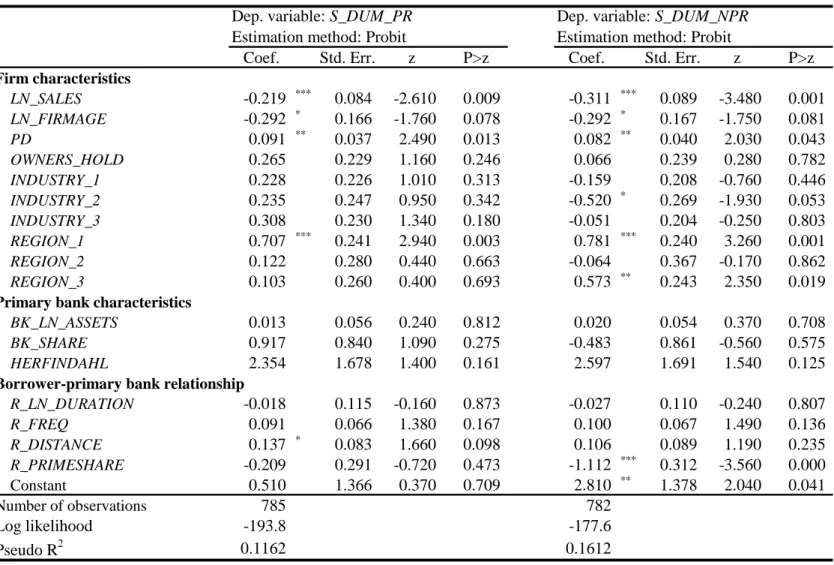
ex-post treatment effect, we implement propensity score matching estimation. To begin with, Table 6 shows the
results of the probit estimations for the determinants of whether a firm obtained an SBCS loan from a primary
(S_DUM_PR) or non-primary bank (S_DUM_NPR).25 The results are mostly in line with the findings of the
previous studies. Starting by looking at LN_SALES and LN_FIRMAGE, we find that the coefficients are
25 In estimating a firm’s probability of obtaining an SBCS loan from a primary bank (non-primary banks), observations for firms that have obtained an SBCS loan only from non-primary banks (a primary bank) are dropped from the sample (“control” group in the treatment effect estimation). This is because we want to restrict our control observations to firms that have not obtained an SBCS loan from any bank.
negative, indicating that smaller and younger firms are more likely to obtain SBCS loans (Frame et al., 2001;
Cowan and Cowan, 2006), either from a primary bank or a non-primary bank. Next, the positive coefficient on
PD implies that SBCS loans are more likely to be extended to observably riskier firms. This is consistent with
the point made by De Young et al. (2008) mentioned in section 3.2 that the adoption of SBCS may lead banks
to take a more aggressive risk-taking stance. Turning to the firm-primary bank relationship variables, the
positive coefficient on R_DISTANCE in the primary bank estimation indicates that the primary bank is more
likely to extend an SBCS loan to a firm that is located farther away from the bank’s branch. One possible
explanation for this result is that primary banks use SBCS in order to complement soft information on
borrower firms that are farther away, because soft information on these firms may be less accurate. The
negative coefficient on R_PRIMESHARE in the non-primary bank estimation suggests that a firm is more
likely to obtain an SBCS loan from a non-primary bank when it has a less intimate relationship with its
primary bank as measured in terms of the primary bank’s share in the firm’s loans outstanding.
Based on the propensity scores obtained from the probit regression models above, we next estimate
the treatment effect for SBCS loans using kernel matching estimators.26 We match each treated observation
with the non-treated observations, each of which has its own weight that is proportional to the “closeness” to
26 We also estimate the treatment effects for SBCS loans using other matching algorithms, namely, 5-nearest matching and radius matching. The estimation results (not reported) in most cases are qualitatively the same as those of the kernel matching estimation and can be obtained from the authors upon request.
the treated observation, where “closeness” here is measured by the propensity scores.
The estimation results for the treatment effect are reported in Table 7. For each variable, there is an
unmatched estimator and an average treatment effect on the treated (ATT) estimator, both of which are shown
in the column labeled “Difference.” For example, regarding the treatment effect of SBCS loans by a primary
bank, in the “Unmatched” row for the variable F_PD, there are two values, one for the treatment group (firms
that obtained an SBCS loan from a primary bank) and the other for the non-treated group (firms that did not
obtain an SBCS loan). The former value (1.715) indicates that SBCS loan user firms’ average probability of
default after the crisis was 1.7 percent, whereas the latter (1.483) indicates that it was 1.5 percent for non-user
firms. The difference between these two figures, 0.2 percentage points, is the unmatched estimate of the
treatment effect as shown in the column labeled “Difference.” We should note, however, that the unmatched
estimate of the treatment effect may well be driven by selection bias since ex-ante differences in terms of firm
and bank characteristics between SBCS loan users and non-users possibly affect the difference in F_PD. The
ATT estimator takes into account the sample selection and gives us the treatment effect of SBCS. In the “ATT”
rows, the value for the non-treated group in the “Unmatched” row is replaced by the value for the control
group, in which the counterfactual firms are non-SBCS loan users with similar ex-ante characteristics as SBCS
users. The difference between the value of “Treated” and “Controls” is -0.3 percentage points but is
statistically insignificant. This suggests that the improvement in the ex-post performance of SBCS loan
borrowers from primary banks that we found in the previous subsection (Table 5) is driven by the selection