九州大学学術情報リポジトリ
Kyushu University Institutional Repository
運動事象知覚における感情・言語情報の利用
郷原, 皓彦
http://hdl.handle.net/2324/2236004
出版情報:九州大学, 2018, 博士(心理学), 課程博士 バージョン:
権利関係:
30
1 1
1.1 2
1.2 3
1.3 SBD 22
1.4 SBD 39
1.5 SBD 47
1.6 51
2 SBD 54
2.1 55
2.2 1 57
2.3 2 64
2.4 3 67
2.5 4 72
2.6 5 73
2.7 2 74
3 SBD 82
3.1 83
3.2 6 88
3.3 7 98
3.4 3 103
4 SBD 112
4.1 113
4.2 8 113
4.5 4 119
5 122
5.1 123
5.2 125
5.3 139
5.4 144
146 165 172
S
1 2 1
(apparent motion) (Wertheimer, 1912)
20 (Wagemans, 2015;
Wagemans et al., 2012 for a review)
1 2
(bistable motion)
1
(correspondence problem) (e.g., Ullman, 1979)
(Dawson, 1991 for a review)
(stream/bounce display: SBD, Metzger, 1934)
SBD SBD
2 4
l
1 2 (bistable motion)
motion quartet Ternus display stream/bounce display (SBD)
SBD
68 487 / 3
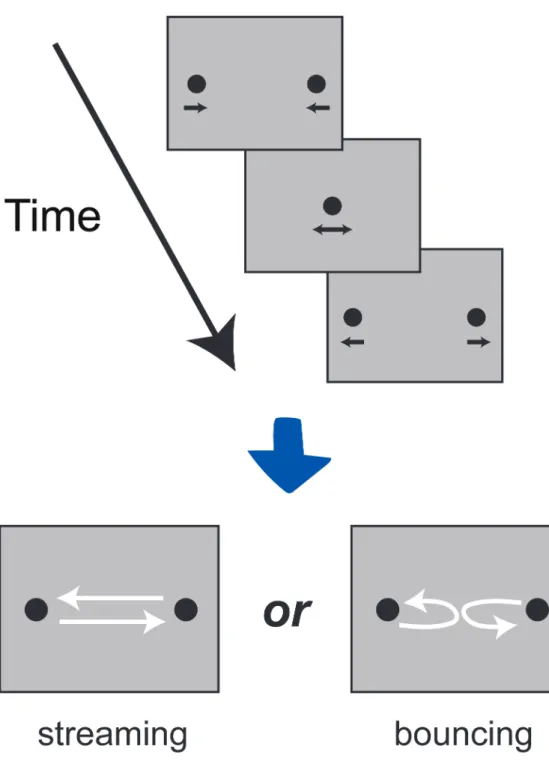
motion quartet (e.g., Ramachandran & Anstis, 1983b, 1985; Figure 1) 2 1
2 1
2 2
1
1 motion quartet (Carter, Konkle, Wang,
Figure 1. The schematic illustration of a typical “motion quartet” display. The upper row represents physical motion event, and the lower row denotes two possible motion directions observers can perceive. White arrows represent possible moving directions of objects.
2
(Gengerelli, 1948) Gengerelli
(Chaudhuri & Glaser, 1991)
MT V5 motion quartet
(Genç, Bergmann, Singer, & Kohler, 2011)
(Rose & Bühcel, 2005)
40Hz (tACS)
(Strüber, Rach, Trautmann-Lengsfeld, Engel, &
Herrmenn, 2013)
Gengerelli
motion quartet Ramachandran and Anstis (1985)
(stimulus-onset asynchrony: SOA) 350 ms motion quartet
(Kohler, Haddad, Singer, & Muckli, 2008) motion quartet
motion quartet
(Tan &
Hsieh, 2013) motion quartet
motion quartet
motion quartet
.3 7 24 5/
Ternus display (Ternus, 1926, Figure 2) motion quartet 2 2
2 Ternus display 1 2
(inter-
stimulus interval: ISI) 2 1
(element motion) 2
2 (group motion)
2 3 Ternus display (e.g., Alais & Lorenceau, 2002; Hein &
Figure 2. The schematic illustration of a typical Ternus display. The upper row represents physical motion event, and the lower row denotes two possible motion events observers can perceive. Red arrows represent possible moving directions of objects.
1
ISI Ternus display ISI Pantle and
Picciano (1976) ISI 30 ms
50 ms
Pantle and Picciano 40 ms ISI
ISI ISI
(e.g., Alais & Lorenceau, 2002; Casco & Spinell, 1988; Dodd, McAuley, & Pratt, 2005; He & Ooi, 1999; Hein & Moore, 2012, 2014; Hsu, Taylor, & Pratt, 2015; Kramer
& Yantis, 1997; Odic & Pratt, 2008; Petersik, 1989 for a review; Ritter & Breitmeyer, 1989; Scott-Samuel & Hess, 2001)3
Ternus display
(Kubovy & Pomerantz, 1981)
(He & Ooi, 1999; Kramer & Yantis, 1997) 2
3 Dawson & Wright (1994) 50 ms ISI
2
2
Kramer and Yantis (1997) Ternus display
(1 ) (2 )
Ternus display
(Alais & Lorenceau, 2002; Casco, 1990; He & Ooi, 1999; Hein &
Moore, 2012, 2014; Ma-Wyatt, Clifford, & Wenderoth, 2005; Petersik & Rice, 2008) Kramer and Yantis
ISI
Ternus display Yu (2000: Experiment 2) Ternus display
1
(i.e., ) (i.e., )
Ternus display
Hsu et al. (2015)
2
Ternus display
(Chen & Zhou, 2010;
Petersik, 1984) Ternus display
2 1
(Dodd et al., 2005)
Ternus display
Ternus display motion quartet 2
2 motion quartet
Ternus display
Ternus display
Ternus display
3/6 8 713 24 5/
Stream/bounce display (SBD: Metzger, 1934: Figure 3) 2
2
2
SBD 2
SBD 70%
(e.g., Bertenthal, Banton, Bradbury, 1993)
Figure 3. The schematic illustration of typical stream/bounce display (SBD). The upper row represents physical motion event, and the lower row denotes two possible motion events observers can perceive. Black arrows in the display indicate the physical motion directions of objects. White arrows represent possible perceived directions of object motion.
(e.g., Sekuler, Sekuler, &
Lau, 1997; Watanabe & Shimojo, 1998; Watanabe, 2001) (1)
(Meyerhoff & Scholl, 2018; Meyerhoff & Suzuki, 2018) (2)
(Watanabe & Shimojo, 1998) (3)
(e.g., Sekuler
& Sekuler, 1999; Watanabe & Shimojo, 2001a, 2001b)
SBD 1.4
D
SBD motion quartet Ternus display
SBD
motion quartet Ternus display 2
( : Ullman, 1979) SBD
2
SBD 2
(Berger & Ehrsson, 2017;
Grassi & Casco, 2009, 2012; Kawachi, 2016)
(Johansson, 1973; Blake & Shiffrar, 2007 for a review) bistable point-light walker (e.g., Vanrie, Dakeyser, & Verfaillie, 2004)
SBD 2
2 motion quartet Ternus display
SBD 2
2
motion quartet
Ternus display SBD
2
SBD (e.g., Hubbard, 2013;
Michotte, 1946/1963; Scholl & Nakayama, 2002, 2004) illusory crescent (Scholl & Nakayama, 2004) 2
SBD
(Mayerhoff & Scholl, 2018)
SBD launching effect (Michotte,
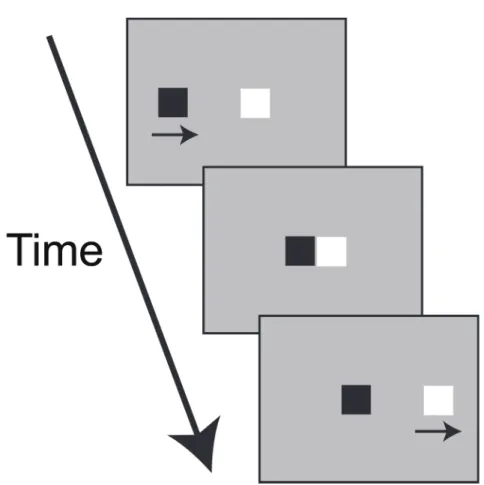
1946/1963) launching effect
A ( )
B ( )
(100 ms ) (Figure 4)
launching effect
(Hubbard, 2013 for a review)
(Michotte, 1946/1963)
(Kanizsa & Vicario, 1968) (Hubbard, 2013 for a review) launching effect 2
SBD launching effect
SBD
1
Figure 4. The schematic illustration of typical display inducing launching effect. The black square is “launcher,” and the white one is “target.” Black arrows in the display indicate the physical motion directions of objects.
SBD motion quartet Ternus display 2
SBD
SBD
1.4 SBD
SBD
D m r T
SBD SBD
D m r
SBD
Bertenthal et al. (1993)
homo-recruitment mechanism (Snowden & Braddick, 1989)
directional recruitment (Sekuler & Sekuler, 1999;
Zeljko & Grove, 2017a) SBD
Bertenthal et al.
directional
recruitment
(Sekuler & Sekuler, 1999, Experiment 3; Zeljko
& Grove, 2017a) Bertenthal et al. (1993)
1 2
3
(Sekuler & Sekuler, 1999; Watanabe &
Shimojo, 2001a, 2001b) Sekuler and Sekuler (1999) 3
SBD 2
Newton 1
Ramachandran and Anstis (1983a)
SBD 2
Newton Newton 1 2
SBD
Watanabe and Shimojo (2001a,b) 3
SBD 2
2 3
Watanabe and Shimojo (2001b) (inverse physics problem) (cf. Marr, 1982)
SBD
oy
SBD
Sekuler
et al. (1997) SBD
150 ms 2.5 ms
150 ms
audiovisual bounce-inducing effect (ABE) (e.g., Grassi & Casco, 2009, 2010)
Sekuler et al. (1997) SBD
Remijn, Ito, and Nakajima (2004)
±100 ms ( ) 50 ms
Watanabe (2001) ±1280 ms
40 ms 60 ms
Dufour, Touzalin, Moessinger, Brochard, and Després (2008)
150 ms 10 ms
ABE ±100 ms
ABE (Fujisaki, Shimojo, Kashino, & Nishida, 2004)
Grassi and Casco (2009, 2010)
ABE (Grassi &
Casco, 2009)
Grassi and Casco (2010)
ABE
Watanabe and Shimojo (2001b)
ABE
ABE
SBD
ABE
(e.g., Donohue, Green, & Woldorff, 2015; Fujisaki et al., 2004; Grassi & Casco, 2012;
Grove, Kawachi, & Sakurai, 2012b; Grove et al., 2016; Grove & Sakurai, 2009; Kawachi
& Gyoba, 2006, 2013, Kawachi, Grove, & Sakurai, 2014; Meyerhoff & Suzuki, 2018;
Watanabe, 2001)
SBD
(2AFC)
ABE (Sanabria, Correa, &
Lupiáñez, 2004)
(Scheier, Lewkowicz, & Shimojo, 2003) ABE
Berger and Ehrsson (2013) SBD
500 ms
Berger and Ehrsson (2017) Grassi and Casco (2009)
SBD
SBD ABE
(functional magnetic resonance imaging: fMRI)
(Bushara et al., 2003)
SBD
(transcranial magnetic stimulation: TMS) TMS
TMS
(Maniglia, Grassi, Casco, & Campana, 2012) SBD
(Watanabe & Shimojo, 1998) TMS
SBD
(electroencephalography: EEG) SBD
SBD
(Hipp, Engel, & Siegel, 2011) SBD
ABE
(Zvyagintsev, Nikolaev, Sachs, & Mathiak, 2011) ABE
p oy
SBD Watanabe and Shimojo (1998)
±150 ms
Watanabe (2001)
±80 ms
(Adams & Grove, 2018; Grove et al., 2012b; Kawabe & Miura, 2006)
Kawachi and Gyoba (2006) SBD
SBD
120 ms
(Kawachi &
Gyoba, 2013)
SBD Watanabe (2001)
640 ms ~ 40 ms
Meyerhoff, Merz, and Frings (2018) SBD
2
SBD ABE
b a s
SBD
SBD (Bertenthal et al., 1993)4
Sekuler and Sekuler (1999; Experiment 1 and 2)
( Burns & Zanker, 2000; Sekuler et
al., 1997 ) Sekuler and Sekuler (1999; Experiment 1) SBD
2
(Remijn & Ito, 2007) SBD
(Berger & Ehrsson, 2017; Grassi & Casco, 2009, 2012; Kawachi, 2016) SBD
Kawabe and Miura (2006) (Gabor)
(15º ) 30º
(Sumi, 1995)
Zhao et al. (2017) P2
P2 (Liu et al, 2009; Omoto et al., 2010)
SBD
SBD (Zhou,
Wong, & Sekuler, 2007) Kawabe and Miura (2006) Gobara and Yamada (in revision)
(Bertenthal et al., 1993) (Feldman & Tremoulet, 2006)5 SBD
SBD
5 Feldman and Tremoulet (2005)
Watanabe and Shimojo (2001a)
100 ms
150 ms ~ 200 ms
(Grove et al., 2012b)
(Kawachi, Kawabe, & Gyoba, 2011) Grove
et al. (2016) 1 4
Matsuno and Tomonaga (2011) SBD
SBD
SBD
SBD
SBD
SBD SBD
Mitsumatsu (2009) SBD
SBD 1
SBD
Saito and Gyoba (2016, 2018) (2018) SBD
SBD
SBD
(
SBD
(Bedard & Barnett-Cowan, 2016)
(Roudaia, Sekuler, Bannet, & Sekuer, 2013) SBD
(Tschacher & Bergomi, 2011) Kitamura, Watanabe, and Kitagawa (2016)
SBD
SBD
SBD 1
SBD
D e
SBD SBD
SBD
Grove et al. (2016)
q
(The Sensory Processing Hypothesis) 1.3.1 SBD
SBD
SBD Bertenthal et al. (1993) Sekuler and Sekuler (1999) Zeljko and Grove (2017a)
Grove, Ashton, Kawachi, and Gyoba (2012a) Zeljko and Grove (2017b) SBD
(signal detection theory: SDT; Macmillan &
Creelman, 2005)
d’ c
c
d’
SBD
6
6 Grassi and Casco (2012) SDT
d’ c d’ c
ABE
launching effect (Michotte,1946/1963)
illusory crescent (Scholl & Nakayama, 2004) (Meyerhoff & Scholl, 2018)
Watanabe and Shimojo (2001b)
SBD (Grassi & Casco, 2009, 2012; Kawachi,
2016) Meyerhoff and Scholl
ABE
(Grove et al., 2012a; Zeljko & Grove, 2016) Meyerhoff and Scholl (2018)
SBD
SBD (i.e.,
)
d’ c (see Grove et al., 2012a)
(see also Grassi & Casco, 2012; Grove et al., 2012a) SBD
q
(The Attention Hypothesis) (Watanabe & Shimojo, 1998)
Watanabe and Shimojo (1998) Bertenthal et al.
(1993) (i.e., directional recruitment)
Grassi and
Casco (2009, 2010) ABE
SBD
SBD
(Adams & Grove, 2018; Mitsumatsu, 2009; , 2018; Saito & Gyoba, 2016, 2018)
q
(The Inference Hypothesis) Helmholtz (unconscious
inference) (Grove et al., 2016)7 1.3.1
Sekuler and Sekuler (1999) Watanabe and Shimojo (2001a, 2001b) SBD Newton
Watanabe and Shimojo (2001b)
7
(Brascamp, Sterzer, Blake, & Knapen, 2018) Brascamp et al. (2018)
(Gaver, 1993a, 1993b) SBD
SBD SBD
SBD
Grove et al. (2016) 1 4
SBD
(i.e., )
Adams and Grove (2018)
SBD
SBD
Meyerhoff and Suzuki (2018) (1) SBD
(2) SBD
(1) (2)
(1) (2) 100 ms
SBD
ABE
8
SBD
(Meyerhoff & Scholl, 2018) SBD
SBD
8 Meyerhoff and Suzuki (2018) (Grassi & Casco, 2009,
2010)
D
1.3 1.4 SBD
SBD
SBD
SBD
SBD
SBD (Berger & Ehrsson, 2013, 2017)
(e.g., Brosch, Scherer, Grandjean, & Sander, 2013 for a review)
(Heider & Simmel, 1944)
2 SBD
1 SBD
2 SBD
SBD
SBD
SBD
SBD
(Grassi
& Casco, 2009, 2010)
SBD SBD
Grassi and Casco (2009, 2010)
(e.g., Francken, Kok, Hagoort, & de Lange, 2015; Francken, Meijis, Hagoort, van Gaal, & de Lange, 2015; Hubbard, 1994; Meteyard, Bahrami, & Vigliocco, 2007; Zwaan, Madden, Yaxley, & Aveyard, 2004)
Ternus display (Chen & Zhou, 2010;
Petersik, 1984) SBD
(sound symbolism) (Hinton, Nichols, & Ohala, 1994)
1 ”bouba”
”kiki” bouba/kiki effect (Ramachandran &
Hubbard, 2001)
(Gobara, Yamada, & Miura, 2016; Rabaglia, Maglio, Krehm, Seok, &
Trope, 2016)
SBD
SBD
SBD
(i.e., ABE) SBD
( T
2 SBD
SBD
2 SBD
SBD 1.5.1
(Barrett & Russell, 1999) 2
3 SBD
SBD 1.5.2
SBD
(Hamano, 1998; , 2014)
SBD
500 ms ~ 500 ms
100 ms 100 ms
4 2 3
SBD 2
3
4 3
3
5 2 4
SBD
2 SBD 1
(Brosch et al., 2013 for a review)
(Heider & Simmel, 1944)
SBD (Berger &
Ehrsson, 2013, 2017) SBD
5
( ) ;-(
(e.g., Lo, 2008; Tossel et al., 2012) (ERP)
(Churches, Nicholls, Thiessen, Kohler,
& Keage, 2014)
2 1
(e.g., Lang, Bradley, & Cuthbert, 2008;
Langner et al., 2010)
2
(e.g., Bradley & Lang, 2007) SBD
1
SBD
SBD
y 12 ( 4 8 , 25.25 )
( : 2016-001)
22 CRT (Mitsubishi,
RDF221S) 1024 × 768 pixels
100 Hz
(Apple, Mac Pro) PsychoPhysics Toolbox
extension (Brainard, 1997; Pelli, 1997) Matlab (The MathWorks, Natick, MA)
2 ( 1.00º)
(14.20º × 14.20º, 49.67 cd/m2) 2
2
12.20º 6.21 deg/s
1989 ms
(` ´) , (°_°) , (^_^) 3
Pro
25pt 2.38º
1989 ms
60 cm
1 Figure 5 3 (
) 5
500 ms 2
500 ms
2 ( Zhou et al. (2007)
)
2
20
60
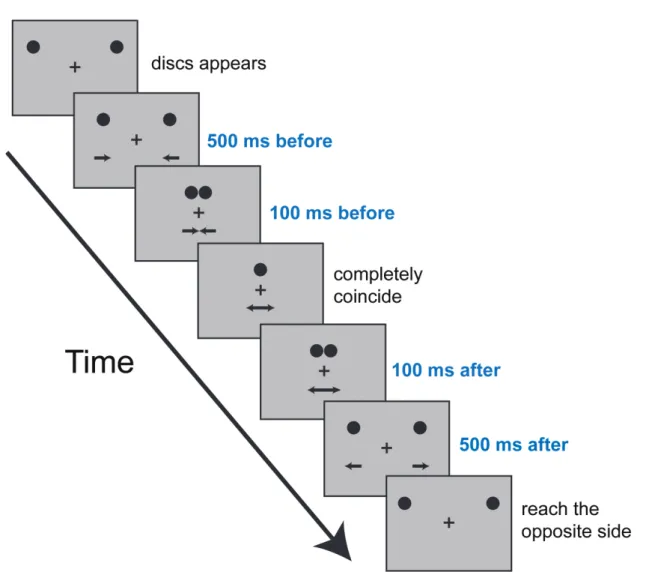
Figure 5. Schematic illustration of a trial in Experiment 1. Two identical black discs started moving simultaneously to the disappearance of the fixation, moved towards each other, coincided at the centre, and continued to the opposite sides of the screen, after which they vanished. The emoticon cue was presented while the objects moved.
Black arrows represent the motion directions of black discs. Participants were asked to report their perceptual outcomes via a button press. This figure is reprinted from Gobara et al. (2018).
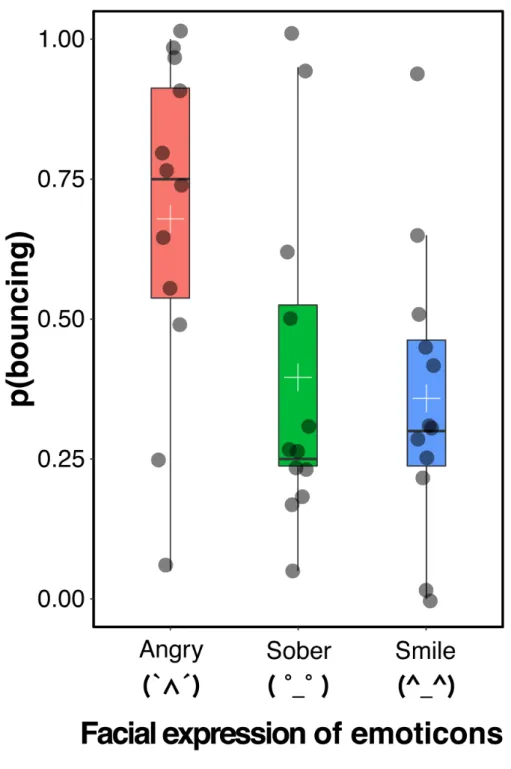
1 Figure 6
1
(F(2, 22) = 9.01, p = .001, ηp2 = .45)
(ps < .01)
SBD
SBD
( ) ( ) 2
(Barrett & Russell, 1999) 1
1 3
9 1
(
1 ) 1
2 3
( 2) ( 3)
SBD
Figure 6. The results of Experiment 1. The dark gray circle on the boxplot represents individual data point. The white cross on the boxplot means the average response proportion of perceiving bouncing. This figure is reprinted from Gobara et al. (2018).
2 3 SBD
y 12 5 7 24.42
( Д ) , ('ω') ( ˙-˙ ) 3
( 1 ) ( Д ) , ('ω') ( ˙-˙ )
1
3 ( )
1
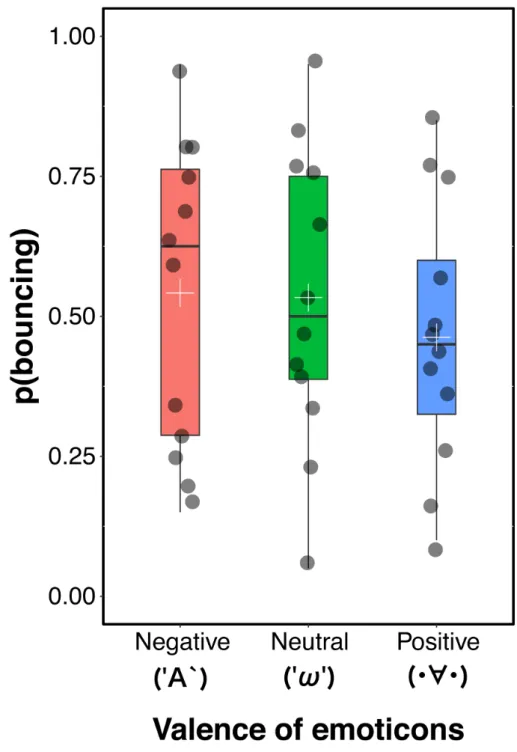
2 Figure 7
1
(F(2, 22) = 6.16, p = .008, ηp2 = .36)
(ps < .05)
3 SBD
Figure 7. The results of Experiment 2. The dark gray circle on the boxplot represents individual data point. The white cross on the boxplot means the average response proportion of perceiving bouncing. This figure is reprinted from Gobara et al. (2018).
3
SBD
y 12 ( 1 , 11 , 22.42 )
('A`) , ('ω') ( ) 3
2
( 1 ) ('A`) , ('ω')
( )
1
3 ( )
1
3 Figure 8
1
(F(2, 22) = 0.70, p = .51, ηp2 = .06) SBD
1 3 SBD
SBD 1
SBD 2 1
(Watanabe & Shimojo, 1998) (Aquino & Arnell, 2007;
Arnell, Killman, & Fijavz, 2007) SBD
1
4 5
4 500 ms
880 ms
(Arnell et al., 2007) 1 3
994.50 ms
5 200 ms
(±100 ms; Remijn et al., 2004)
Figure 8.The results of Experiment 3. The dark gray circle on the boxplot represents individual data point. The white cross on the boxplot means the average response proportion of perceiving bouncing. This figure is reprinted from Gobara et al. (2018).
4
SBD
y 12 5 7 24.42
4 2
2 ( Д ) , ('ω') ( ˙-
˙ ) 3 2
500 ms
2
1
(F(2, 22) = 6.30, p = .007, ηp2 = .36)
(ps < .05) 2
5 200 ms
(
5 200 ms
(
y 12 4 8 23.25
2 ( Д ) , ('ω') ( ˙-
˙ ) 3 2 200 ms
794.50 ms
2
(
1
(F(2, 22) = 1.60, p = .23, ηp2 = .13) 200 ms
)
2 5 SBD
1
SBD
2 3
SBD
4 2
5 2
SBD
SBD
1 SBD
SBD
(Grove et al., 2016)
SBD (Berger & Ehrsson, 2013, 2017)
1
(Turk et al., 2011) (Cunningham, Turk, MacDonald, & Macrae,
2008) (Huang, Wang, & Shi,
2009)
(Read & Vinson, 1996; Vinson, Abney, Dale, &
Matlock, 2014)
(Chen & Zhou, 2011; Hsu et al., 2015; Petersik, 1984; Yu, 2000)
(Heider & Simmel, 1944)
4
SBD
SBD
±100 ms Remijn et al. (2004)
±80 ms (Watanabe, 2001)
(Grove et al., 2016)
Grove et al. (2016)
SBD
SBD
SBD
(ABE) (SDT: Macmillan & Creelmen, 2005) ABE
(Grove et al., 2012a; Zeljko & Grove,
2017b, but see Grassi & Casco, 2012) ABE
(Bushara et al., 2003; Maniglia et al.,
2012) ABE
SBD
TMS
5 SBD
5 1 3
5 1
3
5 (i.e., 794.50 ms)
(cf. Ratcliff, 1978) 4
500 ms SBD
SBD
1 3
1 5 1 SBD
3 4
SBD
(e.g., ±100 ms)
1 3
(Grove et al., 2016) SBD
Grove et al. (2016) SBD
(Grove et al., 2012a; Zeljko & Grove, 2017b, but see Grassi &
Casco, 2012)
(e.g., Remijn et al., 2004; Watanabe, 2001)
SBD
SBD
3 SBD
(e.g., Dils &
Boroditsky, 2010; Francken, Kok, Hagoort & de Lange, 2015; Francken, Meijs, Hagoort, Gaal & de Lange, 2015; Meteyard, Bahrami & Vigliocco, 2007) (e.g., Hubbard, 1994; Gobara et al., 2016; Reed & Vinson, 1996; Vinson & Reed, 2002; Vinson et al., 2014; Zwaan et al., 2004) Meteyard et al. (2007)
(e.g., Francken et al., 2015a, 2015b) (e.g., Meteyard et al., 2007; Dils &
Boroditsky, 2010)
SBD
SBD
(onomatopoeia)
“words that imitate natural sounds, often in a highly language-specific way”
(Dingemanse, Blasi, Lupyan, Christiansen & Monaghan, 2015, p.604)
(e.g., , 2018)
ideophones Dingemanse et al. (2015) “a class of words
that vividly evoke sensory impressions, for example sounds, movements, textures, visual patterns, and actions” (Dingemanse et al., 2015, p. 604) Dingemanse et al. ideophones
onomatopoeaia ideophones onomatopoeia ideophones
( , 2010, p. 156) (
)
( , 2002, p. 72) ideophones
(e.g.,
, 1993) (e.g.,
, 2016; , 2013)
(Kanero, Imai, Okuda, Okada, & Matsuda, 2014)
1
(sound symbolism: Hinton et al., 1994)
Hamano (1998) (2014)
(e.g., /g/ ) (e.g., /k/ )
( , 2010) ( , 2017) (Ohtake & Haryu, 2013) (Hirata, Ukita, & Kita, 2011)
Ramachandran and Hubbard (2001) bouba/kiki effect
(Lockwood &
Dingemanse, 2015 for a review)
(e.g., Sidhu & Pexman, 2017 for a review)
( , 2018;
Gobara, Yamada, & Miura, 2016; Rabaglia et al., 2016) Gobara et al. (2016)
(representational momentum; Freyd & Finke, 1984)
(i.e., )
(i.e., )
(e.g., )
Rabaglia et al. (2016)
(2018)
SBD
SBD
6 SBD
SBD SBD
(
6
SBD SBD
±500 ms ±100 ms 4 (
)
(Remijn et al., 2004) ±100 ms
y 10 ( 4 6 , 21.50 )
22 CRT (Mitsubishi
RDF221S) 1024 × 768 pixels
100 Hz
(Apple, Mac Pro) PsychoPhysics
Toolbox extension (Brainard, 1997; Pelli, 1997) Matlab (The MathWorks, Natick, MA)
(AHS, VOICEROID+ EX)
2 ( 1.00º)
(18.20º × 18.20º, 49.67 cd/m2)
2.50º
2 14.40º (7.55 deg/s)
1937 ms
(/gatuQ/)
(/syuQ/) (/heyuQ/) 3 9
460 ms, 319 ms, 422 ms
62dB 22050 Hz
±500 ms ±100 ms
60 cm
9 Hamano (1998) (2014)
CV CVCV
1 Figure 9 3 (
) 4 (
-500 ms, -100 ms, 100 ms, 500 ms)
13 5
1000 ms 2
500 ms 2
2.50º
-500 ms, -100 ms, 100 ms, 500 ms
2
20
260
Figure 9. Schematic illustration of a trial in Experiment 6, Experiment 7, and Experiment 8. Two identical black discs started moving toward each other, perfectly coincided, and continued to the opposite sides of the screen, after which they vanished.
The horizontal black arrows represent the motion directions of black discs. The verbal stimulus was auditorily presented one of the four sequences with blue characters, except the silent condition.
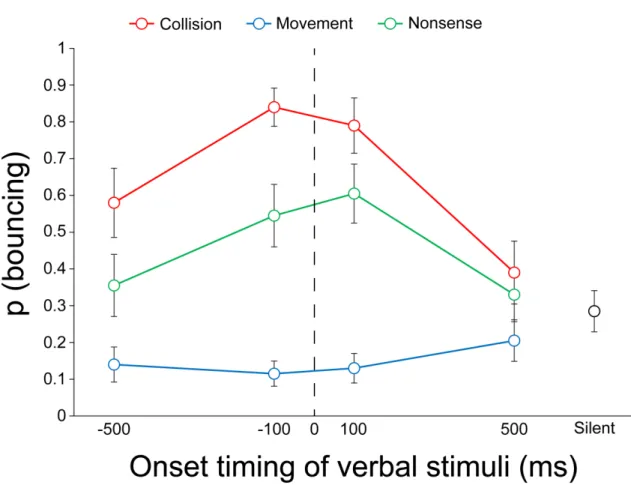
6 Figure 10
2
(F(2, 18) = 31.18, p < .001, ηp2 = .78) (F(3, 27) = 8.39, p < .001, ηp2 = .48)
(ps < .01) (p < .001)
±500 ms ±100 ms
(ps < .05)
(F(6, 54) = 9.04, p < .001, ηp2 = .50)
-500 ms (F(2, 72) = 14.18, p < .001, ηp2 = .61), -100 ms (F(2, 72) = 38.93, p < .001, ηp2 = .81), 100 ms (F(2, 72) = 33.94, p < .001, ηp2
= .79) 500 ms
(F(2, 72) = 2.61, p = .08, ηp2 = .23) -500 ms (ps < .05), -100 ms (ps < .01), 100 ms (ps < .05)
(F(3, 81) = 17.72, p < .001, ηp2
= .66) (F(3, 81) = 7.76, p < .001, ηp2 = .46)
(F(3, 81) = 0.65,
p = .58, ηp2 = .07) -100 ms 100 ms
±500 ms ±100 ms
(ps < .05) 500 ms -500 ms
(p < .05) ±500 ms ±100
ms (ps < .05)
SBD
t -500 ms -
100 ms 100 ms (ts(9) > 4.21, ps < .01, Cohen’s ds > 1.20), ± 100 ms (ts(9) > 2.49, ps < .05, Cohen’s ds > 1.14)
(ts(9) > 3.36, ps < .01, Cohen’s ds > 0.45)
SBD
500 ms 100 ms
SBD (±100 ms; Remijn
et al., 2004)
SBD
±100 ms
500 ms
Remijn et al. (2004)
Grassi and Casco (2010) SBD
SBD
SBD
7 6
Hamano (1998) (2014)
+ (CV ) 1 /s/
/g/
(Gobara et al., 2016; Rabaglia et al., 2016)
SBD
7 CV
SBD
/g/
/s/
SBD SBD
Figure 10. The results of Experiment 6. The negative values in onset timing denote prior presentation to the complete coincidence of moving discs. A broken line indicates the timing when moving stimuli coincided completely. Error bars represent standard errors of the mean.
)
7
SBD
±500 ms ±100 ms 4
y 10 ( 4 , 6 , 21.30 )
6 CV
(/geQ/) (/seQ/) (/heQ/) 3
/g/ /s/ /h/
304 ms, 343 ms, 294 ms 62dB
22050 Hz 6
±500 ms ±100 ms
6
3 (/g/, /s/, /h/) 4 (
-500 ms, -100 ms, 100 ms, 500 ms) 6 6
7 Figure 11
2
(F(2, 18) = 4.63, p < .05, ηp2 = .34) (F(3, 27) = 3.75, p < .05, ηp2 = .29)
/s/ /h/ /g/
(ps < .05)
500 ms -100 ms
(p < .05)
(F(6, 54) = 3.00, p < .05, ηp2 = .25)
-500 ms (F(2, 72) = 3.55, p < .05, ηp2 = .28), -100 ms (F(2, 72) = 6.83, p < .01, ηp2 = .43), 100 ms (F(2, 72) = 5.32, p < .01, ηp2 = .37)
500 ms (F(2, 72) = 0.24, p = .79, ηp2 = .03) -500 ms (p < .05), -100 ms (p < .01), 100 ms (p
< .01) /s/ /g/
-100 ms /h/ /g/
(p < .01) /g/ (F(3, 81) = 6.41, p < .01, ηp2 = .42)
/s/ (F(3, 81) = 2.23, p = .09, ηp2 = .20) /h/ (F(3, 81) = 2.19, p = .10, ηp2 = .20)
/g/ -500 ms 500 ms -100 ms 500
ms 100 ms (ps < .05)
6 t
/g/ -100 ms 100 ms (ts(9) > 2.28, ps < .05,
Cohen’s ds > 0.98) /h/ 500 ms (t(9)
= 2.88, p < .05, Cohen’s d = 0.27) /g/
SBD
/g/ SBD
±100 ms
6 -500 ms 100 ms
6 /s/ SBD
/s/
6
Figure 11. The results of Experiment 7. The negative values in onset timing denote prior presentation to the complete coincidence of moving discs. A broken line indicates the timing when moving stimuli coincided completely. Error bars represent standard errors of the mean.
3 SBD 6
±100
ms 500 ms
500 ms
SBD
-500 ms 100 ms 7
SBD
±100 ms
SBD
6 7
SBD
6
SBD
SBD 2
(Berger & Ehrsson, 2017; Grassi & Casco, 2009, 2010) Grassi and Casco (2009, 2010)
Berger and Ehrsson (2017)
SBD SBD
/g/
/g/ (Hamano,
1998; , 2014)
(Gobara et al., 2016) (Rabaglia et al., 2016)
SBD
6 7 ±500 ms ±100 ms 4
7 /g/ ±100
ms Remijn et al. (2004)
SBD Kanero et al.
(2014)
/g/
SBD
Grassi and Casco (2010)
/g/
( 6)
/g/ ( 7) 6
SBD
6
6 -500 ms
100 ms SBD
(e.g., Remijn et al., 2004) (Grove et al., 2016)
2 4
SBD
2
SBD
±100 ms 7
(i.e., )
(Kanero et al., 2014) 6
(/gatuQ/) CVCV 1 /g/
2 /t/
(Hamano, 1998; , 2014)
SBD
6
(i.e., )
(Berger & Ehrsson, 2017; Grassi & Casco, 2009, 2010)
±500 ms
/g/
/s/
SBD
±100 ms
7 /g/
/s/ /s/
(Kanero et al., 2014) SBD
SBD
6 ±500 ms
SBD
(Grove et al., 2016) SBD
SBD
2 1 SBD
(e.g., Bertenthal et al., 1993) 6
7 28.5 % 36%
SBD
±100 ms
(Burns & Zanker, 2000; Sekuler & Sekuler, 1999; Sekuler et al., 1997)
1
500 ms
SBD
( : Shimojo, 2014 as a review)
Watanabe (2001)
2 (1)
SBD (2)
(3)
(4) 4
SBD
4 2 3
SBD
2
2 3
8
SBD
6 7
±500 ms 2
3 SBD
y 11 ( 6 5 , 24.55 )
22 CRT (Mitsubishi,
RDF225WG) 1024 × 768 pixels
100 Hz 6
6
(/dokiQ/) (/yuruQ/) (/heyuQ/)
3
( 2 )
3 SBD
454 ms, 422 ms,399 ms 62dB
22050 Hz 6
±500 ms ±100 ms
57 cm
3 ( )
4 ( -500 ms, -100 ms, 100 ms, 500 ms)
6
13 6
8 Figure 12
2
(F(2, 20) = 20.81, p < .001, ηp2 = .68) (F(3, 30) = 2.13, p = .12, ηp2 = .18)
(ps < .001)
(F(6, 60) = 4.88, p < .001, ηp2 = .33) -
500 ms (F(2, 80) = 18.40, p < .001, ηp2 = .65), -100 ms (F(2, 80) = 25.58, p < .001, ηp2
= .72), 100 ms (F(2, 80) = 18.64, p < .001, ηp2 = .65), 500 ms (F(2, 80) = 6.68, p < .01, ηp2 = .40)
(ps < .01) -100 ms (p < .05)
(F(3, 90) = 7.20,
p < .001, ηp2 = .42) (F(3, 90) = 1.51, p = .22, ηp2 = .13) (F(3, 90) = 1.98, p = .12, ηp2 = .17)
-500 ms, -100 ms, 100 ms
500 ms (ps < .05)
SBD
t
(ts(10) > 4.42, ps < .01, Cohen’s ds > 1.55), -100 ms
(t(10) = 2.33, p < .05, Cohen’s d = 0.63)
Figure 12. The results of Experiment 8. The negative values in onset timing denote prior presentation to the complete coincidence of moving discs. A broken line indicates the timing when moving stimuli coincided completely. Error bars represent standard errors of the mean.
8 ±500 ms
-500 ms 100 ms
500 ms 1
5 SBD
6
7 SBD
SBD
SBD
SBD
500 ms
4
8 -500 ms 100
ms 2
4 (
ηp2 = .36)
(e.g., Sekuler et al., 1997; Watanabe & Shimojo, 1998) 2
SBD
500 ms 200 ms
5 6
SBD
3
SBD
SBD 5
SBD
2 1 5 SBD
200 ms
SBD
3 6 7 SBD
SBD
6 ±500 ms ±100 ms
-500 ms 100 ms
±100 ms
7 SBD
/g/
±100 ms /s/
SBD
4 8 2
SBD
3 SBD
-500 ms 100 ms SBD
±100 ms
(e.g., Remijn et al., 2004; Watanabe & Shimojo, 1998)
SBD
e
SBD
SBD
(e.g., Arnell
et al., 2007) SBD
SBD (Watanabe & Shimojo, 1998)
SBD
(e.g., )
SBD
(e.g., Fritz, Elhilali, David, & Shamma, 2007; , 2015 for a review)
SBD SBD
(SDT: Macmillan & Creelman, 2005)
(Meyerhoff & Scholl, 2018) SBD
(Berger & Ehrsson, 2017; Grassi & Casco, 2009, 2012; Kawachi, 2016)
SBD
SDT
(Grove et al., 2012a; Zeljko & Grove, 2017b; but see Grassi & Casco, 2012)
SBD
SBD
(Sekuler & Sekuler, 1999; Watanabe & Shimojo, 2001a, 2001b) (570 ms ) (Grove et al. 2016)
(Chalk, Seitz, &
Seriès, 2010; Kok, Brouwer, van Gerven, & de Lange, 2013; Sotiropoulos, Seitz, & Seriès, 2011; Sterzer, Frith, & Petrovic, 2008; Weiss, Simoncelli, & Adelson, 2002)10
SBD
(see also Anstis, 2018) Grove et al.
SBD
Grassi and Casco (2009, 2010)
10 (implicit knowledge)
(explicit belief) (Schwarz, Pfister,
& Büchel, 2016 for a review) Grove et al. (2016)
(i.e., )
Ernst and Banks (2002)
SBD
T B
SBD
SBD
(Grove et al., 2016)
Grove et al. (2016)
Kawabe and
Miura (2006) Gobara and Yamada (in
revision) SBD
Grove et al. (2016)
6
Kawabe and Miura (2006)
SBD
7 /g/
±100 ms
SBD
(e.g., Remijn et al., 2004; Sekuler et al., 1997; Watanabe, 2001;
Watanabe & Shimojo, 1998)11
(Grassi & Casco, 2009, 2010)
(Grassi
& Casco, 2010) 7 /s/
(Meyerhoff & Suzuki, 2018; Watanabe, 2001;
Watanabe & Shimojo, 1998)
(Grassi & Casco, 2009, 2010)
2
SBD 6
3
(i.e., )
(Hamano, 1998;
, 2014)
SBD
SBD
SBD Figure 13
Figure 13. Schematic representation of the time course in which trajectory cues and collision cues affect the preception to SBD. The broken green line represents the possible attenuation of the effect of the trajectory cues after the overlapping of objects.
B e
(1) SBD
(2) SBD
(3)
SBD 2
SBD
SBD
Figure 14 SBD
SBD
12
12
SBD
5.2.1
Figure 14. Schematic representation of the paths in which trajectory cues and collision cues affect the perception of SBD. Broken arrows denote the possible paths based on sensory processing hypothesis, and the area shown by a broken line represents that the processes in this area may be modulated by attention.
n
SBD 2
B B
Grove et al. (2016)
Kawabe and Miura (2006)
(2018) Saito and Gyoba (2016, 2018) SBD
SBD SBD
SBD
(Kanero et al., 2014)
(Besner, 1987 as a review)
SBD
cid
(e.g., Francken, Kok, Hagoort, &
De Lange, 2015) 1 5
SBD
SBD (Mitsumatsu,
2009, , 2018; Saito & Gyoba, 2016, 2018) SBD
SBD
(e.g., Gobara & Yamada, in revision) SBD
(Takahashi, Oishi, & Shimada, 2017)
(e.g., Bremner et al., 2013)
(e.g., , 2007) SBD
B D
5.1.2
SBD
Kawabe & Miura (2006)
SBD
SBD
SBD
SBD
SBD
SBD
SBD
2
SBD
2
Adams, K. L., & Grove, P. M. (2018). The Effect of Transient Location on the Resolution of Bistable Visual and Audiovisual Motion Sequences. Perception, 47, 927-942.
Alais, D., & Lorenceau, J. (2002). Perceptual grouping in the Ternus display: evidence for an ‘association field' in apparent motion. Vision Research, 42, 1005-1016.
Anstis, S. (2018). Amodal Presence and the Bounce/Stream Illusion. i-Perception, 9, 2041669518791833.
Aquino, J. M. & Arnell, K. M. (2007). Attention and the processing of emotional words:
Dissociating effects of arousal. Psychonomic Bulletin & Review. 14, 430-435.
Arnell, K. M., Killman, K. V. & Fijavz, D. (2007). Blinded by emotion: target misses follow attention capture by arousing distractors in RSVP. Emotion. 7, 465-477.
Barrett, L. F., & Russell, J. A. (1999). The structure of current affect: Controversies and emerging consensus. Current Dirrections in Psychological Science, 8, 10-14.
Bedard, G., & Barnett-Cowan, M. (2016). Impaired timing of audiovisual events in the elderly. Experimental Brain Research, 234, 331-340.
Berger, C. C., & Ehrsson, H. H. (2013). Mental imagery changes multisensory perception.
Current Biology, 23, 1367-1372.
Berger, C. C., & Ehrsson, H. H. (2017). The content of imagined sounds changes visual motion perception in the cross-bounce illusion. Scientific Reports, 7, 40123.
Bertenthal, B. I., Banton, T., & Bradbury, A. (1993). Directional bias in the perception of translating patterns. Perception, 22, 193-207.
Besner, D. (1987). Phonology, lexical access in reading, and articulatory suppression: A
critical review. The Quarterly Journal of Experimental Psychology Section A, 39, 467-478.
Blake, R., & Shiffrar, M. (2007). Perception of human motion. Annual Review of Psychology, 58. 47-73.
Bradley, M. M. & Lang, P. J. (2007). The International Affective Digitized Sounds (2nd Edition; IADS-2): Affective ratings of sounds and instruction manual. Technical report B-3. University of Florida, Gainesville, Fl.
Brainard, D. H., & Vision, S. (1997). The psychophysics toolbox. Spatial Vision, 10, 433- 436.
Brascamp, J., Sterzer, P., Blake, R., & Knapen, T. (2018). Multistable perception and the role of the frontoparietal cortex in perceptual inference. Annual Review of Psychology, 69, 77-103.
Bremner, A. J., Caparos, S., Davidoff, J., de Fockert, J., Linnell, K. J., & Spence, C.
(2013). “Bouba” and “Kiki” in Namibia? A remote culture make similar shape–
sound matches, but different shape–taste matches to Westerners. Cognition, 126, 165-172.
Brosch, T., Scherer, K. R., Grandjean, D. M., & Sander, D. (2013). The impact of emotion
on perception, attention, memory, and decision-making. Swiss Medical Weekly, 143, w13786.
Burns, N. R., & Zanker, J. M. (2000). Streaming and bouncing: observations on motion defined objects. Clinical & Experimental Ophthalmology, 28, 220-222.
Bushara, K. O., Hanakawa, T., Immisch, I., Toma, K., Kansaku, K., & Hallett, M. (2003).
Neural correlates of cross-modal binding. Nature Neuroscience, 6, 190-195.
Carter, O., Konkle, T., Wang, Q., Hayward, V., & Moore, C. (2008). Tactile rivalry demonstrated with an ambiguous apparent-motion quartet. Current Biology, 18, 1050-1054.
Casco, C. (1990). The relationship between visual persistence and event perception in bistable motion display. Perception, 19, 437-445.
Casco, C., & Spinelli, D. (1988). Left—right visual field asymmetry in bistable motion perception. Perception, 17, 721-727.
Chalk, M., Seitz, A. R., & Seriès, P. (2010). Rapidly learned stimulus expectations alter perception of motion. Journal of Vision, 10, 1-18.
Chaudhuri, A., & Glaser, D. A. (1991). Metastable motion anisotropy. Visual Neuroscience, 7, 397-407.
Chen, L., & Zhou, X. (2011). Visual apparent motion can be modulated by task-irrelevant lexical information. Attention, Perception, & Psychophysics, 73, 1010-1015.
Churches, O., Nicholls, M., Thiessen, M., Kohler, M. & Keage, H. (2014). Emoticons in mind: An event-related potential study. Social Neuroscience. 9, 196-202.
Cunningham, S. J., Turk, D. J., Macdonald, L. M., & Macrae, C. N. (2008). Yours or
mine? Ownership and memory. Consciousness and Cognition, 17, 312-318.
Dawson, M. R. (1991). The how and why of what went where in apparent motion:
modeling solutions to the motion correspondence problem. Psychological Review, 98, 569-603.
Dawson, M. R., & Wright, R. D. (1994). Simultaneity in the Ternus configuration:
Psychophysical data and a computer model. Vision Research, 34, 397-407.
Dodd, M. D., McAuley, T., & Pratt, J. (2005). An illusion of 3-D motion with the Ternus display. Vision Research, 45, 969-973.
Dils, A. T., & Boroditsky, L. (2010). Visual motion aftereffect from understanding motion language. Proceedings of the National Academy of Sciences, 16396-16400.
Dingemanse, M., Blasi, D. E., Lupyan, G., Christiansen, M. H., & Monaghan, P. (2015).
Arbitrariness, iconicity, and systematicity in language. Trends in Cognitive Sciences, 19, 603-615.
Donohue, S. E., Green, J. J., & Woldorff, M. G. (2015). The effects of attention on the temporal integration of multisensory stimuli. Frontiers in Integrative Neuroscience, 9, 32.
Dufour, A., Touzalin, P., Moessinger, M., Brochard, R., & Després, O. (2008). Visual motion disambiguation by a subliminal sound. Consciousness and Cognition, 17, 790-797.
Ernst, M. O., & Banks, M. S. (2002). Humans integrate visual and haptic information in a statistically optimal fashion. Nature, 415, 429-433.
Feldman, J., & Tremoulet, P. D. (2006). Individuation of visual objects over time.
Cognition, 99, 131-165.
Francken, J. C., Kok, P., Hagoort, P., & De Lange, F. P. (2015). The behavioral and neural effects of language on motion perception. Journal of Cognitive Neuroscience, 27, 175-184.
Francken, J. C., Meijs, E. L., Hagoort, P., Van Gaal, S., & De Lange, F. P. (2015).
Exploring the automaticity of language-perception interactions: Effects of attention and awareness. Scientific Reports, 5, 17725.
Fritz, J. B., Elhilali, M., David, S. V., & Shamma, S. A. (2007). Auditory attention—
focusing the searchlight on sound. Current Opinion in Neurobiology, 17, 437-455.
Fujisaki, W., Shimojo, S., Kashino, M., & Nishida, S. Y. (2004). Recalibration of audiovisual simultaneity. Nature Neuroscience, 7, 773-778.
Freyd, J. J., & Finke, R. A. (1984). Representational momentum. Journal of Experimental Psychology: Learning, Memory, and Cognition, 10, 126.
Gaver, W. W. (1993a). How do we hear in the world?: Explanations in echological acoustics. Ecological Psychology, 5, 285-313.
Gaver, W. W. (1993b). What in the world do we hear?: An ecological approach to auditory event perception. Ecological Psychology, 5, 1-29.
Genç, E., Bergmann, J., Singer, W., & Kohler, A. (2011). Interhemispheric connections shape subjective experience of bistable motion. Current Biology, 21, 1494-1499.
Gengerelli, J. A. (1948). Apparent movement in relation to homonymous and heteronymous stimulation of the cerebral hemispheres. Journal of Experimental Psychology, 38, 592-599.
(2018).
. , 36, 197-205.
Gobara, A., Yamada, Y. (in revision). Stream/bounce perception of motion with tilt.
Gobara, A., Yamada, Y., & Miura, K. (2016). Crossmodal Modulation of Spatial Localization by Mimetic Words. i-Perception, 7, 1-9.
Gobara, A., Yoshimura, N., & Yamada, Y. (2018). Arousing emoticons edit stream/bounce perception of objects moving past each other. Scientific Reports, 8, 5752.
Grassi, M., & Casco, C. (2009). Audiovisual bounce-inducing effect: Attention alone does not explain why the discs are bouncing. Journal of Experimental Psychology:
Human Perception and Performance, 35, 235–243.
Grassi, M., & Casco, C. (2010). Audiovisual bounce-inducing effect: When sound congruence affects grouping in vision. Attention, Perception, & Psychophysics, 72, 378-386.
Grassi, M., & Casco, C. (2012). Revealing the origin of the audiovisual bounce-inducing effect. Seeing and Perceiving, 25, 223-233.
Grove, P. M., Ashton, J., Kawachi, Y., & Sakurai, K. (2012a). Auditory transients do not affect visual sensitivity in discriminating between objective streaming and bouncing events. Journal of Vision, 12, 1-11.
Grove, P. M., Kawachi, Y., & Sakurai, K. (2012b). The stream/bounce effect occurs for luminance-and disparity-defined motion targets. Perception, 41, 379-388.
Grove, P. M., Robertson, C. & Harris, L. R. (2016). Disambiguating the stream/bounce
illusion with inference. Multisensory Research. 29, 453–464.
Grove, P. M., & Sakurai, K. (2009). Auditory induced bounce perception persists as the probability of a motion reversal is reduced. Perception, 38, 951-965.
Hamano, S. (1998). The sound-symbolic system of Japanese. Stanford, CA & Tokyo:
CSLI & Kuroshio Publisher.
(2014).
(2007).
, 78. 424-432.
. (2010).
. , 15, 487-490.
He, Z. J., & Ooi, T. L. (1999). Perceptual organization of apparent motion in the Ternus display. Perception, 28, 877-892.
Heider, F., & Simmel, M. (1944). An experimental study of apparent behavior. The American Journal of Psychology, 57, 243-259.
Hein, E., & Moore, C. M. (2012). Spatio-temporal priority revisited: The role of feature identity and similarity for object correspondence in apparent motion. Journal of Experimental Psychology: Human Perception and Performance, 38, 975-988.
Hein, E., & Moore, C. M. (2014). Evidence for scene-based motion correspondence.
Attention, Perception, & Psychophysics, 76, 793-804.
Hinton, L., Nichols, J., & Ohala, J. J. (Eds.). (1994). Sound symbolism. Cambridge:
Cambridge University Press.
Hipp, J. F., Engel, A. K., & Siegel, M. (2011). Oscillatory synchronization in large-scale
cortical networks predicts perception. Neuron, 69, 387-396.
Hirata, S., Ukita, J., & Kita, S. (2011). Implicit phonetic symbolism in voicing of consonants and visual lightness using Garner's speeded classification task.
Perceptual and Motor Skills, 113, 929-940.
Hsu, P., T. Taylor, J. E., & Pratt, J. (2015). Frogs jump forward: Semantic knowledge influences the perception of element motion in the Ternus display. Perception, 44, 779-789.
Huang, Y., Wang, L., & Shi, J. (2009). When do objects become more attractive? The individual and interactive effects of choice and ownership on object evaluation.
Personality and Social Psychology Bulletin, 35, 713-722.
Hubbard, T. L. (1994). Judged displacement: A modular process?. The American Journal of Psychology, 107, 359-373.
Hubbard, T. L. (2013). Phenomenal causality I: Varieties and variables. Axiomathes, 23, 1-42.
Johansson, G. (1973). Visual perception of biological motion and a model for its analysis.
Perception & Psychophysics, 14, 201-211.
( ) (1993). ― ―
Kanero, J., Imai, M., Okuda, J., Okada, H., & Matsuda, T. (2014). How sound symbolism is processed in the brain: a study on Japanese mimetic words. PLoS ONE, 9, e97905.
Kanizsa G, Vicario G (1968) The perception of intentional reaction. In: Kanizsa G, Vicario G (eds) Experimental research on perception (pp. 71–126). Treiste, IT:
University of Trieste,
Kawabe, T. & Miura, K. (2006) Effects of the orientation of moving objects on the perception of streaming/bouncing motion displays. Perception & Psychophysics.
68, 750–758.
Kawachi, Y. (2016). Visual mislocalization of moving objects in an audiovisual event.
PloS ONE, 11, e0154147.
Kawachi, Y., & Gyoba, J. (2006). Presentation of a visual nearby moving object alters stream/bounce event perception. Perception, 35, 1289-1294.
Kawachi, Y., & Gyoba, J. (2013). Occluded motion alters event perception. Attention, Perception, & Psychophysics, 75, 491-500.
Kawachi, Y., Grove, P. M., & Sakurai, K. (2014). A single auditory tone alters the perception of multiple visual events. Journal of Vision, 14, 1-13.
(2015). ( )
1
(2002). ― ―
Kitamura, M. S., Watanabe, K., & Kitagawa, N. (2016). Positive emotion facilitates audiovisual binding. Frontiers in Integrative Neuroscience, 9, 66.
Kohler, A., Haddad, L., Singer, W., & Muckli, L. (2008). Deciding what to see: The role of intention and attention in the perception of apparent motion. Vision Research, 48, 1096-1106.
Kok, P., Brouwer, G. J., van Gerven, M. A., & de Lange, F. P. (2013). Prior expectations bias sensory representations in visual cortex. Journal of Neuroscience, 33, 16275-
16284.
Kramer, P., & Yantis, S. (1997). Perceptual grouping in space and time: Evidence from the Ternus display. Perception & Psychophysics, 59, 87-99.
Kubovy, M., & Pomerantz, J. (Eds.). (1981). Perceptual organization. Hillsdale, NJ:
Erlbaum.
Lang, P.J., Bradley, M.M., & Cuthbert, B.N. (2008). International affective picture system (IAPS): Affective ratings of pictures and instruction manual. Technical Report A-8.
University of Florida, Gainesville, FL.
Langner, O., Dotsch, R., Bijlstra, G., Wigboldus, D. H. J., Hawk, S. T., & van Knippenberg, A. (2010). Presentation and validation of the Radboud Faces Database. Cognition & Emotion. 24, 1377-1388.
Liaci, E., Bach, M., van Elst, L. T., Heinrich, S. P., & Kornmeier, J. (2016). Ambiguity in tactile apparent motion perception. PloS ONE, 11, e0152736.
Liu, Q., Wu, Y., Yang, Q., Campos, J. L., Zhang, Q., & Sun, H. J. (2009). Neural correlates of size illusions: an event-related potential study. NeuroReport, 20, 809- 814.
Lo, S.K. (2008). The nonverbal communication functions of emoticons in computer- mediated communication. CyberPsychology & Behavior. 11, 595-597.
Lockwood, G., & Dingemanse, M. (2015). Iconicity in the lab: A review of behavioral, developmental, and neuroimaging research into sound-symbolism. Frontiers in Psychology, 6, 1246.
Macmillan, N. A., & Creelman, C. D. (2005). Detection theory: A user's guide. (2nd ed)
London: Lawrence Erlbaum Associates.
Maniglia, M., Grassi, M., Casco, C., & Campana, G. (2012). The origin of the audiovisual bounce inducing effect: a TMS study. Neuropsychologia, 50, 1478-1482.
Marr, D. (1982). Vision: A computational investigation into the human representation and processing of visual information. New York: W.H. Freeman and Company.
Matsuno, T., & Tomonaga, M. (2011). Stream/bounce perception and the effect of depth cues in chimpanzees (Pan troglodytes). Attention. Perception, & Psychophysics. 73, 1532–1545.
Ma-Wyatt, A., Clifford, C. W., & Wenderoth, P. (2005). Contrast configuration influences grouping in apparent motion. Perception, 34, 669-685.
Meteyard, L., Bahrami, B., & Vigliocco, G. (2007). Motion detection and motion verbs:
Language affects low-level visual perception. Psychological Science, 18, 1007- 1013.
Metzger, W. (1934). Beobachtungen über phänomenale Identität. Psychologische Forschung. 19, 1–60.
Meyerhoff, H. S., Merz, S., & Frings, C. (2018). Tactile stimulation disambiguates the perception of visual motion paths. Psychonomic Bulletin & Review, 25, 2231-2237.
Meyerhoff, H. S., & Scholl, B. J. (2018). Auditory-induced bouncing is a perceptual (rather than a cognitive) phenomenon: Evidence from illusory crescents. Cognition, 170, 88-94.
Meyerhoff, H. S., & Suzuki, S. (2018). Beep, be-, or–ep: The impact of auditory transients on perceived bouncing/streaming. Journal of Experimental Psychology: Human
Perception and Performance, 44, 1995-2004.
Michotte, A. (1963). The perception of causality. (trans: Miles T R, Miles E). New York:
Basic Books. (original work published 1946)
Mitsumatsu, H. (2009). Voluntary action affects perception of bistable motion display.
Perception, 38, 1522-1535.
Odic, D., & Pratt, J. (2008). Solving the correspondence problem within the Ternus display: The differential-activation theory. Perception, 37, 1790-1804.
Omoto, S., Kuroiwa, Y., Otsuka, S., Baba, Y., Wang, C., Li, M., ... & Suzuki, Y. (2010).
P1 and P2 components of human visual evoked potentials are modulated by depth perception of 3-dimensional images. Clinical Neurophysiology, 121, 386-391.
(2010). ( ) 1
(pp. 156–184)
Ohtake, Y., & Haryu, E. (2013). Investigation of the process underpinning vowel‐size correspondence. Japanese Psychological Research, 55, 390-399.
Pantle, A., & Picciano, L. (1976). A multistable movement display: Evidence for two separate motion systems in human vision. Science, 193, 500-502.
Pelli, D. G. (1997). The VideoToolbox software for visual psychophysics: Transforming numbers into movies. Spatial Vision, 10, 437-442.
Petersik, J. T. (1984). The perceptual fate of letters in two kinds of apparent movement displays. Perception & Psychophysics, 36, 146-150.
Petersik, J. T. (1989). The two-process distinction in apparent motion. Psychological Bulletin, 106, 107-127.
Petersik, J. T., & Rice, C. M. (2008). Spatial correspondence and relation correspondence:
Grouping factors that influence perception of the Ternus display. Perception, 37, 725-739.
Rabaglia, C. D., Maglio, S. J., Krehm, M., Seok, J. H., & Trope, Y. (2016). The sound of distance. Cognition, 152, 141-149.
Ramachandran, V. S., & Anstis, S. M. (1983a). Extrapolation of motion path in human visual perception. Vision Research, 23, 83-85.
Ramachandran, V. S., & Anstis, S. M. (1983b). Perceptual organization in moving patterns. Nature, 304, 529-531.
Ramachandran, V. S., & Anstis, S. M. (1985). Perceptual organization in multistable apparent motion. Perception, 14, 135-143.
Ramachandran, V. S., & Hubbard, E. M. (2001). Synaesthesia--a window into perception, thought and language. Journal of Consciousness Studies, 8, 3-34.
Ratcliff, R. (1978). A theory of memory retrieval. Psychological Review, 85, 59-108.
Reed, C. L., & Vinson, N. G. (1996). Conceptual effects on representational momentum.
Journal of Experimental Psychology: Human Perception and Performance, 22, 839-850.
Remijn, G. B., & Ito, H. (2007). Perceptual completion in a dynamic scene: An investigation with an ambiguous motion paradigm. Vision research, 47, 1869-1879.
Remijn, G. B., Ito, H., & Nakajima, Y. (2004). Audiovisual integration: An investigation of the ‘streaming-bouncing’ phenomenon. Journal of Physiological Anthropology and Applied Human Science, 23, 243-247.
Ritter, A. D., & Breitmeyer, B. G. (1989). The effects of dichoptic and binocular viewing
on bistable motion percepts. Vision Research, 29, 1215-1219.
Rose, M., & Büchel, C. (2005). Neural coupling binds visual tokens to moving stimuli.
Journal of Neuroscience, 25, 10101-10104.
Roudaia, E., Sekuler, A. B., Bennett, P. J., & Sekuler, R. W. (2013). Aging and audio- visual and multi-cue integration in motion. Frontiers in Psychology, 4, 267.
(2018). –– ––
(2016). ( ) ―
― (pp. 194–210) (2018).
Saito, G., & Gyoba, J. (2016). Hand positions alter bistable visual motion perception. i- Perception, 7, 1-4.
Saito, G., & Gyoba, J. (2018). The posture of putting one’s palms together modulates visual motion event perception. Perception, 47, 225-231.
Sanabria, D., Correa, Á., Lupiáñez, J., & Spence, C. (2004). Bouncing or streaming?
Exploring the influence of auditory cues on the interpretation of ambiguous visual motion. Experimental Brain Research, 157, 537-541.
Scheier, C., Lewkowicz, D. J., & Shimojo, S. (2003). Sound induces perceptual reorganization of an ambiguous motion display in human infants. Developmental Science, 6, 233-241.
Scholl, B. J., & Nakayama, K. (2002). Causal capture: Contextual effects on the perception of collision events. Psychological Science, 13, 493-498.
Scholl, B. J., & Nakayama, K. (2004). Illusory causal crescents: Misperceived spatial relations due to perceived causality. Perception, 33, 455-469.
Schwarz, K. A., Pfister, R., & Büchel, C. (2016). Rethinking explicit expectations:
connecting placebos, social cognition, and contextual perception. Trends in Cognitive Sciences, 20, 469-480.
Scott-Samuel, N. E., & Hess, R. F. (2001). What does the Ternus display tell us about motion processing in human vision?. Perception, 30, 1179-1188.
Sekuler, A. B., & Sekuler, R. (1999). Collisions between moving visual targets: what controls alternative ways of seeing an ambiguous display?. Perception, 28, 415-432.
Sekuler, R., Sekuler, A. B. & Lau, R. (1997). Sound alters visual motion perception.
Nature. 385, 308.
Shimojo, S. (2014). Postdiction: its implications on visual awareness, hindsight, and sense of agency. Frontiers in Psychology, 5, 196.
( ) (2013). ― ―
Sidhu, D. M., & Pexman, P. M. (2018). Five mechanisms of sound symbolic association.
Psychonomic Bulletin & Review, 25, 1619-1643.
Snowden, R. J., & Braddick, O. J. (1989). Extension of displacement limits in multiple- exposure sequences of apparent motion. Vision Research, 29, 1777-1787.
Sotiropoulos, G., Seitz, A. R., & Seriès, P. (2011). Changing expectations about speed alters perceived motion direction. Current Biology, 21, R883-R884.
Sterzer, P., Frith, C., & Petrovic, P. (2008). Believing is seeing: expectations alter visual