A Proposal for a Text-Indicated Writer Verification Method
Yasushi
YAMAZAKI
NaohisaKOMATSU
Dept. of Electronics, Information and Communication Eng., WASEDA Univ.
Tokyo 169, Japan
Abstract
W e propose an on-line writer verification method to improve the reliability of verifying a specific system user. In the proposed method, a different text includ- ing ordina y characters is used on eve y verification process. This text can be selected automatically by the verification system so as t o reflect the specific writer's fentures. A specific writer is accepted only when the same text, which is indicated b y the verification sys- t e m , is written, and the system can verify the writer's personal features from the written text. The proposed method makes it more difficult t o disguise writer him- self with forged handwriting data than the previous methods using only signatures.
1
Introduction
We discuss an identity verification scheme based on handwriting information. Many study results on writer verification schemes are reported[l]. Two ap- proaches are applied in the writer verification. One is based on static information the result of handwriting) action of writing). In this paper, we utilize dynamic information, considering the application of access con- trol systems to allow specific users to enter important rooms or use computer resources.
Most of the recent research focus on signature veri- fication especially in the field of on-line writer verifica- tion. In signature verification, the parameters which reflect the personal features are extracted from charac- ters which are familiar to the writer. This characteris- tic of signature verification makes it possible to realize stable writer verification compared to the verification method without signatures.
However, signature verification has the serious problem of forged handwriting, because the same sig- nature is used in both the enrolment process and the verification process. To solve the problem of forged handwriting, dynamic information such as velocity, ac- celeration, and force exerted on the pen are utilized[l].
Using ordinary characters is another measure to counter forged handwriting. It is hard to imitate the handwriting, because the verification text can be changed at every verification. Moreover, it is expected ithat the reliability of writer verification is improved by selecting characters which reflect personal features.
'Yoshimura, et al. described in their paperla] that an on-line writer verification method using ordinary char- acters is effective to eliminate forgeries. However, the and the other is based on
6
ynamic information (thedefinite on-line method has not been proposed yet.
Considering the above suggestions, we proposed an on-line writer verification method usin ordinary char- acters, and evaluated its reliability[3. However, in the proposed writer verification met
z
od, there is a problem that the reliability varies according to the kind or number of the characters. Namely, if the writer selects characters which do not contain personal fea- tures or the number of written characters is small, the extraction of personal features is not performed sufficiently. Furthermore, if the same text is used re- peatedly in every writer verification, it is easy for a forger to attack with forged handwriting just as in the case of signature verification. Therefore, to carry out writer verification using ordinary characters, it is very important to know how to select a suitable text.2
Text-indicated writer verification method
We propose a writer verification method which is based on a challenge and response type of authenti- cation process to solve the problem described in the previous section. We call it a text-indicated writer verification method in this paper (see Figure 1).
w k, iter
f1 (i) system
0
text generation T(ID(i), RAND) = Tx0
text verification ITx-
T i l c A ?8
writer verificationg (Ti) = ID(i) ?
6)
text indication8
text inputTX
= f ( Ki,Tx )Ki : Feature parameter of writer i f : Characterizing function of the writer g : Writer specific function
T : Text generation function
Figure 1: Text-indicated writer verification method
0
A writer sends his ID(i) to the system.@ The system generates a random number RAND and a text
Ts
by using a text generation function The verification process is as follows:[enrolment 1
text input process
i
[ verification ] writer ID text indication
... ... ...
writer
Figure 2: Enrolment and verification process of text-indicated writer verification
T
with parameters RAND and ID(i). The gener- ated text is selected so as to reflect the feature of writer i.The system indicates the generated text Tx to the writer.
The writer produces his handwritten version of the indicated text Tx. We define Ki as the fea- ture parameter which represents the unique fea- ture of writer i , and f as the function which gives the personal feature of handwriting. TL, the text written by writer i , is given as follows:
Ti = f ( K i , T x ) .
The system recognizes characters of the text Ti and judges whether Tx and Ti. are the same.
If they are the same, the writer verification process(@) is executed. Otherwise, the verifica- tion process terminates and rejects the writer as not being the specified writer.
The function g discriminates the writer by refer- ring to the handwriting information of written text. The system judges whether the values of g(TL) and ID(I) are the same. If so, the claimed writer is accepted. Otherwise, the claimed writer is rejected.
The characteristics of the proposed method are as
0 The verification system selects the text automat- ically so as to reflect the specific writer’s features.
So the verification system can prepare enough characters which contain the specific writer’s fea- tures at every verification instance.
e A writer is accepted only if he produces the hand- written version of the text indicated by the veri- fication system.
The indicated text is varied for every verification.
This makes it difficult to attack with forged hand- writing.
0 In the verification process, the verification system can indicate characters which were not used in the enrolment process.
follows:
3
Enrolment and verification process
oftext-indicated writer verification
In this section, we describe the enrolment and ver- ification processes of the text-indicated writer verifi- cation method. In the proposed processes, the fea- ture extraction method based on categorized hand- writing information, which was proposed in our pre- vious work[3] is applied. The categorized handwriting information is used in the character recognition as well as in the writer verification. This is one of the unique points in our proposal. We also describe the reliabil- ity of the proposed method with simulation results.
In the following subsections, we explain the enrolment and verification process (see Figure 2).
3.1 Enrolment process 3.1.1 Preprocess
Handwriting information is taken from the verification terminal and features are extracted (see Figure 2 - 0 ) . These features should satisfy the following require- ments: @The variation of features of the same writer is small enough, while the differences between features of different writers are large. @Text-independent;
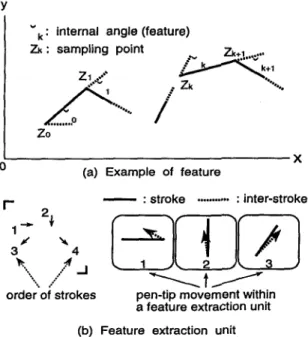
the identity verification system can verify whatever a writer writes. Referring to the above requirements, we use an internal angle between two lines as a feature (see Figure 3(a)). We define a set of one stroke i.e.
from pen down to pen up) and one inter-stroke
t
i.e.from pen up to pen down) as a feature extraction unit, where a set of features is extracted (see Figure 3(b)).
The extracted features are transformed into a set of Fourier descriptors[4], which express the shape of the strokes in the frequency domain. We selected the P- type Fourier descriptor 51 which is applicable to open ing. These P-type Fourier descriptors are then trans- formed into feature vectors, which are used in the next categorization process. As a feature vector, we use the lower frequency part of the P-type Fourier descriptor including n coefficients.
curves, and convenient
I
or the description of handwrit-writers. As a learning algorithm, we use the Learning Vector Quantization (LVQ)[8] algorithm.
Y
Y
k : z k :
internal angle (feature) sampling point
I I
zoI .
(a) Example of feature 0
c
-
: stroke...
e.. : inter-strokeorder-of strokes pen-tip movement within a feature extraction unit (b) Feature extraction unif, (Example of Chinese character ”)
Figure 3: Feature and its extraction unit
3.1.2 Categorization process
The feature vectors are classified into several cate- gories by referring to templates which are prepared in advance see Figure 2 - 0 ) . These templates con- the proposed method, such templates are obtained from feature vectors using an improved clustering algorithm[6] based on the LBG algorithm[’/] which is a well known method in the design of vector quantizers.
We define each reproduced vector in a codebook as a
’template’. The codebook is produced by the cluster- ing algorithm and a set of feature vectors is used as a training sequence. In this categorization process, fea- ture vectors are classified into categories by referring to templates using the vector quantization method.
The codebook produced in this process is referred to as a ’common codebook’ in this paper.
tain persona
I
features obtained from many writers. In3.1.3 Feature extraction process
Personal features are extracted from the categorized feature vectors (see Figure 2 - 0 ) . A learning algorithm is applied to obtain a relationship between the writ- ers’ IDS and their categorized feature vectors. In this paper, we call a set of feature vectors within a writer a ’class’. The learning algorithm has two functions;
registration and discrimination. In registration, the algorithm repeats the renewal of reference vectors so as to match each feature vector with the correct writer of the correct class. We define a set of reference vectors in a category produced by the learning algorithm as a ’codebook’ and regard it as the personal features of
3.1.4 Weighing process
To emphasize the personal features in each category, weighing coefficients are calculated according to the uniqueness of personal features (see Figure 2-@).
Weighing coefficients are produced as follows:
M : number of writers.
R$) : number of times i’s test data is accepted as E’s data in category j. The distance mea- sure used here is the Euclidean distance.
Wii shows writer i’s weighing coefficient in cate- gory 3 and it decides the discriminating power of the learning algorithm.
3.2 Verification process 3.2.1 Generation of text
To make a verification text, N kinds of characters are selected in the dictionary by referring to the weigh- ing coefficients (see Figure 2 - 0 ) . Each of the selected characters includes several categories which have suf- ficient personal features of the claimed writer. In this paper, the selected characters consist of several cate- gories that satisfy following requirements;
1. The category that satisfies Wij
2
Wth. Wij is a weighing coefficient and W l h is a threshold of W , . 2 . The category that satisfies Pi,2
Pth. Pi, is theoccurrence probability of category j in character i and P t h is a threshold of Pij.
3.2.2 Preprocess and categorization process Feature vectors are produced and classified into cate- gories by referring to a common codebook (see Figure 2 - 0 0 ) .
3.2.3 Verification of text
A decision is made whether the writer has written the same characters as the system requested by per- forming character recognition of the written text (see Figure 2 4 3 ) . It should be emphasized that the same feature vectors are used in this character recognition process as in the writer verification process. When the written text is different from the indicated text, the writer is rejected. Written text is compared with indicated text by a character usin DP (Dynamic Pro- gramming) matching technique[gf based on the cate- gories. When the following condition is satisfied, it is decided that the indicated text was correctly writ- ten by the writer; D
<
&, where D is the Euclideandistance between two characters, one of which is in the written text and the other in the indicated text, and Dth is a threshold of D and is not dependent on characters.
3.2.4 Feature extraction process
Via the codebook, the corresponding writer is specified using a LVQ algorithm (see Figure 2-@). In each cat- egory, the reference vector in the codebook, which is the nearest to the produced feature vector, is selected.
Then, the registered writer corresponding to the refer- ence vector is selected. These processes are applied to each feature vector in a category. Therefore, each fea- ture vector is finally assigned to a specific writer. We count the number of times each registered writer was selected as a candidate for the genuine writer in the above processes, and define it as an 'expected value'.
3.2.5 Verification of w r i t e r
The writer is verified based on the expected value defined above (see Figure 243). The largest value of an expected value is defined as w1, and the sec- ond largest value of an expected value is defined as w2.. If the ID shown by the writer before the verifi- cation process agrees with the ID corresponding to wl, the verification process is continued, otherwise the writer is rejected and the process is terminated.
Then, if w1 and w2 satisfy the following threshold condition, the writer is accepted, otherwise rejected;
w2/w1 I t h (0 g t h g 1).
4 Reliability test
In this section, the reliability of the proposed method is shown with simulation results.
In the proposed method, it is important that each category can represent many characteristics of hand- writing efficiently without lack of personal features.
We use a set of Chinese characters as the text in the re- liability test, because Chinese characters seem to have many features of handwriting. In the reliability test, we use two kinds of text. One is the text for mak- ing a common codebook, and the other is the text for a reliability test. The former is called a 'codebook text' and the latter is called an 'experimental text' in this paper. The codebook text consists of 100 char- acters including seven types of fundamental elements of Chinese characters. 5 writers wrote 20 characters to make the codebook text. On the other hand, the experimental text consists of 100 characters (see Table 1). 13 writers who did not contribute to the codebook text wrote 20 characters, repeated 5 times to make this experimental text. We selected 45 characters from the former part of the experimental text and used them as training data. We used the remaining 33 charac- ters of the experimental text as weighing data and 22 characters as test data. It is important that training data is different from test data.
The dictionary in the text generation process con- sists of 11 characters which are the same characters as the test data. These characters were written by another group of 10 writers. All writing data were
gathered at a spatial resolution of 10 points/" and a sampling rate of 110 samples/s. The P-type Fourier descriptors are produced by the 128-point FFT, from which a 82-component feature vector is formed by grouping of the first 41 lowest order complex coef- ficients. Other parameters are decided as follows;
W t h = O , P t h = O .
Table 1: ExDerimental text
4.1
Extracted categories
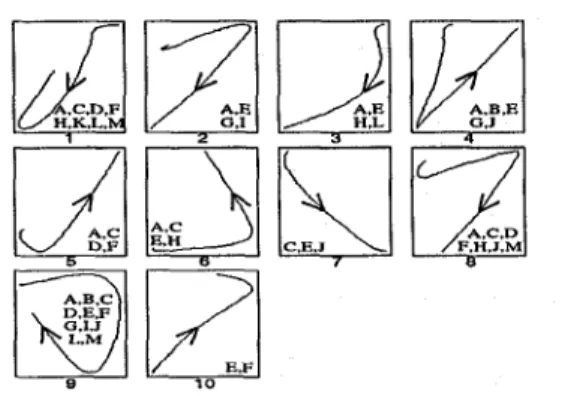
Figure 4 shows the parts of handwriting curves ob- tained from reproduction vectors in the common code- book. Each category reflects the part of strokes which contain personal features. And each label from A to M in the same figure shows the writers who are cor- rectly recognized in the experiment, where the regis- tered writer who has the nearest reference vector to the test data is identified as the writer of the test data. This result shows that personal features can be detected in the simplest elements of a character which consist of one stroke and one inter-stroke ad- joining the next stroke. We can find that there are some categories which contain many personal features as compared with the others, such as categories no.1, no.8 and no.9. Of course, categories which reflect per- sonal features are different for each person. This result suggests the effect of the weighing process.
H.K.L.
PI
F?
F.H.1.M "Figure 4: Handwriting curves extracted from common codebook
4.2
Results
ofwriter verification
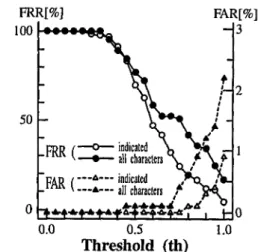
Figure 5 shows the FRR (False Rejection Rate or the rate of incorrectly rejecting the specific writer), and the FAR (False Acceptance Rate or the rate of accepting the wrong writer). In the reliability test, any writer writes twice the three different characters which are selected from the test data. The recogni- tion system automatically selects the characters which contain the specific writer's features. The test result is shown as the curve named 'indicated' in the Figure 5.
Also the results from a writer writing the whole 22 characters of the test data, are shown as the curve named ’all characters’. In Figure 5, FRR is 4,6% and
FAR is 0.9% at the minimum of IFRR+FAR). Com- FRR[%] FAR[%]
paring the curves named ’indicatkd’ and ’all ’charac- 100 3
ters’, the former result is superior to the latter. This result suggests that the method of selecting and in- dicating characters which contain personal features is effective.
4.3
Results
oftext verification
Figure 6 shows the results of the character recogni- tion, where D t h is the threshold value for recognition, FRR is the error rate to recognize a right or indicated character as a wrong one, and FAR is the error rate to recognize a wrong or non-indicated character as a right one. In the Figure 6, the rate of character recognition is about 84% when Dth is set to the intersecting point of the curve FRR and FAR. This result shows that character recognition can be performed by using the features.
5
Conclusion
Figure 5: Verification results (writer verification) In this paper, aiming for further reliability of on-line writer verification, we introduced a new method called text-indicated writer verification which can in- dicate any kind of text including ordinary characters to the writer in verification. We also showed the relia- bility of the proposed method by presenting some sim- ulation results using handwriting data. The proposed method has the advantage of free choice of the text and high robustness against forgeries for the follow- ing reasons; use of ordinary characters besides one’s signature, use of different characters in the enrolment and verification process, and the way of verification by checking that the written text and indicated text are the same. Our further research may involve the determination of appropriate thresholds for the verifi- cation of text and writer, and the evaluation of overall reliability with the most suitable weighing.
References
0.0 0.1 0.2 0.3 0.4 0.52 50
1
0 0
Threshold (th)
same categories that are generated to extract personal
-0- FRR
-
FARF.Leclerc and R.Plamondon: “Automatic signa- ture verification and writer identification : The state of the art
-
1989-1993”, Int. J. of Pat- tern Recogn. Artif. Intell. (IJPRAI), 8 , 3, pp.643- 660( 1994).M.Yoshimura and 1.Yoshimura: “Writer recog- nition the state-of-the-art and issues to be ad- dressed” (in Japanese), Technical Report of IE- Y.Yamazaki and N.Komatsu: “An extraction of individual characteristics based on categorized handwriting information” (in Japanese), IEICE
Trans., J79-D-11, 8, pp.1335-1346(1996).
C.T.Zahn and R.Z.Roskies: “Fourier descriptors for plane closed curves”, IEEE Trans. Computers, Y.Uesaka: “A new Fourier descriptor applica- ble to open curves” (in Japanese), IEICE Trans., ICE, PRMU96-48, pp.81-90(1996).
C-21, 3, pp.269-281( 1972).
J67-A, 3, pp. 166-173(1984).
Threshold (Dth)
Figure 6: Verification results (text verification) [6] Y.Yamazaki and N. Komatsu: “A feature ex-
traction method for personal identification sys- tem based on individual characteristics” (in Japanese
,
IEICE Trans., J79-B-I, 5, pp.373- 380(1996{.[7] Y.Linde, A.Buzo and R.M.Gray: “An algorithm for vector quantizer design”, IEEE Tkans. Com- mun., COM-28, 1, pp.84-95(1980).
[SI T.Kohonen: “Self-Organization and Associa- tive Memory (second edition)”, Springer-Verlag (1988).
[9] H.Sakoe and S.Chiba: “Dynamic programming algorithm optimization for spoken word recogni- tion”, IEEE Trans. Acoust. S eech and Signal Process., A I I I