著者
KU
M
AG
AI J un , O
TSU
KI Teppei , U
M
M
ARED
D
Y
Venkat a Subba Reddy, KO
H
ARI Yos hi hi t o , SEKI
Chi gus a , U
W
AI Koj i , O
KU
YAM
A Yuko , KW
O
N
Euns ang , TO
KI W
A M
i c hi o , TAKESH
I TA M
i t s uhi r o
, N
AKAN
O
H
i r ot o
j our nal or
publ i c at i on t i t l e
TETRAH
ED
RO
N
- ASYM
M
ETRY
vol um
e
26
num
ber
24
page r ange
1423- 1429
year
2015- 12- 31
U
RL
ht t p: / / hdl . handl e. net / 10258/ 00008591
Chiral primary amino alcohol organobase catalyst for the asymmetric
Diels-Alder reaction of anthrones with maleimides
Jun Kumagai,a Teppei Otsuki,a U. V. Subba Reddy,a Yoshihito Kohari,a Chigusa Seki,a Koji
Uwai,a Yuko Okuyama,b Eunsang Kwon,c Michio Tokiwa,d Mitsuhiro Takeshita,d Hiroto
Nakanoa,*
a
Division of Sustainable and Environmental Engineering, Graduate School of Engineering, Muroran Institute of Technology, 27-1 Mizumoto, Muroran 050-8585, Japan
b
Tohoku Pharmaceutical University, 4-4-1 Komatsushima, Aoba-ku, Sendai 981-8558, Japan
c
Research and Analytical Center for Giant Molecules, Graduate School of Sciences, Tohoku University, 6-3 Aoba, Aramaki, Aoba-ku, Sendai 980-8578, Japan
d
Tokiwakai Group, 62 Numajiri Tsuduri-chou Uchigo Iwaki 973-8053, Japan
*
Corresponding author. Tel.: +81 143 46 5727.
E-mail address: [email protected](H. Nakano).
ABSTRACT - Simple chiral TES-amino alcohol organocatalysts containing a bulky
silyl [triethylsilyl: TES] group on oxygen atom at γ-position were designed and
synthesized as new organocatalysts for the enantioselective Diels-Alder (DA) reaction
of anthrones with maleimides to produce chiral hydroanthracene DA adducts (up to
99% yield with up to 94% ee).
Keywords: Organobase catalyst, Diels-Alder reaction, amino alcohol, anthrones,
1. Introduction
Asymmetric organocatalysis has emerged as an important and rapidly growing area of
synthetic organic chemistry, and excellent covalent and non-covalent organocatalysts have
been developed for use in a wide range of reactions.1 The base catalyzed asymmetric
Diels-Alder (DA) reaction is one of the most straightforward and atom economical method
to construct chiral six-membered carbocyclic compounds in synthetic organic chemistry.1
Among the dienes, anthrone has been considered as one of the powerful diene component
O
+
asymmetric Diels-Alder reaction
N R3 O
O
N O
O
HO R3
α,β-unsaturated lactams
N R3
O R5
R6 biologically active
compounds
chiral organobase catalyst
Scheme 1. The asymmetric Diels-Alder reaction of anthrones with
maleimides and its application.
R1
R2 R4
R2 R1
R4
hydroanthracenes
anthrones maleimides
R4
and can react with a variety of dienophiles.2 Particularly, the DA reaction of anthrone with
N-substituted maleimide3 to construct a cage anthrone derivatives, which are key
intermediates for the preparations of some unsaturated lactams with antipsoriatic and
antiproliferative biological activities, have been studied extensively.4 Several efficient chiral
organobases such as cinchona alkaloids,5 pyrrolidine derivatives,6 cyclic guanidines,7
bisoxazolines,8 and tertiary amine thioureas9 have been used to promote those reactions
(Scheme 1).10 However, to the best of our knowledge, the effectiveness of primary β-amino
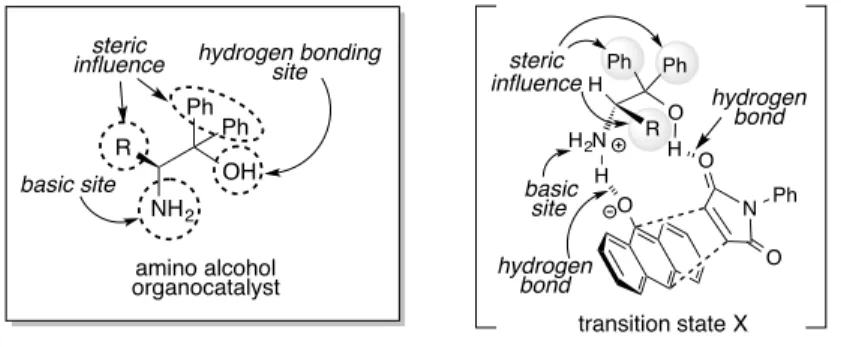
We designed a series of chiral primary amino alcohols 1a-f, 2a-h, and 3-5 with several
substituent groups at the β-position as an organobase catalyst (Scheme 2). The reaction
using these designed amino alcohol catalysts might proceed through the transition state X
(Figure 1). Thus, anionic anthracene is formed by the reaction with amino alcohol acting
NH2
OH Ph
Ph R
hydrogen bonding site
basic site
amino alcohol organocatalyst
steric influence
O N
O
O Ph H2N
O
H H Ph Ph
steric influence
hydrogen bond
basic site
R
hydrogen bond
transition state X
Figure 1. Concept for catalyst design.
H
as a base. Then both anionic diene and maleimide dienophile are fixed by the hydrogen
bondings with the ammonium alcohol and might react stereoselectively to afford the DA
adduct in good chemical yield and enantioselectivity.
We report herein that the newly designed primary amino alcohol containing a bulky silyl
group on oxygen atom at γ-position is an efficient organobase catalyst for the asymmetric
DA reaction of anthrone with maleimides affording chiral hydroanthracene as a DA adduct
with a good chemical yield (up to 99%) and an excellent enantioselectivity (up to 94% ee).
2. Results and Discussion
Primary β-amino alcohol catalysts 1a-f,11 2a-h and 3-5 containing several substituent
groups at the β-position were prepared as follows (Scheme 2). Thus, amino alcohols 1a-f
containing aliphatic or aromatic substituent groups at the β-position were easily prepared by
β-amino alcohol catalysts 2a-g containing several silyl groups on oxygen atom at
theγ-position were also easily prepared11b by the reactions of the amino alcohol 1f with
R2OTf [R2 = TIPS (triisopropylsilyl), TES (triethylsilyl)] or R2’Cl [R2’ = TBDMS
(tert-butyldimethylsilyl), DPMS (diphenylmethylsilyl), TPS (triphenylsilyl), TPrS
(tripropylsilyl), THS (trihexylsilyl)] in moderate to good yields (50-86%). Furthermore, the
bulkiest β-amino alcohol catalyst 2h containing our explored super silyl [TTMSS:
tris(trimethylsilyl)silyl] group11c on oxygen atom at the γ-position was also easily obtained
by the reaction of 1f with TTMSSCl in 53% yield.11c In addition, catalyst 3 masked the
hydroxy group at α-position by TMS (trimethylsilyl) group was prepared from the reaction
of 2e with TMSOTf in 27% yield. Moreover, the catalyst 4 containing tertiary amino group
was obtained by the reaction of 2e with MeI in moderate yield (41%). The catalyst 5
containing secondary amino group was also prepared by the reaction of 2e with benzyl
bromide in 46% yield.
We first examined the DA reaction of anthrone 6 with N-phenylmaleimide 7 using the
common amino alcohols 1a-f as organobase catalyst (Table 1). The reaction of 6 (1 equiv.)
NH2 OH Ph Ph R1 1a 1b 1c 1d 1e 1f
R1 = Ph
R1 = Bn
R1 = i-Pr R1 = t-Bu R1 = i-Bu R1 =
: : : : :
: CH2OH
CHCl3
24 h -40 °C to rt
R2OTf or R2'Cl
Et3N
2a-h 2a 2b 2c 2d 2e 2f 2g 2h
R2 = TIPS12
R2' = TBDMS12
R2' = DPMS
R2' = TPS
R2 = TES12
R2' = TPrS
R2' = THS
R2' = TTMSS11c
: : : : : : : : 52% 65% 50% 86% 72% 69% 69% 53% 1a-f CHCl3 24 h -40 °C to rt
TMSOTf Et3N
1f NH2 OH Ph Ph 3 NH2 OTMS Ph Ph TESO Me-I EtOH K2CO3
4 NMe2 OH Ph Ph TESO
K2CO3 rt, 72 h CHCl3 5 HN OH Ph Ph TESO Bn NH2 OH Ph Ph OH
PhCH2Br
27% 41% 46%
rt, 24 h
Scheme 2. Preparations of amino alcohol organocatalysts.
2e
with 7 (1.2 equiv.) was carried out at room temperature in CH2Cl2 in the presence of 10
mol% of catalysts 1a-f, respectively (entries 1-6). The obtained DA adducts 8 (8a and/or
8b) were isolated and those absolute configurations were determined on the basis of both
literature values of optical rotation and retention times on HPLC chiral column.9 Catalysts
1a-e did not show satisfactory catalytic activity and afforded the DA adduct 8 in only low
chemical yields (14-29%) and enantioselectivities (3-23% ee). Furthermore, amino diol
catalyst 1f afforded 8 in good chemical yield (76%), but the enantioselectivity was quite
low (9%). Considering with the above results, we next examined the same DA reaction
using amino alcohols 2a-h containing bulkier substituted silyl group on oxygen atom at
γ-position in the catalyst. The reaction of 6 (1 equiv.) with 7 (1.2 equiv.) was carried out at
room temperature in CH2Cl2 in the presence of catalysts 2a-h (10 mol%), respectively
(entries 7-14). As results of these reactions, all catalysts showed a catalytic activity and
afforded the DA adduct 8 in moderate to fairly good chemical yields (32-92%).
Furthermore, enantioselectivity also increased in the reaction using almost catalysts
2a-c,e-g (32-43% ee), other than TPS-2d (16% ee) and TTMSS-2h (25% ee) catalysts,
although satisfactory enantioselectivities were not observed under these reaction conditions.
The best chemical yield and enantioselectivity were 92% and 42 % ee in the case of using
the catalyst 2e which was bearing TES moiety on oxygen atom at γ-position in the molecule
(entry 11). From these results, it was indicated that the use of an amino alcohol catalyst
bearing considerably bulky silyl substituent on oxygen atom at γ-position might be not
effective for obtaining an satisfactory enantioselectivity in this reaction. The same reaction
trimethylsilyl (TMS) group brought about a great decrease in chemical yield and
enantioselectivity (74%, 6% ee, entry 15) in comparison with the result of the reaction
using the corresponding amino alcohol catalyst 2e with free
Table 1
The asymmetric Diels-Alder reaction of anthrone 6 with N-phenlmaleimide 7
entry yield (%)a ee (%)
b
a
Isolated yields. b
The ee was determined by HPLC using a Daicel AD-H column(n-hexane : 2-propanol = 80:20). 1 2 3 4 5 6 7 8 9 10 11 12 13 14 15 16 17 1a 1b 1c 1d 1e 1f 2a 2b 2c 2d 2e 2f 2g 2h 3 4 5 23 17 28 14 29 76 68 69 32 40 92 65 57 66 74 84 37 12 23 17 3 9 34 42 32 16 42 43 41 25 11 8a 8b 7 6 21 catalyst
hydroxyl group (2e: 92%, 42% ee, entry 11). This difference may be due to the loss of the
ability for hydrogen bonding to maleimide dienophile 7 or the steric influence of the bulkier
TMS group on the molecule, although the reasons are not clear. Furthermore, the catalytic
abilities of both catalyst 4 with tertiary amino group and catalyst 5 with secondary amino
group in the molecules were also examined (entries 16, 17). However, these catalysts did
not afford DA adduct 8a in satisfactory enantioselectivities in spite of stronger basic
property than primary catalyst 2e.
O
+ N Ph O O N O O HO Ph
6 7 8a
catalyst (10 mol%)
CH2Cl2
In order to optimize the reaction conditions using the superior TES-amino alcohol
organocatalyst 2e, we next examined the effect of the molar ratio of catalyst 2e, the effect
of solvent, reaction temperature and reaction time (Table 2). The increase of catalytic
loading of 2e to 20 mol% resulted in a slight increase in both the chemical yield (93%) and
enantioselectivity (46% ee) (entry 1) than that of the reaction containing 10 mol% of 2e
(Table 1, entry 11). However, the decrease of catalytic loading of 2e to 5 mol% resulted in a
Table 2
Optimization of the reaction conditions using catalyst 2e
entry 2e (mol%) solvent temp. (°C) time (h) yield (%)a
ee (%)b
a
Isolated yields. b
The ee was determined by HPLC using a Daicel AD-H column(n-hexane : 2-propanol = 80:20).
1 2 3 4 5 6 7 8 9 10 11 12 13 14 15
CH2Cl2 CH2Cl2 CH2Cl2 CH2Cl2 CHCl3 ClCH2CH2Cl Et2O MeCN benzene toluene DMF DMSO MeOH EtOH CH2Cl2 20 5 20 20 20 20 20 20 20 20 20 20 20 20 20 rt rt 0 -30 rt rt rt rt rt rt rt rt rt rt rt 24 24 24 24 24 24 24 24 24 24 24 24 24 24 48 93 50 65 24 76 99 81 60 84 76 --98 46 28 27 11 43 27 10 7 17 18 --47
substantial decrease in the chemical yield (50%) with an enantioselectivity (28% ee) (entry
2). To further improve the enantioselectivity, the reactions using 2e were examined at lower
temperatures of both 0 °C and -30 °C (entries 3 and 4). However, satisfactorily results were
not observed in chemical yield and enantioselectivity under each temperature. Next, we also
examined the solvent effects on this reaction. Commonly used aprotic (CHCl3,
ClCH2CH2Cl, Et2O, MeCN, benzene, toluene), aprotic polar (DMF, DMSO), and protic
(EtOH, MeOH) solvents were screened, respectively (entries 5-14). Only ClCH2CH2Cl +
6 7 catalyst 2e 8a
afforded an excellent chemical yield (99%) (entry 6), but other solvents gave chiral DA
adduct 8a in moderate to good yields (60-84%) (entries 5-10). Unfortunately, no
improvements in enantioselectivity were observed in these solvents in comparison with the
use of CH2Cl2 (Table 1, entry 11). Furthermore, the reactions did not proceed in the use of
aprotic polar (DMF, DMSO) and protic (EtOH, MeOH) solvents (entries 11-14). In the best
reaction condition (CH2Cl2, 2e: 20 mol%, rt), extending the reaction time from 24 to 48 h
led to increase the chemical yield (98%) with 47% ee (entry 15).
Under the optimized reaction conditions, a wide range of the DA reactions with
anthrones 6,9a,b2 and maleimides 7,10a-f3-9 were investigated using superior TES-catalyst
2e and the results are shown in Table 3. The obtained DA adducts 11a-h were isolated and
those absolute configurations were determined on the basis of both literature values of
optical rotation and retention times on HPLC chiral columns.7,9,10a The use of
N-methylmaleimide 10a afforded the corresponding DA adduct 11a10a in excellent
chemical yield (97%), although enantioselectivity was low (39% ee) (entry 1). The reaction
with N-(4-methylphenyl)maleimide 10b also afforded the DA adduct 11b10a in a fairly good
chemical yield (91%) and the enantioselectivity also increased to 32% ee (entry 2).
Although bulkier N-benzylmaleimide 10c also did not afford the 11c9 in a satisfactorily
enantioselectivity (46% ee), the chemical yield was fairy good (93%) (entry 3). Based on
the results of the reaction using maleimides 7, 10a-c, the DA reaction of 6 with
N-(2-nitropheny)lmaleimide 10d having a polar and bulkier strong electron-withdrawing
nitro group at 2-position on phenyl group using TES catalyst-2e (20 mol%) was examined
11d7 in excellent chemical yield (97%) and with better enantioselectivity (66% ee) in
comparison with the result using other maleimides 7, 10a-c (entry 4). However, the
reactions using both N-(3-nitrophenyl)maleimide 10e and N-(4-nitrophenyl)maleimide 10f
also afforded the corresponding DA adducts 11e10a,f10a respectively, in excellent chemical
Table 3
The asymmetric Diels-Alder reaction of anthrones 6, 9a,b with maleimides 7, 10a-f using catalyst 2e
N R3
O O
7, 10a-f 7 : R3 = Ph
10a : R3 = Me
10b : R3 = 4-Me-Ph
10c : R3 = Bn
10d : R3 = 2-NO 2-Ph
10e : R3 = 3-NO 2-Ph
10f : R3 = 4-NO 2-Ph O + N O O HO R3
6, 9a,b 11a-c,e-h
catalyst 2e (20 mol%)
R1 R1
R1
R1
6 : R1 = R2 = H
9a : R1 = Cl, R2 = H
9b : R1 = H, R2 = Cl
CH2Cl2
rt, 48 h
R2 R2
R2
R2
11a : R1 = R2 = H, R3 = Me
11b : R1 = R2 = H, R3 = 4-Me-Ph
11c : R1 = R2 = H, R3 = Bn
11d : R1 = R2 = H, R3 = 2-NO 2-Ph
11e : R1 = R2 = H, R3 = 3-NO 2-Ph
11f : R1 = R2 = H, R3 = 4-NO 2-Ph
11g : R1 = Cl, R2 = H, R3 = Ph
11h : R1 = H, R2 = Cl, R3 = Ph
OH O O N 11d NO2
entry diene yield (%)a ee (%)
b
a
Isolated yields. b
The ee was determined by HPLC using a Daicel AD-H column(n-hexane : 2-propanol = 80:20).
dienophile DA adduct
1 2 3 4 5 6 7 8 6 6 6 6 6 6 9a 9b 10a 10b 10c 10d 10e 10f 7 7 11a 11b 11c 11d 11e 11f 11g 11h 97 91 93 97 97 95 98 98 39 32 46 32 35 25 38 11a-c,e-h 11d 66
yields (11e: 97%, 11f: 95%), but satisfactory enantioselectivities (11e: 32% ee, 11f: 35%
ee) were not obtained in the optimized reaction conditions (entries 5,6). Furthermore, the
reactions of dichloroanthrones 9a,b with 7 were also examined in the same reaction
conditions (entries 7,8). Although, that reactions also afforded the corresponding DA
adducts 11g10a,h10a in excellent chemical yields (11g: 98%, 11h: 98%), satisfactory
To further improve the enantioselectivity in the reaction of 6 with 10d using 2e,we next
examined the effect of the molar ratio of catalyst 2e,reaction temperature and reaction time
(Table 4). The reaction was examined at lower temperatures of both 0 °C and -20 °C
(entries 1 and 2). The best enanthioselectivity (94% ee) with good chemical yield (65%)
Table 4
Optimization of the reaction conditions using catalyst 2e
+
6 10d catalyst 2e 11d
CH2Cl2
temp. time
entry 2e (mol%) temp. (°C) time (h) yield (%)a
ee (%)b
a
Isolated yields. b
The ee was determined by HPLC using a Daicel AD-H column(n-hexane : 2-propanol = 80:20).
1 2 3 4 5
20 20 10 5 20
0 -20 0 0 0
48 48 48 48 72
65 21 39 24 83
94 86 91 89 94
was obtained when the reaction was carried out at 0 °C (entry 1). However, the reaction at
-20 °C brought about a decrease of chemical yield and enantioselectivity (21%, 86%
ee)(entry 2). Furthermore, the decrease of catalytic loading of 2e to 10 mol% and 5 mol%,
respectively, resulted in a significant decrease in the chemical yield (10 mol%: 39%, 5
mol%: 24%), respectively, although those enantioselectivities were good (10 mol%: 91% ee,
5 mol%: 89% ee) (entries 3 and 4). In the reaction using catalyst 2e (20 mol%), extending
the reaction time from 48 to 72 h led to increase the chemical yield (83%) with 94% ee
(entry 5).
Based on the observed enantiopurities (DA adduct 8a: 47% ee, Table 2, entry 15, DA
adduct 11d: 94% ee, Table 4, entry 5) of optically active DA adducts 8a or 11d that were
obtained from the reactions of 6 with 7, or with 10d, the models of the enantioselective
DA adduct 8a might go through the transition state Ts-A-1 which has a less steric
interaction between TES group on the ammonium alcohol and maleimide 7 than that of the
transition state Ts-A-2 in Ts-A. Thus, in Ts-A-1, the diene and the dienophile are fixed by
the two hydrogen bonding interactions between the ammonium site on the ammonium
alcohol intermediate and the oxygen atom on the anionic anthracene 6, and between the
hydroxy group on the ammonium alcohol intermediateand the carbonyl group
10d O 6 N O O 7 N O O HO Ph 8a N O O OH 11d' 47% ee 94% ee N O
O NO2
NO2
O N
O
O H2N
O H H O Si O O O N H2N
O H H O Si O O O N O O N H2N
O H H O Si O N O O O O N H2N
O H H O Si Ts-B-1 Ts-B-2 Ts-A-1 Ts-A-2
Transition state A (Ts-A)
Transition state B (Ts-B)
Scheme 3. Plausible reaction courses.
H
H H
H
Ts-A-1). On the other hand, the reaction of 6 with 10d affording the DA adduct 11d might
go through the different transition state Ts-B, based on that both the reaction proceeded
with a high enantioselectivity (94% ee) and the obtained DA adduct 11d have an opposite
absolute stereochemistry in comparison with the reactions using other anthrones 6,9a,b and
maleimides 7, 10a-c,e,f in the manuscript. Thus, reaction proceed through the transition
state Ts-B-2 in which diene and dienophile were fixed by two hydrogen bonding
interactions between ammonium site, hydroxy site of ammonium alcohol and anionic
oxygen atom on anthrone 6, strong ionic nitro group on the maleimide 10d, respectively.
Also, Ts-B-2 shows a less steric interaction between TES group on the ammonium alcohol
and the maleimide part in dienophile 10d when compard with Ts-B-1, although the reason
is not clear.
3. Conclusions
In conclusion, we have developed new chiral amino alcohols 2a-h, 3-5 bearing silyl
groups on oxygen atom at γ-position. The catalysts were easily prepared from the
condensation of cheaply and commercially available chiral amino alcohols in two or three
steps. The Diels-Alder reactions of anthrones with N-substituted maleimides using the
explored catalysts were examined. In these catalysts, TES-amino alcohol catalyst 2e
(up to 97%) and moderate enantioselectivity (up to 94% ee). Further studies, including
catalyst design modifications and mechanistic investigations, are in progress.
4. Experimental
4.1. General
All reactions were carried out under an argon atmosphere in flame-dried glassware with
magnetic stirring. Thin layer chromatography (TLC) was performed on silica gel 60 F254
and analytes were detected using UV light (254 nm) and iodine vapor. Column
chromatography was carried out on silica gel 60N (40–100 µm) and preparative TLC was
carried out on silica gel 60 F254. Melting points were measured using a micro-melting point
apparatus. Infrared (IR) spectra were measured with a FT/IR spectrophotometer (JASCO
FT/IR-400). 1H-NMR (500 MHz) and 13C-NMR (125 MHz) spectra were measured in
CDCl3 on a JEOL JNM-ECA 500 spectrometer. 1H-NMR data were reported as follows:
chemical shifts in ppm from tetramethylsilane (0.0 ppm), integration, multiplicity (s =
singlet, d = doublet, t = triplet, q = quartet, dd = double-doublet, m = multiplet and br =
broad), coupling constants (Hz), and assignment. 13C-NMR spectra were measured with
complete proton decoupling. Chemical shifts were reported in ppm from the residual
solvent as an internal standard (CDCl3; 77.16 ppm). High performance liquid
chromatography (HPLC) was performed using the chiral columns AD-H 4.6 mm x 25 cm
spectra were measured by EI using sector instruments on Hitachi RMG-6MG and
JEOL-JNM-DX 303 spectrometers.
4.2. General procedure for the preparations of amino alcohol organocatalysts 2a-g
A solution of amino alcohol 1f (1 mmol) in CH2Cl2 (15 mL) were added substituted silyl
trifluoromethane sulfonates (1 mmol) or substituted silyl chlorides (1 mmol) and Et3N (1.2
mmol) at -40 °C under argon. The mixture was stirred for 24 h at room temperature. The
reaction mixture was quenched with H2O and extracted with CHCl3. The combined organic
layer was washed with brine and dried over anhydrous Na2SO4 and evaporated to give a
crude products 2a-g. The residue was purified by column chromatography on silica gel
(n-hexane : ethylacetate = 4 : 1) to give products 2a-g (2a : 208 mg, 52%; 2b : 232 mg,
65%; 2c : 220 mg, 50%; 2d : 431 mg, 86%; 2e : 185 mg, 72%; 2f : 275 mg, 69%; 2g : 363
mg, 69%).
4.2.1. (S)-2-amino-1,1-diphenyl-3-(triisopropyllsilyloxy)propanol (2a)
Colorless oil; [α]D24 = -57.1 (c 0.63, EtOH); IR (neat) cm-1: 2942, 2889, 1449, 1248;
1
H-NMR (CDCl3) δ: 7.60-7.59 (m, 2H), 7.51-7.47 (m, 2H), 7.34-7.14 (m, 6H), 3.95-3.93
(dd, J = 5.8 Hz, J = 3.8 Hz, 1H), 3.71-3.65 (m, 2H), 1.00-0.98 (m, 21H); 13C-NMR (CDCl3)
δ: 146.1, 145.0, 128.5, 128.2, 126.7, 126.6, 125.6, 125.1, 79.1, 64.8, 57.4, 17.9, 11.7.
399.2589.
4.2.2. (S)-2-amino-1,1-diphenyl-3-(tert-butyldimethylsilyloxy)propanol (2b)
White solid (Et2O/hexane); mp 49-51 °C; [α]D22 = -51.1 (c 0.45, EtOH); IR (neat) cm-1 :
2951, 2882, 1468, 1307; 1H-NMR (CDCl3) δ: 7.59-7.57 (m, 2H), 7.50-7.48 (m, 2H),
7.34-7.15 (m, 6H), 3.92-3.90 (t, J = 4.6 Hz, 1H), 3.59-3.58 (d, J = 4.6 Hz 2H), 0.86 (s, 9H),
-0.02 (s, 3H), -0.05 (s, 3H); 13C-NMR (CDCl3) δ: 146.0, 145.1, 128.5, 128.2, 126.7, 126.6,
125.5, 125.3, 125.1, 79.3, 64.6, 57.1, 25.8, 18.1, -5.6, -5.1; EI-MS m/z: 358 (M+H)+;
HRMS (EI) calcd for C21H31NO2Si (M+H)+: 358.2202, found: 358.2202.
4.2.3. (S)-2-amino-1,1-diphenyl-3-(diphenylmethylsilyloxy)propanol (2c)
White solid (Et2O/hexane); mp 89-90 °C; [α]D20 = -64.8 (c 1.05, CHCl3); IR (neat) cm-1 :
2948, 2885, 1428, 1255; 1H-NMR (CDCl3) δ: 7.55-7.12 (m, 20H), 4.00-3.97 (m, 1H),
3.68--3.66 (m, 1H), 0.57 (s, 3H); 13C-NMR (CDCl3) δ: 146.4, 146.3, 146.2, 144.5, 135.3,
135.2, 134.3, 130.1, 129.9, 128.5, 128.2, 128.0, 126.8, 126.6, 125.6, 125.1, 78.5, 64.7, 60.5,
57.6, 55.7, -3.3; EI-MS m/z: 440 (M + H)+; HRMS (EI) calcd for C28H30NO2Si (M + H)+:
440.2046, found: 440.2054.
White solid (Et2O/pentane); mp 91-92 °C; [α]D22 = -55.8 (c 0.52, CHCl3); IR (neat) cm-1 :
2951, 2882, 1468, 1307; 1H-NMR (CDCl3) δ: 7.53-7.50 (m, 8H), 7.46-7.43 (m, 3H),
7.37-7.35 (m, 6H), 7.30-7.27 (m, 4H), 7.18-7.14 (m, 3H), 7.11-7.08 (m, 1H), 4.68 (s, 1H),
4.02-3.98 (dd, J = 6.5 Hz, J = 3.5 Hz, 1H), 3.80-3.75 (m, 2H); 13C-NMR (CDCl3) δ: 146.3,
144.1, 135.3, 133.5, 130.2, 128.4, 128.1, 128.0, 126.7, 126.5, 125.5, 125.0, 78.2, 65.0, 57.7;
EI-MS m/z: 501 (M+); HRMS (EI) calcd for C33H31NO2Si (M+): 501.2124, found:
501.2123.
4.2.5. (S)-2-amino-1,1-diphenyl-3-(triethylsilyloxy)propanol (2e)
Colorless oil; [α]D24 = -63.4 (c 0.55, EtOH); IR (neat) cm-1 : 2911, 2876, 1449, 1269;
1
H-NMR (CDCl3) δ: 7.60-7.58 (m, 2H), 7.50-7.49 (m, 2H), 7.34-7.15 (m, 6H), 3.94-3.93 (t,
J = 4.3 Hz, 1H), 3.60-3.59 (m, 2H), 0.91-0.88 (t, J = 8.0 Hz, 9H), 0.56-0.51 (q, J = 8.0 Hz,
6H); 13C-NMR (CDCl3) δ: 146.1, 145.0, 128.5, 128.2, 126.7, 126.5, 125.5, 125.1, 79.1, 64.1,
57.2, 6.64, 4.12; EI-MS m/z: 358 (M + H)+; HRMS (EI) calcd for C21H32NO2Si (M + H)+:
358.2202, found: 358.2202. Anal. Calcd for (C21H31NO2Si): C 70.54, H 8.74, N 3.92,
Found: C 70.61, H 8.70, N 3.87.
4.2.6. (S)-2-amino-1,1-diphenyl-3-(tripropylsilyloxy)propanol (2f)
Colorless oil; [α]D22 = -77.5 (c 1.02, CHCl3); IR (neat) cm-1 : 2953, 2867, 1449, 1204;
1
J = 4.6 Hz, 1H), 3.57-3.56 (m, 2H), 1.32-1.24 (m, 6H), 0.92-0.89 (t, J = 7.2 Hz, 9H),
0.52-0.50 (m, 6H); 13C-NMR (CDCl3) δ: 146.2, 145.1, 128.5, 128.2, 126.7, 126.5, 125.6,
125.1, 79.2, 64.2, 57.3, 18.4, 16.7, 16.1; EI-MS m/z: 400 (M + H)+; HRMS (EI) calcd for
C24H38NO2Si (M + H)+: 400.2672, found: 400.2675. Anal. Calcd for (C24H37NO2Si): C
72.13, H 9.33, N 3.50, Found: C 72.19, H 9.24, N 3.42.
4.2.7. (S)-2-amino-1,1-diphenyl-3-(trihexylsilyloxy)propanol (2g)
Colorless oil; [α]D24 = -49.6 (c 1.27, CHCl3); IR (neat) cm-1 : 2920, 2854, 1449, 1181;
1
H-NMR (CDCl3) δ: 7.59-7.57 (m, 2H), 7.49-7.46 (m, 2H), 7.36-7.14 (m, 6H), 3.93-3.90 (m,
1H), 3.55-3.54 (m, 2H), 1.33-1.21 (m, 24H), 0.89-0.86 (t, J = 6.9 Hz, 9H), 0.51-0.48 (m,
6H); 13C-NMR (CDCl3) δ: 146.2, 145.0, 128.5, 128.2, 126.7, 126.5, 125.6, 125.1, 79.1, 64.1,
57.3, 33.3, 31.6, 31.5, 23.1, 23.0, 22.6, 15.1, 14.2, 13.3; EI-MS m/z: 526 (M + H)+; HRMS
(EI) calcd for C33H56NO2Si (M + H)+: 526.4080, found: 526.4074.
4.3. Preparation of amino alcohol catalyst 3
A solution of amino alcohol 2e (358 mg, 1 mmol) in CH2Cl2 (15 mL) was cooled down
to -40 oC. To the solution was added Et3N (166 µL, 1.2 mmol) and trimethylsilyl
trifluoromethanesulfonate (217 µL, 1.2 mmol) and the reaction mixture was stirred at room
temperature for 24 h. The solution was quenched with water and extracted with CHCl3. The
The filtrate was concentrated under reduced pressure to give the residue. The residue was
purified by column chromatography on silica gel (n-hexane : ethylacetate = 4 : 1) to afford
3 (116 mg, 27%).
4.3.1. (S)-1,1-diphenyl-3-(triethylsilyloxy)-1-(trimethylsilyloxy)propane-2-amine (3)
Colorless oil; [α]D19 = -43.8 (c 1.05, CHCl3); IR (neat) cm-1 : 2953, 2876, 1248; 1H-NMR
(CDCl3) δ: 7.43-7.42 (m, 2H), 7.35-7.34 (m, 2H), 7.30-7.21 (m, 6H), 3.88-3.85 (m, 1H),
3.73-3.71 (m, 1H), 3.00-2.96 (t, J = 9.5 Hz, 9H), 0.54-0.49 (m, 6H), -0.11 (s, 9H);
13
C-NMR (CDCl3) δ: 144.7, 144.2, 128.1, 128.0, 127.8, 127.5, 127.2, 127.0, 82.6, 64.8,
59.2, 6.8, 4.4, 2.1; EI-MS m/z: 430 (M + H)+; HRMS (EI) calcd for C24H40NO2Si2 (M +
H)+: 430.2598, found: 430.2612.
4.4. Preparation of amino alcohol catalyst 4
Amino alcohol 2e (358 mg, 1 mmol), K2CO3 (276 mg, 2 mmol) and iodomethane (120
µL, 2 mmol) were stirred in EtOH (4 mL) at room temperature for 24 h. The reaction
mixture was filtered with ethylacetate. The combined organic layer was washed with water,
brine, dried over anhydrous Na2SO4, and filtrated. The filtrate was concentrated under
reduced pressure to give the residue. The residue was purified by column chromatography
4.4.1. N-dimethyl-(S)-2-amino-1,1-diphenyl-3-(triethylsilyloxy)propanol (4)
Colorless oil; [α]D23 = -29.7 (c 0.74, CHCl3); IR (neat) cm-1 : 2953, 2875, 1447, 1234;
1
H-NMR (CDCl3) δ: 7.46-7.44 (m, 2H), 7.36-7.34 (m, 2H), 7.31-7.18 (m, 6H), 4.03-4.01 (m,
1H), 3.68-3.64 (m, 1H), 3.57-3.55 (m, 1H), 2.37 (s, 6H), 0.94-0.91 (t, J = 8.0 Hz, 9H),
0.58-0.53 (m, 6H); 13C-NMR (CDCl3) δ: 146.2, 145.5, 128.0, 127.6, 127.1, 127.0, 77.6,
70.7, 61.1, 44.0, 6.8, 4.3; EI-MS m/z: 386 (M + H)+; HRMS (EI) calcd for C23H36NO2Si (M
+ H)+: 386.2515, found: 386.2507.
4.5. Preparation of amino alcohol catalyst 5
Amino alcohol 2e (358 mg, 1 mmol), K2CO3 (332 mg, 2.4 mmol) and benzyl bromide
(140 µL, 1.2 mmol) were stirred in CHCl3 (10 mL) at room temperature for 72 h. The
reaction mixture was filtered with ethylacetate. The combined organic layer was washed
with water, brine, dried over anhydrous Na2SO4, and filtrated. The firtrate was concentrated
under reduced pressure to give the residue. The residue was purified by column
chromatography on silica gel (n-hexane : ethylacetate = 4 : 1) to afford 5 (206 mg, 46%).
4.5.1. N-benzyl-(S)-2-amino-1,1-diphenyl-3-(triethylsilyloxy)propanol (5)
Colorless oil; [α]D24 = -24.8 (c 1.05, CHCl3); IR (neat) cm-1 : 2954, 2875, 1449, 1238;
1
(m, 3H), 3.50-3.46 (m, 2H), 0.89-0.86 (t, J = 8.0 Hz, 9H), 0.54-0.49 (m, 6H); 13C-NMR
(CDCl3) δ: 146.6, 145.6, 128.4, 128.3, 128.1, 127.0, 126.5, 125.9, 125.5, 79.0, 63.2, 62.1,
52.4, 6.7, 4.2; EI-MS m/z: 447 (M+); HRMS (EI) calcd for C28H37NO2Si (M+): 447.2594,
found: 447.2589.
4.6. General procedure for the asymmetric Diels-Alder reaction of anthrones 6, with
maleimides 7
Anthrone 6 (0.10 mmol), N-phenylmaleimide 7 (0.12 mmol) and amino alcohol catalysts
1a-f, 2a-h, 3, 4 and 5 (0.01 mmol) were stirred in CH2Cl2 (1 mL) at room temperature for
24 h. The reaction mixture was directly purified by preparative TLC on silica gel (CHCl3)
to afford DA adducts 8. The enantiomeric excess (ee) was determined by HPLC (DAICEL
CHIRALPAK AD-H, 1.0 mL/min, n-hexane : 2-propanol = 80 : 20). Compounds 8 were
known compounds and were identified by spectral data which were in good agreement with
those reported.2-9
4.7. General procedure for the asymmetric Diels-Alder reaction of anthrones 6,9a,b,
with maleimides 7,10a-f
Anthrones 6,9a,b (0.10 mmol), maleimides 7,10a-f (0.12 mmol) and amino alcohol
catalysts 2e (0.02 mmol) were stirred in CH2Cl2 (1 mL) at room temperature for 48 h. The
DA adducts 11a-h. The enantiomeric excess (ee) was determined by HPLC (DAICEL
CHIRALPAK AD-H, 1.0 mL/min, n-hexane : 2-propanol = 80 : 20). Compounds 11a-h
were known compounds and were identified by spectral data which were in good agreement
with those reported.2-9
References
1. (a) List, B.; Synlett. 2001, 1675-1686; (b) Dalko, P. I.; Moisan, L.; Angew. Chem. Int.
Ed. 2004, 43, 5138-5175; (c) Notz, W.; Tanaka, F.; Barbas Ⅲ, C. F.; Acc.Chem. Res.
2004, 37, 580-591; (d) Seayad, J.; List, B.; Org. Biomel. Chem. 2005, 3, 719-724; (e)
Yang, H.; Carter, R. G.; Synlett. 2010, 2827-2838.
2. Prinz, H.; Wiegrebe, W.; Müller, K.; J. Org. Chem. 1996, 61, 2853-2856.
3. (a) Nascimento-Júnior, N. M.; Mendes, T. C. F.; Leal, D. M.; Corrêa, C. M. N.; Sudo,
R. T.; Zapata-Sudo, G.; Barreiro, E. J.; Fraga, C. A. M.; Bioorg. Med. Chem. Lett. 2010,
20, 74-77; (b) Nirogi, R.; Dwarampudi, A.; Kambhampati, R.; Bhatta, V.; Kota, L.;
Shinde, A.; Badange, R.; Jayarajan, P.; Bhyrapuneni, G.; Dubey, P. K.; Bioorg. Med.
Chem. Lett. 2011, 21, 4577-4580.
4. Burgess, K. L.; Lajkiewicz, N. J.; Sanyal, A.; Yan, W.; Snyder, J. K.; Org. Lett. 2005,
7, 31-34.
6. (a) Tokioka, K.; Masuda, S.; Fujii, T.; Hata, Y.; Yamamoto, Y.; Tetrahedron Asymmetry
1997, 8, 101-107; (b) Uemae, K.; Masuda, S.; Yamamoto, Y.; J. Chem. Soc., Perkin Trans.
1 2001, 1002-1006.
7. Shen, J.; Nguyen, T. T.; Goh, Y-P.; Ye, W.; Fu, X.; Xu, J.; Tan, C-H.; J. Am. Chem.
Soc. 2006, 128,13692-13693.
8. Akalay, D.; Dürner, G.; Göbel, M. W.; Eur. J. Org. Chem. 2008, 2365-2368.
9. Zea, A.; Alba, A-N. R.; Bravo, N.; Moyano, A.; Rios, R.; Tetrahedron 2011, 67,
2513-2529.
10.(a) Bai, J-F.; Guo, Y-L.; Peng, L.; Jia, L-N.; Xu, X-Y.; Wang, L-X.; Tetrahedron 2013,
69, 1229-1233; (b) Alba, A-N.; Bravo, N.; Moyano, A.; Rios, R.; Tetrahedron Lett.
2009, 50, 3067-3069.
11.(a) Suttibut, C.; Kohari, Y.; Igarashi, K.; Nakano, H.; Hirama, M.; Seki, C.;
Matsuyama, H.; Uwai, K.; Takano, N.; Okuyama, Y.; Osone, K.; Takeshita, M.; Kwon,
E.; Tetrahedron Lett. 2011, 52, 4745-4748; (b) Sakuta, Y.; Kohari, Y.; Romauli
Hutabarat, N. D. M.; Uwai, K.; Kwon, E.; Okuyama, Y.; Seki, C.; Matsuyama, H.;
Takano, N.; Tokiwa, M.; Takeshita, M.; Nakano, H.; Heterocycles 2012, 86,
1379-1388; (c) Kohari, Y.; Okuyama, Y.; Kwon, E.; Furuyama, T.; Kobayashi, N.;
Otuki, T.; Kumagai, J.; Seki, C.; Uwai, K.; Dai, G.; Iwasa, T.; Nakano, H.; J. Org.
Chem. 2014, 79, 9500-9511.
12.A part of the catalyst in this manuscript was used to the enantioselective 1,3-Dipolar
cycloaddition of nitrones to α,β-unsaturated aldehydes.; Teppei Otsuki,Jun Kumagai,
Mawatari, Nagao Kobayashi, Tatsuo Iwasa, Michio Tokiwa, Mitsuhiro Takeshita,
Atushi Maeda, Akihiko Hashimoto,Kana Turuga, and Hiroto Nakano.; Eur. J. Org.