A comparative study of speech acts of Japanese and American students : ages 8‑17
著者(英) Kenzo Takizawa
journal or
publication title
Doshisha literature
number 39
page range 101‑122
year 1996‑03‑10
権利(英) English Literary Society of Doshisha University
URL http://doi.org/10.14988/pa.2017.0000014795
A COMPARATIVE STUDY OF SPEECH ACTS OF JAPANESE AND AMERICAN STUDENTS: AGES 8-17
KENZO T AKIZA WA
Introduction
In this study, the differences between L 1 Japanese speakers and L 1 American English speakers in the speech acts of greeting, responding to a compliment, requesting, apologizing, refusing, complaining, thanking, and answering a question about the future were investigated and analyzed according to age and sex.
1. Description of the research project 1. 1.
AimThe purpose of this project was to gather concrete data on the behavior of native speakers of both Japanese and English in a variety of speech acts.
This data, reflecting the way people behave in their own cultures, could then be used to as a starting point for cross-cultural studies and language teaching.
1. 2. Procedure
A Discourse Completion Test (DCT), consisting of ten common conversa- tional situations, was designed. The students were asked to read each situation and to write exactly what they would say in that situation. A Japanese-language version of the test was administered to a total of 362 elementary, junior high, and senior high school students in Nagano City, Japan, and an English-language verSlOn of it was administered to 298
(lOlJ
102
students of equivalent ages in Clearwater, Florida, USA. The test for the 16 and 17 year-olds was given in October, 1993; the rest of the groups took the test during the four months from October, 1994 to January, 1995. The data were analyzed according to the level of directness, the number of formulaic expressions, the use of modifiers, the frequency of characteristic express- ions, and the contents. The following chart shows the distribution of the students according to age and sex:
Nagano Clearwater
age number of males number of females number of males number of females
16-17 47 48 32 38
14-15 34 29 25 3S
12-13 37 32 27 20
10-11 32 28 26 31
8- 9 34 41 31 33
total 184 178 141 157
2. Results and discussion 2. 1. Greeting- "On the way to school"
Situation 1: On the way to school, you see Tom walking ahead of you.
Tom is one of your best friends. How would you speak to him? (In the Japanese version, the friend was given a Japanese name.)
75% of the students in Clearwater called their friend's name, while only 30% of the students in N agano did. Among the Japanese students, the younger students were more likely to call their friend's name than the older ones, 42% of the 8-9-year-olds as opposed to 8% of the 16-17-year-olds. (See Figure 1)
Figure l.
, _ Calling the Name at Greeting
I
C F I 6 - 1 I ! 7
Cl'CF CF
Cl'B ! i
CM CM CM CM CM NI' NI' NF NI' NF
NM
~~~:ijiiiiiii:::~~ __ ~ ____ ~~
o 10 20 30 40 so 60 70 80 90
% Distribution
CF = Clearwater female students. CM = Clearwater male students. NF = Nagano female students. NM
=
Nagano male students. For example, CF 16-17=
16-17-year- old Clearwater female students.46% of the Japanese students used only conventional greetings, such as
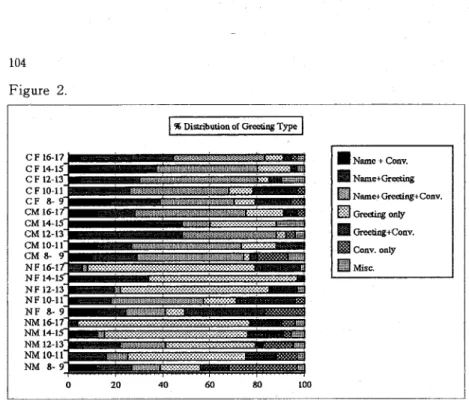
"ohayo': while only 11% of the American students limited themselves to conventional greetings. 40% of the Americans greeted their friend with his name, a conventional greeting, and some conversational speech, such as "Hi, Tom. Can I walk with you?" Only 10% of the Japanese students did this. (See Figure 2)
Figure 2.
CF 14-15:
C F 12-13:
CF 11
CF ~
CM 11 CM CM 12-13 CM CM 'J NF16-11 NF 14-1S:
NF NF NF 8- 9 NMl6-1 NM 14-IS:
NM NM 11 NM 8-'1
o 20
I
% Distribution of Greeting TypeI
40 60 80 100
• Name + Cony.
• Name+Greeting
IlililI
Name+Greeting+Conv.D
Greeting onlyI11III Greeting+Conv.
Im
Cony. only~Misc.
Name = calling the name. Conv. = conversational speech (e.g., Did you do your homework?) Greeting
=
conventional greeting (e.g., Hi). Misc.=
no response, nonsense talk, etc.2. 2. Responding to a compliment- "A new hair style"
Situation 2: You have just gotten your hair cut, and you like the new hair style very much. At school, your favorite teacher sees you and says, "It looks nice." What do you say?
As shown in Figure 3, there are significant differences between the responses of Japanese and American students. Most of the Americans (96%) responded with appreciation (that is, by saying, "Thank you"), while less than half of the Japanese students (47%) did so. 43% of the Japanese students denied the compliment, though younger students had less of a tendency to do
this than older ones, 20% of the 8 and 9-year-olds, as opposed to 54% of the 16 and 17-year-olds.
Figure 3.
CF CP CP CP CP CM CM CM CM CM NF NP NP NP NP NM NM NM NM NM
o
I
Frequencies of Compliment Response TypesI
100
% Distribution
200
• Appreciation
• Agreement
Il!lllI
Expnmation DDe.oial• Referent Shift
Appreciation
=
Appreciation token (e.g., Thank YOll. Thanks). Agreement=
Ad- dressee accepts the compliment and offers a relevant comment on the appreciated topic (e.g., I like it, too). Explanation = Addressee offers a comment on the complimented hair (e.g., I just got it cut). Referent Shift = The praise is shifted to the first speaker (e.g., Your hair looks nice, too). Denial = Negative opinion or Refusal (e.g., No, not at all). Since some students used more than one response type (e.g., Thank you very much. Your hair looks nice, too), total responses are beyond 100%There was also a difference between the responses of males and females. In both Nagano and Clearwater, girls were more likely to respond to a compliment with appreciation than boys, but the difference between the sexes was more marked among the Japanese than the Americans. (CF = 99%, CM = 93%, NF = 58% and NM = 36%.)
106
2. 3. 1. Requesting- "Borrowing a friend's notes"
Situation 3: You were absent from school yesterday. You would like to see your friend's notebook in order to know what they studied yesterday. How do you ask for the notebook?
Direct expressions such as "Nooto misete" (Let me see your notebook.) are found more frequently among Japanese students than American students.
(NM
=
56%, NF=
28%, CM=
17%, and CF=
4%) (See Figure 4) Figure 4.CF CF CF CF CM CM CM CM CM NF NF NF NF NF 8- NMl6-1 NM NM NM10-1 NM 8-
I
Directness Levels on Request: Borrowing a Friend's NotesI : :
! ,~:ii'!~'iili~iiil~iiiiiwi!iii'iiii!Iii~~
20 40 60 80 100
% Dislribution
• Hints
11
Conventionally IndirectiI
DirectDMisc.
Hints (e.g., What did you study yesterday?). Conventionally Indirect = Conventional Requests (e.g., May I see your notebook?). Direct = Imperative Mood (e.g., Let me see your notebook), Need/Want Statement (e.g., I need your notebook).
Figure 5.
I
ChllrllCtCrislic Expressions of Request: Borrowing a Friend's NotesI
o 10 20 30 40 so 60
95 Distribution
• please
11
excuse mem
for a minuteJapanese for "excuse me": sumimasenl waruikedol gomenne. "For a minute" includes
"for a second" or "for a moment".
As shown in Figure 5, Americans use "please" (CM
=
17%, CF=
34%),while Japanese do not use the equivalent Japanese "onegai" very much (NM
= 6%, NF = 6%). However, as a minimizer, Japanese females use "gomen"
(excuse me), (CM
=
1%, CF=
2%, NM=
7%, NF=
19%), and Japanese males use "chotto" (for a minute) (CM=
4%, CF=
1 %, NM=
22%, NF=
5%).
2. 3. 2. Requesting- "The Salt"
Figure 6.
I
Directness Levels on Requests: The SaltI
CF~6-1117 111
Cl' Cl' Cl' Cl' CM CM CM CM CM
NI'
NFI~1II111
NI' NI' NI' NM NM NM
NM . ,
NM 8-
o 20 40 60
!Ill Distribution
80 100
llHims
11
Conventionally IndirectIII
Dire<%8
Mise.Hints (e.g., Mother, where is the salt?). Conventionally Indirect = Conventional Requests (e.g., Would you please get me the salt?). Direct = Imperative Mood (e.g., Dad, get me the salt), Need/Want Statement (e.g., I need some salt).
Situation 7: There is no salt on the table at dinner. You want some salt, but you don't want to get it yourself. You want your mother (or your father) to get
it for you. How do you ask for the salt?
84% of the Americans used Conventionally Indirect forms, such as "Could you please get me the salt, Mom?" (See Figure 6)
76% of the American students included "please" in their request. Japanese requests were characterized by the use of direct expressions, such as "Shio totte" (Get me the salt), NM = 66%, NF = 53%. (See Figure 6) 22% of the boys added "chotto"(for a moment), and 19% of the girls added "waruikedo"
(excuse me, but ... ).
By comparing Situation 3: "Borrowing a friend's notes" and Situation 7:
"The Salt", it can be seen that Americans use politer language in speaking to their parents than to their friends, while Japanese speak to their parents with less polite language than to their friends.
2. 4. Apologizing-
"Thebroken pencil lead"
Situation 4: You have broken the lead of your friend's pencil. You don't have a pencil sharpener, so you are giving back the pencil with the broken lead. What do you say?
The most noticeable feature was the Japanese students' multiple express- ions of apology, e.g. "Gomen ... hontouni gomen" (I'm sorry, ... I'm really sorry). (NM = 19%, NF = 40%) American students rarely used multiple expressions of apology. (CM
=
2%, CF=
2%)Another characteristic difference was in the form of the verb "break".
Clearwater students were more apt to use the active voice, "I broke ... "
(80%), while about half of the Japanese students used the passive voice,
"orechatta" ( ... was broken). (See Figure 7)
no
Figure 7.
I_Ibrokeit _ It was broken lIt broke
I
CF
CM
NF
NM
0 20 40 60 80 100
% Distribution
Note: This distribution shows the usage of the word "break" in their expressions.
2. 5. Refusing- "An Unexpected Test"
Situation 5: Your teacher suddenly announces an unexpected examination.
You are not ready at all, so you don't want to take it today. It seems that the teacher is looking at you and wondering what to do about the test. You don't want to take the test today. What do you say?
Offers of Alternatives, such as "May I take the test tomorrow?" were common responses from both Nagano students and Clearwater students.
(Fig. 8) Differences were seen in the use of Hints, which were used more by Clearwater students (CM
=
13%, CF=
15%, NM=
6%, and NF=
2%)in avariety of strategic expressions, e.g., I'm sick. Can 1 go to the clinic? or Can I ask a lot of questions?
N agano students used Direct Refusal more often than Clearwater students (NM
=
36%, NF=
20%, CM=
19%, and CF=
11 %), and their express- ions were more emotional, such as "Jya da" (I don't like it). Clearwaterstudents used more logical expressions, such as "I don't want to take the test today, because you didn't give us enough time to study."
Males used more Direct Refusals; females used more Excuses. (See Fig. 8) Figure 8.
I
Frequency of Refusing Strategies on an Unexpected TestI
10 20 30 40 so
9Ii Distribution
• Dirett Refusal
• Excuse
III
Offer of Altenucive[]HinIs
Direct refusal (e.g., I don't want to take it). Excuse = Reason for refusal (e.g., I'm not ready for the test). Offer of Alternative = Promise of future acceptance etc. (e.g., May I take the test tomorrow?). Hints = Indirect attempts to dissuade (e.g., Can I make it up? or, I'm not feeling well. May I leave?). A person was likely to use two types (e.g., Excuse
+
Offer of Alternative: I'm not ready. Will you give us the test tomorrow?)2. 6. Apologizing- "Not Listening to the Teacher"
Situation 6: Your teacher asked you a question when you were thinking about something else. Since you haven't been listening, you can't answer it.
The teacher is waiting for your answer. What do you say to the teacher?
In this case, the N agano students admitted the fact that they had not been listening by saying, "Kiite imasen deshita"(I wasn't listening) (NM/F
=
55%,CM/F
=
36%). Clearwater students, on the other hand, more commonlyasked the teacher to repeat the question (CM!F
=
53%, NM/F=
39%).(See Fig. 9) Figure 9.
,---,
CF
CM
NF
NM
o 10
I
Apology or Request When Not Listening to the Teoch<rI
20 30 40
% Distribution
50 60
• ApoJogetic Formwa
III
Admission of FactIII
Asking Teacher to RepeatApologetic Formula: e.g., I'm sorry. Admission of Fact: e.g., I wasn't listening. Asking Teacher to Repeat: e.g., Could you repeat the question, please? Some students expressed both Admission of Fact and Asking Teacher to Repeat, such as "Can you repeat the question? I wasn't listening."
2. 7. Complaining- "Study Harder"
Situation 8: At the dinner table, your mother (or your father) says, "A high school student should study harder." Recently you are told the same thing every day. You don't want to be told to study harder any more. What do you say?
Nagano students' speech was characterized by Assertion
+
Obedience (NM=
18%, NF=
22%, CM=
4%, CF=
13%). Females used this strategy more than males in their respective countries. (See Fig. 10)Figure 10.
I
Complaint about Parents Pushing bimlher to StudyCF • Assertion
• Obedienoe
CM
IiII
Assertion + ObedienceNF [lMisc.
NM
o 20 40 60 80 100
% Distribution
Assertion = Assertion of offensive fact (e.g., I don't want to hear it any more), or Self· justification (e.g., I know what I'm doing). Obedience = Acceptance (e.g., OK.
I'll study harder). Assertion
+
Obedience (e.g., I will study harder, so don't tell me again).2. 8. Expressing gratitude- "Thanks for the gift"
Situation 9: On your birthday, your parents (or parent) give you a wonderful present which you have wanted for a long time. What do you say?
When receiving a birthday present, 46% of the Nagano male students said only a Ritual Thank You, such as "Arigatou" (Thank you) (NF
=
24%, CM=
18%, CF=
8%). American students were more likely to add a modifier to the Ritual Thank You, such as "Thank you so much" (CM=
35%, CF=
21 %, NM
=
14%, and NF=
7%).F or both Japanese and American girls, the most prevalent pattern was Thanking
+
Expressing Pleasure, e.g., "Thank you so much. I love it." (See Fig. 11)114 Figure 1l.
CF
CM NF NM
o 20
I
Th8l)kingfor a Birthday PresentI
40 60
96 Dis1riblllion 80 100
• Ritual Th8llk You Only
• Thank You witb Modifier
III
Tlumkil!g + Expressing Pleasurem
Expressing Pleasure Omy• Mise.
Ritual Thank You Only (e.g., Thank you/Thanks). Thank You with Modifier = (e.g., Thank you so much). Thanking
+
Expressing Pleasure (e.g., Thanks. It's just what I wanted). Expressing Pleasure Only (e.g., That's so sweet).2. 9. Making a statement- "My Future"
Situation 10: In class your teacher says, "I want all of you to tell me what you want to be in the future and why. If you don't know, please tell me about something you would like to do in the future." What do you say?
Nagano students hesitated to make statements about their own futures in public. One striking fact about the data was the high frequency of answers of
"I don't know" or "No comment" and future plans which required neither higher education nor talent among the Japanese students. However, younger Nagano students showed a closer frequency to Clearwater students than to older Nagano students. (See Fig. 12)
Figure 12.
o 20
I
Answering a Question about tbe FutureI
40 60
% Distribution
80 100
• Education orTalentRequired
III
Neither Required or No AnswerEducation or Talent Required = Future plan which requires higher education (e.g., a lawyer or a doctor) or talent (e.g., a musician or a professional baseball player).
Neither Required or No Answer = Future plan which requires neither higher education nor talent,
Or
no answer to offer in class (e. g., I don't know yeti No comment).3. Cultural Background
The Japanese tendency to use only conventional forms reflects the fact that a form works effectively in Japanese society. (Section 1: Greeting- "On the Way to School", Section 9: Expressing Gratitude- "Thanks for the Gift").
Correct use of a form or a formulaic expression in Japan is sometimes more important than its real content. It is very often that the form of greeting,
"Ohayo" (Good morning), or gratitude, "Arigatou" (Thank you) can be
sufficient and appropriate.
Since it is very important to be able to use the correct formulaic expression for each occasion in Japanese society, N agano students repeated their formulaic expressions of apology to show their sincerity and to make sure that the expression functiollE~d well, as in Situation 4: "The broken pencil lead".
Americans, on the other hand, have a tendency to add a variety of expressions to a formulaic expression. With them, Americans often try to develop the conversation into an opportunity to establish a solid relationship with the hearer.
As shown in Situation 2: Responding to a compliment- "A New Hair Style", Japanese etiquette dictates that one must be humble when receiving a compliment, that is, that one must make a slight refusal. In Japanese honorific expressions, which fit the vertical society, the speaker either raises the hearer or lowers himself. On the other hand, among the Americans, there is virtual unanimity that the prescriptively "correct" response to a compli- ment is "thank you" (Herbert, 1990), and their acceptance and show of appreciation facilitates further interchange and social interaction.
Behaving in a humble manner, one of the di~tinguishing characteristics of the Japanese, is a virtue and a form of politeness which is based on the vertical society. Generally speaking, there is unanimity among Japanese that it is appropriate to be humble in public, as in Situation 10: Making a statement- "My Future". On the other hand, Americans feel that it is appropriate to show their dreams and confidence to a certain extent, as long as they avoid self-praise.
The data show that the younger groups of N agano students do not seem to have acquired the ideal of humility, as seen in Situation 2: Responding to a compliment- "A New Hair Style" and Situation 10: Making a statement- "My Future".
There is a fundamental difference in the perception of compliments by women and men. Many researchers have recognized that, for females, compliments are positively affective speech acts, serving to increase or consolidate the solidarity between speaker and addressee (Holmes, 1988 and Herbert, 1990). Ide, et al. (1986) reports that the difference between Japanese males and females in responding to compliments is more marked than the difference between American males and females, a finding that agrees with the data presented in this report.
The level of directness used in Japanese depends on whom one is talking to. Japanese use direct, informal language to those who are inside their own group: family members, friends, or co-workers; they use formal language to those who are outside their group and in formal settings. Since both Situation 3: "Borrowing a friend's notes" and Situation 7: "The Salt" involve members of the speaker's "in" group, informal language was used. In making requests, Japanese students tend not to use the equivalent of "please", but they soften their requests with minimizers such as "chotto" (for a minute).
In an American family, parents tend to train their children to speak politely to them, so Clearwater students used "please" more often when asking their parent for the salt (73%) than when they asked their friend for the notebook (26%).
Concerning the use of the active and passIve vOIces of the verbs- Americans used the active voice and Japanese the passive voice (Section 4:
Apologizing- "The broken pencil lead") - Ando (1993) writes that in an English sentence, the actor is prominent because the structure is "actor- action". In a Japanese sentence, the actor is not often clearly identified, and the listener may sometimes feel that the action happened naturally. There is an interesting parallel between the use of the active voice in the English-speaking world, where emphasis is put on the individual, and the use of the passive voice in Japanese society, where group harmony is stressed
and people are more reserved.
Hints used by Clearwater students had a variety of strategic expressions (Situation 5: Refusing- "An Unexpected Test"), which indicates they are able to think of such a strategy freely and say it to the teacher without too many restrictions. Individualism and freedom, which American society value highly, support the variety of strategic expressions.
In Situation 6: Apologizing- "Not Listening to the Teacher", the Japanese students sometimes preferred to express a general feeling of discontent, such as "Jya da" (I don't like it), which is vague, without stating what and why, practically leaving the decision of what action to take entirely up to the teacher.
It may be said that Japanese are self-restrictive; American self-assertive.
In the situation 6: Apologizing- "Not Listening to the Teacher", Admission of Fact such as "I wasn't listening", may be a kind of taking of responsibility by admitting his or her own fault. In that sense, the percentage of Admission of Fact and Apologetic Formula shows a tendency toward regret or self-restriction, whereas Asking Teacher to Repeat shows a right-oriented, self-assertive tendency. The Japanese tendency of self-restriction is based on the Japanese group-oriented culture in which harmony is very important, and the American tendency of self-assertion is based on the idea of individualism, where an individual is expected to claim his or her rights, even in the classroom.
Nagano students showed Assertion
+
Obedience as a strategy (Section 8:Complaining "Study Harder"), where their words of Obedience such as
"Wakkatta" (I understood) may not be sincere, but may be used as a softener attached to Assertion. It could be said that generally females like to soften their assertions as much as possible.
When receiving a birthday present, females are a little more talkative than males (Situation 9: Expressing Gratitude- "Thanks for the Gift"). There is a
slight difference in the perception of recelvlllg a present by males and females; a present, for females, may be a positively affective interaction, serving to increase or consolidate the solidarity between the sender and the receiver, so they try to return a "verbal gift" (Herbert, 1990) for the present.
4. Concluding Comments
The data in this research showed some aspects of Japanese and American culture. The students in N agano tended to stick to conventional forms or formulaic expressions (Situations 1,4, and 9), to be humble (Situations 2 and 10), and they used inside, or informal, language to their friends and parents (Situations 3 and 7). Their tendencies could be explained by social and cultural views. The students in N agano live in a group-oriented, vertical society where harmony and formality are important. When a Japanese speaks, he faces two fundamental decisions. One is whether he is talking to members of his "in" group or "out" group. If he is talking to someone in his
"in" group, he is expected to absorb the feeling of the group and speak
"inside" language, which is relaxed and informal. If he is talking to someone outside of his group, he is expected to instantly figure out his position in the hierarchy and speak "outside" language, which is formal and uses appropri- ate honorific expressions.
The students in Clearwater had a tendency to express their opinions more freely in a greater variety of expressions (Situations 1,5,9, and 10), to be logical (Situation 5), and confident (Situation 10). They also showed a tendency to be self-assertive (Situation 6). They live in an equality-based society, where individualism, freedom and rights are very important. They value their own rights, such as freedom, so they pay attention to protecting the rights of others, in order to keep their own rights. They enjoy their freedom of speech, but care about politeness so they can avoid "face threatening acts" (Brown & Levinson, 1987).
The data also tells about age and sex variables. Younger Japanese did not show the humility which the older ones did (Situation 2), and they showed confidence and dreams, as the American students did (Situation 10). Both Japanese and American males of all ages were direct and frank (Situation 5).
Females generally were strategic (Situation 8) and talkative (Situation 9).
The outcome of a speech act is actually very complicated because not only do different nations have different cultures, but within one nation, people of different ages and sexes also have their own "cultures". We cannot overgeneralize the patterns of a national culture, because the reality may be different and it may lead to incorrect stereotypes. From a pedagogical point of view, it is good for learners to see a lot of actual data and the results of data analysis on actual communication to understand the similarities and differences for themselves. This type of study, which is necessary for the understanding of a foreign culture, can be both an enjoyable and informative part of their language study.
(This research was supported by a grant from the Ministry of Education in 1995. I would like to express my great thanks to the teachers in Clearwater, Florida, who helped with collecting the data.)
List of References
Ando, S. (1986). Eigo no riron • nihongo no riron (Theory in English' Theory in Japanese). Tokyo: Taishukan Shoten.
Azuma, S. (1994). Teineina eigo' Shitsureina eigo (Politeness Strategies).
Tokyo: Kenkyusha Shuppan.
Beebe, L., Takahashi, T., & Uliss-Weltz, R. (1990). "Pragmatic Transfer in ESL Refusals." In Scarcella. R., Adersen, E. & Krashen, S., eds., Developing Communicative Competence in a Second Language. New York;
Newbury House.
Blum-Kulka, S., House, ]. & Kasper, G. (1989). Cross-Cultural Pragmatics:
Requests and Apologies. N.].: Ablex
Brown, p. & Levinson, S. (1987). Politeness: Some universals in language usage.
Cambridge: Cambridge University Press.
Chiang, B. & Pochtrager, F. (1993). "A Pilot Study of Compliment Responses of American-Born English Speakers and Chinese-Born English Speakers." EDRS Document No. ED356649
Eisenstein, M. & Bodman, ]. (1986). "I very Appreciate: Expressions of Gratitude by Native and Non-native Speakers of American English,"
Applied Linguistics, Vo!. 7, pp. 167-185.
Fraser, B. (1990). "Perspectives on Politeness." Journal of Pragmatics 14, pp.
219-236.
Herbert, B. (1990). "Sex-based differences in compliment behavior." Lan- guage in Society 19, pp. 201-224.
Holmes, ]. (1986). "Compliments and Compliment Responses in New Zealand English." Anthropological Linguistics. 28(4), pp. 485-508.
Ide, S., et al. (1986). Nihonjin to amerikajin no keigo koudo (Politeness in Japanese and American). Tokyo: Nanundo.
Kasper, G. (1989). "Variation in interlanguage speech act realization." In Grass, S., Madden, C., Preston, D. & Selinker, L., eds., Variation in Second Language Acquisition: Discourse and Pragmatics. Clevedon: Multi- lingual Matters.
Kasper, G. (1990). "Linguistic Politeness: Current Research Issues."
University of Hawai'i Working Papers in ESL, Vo!. 9, pp. 1-33.
Kasper, G. & Blum-Kulka, S. (1993). Interlanguage Pragmatics. New York:
Oxford University Press.
Matsumoto, S. (1994). Nichibei bunka no tokushitsu (Distinguished Feature of Japanese and American Culture). Tokyo: Kenkyusha Shuppan.
Maynard, S. (1993). Kaiwa bunseki (Conversation Analysis). Tokyo:
122
Kuroshio Shuppan.
Takahashi, S. (1992). "Transferability of Indirect Request Strategies."
University of Hawai¥ Working Papers in ESL, Vo!.
IL
pp. 69-124.Takizawa, K. (1994). "Nichibei kokosei no kaiwa hikaku (A Comparative Study of Speech Acts of Japanese and American High School Students)." STEP BULLETIN Vo!. 6, pp. 112-125.
Takizawa, K. (1995). "Nichibei jidou seito no shousan ni taisuru hannou no hikaku (Comparison of Compliment Responses of American and Japanese Students)." JASTEC Journal No. 14, pp. 79-90.
Yamagishi, K. (1995). Nichiei gengo bunkaron ko (Aspects of J apanese- English Languages and Cultures). Tokyo: Kobian Shobo.