森︵三品︶聡美 MISHINA-MORI Satomi
Object Drop in English and Japanese Child Language: A Discourse-Pragmatic Account
幼児の英語ならびに日本語における 目的語の省略:談話語用論による説明
MISHINA-MORI Satomi
Key words: 目的語脱落、談話語用論、日本語、英語、縦断研究
object drop, discourse-pragmatics, Japanese, English, longitudinal study
Abstract
It has been suggested that object drop in English is largely governed by lexical learning, whereas discourse-pragmatics explains the alternation of null/overt objects in Japanese (e.g., O’Grady et al., 2008). This paper challenges this view by showing that both monolingual Japanese and English children observe discourse-pragmatic principles for referential choice when using objects in their respective languages. Year-long observational data of naturalistic mother-child interactions of two English and two Japanese monolingual children at early stages of development were drawn from the CHILDES corpus, and the relationship between the children’s referential choice and the discourse-pragmatic feature of the referent was analyzed.
The results revealed that from early stages of development, both Japanese- and English-speaking children showed sensitivity to the discourse-pragmatic features when selecting referential form: more of their null objects were in contexts where the referent was recoverable from the context (or given information), and ellipsis was found to be fewer in contexts in which referents were not easily recoverable from the context (new information).
The results contradict the view that early stages of object drop in English do not involve discourse-pragmatic considerations and call for further investigation of discourse-pragmatics of children’s referential choice in a variety of languages.
1. Introduction
Argument drop in children’s speech during the earliest stages of development is a well-documented phenomenon, regardless of whether the adult norm allows null arguments (e.g., Hirakawa, 1993; Nakayama, 1994; Guerriero et al., 2006 on Japanese;
Clancy, 1993, 1997; Kim, 2000 on Korean; Bloom, 1990, 1993; Valian, 1990; Hyams &
Wexler, 1993; Guerriero et al., 2006 on English). Observe the following examples of typical null subjects and objects in Japanese and in English:
(1)
a. Ø miruku nonda.
( I ) milk drink-PAST
1)I drank milk.
b. boku Ø nonda.
c. Ø Ø nonda.
(2)
a. Ø want milk.
b. I want Ø.
Diff erent approaches have been made to explain this phenomenon (see Guerriero et al., 2006 for an extensive review), but the latest body of research seems to suggest that the discourse-pragmatic approach is the most promising framework to explain the alternation of arguments. This view originated from the robust fi ndings in adult native speaker discourse studies, which mainly looked at narratives, that their referential choice is governed by discourse-pragmatic principles (Chafe, 1994; Du Bois, 1987; Givon, 1983).
More specifi cally, the referential form (e.g., lexical, pronominal or null) is determined by the information status of the referent: if the referent was fi rst introduced to the discourse having a high informative value (new information) or if it has already been referred to in the discourse and, thus, has less informative value (given information). New information tends to be in lexical form, and given information is likely to occur in pronominal form in overt argument languages and in null form in languages that allow arguments to be dropped.
The success in explaining the alternation of referents using the concept of
informative value of referents in adult discourse has led some researchers to further
hypothesize that this phenomenon can also explain the null phenomenon in child speech
(Allen, 2000; Clancy, 1993, 1997; Guerriero et al., 2006). For example, Clancy (1997)
supported this view by examining the relationship between the referential forms (ellipsis,
pronouns, and lexical nouns) and several discourse factors in two Korean children. She
森︵三品︶聡美 MISHINA-MORI Satomi
found that given information tended to be expressed in ellipsis, whereas referents that had informative value, such as newly introduced information or referents that were intended to show contrast or emphasis, were expressed in lexical forms. Along the same lines, Allen (2000) also provided strong evidence for the relationship between informative features of the referent and referential forms, drawing on four two-year-old children acquiring Inuktitut. Guerriero et al. (2006) and Mishina-Mori (2012), both of whom investigated Japanese and English children, also showed that children tend to show sensitivity to discourse-pragmatics when selecting referential forms; language universal principles (i.e., lexical forms to express new information and non-lexical forms to express given information) and language specifi c principles (i.e., non-lexical forms consist mainly of null forms in Japanese, whereas they are mostly pronouns in English) are observed by the time children turn three.
The majority of studies on argument drop as summarized above have focused on subject drop only (e.g., Valian, 1990; Hymes & Wexler, 1993) or have combined subjects and objects together (e.g., Clancy, 1993, 1997; Guerriero et al., 2006), but few have focused specifi cally on object drop. A number of studies that dealt with object drop have proposed that in English, it is largely governed by one-by-one lexical learning from the input (Rispoli, 1992; Ingham, 1993; Theakston et al., 2001), whereas discourse-pragmatics explains the alternation of null/overt object in Japanese (O’Grady et al., 2008). The rationale behind the former argument is that object drop in child English is observed far more frequently with verbs that allow both transitive and intransitive readings than with verbs that are obligatorily transitive, which is assumed to be a refl ection of the properties of the caregiver’s speech. For example, children would drop signifi cantly more objects with transitive verbs that allow intransitive reading when the object can be understood as some generic entity (e.g., eat, read) than with those that do not allow such options. Thus, they argue that object drop is fundamentally a lexical phenomenon. However, no such relationship is found in object drop in Japanese (O’Grady et al., 2008), and they further show that Japanese null objects are governed solely by discourse-pragmatic considerations.
Although there seems to be fi rm evidence to prove that lexical learning occurs in the development of child English, the possibility that discourse consideration is also involved is not excluded. It would be misleading to maintain that English object ellipsis in the early stages of development is solely lexical in nature when they have not examined the discourse-pragmatic context of the English null objects. If we assume that young children, whatever their fi rst language may be, are sensitive to the discourse-pragmatic context, then discourse may also be an accounting factor for their null objects.
The purpose of the current study is, therefore, to examine whether discourse-
pragmatics plays a role in the referential choice of objects in both English and Japanese children’s speech. We examine the relationship between null objects and the information status of the referent to see if null objects in both English and Japanese tend to occur when the referent is recoverable from the context or given information. Below is a brief description of the basic characteristics of object drop in English and Japanese.
2. Object drop in English and Japanese
In English, both subjects and objects must, in principle, be realized, and null forms are restricted to specifi c contexts in adult grammar. Observe the examples below:
(3)
a. She wrote a letter.
*b. Ø wrote a letter.
*c. She wrote Ø .
As shown in the following example, however, null objects are possible when the transitive verb also allows intransitive use when the object is referring to a generic entity.
(4)
a. What’s he doing?
He’s eating Ø.
b. Where are the cookies that I bought yesterday?
*He’s already eaten Ø.
In (4) a., the person having a meal is being referred to; thus, eat can be used without an overt object. However, in (4) b., the specifi c cookies are referred to, meaning it must be mentioned in overt form.
In child English, it has been reported that children initially omit objects that are necessary in adult grammar, such as the object that has a defi nite referent (i.e., as in example (4) b.), but gradually unlearn the rule and begin to show sensitivity to the defi nite/generic diff erence. Rispoli (1992) traced the development of object use in 40 English monolingual children from 1;0 to 3;0 and found that in the earliest stages, children drop objects when they are necessary, but after turning two, their omission approximates target-like usage, limiting the null forms to objects with generic referents.
Japanese grammar shows a stark contrast with that of English in this respect—both
subjects and objects can be dropped if the referent has already been introduced to the
discourse context.
森︵三品︶聡美 MISHINA-MORI Satomi
(5)
a. Ken wa booru wo ketta.
Ken-TOP ball-ACC kick-PAST b. Ø booru wo ketta.
c. Ken wa Ø ketta.
O’Grady et al. (2008) examined if there is a relationship between object omission and the type of verbs as observed in English, concluding that there is not and that Japanese object drop is best explained by the recoverability of the referent or information status.
3. Research questions
The current study addresses the following research question: Can the discourse- pragmatic principles for referential choice account for the use of objects at diff erent stages of development in monolingual children acquiring English and Japanese? More specifi cally, this study asks the following questions: 1) Do children drop objects more often for given information than new information? (i.e., are objects dropped more frequently when it is recoverable from the context?); 2) Are there any developmental trends observed in the use of object drop?
It is predicted that both English and Japanese children will show sensitivity to the discourse-pragmatic context. More specifi cally, children will alternate between diff erent referential forms (null and overt objects) according to discourse-pragmatic features, regardless of the language they are acquiring: more null objects will be used for given information (i.e., the referent is recoverable from the context) compared to those used for new information (i.e., the referent is non-recoverable from the context). Furthermore, it is expected that sensitivity may be absent in the earliest stage but will emerge as children develop their overall language abilities.
4. Method 4. 1. Subjects
Longitudinal data of two English-speaking and two Japanese-speaking children were drawn from the CHILDES corpus (MacWhinney, 1995). The English children studied are Sarah and Eve (Brown, 1973), and the Japanese children are Aki and Ryo (Miyata, 1995).
All the data involve naturalistic interaction between the child and his/her caregiver(s).
Because one of the main purposes of this study is to observe the developmental changes
in the use of objects in these children, data fi les were selected from the corpus based on
the children,s MLU, so that the data would involve three stages defi ned by MLU: Stage 1
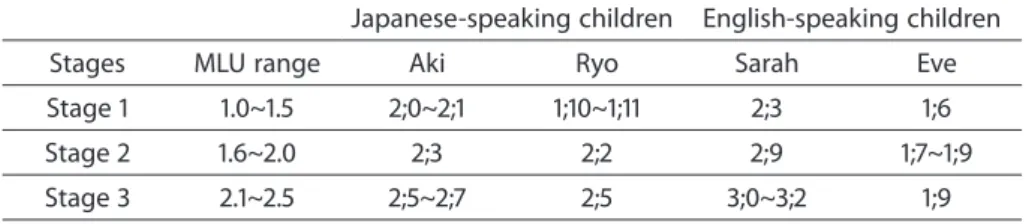
MLU 1.0-1.5; Stage 2 MLU 1.5-2.0; Stage 3 MLU 2.0-2.5. Each stage consists of two to three data fi les per each child. The biological ages of the children varied to some extent at each stage: Stage 1 1;6 to 2;3; Stage 2 1;7 to 2;9; and Stage 3 1;9 to 3;2. Table 1 summarizes the subject information.
4. 2. Coding and analysis
To count the number of null and non-null objects in the children’s data, Matsuoka et al.’s coding scheme, which was created based on CHAT conventions (MacWhinney, 1995), was adopted. The children’s utterances that contained verbs were coded for 1) the grammatical status of the argument in focus (Subject or Object), although the subjects were excluded from the current analysis; 2) the argument form of each object (Null, Pronominal, and Lexical); 3) the information status of the argument (New or Given information); and 4) the verb type (Transitive or Intransitive). We adopted Guerriero et al.’s (2006) criteria to diff erentiate between new and given information: if the referent appeared in the discourse for the fi rst time or 20 or more turns after the previous appearance within the same discourse, then it was coded as new information; however, if the referent had already been introduced to the discourse, then it was coded as given information. Also following Guerriero et al. (2006), fi rst- and second-person pronouns (I, you, we) were always coded as given information. The frequencies of null, pronominal, and lexical forms in reference to new information and given information for each child were counted using the CLAN programs (MacWhinney, 1995).
5. Results
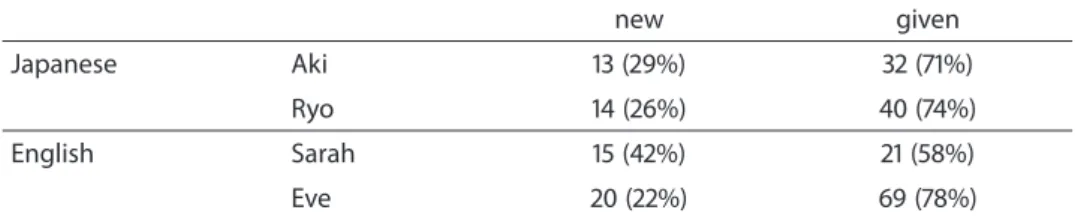
The fi rst analysis concerns the general tendency regarding the relationship between referential choice and information status of the referent across time. The number of occurrences and the proportions of null objects with reference to new and given information out of all the occurrences of null objects were calculated for each child with all stages combined and are presented in Table 2.
As is evident from the table, null objects were used to express given information
Japanese-speaking children English-speaking childrenStages MLU range Aki Ryo Sarah Eve
Stage 1 1.0~1.5 2;0~2;1 1;10~1;11 2;3 1;6
Stage 2 1.6~2.0 2;3 2;2 2;9 1;7~1;9
Stage 3 2.1~2.5 2;5~2;7 2;5 3;0~3;2 1;9
Table 1. Ages of subjects at each stage
森︵三品︶聡美 MISHINA-MORI Satomi
more frequently than to express new information in the data for all children. Though the ratio was lower in Sarah (58%), Aki, Ryo, and Eve dropped objects when the referent was given information more than 70% of the time (71%, 74%, and 78%, respectively), meaning that null forms were produced predominantly in recoverable contexts. The data, therefore, indicate that the children diff erentiated the discourse-pragmatic context and selected referential form (null or overt) according to the context, regardless of the language they were acquiring. Thus, the current results confi rm our prediction: both English- and Japanese-speaking children show sensitivity to the discourse-pragmatic context in their use of null objects.
It should be noted that the ratio of null forms with reference to given information was clearly lower in Sarah’s data compared to the other three children. We infer that this result is because she was using more pronominal forms than null forms to express given information, which is closer to the adult norm in English. Table 3, which shows the ratio of null vs. pronominal forms with reference to given information in English-speaking children, illustrates this point. Sarah’s reference to given information is skewed to the use of pronominal forms (85%), whereas the proportion of null forms is still quite high in Eve’s data. It has been reported that English-speaking children would fi rst produce null forms but gradually approximate adult grammar, and at approximately age three, argument drop, whether subject or object, would be replaced by pronouns to express referents that were already introduced into the discourse (Guerriero et al., 2006). Sarah was almost three at Stage 2, so she must have reached the stage of unlearning the null forms and acquiring the use of pronouns, which is grammatically correct in English. A diff erent tendency was observed in Eve, which may be because she was younger, not having reached two during the period of observation, despite her high MLUs.
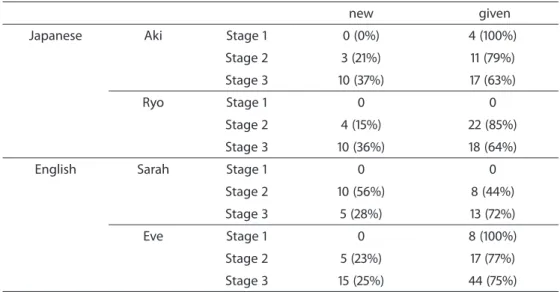
We now turn to the analysis of developmental trends in the use of null objects in each child. The proportion of null objects used in newly introduced contexts and those used in given contexts out of all occurrences of object ellipsis at the three diff erent stages are tabulated for each child in Table 4.
The data reveal that for all four children, there are very few occurrences of null objects at Stage 1. This fi nding is not surprising, as at Stage 1, the MLU range was
new given
Japanese Aki 13 (29%) 32 (71%)
Ryo 14 (26%) 40 (74%)
English Sarah 15 (42%) 21 (58%)
Eve 20 (22%) 69 (78%)
Table 2. The number of occurrences and ratio of null objects in new and given contexts
between 1.0 and 1.5, that is, roughly at the one-word stage, meaning that the production of verbs would be infrequent. From Stage 2 on, all children began using transitive verbs, and in both stages, three out of four children produced null objects in recoverable contexts far more frequently compared to non-recoverable contexts. The ratio of object ellipsis produced in given contexts was about or more than double the ratio of the null forms produced in non-recoverable contexts: for example, Aki’s object drop totaled 79%
for given information but 21% for new information at Stage 2 and totaled 63% vs. 37% at Stage 3. As was the case in the former analysis, Sarah was an exception, which is most likely because her pronoun use for given information, which is the adult norm in English, began to develop at Stage 2. Considering the fact that pronoun use is reported to emerge at approximately age three, as the use of ungrammatical null forms gradually disappears in English monolingual children (Guerriero et al., 2006), it is no wonder that Sarah, who was 2;9 at Stage 2, would choose pronominal forms, rather than null forms, to express given information. Eve, however, was still using null forms predominantly in given contexts, which may be explained by the fact that she was still one-year-old at Stages 2 and 3, although her MLU developed to be over 2.0.
null pronominal
Sarah 21 (15%) 122 (85%)
Eve 69 (43%) 90 (57%)
Table 3. The ratio of null vs. pronominal forms with reference to given information in English-speaking children
new given
Japanese Aki Stage 1 0 (0%) 4 (100%)
Stage 2 3 (21%) 11 (79%)
Stage 3 10 (37%) 17 (63%)
Ryo Stage 1 0 0
Stage 2 4 (15%) 22 (85%)
Stage 3 10 (36%) 18 (64%)
English Sarah Stage 1 0 0
Stage 2 10 (56%) 8 (44%)
Stage 3 5 (28%) 13 (72%)
Eve Stage 1 0 8 (100%)
Stage 2 5 (23%) 17 (77%)
Stage 3 15 (25%) 44 (75%)
Table 4. The number of occurrences of null objects in new and given contexts at each stage
森︵三品︶聡美 MISHINA-MORI Satomi
Thus, the data indicate that the children discriminated discourse context and dropped objects accordingly from the earliest stage of transitive verb production, a tendency that continued at Stage 3.
6. Discussion
The current results revealed that from the early stages of development, both Japanese- and English-speaking children showed sensitivity to the discourse-pragmatic context when selecting referential form: more of their null objects were used with reference to given information compared to those used with reference to new information. The results, thus, question the view that the early stages of object drop in English are mainly governed by lexical learning and do not involve discourse-pragmatic considerations (e.g., Rispoli, 1992; O’ Grady, et al., 2008). It is beyond the scope of the current study to question lexical learning itself, as it does not directly test the hypothesis, but our data suggest that children’s selection of referential form in object position can be explained by discourse motivations.
Our data also suggest that English-speaking children exhibit sensitivity to discourse- pragmatic contexts even before the use of pronominal forms are established, which is said to occur when children turn three. Eve, who was not yet two, used null objects far more frequently in recoverable contexts than in non-recoverable contexts. Previous studies suggest the opposite. For example, Guerriero et al. (2006) argued that monolingual English children did not show such sensitivity before turning two, but by the time they were three, they began using diff erent referential forms discriminately according to the context. Their argument, however, was based on whether children followed the universal discourse-pragmatic principle, that is, whether children were likely to use non- lexical forms (in the case of English pronominal forms) for given information and lexical forms for new information. The current results suggest that if we focus on the use of null forms, which are persistently used until children reach a certain age, in new vs. given contexts, we may observe children’s sensitivity to discourse-pragmatic contexts. If we consistently fi nd that English-speaking children tend to drop objects when they are recoverable from the context more often than when they are not, such data would constitute clear evidence that discourse-pragmatic principles are at work in very young children. This phenomenon is particularly interesting because it can be interpreted as a pure refl ection of children’s sensitivity to discourse-pragmatic principles and not a refl ection of the input, as null objects are ungrammatical in adult grammar and, thus, such skewed use is not likely to be present in the input.
In conclusion, the current fi ndings support the view that discourse-pragmatics can
account for the referential choice in object position in children acquiring both English and Japanese. Further research must be conducted on the role that discourse-pragmatic considerations play in languages such as English, where null arguments are ungrammatical and the involvement of discourse is, thus, likely to be overlooked.
Additional investigation into discourse-pragmatics of children’s referential choice in a variety of languages would shed light on the mechanism of referential choice and the acquisition process of arguments.
Note
1) The abbreviations used in the gloss in the current paper are as follows: Ø = omitted argument; ACC = accusative case marker; TOP = topic case marker; PAST= past tense marker.
References
Allen, S. (2000). A discourse-pragmatic explanation for argument representation in child Inuktit. Linguistics, 38, 483-521.
Bloom, P. (1990). Subjectless sentences in child language. Linguistic Inquiry, 21, 491-504.
Bloom, P. (1993). Grammatical continuity in language development: the case of subjectless sentences. Linguistic Inquiry, 24, 721-34.
Brown, R. (1973). A fi rst language: The early stages. Cambridge, MA: Harvard University Press.
Clancy, P. (1993). Preferred argument structure in Korean acquisition. In Eve V. Clark (Ed.), Proceedings of the Twenty-fi fth Child Language Research Forum (pp. 307-314). Stanford, CA:
CSLI Publications.
Clancy, P. (1997). Discourse motivations for referential choice in Korean acquisition. In H. Sohn
& J. Haig (Eds.), Japanese/Korean linguistics, vol.6 (pp.639-659). Stanford, CA: CSLI Publications.
Chafe, W. L. (1994). Discourse, consciousness, and time: The fl ow and displacement of conscious experience in speaking and writing. Chicago: The University of Chicago Press.
Du Bois, J. W. (1987). The discourse basis of ergativity. Language, 63, 805-855.
Givon, T. (1983). Topic continuity in discourse: an introduction. In J. H. Greenberg & T. Givon (series eds.) & T. Givon (vol. ed.), Typological studies in language: Vol.3 Topic continuity in discourse: A quantitative cross-language study. Amsterdam: John Benjamins Publishing.
Guerriero, A. M. S., Oshima, Y. T., & Kuriyama, Y. (2006). The development of referential choice in English and Japanese: A discourse-pragmatic perspective. Journal of Child Language, 33(4), 823-857.
Hirakawa, M. (1983). Null subjects versus null objects in an early grammar of Japanese. McGill Working Papers in Linguistics, 9, 30-45.
Hyams, N. M. & Wexler, K. (1993). On the grammatical basis of null subjects in child language.
Linguistic Inquiry, 24, 421-59.
森︵三品︶聡美 MISHINA-MORI Satomi Ingham, R. (1993). Input and learnability: direct-object omissibility in English. Language
Acquisition, 3, 95-120.
Kim, Young-Joo. (2000). Subject/object drop in the acquisition of Korean: A cross-linguistic comparison. Journal of East Asian Linguistics, 9(4), First Language Acquisition of East Asian Languages, 325-351.
MacWhinney, B. (1995). The CHILDES project: Tools for analyzing talk. (second edition). Hillsdale, NJ: Lawrence Erlbaum Associates Publishers.
Matsuoka, K., Mishina-Mori, S., & Sugioka, Y. (2008). Discourse-Pragmatic Analysis of Subjects in Japanese/English Bilingual Children’s Speech. Paper presented at Conference on Bilingual Acquisition in Early Childhood. The Chinese University of Hong Kong. December 12.
Mishina-Mori, S. (2012). A discourse-pragmatic analysis of referential choice in English and Japanese monolingual children: A longitudinal study. Language, Culture, and Communication: Journal of the College of Intercultural communication, 4, 35-49.
Miyata, S. (1995). The Aki corpus---Longitudinal speech data of a Japanese boy aged 1;6-2;12.
Bulletin of Aichi Shukutoku Junior College, 34, 183-191.
Nakayama, M. (1994). Null arguments in Japanese children’s speech. MIT Working Papers in Linguistics, 24, 247-61.
O’Grady, W., Yamashita, Y., & Cho, S. (2008). Object drop in Japanese and Korean. Language Acquisition, 15: 58-68.
Oshima-Takane, Y. & MacWhinney, B. (1995). CHILDES manual for Japanese. Montreal: McGill University.
Rispoli, M. (1992). Discourse and the acquisition of eat. Journal of Child Language, 19, 581-595.
Theakston, A., Lieven, E., Pine, J., & Rowland, C. (2001). The role of performance limitations in the acquisition of verb-argument structure: An alternative account. Journal of Child Language, 28, 127-152.
Valian, V. (1991). Syntactic subjects in the early speech of American and Italian children.
Cognition, 40, 21-81.