国際化推進共同研究概要
No.1
20EA-1
タ イ ト ル: Dynamical mechanisms of stratospheric control on the tropical troposphere and ocean
研究代表者: UEYAMA Rei 所内世話人: 江口 菜穂 研究概要: ここ数 10 年間で西アフリカのサヘル域で顕著な降水現象が増加している。この 降水トレンドのメカニズムを知るために、客観解析データ(JRA55)と衛星デ ータから導出した熱帯対流圏界面に到達する積雲対流活動、およびメソ スケール規模の対流活動の指標を用いて、解析を行った。西アフリカ上 空では、対流圏は温暖化、下部成層圏は寒冷化していた。この傾向は温 室効果ガスによる影響と一致するが、大西洋からの下層の水蒸気輸送に よる降水トレンドとは合致しない。背の高い積雲対流が活発となったサヘ ル域の上層では、気温の鉛直勾配が減少する一方、ギニア沿岸では対 流圏が温暖化し、背の低い積雲活動が活発となっていた。西アフリカ域の 降水トレンドの特徴は、成層圏循環場によって駆動された背の高い積雲 対流活動に起因していることが示唆された。
Dynamical Mechanisms of Stratospheric Control on the Tropical Troposphere and Ocean Rei Ueyama (NASA Ames Research Center) I. Abstract Extreme precipitation events in the Sahel region of West Africa have become more frequent over recent decades. We investigated the mechanism behind this recent precipitation trend using a combination of JRA-55 reanalysis, satellite precipitation measurements, and convection diagnostics including observations of tropical overshooting clouds and mesoscale convective systems. We found that the recent changes over West Africa involve a cooling of the tropical lower stratosphere and tropopause layer, and a warming in the troposphere. This feature is similar to that which might result from increased greenhouse gas levels, but is distinct from the interannual variation of precipitation associated with the modulation of water vapor transport from the Atlantic Ocean. We suggest that the decrease in the vertical temperature gradient in the tropical tropopause region enhances extreme deep convection over the Sahel, where penetrating convection is frequent, whereas tropospheric warming suppresses the shallower convection over the Guinea Coast. The essential characteristic of the recent changes over West Africa is therefore the depth of convection, rather than the total amount of surface precipitation, which is largely driven by stratospheric forcing. II. Introduction West Africa is particularly susceptible to the impacts of climate change, with significant changes in the precipitation regime likely to occur over the next few decades (Gaetani et al., 2020). Assessing the role of the tropical tropopause layer (TTL; around 140–70 hPa) in driving precipitation trends is a valuable step towards improving our understanding of the present and future evolution of West African rainfall regimes. Kodera et al. (2019) found that extreme deep convection in the ascending branch of the boreal summer Hadley circulation became active over recent decades, particularly over the African and Asian sectors. In West Africa, this increase in convective activity was associated with the recent recovery of rainfall over the Sahel following the long and severe drought conditions of the 1970s and 1980s. However, the recent increase in precipitation over the Sahel is not a simple recovery to the former wet state: The characteristics of rainfall have also changed, becoming more intense and intermittent. The analysis of mesoscale convective systems (MCSs) with cold cloud top temperatures (Taylor et al., 2017) corroborates the increasing intensity of deep convection over West Africa. Kodera et al. (2019) also note that the recent increase in tropical extreme deep convection occurred in association with a cooling of the tropical lower stratosphere, suggesting the possible role of TTL processes in the recent precipitation increase over the Sahel. In this study, we demonstrate the importance of TTL processes in driving precipitation trends in West Africa.
III. Method/Data We analyzed JRA-55 reanalysis data, surface precipitation measurements from Global Precipitation Climatology Project (GPCP), and deep convection diagnostics based on satellite observations of tropical overshooting clouds (COV). Our results are compared with occurrence frequencies of MCSs over the Sahel obtained by Taylor et al. (2017). Preliminary analyses of satellite-derived convective cloud top altitudes (Pfister et al, 2021) were also used to corroborate the tropical convective overshooting cloud data. Our approach for calculating the convective cloud top altitudes is based on the assumption that rainfall, properly thresholded, can define the area where convection is occurring. These rainfall data, coupled with the infrared satellite information, can then define both the regions where the mass-transporting convective cores occur, and their altitude. IV. Results Precipitation during the summer monsoon season of July, August, and September (JAS) from the 1980s to the present increased over the Sahel (15°W‒ 20°E, 12.5°N‒17.5°N; Fig. 1c), but decreased over the Guinea Coast (15°W‒20°E, 2.5°N‒7.5°N; Fig. 1d). As such, surface precipitation does not exhibit a clear trend when averaged over the entire West African region (15°W‒20°E, 2.5°N‒ 17.5°N; (Fig. 1e). A decreasing precipitation trend is particularly pronounced over the coastal regions west of the Guinea Highlands and South Cameroon Plateau (Fig. 1b). Over these elevated terrains, convergence of the air from the ocean results in heavy precipitation (Fig. 1a). Since convection over the coastal region is generally not deep enough to penetrate into the TTL, uplifted air diverges in the upper troposphere. In contrast, an increasing precipitation trend is found further inland in regions of high equivalent potential temperature near the surface, where extreme deep convective clouds with overshooting tops occur. This extreme deep convection over Sahel is also evident in the large horizontal divergence at higher levels in the TTL. These results suggest that the regional differences in recent precipitation trends (Fig. 1b) may arise from differences in convective activity. In particular, precipitation increased where extreme deep convection occurs frequently, but decreased where convection is relatively shallow. This implies the important role of the depth of convection in precipitation changes over the last few decades.
Figure 1: (a) Climatological mean surface precipitation over West Africa during JAS and (b) its linear trend over the period 1979–2018. (c, d, and e) Time series of JAS mean precipitation averaged over (c) the Sahel, (d) the Guinea Coast, and (e) West Africa. Lines and numbers indicate linear trend (mm/day/decade). Regions within West Africa are indicated by dotted lines within the brown box in (a). Latitudinal differences between the two regions can clearly be seen in the meridional cross-section of JAS mean standardized temperature and vertical velocity anomalies shown in Figure 2. Although cooling in the TTL occurred over a wide range of latitudes, upwelling in the troposphere was enhanced only over the Sahel. This suggests that TTL cooling impacts only those regions where upwelling extends from the upper troposphere to the TTL (i.e., about 200 to 140 hPa), as indicated by the climatological divergence field (dotted lines). Figures 2b and 2c show the evolution of standardized COV frequencies during the period 2001–2018. The mean occurrence frequency of COV over the Sahel is 4.4 ‰, which is four times as large as that over the Guinea Coast. There is an increasing trend superimposed on the year-to-year variability in the COV occurrence frequency over the Sahel, which matches the evolution of MCSs with a cloud top temperature < −70°C reported by Taylor et al. (2017). In contrast, the COV occurrence frequency over the Guinea Coast exhibits a decreasing trend.
Figure 2: (a) Meridional cross-section of mean standardized anomalies for JAS 2000–2018 over the Sahel (15°W–20°E). Temperature and pressure vertical velocity are shown by color shading and contour lines, respectively. Climatology of the horizontal divergence is shown by dotted lines. (b, c) Standardized JAS mean COV occurrence frequency from 2001 to 2018 over (b) the Sahel and (c) the Guinea Coast. These two regions are indicated by the arrows along the x-axis of (a). Blue lines in (b) indicate the standardized JAS mean MCSs with cloud top temperature below −70°C from Taylor et al. (2017). Scale for the MCS is given on the right-hand side. V. Discussion/Summary The different precipitation trends seen over the Sahel and Guinea Coast can be interpreted as a result of the differences in the depth of convective clouds in the two regions. Penetrating deep convection over the Sahel is susceptible to temperature changes in the TTL and thus increases in response to TTL cooling. In contrast, convective activity over the Guinea Coast is not influenced by cooling in the TTL, but rather suppressed by warming in the troposphere. Therefore, the observed changes in TTL temperatures have led to an increasing precipitation trend over the Sahel, while it led to a decreasing precipitation trend over the Guinea Coast. To better understand the details of the stratosphere‒troposphere coupling process, we will investigate the coupling process as depicted in convective cloud top data (Pfister et al., 2021) in a future study. Specifically, the 0.25° longitude/latitude resolution, 3-hourly cloud top data will be useful for illustrating the time evolution of deep convective activity over a given region (e.g., Africa) in response to stratospheric forcing. In this study, we analyzed vertical velocity and divergence data from the JRA-55 reanalysis. However, vertical velocity is not an observed variable and depends strongly on the model (i.e., the cumulus parametrization) used for the reanalysis. This is especially true in the TTL, where there is little observational data available. Preliminary analysis of the European Centre for Medium-Range
Weather Forecasts reanalysis data (ERA Interim and ERA 5) indicates that there is no clear increasing trend in the vertical velocity in the TTL over the Sahel. Further detailed verification of the reanalysis data is needed. VI. References Gaetani, M., S. Janicot. M. Vrac, A.M. Famien, and B. Sultan, 2020: Robust assessment of the time of emergence of precipitation change in West Africa. Sci. Rep., 10, 7670. https://doi.org/10.1038/s41598-020-63782. Kodera, K., N. Eguchi, R. Ueyama, Y. Kuroda, C. Kobayashi, B.M. Funatsu, and C. Claud, 2019: Implication of tropical lower stratospheric cooling in recent trends in tropical circulation and deep convective activity. Atmos. Chem. Phys., 19, 2655-2669, doi:10.5194/acp-19-2655-2019. Pfister, L., Ueyama R., Jensen E., and Schoeberl, M., 2021: A method for obtaining high frequency, global, IR-based convective cloud tops for studies of the tropical tropopause layer, in preparation. Taylor CM, D. Belušić, F. Guichard, D.J. Parker, T. Vischel, O. Bock, P.P. Harris, S. Janicot, C. Klein, and G. Panthou, 2017: Frequency of extreme Sahelian storms tripled since 1982 in satellite observations. Nature 544(7651): 475–478. doi: /10.1038/nature22069. VII. List of Publications and Selected Presentations • Kodera, K., Eguchi, N., Ueyama, R., Funatsu, B., Gaetani, M., and Taylor, C. (2021), The impact of tropical tropopause cooling on Sahelian extreme deep convection, J. Meteor. Soc. Japan, in review. • Ueyama, R., E. Jensen, M. Krämer, L. Pfister, and M. Schoeberl (2020), Impact of convectively-detrained ice crystals on the humidity of the tropical tropopause layer during boreal winter, PIRE-CIRRUS seminar. (oral) • Ueyama, R., E. Jensen, and L. Pfister (2020), Convective impact on the stratospheric-entry water vapor through the tropical UTLS in boreal winter and summer, American Geophysical Union Fall Meeting 2020. (oral) • Ueyama, R., E. Jensen, and L. Pfister (2020), Convective impact on the stratospheric-entry water vapor through the tropical UTLS in boreal winter and summer, American Meteorological Society Meeting 2021. (oral) VIII. Research meeting and discussion Several virtual meetings with Rei Ueyama, Nawo Eguchi, and Kunihiko Kodera Discussion topics: • Relationship between sudden stratospheric warmings and typhoons • JRA55 vs. ERA5 differences (e.g., omega trend at 150 hPa over Sahel) • Update on ongoing research projects by each member of our group • Future research topics to pursue together
IX. Additional information Rei Ueyama has been on a reduced (75%) work schedule since March 2020 due to COVID-19 caregiving of two young children at home. Schools in San Mateo County, California, USA still remain closed. NASA has granted excused leave to employees with COVID-19 caregiving responsibilities. Due to this unprecedented circumstance, work capacity has been severely limited. All travel is still restricted so meeting in person was not possible this past year. However, we have maintained communication via email and virtual meetings. X. Members Rei Ueyama NASA Ames Research Center Nawo Eguchi RIAM, Kyushu University Kunihiko Kodera Meteorological Research Institute
国際化推進共同研究概要
No.2
20EA-2
タ イ ト ル: Turbulent mixing in the Kuroshio Current off Taiwan
研究代表者: JAN Sen
所内世話人: 遠藤 貴洋
研究概要:2018 年に開始された、国際化推進共同研究「Turbulent mixing in the Kuroshio current off Taiwan」では、昨年度に引き続き九州大学応用力学研究所にて研 究集会を開催する予定であったが、コロナ禍のためオンラインで実施せざるを得なかった。そ れにも関わらず、海外から 5 名、日本から 15 名が参加し、黒潮が海山を乗り越えることで生 じる強い乱流混合の時空間変動の解明を進めていく上で、有意義な国際研究集会となった。 この共同研究の成果をもとに、国際誌へ論文 2 編が投稿された。
Report on 2020 RIAM International Joint Research Project
Turbulent mixing in the Kuroshio current off Taiwan
JAN, Sen (Institute of Oceanography, National Taiwan University)
Objective
Turbulent mixing in the ocean controls transport of heat, freshwater, dissolved gasses, and pollutants. Turbulent mixing is also of crucial importance for ocean biology, from determining the flow field for the smallest plankton to setting large-scale gradients of nutrient availability. Recent observations suggest that the interaction of large-scale, low-frequency geostrophic currents with steep topography produces a rich sub-mesoscale and mesoscale vorticity field, which initiates a cascade of energy down to small scales and turbulence. The Kuroshio off Taiwan is the very region where such processes are highly expected, especially over the I-Lan Ridge between Taiwan and Yonaguni Island, Japan (Figure 1). This joint research project, which started in 2018, aims to quantify the turbulent dissipation and associated nutrient transport in the Kuroshio current over the I-Lan Ridge.
Research Plan
As part of this joint research project (18EA-2 and 19EA-3), we have carried out the field experiment over the I-Lan Ridge using R/Vs Ocean Researcher I and II (OR1 and OR2) and Legend. The RIAM researchers joined the OR1 and Legend cruises to deploy their microstructure profiler, TurboMAP, and our tow-yo microstructure profiler, VMP-250, respectively. Through the intercomparison of these microstructure data in the research workshop held in January at RIAM, we quantified the turbulent dissipation and associated nutrient transport in the Kuroshio current over the I-Lan Ridge as well as their downstream extent. In this fiscal year, we try not only to summarize our joint research but also to share and discuss turbulent mixing processes in the Kuroshio current over various kinds of bottom topography besides I-Lan ridge with Japanese researchers.
The members involved in this collaborative research and their roles are: • JAN, Sen (NTU, Professor): Representative person
• YANG, Yiing Jang (NTU, Associate Professor): Analysis of the mooring data • CHANG, Ming-Huei (NTU, Associate Professor): Analysis of the VMP-500 data
• CHEN, Jia-Lin (National Cheng Kung University, Assistant Professor): Numerical modelling using OpenFOAM
• CHENG, Yu-Hsin (NTU, Post-doc Researcher): Analysis of the VMP-500 and satellite data • GUO, Xinyu (Ehime University, Professor): Numerical modelling using POM
Figure 1. Bird’s-eye view of bathymetry around the I-Lan Ridge. The Kuroshio current flows over the ridge to enter the East China Sea.
• NAGAI, Takeyoshi (Tokyo University of Marine Science and Technology, Assistant Professor): Analysis of the tow-yo microstructure profiler data
• MATSUNO, Takeshi (RIAM, Emeritus Professor): Analysis of the TurboMAP data • SENJYU, Tomoharu (RIAM, Associate Professor): Analysis of the mooring data • ENDOH, Takahiro (RIAM, Associate Professor): In charge of the collaborative research
• TSUTSUMI, Eisuke (The University of Tokyo, Project Assistant Professor): Numerical modelling using MITgcm
Summary of collaborative research
Due to the COVID-19 pandemic, the workshop planned to be held at RIAM had to be changed to the online meeting entitled “Online meeting on turbulent mixing in the Kuroshio current over the topography”, which was held on January 26 and 27, 2021. Associated with this, all the research budget provided for travel expenses has been returned. In addition to the members of our joint research project listed above, we invited two student speakers
• JIE, Gao (Ehime University, Doctoral Student) • DURAN, Silvana (Tokyo University of Marine
Science and Technology, Master’s Student),
who study the biogeochemical responses to the turbulent mixing generated by the interaction of the Kuroshio current with an island and near-inertial internal gravity waves,
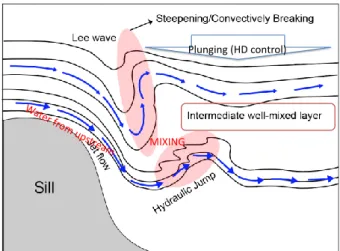
respectively. In total, five overseas researchers as well as 15 Japanese researchers and students attended this online meeting. We discussed diversity and universality in the turbulent mixing generated by the interaction of the Kuroshio current with various topographic features (Figure 2).
Based on this joint research project, the following two articles have been submitted to international journals.
1. CHANG, Ming-Huei, et al., Observations of Kuroshio flowing over a sill: small-scale processes and turbulent mixing, submitted in January, 2021.
2. NAGAI, Takeyoshi, et al., The Kuroshio flowing over seamounts and associated submesoscale flows drive 100-km-wide 100-1000-fold enhancement of turbulence, submitted in February, 2021.
The program of the online meeting is attached below.
Figure 2. Schematic of the small-scale features resulting from the interaction between the Kuroshio and the I-Lan Ridge (adapted from the presentation by Dr. Ming-Huei Chang of NTU).
A simplified summary
Both lee wave and hydraulic jump stay in the lee of the sill
MIXING
Water fro m up
stream
Online meeting on turbulent mixing in the Kuroshio current over the
topography
Time Table in JST January 26 (Tue.)
14:30 Opening remarks
14:35 Sen Jan (IONTU): Update of the result from direct TKE dissipation rate measurements off Taiwan with the data collected in 2020
15:05 Ming-Huei Chang (IONTU): Observations of Kuroshio flowing over a sill: small-scale processes and turbulent mixing
15:35-45 Break
15:45 Jia-Lin Chen (NCKU): Mixing enhancement modulated by unsteady shear flow in the Kuroshio above a system of seamounts
16:15 Eisuke Tsutsumi (AORI): An updated analysis on the observation and numerical modeling of turbulent mixing in the I-Lan ridge
January 27 (Wed.)
10:00 Takeyoshi Nagai (TUMSAT): The Kuroshio Nutrient Stream, where the diapycnal mixing matters 10:35 Silvana Duran (TUMSAT): Elevated nutrient supply caused by an approaching Kuroshio to the southern coast of Japan
11:05 Jie Gao (CMES): Occurrence of phytoplankton bloom as the Kuroshio passes an island 11:35- Discussion and Closing remarks
国際化推進共同研究概要
No.3
20NU-1
タ イ ト ル: Numerical simulation of EC and EBW in QUEST
研究代表者: BERTELLI Nicola
所内世話人: 出射 浩
研究概要: コロナ禍の影響で研究代表者は来日できなかったが、本共同研究課題は、
遠隔で開催された別課題の「Plasma start-up and sustainment in spherical tokamak configuration by RF」に関するワークショップでの QUEST に関する発表で議論された。
議論された QUEST に関する発表は、出射 浩:「QUEST における相対論的
ドップラーシフト効果に基づく第2高調波電子サイクロトロン加熱の速 度空間での制御」である。
Numerical simulation of EC and EBW in QUEST
BERTELLI Nicola (Princeton University, U.S.A)
I could not visit Research Institute for Applied Mechanics in Kyushu University due to the Corona pandemic. This collaboration subject was discussed at the QUEST talk in the remote workshop on “Plasma start-up and sustainment in spherical tokamak configuration by RF” that is a different joint international research subject.
The related QUEST talk is as follows.
“Momentum-space control on relativistic Doppler-shifted resonance in second harmonic ECH on QUEST” by H. Idei
The 28 GHz heating equipment of the launcher system with a focusing / steering mirror and the quasi-optical polarizer system has been developed to conduct the EC plasma ramp-up with local heating effect, or real and momentum space control. Heating and ramp-up scenario were assessed following TASK/WR ray-tracing analysis (with full relativistic-effect) and resonant momentum pitch analysis. The refractive indexes in parallel to the magnetic field N//s were scanned to control the resonant momentum space.
In the larger N// case, the energetic electrons were effectively generated, and ramped
plasma current became large. In the smaller N// case (~0.1), the bulk electrons were heated
国際化推進共同研究概要
No.4
20NU-2
タ イ ト ル: Plasma start-up and sustainment in spherical tokamak configuration by RF 研究代表者: SHEVCHENKO Vladimir 所内世話人: 出射 浩 研究概要: 高温プラズマ理工学研究センターで毎年開催され、これまでに8回を数 えるワークショップを遠隔会議として実施した。英国の研究者が応用力 学研究所・国際推進共同研究としてワ ークショップを開催している。こ れまでも一部の発表はリモートで実施されていたが、今回は、ワークシ ョップ参加者が見込めないため、3日間、14件の講演を全て遠隔会議 で実施した。英国、米国からの参加があることから、大きな時差がある 中 で の 開 催 で あ っ た が 、「 Plasma start-up and sustainment in spherical tokamak configuration by RF」 につき、活発に最新の実験 データ・解析、理論計算が議論された。ワークショップには、センターの 海外連携分野の研究者も参加しており、QUEST 実験への提言、コメント も頂いている。
Plasma start-up and sustainment in spherical tokamak
configuration by RF
SHEVCHENKO Vladimir (Tokamak Energy Ltd., United Kingdom)
A workshop on “Plasma start-up and sustainment in spherical tokamak configuration by RF” was held remotely as follows because no participants to the workshop were expected due to Corona pandemic.
Agenda (25th to 27th Jan. in 2021)
Monday 1/25
JST 20:00 / GMT 11:00 / EST 6:00 [ + 10 min. ] Vladimir Shevchenko / Hanada
WS purpose and agenda
JST 20:10 / GMT 11:10 / EST 6:10 [ + 40 min. ] Yuichi Takase
Survey of RF research on TST-2
JST 21:00 / GMT 12:00 / EST 7:00 [ + 30 min. ] Akira Ejiri
Electron temperature and density profile measurements by Thomson scattering systems on TST-2 and QUEST
JST 21:30 / GMT 12:30 / EST 7:30 [ + 40 min. ] Kazuaki Hanada
Historical Progress on QUEST for steady operation What we could obtain?
-JST 22:10 / GMT 13:10 / EST 8:10 [ + 30 min. ] Makoto Hasegawa
Extension of Operation Region for Steady State Operation on QUEST by Integrated Control with Hot Walls
Tuesday 1/26
JST 21:00 / GMT 12:00 / EST 7:00 [ + 40 min. ] Vladimir Shevchenko
JST 21:40 / GMT 12:40 / EST 7:40 [ + 20 min. ] Erasmus du Toit
Developing a 0D model for studying EBW start-up in MAST JST 22:00 / GMT 13:00 / EST 8:00 [ + 30 min. ]
Syunichi Shiraiwa
Recent development in Petra-M FEM framework and application to tokamak experiments
JST 22:30 / GMT 13:30 / EST 8:30 [ + 30 min. ] Nicola Bertelli
High harmonic fast wave simulations in NSTX-Upgrade by using the Petra-M FEM framework
JST 23:00 / GMT 14:00 / EST 9:00 [ + 30 min. ] Masayuki Ono
Multi-Mode Excitation in Radio-Frequency Heating and Current Drive
Wednesday 1/27
JST 20:00 / GMT 11:00 / EST 6:00 [ + 30 min. ] Naoto Tsuji
Electron cyclotron heating assisted Ohmic start-up in the trapped particle configuration on spherical tokamaks
JST 20:30 / GMT 11:30 / EST 6:30 [ + 30 min. ] Hiroshi Idei
Momentum-space control on relativistic Doppler-shifted resonance in second harmonic ECH on QUEST
JST 21:00 / GMT 12:00 / EST 7:00 [ + 30 min. ] Ryuya Ikezoe
Development of a magnetic fluctuation measurement system on QUEST JST 21:30 / GMT 12:30 / EST 7:30 [ + 30 min. ]
Takeshi Ido
Design of a Heavy Ion Beam Probe for QUEST JST 22:00 / GMT 12:30 / EST 7:30 [ + 30 min. ] Kengo Kuroda
Initial results from high-field-side Transient CHI start-up on QUEST JST 22:30 / GMT 12:30 / EST 7:30 [ + 10 min. ]
Vladimir Shevchenko / Hanada Closing Remarks
Summary Yuichi Takase
Survey of RF research on TST-2
RF experiments performed on TST-2 were reviewed. TST-2 started operation in 1999 on the Hongo Campus of U. Tokyo. During initial operation, plasma current of nearly 100 kA was achieved by OH operation, and ST plasma formation with 1 kA plasma current was achieved by 1 kW of ECH at 2.45 GHz. TST-2 was moved to Kyushu University in 2003 to perform EBW experiments at 8.2 GHz with 200 kW power. X-B mode conversion heating with up to 70% heating efficiency was demonstrated, and a steady state current of 4 kA was maintained. A plasma ramp-up scenario using RF and vertical field ramp was developed and applied to JT-60U where a formation of advanced tokamak with up to 90% bootstrap current fraction was demonstrated. TST-2 was moved to the Kashiwa Campus of U. Tokyo and resumed operation in 2005. It was shown that the formation of ST configuration by pressure driven current is possible using lower frequency RF waves (21 MHz, 200 MHz). Electron heating by HHFW at 21 MHz was demonstrated. Current drive by LHW at 200 MHz was developed using different methods of wave excitation, inductively coupled combline antenna, dielectric loaded waveguide antenna, and capacitively coupled combline antenna (outboard launch and top launch). The highest plasma current was achieved by top launch LHW, consistent with GENRAY/CQL3D modelling. Further improvements are expected at higher toroidal field based on both experimental and computational results. A new type of travelling wave antenna (finline antenna) is being developed for use at 2.45 GHz.
Akira Ejiri
Electron temperature and density profile measurements by Thomson scattering systems on TST-2 and QUEST
TS systems have been constructed and operated for TST-2 and QUEST. The systems can measure 5+5 (TST-2) / 6+6 (QUEST) spatial points with 6 wavelength channels. The minimum measurable density is around 1x10¹⁷m-3, and the systems suitable for RF driven low density plasma in TST-2 and QUEST.
RF induced transport model has been introduced to explain the HX spectra, central temperature and response of RF turn off. Some features can be explained by the model, and some cannot be.
A double pass TS scheme is under development to measure temperature anisotropy of bulk electrons in RF driven plasmas. Theoretical work on the scheme was done to find optimum configuration.
Increasing measurement days in QUEST is important, and some efforts were made, and some are in progress/preparation.
Kazuaki Hanada
Historical Progress on QUEST for steady operation What we could obtain?
-We could successfully promote steady state operation of tokamak with QUEST which has all-metal plasma facing walls and a hot wall more than 10 years. It found that hydrogen transport barrier is formed between a plasma-induced deposition layer and a substrate made of metal, which plays an essential role in fuel particle recycling. The hydrogen barrier gives rise to presence of new time constant for steady state operation which is related to the surface recombination coefficient. We have developed the way of monitoring of the value shot by shot using fuel emission just after the plasma termination. The method can be applied to all the plasma experimental devices.
Temperature dependence of surface recombination coefficient is a key to handle particle balance and the time constant. We have demonstrated that the higher wall temperature provides faster wall saturation and it leads to shorter pulse length. To overcome the difficulty, wall temperature control is a candidate. Recently, several 6 hours discharges could be obtained and we confirm that wall temperature control is a promising way to extend the pulse duration due to regulation of fuel particle balance.
In near future, we will try to achieve longer discharges under the high temperature relevant to fusion reactors.
Makoto Hasegawa
Extension of Operation Region for Steady State Operation on QUEST by Integrated Control with Hot Walls
The plasma first wall could be maintained at a temperature over 600 K. Long plasma discharge over 6 hours could be obtained under a high temperature environment of 473 K with hot wall of APS-W and CS of SUS. The control of particle supply is sensitive to temperature changes in the first wall (HW and CS). Detailed temperature control of the first wall leads to an increase in operating area.
Vladimir Shevchenko
ECRH & CD in spherical tokamaks
In February-March 2020 there was a short experimental campaign P2.1 on ST40. This campaign was conducted to re-confirm operational status of ST40 after re-commissioning. After that several new diagnostics have been installed and commissioned. Solenoid and additional vertical field power supplies were installed and tested. 0.6 MW 25 keV Heating Neutral Beam (HNB) injector has been tested and installed. Some plasma heating and fuelling were observed with HNB injection into plasmas. To date plasma currents achieved in ST40 are above 0.5 MA with the current flattop up to 100 ms. Toroidal fields close to 2 T at the major radius of 0.4 m have been delivered on a regular basis. Kiloelectron volt range electron and ion temperatures have been regularly achieved during this campaign. All diagnostics were commissioned and prepared for full scale experiments. Currently, installation of liquid nitrogen cooling for TF and Bv coils is completed. Next experimental campaign P2.2 is prepared to achieve first plasma in February 2021.
Further upgrades of ST40 include installation of the 2nd HNB 1 MW 50 keV. It was commissioned and prepared for experiments with plasma. The contracts for two dual (140/105 GHz) frequency 1 MW gyrotrons were placed and first of them is scheduled for delivery in Q3 2021. Capabilities of limitations of ECRH and CD at both frequencies were discussed in relation to ST40 and the future project ST-F1.
Erasmus du Toit
Developing a 0D model for studying EBW start-up in MAST
Electron Bernstein wave (EBW) start-up, including the generation of a plasma current and formation of closed flux surfaces (CFS), was successfully demonstrated in the spherical tokamak MAST [1]. The formation of CFS is a crucial part of start-up, and, while various mechanisms have been proposed to explain their formation, no detailed theoretical studies have previously been undertaken to study the time-evolution of the plasma current and formation of CFS. In this work, we present a simple model that explains the experimental observations in terms of the underlying physics, by studying the time evolution of the electron distribution function under a number of effects, including an electron source, orbital losses, collisions, EBW heating, and plasma induction.
Simulations show good agreement with experiments, providing explanations for several experimentally observed effects, including the current drive mechanism and role of the vacuum magnetic field. In particular, we show that collisions are responsible for only a
small part of the current drive. The open magnetic field line configuration during start-up, which leads to an asymmetric confinement of electrons [2] and is controlled by the vacuum magnetic field, is responsible for the majority of the generated plasma current. [1] V.F. Shevchenko et al., EPJ Web of Conf. 87, 02007 (2015).
[2] T. Yoshinaga et al., Phys. Rev. Lett. 96, 125005 (2006).
Syunichi Shiraiwa
Recent development in Petra-M FEM framework and application to tokamak experiments
We present the recent progress of Petra-M framework development. Petra-M is a finite element (FEM) analysis platform we are developing for the integrated RF modeling. The goal is to realize the full wave RF simulation which includes the entire tokamak plasma from antenna to the hot core region with high physics and geometrical fidelity. Petra-M uses the MFEM finite element library developed by LLNL for the FEM assembly and combine it with other Open Source software including ASCR developed efficient linear solvers and meshing algorithm. This year. significant development was made to enhance its geometry editing capability, allowing for creating the detailed antenna structure based on the information directly imported from the CAD software. We also extend our usage of the high order finite element basis to reduce the total degree of freedoms, which allows for resolving the high harmonic fast waves in the entire NSTX-U device for the first time. The verification and validation effort of Petra-M models are in progress through domestic and international collaborations. This collaboration network covers the almost all RF waves including ICRF, HHFW, Helicon and LH waves and major tokamak experimental facilities worldwide, which makes the extensive test of our simulation platform possible. Potential path to incorporate the arbitrary order finite Larmor radius (FLR) effects to FEM wave simulation is discussed. Initial test in the 1D geometry using the O-X-B mode conversion scenario foreseen on NSTX-U is consistent with the dispersion relation, and extension to 2D/3D is in progress.
Nicola Bertelli
High harmonic fast wave simulations in NSTX-Upgrade by using the Petra-M FEM framework
In this work we present the recent applications of the Petra-M finite-element-method (FEM) platform to NSTX-Upgrade. Petra-M code [1] is a state-of-the-art generic electromagnetic simulation tool for modeling RF wave propagation based on MFEM [http://mfem.org], open source scalable C++ finite element method library. This paper
shows the full 3D NSTX-U device geometry including realistic antenna geometry and 3D scrape-off-layer (SOL) plasma in order to capture the 3D effects and the antenna-plasma interaction in the SOL plasma and, at the same time, the core wave propagation. The antenna geometry and the 3D NSTX-U geometry are from the NSTX-U CAD models. A first ever HHFW full wave simulation for the full 3D NSTX-U torus has been shown [2]. A scan of the antenna phasing shows a strong interaction between FWs and the SOL plasma for lower antenna phasing, which is consistent with previous NSTX HHFW observations. A large electric field is found on the wall surface even far away from the antenna region. This quantity will be important, as a next step, for studying the antenna impurity generation and RF sheath effects. The evaluation of the launching wave spectra for three antenna phasing have been also presented. Such spectra are consistent with the RF wave theory. A comparison between the scattering matrix (S-matrix) between vacuum and plasma cases has been discussed. The S-matrix evaluation is the first step to be able to quantify the HHFW antenna performance and compared it with the measurements. Finally, we have discussed the PPPL-MIT collaboration on direct RF power level utilizing the RF probes installed on NSTX-U.
[1] S. Shiraiwa et al., EPJ Web of Conferences 157, 03048 (2017).
[2] N. Bertelli, S. Shiraiwa, et al, AIP Conf. Proceeding 2254, 030001 (2020).
Masayuki Ono
Multi-Mode Excitation in Radio-Frequency Heating and Current Drive
While the rf actuators are potentially quite attractive for use in fusion reactor systems particularly with the technology and economic advantages, there are quite significant rf-plasma interaction related issues still require improved understanding and predictive capabilities in order for the rf actuators to become the mainstream fusion reactor components. The main challenges for rf actuators is that the antenna or waveguide launcher is placed at the plasma edge where the plasma density is essentially zero. Then the launched waves much traverse the so-called plasma scrape-off layer where the density increases from zero to 1019/m3 in a short distance of a few cm. Because of the large
variation in the density, the full wave equations must be solved from antenna/launcher to the plasma core. There are also a large variation in the electron and ion temperatures. The rf actuators are presently in three frequency ranges: ECH (electron cyclotron heating) using gyrotrons in 28 -170 GHz, LHCD (lower hybrid current drive) in 2 – 8 GHz range, and ICRF (ion cyclotron range of frequency) in 10 – 140 MHZ ranges. More recently, helicon experiments are being performed in the 500 MHz range. It is also recognized that for the same wave frequency range, there is a possibility of exciting multiple modes. For
ECH, it is well known that there are mode and O- mode which can be excited. The X-mode and O-X-mode excitation can be controlled to a large extent by controlling the polarization and injection angle of the launched waves. In addition, EBW (electron Bernstein wave) excitation is possible. The EBW is considered for its accessibility to the high-density regime above the so-called ECH cut-off density limit. For helicon regime, it is also well known that there are both electromagnetic wave (“helicon”) and electrostatic electron plasma wave (EPW) which is the LHCD wave. Recent wave modeling work at PPPL showed that both helicon and LHCD waves can be excited simultaneously [1]. Our analyses found that the edge density profile is highly important for the EPW excitation. In particular, the density “gap” if created in front of the antenna can lead to a significant EPW excitation even for a perfectly aligned antenna. For HHFW/ICRH, there are also fast electromagnetic (FW) wave and electrostatic EPWs including the IBW (ion Bernstein wave) branches. Since the EPW waves can exists at the low-density edge region of the plasma even for the ICRF frequency range, it is important to includes those electrostatic waves to fully understand the rf coupling physics. One of the challenges of the rf coupling problem for the electrostatic waves is the treatment of the so-called “S”-resonance [2] where the cold plasma approximation breaks down. The FLR effects would lead to the IBW excitation at the “S” resonance. This suggests the potential importance of including the FLR effects in assessing the viability of rf actuators. The wave equations with the FLR effects have been developed for multiple harmonics. Once such wave equations are validated, it is then possible to incorporate them into the Petra-M 3-D full wave code [3] to obtain the full picture of the rf actuator wave coupling physics.
[1] Kim, E.-H., M. Ono, N. Bertelli, S. Wang, and H. K. Park (2020), AIP Conf. Proceeding 2254, 050010 (2020); https://doi.org/10.1063/5.0013978
[2] T.H. Stix, Waves in Plasmas (American Institute of Physics, New York, 1992). [3] S. Shiraiwa, N. Bertelli, et. al., at this workshop.
Naoto Tsuji
Electron cyclotron heating assisted Ohmic start-up in the trapped particle configuration on spherical tokamaks
TST-2 experiment showed that breakdown became slower when electron cyclotron (EC) waves were applied to the start-up in the conventional field-null configuration. Prompt breakdown was recovered when the trapped-particle configuration (TPC) was used instead of the field-null configuration. A simple numerical analysis showed that breakdown indeed became slower at low neutral pressure and high EC power, consistently with the experimentally observed trends.
Hiroshi Idei
Momentum-space control on relativistic Doppler-shifted resonance in second harmonic ECH on QUEST
The 28 GHz heating equipment of the launcher system with a focusing / steering mirror and the quasi-optical polarizer system has been developed to conduct the EC plasma ramp-up with local heating effect, or real and momentum space control. Heating and ramp-up scenario were assessed following TASK/WR ray-tracing analysis (with full relativistic-effect) and resonant momentum pitch analysis. The refractive indexes in parallel to the magnetic field N//s were scanned to control the resonant momentum space.
In the larger N// case, the energetic electrons were effectively generated, and ramped
plasma current became large. In the smaller N// case (~0.1), the bulk electrons were heated
up to 500 eV at ~1-2 x 10¹⁸m-3.
Ryuya Ikezoe
Development of a magnetic fluctuation measurement system on QUEST
Poloidal and toroidal arrays of pick-up coils have been firstly installed inside the QUEST vacuum vessel. Abrupt decrease in plasma current and corresponding variation of equilibrium field were measured. Prompt loss of energetic electrons might be related. High-frequency waves driven by energetic electrons in a whistler band has been measured in a spherical tokamak. RF pick-up coils installed at HFS and at the fast-reciprocating probe head have shown various features of high-frequency wave activities.
In the future, multi-channel data acquisition system will be operated in the next campaign to get all the pick-up coil signals at the same time. A dedicated experiment using the developed fast-reciprocating RF probes and HFS RF probes is planned in next February. Detailed analyses will be done to characterize the high-frequency waves driven by energetic electrons on QUEST and elucidate the physics behind. Continues to develop a nice wave measurement environment, control knobs for energetic electrons, and distribution function diagnostics.
Takeshi Ido
Design of a Heavy Ion Beam Probe for QUEST
Heavy Ion Beam Probe (HIBP) has been designed for QUEST to investigate physical mechanism of the particle and heat transport in plasmas. The injected probe beam for the HIBP on QUEST is singly charged cesium ions (Cs+), and the required beam energy ranges from 10 keV to 50 keV. By controlling the beam energy and incident angle of the probe beam, measurable area covers the upper half of the QUEST plasmas. According to
the numerical calculation, the intensity of the detected beam current is large enough to measure micro turbulences at the central region of plasmas with the density of 1 x 10¹⁹
(m-3) or less.
Kengo Kuroda
Initial results from high-field-side Transient CHI start-up on QUEST
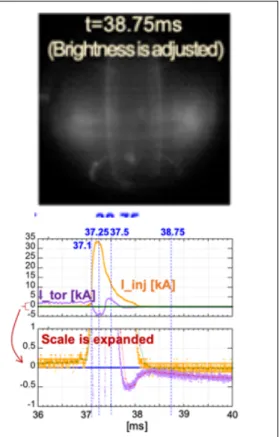
T-CHI current start-up by using newly designed simple electrode has made important progress. Flux evolution from the LFS and HFS T-CHI were examined. The potential for flux evolution with a narrow footprint appears to be possible using HFS T-CHI compared to that for LFS T-CHI. Some anticipated HFS T-CHI improvements were observed on the modified system with in-vessel coil and cylinder electrode. On the low injector flux configuration, camera images suggest a persisting plasma although a confined plasma current is unclear. On the high injector flux configuration, current up to 35 kA was generated in plasma that evolved only to the mid-plane (full growth into vessel should rapidly increase the generated toroidal current for the same injector current). Optimization of gas injection system on the modified electrode configuration are planed for next tasks. This is necessary to make sure CHI initiation happens in the injector region while preventing absorber arc for formation.
国際化推進共同研究概要
No.5
20NU-3
タ イ ト ル: High power mm wave transmission line technology for advanced fusion devices
研究代表者: LECHTE Carsten Hanno
所内世話人: 出射 浩 研究概要: ITER プラズマでの不安定性抑制のための大電力・高周波デバイスの開発 を進めている。これまでに九州大学でデバイスの低電力試験を、量子科学 技術研究開発機構・那珂核融合研究所で大電力試験を実施している。今年 度、高周波電界の偏波面を変えて行う実験を実施する予定であったが、海 外からの研究者の参加が見込めない中、遠隔会議を重ねることで、偏波面 制御デバイスの開発(ドイツ)、据付・大電力試験(那珂核融合研究所)を 進め、偏波面制御でこれまで起きていたアーキング現象を大幅に軽減する ことに成功した。遠隔会議での議論、遠隔支援のもとで実験を実施し、共 同研究を推進した。
High power mm wave transmission line technology
for advanced fusion devices
LECHTE Carsten Hanno University of Stuttgart, Germany
The FAst DIrectional Switch (FADIS) system has been studied for ITER application at 170 GHz as a topic under joint international research framework at Research Institute for Applied Mechanics in Kyushu University. The system device was developed at University of Stuttgart, Germany, and shipped to Kyushu University in 2018. Basic performance was tested at low power level in Kyushu University, and shipped to Naka Institute of National Institutes for Quantum and Radiological Science and Technology in 2019. High power tests were conducted in Naka Institute along the low power test results in Kyushu University.
The incident wave-polarization has to be controlled for proper FADIS performance. The optimum incident wave into the FADIS is a linear-polarized wave with an azimuthal angle in the horizontal-vertical wave-field plane. The quarter wavelength polarizer (rotator) in Kyushu University was used to control the azimuthal angle of the polarization. The performance of the rotator was tested at the low power test facilities in Kyushu University. Although the azimuthal angle was properly controlled with the rotator, the ellipticity was also changed by setting of the azimuthal angle. The controlled wave was an elliptically polarized-wave, and not the optimum linearly polarized-wave. The FADIS system was installed at the transmission line of the high-power test-stand with the rotator in Naka Institute. Although the FADIS performance was tested at the high-power test-stand in Naka Institute, but we had many unwanted arcing events inside the FADIS. To avoid the arcing events in the FADIS, a universal polarizer has been developed at University of Stuttgart. The universal polarizer can control the azimuthal angle of the polarization without changing of the ellipticity by rotating the device on the transmission-line axis. The optimum transmission-linearly polarized-wave can be excited with the universal polarizer. Figure 1 shows a photo and a drawing of the universal polarizer. It was tested at the low power level in University of Stuttgart, and shipped to Kyushu University. It was finally shipped to Naka Institute, and installed at the transmission line of the high-power test-stand. Figure 2 illustrates setup of the universal polarizer in the transmission. The polarizer was set with an angle of 17.65 degrees on the transmission-line axis to excite the optimal polarization with the azimuthal angle of 37.3 degrees. We communicated with e-mails together with to discuss how to install the polarizer and
conduct the high-power test in Naka Institute, because we could not join the high-power test in Naka Institute due to the Corona pandemic. In the discussion on the high-power test, electropolishing of mirrors in the FADIS was proposed to avoid the arcing events. After the electropolishing of the mirrors, the high-power test was conducted in Naka Institute.
Fig.1: Photo and Drawing of universal polarizer developed at University of Stuttgart.
A-A ( 1 : 2 ) B ( 1 : 1 ) A A B 1 1 2 2 3 3 4 4 5 5 6 6 A A B B C C D D 1 A3 20200120_POLdreher Status Änderungen Datum Name
Gezeichnet Kontrolliert Norm Datum Name 20.01.2020Zeitler 400 18 0 64,4 66,25 125 9 0 160 8 14 20 9 0 17 2 8 72 136 200 264 328 392 R15 45° 22 ,5° 6,27 3 0 4 16 22
Alle nicht bemaßten Gewinde M8x22/16 Alle innenliegenden Kanten R=11 (wenn machbar kleiner) Fräsbahnabstand für Spiegelfläche 0,35mm 22 2 7 ,8 9 ( ) Al 1x M 1 : 2 7 5 64,4 66,25 Phase Converter 10° 95 13 2 ,1 1 400 16 0 18 0 Alle Flanschgewinde M8x18/15 4 5 ,5 1 ( ) R21 28 2014 14 20
Fig.2: Setup of the universal polarizer in the transmission line. The polarizer is set with an angle of 17.65 degrees on the transmission-line axis to excite the optimal polarization.
The experiments are performed from 7th to 10th September in 2020. Radio Frequency (RF) power injection to FADIS was started with a relatively low power level of 130kW (Gyrotron beam current; Ib~10A). After the ~100kW (Ib ~10A) power test, the power
increased up to 341kW (Ib ~30A). The arc light was observed, but the intensity of the arc
light apparently deceased, compared with the experimental campaign in 2019 as shown in Fig. 3. After confirming the arc light decreased, a frequency scan was performed in
Fig.3: Left side is arc light with power of 341 kW in 2020. Right side is arc light in 2019.
Fig. 2 Left side is arc light with power of 341kW in 2020. Right side is arc light in 2019 experiments with power of 324kW.
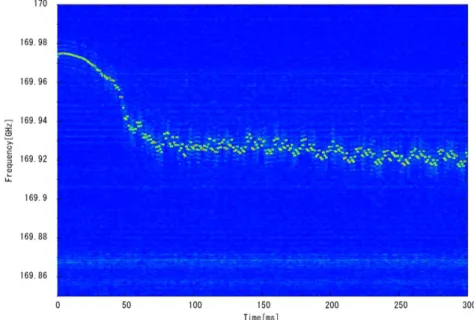
After confirming the arc light is decreased, a frequency scan was performed in order to find a resonant frequency. The time dependence of the frequency is shown in Fig. 3. As shown in the figure, the frequency change becomes stable after 100ms except ~5MHz frequency oscillation. By changing the gyrotron oscillation magnetic field (∝Bc) slightly, the stable frequency can be changed slightly.
Fig. 3 Time dependence of the frequency. Ic~10A operation with Bc=86.7A
旧電源
FA D I S
試験(
J-8
)
2020
年
9
月
8
日( 火)
(
作成: 梶原
)
内容:FADIS試験 1. Ic∼
10 A での調整及びパワー測定 昨日の500 msシ ョ ッ ト が途中から 下モ ード にな っ て いたため、 本日は500 ms正規発振と な る よ う に、 調整行な っ た。 主磁場を 上げる こ と によ り 、 下モ ード 発振はおこ ら なく な り 、 最終的に以下のパラ メ ー タ にて パワー測定を 行なっ た。 設定: Ef:43.0V, DCG:59.0kV, BPS:20.0kV, APS:11kVBc:86.6A, Bg:-5.0A, パルス 幅:500ms, イ オン ポン プ 2.0µA
測定値: Ic:10.54A,Vk:-53.58kV,Va:-10.85kV,Vb:19.79kV Vak:42.73kV, Vbk:73.37kV, Ia0mA→79mA(248msにて ア ノ ード ジ ャ ン プ) 中パルス ダミ ー: 126kW 発振パワー:126/ 0.93= 135kW,発振効率:17.45%, 総合効率:23.9% 2. Ic
∼
30 A での調整及びパワー測定 Ic∼
30 A での調整及び、 パワー測定を 行い FADISの発光の様子を 撮影し た。 パルス 幅は100 ms。 以 下にパラ メ ータ を 、 図1に波形、 図2に発光の様子を 示す。 参考ま でに電解研磨前の昨年の発光の様子 も 示す。 電解研磨前よ り 発光が減少し て いる が、 前回の記録がDVD レ コ ーダによ る も のだっ たのに対 し て 、 今回はカ メ ラ 本体で 記録し て いる ため、 フ レ ームレ ート の違いから 発光の瞬間がう ま く 撮影でき て いな い可能性も ある 。 設定: Ef:50.0V, DCG:59.0kV, BPS:20.0kV, APS:14kV Bc:85.8A, Bg:-5.0A, パルス 幅:100ms 測定値: Ic:27.28A,Vk:-54.82kV,Va:-13.95kV,Vb:19.77kV Vak:40.87kV, Vbk:74.59kV, Ia0mA→75mA(75msにてア ノ ード ジ ャ ン プ) 中パルス ダミ ー: 337kW 発振パワー:337/ 0.93= 362kW, 発振効率:17.08%, 総合効率:24.20% Vb (10kV/div) Va (10kV/div) Vk (10kV/div) Ic (10A/div) Ia (50mA/div) RF (a.u.) 窓アーク (a.u.) 図1 Ic ∼30A、100msショ ッ ト 電解研磨後(2020) 電解研磨前(2019) 図2 左が今回の発光、 右が2019年の発光 3. 本日の運転 周波数を 掃引し Resonant Loadに入射でき る か試みる 。Fig.4: Time dependence of oscillated frequency in 10 A operation of Ib with
gyrotron axial magnetic field Bc made at 86.7 A. The frequency becomes stable after
100 ms except for a ~ 5 MHz frequency oscillation.
Fig. 2 Left side is arc light with power of 341kW in 2020. Right side is arc light in 2019 experiments with power of 324kW.
After confirming the arc light is decreased, a frequency scan was performed in order to find a resonant frequency. The time dependence of the frequency is shown in Fig. 3. As shown in the figure, the frequency change becomes stable after 100ms except ~5MHz frequency oscillation. By changing the gyrotron oscillation magnetic field (∝Bc) slightly, the stable frequency can be changed slightly.
Fig. 3 Time dependence of the frequency. Ic~10A operation with Bc=86.7A
旧電源
FA D I S
試験(J-8
)2020
年9
月8
日( 火)(
作成: 梶原)
内容:FADIS試験 1. Ic ∼10 A での調整及びパワー測定 昨日の500 msシ ョ ッ ト が途中から 下モ ード にな っ て いたため、 本日は500 ms正規発振と な る よ う に、 調整行な っ た。 主磁場を 上げる こ と によ り 、 下モ ード 発振はおこ ら なく な り 、 最終的に以下のパラ メ ー タ にて パワー測定を 行なっ た。 設定: Ef:43.0V, DCG:59.0kV, BPS:20.0kV, APS:11kVBc:86.6A, Bg:-5.0A, パルス 幅:500ms,イ オン ポン プ 2.0µA 測定値: Ic:10.54A,Vk:-53.58kV,Va:-10.85kV,Vb:19.79kV Vak:42.73kV, Vbk:73.37kV, Ia0mA→79mA(248msにて ア ノ ード ジ ャ ン プ) 中パルス ダミ ー: 126kW 発振パワー:126/ 0.93= 135kW,発振効率:17.45%, 総合効率:23.9% 2. Ic ∼30 A での調整及びパワー測定 Ic ∼30 A での調整及び、 パワー測定を 行いFADISの発光の様子を 撮影し た。 パルス 幅は100 ms。 以 下にパラ メ ータ を 、 図1に波形、 図2に発光の様子を 示す。 参考ま でに電解研磨前の昨年の発光の様子 も 示す。 電解研磨前よ り 発光が減少し て いる が、 前回の記録がDVDレ コ ーダによ る も のだっ たのに対 し て 、 今回はカ メ ラ 本体で 記録し て いる ため、 フ レ ームレ ート の違いから 発光の瞬間がう ま く 撮影でき て いな い可能性も ある 。 設定: Ef:50.0V, DCG:59.0kV, BPS:20.0kV, APS:14kV Bc:85.8A, Bg:-5.0A, パルス 幅:100ms 測定値: Ic:27.28A,Vk:-54.82kV,Va:-13.95kV,Vb:19.77kV Vak:40.87kV, Vbk:74.59kV, Ia0mA→75mA(75msにてア ノ ード ジ ャ ン プ) 中パルス ダミ ー: 337kW 発振パワー:337/ 0.93= 362kW, 発振効率:17.08%, 総合効率:24.20% Vb (10kV/div) Va (10kV/div) Vk (10kV/div) Ic (10A/div) Ia (50mA/div) RF (a.u.) 窓アーク (a.u.) 図1 Ic ∼30A、100msショ ッ ト 電解研磨後(2020) 電解研磨前(2019) 図2 左が今回の発光、 右が2019年の発光 3. 本日の運転 周波数を 掃引し Resonant Loadに入射でき る か試みる 。
order to find a resonant frequency of the FADIS. The time dependence of the frequency is shown in Fig. 4. As shown in the figure, the frequency becomes stable after 100 ms except for a ~ 5 MHz frequency oscillation.
By changing the gyrotron oscillation magnetic field Bc slightly, the stable frequency
can be changed slightly. The result of the frequency scan by Bc is shown Fig. 4. As shown
in Fig. 4, the frequency is changed from 169.87 GHz to 169.99 GHz (~ 120 MHz). The frequency scan was performed with both Ib ~ 10 A (100 kW) operation and Ib ~ 30 A
operation (341 kW). Note, the frequency was measured around 250 ms for the Ib ~10 A
operation and 200 ms for the Ib ~ 30 A operation, since the pulse width was not extended
more than 200 ms for Ib ~ 30 A operation to avoid the risk of the gyrotron damage by RF
reflection from the FADIS.
During the frequency scan, coupled power in non-resonant and resonant dummy loads in the FADIS was measured as shown in Fig. 6. The power increased as magnetic field
Bc decreased, which is the nature of gyrotrons. The coupling into non-resonant or resonant
dummy load should depend on the frequency as switching performance in the FADIS operation. However, as shown in Fig. 6, there was no specific change of power in the non-resonant and resonant dummy loads with any specific frequency. As a conclusion, we could not find any evidence that we operated with resonant frequency in the high-power test. The wider region of the frequency scan was not possible due to the gyrotron condition and power supply condition. Fine tuning of frequency or resonant conditions is needed to confirm the switching FADIS operation in the high-power test.
Fig. 5: Measured frequency according to gyrotron magnetic field Bc .
The result of the frequency scan by Bc is shown Fig. 4. As shown in Fig. 4, the frequency is changed from 169.87GHz to 169.99GH (~120MHz). The frequency scan was performed with both Ic~10A (100kW) operation and Ic~30A operation (350kW). Note, the frequency is measured around 250ms for the Ic~10A operation and 200ms for the Ic~30A operation, since the pulse width was not extended more than 200ms for Ic~30A operation to avoid the risk of the gyrotron damage by RF reflection from FADIS.
Fig. 4 Measured frequency according to gyrotron magnetic field Bc.
During the frequency scan, the non-resonant load and the resonant load input power is measured as shown in Fig. 5. The power is increased as magnetic field Bc is decreased, which is nature of gyrotron. However, as shown in Fig. 5, there was no specific change of power in Non-resonant dummy load and resonant dummy load with any specific frequency. As a conclusion, we could not find any evidence that we operated with resonant frequency. The wider region of the frequency scan was not possible due to the gyrotron condition and power supply condition. So, we stopped the frequency scan as it is.
169.86 169.88 169.9 169.92 169.94 169.96 169.98 170 85.4 85.6 85.8 86 86.2 86.4 86.6 86.8 87 87.2 87.4 87.6 F re q u e n cy [ G H z ] Bc [A] Ic=10A Ic=30A
Fig. 6: Measured power according to gyrotron magnetic field Bc ,
i.e. frequency.
Fig. 5 Measured power according to gyrotron magnetic field Bc, i.e., frequency. 0 50 100 150 200 250 300 350 400 85.4 85.6 85.8 86 86.2 86.4 86.6 86.8 87 87.2 87.4 87.6 P o w e r [a .u .] Bc [A] Ic=10A Non-res Ic=30A Non-res Ic=10A Res Ic=30A Res
国際化推進共同研究概要
No.6
20NU-4
タ イ ト ル: Development of Core-SOL-Divertor model for simulating tokamak plasmas with impurities
研究代表者: WISITSORASAK Apiwat 所内世話人: 糟谷 直宏 研究概要: トカマクプラズマにおける不純物輸送について統合的な解析を可能とするために、 TASK/TI コードへ SOL ダイバータ領域の効果を組み合わせるのが本研究の課題である。 コア輸送モデルと SOL 流体モデルとの結合を図っている。本年度はコロナ禍の影響で応 力研出張が取りやめとなった。代わってオンラインでの打ち合わせによりお互いの研究 状況を理解し、今後の展望について議論した。
1
Development of Core-SOL-Divertor model for simulating tokamak plasma with impurities
Apiwat Wisitsorasak, Department of Physics, King Mongkut's University of Technology Thonburi, Thailand Impurities in tokamak plasma introduce several deleterious effects on the overall performance of the devices. Large amount of the impurities can dilute the fuel and reduce the rate of the fusion reactions. Furthermore, one of the most immediate effect is the radiated power loss which leads to lower the temperature of the plasma. For examples, impurity ions, such as oxygen and carbon, which are originating from the tokamak vessel, cool the plasma strongly near the edge. However, too much edge cooling destabilizes the plasma and leads to plasma disruption which can severely damage the wall and other structures [1, 2]. On the other hand, metal ions from the plasma-facing components, such as tungsten, can travel farther from the edge and cause significant radiation in in the core. This prevents the plasma to reach high enough temperature for ignition. Hence the concentration of the impurities should be minimized. For a tokamak with the divertor configuration, the impurities shall be pumped away near the divertor, otherwise they will accumulate in the vessel. Besides the downside effects of the impurities, the radiation of the plasma impurities nevertheless has some helpful consequences. Injection of noble gases, such as argon or neon, is intentionally used to increase the radiation in the edge region of the plasma. A well-controlled amount of these seeded impurities helps to disperse the plasma power exhaust over wider surface areas and reduce the temperature in front of the plasma facing components.
This work ultimately aims to understand the transport behavior of the underlying physical mechanisms of the impurities by using a simulation. TASK is a major code in Japan for integrated plasma simulation. The module TI for impurity transport in TASK has been developed by Prof. Emeritus Atsushi Fukuyama in Kyoto University in collaboration with Prof. Naohiro Kasuya in Kyushu University and Theory group in National Institute for Quantum and Radiological Science and Technology (QST). It is based on a fluid description of the plasma and able to compute the profile evolution of the densities and temperatures of all ion stages. The code is a one-dimensional (radial) code in which a method of flux averaging is used. However, the present version of the code only considers the transport in the plasma core in which the magnetic field lines are closed. The transport in the scrape-off layer (SOL), the region outside the plasma core, is not considered yet. Thus, this work will eventually develop the edge transport modeling code and couple it to the impurity transport code in the core by collaboration with RIAM.
The dynamics of the plasma in the edge is complex and involves several nonlinear plasma phenomena [2]. To simulate the plasma in this region, one may reduce the complexity of the problem by only considering the transport along a magnetic field line. The dynamics five-point model is further simplifying the transport and is developed to investigate the response of the plasma in the SOL and divertor regions at five points: the stagnation point (0), upstream throats of divertors (𝑢#, 𝑢%), and divertor plates (𝑠#, 𝑠%), see figure 1 [3, 4].
The five-point model simply considers that the plasma particles are transported along an open magnetic flux tube which is divided into four regions (figure 1). By integrating the fluid equations along the magnetic flux tube in each region, one obtains the dynamical equations of the density (𝑛), ion particle flux (Γ), electron (𝑇*) and ion (𝑇+) temperatures at each point along the SOL as follows [3, 4].
𝐿-./𝑑𝑛1/𝑑𝑡 = −Γ78−Γ79+ 𝑆1𝐿-./, (1)
𝐿<=>𝑑𝑛?9,8/𝑑𝑡 = −Γ79,8−Γ?9,8+ 𝑆9,8𝐿-./, (2)
0.5𝑚+C𝑙E,F+ (𝑅9,8+ 1)𝐿<=>K𝑑Γ79,8/𝑑𝑡 = 𝑛1(𝑇*1+ 𝑇+1) − 𝑛?9,8C2𝑇M?9,8+ (1 + 𝑔)𝑇=?9,8K, (3)
2
1.5𝐿<=>𝑑(𝑛?9,8𝑇O?9,8)/𝑑𝑡 = −𝑄O79,8− 𝑄O?9,8− 𝛿O𝜎9,8𝐽(𝜙79,8− 𝜙?9,8) + (𝑊O9,8+ 𝑊OMU9,8)𝐿<=>, (5) where the subscript 𝑗 refers to particle species (𝑖 for ions and 𝑒 for electron) with 𝛿*= 1, 𝛿+= 0, 𝜎#= −1 and 𝜎%= 1. 𝑆1 and 𝑊1 are the particle and energy source in the radial direction. The neutral particle source and the ionization energy due to these neutrals are given by 𝑆9,8 and 𝑊O9,8, respectively. Γ and 𝑄 are the particle and heat flux from the core.
Figure 1: Schematic diagram showing the geometry of the five-point model which considers the transport along the magnetic field.
The dynamic five-point model can be extended to explicitly describe impurity production and transport in the tokamak edge region. This task can be achieved by considering the multifluid equations of impurity species. In the edge, the temperature and density of the plasma are typically less than 200 eV and 1021 m-3, respectively [2]. Thus, the charge recombination of the impurity ions may be neglected.
Upon neglecting the inertia terms and only considering the transport along the field line, the impurity transport equations of each charge state at the steady state can be written as
𝜕𝑛[𝑣[ 𝜕𝑧 = 𝑛[^_𝛼[^_− 𝑛[𝛼[, (6) 𝑛[𝑣[= − 𝜏[𝑇+ 𝑚b 𝜕𝑛[ 𝜕𝑧 − 𝑘𝑒𝑛[𝜏[ 𝑚b 𝜕𝜙 𝜕𝑧+ 𝑛[𝑣+≡ −𝐷[ 𝜕𝑛[ 𝜕𝑧 + 𝑤[𝑛[, (7)
where the subscript 𝑘 denotes the charge state of impurity (𝑘 = 1, . . . , 𝑍hij), 𝑚b is the impurity mass, 𝑣[ is the parallel velocity, 𝛼[= 𝑛*〈𝜎𝑣〉[ is the ionization rate coefficient of impurity species 𝑘 [5, 6]. These two equations can be solved in two different limits which are based on the relative magnitudes of the ionization and parallel transport contribution for the density of each charge state. For the lower charge state (𝑘 < 𝐾 < 𝑍hij), the characteristic time of the ionization process is approximately faster than the parallel transport process. This subsequently leads to the following relation:
𝑛[=
𝛼[^_
𝛼[ 𝑛[^_.
(8)
On the opposite case, for the higher charge state (𝑘 ≥ 𝐾), the ionization process will occur on the time scale much longer the parallel transport. The continuity equation then becomes
𝑛[𝑣[= p 𝛼[^_𝑛[^_(𝑧) d𝑧 r
s ,
(9)
where the integration is performed along the magnetic field line (𝑧 direction). Finally, one can explicitly solve equations (6) and (7) for the density of the kth charge state:
3
𝑛[(𝑧) = 𝑒tu(s)v𝑛[,?9,8+ p 𝑒^tu(sw)p 𝛼[^_ 𝐷[ 𝑛[^_(𝑧 xx) r sw d𝑧 xx d𝑧x s 1 y, (10)where 𝑃[(𝑧) is an integrating factor which depends on local velocities and electric potential [5]. In principle, once the background plasma is numerically determined by the basic five-point model, equations (8) and (10) can be directly used to solve the impurity density of each charge at each point along the field line.
Even though the ultimate goal of this work is to develop the calculation method for providing the plasma boundary conditions for self-consistently simulating the impurity transport in the core, such calculation has not been integrated into the transport code yet. The COVID-19 pandemic has large impact on international travel in which several commercial flights have been canceled and many countries have also imposed restrictions for all travelers. These limited visiting RIAM during the last year. However, we have communicated and collaborated the project by using online tools such as Zoom and exchanging emails.
In the future work we have planned to implement the calculation of the impurity transport into TASK/TI code which will be a useful and effective method to simulate complex plasmas in both core, SOL, and divertor regions. The simulation result based on this scheme will be eventually evaluated with experimental results from QUEST, PLATO, WEST, and other tokamak, based on availability of the data.
References:
[1] Wesson, J., & Campbell, D. J. (2011). Tokamaks (Vol. 149). Oxford University Press.
[2] Stangeby, P. C. (2000). The plasma boundary of magnetic fusion devices (Vol. 224). Philadelphia, Pennsylvania: Institute of Physics Publication.
[3] Hayashi, N., Takizuka, T., Hatayama, A., & Ogasawara, M. (1998). Onset condition of thermoelectric instability in divertor tokamaks. Nuclear Fusion, 38(11), 1695.
[4] Hayashi, N., Takizuka, T., & Hosokawa, M. (2007). Modeling of dynamic response of SOL-divertor plasmas to an ELM crash. Journal of Nuclear Materials, 363, 1044-1049.
[5] Zagorski, R., & Romanelli, F. (1996). Modelling of impurity production and transport in the scrape-off layer of a high-density limiter tokamak. Nuclear Fusion, 36(7), 853.
[6] Stangeby, P. C., & Elder, J. D. (1995). Impurity retention by divertors: one dimensional models. Nuclear Fusion, 35(11), 1391.