[研究論文]
Domestic Institutional Quality as a
Factor in East Asian Regionalization
東アジア諸国の国内制度が地域統合に与える影響
Tamás Mészáros
Doctoral Program, Graduate School of Media and Governance, Keio University メーサーロシュ・タマーシュ 慶應義塾大学大学院政策・メディア研究科後期博士課程 近年の研究では、東アジアにおける自由貿易協定の貿易創出効果に対する 疑問が報告されているため、地域の貿易に影響を与える他の要因を検証する 必要がある。したがって、本稿では、各国の国内制度が東アジアの貿易へ与え る影響について、重力モデルを用いて実証分析する。その結果は、国内制度が 貿易へプラスの効果をもたらすことを示した。
Recent research questioning the overall trade creation effects of some East Asian Free Trade Agreements calls for the investigation of the influence of other variables on regional trade. To this end, this paper examines the effects of domestic institutional quality, and the changes thereof, on trade among East Asian economies by using the gravity model of trade. The results show that domestic institutional quality has a significant positive effect on trade, which suggests that improving domestic economic governance should be prioritized in future trade agreements.
Abstract:
Keywords: international political economy, regionalization, free trade agreements, East Asian regionalism, gravity model
国際政治経済学、リージョナル化、自由貿易協定、東アジアのリージョナリ ズム、貿易における重力モデル
1 Introduction
East Asia had experienced rapid economic development over the past decades
and emerged in the 21st century as a global center for manufacturing and an
increasingly important market. This rapid transformation was achieved in large part through harnessing international trade and Foreign Direct Investment (FDI). Regional economies pursued trade-based growth strategies and relied heavily on foreign markets and foreign inputs throughout their development (Kimura, 2006). Since the
late 1980s, an increasing part of their success was based on the expansion of regional production networks in the manufacturing sector, which bind together numerous economies of varying size and levels of development, and contribute to the high levels of intra-regional trade and investment in East Asia (Kimura and Ando, 2005).
The common narrative in the International Political Economy (IPE) literature is
that this economic architecture emerged due to market forces. Facing rising domestic wages and the appreciation of the Japanese yen, in the late 1980s Japanese firms began to relocate their production to Southeast Asia and China, sowing the seeds of region-wide production networks. The market-based nature of this process underwent a major shift after the Asian Financial Crisis of 1997-98, which gave impetus for the establishment of regional institutions to manage interdependence with and within the Association of Southeast Asian Nations (ASEAN), such as the Chiang Mai Initiative, the ASEAN+ process, and the proliferation of bilateral and ASEAN+1 Free Trade Agreements (FTA) (Urata, 2019). More recently, an increasing number of plurilateral
ʻmega-FTAsʼ have been negotiated to unify the plethora of bilateral FTAs (Watanabe,
2016); the Comprehensive and Progressive Agreement for Trans-Pacific Partnership (CPTPP) entered into force in 2018, while the Regional Comprehensive Economic Partnership (RCEP) is under negotiation as of early 2020 1).
Recent research tends to focus on these institutional arrangements. A large body
of the economics and IPE literature investigates the economic utility and political background of FTAs, while the International Relations (IR) literature has been focusing on regional powersʼ strategic interests behind institution-building.
Nevertheless, recent findings suggest that the ʻmarket-basedʼ logic of the previous
decades remains important. A substantial part of recent trade liberalization has been achieved through unilateral measures by national governments, and changes in domestic economic policies and institutions remain key contributors to trade in East Asia (Baldwin, 2011). Moreover, recent research highlighted that FTAs produce heterogenous effects on trade, and some East Asian FTAs did not lead to the expansion of participantsʼ trade levels (Ando et al., 2019; Yamanouchi, 2019). This
flows in the region.
This paper aims to contribute to the research on the role of such factors by
investigating how and to which degree did domestic institutional quality, and the changes thereof, influence international trade within the ASEAN Plus Six. I argue that regional states considered international trade and investment as a vehicle of national development and instituted domestic reforms to be able to harness the forces of regionalization and globalization. Consequently, the hypothesis of the paper posits that domestic institutional quality is expected to have a significant and positive effect on regional trade. The hypothesis was tested by utilizing the gravity model of trade to explore the relationship between independent variables representing domestic institutional quality, regional trade as the dependent variable, and FTAs and exogenous factors such as infrastructural and financial development as control variables.
Previous studies have found a significant link between the quality of domestic
institutions and trade 2) (Nunn, 2007; Levchenko, 2007; Nunn and Trefler, 2014),
supporting this analysis. Nevertheless, this study differs from previous ones in two important aspects. First, it investigates the role of institutions specifically in East Asia, instead of looking at global effects. Second, and more importantly, it aims to not only capture the effects of domestic institutions on trade but to compare those to other variables, namely FTAs and exogenous factors. This means that the implications of these findings are more relevant to the study of East Asian regionalism.
The paper is organized as follows. The next section sets out the background of
the hypothesis and provides the conceptual tenets of the study. The third section describes the operationalization of the variables and the specification of the gravity models. The fourth section introduces the estimation results and discusses the findings, followed by the conclusion.
2 Research background
2.1 A brief overview of East Asian regionalization and regionalism
regional integration and regionalism as politically led phenomena, which rest on the establishment of international institutions in order to reduce barriers to the movement of factors of production among nations. East Asiaʼs development challenges this
narrative, for it represents a form of de facto regional integration (regionalization) without well-developed de jure institutionalized integration (regionalism) (Watanabe, 2016). Although it lacks a region-wide political institution providing for free trade such as the European Union (EU) or the North American Free Trade Agreement (NAFTA) 3), East Asia is home to dense regional production networks which are more
sophisticated than either European or North American ones (Kimura, 2006). In terms of the share of intra-regional trade in total trade, an often-used metric of regional integration, East Asia is the second most integrated region of the world behind the European Union, as Figure 1 shows.
Figure 1 East Asian trade since 1960.
-4000 -2000 0 2000 4000 6000 8000 10000 12000 -20 -10 0 10 20 30 40 50 60
Intra-regional trade share Share in world exports Share in world imports Value of total trade
Plaza Accord APEC Asian financial crisis
China’s WTO accession
WTO ITA
Reform in China, compe��ve liberaliza�on Export-oriented industrializa�on in Japan, NIEs
This theoretical paradox is usually explained through the agency of market
forces: Multinational Enterprises (MNEs) created these production networks to take advantage of the differences in location advantages and production costs across the region even in the absence of regionalism 4). Moreover, it has been argued that the
market-led integration of the late 1980s and the 1990s has morphed into institution-led integration from the early 2000s through the proliferation of regional FTAs (Urata, 2019). According to data from the World Trade Organization (WTO), East Asian states were parties to a cumulative 87 regional trade agreements in 2019.
However, this narrative has been challenged on several fronts. Some scholars of
IPE argue that East Asian FTAs serve political goals, and their contribution to trade-creation is marginal (Baldwin, 2008; Ravenhill, 2010). A neorealist IR version of this narrative states that East Asia is beset by ʻinstitutional balancing,ʼ where regional
powers pursue institutionalization to attain their geostrategic goals or thwart the goals of their competitors (Lee, 2014; He, 2018). A more balanced IPE approach posits that East Asian FTAs focus narrowly on vertically differentiated intra-industry trade (in other words, the institutionalization of production networks) and neglect other aspects of integration (Manger, 2014). Finally, recent economics literature suggests that the effects of FTAs are heterogenous, meaning that they might affect certain sectors and countries positively, while others neutrally or even negatively (Baier, Bergstrand, and Clance, 2018). In fact, recent studies investigating Japanese FTAs found that those did not make significant contributions to Japanʼs trade with its FTA-partners (Ando et
al., 2019; Yamanouchi, 2019). In sum, it is reasonable to investigate factors other than FTA-formation as explanatory variables of regional trade.
To this end, this paper invokes a combination of neoinstitutionalist IPE theory
and the empirical findings of economics. As explained by Keohane (1984), the purpose of international institutions is to reduce uncertainty, transaction costs and asymmetries of information among actors in the international system. In practice, FTAs serve the same purpose with regards to the transnational operation of sub-state actors, namely MNEs. However, in the case of MNEs, the reduction of uncertainty, transaction costs and asymmetries of information can be achieved not only on the
international level but also on the domestic one. From this perspective, East Asiaʼs de
facto integration has been heavily supported by state actors through domestic policies and institutional arrangements even in the absence of regional institutions.
Domestic institutional reform was theorized as a key driver of East Asian
growth as early as the World Bankʼs (1993) report on the East Asian ʻmiracle.ʼ More
recently, students of Development Economics posited that institutional change is the most important explanatory variable of economic development (Acemoglu and Robinson, 2012). As mentioned above, previous studies have also found a positive relationship between the quality of domestic institutions and trade. Hence, it would be reasonable to expect that domestic institutional quality affects trade flows in East Asia.
In addition, a strand of research debates whether the expansion of regional trade
can be separated from globalization, or in other words, if regionalism is an autonomous phenomenon or merely a part of a global one (Chen and Lombaerde, 2014). Recent papers by Ando and Kimura (2013, 2014) showed that the geographical reach of East Asian production networks have been expanding, as the region has become an important source of imports for production networks in Central and Eastern Europe and North America. Consequently, some authors refer to Global Value Chains and global production networks instead of regional ones (Baldwin, 2016, p. 6). While the relationship between regionalization and globalization is beyond the scope of this study, the WTO will be included in calculations as representing (although only partially) global institutional change.
2.2 Domestic sources of regionalization
As Kimura and Ando (2005, pp. 179-180), Kimura (2006, pp. 337-340) and
Baldwin (2016, pp. 98-105) detail, the development of regional production networks has been backed by “a great transformation of the development strategies” of East
Asian countries. Over the 1970s, most ASEAN members and China employed a dual-track approach to industrialization, trying to foster both import-substituting and export-oriented industries at the same time, but also relying on incoming FDI for the
lack of technological capacity.
Nevertheless, until the mid-1980s, their attitude toward foreign companies was
cautious: import-substituting FDI faced severe regulatory burdens. As the dual-track efforts had produced mixed results, first in Malaysia and Thailand in the late 1980s, and from the early 1990s in the Philippines, Indonesia, and China, the selective approach towards FDI was replaced by the “accepting everybody” policy in most
sectors. East Asian emerging economies began to actively compete for incoming FDI by upgrading their location advantages and reducing the cost of foreign investment and endeavoured to host as many exporting MNEs as possible through concentrated domestic policy accommodation.
The period from the mid-1980s to the 1990s is often described as
“race-to-the-bottom liberalization.” Tariffs on intra-regional trade have receded dramatically due
to unilateral tariff reductions to attract inward FDI. Additionally, duty-drawback systems allowed exporting MNEs to get waivers for the duties and tariffs on the imported inputs used in the production of their exported products. (Baldwin, 2008, pp. 453-462; Kimura and Ando, 2005, p. 213). As Baldwin (2008, p. 458) underlines,
“it is useful to think of this sort of tariff-cutting as “quasi-regionalism” because its
effect is to reduce tariffs only on intra-regional trade, but it was not formally discriminatory.”
In summary, the success of East Asian regionalization was based on substantial
domestic reforms. Domestic policies promoting trade and FDI-hosting competitiveness continued even in the early 2000s. For most states of the region,
“comprehensive domestic regulatory reform dominates as an integration strategy”
(Dee, 2008, p. 151).
2.3 Additional factors on the regional and global level
While domestic policy accommodation was an important catalyst of
international production network development, the fragmentation of production and outsourcing was made possible in the first place by technological improvements: the reduction of transportation costs and the advances in information-communication
technology (ICT). Technological change and the expansion of physical infrastructure were identified as key factors shaping the transnational structure of production (Baldwin, 2016; Olarreaga, 2016).
Further support for regionalization came from the regional and global levels.
Despite its unambitious goals, the ASEAN Free Trade Area has slowly developed into “one of the cleanest and most effective regional trade arrangements in the world”
since its adoption in 1993 (Kimura, 2006, pp. 338-339). The AFTA was followed by a raft of bilateral and ASEAN+1 FTAs. While recent research debates the magnitude of the overall trade-creation effects of these, they played an important role in reducing trader barriers and transaction costs in East Asia (Mutsvangwa et al., 2019), and thus their net contribution was certainly positive (Urata, 2019).
Of similar importance were global agreements. While the WTOʼs influence has
been waning, the General Agreement on Tariffs and Trade (GATT), and later the WTO provided foundation for the development of production networks through global liberalization (Baldwin, 2016, pp. 69-75). The WTO Information Technology Agreement (ITA) was especially important, for it liberalized the trade of semiconductor-related parts and components. This, coupled with the extensive use of the duty drawback systems, meant that production network-forming firms in the electric machinery sector barely paid tariffs from the late 1990s onward (Kimura, 2006, p. 340).
Further trade-creation stemmed from Chinaʼs WTO-accession in 2001, and
Vietnamʼs in 2007. For both China and Vietnam, joining the WTO required
widespread tariff liberalization and the adoption of the international rules of commerce. Thus WTO-accession led to domestic institutional reforms in these two quasi-socialist economies, while providing them access to the world markets.
This highlights an important aspect of the interplay between international
institutions and domestic reform, namely that FTAs institute domestic reform. First, trade liberalization alters the domestic political economy by strengthening pro-liberalization sectors (exporters), which leads to a self-sustaining cycle of liberalization and pro-business reform, called the juggernaut effect (Baldwin, 2016, p.
69). Second, the reduction of Non-Tariff Barriers, regulatory burdens, market distortions due to discriminative domestic competition policies, and other so-called WTO+ and WTO-X issues, have become increasingly central elements of FTAs. In the words of Baldwin (2011, p. 28), instituting domestic reform has become the key goal of contemporary FTAs.
On the one hand, this means that FTA-negotiators seek to improve the trade and
investment environment by mandating domestic reform, which line up with the hypothesis of this paper. On the other hand, such developments make it harder to separate the effects of domestic reform and FTA-formation on trade, since these increasingly go hand in hand, and FTAs produce both ex ante (reform as a requirement for participation) and ex post effects on both institutions and trade. In the scope of this paper, however, such effects of FTAs appear to be meagre. As mentioned above, East Asian FTAs are often criticised for requiring weak commitments from participants, and the connection between regulatory reform and FTA-participation is not evident in the dataset used in this study 5). Nevertheless, the case may be different
for CPTPP and RCEP, which are discussed later on.
3 Research methodology
3.1 Variables and data sources
What follows from the previous discussion is that East Asian regionalization can
be conceptualized as dependent on multiple institutional variables across the regional, global, and the domestic level of analysis, with domestic institutions playing a substation role in the process.
To test the hypothesis, four ʻbroadly definedʼ institutional variables were
operationalized: (1) the quality of domestic institutions and governance in a country; (2) financial development; (3) infrastructure; and (4) the quality of FTAs a country is signatory to.
The governance variable is constructed from the World Bankʼs Worldwide
Governance Indicators dataset (World Bank, 2018). The data covers six indicators: (i) Voice and Accountability; (ii) Stability and Absence of Violence; (iii) Government
Effectiveness; (iv) Regulatory Quality; (v) Rule of Law; and (vi) Control of Corruption. These indicators represent institutional features that are relevant to the transaction costs of international trade. A considerable body of literature found that countries with stable and accountable political systems, less violence, and less corruption tend to have more efficient and more open economies (Acemoglu and Robinson, 2012). Regulatory quality has been proven to be an especially important factor for the entry of foreign companies (Helpman, Melitz and Rubinstein, 2008). Rule of law represents a good measure of the quality of contracting institutions, and therefore is a relevant determinant of the hold-up problems affecting international trade and investment. This is especially important in the East Asian case, where the high-frequency trade of intermediary inputs dominates intra-regional trade (Kimura and Ando, 2005).
The economics literature suggests that efficient credit allocation and a sound
financial infrastructure are necessary requirements for industrialisation, and thus trade and integration. To test this assumption, a financial development indicator was constructed by combining two values: domestic credit to the private sector, and exports and imports of financial services. The domestic credit score signifies the capacity of the financial sector and has been used in previous studies to measure financial development (Beck, 2002; Becker et al., 2013). The exports and imports of financial services measured in relation to GDP represent the international embeddedness and competitiveness of the financial sector 6). Data was gathered from
the World Bank World Development Indicators and national banks of regional states.
Infrastructure was measured across two variables. The first is primary energy
supply per capita. Energy supply is vital for industrial production and is one of the major challenges facing low-income countries in attracting inward FDI. Data was obtained from ESCAP and the US Energy Information Administration. The second infrastructure variable is a combination of three components: landline phone subscriptions, mobile phone subscriptions, and broadband internet subscriptions per million persons. Data is from the World Bank World Development Indicators.
due to scarce data availability, as relevant data was hard to obtain for the least developed states of the region. In some cases, even more developed countries lacked comparable time-series data for important infrastructural or institutional indicators. Given that the aim of this study is to investigate long-term effects, the ability to gather comparable time-series data for the longest period possible was prioritized.
The countries covered in the regression model were the sixteen countries taking
part in the RCEP negotiations, since this group represents the broadest institutionalized form of East Asian regional integration. The data used in the gravity model covered the years from 1996 to 2016, since these were the years were data on domestic institutional quality was available from the World Bank. Additional data for the gravity model were used from the datasets of Head and Mayer (2014) and Gurevich and Herman (2018), and the UN COMTRADE database.
To investigate the effects of international institutions, additional variables were
used. First, in some specifications of the model, dummy variables were used to measure the effects of different FTAs. Second, to evaluate the quality of FTAs, a variable measuring the depth of FTAs was included as operationalized by Petri and Plummer (2016). This variable is a numerical score which is based on the length of the agreement text, the coverage of sub-issues (such as government procurement, dispute settlement, IPR, etc.), and a WTO score, which shows how far an agreement goes in liberalization. The reason for including this variable lies in the assumption that ʻdeeperʼ FTAs have a larger effect on trade. Finally, the effects of
WTO-membership were measured with a dummy variable.
As mentioned above, FTAs can produce domestic reform, hence for the purposes
of this paper it is important to distinguish FTA-induced reforms. In this dataset, the FTA scores treat this problem to a degree by differentiating between deeper and shallower FTAs. Second, neither the FTA dummies nor the FTA scores had a significant effect on institutional quality according to regression checks, suggesting that domestic reforms are not tied to FTA participation in the years and countries covered.
3.2 The gravity model
To evaluate the effects of the variables on intra-regional trade, this study utilizes
three types of the gravity model of trade. First, we estimate the structural gravity model with fixed effects as described by Anderson and van Wincoop (2003) and Baier and Bergstrand (2007). The basic model is:
where pij xij is the bilateral trade value from country i to country j, Yi is the total
sales of country i, Ej is the total expenditure of country j, Y is the sum of sales in the
world, tij captures bilateral iceberg trade costs from country i to j, Pj is an inward
multilateral resistance term, ∏ i is an outward multilateral resistance term, and σ is the elasticity of substitution. The model is estimated first using the following equation, based on Yamanouchi (2019):
where X is the bilateral merchandise trade export value between country i and j
at time t; WTO is a dummy variable which takes the value of 1 if both countries are WTO-members in a given year; δijB is a country-pair fixed effect and reflects all
time-invariant factors which affect the bilateral trade values; δitX is an exporter-time fixed
effect and reflects the production capacity of exporter, outward multilateral resistance, and unilateral trade policies; and δjtM is an importer-time fixed effect and reflects the
total expenditure of the importer, inward multilateral resistance, and unilateral trade policies. The combination of the two country-year fixed effects controls for bilateral exchange rates.
The rest of the variables are those described above. FTAScore is the depth of the
trade agreements in place between country i and j in year t, as calculated by Petri and Plummer (2016). To avoid having zero values, if there is no agreement in place
between country i and j, the variable takes the value of 0.01. The FTAScore value is introduced with a three-year lag after the implementation of an agreement. Although Baier and Berstrand (2007) found that the trade creation effects of FTAs are significant ten years after their inception, most East Asian FTAs are too recent to allow for a ten-year lag, therefore a shorter time-lag was used.
The Governance variable was constructed by taking the mean of the values of
the six indices of the Worldwide Governance Indicators for a given country in a given year. This variable was constructed on a country-pair level, since gravity models with fixed effects cannot be used with country-specific variables (Baier and Bergstrand, 2009). The same holds true for the rest of the variables: IT Infrastructure, Energy, and Financial development, which represent data as specified in the previous section. In all estimations, standard errors were robust and clustered by country pair. The models were estimated using OLS.
For the sake of comparison, a second gravity model was calculated using the
usual gravity variables instead of the country-pair fixed effects but retaining exporter-time and importer-exporter-time fixed effects.
where Distance, Contiguity, Common Language, and Common Colonizer
represent the traditional gravity model variables used to measure bilateral ʻdistanceʼ
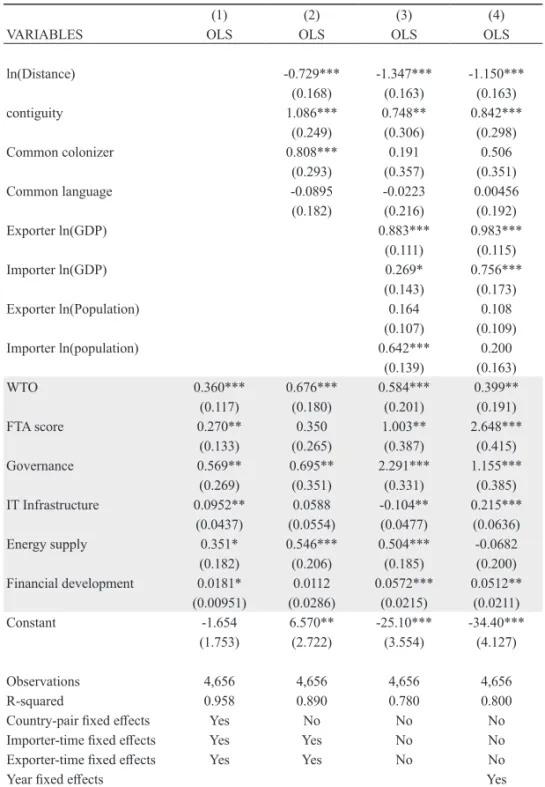
and thus serve the role which country-pair fixed effects serve in the previous model, although with lesser predictive value. This model was estimated using OLS as well. The results of the first two estimations are detailed in Table 1.
Table 1 Regression results of the first and second models
(1) (2) (3) (4)
VARIABLES OLS OLS OLS OLS
ln(Distance) -0.729*** -1.347*** -1.150*** (0.168) (0.163) (0.163) contiguity 1.086*** 0.748** 0.842*** (0.249) (0.306) (0.298) Common colonizer 0.808*** 0.191 0.506 (0.293) (0.357) (0.351) Common language -0.0895 -0.0223 0.00456 (0.182) (0.216) (0.192) Exporter ln(GDP) 0.883*** 0.983*** (0.111) (0.115) Importer ln(GDP) 0.269* 0.756*** (0.143) (0.173) Exporter ln(Population) 0.164 0.108 (0.107) (0.109) Importer ln(population) 0.642*** 0.200 (0.139) (0.163) WTO 0.360*** 0.676*** 0.584*** 0.399** (0.117) (0.180) (0.201) (0.191) FTA score 0.270** 0.350 1.003** 2.648*** (0.133) (0.265) (0.387) (0.415) Governance 0.569** 0.695** 2.291*** 1.155*** (0.269) (0.351) (0.331) (0.385) IT Infrastructure 0.0952** 0.0588 -0.104** 0.215*** (0.0437) (0.0554) (0.0477) (0.0636) Energy supply 0.351* 0.546*** 0.504*** -0.0682 (0.182) (0.206) (0.185) (0.200) Financial development 0.0181* 0.0112 0.0572*** 0.0512** (0.00951) (0.0286) (0.0215) (0.0211) Constant -1.654 6.570** -25.10*** -34.40*** (1.753) (2.722) (3.554) (4.127) Observations 4,656 4,656 4,656 4,656 R-squared 0.958 0.890 0.780 0.800
Country-pair fixed effects Yes No No No
Importer-time fixed effects Yes Yes No No
Exporter-time fixed effects Yes Yes No No
To investigate individual FTAs separately, an additional model was estimated,
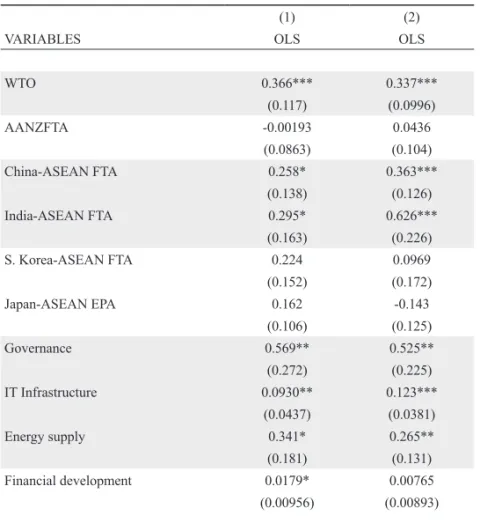
where dummy variables represent the five ASEAN+1 FTAs: the Australia-New-Zealand-ASEAN FTA (AANZFTA), China-ASEAN FTA, India-ASEAN FTA, Japan-ASEAN FTA/EPA, and South Korea-Japan-ASEAN FTA. Similarly to the FTAScore variable, these dummies were introduced with a three-year lag. The model was estimated with two specifications, one following the methodology of Ando and Urata (2015), with exporter-time and country-pair fixed effects, and one following the methodology of Yamanouchi (2019), where importer-time fixed effects were added. The results are presented in Table 2.
Table 2 Regression results of the first model with FTAs included
(1) (2)
VARIABLES OLS OLS
WTO 0.366*** 0.337*** (0.117) (0.0996) AANZFTA -0.00193 0.0436 (0.0863) (0.104) China-ASEAN FTA 0.258* 0.363*** (0.138) (0.126) India-ASEAN FTA 0.295* 0.626*** (0.163) (0.226) S. Korea-ASEAN FTA 0.224 0.0969 (0.152) (0.172) Japan-ASEAN EPA 0.162 -0.143 (0.106) (0.125) Governance 0.569** 0.525** (0.272) (0.225) IT Infrastructure 0.0930** 0.123*** (0.0437) (0.0381) Energy supply 0.341* 0.265** (0.181) (0.131) Financial development 0.0179* 0.00765 (0.00956) (0.00893)
Constant -1.547 1.361
(1.751) (1.218)
Observations 4,656 4,656
R-squared 0.958 0.954
Country-pair fixed effects Yes Yes
Importer-time fixed effects Yes No
Exporter-time fixed effects Yes Yes
As mentioned above, the fixed effects model does not allow for the measurement
of exporter- and importer-specific variables, as these would be absorbed by the fixed effects. For this reason, a fourth model was used to measure the exporter- and importer-specific effects of the institutional variables. For this model, a ʻsubstituteʼ
for fixed effects was used. Baier and Bergstrand (2009) suggest that the multilateral resistance terms introduced by Anderson and van Wincoop (2003) can be
ʻapproximatedʼ through observable trade costs. Following Baier and Bergstrand
(2009), I used two approximations: one based on bilateral distance, and one on a remoteness variable as defined by Head and Mayer (2014). These variables were constructed according to the following equation and were calculated with the codes of Shepherd (2016, pp. 28-29).
Thus, the model was estimated as:
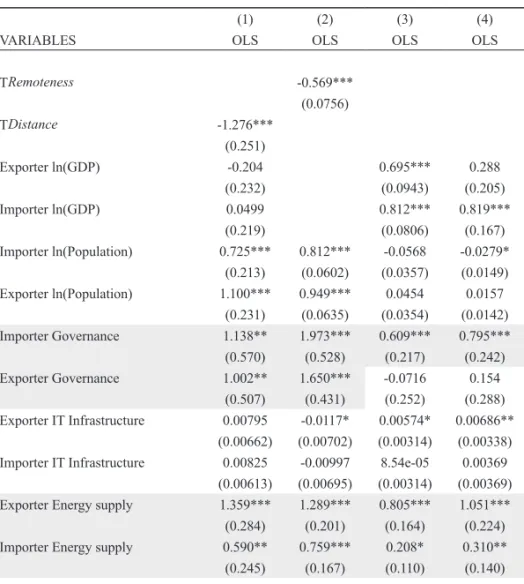
importer-specific fixed effects, but with country-pair fixed effects was estimated. Moreover, a random effects model was used for additional comparison, since it has been suggested that a random-effects regression accounts for unobserved heterogeneity, and yet allows the inclusion of variables that would be collinear with the fixed effects (Shepherd, 2016, p. 28). Nevertheless, the usage of random effects for gravity equations has not been theoretically developed, hence the results should be treated with caution. The results are presented in Table 3.
Table 3 Regression results of the third model
(1) (2) (3) (4)
VARIABLES OLS OLS OLS OLS
TRemoteness -0.569*** (0.0756) TDistance -1.276*** (0.251) Exporter ln(GDP) -0.204 0.695*** 0.288 (0.232) (0.0943) (0.205) Importer ln(GDP) 0.0499 0.812*** 0.819*** (0.219) (0.0806) (0.167) Importer ln(Population) 0.725*** 0.812*** -0.0568 -0.0279* (0.213) (0.0602) (0.0357) (0.0149) Exporter ln(Population) 1.100*** 0.949*** 0.0454 0.0157 (0.231) (0.0635) (0.0354) (0.0142) Importer Governance 1.138** 1.973*** 0.609*** 0.795*** (0.570) (0.528) (0.217) (0.242) Exporter Governance 1.002** 1.650*** -0.0716 0.154 (0.507) (0.431) (0.252) (0.288) Exporter IT Infrastructure 0.00795 -0.0117* 0.00574* 0.00686** (0.00662) (0.00702) (0.00314) (0.00338) Importer IT Infrastructure 0.00825 -0.00997 8.54e-05 0.00369
(0.00613) (0.00695) (0.00314) (0.00369) Exporter Energy supply 1.359*** 1.289*** 0.805*** 1.051*** (0.284) (0.201) (0.164) (0.224) Importer Energy supply 0.590** 0.759*** 0.208* 0.310** (0.245) (0.167) (0.110) (0.140)
Exporter Financial dev. 0.683*** 0.546** 0.00806 -0.00590 (0.258) (0.257) (0.0987) (0.101) Importer Financial dev. 0.578** 0.495** 0.210** 0.203** (0.227) (0.227) (0.0870) (0.0906)
Constant -23.82*** -21.93*** -41.81*** -37.90***
(5.230) (1.539) (2.741) (4.132)
Observations 4,656 4,656 4,656 4,656
R-squared 0.729 0.735 0.949
Country-pair fixed effects No No No Yes
Bilateral trade cost approximations Yes Yes No No
Random effects No No Yes No
4 Estimation results and discussion
The results show that in all specifications, the quality of governance and
WTO-membership are significant determinants of trade. Quality of governance consistently has the highest coefficient among the variables, confirming the hypothesis.
One exception is that when the exporter- and importer-specific variables are
estimated in a model with country-pair fixed effects or random effects, only the importer-side governance variable is significant, while the exporter side variable is not. This is contrary to expectations: domestic institutional quality is usually discussed in the context of industrialization; hence it is expected to have a stronger significance on the exporter side. On the other hand, it can be considered that institutional quality goes hand in hand with economic openness, hence countries with better institutions might be more open to imports. In any case, given the weaknesses of the random-effects model, the importance of these exceptions is meagre.
Coefficients for WTO-membership are significant across all the specifications.
With fixed effects, the WTO dummy is stronger than the FTA score and all FTA dummies except for one. This validates the argument that WTO-membership has been an important factor in East Asian trade-creation.
The significance of exogenous variables is weaker. Energy supply is significant
model with the strongest predictive value, with exporter-time, importer-time, and country-pair fixed effects. IT infrastructure has a meagre and often insignificant effect. Financial development is strong and significant when the country-specific variables are measured separately, but weak in fixed effects models. It is likely that the weakness of these indicators stem from the fact that differences in ITC attainment and financial development between countries are more nuanced than what could be estimated with the crude comparative data available, and hence their effects are understated in this model.
In fact, Baldwin (2016) posits that global trade and the structure of the world
economy are ultimately determined by the costs of moving goods, services, know-how, and people; which are, in the scope of this study, exogenous factors. According to this view, nations are no longer the natural unit of analysis in determining international competitiveness, since the fragmentation of production and the concentration of knowledge within MNEs decreases their ability to influence outcomes through traditional development policies. This paper uses a more traditional understanding of the international economy with a more favourable view of state capacity, but it should be noted that to more thoroughly investigate such trends, a more advanced analytic toolkit shall be developed.
Among the FTAs, only the China-ASEAN and the India-ASEAN agreements
are significant in this model. This might mean on the one hand that the FTAs of ASEAN with developed countries are highly heterogenous, which is not inconsistent with previous research (Ando and Urata, 2015; Yamanouchi, 2019). On the other hand, this result suggests that in the case of the ASEAN, due to its diversity, even less ambitious FTAs might be effective in raising trade values: even though the China-ASEAN and the India-China-ASEAN agreements are of lower quality than the Japan-ASEAN EPA, they still create new trade flows among previously relatively closed economies. This in line with the finding of Baier, Bergstrand, and Clance (2018), that FTAs have higher effects for countries with lower per capita GDP.
Apart from heterogeneity, another possibility which has not been explored here
FTA, considerable trade and production networking activity had preceded the implementation of the FTA, and Japan had already conducted a number of bilateral treaties with individual ASEAN members. Thus, one can hypothesise that the ASEAN-Japan EPA and the South Korea-Japan FTA have institutionalised trade ties which had already existed. Moreover, the young age of regional FTAs must be considered: it is possible that not enough time has passed since their implementation, and their trade-creation effects will grow over time.
When it comes to the depth of FTAs, the FTA score variable is significant in
three models out of four, yet loses its significance when time-invariant unobservable trade costs (country-pair fixed effects) are dropped. The FTAScore variable is weaker than the WTO dummy in the models, likely as a result of overall weak FTA depth in the treaties surveyed.
It should be noted that the regional institutional architecture is currently
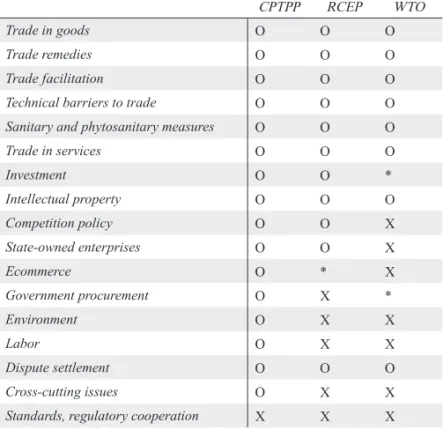
undergoing momentous changes which are not captured in this study. The first of these is the conclusion of the CPTPP. This treaty was to be adopted under the leadership of the United States as the Trans-Pacific Partnership among twelve Pacific states, including seven ASEAN Plus Six members. However, after the election of the protectionist Donald J. Trump as president of the US, Washington left the agreement. A somewhat weaker form of the TPP was signed in March 2018 as CPTPP by the rest of the participants and came into effect on 30 December 2018 among six countries which ratified it 7). The CPTPP covers a dearth of WTO+ and WTO-X issues such as
competition policy, widespread investment liberalization, intellectual property rights, and other forms of regulatory convergence (see Table 4). Therefore, it is described as a high quality 21st century free trade regime which establishes new benchmarks for international trade and investment rules and requires deep domestic reforms (Watanabe, 2016).
Table 4 The coverage of CPTPP and RCEP
CPTPP RCEP WTO
Trade in goods O O O
Trade remedies O O O
Trade facilitation O O O
Technical barriers to trade O O O
Sanitary and phytosanitary measures O O O
Trade in services O O O Investment O O * Intellectual property O O O Competition policy O O X State-owned enterprises O O X Ecommerce O * X Government procurement O X * Environment O X X Labor O X X Dispute settlement O O O Cross-cutting issues O X X
Standards, regulatory cooperation X X X Source: JETRO (2015)
The RCEP also goes beyond the WTO and ASEAN+ FTAs in its coverage but is
much less ambitious in liberalization and rule-setting than the CPTPP, as a substantial part of its membership is made up of less advanced economies (Chia, 2015). The status of the RCEP is unclear as of March 2020, after India decided to step away from the table due to its reluctance to open its markets.
While it is beyond the scope of this paper to analyse these undertakings in detail,
it should be highlighted that the wider adoption of CPTPP would result in significant FTA-induced domestic reforms, which would create favourable conditions for durable trade-creation and integration in the region and beyond. While it is less ambitious, the same holds true for the RCEP, which would provide more gradual liberalization in the case of a number of low income, closed ASEAN countries, and
therefore would open new markets and opportunities for production relocation, provided that these countries (see Chia, 2015).
Finally, an important limitation should be noted when interpreting the results.
The dataset contains data only for the ASEAN Plus Six, and no data for the rest of the world, as our goal was to discern the effects of institutional variables on East Asian intra-regional trade. Accordingly, variations across countries and across time come only from the variations among these sixteen countries. The discussion presented here is only valid for the determinants of trade among these economies and do not explain extra-regional effects.
5 Conclusion
This paper aimed to estimate how and to which degree did domestic institutional
quality, and the changes thereof, influence international trade within the ASEAN Plus Six. The expectation was to find a significant effect, based on the hypothesis that East Asian nations follow trade-based development policies and therefore instituted domestic institutional reform to be able to participate in regional trade. The hypothesis was tested through various specifications of the gravity model of trade and the empirical analysis positively confirmed the hypothesis.
Taken in its entirety, the empirical model lines up with the theory-based and
historically inferred arguments presented in the second section of the paper. While both domestic, regional and global factors contributed to the expansion of East Asian regional trade, domestic institutional quality had the highest coefficient in these estimations, consistent along the different specifications. WTO-membership remains equally important in providing rules, regulation and stability to regional commerce. This is not surprising, since East Asian regionalization is deeply embedded into globalization. On the regional level, progress has been heterogenous, which is not inconsistent with recent research.
The results of these estimations imply that domestic institutional reforms remain
of paramount importance for East Asian trade and economic development. One implication of this is that the low- and middle-income economies of the region should
press on with institutional reforms so as to be able to continue on their current development paths, especially as globalization is moving from physical forms of trade to nonphysical and more knowledge-intensive ones. A second implication is when it comes to regional institutions, those which promote market reforms and regulatory reforms, such as the CPTPP, would provide larger and more lasting trade-creation effects, while less ambitious institutions, such as the RCEP, would be less durable and effective. However, the regionʼs heterogeneity means that for the least
advanced economies of East Asia, the less ambitious and ʻmore flexibleʼ RCEP-type
agreements may provide ample benefits and motivations for reform as well.
Research on the effects of domestic institutional quality and domestic
institutional change on regional trade is relatively scarce, especially in the case of East Asia. This paper aimed to contribute to the discourse by introducing new variables and estimating them in a number of specifications, albeit with a less ambitious scope than some of the previous, more general papers (Nunn and Trefler, 2014). To attain more robust results, future research shall involve a larger dataset and improved control variables especially in the case of infrastructure and ICT attainment.
Endnotes
1) The RCEP involves the member countries of the ASEAN Plus Six framework, namely Australia, Brunei, Cambodia, China, India, Indonesia, Japan, Laos, Malaysia, Myanmar, New Zealand, Philippines, Singapore, South Korea, Thailand, Vietnam. India decided to suspend its participation in the RCEP negotiations in late 2019.
2) Institutions are understood here broadly, “as the rules of the game”, or “the set of rules in a society,” which “are key in the determination of transaction costs,” as formulated by North (1992, p.5-10).
3) The NAFTA was renegotiated as the Agreement between the United States of America, the United Mexican States, and Canada (USMCA), which is due to enter into force in 2020. 4) A related argument explains East Asian regionalization through the concept of informal
governance networks made up of sub-state actors which are involved in transnational activities. (Katzenstein and Shiraishi 1997)
5) For example, the rule of law and regulatory quality in Vietnam began to improve in the early 2010s. Laos stagnated even though it is participant to ASEAN FTAs. Chinaʼs values are highly heterogenous, but the improvements occurred mostly after 2010.
services data on the other side of the equation does not interfere with it.
7) The current membership of the CPTPP include Japan, Mexico, Singapore, New Zealand, Canada, Australia and Vietnam. Chile, Brunei, Peru and Malaysia are also signatories, but are yet to ratify the treaty as of March 2020.
References
Acemoglu, D., and Robinson, J. (2012) Why nations fail: The Origins of Power, Prosperity, and
Poverty, New York: Random House.
Anderson, J. E., and van Wincoop, E. (2003) “Gravity with Gravitas: A Solution to the Border Puzzle”, American Economic Review. 93(1), pp. 170-192.
Ando, M., and Urata, S. (2015) “Impacts of Japanʼs FTAs on Trade: The Cases of FTAs with Malaysia, Thailand, and Indonesia”, RIETI Discussion Paper. 15-E-104. Jakarta: Economic Research Institute for ASEAN and East Asia.
Ando, M., Urata, S., and Yamanouchi, K. (2019) “Do Japanʼs Free Trade Agreements (FTAs) Increase Its International Trade?”, RIETI Discussion Paper Series, 19-E-090. Jakarta: Economic Research Institute for ASEAN and East Asia.
Ando, M., and Kimura F. (2013) “Production Linkage of Asia and Europe via Central and Eastern Europe”, Journal of Economic Integration. 28(2), pp. 204-240.
Ando, M., and Kimura F. (2014) “Evolution of Machinery Production Networks: Linkage of North America with East Asia”, Asian Economic Papers. 13(3), pp. 121-160.
Baier, S. L., and Bergstrand, J. H. (2007) “Do Free Trade Agreements Actually Increase Membersʼ International Trade?”, Journal of International Economics. 71(1), pp. 72-95. Baier, S. L., and Bergstrand, J. H. (2009) “Bonus vetus OLS: A simple method for
approximating international trade-cost effects using the gravity equation”, Journal of
International Economics. 77(19), pp. 77-85.
Baier, S. L., Bergstrand, J. H., and Clance M. W. (2018) “Heterogeneous Effects of Economic Integration Agreements”, Journal of Development Economics. 135(1), pp. 587-608. Baldwin, R. E. (2006) “Multilateralising Regionalism: Spaghetti Bowls as Building Blocs on the
Path to Global Free Trade”, The World Economy. 29(11), pp. 1451-1518.
Baldwin, R. E. (2008) “Managing the Noddle Bowl: The Fragility of East Asian Regionalism”,
The Singapore Economic Review. 53(3), pp. 449-478.
Baldwin, R. E. (2011) “21st century regionalism: Filling the gap between 21st century trade and 20th century trade rules”, WTO Staff Working Paper. ERSD-2011-08
Baldwin, R. E. (2016) The Great Convergence:Information Technology and the New
Globalization. Cambridge: Harvard University Press.
Beck, T. (2002) “Financial development and international trade: is there a link?”, Journal of
International Economics. 57(1), pp. 107-131.
Becker, B., Chen, J., and Greenberg, D. (2013) “Financial Development, Fixed Costs and International Trade”, The Review of Corporate Finance Studies. 2(1), pp. 1-28.
Chen, L., and De Lombaerde, P. (2014) “Testing the relationships between globalization, regionalization and the regional hubness of the BRICs”, Journal of Policy Modeling. 36S, pp. S111-S131.
Chia, S. Y. (2015) “Emerging Mega-FTAs: Rationale, Challenges, and Implications,” Asian
Economic Papers. 14(1), pp. 1-27.
62(2), pp. 151-163.
Gurevich, T. and, Herman P. (2018) “The Dynamic Gravity Dataset: 1948-2016”. USITC Working Paper 2018-02-A.
He, K. (2018) “Role conceptions, order transition and institutional balancing in the Asia-Pacific: a new theoretical framework”, Australian Journal of International Affairs. 72(2), pp. 92-109.
Head, K., and Mayer T. (2014). “Gravity Equations: Workhorse, Toolkit, and Cookbook”. In Golpiath, G., Helpman, E., and Rogoff, K. (Eds): Handbook of International Economics (4). Oxford: North-Holland. pp. 131-195.
Helpman, E., Melitz, M., and Rubinstein, Y. (2008) “Estimating trade flows: trading partners and trading volumes”, Quarterly Journal of Economics. 123(2), pp. 441-487.
Japanese External Trade Organization (2015) “JETRO global trade and investment report.” Tokyo: JETRO.
Katzenstein, P. J., and Shiraishi, T. (1997) Network Power: Japan and Asia. Ithaca: Cornell University Press.
Keohane, R. O. (1984) After Hegemony: Cooperation and Discord in the World Political
Economy. Princeton: Princeton University Press.
Kimura, F. (2006) “International Production and Distribution Networks in East Asia: Eighteen Facts, Mechanics, and Policy Implications”, Asian Economic Policy Review. 1(2), pp. 326-344.
Kimura, F., and Ando, M. (2005) “Two-Dimensional Fragmentation in East Asia: Conceptual Framework and Empirics”, International Review of Economics and Finance. 14(3), pp. 317-348.
Lee, S. (2014) “Institutional Balancing and the Politics of Mega-FTAs in East Asia”, Asian
Survey. 56(6), pp. 1055-1076.
Levchenko, A. A. (2007) “Institutional quality and international trade”, Review of Economic
Studies. 74(3), pp. 791-819.
Manger, M. S. (2014) “The Economic Logic of Asian Preferential Trade Agreements: The Role of Intra-Industry Trade”, Journal of East Asian Studies. 14(2), pp. 151-184.
Mutsvangwa, S., Parsons, C. R., and Shrestha, N. (2019) “Japanʼs trade agreements arenʼt “window dressing” after all”, The International Trade Journal. 33(2), pp. 176-196. North, D. C. (1992) Transaction costs, institutions, and economic performance. San Francisco:
ICS Press.
Nunn, N. (2007) “Relationship-specificity, incomplete contracts, and the pattern of trade”,
Quarterly Journal of Economics. 122(2), pp. 569-600.
Nunn, N., and Trefler, D. (2014) “Domestic Institutions as a Source of Comparative Advantage”. In Golpiath, G., Helpman, E., and Rogoff, K. (Eds): Handbook of International Economics (4). Oxford: North-Holland. pp. 263-315.
Olarreaga, M. (2016) “Trade, Infrastructure, and Development”, ADBI Working Papers Series, 626. Tokyo: Asian Development Bank Institute.
Petri, P. A., and Plummer, M. G. (2016) “The Economic Effects of the Trans-Pacific Partnership: New Estimates”, Working Paper 16-2. Peterson Institute for International Economics and East-West Center.
Ravenhill, J. (2010) “The ʻnew East Asian regionalismʼ: A political domino effect”, Review of
International Political Economy. 17(2), pp. 178-208.
Shepherd, B. (2016) The Gravity Model of International Trade: A User Guide. United Nations ESCAP.
https://www.unescap.org/resources/gravity-model-international-trade-user-guide-updated-version (Accessed on September 22, 2018)
Urata, S. (2019) “Trends of FTAs in East Asia from the 1990s to the 2010s: defensive and competitive regionalism”. In Ing, L Y., Richardson, M., Urata, S. (Eds.) East Asian
Integration: Goods, Services and Investment. New York: Routledge. pp. 6-24.
Watanabe, Y. (2016) “Japanese Trade Strategy in the 21st Century: TPP, the Japan-EU EPA, and the Global Trading System”, German Marshall Fund Asia Policy Paper. 22, pp. 20-25. The World Bank (1993) The East Asian miracle: economic growth and public policy. New York:
Oxford University Press.
The World Bank (2018) “World Integrated Trade Solutions database”, https://wits.worldbank. org/ (Accessed on November 2, 2018)
Yamanouchi, K. (2019) “Heterogeneous Impacts of Free Trade Agreements: The Case of Japan”,
Asian Economic Papers. 18(2), pp. 1-20.
〔受付日 2019. 11. 29〕 〔採録日 2020. 5. 29〕