
関西学院大学リポジトリ
119
0
0
全文
(2) The Impact of Human Resource Management Practices on Standard Screw Manufacturing Organizations in Taiwan Chun-Lin Yang. I. Introduction 1. Introduction. The traditional concept of strategy (Andrew, 1971) is phrased in terms of the resource position (strengths and weakness) of the firm, whereas most of our formal economic tools operate on the product-market side. Shapiro (1989) argued that the primary focus of strategy is to understand the type of competition and the ability to make reliable predictions concerning a firm and how firms are affected by exogenous or structural change. According to Caves, Porter, and Spence's (1980) framework, effective business strategies can be classified as either cost leadership strategies or differentiation strategies (Dess and David, 1984). For manufacturing firms, adoption of cost leadership is a main strategy used in order to save costs in every possible way, in an attempt to be more productive than their competitors. Since the purpose of any firm is to make the most profits possible, the way in which a firm manages its human capital is increasingly recognized as centrally important to the execution of its strategy (Hambrick et aI., 1989). In the 1990s, it became a widely held premise that people provide organizations with an important source of sustainable competitive advantage (Prahalad, 1983; Preffer, 1994; Wright, McMahan, & McWilliams, 1994) and that the effective management of human capital, not physical capital, may be the ultimate determinant of organizational performance (cf. Adler, 1998; Reich, 1991). The value of human capital may be especially apparent in modem manufacturing organizations that have invested heavily in production innovations such as advanced manufacturing technology, statistical process control, and computer numerically controlled machine tools. Such initiatives tend to depend heavily on employee skills and commitment as key components in the value creation process (cf. Snell& Dean, 1992). Accordingly, it is instrumental for manufacturing firms to harness the productive potential of their employees in order to achieve superior performance. In most manufacturing firms, cost-based manufacturing strategies tend to focus on internal effectiveness of capital equipment, thereby reducing the impact of human capital on performance. This is in line with the economic thinking of substituting capital for labor. Accordingly, administrative approacheS. to human resource that focus on standardized policies and procedures would likely be On the other hand. manufacturing strategies that. the increase of skills of. lTIo:-;t. appro-. quality and flexibility tend to. thereby necessitating a human-capital-enhancing approach. human. resource that focus on skill acquisition and development. In thi:-; study, the HR practices are defined as the traditional view of the HR functions still done today by the HR department. The administrati ve polices are defined as processes and procedures used in HR practices. The human-capital-enhancing prac1.
(3) tices are defined as the processes and procedures that are an emerging area of HR and are becoming an important part of the firm's strategy. These human-capital enhancing practices are among the critical elements that develop organizational capability that in turn provide sustainable competitive advantage. In order to understand the broad concepts that are present in this paper, it is important to explain the distinction between administrative activities, human capital enhancing, and human resource practices (Table 1). Table 1 summarizes the distinctions between the common human resource practices, administrative human resource activities, and those designed to enhance the level of human capital within firms. As noted in Table 1, I select three central HRM practices as outcomes of HR, administrative, and Human-Capital-Enhancing practices. These three HRM practices of strategic HR process are: (1) Employee' creativity; (2) Turnover rate; (3) Tacit manufacturing knowledge. And a fourth is the resulting human capital performance. The HRM practices themselves will be discussed as below.. 2. Situation in Taiwan In Taiwan, technology-intensive industries have expanded from 30% of the total industrial structure in 1987 to 43% today, while labor-intensive industries have declined to 25%. In fact, manufacturing was the main productive force in Taiwan, without exception, it also raised the economy of Taiwan. In other words, important changes have occurred in Taiwan's industry structure over the last decades. Making Taiwan a 'high-tech island' has been the most prominent feature of the industrial policy direction of both the government and industries. Accordingly, the development of science-based industrial parks will help to pool resources, cluster high-tech firms together, and facilitate R&D activities. For various reasons, there were 25% who could not adopt high-tech product innovations. This 25% of manufacturers are composed of numbers of manufacturing firms that still produce essentially the same manufactured products as thirty years ago, which means they are producing without product innovations but still are profitable and able to survive. These firms try to find alternative ways to compete and to make themselves more profitable. One alternative was an ethos of industry migration from Taiwan to China in 1990s. Also, the lack of product innovation is the main factor for product standardizations for many years. In the 1980s, Taiwan was a low cost of living country, but this had changed now. In addition, the competitive landscape of this industry has not allowed these firms to pass on the cost increase resulting from the increases in standard of living to their customers, thus the benefit to the firm has become lower and has lessened their competitive advantages. An alternative way was the development of human resource cabilitics linked to a low cost manufacturing strategy. Among the firms that survive, one reason for their. that they have better HRM practices to retain their. standardizations. their cllstomers, and lower costs to compete with their. hough they are still producing essentially the same products as thirty years ago, costs in order. to. product Therefore, althave lowered the. keep surviving in this violently competitive market. According to Budhwar's (2004). 2.
(4) Comprehensive Training And Problem-Solving Skills Salary Skill-Based Group Incentives. Job Based Training Policies And Procedures. Hourly Individual incentives. Training. Compensation. 3. Employees Motivation And Creativity. Selective Staffing on Technical Skills And Attitude. Physical! technical Skills Selection. Staffing. Tacit Manufacturing Knowledge. Turnover Rate. Improvements in Communications Between Employees And Management. Manufacturing Processes Innovation. Strategic HR Processes. H uman-Capi tal-Enhancing. Administrative Polices. HR Practices. Resource Practices. Distinction between Administrative, Human-Capital-Enhancing, and Human. TABLE 1.
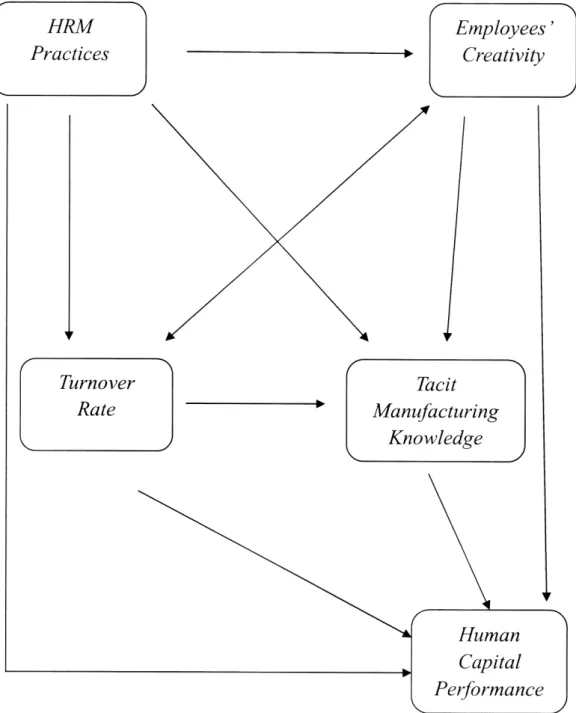
(5) statement,he argued that the development of HRM systems in Taiwan can be divided into three different stages (Yao, 1999). The first stage was during the mid-1960s, and coincided with the country's focus on the agricultural industry. In this stage, Negandhi (1973) found that the HRM systems used by local Taiwanese enterprises were less developed than those of US and Japanese subsidiaries. The second stage was the learning period (1965-1985). During this period of time, many multinational companies (mainly from the USA and Japan) set up their manufacturing line in Taiwan and also made Taiwan adopt labor-intensive manufacturing by focusing on the manufacturing industry. Yeh (1991) conducted his study in 1984-1985 and found that local companies had learned quickly from their Japanese and US competitors, mainly on manufacturing and recruitment. The third stage started in the mid-1980s. It was also the time that US organizations started to focus on the idea that business strategy was important to the HRM systems. At the same time, Taiwanese organizations imitated and started to bring the HRM practices into the boardroom. It was also the time that Taiwan's industry became more service-oriented and more focused on IT, with many IT firms, such as Acer and Mitac, being set up. Wu (1990) examined the role of HR managers in the top 500 manufacturing firms in Taiwan. She found that 88% of the firms had a formal personnel department and 80% of the heads of the HRM function bore the title manager. More recently, Huang (2001) found that 44% of companies in Taiwan have HRM practices linked closely to a firm's strategic function. The role of HRM in many companies had transformed from an administrative role to a strategic role smoothly. In this case, I will use my three central HRM practices to discover the current situation in manufacturing firms in Taiwan. Unfortunately, the areas of HRM activities are not well examined and discussed by Taiwanese scholars in Taiwan. I have found only limited research which has examined this topic. This is also the reason that I choose this area to examine. In general, the areas of HRM activities are very well examined in the west and Japan. As noted earlier, many scholars have suggested that the best HRM practice is contingent on the competitive strategy of a firm. Achieving competitive advantage success through people involves fundamentally altering how we think about the workforce and the employee relationship. It also means achieving success by working with people, not by replacing them or limiting the scope of their activities. It entails seeing the workforce as a resource of strategic advantage, not just as a cost to be minimized or avoided (Preffer, 1995). Moreover, Barney & Wright (1998) argued that the role of the HR executive as a strategic partner in developing and maintain competitive advantage can positively influence the firm and its performance. With those issues I have mentioned in mind, I purpose this study with two overall objectives: (1) Determine the extent to which HRM systems directly enhance the human capital performance; (2) Analyze the moderating efTects of employee' turnover rate, and tacit. knowledge on the. """'''''''''.fJ. between HRM systems and hu-. man capital performance in raiwan's manuhlcturing; Figure I summarizes my research. model.. This research paper is divided into three sections. First is a review of the empirical research literatures. The second is the definition of the central conceptual framework. The third is the central theories and hypotheses. The hypotheses are tocusing on the relationships between HM practices and firm perform4.
(6) Figure 1 Human Resource Management and Human Capital Performance. ance.. II. Empirical HRM Research Literatures Review Human resource activities are frequently acknowledged to playa central role in linking employee capability with the productivity requirements of a firm; however, the specific form of this relationship is still an open debate. To date, two primary perspectives: (1) Universal approach; (2) Contingency approach have both been used to describe the link between human resource management and firm performance (Youndt, Snell, Dean, & Lepak, 1996). The universal approach perspective implies a direct relationship between particular approaches to human resources management and performance. For instance, many scholars who used universal approach have argued that increasing the investment in employee skills, knowledge, and capabilities can increase the firm performance (Duncan & Hoffman, 1981; Rumberger, 1987; Tsang, 1987). Moreover, Becker (1976) and Parnes (1984) also argued that the way to increase productivity and firm performance is to invest in human capital (through the HRM practices). Brooks and Nafukho (2006) also stated that human resource development and organization performance is highly integrated. The contingency approach posits that an organization's strategic posture either augments or diminishes the. of human resource. ()t1. performance.. and his colleagues (1995). organizations exhibited higher performance when. the findings of Wright recruited and ac-. quired employees possessing competencies consistent with the organizations' current strategies. Moreover, they also found that organizations exhibited higher performance when they sought out a strategy that matched their current employees' competencies (cf. Snow & Snell, 1993). This work applies em5.
(7) pirical support for the general assumption that a tighter fit between human resource competencies and strategy leads to a higher level of firm performance (Baird & Meshoulam, 1988; Miles & Snow, 1984, 1994). Analytically, this distinction has been operationally defined as main effects for the universal perspective and as interaction (or moderation) effects for the contingency perspective. "Theoretically, the universal approach helps researchers document the benefits of HR across all contexts, ceteris paribus, and the contingency approach helps researchers look more deeply into organizational phenomena to derive more situationally specific theories and prescriptions for management practices" (Youndt, Snell, Dean, & Lepak, 1996: 837). In this research, I am focusing on the relationship between human resource activities and organization performance, so I choose to use the contingency approach since I am examining the traditional manufacturing firms who have chosen a low cost strategy and will examine the influence of their HR practices on their firm performance. Over the years, researchers have amassed a fair amount of empirical evidence that certain HR practices can directly affect firm performance. In 1980s, it was recognized that since firm investments to increase employee skills, knowledge, and abilities carry both out of pocket and opportunity costs, they are only justified if they produce future performance increases via increased productivity (Duncan & Hoffman, 1981; Rumberger, 1987; Tsang, 1987). Moreover, there were some studies that showed that comprehensive selection and training activities are frequently correlated with both productivity and firm performance (Kleiner et al., 1987; Russell et al., 1985).In other words, increased productivity derived from human capital investment depends on the contribution of employees to a firm. Therefore, the higher the potential for employee contribution in a firm, the more likely it is that the firm will invest in human capital (via human resource management activities) and that these investments will lead to higher individual productivity and firm performance (Becker, 1976; Parnes, 1984). As many contemporary manufacturers are said to be increasing the potential for employee contribution in their production equations (Walton & Susman, 1987), human capital theory would suggest that human resource practices can directly influence firm performance. From 1990s, a good deal of empirical evidence showed that individual HR practices, put together as internally consistent systems or bundles of HR practices, can directly influence organizational performance (e.g., Arthur, 1994; Huselied, 1995; Freund & Epstein, 1984; Mac Duffie, 1995; Kleiner, Block, Roomkin, & Salsburg, 1987; Kochan& Osterman, 1994; MacDuffie,1995; Osterman, 1994; Pfeffer, 1994; Russell, Terborg, & Powers, 1985; Terpstra& Rozell, 1993) (Table 2 summarized the best HR practices of those above empirical issues). For supporting the HR systems and internal fit perspective, Arthur (1992, 1994) showed that certain HR practices that focused on enhancing employee commitrnent ! e.g. decentralized decision making. cLHnprehensive training. :>alaried compensation, employee 011). generated higher. HR. that focused on control. efti-. the reduction of employee :>kilb and discretion often incre(J:>ed turnover and re:>ulted in poorer Illtrlubcturing performance. Similarly in a different study of what arc called high performance work. Huselid (1995) indicated that when firms invested in HR activities such as incentive. compensation, selective staffing techniques, and employee participation they gained the result of lower 6.
(8) turnover, greater productivity, and increased organizational performance. Huselid (1995) also indicated that these positive performance results come through their impact on employee skill development and motivation. Research done more recently has indicated a deepening of the understanding of HRM and firm strategy. Bendoly and Prietula (2008) considered that training for a given operational task and experiential learning could heighten the individual skill in order to heighten organizational productivity. In another study, organization performance was described as a potential function of individual skill and associated organizational learning (Carrillo & Gaimon, 2004). Also, numerous scholars argued that motivation and skill both clearly interact to raise organizational performance (MacCarthy & Atthirawong, 2003; Yeo & Neal, 2004). Furthermore, some scholars have recognized that skill and motivation can not only interact to affect organization performance but also exist in a synergistic relationship, so that skill may drive motivation and motivation may be active in the development of skills (Bendoly & Hur, 2007). Going beyond these direct HR-performance relationship, however, other evidence indicates that the impact of HR practice are strongest when matched with the competitive requirements inherent in a firm's strategy (e.g., Capppelli & Singh, 1992; Jackson, Schuler, & Rivero, 1989; Miles & Snow, 1984; Wright, Smart, & McMahan, 1995; Burton, Lauridsen, & Obel, 2004). Delaney & Huselid (1996) looked at the effect of certain individual HRM practices (e.g. comprehensive selection and training activities) and they found positive effects on firm performance. More recently, Ichniowski et a1. (1999) derived specific prototypical bundles of HRM practices that they explored as determinations of finn performance. For HRM activities, Huelid (1995) found in his investigation of investment in HRM activities which included incentive compensation, selective staffing techniques, and employee participations that these resulted in lower turnover, greater productivity, and increased organizational performance. MacDuffie (1995) found that bundles of inter-related HRM practices had more influence on performance than individual practices working in isolation. Barney and Wright (1998) argued that the relation between developments in the HR Department and firm performance is positive. Each of these strategies with differentiation or cost leadership implies something different about the potential role of HRM practices in improving firm performance. In Table 2, I show selective representative studies that provide a list of empirically examined HR practices to provide a potential list of HR practices that I will use in this research. At their root, most of the studies focus on enhancing the skill base of the employee via HR practices such as selective staffing, comprehensive training, and broad developmental efforts like job rotation and cross-utilization. Further those studies tend to promote empowerment, participaand teamwork with Job redesign. group-based incenti \I.::S. and a transition from. tive hourly. to. salaried compensation for production workers.. With those IIR practices in mind, I will apply them to my three central HRM strategic factors to conduct this study from the perspectives of cost strategies and the resource based view of the firm to the current HRM in manufacturing firms in Taiwan. From the above scholars' research, I selected the 7.
(9) Freund &Epstein( 1L)~4) Job enlargement Job rotation Job design Formal training Personalized work hours Suggestion systems Quality circles Salary for blue-collar workers Attitude surveys Production teanlS Labor/managelnent committees Group productivity incentives Profit sharing Stock purchase plan. Arthur( 1992) Broadly defined jobs Employee participation Fonnal dispute resolution Information sharing Highly skilled workers Self-managed teams Extensive skills training Extensive benefits High wages Salaried workers Stock ownership. 8. Pfeffer( 1994) Employment security Selective recruiting High wages Incentive pay Employee ownership Information sharing Participation Empowerment lob redesign/teams Training and skill development Cross-utilization Cross-training Symbolic egalitarianism Wage compression Promotion from within Huselid(1995) Personnel selection Performance appraisal Incentive compensation lob design Grievance procedures Information sharing Attitude assessment Labor/management participation Recruiting intensity Training hours Promotion criteria (seniority vs. merit). TABLE 2 Summary of Best Practices in Human Resources. MacDuffie( 1995) Work teams Problem-solving groups Employee suggestions lob rotation Decentralization Recruitment and hiring Contingent compensation Status differentiation Training of new employees Training of experienced employees.
(10) HR practices of Arthur (1992), Pfeffer (1994), and Huselid (1995). These will be applied to the three central HRM practices outcomes :(1) Employee' creativity; (2) Turnover rate; (3) Tacit manufacturing knowledge to determine their hypothesized relationships.. III. Central Conceptual Framework 1. Three Main HRM Practices. In order to do this research, I use a conceptual framework (Figure 2) derived from the studies discussed above as the core framework that explain the relationship between HRM practices and firm performance. In this model, I examine the impact of HRM practices on four HRM practices: (1) Employee' creativity; (2) Turnover rate; (3) Tacit manufacturing knowledge; (4) Human capital performance. Moreover, each elements has connections with each other, we leave to later a discussion of whether the relationship is positive or negative. We focus here on the direct or indirect characteristics of the relationships of the HRM practices and three HRM practices on human capital performance. For these HRM practices, some scholars have classified these as organizational component or individual component. In order to run this study, HRM practices Employee' creativity; Tacit manufacturing knowledge are defined as individual components here. For the HRM practice of Employees' creativity, it is assumed that their creativity will occur or originate within the employees themselves. For the HRM practice of turnover rate, it is considered that both the employees may want to leave by themselves and that the firm strategy may force them. For the HRM practice of tacit manufacturing knowledge, it is defined as the in-house manufacturing knowledge that can be well known by those employees. Nonaka, Toyama, and Konno (2000) identified that the organization is not only an information processing machine, but a place that can create knowledge by its action and interactions with its environment and through the synthesis of organization capabilities. Before the manufacturing procedures, employees will learn some knowledge from the training programs or the manual book. These will help them to produce more efficiently. However, they can try to write everything down, but the experience is not included. All kinds of situations will occur in the production line, even the out of the expectation. The tacit manufacturing knowledge will help in handling with these problems and also increase the quality issues.. IV. Central Theories and Hypotheses 1. Central Conceptual Views Resource Based View (RBV). "The attributes that make the firm a significant. theoretical attention. recent history, the change- the firm itself. its existing patterns of routine. its tangible and. of action available to the individual involved (Winter, 196R: 12).. as any. worthy of assets, its attributes. this, a routine activity can be viewed as a re-. source is meant anythillg which could be thought of as a strength or weakness of a. firm. More. formally, a fIrm's resources at a certain given time can be defined as those (tangible and intangible) assets which are tied closely to the firm (Caves, Porter, and Spence, 1980). Examples of resources are: b9.
(11) Figure 2: General Conceptual Framework Relationships between HRM Practices and Human Capital Performance. HRM. Employees' Creativity. Practices. Turnover Rate. Tacit Manufacturing Knowledge. Human Capital Performance. rand names, in-house knowledge of. employment of skilled personnel, trade contacts, ma-. enicient procedures, capital, and f IRLvI the sources. side..; of the same coin. Most CLill. etc. "For the fi. ['esources and products are. re4uire the services of. resources and most re-. he used in several products. By specifying the size of the tirm's. in different product. markets, it is possible to infer the minimum necessary resource commitments, Conversely, by specifying a resource profile for a firm, it is possible to find the optimal product-market activities" (Wemerfelt, 10.
(12) 1984: 171). "Looking at economic units in terms of their resource endowment has a long tradition in economics. The analysis is typical confined, however, to categories such as labor, capital, and perhaps land. The idea of looking at firms as a border set of resources goes back to the seminal work of Penrose (1959), but, apart from Rubin (1973), has received relative little formal attention, the reason, no doubt, is the unpleasant properties (for modeling purpose) of some key examples of resources, such as technological skills" (Wernerfelt, 1984: 171). Form the views of strategic management and organizational economics, the resource based theory of competitive advantage focus on what the role of internal resources like employees play in developing and maintaining a firm's competitive capabilities (Barney, 1991; Wright & McMahan, 1992; Wright et al., 1994). In fact, numerous researchers have recently noted that people may be the ultimate source of sustained competitive advantage since traditional sources related to markets, financial capital and scale economies have been weakened by globalization and other environmental changes (Reich, 1991; Ulrich & Lake, 1991). Pfeffer (1994), in particular, has made the case that in order to succeed in today's global business markets must invest the appropriate human resource practices to acquire and build employees within better skill and capabilities than their competitors. Moreover, in recent years, strategy scholars have increasingly agreed that non-imitable and non-substitutable organizational capabilities (and resources) are the main source of higher level firm performance (Barney, 1991; Dosi, N elson, and Winter, 2000; Rumelt, 1974; Wernerfelt, 1984). Although there are a number of theoretical arguments about the characteristics of resources or capabilities that emerge competitive advantage (Barney, 1991) and also keep their non-imitation (Dierickx and Cool, 1989; Peteraf, 1993). In short, through the RBV theory, human capital is seen as the most important resource of an organization, it controls the standardize production procedures, R&D developments, manufacturers, and strategic management. Each department has its own responsibility to maintain or increase profitability and organized the organization running so that it can continue to go forward. Barney and Wright (1998) argued through the value, rareness, irnitability, and organizational framework, that the human resource function plays an important role in developing a sustainable competitive advantage in an organization. Cost Strategies. Michael Porter (1. mensiun which are. should include three di-. niche and cost strategy. The role of cost strategy played in this re-. search is that the majority of Taiwanese traditional manufacturing firms adopted the cost strategy as their major strategy. The reason for doing this is because it is the easiest way to cut cost and can also increase the firm financial performance. Perfonnance appraisal would also need to concentrate on areas such as errors reduction and process standardization in order to reduce costs and improve efficiency (Majchrzak, 19R8). Organizations can directly and immediately create for their customers and them\alue CUll. reducing costs. other characteristic nf the. such as quality, are held. tent. Since people are one of the most costly and uncontrollahle resources affecting this equation,. the approach used most often in manufacturing to control costs is to diminish the amount of human capital needed in the production process by substituting capital equipment for people. Since capital equipment embodies technological advances, this substitution not only have the potential to reduce 11.
(13) costs by eliminating people, but can also lower the wage levels for the remaining employees. This is especially the case if the new production systems require lower skill levels and decision-making capabilities form those remaining employees (Majchrzack, 1988). It has been found that programmed production systems and highly structured jobs are used as a method for deskilling manufacturing workers, and resulting in the reduction of discretion in decision-making in their jobs (Helfgott, 1988). Moreover, administrative HR systems (i.e., selection for manual skills, policies and procedures training, resulted-based performance appraisal, hourly pay, and individual incentives) are consistent with the requirements of a cost strategy focused on standardizing process, reducing errors, and maximizing production efficiency. This cost reduction strategy is usually adopted by lower technological and skill organizations. These firms have one common characteristic which is old manufacturing equipment. They are limited in their ability to invest in their R&D, in term of capital expense, they turn to focus on their productivity and quality while maintain the same cost in order to keep their profits. In this study, I adopted the Resource Based View (RBV) and cost strategy as my central conceptual perspectives. The RBV offers a quite useful conceptual basis for understanding why HRM can make a potential contribution to human capital performance at the level of the firm directly. Moreover, both the RBV and HRM are focused not only on the employee but also on how to make the firm profitable through contingency administration. From the cost strategy view, it explains how these low skill manufacturing can still survival and keep their profits and compete with their competitors. It can also explain why the current Taiwan manufacturing industries can keep their competitive advantage form decades ago. In this study, I conclude the conceptual framework as seen in Figure 2 to analyze these phenomenon.. 2. Hypotheses (1). HRM Practices and Human Capital Performance In the past years, there are many research studies that discussed how HRM elements successfully affected an organizational performance. Pfeffer (1998) argued a set of seven practices for the successful organization, which are (1) Employment security ;(2) Selective hiring of new personnel ;(3) Self-managed teams and decentralization of decision making as the basic principles of organizational design ;(4) Comparatively high compensation contingent on organizational performance ;(5) Extensive training ;(6) Reduced status distinctions and barriers, including dress, language, office arrangements, and wage differences across levels ;(7) Extensive sharing of financial and performance information throughout the organization. Similarly, following the work of Ichniowski and Shaw (1999), Chang and Chen (2002) combined the HRM practices into eight elements: human resource planning, recruiting and. incentive pay,. appraisal, teamwork.. scholars have focLised their discussion on. tlexibility, and employee team work, and per-. formal1l:e appraisal. I will not adopt these in my study. The main reason for not adopting these three HRM practices is because the sample firms of this research are small and medium enterprises in Taiwanese traditional manufacturing. In these kinds of organizations, they do not focus their HRM sys-. 12.
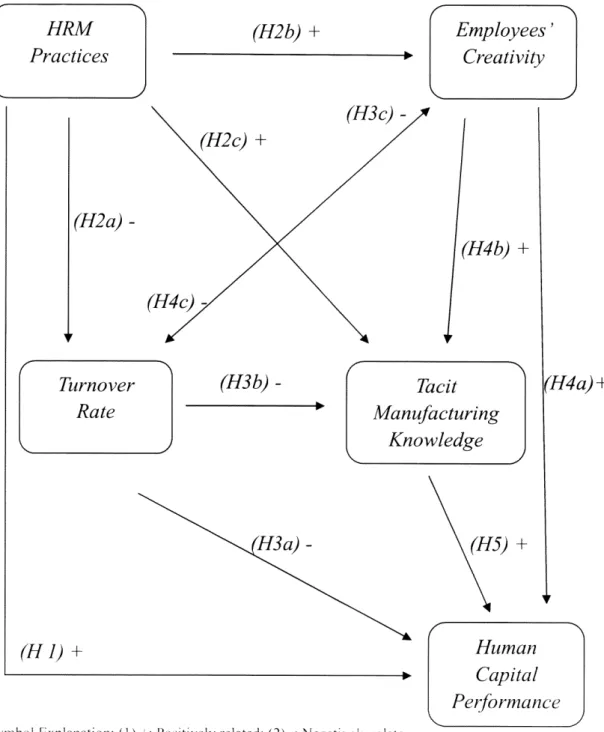
(14) tems on employee security, team work, and performance appraisal. In order to make the most profit for their firms, they produce their products in the simplest and most efficient way. They focus on recruitment, selection, and compensation and prefer their employees to manufacture according to what the training program has taught them.. Huselid (1995) found that the implementation of high-performance. work system (rigorous recruitment, selection, compensation, and training functions) had higher employee productivity and better corporate financial performance. In this study, I will adopt the recruiting and selecting, training, and compensation systems as my three main HRM practices. In selecting these three HRM practices, we understand other HRM practices are also important for any other organizations. However, we would like to discuss employee' creativity, turnover rate, and tacit manufacturing knowledge in this study which are directly connected to those three HRM practices. Moreover, emerging research show that investment in human capital, including training, are positively related to organizational performance (Kraiger, McLinden, & Casper, 2004 ).They argued that various HRM systems have an effect on human capital performance and this argument leads to hypothesis one:. Hypothesis 1: HRM practices are positively associated with human capital performance.. (2). HRM Practices, Turnover Rate, Employee' Creativity, and Tacit Manufacturing Knowledge From the empirical literature review, it is obviously understood that investing or improving the. HR practice can enhance the organizational performance. Arthur (1992, 1994) found that HR practice focused on enhancing employee commitment was related to higher performance by reducing turnover rate. Empirical literature also suggest that employee creativity make a substantial contribution to organization innovation, effectiveness, and survival (Amabile, 1996; Kanter, 1983; Oldham, 2002). Moreover, as firms increase the amount of investment in HR practice, these will directly/ indirect be related to employee' creativity. By increasing the employee creativity, employees will offer new solution and possibilities that can benefit the organization. These results in my hypothesis Two a, and b:. Hypothesis 2a: HRM practices are negatively associated with the turnover rate.. Hypothesis 2b: HRM practices are positively associated with employee' creativity.. Every senior employee of a manufacturing firm has intangible knowledge derived from the culture and. of their career life in the organization. This intangible because it is ditlicult to \\Tite dov"n but can be taught. job. to Wagner and Sternberg (19R5), tacit. practical knowledge learned informally through experience on the job.. also is called tacit by doing or on the is detined as worked related also de tined that it is an. intellectual and cognitive process that is neither expressed nor declared openly but rather implied or simply understood. The main source of tacit manufacturing knowledge always comes with the internal 13.
(15) training programs, new recruitment socialization, and practical experience. Nonaka (1991) argued that creating knowledge in an organization emerges through middle managers systemically incorporating tacit knowledge iI-om both frontline employees and senior executives, making it explicit, and driving it into new technologies and products. Therefore, tacit manufacturing knowledge can be a source for further innovation. Training and development continues to be a valued component in the modern management of human resources, because it sets the grounds for more tacit manufacturing knowledge to be created. These result in my hypothesis Two c:. Hypothesis 2c: HRM practices are positively associated with tacit manufacturing knowledge.. (3). Turnover Rate, Human Capital Performance, Tacit Manufacturing Knowledge, and Employee' Creativity "Happy employees are productive employees." "Happy employees are not productive employees." People hear these conflicting statements made by HR professionals and managers in organizations. There is confusion and debate among practitioners on the topic of employee attitudes and job satisfaction, even at a time when employees are increasingly important for organizational success and competitiveness. Saari and Judge (2004) suggested to practitioners methods covering how to close three gaps in knowledge and for evaluating implemented practices in order to in order to influence employees' attitudes and reduce the turnover rate. This leads to my hypothesis Three a:. Hypothesis 3a: Turnover rate is negatively associated with human capital performance.. For an organization, the lower proportion of turnover rate of employees, the more tacit knowledge can be kept in the organization. As mentioned earlier, the intra-tacit knowledge (well known knowledge of an organization that is generated inside the organization) came iI-om the training program that the organization offered. Consequently, when the employee leaves the firm, it also means they have to increase the cost of training new recruits, and it takes time to integrate them into production routines. In this situation, this will also decrease the productivity of the firm. As noted earlier, Nonaka, Toyama, and Konno (2000) identified that the organization is not only an information processing machine, but a place that can create knowledge by its action and interactions with its environment and through the synthesis of organization capabilities. March (1991) argued that moderate amounts of turnover rate can improve organizational knowledge but only if more knowledge was generated in the environment. However, if the :)ullt"ce of new knowledge is from intra-tacit activities a low turnover rate is preferred. These argumenh. in my hypothesis Three. Hypothesis 3b: Turnover rate is negatively associated with tacit manufacturing knowledge.. Wentling & Palma (2000) argued that organizations keep increasing the capabilities of their em-. 14.
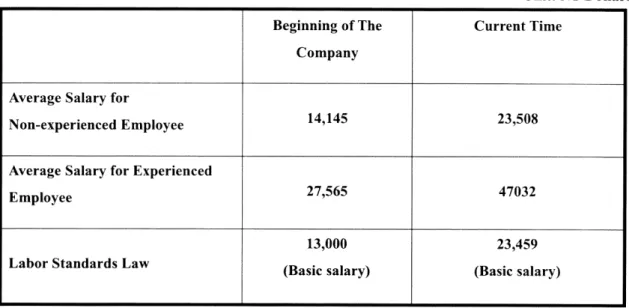
(16) ployees in terms of experience, expertise, knowledge, perspective, and skills. Generally, organizations are never willing to let their productive employee flow out. In the perspective of REV, they will damage their assets if the employees left. In the beginning of the selection process, organizations spend their organizational resource and cost on selecting and training these employees in order to make them productive and to behave in some certain ways that enhances efficiency. These enhancements in efficiency originate with employee creativity. These arguments result in my hypothesis Three c:. Hypothesis 3c: Turnover rate is negatively associated with employee' creativity.. (4). Employee' Creativities, Human Capital Performance, Tacit Manufacturing Knowledge, and Turnover Rate Employee surveys regarding the importance of various factors in motivation generally produce results that are inconsistent with studies of actual employee behavior and also the firm performance (Rynes, Gerhart, & Minette, 2004). However, when the HRM practices truly affected or concentrated on increasing the employees' motivation, these practices also directly affected the employees' creativity. Nonaka (1991) indicated that creativity is not just a matter of processing objective information, but depends on tapping the tacit and often highly subjective insights, intuitions, and ideals of employees. Furthermore, organizations enable different kinds of motivations and have different capabilities to generate and transfer tacit knowledge and creativity in the firms. In other word, in-house knowledge generation and transfer are essential for organizational competitive advantages. Consequently, the employees' creativity will directly affect the human capital performance. In another way, it also has an obvious growth effect on the working efficiency of the firm. This leads to my hypothesis Four a and b:. Hypothesis 4a: Employee' creativity is positively associated with human capital performance.. Hypothesis 4b: Employee' creativity is positively associated with tacit manufacturing knowledge.. Increasingly numbers of organizations have showed how rewards, particularly salaries, could be related to desired behavior and/or performance outcomes to improve employee productivity and performance (Gerhart & Rynes, 2003; Preffer, 1998; Rigby, 2001). In other words, salary is one of the extrinsic motivators for employees. It will encourage the employee creativity and decrease the turnover rate. fn an organization, when the employees are fully motivated. they would focus on their own perri.mnance in order to stay in the. and furthermore. decrease the turnover rate. This. result in my hypothesis Four c:. Hypothesis 4c: Employee' creativity is negatively associated with turnover rate.. 15.
(17) (5). Tacit Manufacturing Knowledge and Human Capital Performance As noted earlier, Wagner and Sternberg (1985) defined the tacit knowledge as worked related practical knowledge learned informally through experience on the job and an intellectual and cognitive process that is neither expressed nor declared openly but rather implied or simply understood. Brockmann and Anthony (2002) defined tacit knowledge as the work-related know-how that is acquired through direct experience and instrumental in achieving goals important to the holder. As noted earlier, Huselid (1995) found that the implementation of high-performance work system (rigorous recruitment, selection, compensation, and training functions) had higher employee productivity and better corporate financial performance. The tacit manufacturing knowledge usually came through training programs. Thereby tacit manufacturing knowledge can influence the efficiency of an organization. It is also indicated that maintaining the tacit knowledge which an organization creates can influence organization performance (Nonaka, Toyama, & Konno, 2000). In this study, tacit manufacturing knowledge means the knowledge that the employees usually know and realize how to practice. In other words, the more tacit manufacturing knowledge the employees have, the more efficiency and productivity will appear in an organization. This results in my hypothesis Five:. Hypothesis 5: Tacit manufacturing knowledge is positively associated with human capital performance.. 3. The Positive or Negative Relationships between HRM Practices and Human Capital Performance. From those above hypotheses, it is not difficult to discover that each HRM practice have the alternative positive or negative relationships and are affected with each other (Figure 3). From hypothesis 1, it can be easily observed that the HRM practices are positively related with human capital performance. From hypothesis 2b and 2c, the HRM practices have positive relationships with both employees' creativity, and tacit manufacturing knowledge. However, for the hypothesis 2a, HRM practices are negatively related with turnover rate. From both the hypothesis 3a and 3b, the turnover rate has a negative relationship with both tacit manufacturing knowledge, and human capital performance. From hypothesis 3c, the turnover rate is negatively associated with employee' creativity. From hypotheses 4a and 4b, employee' creativity has positive relationship with human capital performance, and tacit manufacturing knowledge. Conversely, from hypothesis 4c, the HRM practice of employee' creativity is negatively related with turnover rate. From hypothesis 5, tacit manufacturing knowledge is positively related with human capital performance.. V. lVlethodology 1.. Method I analyze these data in detail, to examine the reason that certain firms still survive up to today. without obvious technology innovation. This study explains whether the strategic HRM activities ofth-. 16.
(18) Figure 3: General Conceptual Framework with Hypotheses The Hypothesized Positive or Negative Relationships between HRM Practices and Human Capital Performance.. HRM. Employees' Creativity. (H2b) +. Practices (H3c) (H2c) +. (H2a) (H4b) + (H4c) -. (H3b) -. Turnover Rate. Tacit Manufacturing Knowledge. Human Capital Performance. (H 1) +. Symbol Explanation: (I). csc tirms might be a main. (H4a) +. f:. Positively related; (2) -:. I~lctor. for why those firms are still. relate.. after thirty years.. In order to conduct this study, I designed a cross-sectional survey questionnaire which included structured questions and semi-structural questions. In Taiwan, there are thirty-nine standard screw manufacturing firms. I interviewed thirty-one of 17.
(19) them, which means I covered 79.49% of the standard screw manufacture population. In my study, I asked our sample firms to provide data for three time periods: three years prior to the practice of a new HRM system; the year of adopting or improving the new HRM system; and three years after adopting the new HRM systems. Specifically, the data I asked for includes the workers' number of production lines, amount of firm productivity per month, on individual productivity per month, the turnover rate, the percentage of tacit manufacturing knowledge, numbers of new ideas and suggestions, and the numbers of official, outsource, office, and production line employees. In addition to those data regarding the time periods, I also asked about their compensation systems for non-experienced and experienced employees at the time of establishment of the company and compare to now, the type of quality control system they are adopting, and the most appropriate proportion between the new HRM system and new manufacturing equipment, if they are to make an assumption. In this study, I will use the Resource Based View (REV) as my central theory to conduct this research. As noted before, HR has been treated as an invisible asset to an organization. An organization cannot manufacture products without their human capital. This is why I adopted the Resource Based View (REV) as the central theory of this study. In my analysis of the survey, I also asked for the organization's opinions regarding this issue. For this part, I needed their personal opinion and judgment on how they feel about certain HRM practices. To support their observations and opinions, I also asked for specific figures (pre, during, and post) as evidence.. 2.. Sample Firms and Interviews. There are many different types of screws, including high technical and standard ones. In selecting our sample firms, I have chosen the traditional standard screw manufacturers. I can examine how the HRM systems affect them and what their productivities are. These traditional standard screw manufacturers are still manufacturing similar products to those from thirty years ago, and are still profitable, in spite of the emergencies of competitors in low cost economics. I believe the reason is that their current HRM systems are better than before and keep them improving and developing. Before selecting my sample firms, I control for the three following conditions: (1) The business has to have started before 1991; (2) They have to be 100(% standard screw manufacturers; (3). They have to be located in Taiwan regardless the exact. \Vith these perspectives ill mimL I have selected sample ti[ms tl"um the Industry of Association. OveralL there are thirty-nine standard screw. companies in. of them are located in the southern part of Taiwan. six of them are located in the middle part of Taiwan, and four of them are located in the northern part of Taiwan. All \ssociation of Screw. 18. the.
(20) standard screw For the location of our sample firms, five are located at the middle part of Taiwan and twenty-six are located at the southern part of Taiwan. For those sample firms located in the middle part of Taiwan, they are located in the: (1) Chuansing Industrial Park (j:£~I*l!I);. (2) Changhua Coastal Industrial Park For those sample firms located in the southern part of Taiwan, they are located in the: (1) Benjhou Industrial Park (~1J+fI*1!I);. (2) Yongan Industrial Park (3) Houshun Industrial Park (i&~~I*l!I). Before conducting interviews with these sample firms, I contacted them through telephone and mail to explain to them the purposes and the kind of data I would need. I also asked to interview both the managers of Human Resource and Production Departments. Unfortunately, eight firms refused to be interviewed or fill out t a mail survey. As a result, I have interviewed thirty-one sample firms total, and this is about 79.487% of all the standard screw manufacturing firms in Taiwan. Fir those. firms (20.51. similar product as others.. are also the standard screw. manut~lCturer. that. the. to the information that they offered on their homepage, their. tal amounts are between the smallest or biggest size of our samples. In other words, they are the same size with our interviewed firms. In order to have more proper perspective to conduct this research, we also ask the Or()(lllct:lon numbers from 'rhe Association of Screw offered us the average number of past ten years. of Screw. firms we interviewed and. 25,900 13.399 for other. 10) of those. firms that refuse our interview. The average number of those inter-. 167AOO. viewed. The Association. for those. firms that refuse our interview firms is 86.60 1~'o and. 'The market share for those interviewed firms.. we cannot have any further data about these firms.. did not offer any detailed information about their labors and. on their. 110m(~Dages.. The way that I collected the data was by interviewing the managers of both the Departments of HR and Production in each company. In this questionnaire, I would need the data regarding HRM sys-. tems and Production. Normally, there are two way of collecting data: mailing the surveyor conducting an interview. For our questionnaires, the following are some of the reasons that I believe it would be more efficient for us to conduct actual interviews with our sample firms: ( 1) These questionnaires are complicated and not that easy to understand. I would use the op-. portunity to explain those questions face to face if they have questions. ()) [would he asking ahout the tlnancial situation of the firm, I assumed our sample firms not too willing to provide thnse kinds of business secrets hy mail. (3). {'he three questionnaire forllls are lengthy; I helieve it would be hetter to have interviews with them to show our respect.. (4) To prevent incomplete questionnaire.. 19.
(21) (5) To prevent a delay in response or even be ignored by managers In order to have interviews with our sample firms, I took two steps in arranging the appointments: (1) Step one, I placed a call to our selected sample firms and explained what I would like to ask. and the kind of data I would need for the interview. After obtaining their permission, I then sent out our cover letter and the three questionnaires forms to both the Managers of HR and Production Departments. The questionnaires are Questionnaire about Official Employees, Outsource Employees, and Uno fficial Employees (optional). (2) Step two, I called the sample firms which I had mailed the questionnaires to in order to arrange the appointment. For those sample firms that are not willing to meet with us and nonresponsive managers, I will also send these three forms of questionnaires to them and show our concern about their situation by phone calls.. 3. Definitions and Measurements (1) Independent and Depend Variables:. •. HRM Practices. Definition: In this study, I select the recruiting and selecting, training and compensation as the main HRM practices that I would like to examine. I understand that there are other HRM practices that can be discussed, however, according to our pre-research, these standard screw manufacturing firms do not have other HRM practices out of these three. This is why I only discussed about the recruiting and selecting, training and compensation as the main HRM practices in this study. Each one of these practices is related directly to my three variables which will be discussed in this research. I will use these three practices to exam how they affect our sample firms and the variables of this study. Measurement: Initially, I was planning to ask the amount of companies investing in the HRM practices and how it affects the employees' creativity, tacit manufacturing knowledge, and the turnover rate. This can be measured by the proportion of their annual budget of these three HRM practices. To do this, I intended to ask the interviewee to provide the annual budget of these three HRM practices to be our data base. However, In the process of doing these data collection interviews, the managers refused to provide us any information about their financial situations. Therefore, I asked them about the percentage of how they change or improve in the 1-1RM practices of recruiting and selecting, training. •. Turnover rate. Definition and Vleasurement: Companies spend enormous amounts of money and resources in their attempts to retain their top employees for their work force. In this study, the turnover rate will include the employees who have left the job regard20.
(22) less of whether they have left voluntarily, or by organizational decision. In addition, I do not take organizational and age level of turnover rate into consideration. However, those employees who left for retirement or accident and injuries on the job will not be included. In this research, I will adopt the numbers of turnover rate that are offered by the interviewed sample firms. The turnover rate could be monthly, seasonally or annually.. •. Employees' Creativities. Definition and Measurement: Creativity is defined as the development of ideas, outcomes, products, or solutions that are judged as (a) original and novel and (b) appropriate and potentially useful for the situation (Shalley, Zhou, & Oldham, 2004; Zhou & Shalley, 2003). Moreover, almost all definitions of creativity involve the concept of usefulness and appropriateness as well as novelty (e.g., Amabile, 1996; Sternberg & Lubart, 1996; Zhou, 2003). In this study, I define creativity as new methods, new ideas, new thinking, and new improvements to production or suggestions both for organizational entrepreneurship and manufacturing. As an example, the General Manager from firm 3 pointed out that there might have been some suggestions to use other metal compound to produce screws instead of steel that will in turn increase the strength intensity of the screws and allow it to have a wider application. However, the company did not produce screws in that way because they do not have that kind of customers that would demand this type of screws and they are tired of developing new screws also. As part of the questionnaire data collection process, I asked the interviewed organizations to provide the numbers of suggested and adopted ideas. However, the sources of these ideas are not part of my consideration.. •. Tacit Manufacturing Knowledge. Definition: Tacit knowledge is the work-related practical know-how that is acquired through direct experience and instrumental in achieving goals important to the holder (Wagner & Sternberg, 1985). Tacit knowledge is defined as the working procedures, operation steps, or experience about how they judge the products by appearances which cannot be written, and have to be learned by doing or taught by an experienced workers, senior employees, through on job training (OlT), or learning by doing (LBD). As a result tacit knowledge is the proportion of a work task that cannot be written, but learned from OlT. In our questionnaire, I will ask our responder about what is the proportion of the tacit manufacturing knowledge control in their work. .:+Oo~). For :~-w()rk. learned. of A-work can he learned. has to he learned from an on joh training (OlT), then. paper reading like operator rules, and 300;;) of worker, and other. 60(~;;). 3()O (). uf A-work has to he. of A-work is defined as tacit knowledge.. By asking the managers how much their employees learned from the manual book and how much they learn from on job training (OlT) and learning by doing (LBD), and by asking. 21.
(23) how much on job training (OJT) and learning by doing (LBD) can be divided into personal experience and/or taught by senior operators. I include both the on job training (OJT) and learning by doing (LBD) here. Measurement: In this study, I had the percentage of tacit manufacturing knowledge provided by our sample firms. I asked firm 1 to measure their tacit manufacturing knowledge. It was defined as those problems or questions that cannot be solved or taught from the employee manual books; rather the knowledge needs to be answered by experienced employees or senior employees. Therefore, the percentage they provided was also the percentage of tacit manufacturing knowledge. During the data collecting process, some general managers pointed out specifically what the tacit manufacturing knowledge is. These could include the working sound of the manufacturing equipments, or identifying the quality of the screw to be whether good or bad just from the appearance of the screws. •. Human Capital Performance. Definition: In this research, the financial performance is not the major concern. It would be better to determine human capital performance by measuring their output per employee. Thomas (2000) argued that people possess innate abilities, behaviors, personal energy, and time. These elements make up human capital the currency people bring to invest in their jobs. He also argued worker, not organizations, owns the human capital. Workers, not organizations, decide when, how, and where they will contribute it. In this research, human capital performance is defined as organizational output. I will need this data for the examination under the previous HRM systems and the new HRM systems. Measurement: I will adopt the data provided by the interviewed firms for the output of an organization or the average employee productivity. Moreover, there will be three different kinds of data: (1) The output or productivity before adopting new HRM system; (2) The output or productivity during adopting or improving new HRM system; (3) The output or productivity after adopting new HRM system. With these data of productivity and numbers of manufacturing employees, I can easily understand the per productivity of each firm.. (2) Control Variables: In this. •. The Year have. I have set control variables in conducting this research: Establishment of the Business. Businesses with longer market share than the younger husinesses even if they have. always same size. In this. study, I \v(luld :dso like to investigate how these sample firms can still survive and make profit 20 years later by producing similar standard screws as always. In establishing this controlled variable, our sample firms have to be in the business at least 20 years ago. In other words, our 22.
(24) sample firms had to have started their business before 1991. Nationalities of Employees and Firms. This study does not take the nationalities of employ-. •. ees and sample firms into consideration .. The sample firms I chose are all located in Taiwan. Most of Taiwan based organizations would choose to hire foreign labors in order to decrease their wage expense. Most of the foreign labors came from China and Southeast Asia (to date, the nationalities of those labors includes Indonesia, Thailand, Vietnam, and Philippine). Therefore, the policies differ with the proportion of Taiwanese and foreign workers. I assume their policies are perfectly made for those employees whom belong to their firms. Similarly, the nationalities of investors are not being taken into consideration either. Whether the company is invested in by foreigner or the locals is not a concern here as well. For the companies that are based in a foreign country, yet invested in by locals will not be part of this research data base also. Only data from those firms that are located in Taiwan will be collected. 3 Years as a Period of Time. I chose the sample firms that are in the business for at least 20. •. years (had started their business before 1991 ).They are 100% standard screw manufacturers. In controlling this variable, those firms who produced high-tech screws usually have lower productivity and efficiency than those standard screw manufacturers. In order to match up with the same amount of productivity as the traditional manufacturing firms, these high-tech manufacturing firms will require more time and manufacturing knowledge to be able to do so. Although from the very beginning up until now, those companies may have had major changes or improvements on HRM system and/or manufacturing equipment, I would like to examine how the most recent HRM systems affect the pre and post employee productivity. This is the reason why I decided to use 3-year as a term for each before, during, and after phase. It will also be difficult to collect data that is over 10 years old because these traditional. Taiwanese screw manufacturers almost never keep their commercial record for more than 10 years. In the questionnaire, although I set 3 years as the base line, it does not mean I only select those sample firms that matches our questionnaire form. I have also prepared additional tables to collect data from those samples firms which do not fit the profile. Basically, I will be asking our sample firms to provide as much data as they can, but it should be at least 3 years in length. •. Three Stages of Time Periods. Three time periods: For the time periods of data, I would like to ask our Intcniewees to provide the data in three periods of time:. (1). illdex of three years before the new HRM are practiced;. (2) Average index of one year or three years during the new HRM are practicing (it depends on the year of practicing new HRM practice);. 23.
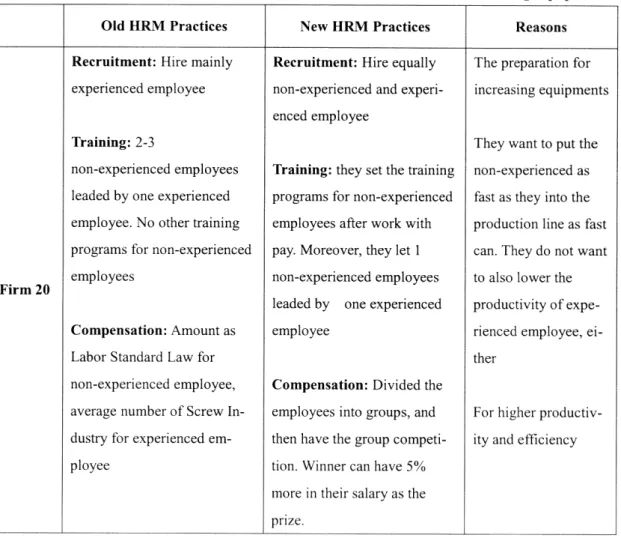
(25) (3) Average index of three years after the new HRM are practiced.. •. 60%. of HRLVI System & Manufacturing Equipment. In this research, I am looking for. substantial changes in the HRM system and in capital equipments. I define substantial to be a over 60% changes in the policies, procedures, and practices related to HRM compared to the current HRM system. This is a self reported measured based on the interviewees' knowledge of the HRM system. Likewise, for capital equipment change, I am looking for substantial change in the form of additions tolor modification to the production equipment or lines currently in use and use the 60% award as our guide. For our sample firms, they focused on their HRM systems on recruitment and selection, training, and compensation. The firms provided us with the percentage of the changes that has occurred. It was measured by the number of practices that had changed. For example, firm 5's data showed 100% change and improvements in their HRM systems. They explained in detail that regarding the previous recruitment and selection process, they did not hire the employees based on their school background, but on their passion and willingness to learning. This applies to both the non-experienced and experienced employees, however, with the new system, they ask the applicants to have at least some education background on mechanical or electrical knowledge. The reason behind is that they want to hire employee with some academic knowledge, thus increasing the intellectual minds inside the plant. For the training part, they also pointed out that they only allow one experienced employee to lead two to three non-experienced employees when producing. However, the productivity of this group in this situation is almost the same as the productivity of an experienced employee. Moreover, it is not as effective as the employer had expected. In this kind of situation, the new HRM practices changed the strategy so that one experienced employee lead only one non-experienced employee. In addition, they set up training programs for those non-experience employees. In firm 22, they divided the non-experienced employees into three levels: (l) New employees without any experience;. (2) New employees that had joined the company for more than a month, but less than three months; (3) Nevv'. less. that had joined the company for more than three months, but six months.. In order tn tit their new systems of recruitment and selection, they also set. tince. levels of training pr(lgrams for these non-experienced employees of those three leveL->: (1) Lead by an experienced employee, and need to read two hours of manllal book. There will a paper examination at the beginning of the second month. If he or she passes the examination, the salary will raise and that employee will become 24.
(26) an official employee. If not, the salary will not change. If the non-experienced employee cannot pass the examination after three times, the company will let him or her go. (They did not share with us the information on how much they will raise in salary); (2) Lead by an experienced employee, and need to read one hour of manual book. There will be a paper examination at the beginning of the fourth month. If he or she passes the examination, the salary will raise. If not, the salary will not change. (Again, they did not share with us the information on how much they will raise in salary.); (3) Lead by an experienced employee. There will be an operation examination at the beginning of seventh month. If he or she passes the examination, the salary will raise. If not, the salary will not change. (Again, they did not share with us the information on how much they will raise in salary.); For the part of compensation, they did not have this kind of compensation system prior to this. This is a whole new compensation system.. •. Firm Size and Production Lines. In this study, I do not control the firm size or their capital amount. In our questionnaire, I asked the sample firms to provide the numbers of production lines for our three stages of time, the numbers of offices and manufacturing employees. This way, I can understand the individual productivity of each sample firms. Firm size is less of a factor in that all firms are considered small median enterprises.. •. Firm Products. There are many different kinds of screws, including high technical and standard ones. In selecting our sample firms, I choose those firms that only produced 100% standard screws. I can examine how the HRM systems affect them. Besides, those firms who produced high-tech screws have lower productivity than those standard screw manufacturers.. •. Problems of New or Old Manufacturing Equipments. In this research, the new manufacturing equipment means the equipment has been changed or improved over 60% in a certain period of time.. •. Outsource Employees. The numbers or proportions of outsource employees. The outsource employees may be more productive than official employees, and with lower pay than official employees also. From an employer of an organization's point of view, hiring the outsource employees can reduce the time and cost on their training program. It can also reduce the cost of HRM system by hiring those outsource employees. In general, with the same number of employees and manufacturing equipments, organizations who adopt the outsource employees system may have a higher profit than the uther. •. Human Capital Performance. In this. define the human. pertc)rmance as the. productivity. If I know the total output of manufacturing employees, and then I can easily understand the output per employee. The formula to find out the average employee productivity is ·'Tons/ Number of manufacturing employees".. 25.
(27) 4.. Questionnaires Since there is insufficient information about Taiwanese manufacturing in Japan, I choose to col-. lect the data of Taiwanese manufacturing firms by having either interviews or mailing surveys. For the interview, I have designed three questionnaires for the managers of HR and Production Departments. I have designed three forms of questionnaires to collect the data: ( 1) About official employees;. (2) About outsource employees;. (3) U nofficial (Optional) Questionnaire. The questionnaire about official employees is targeted toward the official employees of our sample firms. In this questionnaire, I would like to know how their HRM practices and Human Capital Performance changed over time. There are four sections in this questionnaire. In the first section, I focused on their structural and HRM systems. Questions include when this company was established, their manufacturing strategy, new and old HRM systems, numbers of their office and outsource employees, numbers of production lines, and the problem of publicly or privately held company. In the second section, I focused on the time points concerning the HRM systems. Questions include the percentage of changes in their systems and the time for latest changes and the time and frequency of changing or improving of their manufacturing equipment. The third section is the survey questions which I also ask for the data of pre, during, and post. In this section, I adopted the Likert scale to let those General Managers to choose how they feel by circling. Those questions include their feedback on the new HRM practice, employees' creativity, tacit manufacturing knowledge, productivity, and turnover rate after the new HRM systems are established. I also asked them to provide data to support their perspectives. In addition, I also asked their opinion and how they felt about new HRM system and new manufacturing equipment. The fourth section is the comment section. The questionnaire about outsource employees was designed for our sample firms who have outsource employees in their company. The purpose of this questionnaire is to understand the structure of outsource employee and how they affect this company. There are two sections in this form of questionnaire. The first section is about the history of adopting outsource employees, any HRM practices for outsource employees, where they put these outsource employees in, and is there any training programs for these outsource employees. The second section is the survey questions comparing outsource and official employees. For the unofficial (optional) questionnaire, I design this form for our sample firms to provide their financial situation. The purpose of this questionnaire is to understand if they paid attentions on their HRM practices, and the percentage they invested in them. In this section, I asked about of investment in HRM.. the. 5.. company income and. and the capital amount.. Interviews with the Sample Firms l; pon interviewing with the thirty-one sample firms, I learned that that they do not separate the. position of the HR and Production Managers. In other words, they combined the work scope for the 26.
(28) managers of HR and Production as one, the General Manager. Below are some of the reasons they decided to do this: (1) To save the expense for the two departments. Since the firm is medium to small in size, there is no clear reason to keep these two departments separately; (2) They delegated the responsibility of recruiting employment to the General Manager since he/she should understand both the departments of HR and Production the best, thus would be able to make. the most appropriate decisions. when hiring new employees for the company;. (3) It would be easier for stock holders to hold the General Manager responsible if something happened due to hiring the wrong or unproductive employees. For the official employee's questionnaire, our sample firms are willing to answer all of the questions and provided as much data as they could. However, they refused to provide information about each year other than the average numbers of employees, production lines and manufacturing equipments. One reason that they refused or would not provide us the detail data is because these types of information are very important commercial secrets. They cannot take the risk if these detail data went out to their competitors. According to them, another reason is that they are only minor enterprises and they do not want to be noticed by anybody. For the outsource employees questionnaire, none of the sample firms used outsource employees in their office or manufacturing lines. Most of the people usually believe that using outsource employees should be an easy way to reduce labor cost. This way, companies may not need to spend for selection, training program, welfare, and so on. Contrary to public belief, our sample firms saw this differently. Instead of lowering the cost, adopting the outsource employees might have an opposite effect because there might be problems with quality and management of outsource employees. They told us that the biggest difference between the official and outsource employees is their loyalty to the company. All of these sample firms agreed that loyalty is the most important attitude in working for a company. Same principle applies; these sample firms do not outsource their products to lower the cost either. They do all their manufacturing in their plants. There are three reasons that they do this to decrease the cost: (1) To decrease the transportation expense; (2) To decrease all the costs that the upstream firms can get from them; (3) To have better sale prices than their competitors, and higher market share rate. For the unofficial (optional) questionnaire, all the sample firms refused to answer about any financial situation. The reason is that none of them are published publicly. They do not wish anybody or employees outside the circles of stock holder to know any information about their financial situations. data of the three time. data collection interviews. some General Managers. periods from their memories. They stated that the company does not keep this kind of record for such a long period of time. Even if they do, they would not be able to show it to. LIS.. In explaining so, the in-. terviewers chose to believe they are providing the real numbers. For the rest of the General Managers, they wanted us to wait for them to find out and calculate it for us.. 27.
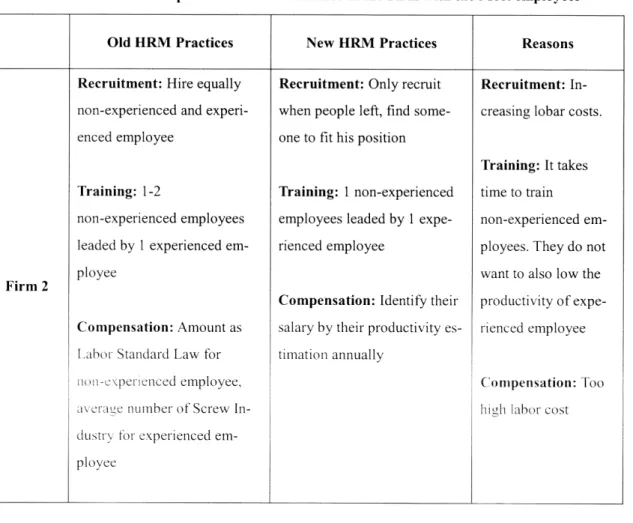
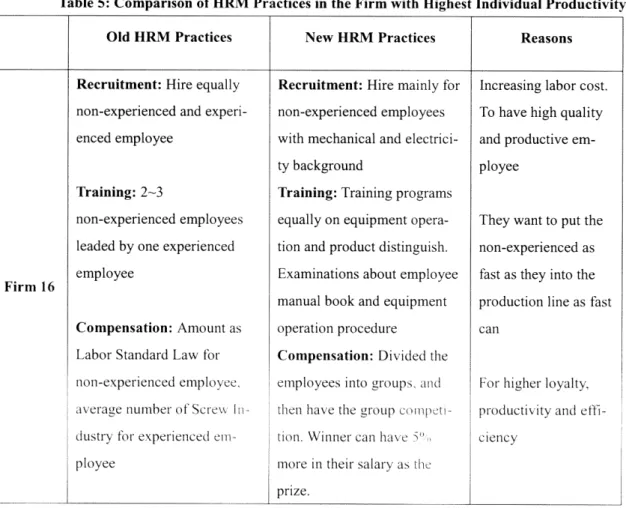
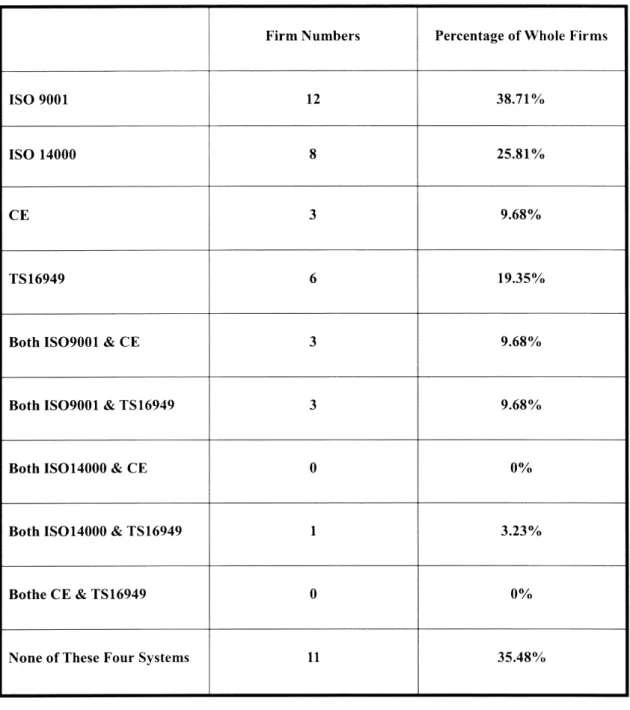
(29) (1) The Interview with The firm with the Most Employee Numbers. In all of our sample firms, Firm 2 has the most employees. Firm 2 was established in 1980. The table lists out the main old and new HRM practices. It also includes the reasons that they wanted to improve. Table 3 as below show the old and new HRM practices and reasons why Firm 2 wanted to improve. Although Firm 2 has the most employees, its employees are not the productive ones. From the data that were provided by Firm 2 General Manager, they had 140 employees before the new HRM practices were practiced, 180 employees during the new HRM practices, and 170 employees after the new HRM practices were in place. After the new HRM practices were practiced, their individual productivity is 3.5294 (per employee/ per tons/ per month). However, the average number is 21.1220. They do not have other training programs for their non-experienced employees, not even the utilizing the experienced employees. They adopted the new compensation system to determine their salary by their annual productivity estimation. In this case, I believe the main reason is that they have too many employees, and are not using them properly. Although they improved their HRM practices, they did not enforce these practices completely. They set the limitation for their employees, but did not account for the increase in limitation range through training programs. In addition, Firm 2 has two QC systems, they are ISO 9001 (2000) and TS 16949 (2007).. Table 3: Comparison of HRM Practices in the Firm with the Most employees Old HRM Practices. New HRM Practices. Reasons. Recruitment: Hire equally. Recruitment: Only recruit. Recruitment: In-. non-experienced and experi-. when people left, find some-. creasing lobar costs.. enced employee. one to fit his position Training: It takes. Training: 1-2. Training: 1 non-experienced. time to train. non-experienced employees. employees leaded by 1 expe-. non-experienced em-. leaded by 1 experienced em-. rienced employee. ployees. They do not. ployee. want to also low the. Firm 2. I. Compensation: Identify their. productivity of expe-. Compensation: Amount as. salary by their productivity es-. rienced employee. ["ahor Standard Law for. timation annually. cIJt:[ 1t:[[L,t:d. employee,. I I. Compensation: Too. llumher of Screw In-. lahul' cost. for experienced employee. 28. II.
図
+7


関連したドキュメント
It is suggested by our method that most of the quadratic algebras for all St¨ ackel equivalence classes of 3D second order quantum superintegrable systems on conformally flat
This paper is devoted to the investigation of the global asymptotic stability properties of switched systems subject to internal constant point delays, while the matrices defining
In this paper, we focus on the existence and some properties of disease-free and endemic equilibrium points of a SVEIRS model subject to an eventual constant regular vaccination
Next, we prove bounds for the dimensions of p-adic MLV-spaces in Section 3, assuming results in Section 4, and make a conjecture about a special element in the motivic Galois group
Transirico, “Second order elliptic equations in weighted Sobolev spaces on unbounded domains,” Rendiconti della Accademia Nazionale delle Scienze detta dei XL.. Memorie di
Then it follows immediately from a suitable version of “Hensel’s Lemma” [cf., e.g., the argument of [4], Lemma 2.1] that S may be obtained, as the notation suggests, as the m A
Our method of proof can also be used to recover the rational homotopy of L K(2) S 0 as well as the chromatic splitting conjecture at primes p > 3 [16]; we only need to use the
Yin, “Global existence and blow-up phenomena for an integrable two-component Camassa-Holm shallow water system,” Journal of Differential Equations, vol.. Yin, “Global weak
