Two
applications
of
Coulomb
wave
functions
in
hydrodynamics
(
流体力学におけるクーロン波動関数の応用
2
例
)
Takahiro
Nishiyama(
西山 高弘)
Department ofApplied Science, Yamaguchi University, Ube 755-8611, Japan e-mail: [email protected]
1
Introduction
The regular Coulomb wave function $F_{L}(\eta, \rho)$ for $L\in N\cup\{0\},$ $\eta\in \mathbb{R}$ and $\rho>0$ is
defined by
$F_{L}(\eta, \rho)=C_{L}(\eta)\rho^{L+1}e_{1}^{-i\rho}F_{1}(L+1-i\eta;2L+2;2i\rho)$ $=(2i)^{-(L+1)}C_{L}(\eta)M_{i\eta,L+1/2}(2i\rho)$,
where $1F_{1}$ and $M$ denote Kummer’s and Whittaker‘s regular confluent hypergeometric
functions, respectively, and
$C_{L}( \eta)=\frac{2^{L}|\Gamma(L+1+i\eta)|}{e^{\pi\eta,2}(2L+1)!}=\{\begin{array}{ll}\frac{2^{L}}{(2L+1)!}\sqrt{\frac{2\pi\prod_{k=0}^{L}(k^{2}+\eta^{2})}{\eta(e^{2\pi\eta}-1)}} for \eta\neq 0,\frac{2^{L}L!}{(2L+1)!} for \eta=0,\end{array}$
[1, Chapter 14], [3, Appendix I.A.14]. The value of $F_{L}(\eta, \rho)$ is real because of the
Kummer transformation
$e^{-i\rho_{1}}F_{1}(L+1-i\eta;2L+2;2i\rho)=e^{i\rho_{1}}F_{1}(L+1+i\eta;2L+2;-2i\rho)$
[1, Eq. 13.1.27]. If $\eta$ is aconstant, then $w(\rho)=F_{L}(\eta, \rho)$ is a solution to $\frac{d^{2}w}{d\rho^{2}}+[1-\frac{2\eta}{\rho}-\frac{L(L+1)}{\rho^{2}}]w=0$.
As another solution to this equation that is independent of $F_{L}(\eta, \rho)$, the irregular
Coulomb
wave
function $G_{L}(\eta, \rho)$ is defined by$G_{L}( \eta, \rho)=\frac{(\pm 2i)^{2L+1}\rho^{L+1}e^{\mp i\rho}}{C_{L}(\eta)(2L+1)!}\Gamma(L+1\mp i\eta)U(L+1\mp i\eta, 2L+2, \pm 2i\rho)\pm iF_{L}(\eta, \rho)$
so
that $G_{L}( \eta, \rho)\frac{d}{d\rho}F_{L}(\eta, \rho)-F_{L}(\eta,\rho)\frac{d}{dp}G_{L}(\eta,\rho)=1$.
Here $U$ and $W$denote Kummer’sand Whittaker $s$ irregular confluent hypergeometric functions, respectively. There
are
various formulas for $F_{L}(\eta, \rho)$ and $G_{L}(\eta, \rho)$ in [1]. In particular, the
case
$L=\eta=0$ iseasy: $F_{0}(0,\rho)=\sin\rho$ and $G_{0}(0,\rho)=\cos\rho$
.
Coulomb
wave
functionsare
mainly used in quantum physics, especially inscat-tering theories (see [8], and rcferences therein, e.g. [7, Chapter III]). In the field of
hydrodynamics, howcver, therc
are
only a few papers using them. In this article, twoapplications of Coulomb
wavc
functions in hydrodynamicsare
introduced. One is toan
orthogonal series associated with steady Euler flows (\S 2), and the other is to thestability problem for pipe Poiseuille flow (\S 3).
2
An
orthogonal
series
associated with steady
Euler
flows
When
an
Euler flow istwo-dimensional and ina
steady state, then it is described by a stream function $\psi(x, y)$as
$\frac{\partial^{2}\psi}{\partial x^{2}}+\frac{\partial^{2}\psi}{\partial y^{2}}=-g(\psi)$
with
an
arbitrary differentiable function $g$ [$2$, Section 7.4]. It is clear that each basisfunction of the two-dimensional Fourier series satisfies this equation with $g$ linear.
Therefore, the two-dimensional Fourier series can be regarded
as
a superposition ofsteady planar Euler flows.
Similarly, asteadyaxisymmetric Euler flow isdescribedbya Stokesstream function
$\phi(r, x)$ in the cylindrical coordinate system $(r, \theta, x)$
as
$r \frac{\partial}{\partial r}(\frac{1}{r}\frac{\partial\phi}{\partial r})+\frac{\partial^{2}\phi}{\partial x^{2}}=-r^{2}h(\phi)$
ifthe $\theta$-component of velocity is equal to
zero
[2, Section 7.5]. Here $h$ isan
arbitrarydifferentiable function. If$h$is linear, then
$r \frac{\partial}{\partial r}(\frac{1}{r}\frac{\partial\phi}{\partial r})+\frac{\partial^{2}\phi}{\partial x^{2}}=-\lambda r^{2}\phi$ (1)
with a constant $\lambda$. What is an orthogonal series whose basis functions mean steady
axisymmetric Euler flows?
Set $\phi=\Phi(r)e^{2:}\mathfrak{n}\pi x/b(n\in \mathbb{Z}, b>0)$ in (1). Then $\Phi(r)$ should satisfy
$r \frac{d}{dr}(\frac{1}{r}\frac{d\Phi}{dr})-4(\frac{n\pi}{b})^{2}\Phi+\lambda r^{2}\Phi=0$
.
(2)As mentioned byHerrnegger [5] and Maschke [6], it has a solution
when $\Phi(0)=0$ is imposed. The author [9], [10] pointed out that there exists a set $\{\lambda_{m,n}\}(m\in N)$ for eachfixed $n\in \mathbb{Z}$ and a constant$a>0$ such that $R_{\eta}^{n}(\sqrt{\lambda_{m,n}};a)=0$
and
$( \frac{2n\pi}{ab})^{2}<\lambda_{1,n}<\lambda_{2,n}<\lambda_{3,n}<\cdots$ .
Furthermore, using the Hilbert-Schmidttheory, he deduced that $\{m(\sqrt{\lambda_{mn}};r)\}(m\in$
N$)$for eachfixed$n$isacomplete orthogonal systemon$(0, a)$ with the weightfunction
$r$.
In otherwords, every function $f(r)$ that satisfies $\int_{0}^{a}[f(r)]^{2}rdr<\infty$
can
berepresentedin the form
$f(7^{\cdot}) \sim\sum_{m=1}^{\infty}R_{0}^{n}(\sqrt{\lambda_{mn}};r)\frac{\int_{0}^{a}R_{0}^{n}(\sqrt{\lambda_{mn}};t)f(t)tdt}{\int_{0}^{a}[R_{0}^{n}(\sqrt{\lambda_{mn}};t)]^{2}tdt}$ (3)
in the square integrable space with the weight $r$.
In consequence, thc set $\{\phi_{m,n}(r, x)\}:=\{R_{t^{n}}(\sqrt{\lambda_{mn}};r)e^{2in\pi x/b}\}(m\in N, n\in \mathbb{Z})$ is a
complete orthogonal system with the weight $r$
on
$(0, a)\cross(-b/2, b/2)$ such that eachbasis expresses a steady axisymmetric Euler flow. It should be noted that the author [10] derivcd
an
integral transform whose kernel is a Stokes streamfunction ofa steady axisymmetric Euler flow by letting $aarrow\infty$ and $barrow\infty$.Notingthat
$\int_{0}^{a}[R_{t}^{n}(\sqrt{\lambda_{mn}};r)]^{2}rdr=\frac{A_{m,n}B_{m,n}}{2a\sqrt{\lambda_{mn}}}$
is valid for
$A_{m,n}= \frac{d}{dr}m(\sqrt{\lambda_{mn}};r)_{r=a}$, $B_{m,n}= \frac{\partial}{\partial u}R_{\eta}^{n}(u;a)_{u=\sqrt{\lambda_{mn}}}$
[10, Eq. (4.1)], wecanprove the followingtheorem, whichis a more specificresult than (3):
Theorem 1 ([11]).
If
$\int_{0}^{a}|f(t)|tdt<\infty$ and the total vareationof
$f$ is bounded on$[\alpha_{1}, \alpha_{2}]\subset(0,a)$, then
$\frac{f(r-0)+f(r+0)}{2}=2a\sum_{m=1}^{\infty}\frac{\sqrt{\lambda_{mn}}}{A_{m,n}B_{m,n}}R_{0}^{n}(\sqrt{\lambda_{mn}};r)\int_{0}^{a}R_{0}^{n}(\sqrt{\lambda_{mn}};t)f(t)tdt$
for
allfixed
$r\in(\alpha_{1}, \alpha_{2})$ and$n\in \mathbb{Z}$.The proofis doneby extending $F_{L}(\eta, \rho)$ and $G_{L}(\eta, \rho)(L=0$or 1$)$ tocomplex
$\eta$ and $\rho$. It is similar to the proof ofWatson $f20$, Sections 18.$21-18.24J$ on the Fourier-Bessel
series, the best-known orthogonal series with the weight function $r$
.
Because of thegammafunction, howcver, Coulomb wave functions with complex arguments
are
more delicate to treat than Bessel functions.3Stability problem for pipe Poiseuille flow
Thc stability problcm for pipe Poiseuilleflow has a long history. The analytical study
of its dcpendcnce
on
the Reynolds number $R$was
started by Sexl [17]. After that,many researchers investigated behavior of small disturbances to the pipe flow ffom various theoreticalvicwpoints and deduced the linear stability at every $R$ (see [4], and
references therein). It was Pekeris [13] who first applied a confluent hypergeometric function (i.e.
a
Coulombwave
function with complex arguments) to the stability anal-ysis of pipe Poiseuilleflow. Sexl&
Spielberg [18] followed. In this section, byusing the result ofasymptotic analysisof Skovgaard [19],we
consider thedistributionofcomplex phase velocities for small axisymmetric torsional disturbances to pipe Poiseuille flow.Let $\Omega(r)$ be afunction such that $\Omega(r)e^{i\alpha(x-d)}/r$ is anormal mode for axisymmetric
torsional disturbancesto the pipe flow whichhas the velocity $1-r^{2}(0<r<1)$ in the x-direction in the cylindrical coordinate system $(r, \theta,x)$. Here the wave-number $\alpha>0$
and the complex phase velocity $c\in \mathbb{C}$
are
constants. Pekeris [13] derived the linearizedequation of the same type
as
(2):$7^{\cdot}$$\frac{d}{dr}(\frac{1}{r}\frac{d\Omega}{dr})-\alpha^{2}\Omega-i\alpha R(1-r^{2}-c)\Omega=0$
with the boundary conditions $\Omega(1)=0$ and $| \lim_{rarrow+0}\Omega(r)/r|<\infty$. Setting
$\kappa=\frac{1}{4}[\frac{\sqrt{\alpha R}(1-c)}{e^{i\pi/4}}-\frac{\alpha^{2}e^{i\pi/4}}{\sqrt{\alpha R}}]$ ,
we solve it
as
$\Omega(r)\propto F_{0}(\kappa,e^{i\pi/4}r^{2})\propto F_{0}(-i\kappa,$ $- \frac{1}{2}\sqrt{\alpha R}e^{1\pi/4}r^{2})$
$\propto\mu(\alpha, R, c;r):=M_{\kappa,1/2}(\sqrt{\alpha R}e^{-i\pi/4}r^{2})$
with
$\mu(\alpha, R, c;1)=0$
.
(4)This (4) determines the value of $c$ for given $\alpha$ and $R$. If $R|1-c|arrow\infty$ with $\alpha$ fixed,
then $\kappa$ is asymptotically equal to $k$ defined by
$k= \frac{\sqrt{\alpha R}(1-c)}{4e^{i\pi/4}}=\frac{\sqrt{\alpha R}}{4|z|}e^{-i(\arg z+\pi/4)}$,
where $z=1/(1-c)$. Therefore, in the limit
$\sqrt{R}|1-c|arrow\infty$ and $R|1-c|arrow\infty$ with $\alpha fixed$, (5)
we have $|k|arrow\infty$ and $\mu(\alpha, R, c;1)\sim M_{k,1/2}(4kz)$, to which the result of asymptotic
${\rm Im} z$
Figure 1: The sets $D_{1},$ $D_{2}^{\pm}$ and $\ell$ of
$z$, and the corresponding sets of$c=1-1/z$.
Let us make ready for stating asymptotic forms of$\mu(\alpha, R, c;1)$. As proved in [13],
every $c(=c_{r}+ic_{\dot{\tau}})$ of (4) satisfies $0<c_{r}<1$ and $c_{i}<0$. Consequently, $z$ should
belong to one of the three sets
$D_{1}= \{s:-\pi/2<\arg s<-\pi/4, |s-\frac{1}{2}|>\frac{1}{2}, |s|<\infty\}$ , $D_{2}= \{s:-\pi/4<\arg s<0, |s-\frac{1}{2}|>\frac{1}{2}, |s|<\infty\}$ ,
$l= \{s:\arg s=-\pi/4, |s-\frac{1}{2}|>\frac{1}{2}, |s|<\infty\}$.
We define the function $\xi$by
$\xi(z)=\{\begin{array}{ll}\frac{1}{2}z^{1/2}(z-1)^{1/2}-\frac{1}{2}\ln[z^{1/2}+(z-1)^{1/2}]-i\pi/4 for z\in D_{1},\frac{1}{2}z^{1/2}(z-1)^{1/2}-\frac{1}{2}\ln[z^{1/2}+(z-1)^{1/2}] for z\in D_{2}\cup\ell.\end{array}$
Here, and from
now
on, multivalued functions should be understood to take theirprincipal values. Using this $\xi$, we divide $D_{2}$ into the two sets
$D_{2}^{+}=\{s\in D_{2}:{\rm Im}\xi(s)\geq 0\}$, $D_{2}^{-}=\{s\in D_{2} : {\rm Im}\xi(s)<0\}$.
Figure 1 shows the locations of $D_{1},$ $D_{2}^{\pm}$ and $\ell$ on the z-plane and the corresponding
sets on the c-plane. It also shows the point $z=\rho_{0}e^{-i\pi/4}\in l$ with $\rho_{0}\approx 2.1844$, at
which $\arg\xi(z)=-\pi/2$ holds, and the corresponding point
Wc
now
express asymptotic forms of$\mu(\alpha, R,c;1)$ in the limit (5)as
follows:$\mu(\alpha, R, c;1)\sim 2(-\xi)^{1/2}(\frac{z}{z-1})^{4}I_{1}(4k\xi)1$ for $z\in D_{1}$, (7)
$\mu(\alpha, R,c;1)\sim\frac{2^{2/3}3^{1/6}\xi^{1/6}e^{*\pi(k-2/3)}}{k^{1/3}}(\frac{z}{z-1})^{1/4}Ai((6k)^{2/3}\xi^{2/3}e^{-2\cdot\pi/3})$
for $z\in D_{2}^{-}$, (8) $\mu(\alpha, R,c;1)\sim\frac{2^{5/3}3^{1/6}\xi^{1/6}e^{1\pi/6}\sin\pi k}{k^{1/3}}(\frac{z}{z-1})^{1/4}Ai((6k)^{2/3}\xi^{2/3}e^{2i\pi/3})$
for $z\in\ell$ with $|z|>\rho_{0}$. (9)
Here$I_{1}$ denotes the first-kind modffied Besselfunctionof the first order, andAidenotes
the Airy function. The case $z\in D_{2}^{+}$ or $z\in\ell$ with $|z|\leq\rho_{0}$ is omitted because the
asymptotic form has no zero. For details of the derivation of (7)$-(9)$,
see
[19], and also[12].
The
zeros
of the right hand sides of (7)$-(9)$ approximately determine $c$ of (4) inthe limit (5). Since all zeros of $I_{1}$ and Ai
are
locatedon
the imaginary axis and thcnegative real axis, respectively, the equality $\arg(k\xi)=-\pi/2$ is necessarily satisfied by
all $z$ that make the right hand side of (7) or (8) vanish. It leads to
$\arg\{z^{1/2}(z-1)^{1/2}-\ln[z^{1/2}+(z-1)^{1/2}]-\frac{i\pi}{2}\}-\arg z+\frac{\pi}{4}=0$ for $z\in D_{1}$, (10)
$\arg\{z^{1/2}(z-1)^{1/2}-\ln[z^{1/2}+(z-1)^{1/2}]\}-\arg z+\frac{\pi}{4}=0$ for $z\in D_{2}^{-}$. (11)
Moreover, as another neccssary condition for $\mu(\alpha, R,c;1)$ to vanish approximately,
we
add
$|z|>\rho_{0}$ for $z\in\ell$, (12)
under which
the.factor
$\sin\pi k$ in (9) haszeros
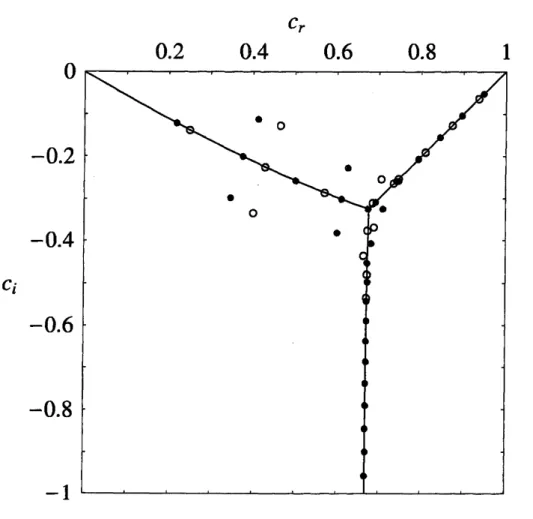
(while Ai in (9) has no zero). Bynumerically solving (10) and (11) with respect to $c=1-1/z$ and adding the straight
linesegment given by (12), weobtainthe Y-shaped contour shown in figure2, onwhich
zerosof$\mu(\alpha, R, c;1)$
are
approximatelylocated. Thethree branches ofthis contourmeetat a point $c=c_{0}$, alrcady appeared in (6) and figure 1. Figure 2 shows the locations
of $c$ computed by Schmid
&
Henningson [15, Table 1, $n=0$], $[16, p.506, n=0]$,too. Most of them
are
on or near the Y-shaped contour. Althoughsome
are off the leftward branch ofthc contour, theyare
not of torsional disturbances but of meridional disturbances (see [14, Figure 2]). It should be noted that the Y-shaped structure in figure 2 is independent of$\alpha$ and $R$. Of course, the location of each individual $c$of (4)depends on $\alpha$ and $R$,
as
investigated in detail in [12]. In particular, about $c_{\tau}\approx 2/3$ onthe downwardbranch of the contour, the followingtheorem
can
beanalyticallyproved:Theorem 2 ([12]).
If
$\alpha$ and$R$ arefixed
at arbitrarypositive numbers, then there exist0.2
$c_{r}$
0.4
0.6
0.8
1
Figure 2: The Y-shaped contourobtained from (10)$-(12)$, with $c$ computed by Schmid
&
Henningson [15], [16] for $R=3000$ $(\bullet$ $)$ and $R=2000(0)$ when $\alpha=1$.Acknowledgment
The author thanks Professor Yuji Hattori for his information about [5] and [6].
References
[1] M. Abramowitz, I. A. Stegun, Handbook
of
Mathematical Functions, with Formu-las, Gmphs, and Mathematical Tables, U. S. Government Printing Office, 1964. [2] G. K. Batchelor, AnIntroduction to FluidDynamics, Cambridge University Press,1967.
[3] H. Buchholz, The
Confluent
Hypergeometric Function, Springer, 1969.[4] P. G. Drazin, W. H. Reid, Hydrodynamic Stability, Cambridge University Press,
[5] F. Herrnegger, On the equilibrium and stability of the belt pinCh, Proceedings
of
the
Fifth
EuropeanConference
on
Controlled Rasion and Plasma Physics,Greno-ble, France, August 21-25, 1972, vol. 1, p. 26.
[6] E. K. Maschke, Exact solutions of the MHD equilibrium equation for a toroidal
plasma, Plasma Phys. 15 (1973) 535-541.
[7] N. F. Mott, H. S. W. Massey, The Theory
of
Atomic Collisions, Clarendon, 1933. [8] National BureauofStandards, Tablesof
Coulomb Wave Functions, U. S.Govern-ment Printing Office, 1952.
[9] T. Nishiyama, Construction of axisymmetric steady states of
an
inviscidincom-pressible fluidby spatiallydiscretizedequations for pseudo-advectedvorticity, Int. J. Math. Math. Sci. 2005 (2005) 3319-3346.
[10] T. Nishiyama, Anintegraltransformwhosekernel is astreamfunction ofasteady
Euler flow with axisymmetry, Z. Angew. Math. Phys. 58 (2007) 68-80.
[11] T. Nishiyama, Application of Coulomb
wave
functions toan
orthogonal seriesassociated with steady axisymmetric Euler flows, J. Approx. Theory 151 (2008)
42-59.
[12] T. Nishiyama, Distribution of complex phase velocities for small disturbances to
pipe Poiseuille flow, J. Fluid Mech. 620 (2009) 299-312.
[13] C. L. Pekeris, Stability of the laminar flow through a straight pipc of circular
cross-section to infinitesimal disturbances which
are
symmetrical about the axisof the pipe, Proc. Nat. Acad. Sci. USA 34 (1948) 285-295.
[14] W. H. Reid, B. S. Ng, On the spectral problem for Poiseuille flow in a circular pipe, Fluid$Dyn$. Res. 33 (2003) 5-16.
[15] P. J. Schmid, D. S. Henningson, Optimal energy density growth in Hagen-Poiseuille flow, J. Fluid Mech. 277 (1994) 197-225.
[16] P. J. Schmid,D. S. Henningson, Stability and 71nansitionin ShearFlows, Springer, 2001.
[17] T. Sexl, ZurStabilit\"atsfrage dcr Poiseuilleschen undCouetteschenStr\"omung, Ann.
Phys. 83 (1927) 835-848.
[18] T. Sexl, K.Spielberg, Zum $Stabilittsproblem$derPoiseuille-Str\"omung, ActaPhys.
Austriaca 12 (1958) 9-28.
[19] H. Skovgaard,
Unifom
Asymptotic Expansionsof Confluent
Hypergeometric Functions and Whittaker Functions, Jul. Gjellerups, 1966.$[20|$ G. N. Watson, A 7heatise on the Theory