An
$(N-2)$
-dimensional
surface
with positive principal
curvatures
gives
an
$N$-dimensional
traveling
front
in
bistable
reaction-diffusion
equations
Masaharu
Taniguchi*
Department
of
Mathematics, Facultyof
Science, Okayama University3-1-1, Tsushimanaka, Kita-ku, Okayama City, 700-8530, JAPAN
Abstract
This paper is a preliminary report of the forthcoming paper [21]. This paper studies traveling fronts to the Allen-Cahn equation in $\mathbb{R}^{N}$
for $N\geq 3$. We consider
$(N-2)$-dimensional smooth surfaces asboundariesof strictlyconvexcompactsets in
$\mathbb{R}^{N-1}$
, and define an equivalence relation between them. We prove that there exists
atraveling front associated with a given surface and that it is asymptotically stable for given initial perturbation. The associated traveling fronts coincide up to phase transition if and only if the given surfaces satisfy the equivalence relation.
AMS Mathematical Classifications: $35C07,$ $35B20,$ $35K57$
Key words: travelingfront, Allen-Cahn equation, non-symmetric
As a preliminary report of the forthcoming paper [21] we briefly state the results. We study the following reaction-diffusion equation
$\frac{\partial u}{\partial t}=\triangle u+f(u) x\in \mathbb{R}^{N}, t>0$,
(1)
$u(x, 0)=u_{0} x\in \mathbb{R}^{N}.$
Here $\triangle=\sum_{j=1}^{N}D_{jj}$ with $D_{j}=\partial/\partial x_{j}$ and $D_{jj}=(\partial/\partial x_{j})^{2}$ for $1\leq j\leq N$. Now $N\geq 3$ is a
giveninteger, and $u_{0}$ is agiven bounded and uniformly continuous function from
$\mathbb{R}^{N}$
to$\mathbb{R}.$
The assumption on $f$ is as follows.
(A1) $f\in C^{1}[-1, 1]$ satisfies $f(1)=0,$ $f(-1)=0,$ $f’(1)<0,$ $f’(-1)<0$ and
$\int_{-1}^{1}f(s)ds>0.$
(A2) There exists $a_{*}\in(-1,1)$ such that
$f(s)<0$ for all $s\in(-1, -a_{*})$,
Figure 1: Thegraphof$f.$
See Figure 1. Equation (1) is called the Nagumo equation [15] or the unbalanced Allen-Cahn equation [1]. For this equation, multi-dimensional traveling fronts have been studied by many mathematicians. Two-dimensional $V$-form fronts are studied by Ninomiya and
myself [16, 17], Hamel, Monneau and Roquejoffre [8, 9] and Haragus and Scheel [10] and
so
on. Cylindrically symmetric traveling fronts in $\mathbb{R}^{N}$are studied by [8, 9]. Raveling fronts of pyramidal shapes and convexpolyhedral shapes
are
studied by [18, 19, 13, 20]. See [14] for a related work. haveling fronts associated with strictlyconvex
compact domain in$\mathbb{R}^{2}$
with
a
smooth boundary are studied for the Allen-Cahn equation in $\mathbb{R}^{3}$in [20]. The purpose of this paper is to show that astrictly
convex
compact set in $\mathbb{R}^{N-1}$with
a
smooth boundary gives a traveling front in the Allen-Cahn equation in $\mathbb{R}^{N}$by using
a
clear and concise argument. Since the Allen-Cahn equation is one of the simplest reaction-diffusionequations, the argument in this paper might be useful for studies on other reaction-diffusion
equations
or
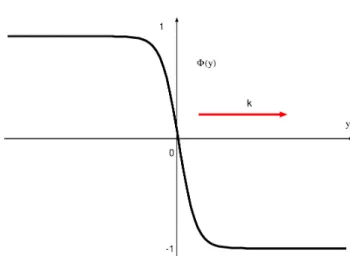
reaction-diffusion systems that admit comparison principles.The profile equation ofa one-dimensional traveling front with speed $k$ is given by
$-\Phi"(y)-k\Phi’(y)-f(\Phi(y))=0 -\infty<y<\infty,$
(2)
$\Phi(-\infty)=1, \Phi(\infty)=-1.$
Itis known that (2) hasasolution$\Phi$under (A1) and (A2), and it isuniqueup to translation.
One can refer to [2, 3, 11, 12, 6, 4] for instance. See Figure 2. Now (A1) gives $k>$ O.
Especially
one
has $k=\sqrt{2}a_{*}$ and $\Phi(x)=-\tanh(x/\sqrt{2})$ when $0<a_{*}<1$ and $f(u)=$ $-(u+1)(u+a_{*})(u-1)$.The Allen-Cahn equation by a movingcoordinate system with speed $c$toward the $x_{N^{-}}$
direction is given by
$(D_{t}-\Delta-cD_{N})w-f(w)=0 x\in \mathbb{R}^{N}, t>0,$
(3)
$w(x, 0)=u_{0}(x) x\in \mathbb{R}^{N}.$
Here we assume $c>k$. We denote the solution of (3) by $w(x, t;u_{0})$. The profile equation
ofa traveling front in $\mathbb{R}^{N}$
is given by
$(-\triangle-cD_{N})v-f(v)=0 x\in \mathbb{R}^{N}$. (4)
Figure 2: A one-dimensionaltraveling front $\Phi.$
Here
we
put $x’=(x_{1}, \ldots, x_{N-1})\in \mathbb{R}^{N-1}$ and $x=(x’, x_{N})$.
We extend $f$ as afunction of class $C^{1}(\mathbb{R})$ with $f’(\mathcal{S})<0$ for $|s|>1$. Setting
$\beta=\frac{1}{2}\min\{-f’(-1), -f’(1)\}>0,$
we
choose $\delta_{*}\in(0,1/4)$ with$-f’(s)>\beta$ if $|s+1|\leq 2\delta_{*}$ or $|s-1|\leq 2\delta_{*}.$
In this paperwe assume $c>k$. Let
$M = \max_{|s|\leq 1+\delta_{*}}|f’(s)|>0,$
$\sqrt{c^{2}-k^{2}}$
$m_{*} =$
$\overline{k}$’
and define $\theta_{*}\in(0, \pi/2)$ by
$\tan\theta_{*}=m_{*}.$
Let $n\geq 2$beagiven integer and$1et\{a_{j}\}_{j=1}^{n}$ beaset of unit vectors in$\mathbb{R}^{N-1}$ with $a_{i}\neq a_{j}$
for $i\neq j$. Then $a_{j}=(a_{j}^{1}, \ldots, a_{j}^{N-1})$ satisfies
$|a_{j}|^{2}= \sum_{i=1}^{N-1}(a_{j}^{i})^{2}=1$ for all $1\leq j\leq n.$
Here we put $x’=(x_{1}, \ldots, x_{N-1})\in \mathbb{R}^{N-1}$ and $x=(x’, x_{N})=(x_{1}, \ldots, x_{N})\in \mathbb{R}^{N}$ with $|x’|=\sqrt{\sum_{i--1}^{N-1}x_{i}^{2}}$ and $|x|=\sqrt{\sum_{i=1}^{N}x_{i}^{2}}$, respectively. For $x’\in \mathbb{R}^{N-1}$ we set
$h_{j}(x’) = m_{*}(a_{j}, x$ (5)
$h(x’)$ $=$
l
nmax
$\leq$j$\leq$Here $(a_{j}, x’)$denotestheinnerproductofvectors$a_{j}$ and$x’$. In thispaper
we
call $\{(x’, x_{N})\in$$\mathbb{R}^{N}|x_{N}\geq h(x’)\}$ a pyramid. Setting
$\Omega_{j}=\{x’\in \mathbb{R}^{N-1}|h(x’)=h_{j}(x’)\}$
for$j=1$,
.
. .,$n$, we have$\mathbb{R}^{N-1}=\bigcup_{j=1}^{n}\Omega_{j}.$
We denote the boundary of$\Omega_{j}$ by$\partial\Omega_{j}$. Nowwe put
$S_{j}=\{x\in \mathbb{R}^{N}|x_{N}=h_{j}(x’)$ for $x’\in\Omega_{j}\}$ for each $j$, and call $\bigcup_{j}^{n}S_{j}\subset \mathbb{R}^{N}$ the lateral faces ofa pyramid. We put
$\Gamma_{j}=\{x\in \mathbb{R}^{N}|x_{N}=h_{j}(x’)$ for $x’\in\partial\Omega_{j}\}$
for$j=1$,. . .,$n$. Then $\bigcup_{j=1}^{n}\Gamma_{j}$ represents the set of all edges ofa pyramid. For$\gamma>0$ let
$D(\gamma)=\{x|$ dist $(x, \bigcup_{j=1}^{n}\Gamma_{j})>\gamma\}.$
Now we define $v(x)$ by
$\underline{v}(x)=\Phi(\frac{k}{c}(x_{N}-h(x’)))=\max_{1\leq j\leq n}\Phi(\frac{k}{c}(x_{N}-h_{j}(x’)))$ .
Figure 3: The graphofa levelset ofa pyramidaltraveling front ([18, 19])
Pyramidal traveling fronts arestated
as
follows. See Figure 3. For the proofsee [16] forTheorem 1 ([16], [13]) Let$h$ be given in (6). Let $V$ be
defined
by$V(x)= \lim_{tarrow\infty}w(x, t;\underline{v})$
for
all $x\in \mathbb{R}^{N}.$Then$V$
satisfies
$(-\triangle-cD_{N})V-f(V)=0 x\in \mathbb{R}^{N}$. (7) with
$\lim_{\gammaarrow\infty}\sup_{x\in D(\gamma)}|V(x)-\underline{v}(x)|=0,$
$-1<\underline{v}(x)<V(x)<1 forallx\in \mathbb{R}^{N}.$
Figure4: The graph ofa levelset of $U.$
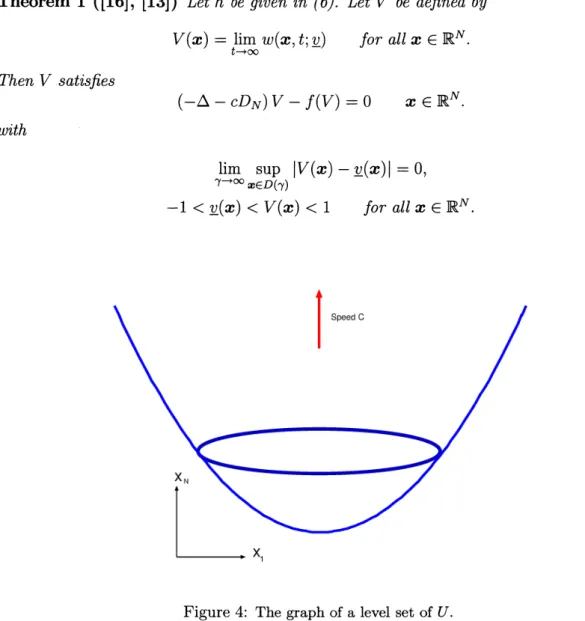
Cylindrically symmetric traveling front $U(r, z)$ satisfies
$(-D_{rr}- \frac{N-2}{r}D_{r}-D_{zz}-cD_{z})U-f(U(r, z))=0$, for $r>0,$ $z\in \mathbb{R}$, (8)
$U_{r}(0, z)=0$ for $z\in \mathbb{R},$
$U(0,0)=0.$
Here $D_{r}U=\partial U/\partial r,$ $D_{rr}U=\partial^{2}U/\partial r^{2},$ $D_{z}U=\partial U/\partial z$ and $D_{zz}U=\partial^{2}U/\partial z^{2}$. See Figure4.
The following is the main assertion in this paper.
Theorem 2 ([21]) Let $g\in C^{2}(S^{N-2})$ satisfy $g(\xi)>0$
for
all $\xi\in S^{N-2}$. Assume thatFigure
5:
The graph of a level set of$\tilde{U}.$curuatures
of
$\partial D_{g}=\{g(\xi)\xi|\xi\in S^{N-2}\}$ are positive at every pointof
$\partial D_{g}$. Then thereexists a unique solution $\tilde{U}$
to
$(- \sum_{i=1}^{N}\frac{\partial^{2}}{\partial x_{i}^{2}}-c\frac{\partial}{\partial x_{N}})\tilde{U}-f(\tilde{U})=0 in\mathbb{R}^{N}$, (9)
$\lim_{sarrow\infty}\sup_{|x|\geq s}|\tilde{U}(x)-\min_{\xi\in S^{N\underline{2}}}U(|x’-g(\xi)\xi|, x_{N})|=0$. (10)
Let$g_{j}$ satisfy the assumption stated above and let
$\tilde{U}_{j}$ be the associated solution
for
$j=1$,2, respectively. One has$\tilde{U}_{2}(x_{1}, \ldots, x_{N-1}, x_{N})=\tilde{U}_{1}(x_{1}, \ldots, x_{N-1}, x_{N}-\zeta)$ (11)
for
some $\zeta\in \mathbb{R}$if
and onlyif
$g_{1}\sim g_{2}.$Let $\mathcal{G}$ be the set of all
$g$ that satisfies the assumption of Theorem 2. Let $D_{9}$ be as in
Theorem 2 for $g\in \mathcal{G}$. Wedefine an equivalence relation in $\mathcal{G}$. Roughly speaking, we define
$g_{1}\sim g_{2}$ if and only if
one
can expand $D_{91}$ with a constant width and the expandedone
equals $D_{g_{2}}$ or one canexpand $D_{g_{2}}$ with aconstant width and the expandedone equals $D_{g_{1}}.$
See Figure 6.
Let $g\in C^{2}(S^{N-2})$ satisfy $g(\xi)>0$ for all $\xi\in S^{N-2}$. We set
$C_{g} = \{g(\xi)\xi|\xi\in S^{N-2}\},$
and have $C_{g}=\partial D_{g}\subset \mathbb{R}^{N-1}$. For some neighborhood of$g(\xi)\xi\in C_{g}$ with $\xi\in S^{N-2}$ we
write$C_{g}$ as $(y, \psi(y))$ with $\psi(y^{0})=0$ and $\nabla\psi(y^{0})=0$, where $y=(y_{1}, \ldots,y_{N-2})$. Here we
put $g(\xi)\xi=(y^{0}, \psi(y^{0}))$ with$y^{0}\in \mathbb{R}^{N-2}.$
Let $v(y)$ be the unit normal vector of $C_{g}$ at $(y, \psi(y))$ pointing from $D_{9}$ to $\mathbb{R}^{N-1}\backslash D_{g}.$
We have
$v(y)= \frac{1}{1+|\nabla\psi(y)|^{2}}(^{-\nabla\psi(y)}1)$ ,
where
$\nabla\psi(y)=t(D_{1}\psi(y), \ldots, D_{N-2}\psi(y))$.
The eigenvalues $\kappa_{1}(y^{0})$,
.
. . ,$\kappa_{N-2}(y^{0})$ of the Hessian matrix $-D^{2}\psi(y^{0})=-(D_{ij}\psi(y^{0}))_{1\leq i,j\leq N-2}$are
the principal curvatures of $C_{9}$ at $(y^{0}, \psi(y^{0}))$. We take the basis of$\mathbb{R}^{N-1}$as
theeigen-vectors of the Hessian matrix. Using this principal coordinate system, we have
$-D^{2}\psi(y^{0})=$ diag
(
$\kappa_{1}(y^{0}), \ldots, \kappa_{N-2}(y^{0}))$and
$D_{j}v_{i}(y^{0})=\kappa_{i}(y^{0})\delta_{ij} 1\leq i, j\leq N-2.$
We define $\mathcal{G}$ by
{
$g\in C^{2}(S^{N-2})|g\geq 0$,all principal curvature of$C_{9}$ are positive at every point of$C_{g}$}.
For any$g\in \mathcal{G}$ and $a\geq 0$
we
define $g_{1}=\tau_{a}g$ by$C_{g_{1}}=\{x’\in C_{g}\cup(\mathbb{R}^{N-1}\backslash D_{9})|$ dist$(x’, C_{9})=a\}.$
See Figure 6.
Then we have the following lemma.
Lemma 1 For any $a\geq 0,$ $\tau_{a}$ is a mapping in
$\mathcal{G}$
.
Moreover one has$\tau_{b}(\tau_{a}g)=\tau_{b+a}g$ (12)
for
any$a\geq 0,$ $b\geq 0$ and $g\in \mathcal{G}.$Now we define an equivalence relation $g_{1}\sim g_{2}$ for $g_{1},$$g_{2}\in \mathcal{G}$. We define $g_{1}\sim g_{2}$ if and
only if
one
has either $g_{1}=\tau_{a}g_{2}$ or$g_{2}=\tau_{a}g_{1}$ forsome
$a\geq 0$. We will showthat $\mathcal{G}/\sim$ givesa traveling front of(1).
Theorem 2 says that each element of a quotient set $\mathcal{G}/\sim$ gives an $N$-dimensional
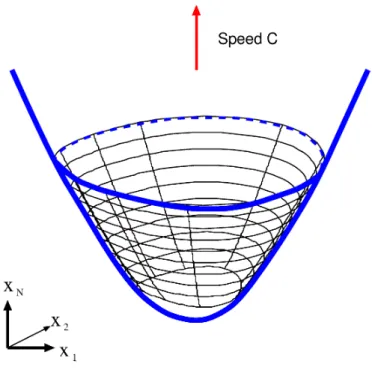
traveling front $\tilde{U}$
in the Allen-Cahn equation. Figure 5 shows the graph of a level set
$\{x\in \mathbb{R}^{N}|\tilde{U}(x)=-a_{*}\}.$
We choose $\eta>0$ large enoughsuch that we have
Figure 6: The graphs of$C_{g}$ and $C_{g_{1}}.$
and $D_{9}$ is included in the closure of
a
circumscribed ball of $C_{9}$ at $g(\xi)\xi$ with radius $\eta$ forevery $\xi\in S^{N-2}$. Let $\nu(\xi)$ be the unit normal vector of$C_{g}$ at $g(\xi)\xi$ pointing from $D_{g}$ to
$\mathbb{R}^{N-1}\backslash D_{g}$ for $\xi\in S^{N-2}.$
Now we define aweak subsolution$\underline{v}(x)$ as
$\underline{v}(x’, x_{N})=\xi S^{N\underline{2}}\max_{\in}U(|x’-g(\xi)\xi+\eta\nu(\xi)|, x_{N}+m_{*}\eta)$ for all $(x’, x_{N})\in \mathbb{R}^{N}$
.
(13)The stability of $\tilde{U}$
is as follows. Corollary 3 (Stability [21]) Let$\underline{v}$ and
$\tilde{U}$
be as in (13) and Theorem 2, $re\mathcal{S}$pectively. Let
a bounded and uniformly continuous
function
$u_{0}$ satisfy$\lim_{Rarrow\infty}\sup_{|x|\geq R}|u_{0}(x)-\tilde{U}(x)|=0,$
$\underline{v}(x)\leq u_{0}(x)\leq 1$
for
all $x\in \mathbb{R}^{N}.$Then
one
has$\lim_{tarrow\infty}\sup_{x\in R^{N}}|w(x, t;u_{0})-\tilde{U}(x)|=0.$
This workissupportedbyJSPSGrant-in-Aid for ScientificResearch (C),Grant Number
26400169.
References
[1] S.M. Allenand J. W. Cahn, A microscopic theory
for
antiphase boundary motion and[2] D. G. Aronson and H. F. Weinberger, Nonlinear
diffusion
in population genetics, Partial Differential Equations and Related Topics, ed. J. A. Goldstein, Lecture Notesin Mathematics, 446 (1975)
5-49.
[3] D. G. Aronson andH. F. Weinberger, $Multidimen\mathcal{S}ional$ nonlinear
diffusion
arising inpopulation genetics, Adv. in Math., 30, No.1 (1978), 33-76.
[4] X. Chen, Existence, uniqueness, and asymptotic stability
of
traveling wavesin nonlocal evolution equations, Adv. Differential Equations, 2, No. 1 (1997),125-160.
[5] M. del Pino, M. Kowalczyk and J. Wei, On de Giorgi conjecture in dimension N $\geq 9,$
Annals ofMath., 174 (2011), 1485-1569.
[6] P. C. Fife and J. B. McLeod, The approach
of
solutionsof
nonlineardiffusion
equationsto travelling
front
solutions, Arch. Rat. Mech. Anal., 65 (1977), 335-361.[7] D. Gilbarg and N.S. Rudinger, “Elliptic Partial Differential Equations of Second
Order Springer-Verlag, Berlin,
1983.
[8] F. Hamel, R. Monneau and J.-M. Roquejoffre, Existence and qualitative properties
of
multidimensional conical bistable fronts, Discrete Contin. Dyn. Syst., 13, No. 4 (2005),
1069-1096.
[9] F. Hamel, R. Monneau andJ.-M. Roquejoffre, Asymptoticpropertiesand
classification
of
bistablefronts
with Lipschitz level sets, DiscreteContin. Dyn. Syst., 14, No. 1 (2006), 75-92.[10] M. Haragus and A. Scheel, Corner
defects
in almost planarinterface
propagation,Ann. I. H. Poincar\’e, AN 23 (2006), 283-329.
[11] Y. I. Kanel’, Certain problems on equations in the theory
of
burning, Soviet. Math.Dokl., 2 (1961),
48-51.
[12] Y. I. Kanel’, Stabilization
of
solutionsof
the Cauchyproblemfor
equationsencountered in combustion theory, Mat. Sb. (N.S.), 59 (1962), 245-288.[13] Y. Kurokawa and M. Taniguchi, Multi-dimensionalpyramidal traveling
fronts
in theAllen-Cahn equations, Proc. Roy. Soc. Edinburgh Sect. A, 141 (2011),
1031-1054.
[14] R. Monneau, J.-M. Roquejoffre and V. Roussier-Michon, $\mathcal{I}$
Vavelling graphs
for
theforced
mean
curvature motion in an arbitrary space dimension, Ann. Sci.\’Ec.
Norm. Sup\’er. (4), 46 (2013), 217-248.[15] J. Nagumo, S. Yoshizawa and S. Arimoto, Bistable transmission lines, IEEE hans.
Circuit Theory, CT-12, No. 3 (1965),
400-412.
[16] H. Ninomiya and M. Taniguchi, Existence and global stability
of
traveling curvedfronts
in the Allen-Cahn equations, J. Differential Equations, 213, No. 1 (2005), 204-233.[17] H. Ninomiya and M. Taniguchi, Global stability
of
traveling curvedfronts
in the[18] M. Taniguchi, Traveling
fronts
of
pyramidal shapes inthe Allen-Cahn equations,SIAM
J. Math. Anal., 39, No. 1 (2007), 319-344.
[19] M. Taniguchi, The uniqueness and asymptotic stability
of
pyramidal travelingfronts
in the Allen-Cahn equations, J. Differential Equations, 246 (2009),
2103-2130.
[20] M. Taniguchi, Multi-dimensional traveling
fronts
in bistablereaction-diffvsion
equa-tions, Discrete Contin. Dyn. Syst., 32 (2012),1011-1046.
[21] M. Taniguchi, An (N$-1)$-dimensional

![Figure 3: The graph of a level set of a pyramidal traveling front ([18, 19])](https://thumb-ap.123doks.com/thumbv2/123deta/5957159.1055930/4.892.159.722.172.958/figure-graph-level-set-pyramidal-traveling.webp)