Influence of In vitro Culture System on
Development of Quail Embryo
By
Ichiro Fukunaga*, Takeshi Sasaki**, Motokazu Ando**, Koichiro Hashimoto***
and Hiroshi Ogawa**
(Received August 22, 2012/Accepted March 11, 2013)
Summary:An in vitro quail embryo culture system was developed using an artificial vessel, which comprised a polytetrafluoroethylene membrane and a polypropylene tube. In vitro culture was set up either directly from the blastoderm stage or after 60 hours incubation from the blastoderm stage, in the presence or absence of airspace. When embryos were cultured from the blastoderm stage, embryo viability gradually decreased in the presence of airspace from the initial stage of culture until stage 45, just before hatching. When embryos were preincubated for 60 hours before in vitro culture, viability initially remained high although mortality was high at 9 days and beyond, and all embryos died before reaching stage 45 in the absence of airspace. Using an artificial vessel under this embryo culture system, developmental stage of dead embryos was delayed, and body weight and 3rd toe length were lower than in controls (intact egg embryos). In addition, several types of malformations were observed at the blasto- derm stage, and we conjectured that early stage ectodermal damage had contributed to teratogenesis and early mortality. Moreover, the absence of airspace contributed to mortality in the later develop- mental stages.
Key words:in vitro culture system, avian embryo culture, malformations, Japanese quail
Introduction
Most embryonic growth in avian species occurs within the egg. In addition, 80% of minerals required for em- bryonic growth are provided by the eggshell1). Therefore, embryonic development is difficult within abnormal or cracked eggshells and outside the eggshell. This can be resolved by using an embryo culture system termed the surrogate eggshell system2), which involves a mechanism peculiar to avian species. Perry2) devised an in vitro cul-
ture system for developing chick embryos from the uni- cellular stage. This system comprised 3 systems (Systems I, II, and III). In System I, unicellular embryos were collected from the oviduct and incubated in a glass ves- sel for 24 hours to attain the blastoderm stage. In System II, the blastoderm stage was incubated for 2-3 days in the absence of airspace in a surrogate eggshell. In Sys- tem III, after initial incubation for 2-3 days under System II, the embryo was cultured in a large surrogate eggshell
in the presence of airspace until hatching. Perry’s method was also applied to Japanese quail3). If this embryo culture system could be successfully applied to embryos of rare or endangered avian species within abnormal or cracked eggshells, it would greatly enhance their protection and breeding management. Although a surrogate eggshell of suitable size for avian species was not available to us, additionally, there was a high possibility of surrogate eggshells being infected, e.g., by pathogenic bacteria. Therefore, avian in vitro embryo culturing using artificial vessels was performed, mainly using Japanese quail. Embryo viability achieved for Japanese quail in Systems I3), II4), and III (hatching)5) was 80%, 65%, and 43%, respectively. Therefore, an in vitro culture system using artificial vessels seems to be consummative in theory.
However, artificial vessels were used only for a part of the incubation period in these experiments, and a suc- cessful example of shell-less culture system using artifi-
* ** ***
Department of Animal science, Graduate School of Agriculture, Tokyo University of Agriculture Department of Human and Animal-Plant Relationships, Tokyo University of Agriculture Affiliate professor, Department of Animal Science, Tokyo University of Agriculture
cial vessels for embryonic development from Systems I or II to System III has not been reported to date. In addition, studies on artificial vessel culture were mainly conducted in System III, while there are few data on embryo culture using artificial vessels in System II. The influence of an in vitro culture system was ex- amined, which began from System II or III on Japanese quail embryonic development.
Materials and Methods
⑴ Eggs
Fertilized Japanese quail eggs were obtained from Tokaiyuki Co. (Aichi, Japan).
⑵ Culture Vessels
The artificial vessels and calcium lactate weights used were as described by Kamihira et al.5). Fig. 1 depicts the artificial culture vessel developed in the present study. In addition, 35 ml distilled water was added to a 50 ml polypropylene tube (BD Falcon Conical Tube ; Nihon BD Co., Tokyo, Japan). A round-bottomed sac was constructed from a gas-permeable porous polytetrafluoroethylene (PTFE) membrane (Milliwrap ; Nihon Millipore Co., Tokyo, Japan) and a polypropylene tube (artificial vessel). Quail egg contents were transferred to the artificial vessel in the presence (Fig. 1A) or absence (Fig. 1B) of airspace, and sealed with Milliwrap and polyvinylidene chloride film (Saran Wrap ; Asahi Kasei Life and Living Co., Tokyo, Japan). All materials were sterilized by autoclaving before culture vessel assembly.
⑶ Embryo Culture
Embryo cultures were initiated by addition of either blastoderm stage embryos or embryos that have under- gone 60 hours preincubation from the blastoderm stage. Intact fertilized eggs, which were used as controls were incubated in their own eggshells at 38.0℃ and relative humidity of 60% while being rocked at 60°/hour.
Thin albumen (1.5 ml, derived from White Leghorn eggs) supplemented with 35 mg calcium lactate (Sigma-Aldrich Co., Tokyo, Japan) was added to the culture tubes. The embryos were cultured in an incubator equipped with an automatic rocking device (Type P-008 ; 60°/hour ; Showa Furanki Co., Tokyo, Japan). The cul- ture was maintained at 38.0℃ and 60% relative humidity. Rocking was stopped 2 days before the expected hatching day. Milliwrap and Saran Wrap were punctured to facilitate pulmonary respiration 1 day before expected hatching day.
⑷ Identification of Embryonic Developmental Stage Embryo viability was confirmed daily, and dead embryos were removed. The criteria for embryonic death were cessation of blood flow, fetal activity, or cardiac arrest. Dead embryos were removed with the vitelline sac and egg yolk. The body weight and 3rd toe length of the embryos were measured. Embryonic de- velopmental stage was determined according to the report by Hamburger and Hamilton6).
⑸ Statistical analysis
A significant difference (p<0.05) in viability was ob- served between the presence and absence of airspace in both the blastoderm stage and 60 hours preincubation, after analyses using the chi-square test. Statistical analyses of body weight and 3rd toe length were per- formed by Scheffé’s multiple comparison test (p<0.05).
Results
⑴ Viability and Developmental Stage of In vitro Cul- tures Set up from the Blastoderm Stage
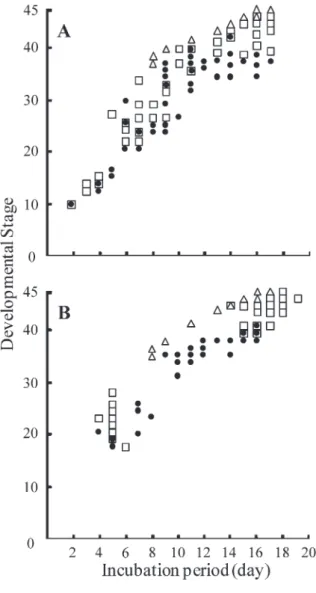
Fig. 2 depicts the results for viability and hatchability of Japanese quail embryos. In the presence of airspace, embryonic viability gradually decreased from 1 day (100%, 52/52) to 15 days (19.2%, 10/52), and decreased further at 16 days (15.4%, 8/52). All embryos died by 17 days, while 8 embryos attained stage 45 (15.4%). In contrast, in the absence of airspace, embryonic viability gradually decreased from 1 day (100%, 58/58) to 8 days (65.5%, 38/58) and then decreased sharply on the 9th day (46.6%, 27/58). All embryos were dead by 17 days, and no embryo reached stage 45. Fig. 3A depicts the distri- bution of developmental stages attained by the dead Fig. 1 Quail embryo culture vessels in the presence (A)
and absence (B) of airspace ; the vessels were sealed with Saran Wrap and Milliwrap.
embryos. In in vitro culture and the presence of airspace, the most developed stage attained was stage 45 on 16th and 17th days (15.4%, 8/52). In contrast, in in vitro culture in the absence of airspace, the most developed stage attained was stage 42 on the 14th day (1.7%, 1/58). ⑵ Viability and Developmental Stage of In vitro Cul-
tures Set up after 60 hours Preincubation
All embryos cultured in the presence of airspace sur- vived up to 4 days. Embryonic viability was >80% from 6-14 days, and sharply decreased from 15 days (74.5%, 41/55) to 17 days (34.5%, 19/55). Almost all embryos had died by 20 days, and 10 embryos attained stage 45 (18.2%). In contrast, all embryos cultured in the absence of air- space survived up to 4 days, but mortality rapidly in- creased from 10 days (71.2%, 37/52) to 12 days (44.2%, 23/52). All embryos had died by 17 days without at- taining stage 45. Fig. 3B depicts the distribution of devel- opmental stage of dead embryos. The developmental stage attained under in vitro culture in the presence of airspace was stage 46 at 16 days (1.8%, 1/55). In contrast, under in vitro culture in the absence of airspace, the most developed stage attained by the dead embryos was stage 40 at 16 days (1.9%, 1/52).
⑶ Viability and Developmental Stage of Intact Eggs All embryos survived up to 7 days, embryonic viability gradually decreased from 8 days (96.8%, 90/93) to 15 days (86.7%, 80/93). Embryos hatched from 16 days to
17 days (66.7%, 62/93), and 4 embryos attained stage 45 (4.3%, 4/93). Fig. 3 depicts the distribution of develop- mental stage for dead embryos. The most developed stage attained by the dead embryos was stage 46 at 16 days and 17 days (11.8%, 11/93).
⑷ Body Weight and 3rd Toe Length of Dead Stage 45 Embryos
Fig. 4 reveals that embryos that died at stage 45 had lower body weight and shorter 3rd toe length (p<0.05) than the control, and that embryos cultured from the blastoderm stage had lower body weight and shorter 3rd toe length than 60 hours preincubation embryos (p<0.05). ⑸ Malformations
Table 1 summarizes data regarding the rate of malfor- Fig. 2 Viability of quail embryos
In vitro culture was set up from the blastoderm stage in the presence (□ : n=52) or absence (○ : n= 58) of airspace, and after 60 hours preincubation in the presence (■ : n=55) or absence (● : n= 52) of airspace; controls (△ : n=93).
A significant difference (p<0.05) in viability was observed between the presence and absence of airspace in cultures from the * blastoderm stage or † 60 hours preincubation, after analyses using the chi-square test.
Fig. 3 Developmental stages attained by dead quail embryos
Embryonic culture set up from (A) the blastoderm stage or (B) 60 hours preincuba- tion. In vitro culture in the presence (□) or absence (●) of airspace ; controls (△).
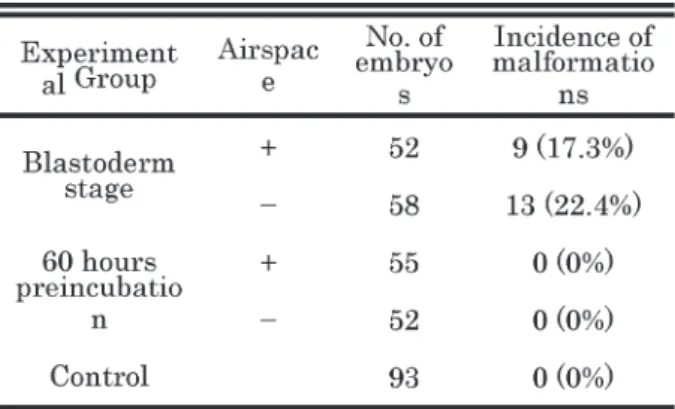
mation in embryos cultured from the blastoderm stage in the presence (17.3%, 9/52) or absence (22.4%, 13/58) of airspace. Malformations were not observed in 60 hours preincubation embryos or intact fertilized eggs. Table 2 and Fig. 5 show the types of malformations observed, including anophthalmia and microphthalmos [69.2%, 9/13 (presence of airspace) ; 64.3%, 9/14 (absence of airspace)] in artificial vessel culture, with these two conditions accounting for the majority of malformations.
Discussion
Kawashima et al.4) reported 65% embryonic viability
after 55 hours incubation from the blastoderm stage using a PTFE membrane and a plastic case in the ab- sence of airspace, and with calcium addition in Japanese
quail. In the present study, embryonic viability after 55 hours incubation start from the blastoderm stage with calcium addition was higher (>90%) than that reported
Table 1 Incidence of embryonic malformations
Table 2 Types of malformations observed in cultures using blastoderm stage embryos
Fig. 5 Types of observed embryonic malformation A, B and C : microphthalmos of left eye (same embryo) ; D, E and F : anophthalmia of right eye ; G : normal embryo ; H : evisceration caused by hypoplastic breastbone ; I : brain exposure caused by acrania.
Fig. 4 Average body weight and 3rd toe length of dead embryos at stage 45
White columns represent 3rd toe length ; black columns represent body weight. Columns and vertical bars represent the mean and standard error of mean values, respectively. Different letters represent significant differences (p<0.05) as assessed by Scheffé’s test.
by Kawashima et al.4) regardless of the presence or ab-
sence of airspace. Kamihira et al.5) reported that hatch-
ability was improved by the addition of calcium lactate or eggshell powder to the culture medium in artificial vessel culture. The addition of calcium appears to enhance embryonic viability at the early stage of devel- opment under in vitro culture using artificial vessels. Embryonic viability was >80% up to 14 days, but de- creased sharply by 20 days when embryo culture was set up using 60 hours preincubated embryos in the presence of airspace. This culture system was referred to by Kamihira et al.3), and the change in viability is
similar to that reported by Kamihira et al.3). In the
present study, viability was higher after 9 days in the presence of airspace than in its absence, regardless of the blastoderm stage or 60 hours preincubation, and embryonic viability in the absence of airspace gradually decreased between 10-17 days. Perry2) observed that an
excess of medium above the embryo was not detrimental in System III until 8 days, when the embryos died unless the vascular extraembryonic membranes were exposed to the atmosphere, as in System III. Therefore, the ab- sence of airspace may contribute to low viability and high mortality of embryos after 9 days.
Embryonic viability in the presence of airspace was sharply decreased from between 15-16 days, regardless of the blastoderm stage or 60 hours preincubation. Decreased viability in the later stages of Japanese quail embryo culture was reported by Ono et al.3) and Kamihira
et al.5) using artificial vessels, and by N
irasawa et al.7)
using chick eggshells. Furthermore, decreased viability in the later stages of chick embryo culture was reported by Dunn8) and Fujita et al.9) using artificial vessels, and
by Kawashima et al.10) and Fujita et al.11) using surrogate
chick eggshells. Because the allantoic membrane circu- lation transitions to the lungs post 19 days incubation in the chick10, 12, 13), decreased viability might be responsible for the failure of the artificial vessel to compensate for increased embryonic oxygen requirement during transi- tion within the circulatory system.
In contrast, lower hatchability has been reported when carbon dioxide concentration is high or oxygen concent- ration is low during the culture period14-18). Therefore, the low hatchability of embryo culture systems may be due to either the low oxygen or high carbon dioxide con- centration.
The developmental stage of dead embryos was delayed in all embryo culture system groups, and it was slower in artificial vessel culture set up from the blastoderm stage than for 60 hours preincubation. It was shown that the longer the embryo was cultured in vitro, the slower the embryo developmental stage. Fujita et al.8) reported that
the embryonic developmental stage was delayed when chick embryos were cultured in artificial vessels. However, on the basis of only the observations during embryonic developmental stage it cannot be concluded that delayed death at the developmental stage was due to culture in artificial vessels.
Johnston and Comar1) suggested that approximately
80% of the calcium that is necessary for avian embryonic growth during the developmental stage is provided by the eggshell. In the present study, we added calcium lactate to the artificial vessel culture medium (with thin albumen). However, embryos were smallest when cul- tured in vitro from the blastoderm stage in terms of body weight and 3rd toe length, followed by 60 hours preincubation and controls. It was demonstrated that the longer the embryo was cultured in vitro, the smaller the embryo size. Ono and Wakasugi19) reported that the
embryonic body weight in Japanese quail was high and 3rd toe length was long in the controls (intact embryos) under both mineral rich culture using chick eggshell and mineral free culture using Saran Wrap. Kamihira et al.5)
also reported that body weights of embryos dying at 17 days were higher than those of controls under artificial vessel culture, regardless of calcium addition. In contrast, Fujita et al.20) reported that embryonic mineral content
significantly (p<0.05) increased between 7-21 days in chicks. Nakane and Tsudzuki21) reported that the calcifi-
cation of the 3rd toe was observed on the 9th day post incubation in Japanese quail. Therefore, it was considered that minerals were not absorbed by embryos even if enough minerals were added to the culture medium in artificial vessel culture.
In contrast, Ruijtenbeek et al.22) reported that hypoxic
embryonic body weight and visceral weight were lower for normoxic chick embryos incubated under normoxic (21% O2) or hypoxic (15% O2) conditions. Therefore, we conjectured that low body weight, short 3rd toe length, and delay in embryo development were due to the hypoxic status used in artificial vessel culture. It was considered that mineral absorption and aeration of culture were necessary in future embryo studies.
In this study, malformations were observed in artificial vessel culture set up from the blastoderm stage embryos. Nirasawa et al.22) reported that although malformations
were observed in the cultured embryos (23.5%) in the presence of airspace in System II (surrogate chick eggshells), malformations were not observed when the surrogate eggshell was filled with thin albumen. Kawashima et al.13)
concluded that early stage embryos with incomplete amnion are adversely affected by direct exposure to the atmosphere in System III (chick embryos cultured in surrogate eggshells). Amnion formation was found to be
complete after 65-69 hours or 55-63 hours incubation, in chick10) and Japanese quail, respectively23). In the present study, because embryonic malformations were observed when the blastoderm stage embryos were developed in vitro, drying by the airspace or contact stimulus by the PTFE membrane in early embryogenesis may have contributed to teratogenesis. Furthermore, we observed numerous ocular malformations, similar to that reported by Nirasawa et al.6) (82%, 18/22 versus 88%, 22/25).
Ectodermal defects may be responsible for the high frequency of ophthalmic teratogenesis, as the eye develops from the ectoderm24).
On the basis of the results, artificial vessel culture ap- pears to contribute significantly to the increase in mor- tality and incidence of teratogenesis when quail embryos were cultured from the blastoderm stage to hatching. Consequently, environmental improvement in embryo culture at an early stage is considered to contribute to the reduction in both mortality and incidence of terato- genesis.
References
1) johnston P M, Comar C L. (1955). Distribution of calcium
from the albumen, yolk and shell to the developing chick embryo. Am J Physiol 183 : 365-370.
2) Perry M M. (1988). A complete culture system for the chick
embryo. Nature 331 : 70-72.
3) ono T, murakami T, moChii M, agata K, kino K, otsuka
K, ohta M, mizutani M, yoshida M, eguChi G. (1994). A
complete culture system for avian transgenesis, supporting quail embryos from the single-cell stage to hatching. Dev Biol 161 : 126-130.
4) kawashima T, kumata K, yoshinori T, kuwana T, hashimoto
K. (2005). An avian embryo culture system for embryo- genesis using an artificial vessel : possible conservation benefits in the rescue and management of endangered avian species. Zoo Biol 24 : 519-529.
5) kamihira M, oguChi S, taChibana A, kitagawa Y, iijima S.
(1998). Improved hatching for in vitro quail embryo culture using surrogate eggshell and artificial vessel. Dev Growth Differ 40 : 449-455.
6) hamburger V, hamilton HL. (1951). A series of normal stages
in the development of the chick embryo. J Morphol 88 : 49-92.
7) nirasawa K, naito M, oishi T. (1992). Culture of Japanese
quail embryos from the blastoderm stage to hatch in chicken egg shells. Jpn Poult Sci 29 : 139-144 (in Japanese). 8) dunn B E. (1974). Technique for the shell-less culture of
the 72-hour avian embryo. Poult Sci 53 : 409-412.
9) Fujita Y, takahashi S, nasu A, shimoi G, kameyama Y,
hashizume R, ito M. (2007). Influence of surrogate eggshell
environment on development of cultured chicken embryos. J Agric Sci Toyko Univ Agric 52 : 115-119 (in Japanese). 10) kawashima T, ishiguro S, aikawa R, tamaki Y, ogawa H,
hashimoto K. (2002). Factors affecting successful hatching
in avian embryo culture system. J Reprod Dev 48 : 137-142.
11) Fujita Y, takahashi S, nasu A, shimoi G, kameyama Y,
hashizume R, ito M. (2007). Influences of surrogate egg-
shell on viability and hatchability of silkie fowl embryos cultured in vitro and dynamics of minerals in eggshell. J Agric Sci Toyko Univ Agric 52 : 120-124 (in Japanese). 12) romanoFF, A. L. (1960). Respiratory movements. In : The
Avian Embryo. New York : The Macmillan Company. p 563-567.
13) rowlet K, simkiss K. (1985). The surrogate egg. New Sci
15 : 42-44.
14) taylor L W, sjodin R A, gunns C A. (1956.) The gaseous
environment of the chick embryo in relation to its devel- opment and hatchability. 1. Effect of carbon dioxide and oxygen levels during the first four days of incubation upon hatchability. Poult Sci 35 : 1206-1215.
15) taylor L W, kreutziger G O. (1965). The gaseous environ-
ment of the chick embryo in relation to its development and hatchability. 2. Effect of carbon dioxide and oxygen levels during the period of the fifth through the eighth days of incubation. Poult Sci 44 : 98-106.
16) taylor L W, kreutziger G O. (1966). The gaseous environ-
ment of the chick embryo in relation to its development and hatchability. 3. Effect of carbon dioxide and oxygen levels during the period of the ninth through the twelfth days of incubation. Poult Sci 45 : 867-884.
17) taylor L W, kreutziger G O. (1969.) The gaseous environ-
ment of the chick embryo in relation to its development and hatchability. 4. Effect of carbon dioxide and oxygen levels during the period of the thirteenth through the sixteenth days of incubation. Poult Sci 48 : 871-877. 18) taylor L W, kreutziger G O, aberCrombie GL. (1971). The
gaseous environment of the chick embryo in relation to its development and hatchability. 5. Effect of carbon dioxide and oxygen levels during the terminal days of incubation. Poult Sci 50 : 66-78.
19) ono T, wakasugi N. (1984). Mineral content of quail em-
bryos cultured in mineral-rich and mineral-free conditions. Poult Sci 63 : 159-166.
20) Fujita Y, takahashi S, miyata T, hashizume R, ito M. (2007).
Characterization of mineral dynamics related with osteo- genesis during chick development. J Ani Sci 78 : 155-160 (in Japanese).
21) nakane Y, tsudzuki M. (1999). Development of the skeleton
in Japanese quail embryos. Dev Growth Differ 41 : 523-534.
22) ruijtenbeek K, Le Noble F A, Janssen G M, Kessels C G, Fazzi
G E, BlanCo C E, De Mey J G. (2000). Chronic hypoxia
stimulates periarterial sympathetic nerve development in Chicken embryo. Circulation 102 : 2892-2897.
23) ZaCChCi A M. (1961.) Lo sviluppo embrionale della quaglia
giapponese (Coturnix coturnix japonica T. e S.). Arch Ital Anat Embriol 66 : 36-62 (in Italian).
24) RomanoFF A L. (1960). Organ-forming potencies in the avian
blastoderm. In : The Avian Embryo. New York : The Macmillan Company. p 179-184.