RESPONDING TO THE TRANS-PACIFIC PARTNERSHIP (TPP): COMPARATIVE STUDY ON INTERNATIONAL TRADE POLICY OF
MALAYSIA, VIETNAM, AND INDONESIA
by
Rakhmat Syarip
September 2015
Thesis Presented to the Higher Degree Committee
Of Ritsumeikan Asia Pacific University
In Partial Fulfillment of the Requirements for the Degree of
ii CONTENT CONTENT ... ii CERTIFICATION ... iv ACKNOWLEDGEMENT ... v ABSTRACT ... vi
TABLES AND FIGURES ... vii
ABBREVIATIONS & ACRONYMS ... viii
CHAPTER I - INTRODUCTION ... 1
I.1 Background ... 1
I.2 Literature Review ... 6
I.3 Research Questions ... 14
I.4 Significance ... 15
I.5 Structure of Research ... 15
CHAPTER II – RESEARCH DESIGN ... 18
II. 1 Conceptual Framework ... 18
II.1.1 International Factors: The Need to Forge Closer Relations to the US ... 21
A. Economic Gains ... 21
B. Political-Security Needs ... 24
C. Proposition and Hypotheses ... 29
II.1.2 Domestic Factors: Support to Economic Reform ... 30
A. Support from State Decision-Makers ... 33
B. Support from Societal Groups ... 37
C. Proposition and Hypotheses ... 40
II.2 Method... 42
II.3 Technique of Validation ... 43
II.4 Case Selection ... 44
II.5 Data Collection ... 48
CHAPTER III - TPP: EVOLUTION AND CONTROVERSIES ... 50
III.1 Evolution: From TPSEP to TPP ... 50
III.2 Economic Controversies: TPP between Promise and Reality ... 53
III.2.1 20th vs 21st Century Agreement ... 53
III.2.2 Opposition from Member Countries ... 56
III.3 Political Controversies ... 57
III.3.1 TPP: US‟ Tools for Engaging the Asia-Pacific ... 57
III.3.2 TPP as New Regional Model in Asia-Pacific ... 62
III.4 Conclusion ... 64
CHAPTER IV - MALAYSIA ... 66
IV.1 The Development of TPP Case in Malaysia ... 67
IV.2 International Factor ... 69
IV.2.1. Economic Benefits: Seeking Trade, Investment and Economic Reform ... 69
IV.2.2 The Political-Security Needs: Malaysia between the US and China ... 78
iii
IV.3.1 The Pro-TPP Groups ... 83
IV.3.2 The Anti-TPP Groups ... 87
IV.3.3 Assessing the Influence of Pro- and Anti-TPP Groups: Toward Consensus? 92 IV.4 Conclusion ... 100
CHAPTER V - VIETNAM ... 103
V.1 Vietnam and TPP Negotiation ... 105
V.2 International Factor ... 106
V.2.1 Highly-Leveraging Deals: Vietnam Pursues Trade and Investment Gains ... 106
V.2.2 Political-Security Needs: Vietnam between China and the US ... 113
V.3 Domestic Factor ... 120
V.3.1 The Rise of Pro-TPP Groups in Vietnamese Politics ... 121
V.3.2 The Silent Resistance ... 128
V.4 Conclusion... 132
CHAPTER VI - INDONESIA ... 134
VI.1 Indonesia‟s Reluctance on TPP ... 135
VI.2 International Factor ... 137
VI.2.1 Contentious Economic Benefits: To Gain or Not to Gain? ... 137
VI.2.2 Political-Security Needs: Defending ASEAN-Centrality ... 141
VI.3 Domestic Factor ... 150
VI.3.1 The Pro-ASEAN Group ... 151
VI.3.2 The Role of Protectionist Group ... 156
VI. 4 Conclusion ... 162
CHAPTER VII - CONCLUSION ... 166
VII.1 International Factors ... 170
VII.2 Domestic Factors ... 175
VII.3 Further Research ... 179
APPENDIX – LIST OF INTERVIEWS ... 183
iv
CERTIFICATION
I, Rakhmat Syarip, hereby declare that this master thesis is my own work which contains ideas and information from published as well as unpublished works of different scholars who are recognized through the references listed in the thesis. The main arguments and ideas that are not cited are ideas and agreements written by author of this thesis.
v
ACKNOWLEDGEMENT
The thesis is the result of hard work and prayer for the whole two years. I would like to express my deepest gratitude for those who are with me throughout the journeys.
First, my deepest appreciation goes to my supervisor, Prof. Yoshimatsu
Hidetaka. Without all your comments, teaching and guidance, I will not be able
to reach this point. You clearly pushed me to my academic limit, tested my knowledges, and challenged my curiosity, of which I am forever grateful. I am blessed to work under an enthusiastic and hardworking sensei.
Second, I would like to thank Asian Development Bank (ADB) for the full scholarship, without which I could not study in this university. Special thanks goes to Ritsumeikan Center for Asia-Pacific Studies (RCAPS) which, along with ADB, provided me funding for field research in Kuala Lumpur and Jakarta. I also want to express my appreciation to all informants for this research, e.g. in
Malaysian AIDS Council, Institute for Strategic and International Studies (ISIS) Malaysia, Universiti Kebangsaan Malaysia, Monash University Malaysia, University of Indonesia, Bina Nusantara University, Third World Network (TWN) Indonesia, and the ASEAN Secretariat.
Third, I appreciate my friends, Taylor Searcy and Ashley Park, for helping me improving the grammar and other technical things. Finally, I would like to thank all my friends in Graduate Program, especially Fall 2013 class. You shared with me your laughter, friendship and joy. I feel honored to meet these amazing people from around the globe. I hope our fate cross again someday, somewhere, somehow.
RAKHMAT Syarip
vi ABSTRACT
Despite its tremendous economic potentials, until now there is no mega-regional FTA covering all corners of the Asia-Pacific. Backed by the United States (US), the Trans-Pacific Partnership (TPP) is the recent attempt to do so and is promoted to be the „high quality 21st century agreement‟. The research basically discusses Southeast Asian perspective on the FTA, focusing on why Malaysia and Vietnam decided to join whereas Indonesia decided not to. Positioning TPP within the existing literature on Southeast Asia trade policy-making, the research is important for two particular reasons. First, existing literature tend to be domestic-driven, while the „US factor‟ embedded within TPP means that international factors are important to understand the behavior of these countries. Second, the prevailing assumption of „state-domestic business influence on trade policy‟ is no longer true for the TPP case as more various actors, including within the state, have concerns over the impact of the „high-quality‟ agreement.
The research finds that economic gain is not the only reason why a country joins an FTA. In fact, just like the Great Powers, small and medium countries in Southeast Asia align their trade strategy with political and security objectives. The decision on TPP intersects heavily with how they regard the position of China and the US in the Asia-Pacific, namely whether the former is seen as a political-security threat, whether it is important to engage the latter as part of hedging strategy and whether the latter‟s TPP maneuver aligns with their regional foreign policy priorities. Moreover, the high-quality nature of TPP means that accession decision relates to political debate among various domestic actors on whether a country needs to conduct economic reforms. Specifically, the research finds that the interest of the leader and the Ministry of Trade on economic reforms, rather than the state as a whole, as well as their maneuver to deal with protectionist camp, play important role in determining Southeast Asian countries‟ decisions on TPP.
Keywords: US‟ pivot, trade and security linkage, 21st century FTA, domestic support on economic reform
vii
TABLES AND FIGURES
Tables
Table I.1 – Southeast Asian Countries FTAs (Concluded) ... 4
Table I.2 – Summary of Literature Review... 13
Table I.3 – Literature Gap and Proposed Solution ... 14
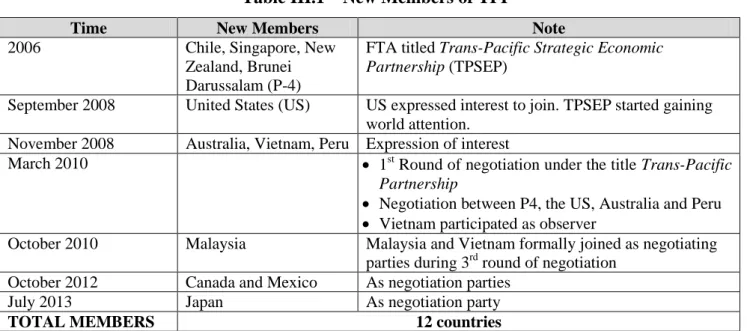
Table III.1 – New Members of TPP ... 52
Table IV.1 – Trade to GDP Ratio (Percent) ... 70
Table IV.2 – Top Five Foreign Investment in Malaysia (US$ Million) ... 71
Table IV.3 – Share of FDI Going to East Asian Countries, (Percent) ... 73
Table V.1 – Trade/ GDP Ratio of Vietnam (Percent) ... 106
Table V.2 – Vietnam‟s Export and Surplus to the US ... 107
Tabel V.3 – TPP-Induced Economic Benefits in 2025 ... 108
Table V.4 – Share of Industrial Production (Percent) ... 111
Tabel VI.1 – FDI Realization by Country (US$ million) ... 138
Table VI.2 – Trade: Indonesia to the US ... 138
Table VI.3 – Contribution to Indonesian GDP, Demand Side (Percent) ... 140
Table VI.4 – Trade: Indonesia to China (US$ Million) ... 148
Table VII.1 – The Motives on TPP: Experiences of The Three Case Studies ... 168
Table VII.2 – The International Factors: Experiences of The Three Case Studies ... 170
Table VII.3 – The Diverging Actors on TPP ... 175
Figures Figure II.1 – Diagram of Conceptual Framework... 18
Figure II.2 – The Needs to Forge Closer Relations to the US: Hypotheses... 29
viii
ABBREVIATIONS & ACRONYMS
ABAC : ASEAN Business Advisory Council
ACA : Anti-Corruption Agency
AEC : ASEAN Economic Community
AFTA : ASEAN Free Trade Area
AIA : ASEAN Investment Area
AIDS : Acquired Immune Deficiency Syndrom
AmCham : American Chambers of Commerce in Vietnam
APEC : Asia-Pacific Economic Cooperation
APINDO : Indonesian Entrepreneur Association
ASEAN : Association of Southeast Asian Nations
BANTAH TPPA: Coalition to Act Against TPPA
BBC : British Broadcasting Corporation
BIMST-EC : Bangladesh, India, Myanmar, Sri Lanka, Thailand Economic Cooperation
BIT : Bilateral Investment Treaty
BN : Barisan Nasional
BTA : Bilateral Trade Agreement
CBA : Cost and Benefit Analysis
CCP : Chinese Communist Party
CEO : Chief Executive Officer
CEPA : Comprehensive Economic Partnership Agreement
CEPEA : Comprehensive Economic Partnership of East Asia
CIEM : Central Institute for Economic Management
CJK FTA : China-Japan-Korea Free Trade Agreement
CLMV : Cambodia, Laos, Myanmar and Vietnam
COMECON : Council of Mutual Economic Assistance
CSIS : Center for Strategic and International Studies
CSOs : Civil Society Organizations
DAP : Democratic Action Party
EAFTA : East Asian Free Trade Area
EAS : East Asia Summit
EEC : European Economic Community
EFTA : European Free Trade Association
EU : European Union
EVSL : Early Voluntary Sectoral Liberalization
FDI : Foreign Direct Investment
FDRA : Footwear Distributors and Retailers of America
FELCRA : Federal Land Consolidation and Rehabilitation Agency
FELDA : Federal Land Development Authority
FIEs : Foreign-Invested Enterprises
FTA : Free Trade Agreement
ix
GATT : General Agreement on Tariff and Trade
GCC : Gulf Cooperation Council
GDP : Gross Domestic Product
GLCs : Government-Linked Companies
GSO : General Statistic Office of Vietnam
GSP : General System of Preferences
HIV : Human Immunodeficiency Virus
IBRA : Indonesian Banking Restructuring Agency
IGJ : Institute for Global Justice
ILO : International Labor Organization
IMET : International Military Education and Training Program
IMF : International Monetary Fund
IPE : International Political Economy
IPR : Intellectual Property Right
IR : International Relations
ISDS : Investor-State Dispute Settlement
ISIS : Institute for Strategic and International Studies
ITI : International Trade and Industry
ITO : International Trade Organization
Kadin : Indonesian Chambers of Commerce and Industry
KBE : Knowledge-Based Economy
KORUS FTA : Korea-US Free Trade Agreement
Lefaso : Vietnam Leather and Footwear Association
Lemhanas : National Resiliency Institute
LPEM : Institute for Economic and Social Research
MFN : Most-Favored Nations
MNCs : Multinational Corporations
MoA : Ministry of Agriculture
MoF : Ministry of Finance
MoFA : Ministry of Foreign Affairs
MoT : Ministry of Trade
MP : Member of Parliament
NAFTA : North American Free Trade Area
NAM : Non-Aligned Movement
NEM : New Economic Model
NEP : New Economic Policy
NGOs : Non-Governmental Organizations
NIEs : Newly Industrializing Economies
NTBs : Non-Tariff Barriers
NTR : Normal Trade Relations
P-4 : Pacific-4 (Brunei, Chile, New Zealand, Singapore)
P-7 : Pacific-7 (P-4, the US, Australia and Peru)
PAP : People Action Party
PAS : Pan-Islamic Party
PIFs : Pacific Island Forums
x
PM : Prime Minister
PR : Pakatan Rakyat
PSI : Proliferation Security Initiative
PSM : Parti Sosialis Malaysia
PTA : Preferential Trading Arrangement
R & D : Research and Development
RCEP : Regional Comprehensive Economic Partnership
ROO : Rules of Origins
SBY : Susilo Bambang Yudhoyono
SMEs : Small and Medium Enterprises
SNI : Indonesian National Standard
SOEs : State-Owned Enterprises
T & C : Textile & Clothing
TAC : Treaty of Amity and Cooperation
TIFA : Trade and Investment Framework
TPA : Trade Promotion Authority
TPP : Trans-Pacific Partnership
TPPA : Trans-Pacific Partnership Agreement
TPSEP : Trans-Pacific Strategic Economic Partnership
TRIMs : Trade-related Investment Measures
TWN : Third World Network
UK : United Kingdom
UNDP : United Nations Development Program
UKM : Universiti Kebangsaan Malaysia
UMNO : United Malay National Organization
UNCTAD : United Nations Conference on Trade and Development
UNDP : United Nations Development Program
US : United States
VCCI : Vietnam Chambers of Commerce and Industry
VCP : Vietnam Communist Party
Vitas : Vietnam Textile and Apparel Association
WTO : World Trade Organization
1
CHAPTER I - INTRODUCTION
I.1 Background
The Asia-Pacific is a site where economies grow tremendously dynamic.
The region is home to several of the most advanced economies such as the United
States (US) and Japan, Newly Industrializing Economies (NIEs) such as South
Korea, Singapore, Hong Kong and Taiwan, and also new economic powerhouses,
such as China, Vietnam and Indonesia. The region covers a vast area including
Northeast and Southeast Asia, Western Pacific, North America and Latin America.
The Asia-Pacific is such an important region that it covers almost 55 percent of
the world‟s Gross Domestic Product (GDP) and contributes to 40 percent of world
population and 44 percent of world trade.1
Despite such potential, the region has yet to establish a region-wide Free
Trade Agreement (FTA). Asia-Pacific only has the Asia-Pacific Economic
Cooperation (APEC), which basically serves as an economic forum where leaders
can discuss with each other without any legally binding agreement. Within APEC,
the idea of a mega-regional FTA has been developed since the mid-1990s through
the introduction of Early Voluntary Sectoral Liberalization (EVSL). However, it
is not only that it was a mere sectoral rather than comprehensive liberalization, but
also it failed to materialize in the APEC Summit of 1998. There are several other
attempts under a more limited geographical scope. The North American Free
1 What is Asia-Pacific economic cooperation? (n.d.). Retrieved from
2
Trade Area (NAFTA) and the ASEAN Economic Community (AEC)2 are among
the most established one, yet it has never evolved into a bigger geographical
region. There were many discussions on creating East Asian Free Trade Area
(EAFTA) among the ASEAN + 3 countries (China, Japan and South Korea) and
the Comprehensive Economic Partnership of East Asia (CEPEA) among the
ASEAN + 6 countries (China, Japan, South Korea, Australia, New Zealand and
India), yet both proposal never materialized. Until recently, the idea of creating an
Asia-Pacific FTA only exists on a bilateral basis, in which countries engage in
cross-regional FTAs such as the Japan-Singapore FTA, South Korea-Chile FTA,
etc. (Solis & Katada, 2008).
Despite of such failures, the idea of Free Trade Area of the Asia-Pacific
(FTAAP) is not dead.3 After EVSL, the genuine idea of a mega-regional FTA had
to wait for nearly one decade to revive. The Trans-Pacific Partnership (TPP) is
among the most recent attempt by Asia-Pacific countries to materialize their
economic potentials, where they try to open up their economies to one another
hoping for greater economic exchange, growth and mutual prosperity. 4
Chronologically, TPP is the evolution of the Trans-Pacific Strategic Economic
2 ASEAN or Association of Southeast Asian Nations is a regional grouping among ten members of Southeast Asian countries, i.e. Indonesia, Malaysia, Singapore, Thailand, the Philippines, Brunei Darussalam, Vietnam, Cambodia, Laos, and Myanmar.
3
See, for example, at Joint Statement of the 20th APEC Economic Leaders‟ Meeting, “Integrate to Grow, Innovate to Prosper”, in Vladivostok, Russia, 8-9 September 2012, where leaders, “...recognize that Free Trade Area of the Asia-Pacific (FTAAP) is a major instrument to further APEC‟s regional economic integration agenda....” Retrieved from
http://japan.kantei.go.jp/noda/diplomatic/201209/09apec_e.html
4 Besides the TPP, there is another attempt to create a region-wide FTA, namely the Regional Comprehensive Economic Partnership (RCEP). The RCEP is said to be the rival of TPP as its main promoter is China while TPP‟s promoter is the US. Although it is true that the RCEP is a mega-regional FTA (its GDP accumulation of participating countries is even bigger than TPP), it is not an Asia-Pacific FTA as it only consists of ASEAN + 6 countries. It remains to be seen whether the RCEP will add members from other regions.
3
Partnership (TPSEP), which is basically a FTA among Pacific-4 (P-4) economies,
namely Brunei, Chile, New Zealand, and Singapore in 2005. However, since the
US expressed its intention to join in September 2008, the supposedly peripheral
FTA gained worldwide attention. It is the US status as the world‟s biggest
economy as well as the world‟s remaining superpower that boosts TPSEP into the
world‟s headline. After the US, more and more countries are lining up to join.
When TPP conducted its first negotiation meeting on 15-19 March 2010 in
Melbourne, Australia, the previous P-4 had grown into the P-7 by including the
US, Australia and Peru. Afterwards, more and more countries have also joined,
such as Vietnam, Malaysia, Mexico, Canada and, the latest, Japan. Until now,
TPP has already concluded its 19th round of negotiation.
Seen from Southeast Asia, the TPP is seen for its economic importance.
The logical reason is for the US economy, which traditionally constitutes one of
the biggest export destination for countries in this region. In fact, the US is such a
big economy that it almost dwarfs others, by contributing 58 percent of the TPP‟s
total GDP and 40 percent of its total population.5 The US is aways seen as very
restrictive in selecting FTA partners, therefore, when it decided to join the TPP, it
somehow sent temptation across the Asia-Pacific to take leverage of the US
market. Not exceptionally in Southeast Asia, such an offer is very attempting
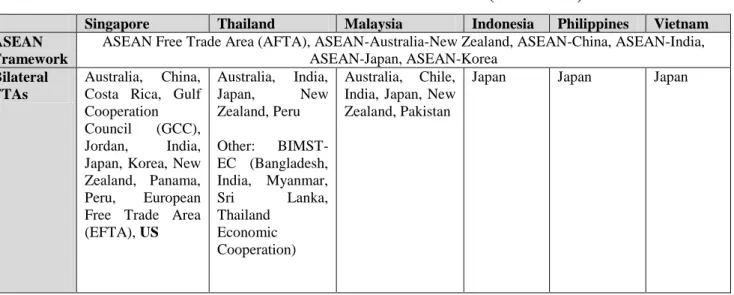
since, as seen in Table I.1, only Singapore has sucessfully concluded a bilateral
FTA with the US. Others, in search for market access, investment and other
5 In fact, given its superior economic and political status, the US is very dominant in TPP until one can refer it as a US-led FTA. This point will be discussed in greater details in Chapter III. The proportion is calculated based on data from the United Nations Conference on Trade and Development (UNCTAD) Handbook of Statistics, 2012, pp. 412-418 and 454-471.
4
economic gains, direct their FTA on ASEAN frameworks and bilateral FTAs with
countries all around the world, but fail to engage the US.
Table I.1 – Southeast Asian Countries FTAs (Concluded)
Singapore Thailand Malaysia Indonesia Philippines Vietnam
ASEAN Framework
ASEAN Free Trade Area (AFTA), ASEAN-Australia-New Zealand, ASEAN-China, ASEAN-India, ASEAN-Japan, ASEAN-Korea
Bilateral FTAs
Australia, China, Costa Rica, Gulf Cooperation Council (GCC), Jordan, India, Japan, Korea, New Zealand, Panama, Peru, European Free Trade Area (EFTA), US Australia, India, Japan, New Zealand, Peru Other: BIMST-EC (Bangladesh, India, Myanmar, Sri Lanka, Thailand Economic Cooperation) Australia, Chile, India, Japan, New Zealand, Pakistan
Japan Japan Japan
Source: compiled from Ministry of Trade and Industry, Singapore, 2012; Department of Trade Negotiations, Thailand, 2010; Ministry of International Trade and Industry, Malaysia, 2012; Directorate General of National Export Development, Ministry of Trade, Indonesia, 2011; Department of Trade & Industry, the Philippines 2008; Ministry of Industry and Trade, Vietnam, n.d.a
It is the purpose of this research to seek explanation on Southeast Asia‟s
response to TPP. Despite its temptation, the response by countries in the region is
far from similar: some countries such as Brunei, Singapore, Vietnam, and
Malaysia are in the negotiation table already while some countries are still very
sceptical on the prospect, such as Thailand, Indonesia, and the Philippines. Given
such a situation, it is very reasonable to ask: why do they choose such an
approach? What kind of factors contributes to these behaviors? How does such
international stimulus coalesce with domestic priorities and political context?
How do the factors work to influence these behaviors? Therefore, the research is
5
toward TPP. It seeks to explore why some countries participate in the negotiating
process while some others do not. As part of the Asia-Pacific, Southeast Asia is
far from immune to its dynamic, especially the TPP. In fact, as part of the
economically dynamic East Asia that contributes to the „miracle‟ story and „rise of
the rest‟ phenomenon, Southeast Asia is actually one of the main targets of US‟
charm through the TPP.
By doing so, the research would like to contribute to the existing literature
on Southeast Asia‟s trade policy. Firstly, the research will adopt a
political-economy approach to explain these policies. Within the realm of international
trade, the economic approach seems to prevail and leaves the political approach
underresearched (Mansfield & Milner, 1999). TPP is indeed an economic measure,
however, as it is situated within the very context of interaction among states, the
political-economy approach becomes all the more important. Secondly, the
research will adopt a comparative perspective by selecting 3 case studies: on one
hand Vietnam and Malaysia as members of negotiating parties, and on the other
hand Indonesia as the non-negotiating party. It is very important to follow such an
approach as existing literature are far too concerned on single-country analysis.
Thirdly, discussing TPP provides an opportunity to seek the nature of trade policy
decision making in Southeast Asia. It is the TPP that mekaes Southeast Asian
countries deal with the superpower, namely the US. So far, existing literature lag
behind this insight by putting too much attention on domestic level analysis. Even
more, within the domestic approach it is still far too occupied by unitary state
6
unitary. It is also by investigating TPP that one can comprehend that in Southeast
Asia, diverse societal groups actively look for opportunities to influence the
decision-making process.
The following subsection will scrutinize those points even more. The
literature review will be presented with special attention to the above-mentioned
gaps. Findings from the literature review will lead to the formulation of research
questions and objectives. The chapter will conclude by providing the structure of
the research.
I.2 Literature Review
Existing literature mainly discuss the more economically developed
countries in the region, namely the ASEAN-5 (Indonesia, Malaysia, Singapore,
Thailand, and the Philippines). Here, the literature review will focus on these
countries with particular interest on the political aspect of Southeast Asian trade
policy. Discussion on economic aspect has been far too robust, comprising of the
potentials of FTA, existing FTAs‟ impact on GDP, income, labor and so on.6
Despite its economic leverage, it lacks political importance, which becomes
central for this research. It is found that the political aspect of Southeast Asian
trade policy seems to be left behind, as there are only relatively limited
discussions on it. This is especially true for the case of Vietnam, which becomes a
6
The literature is particularly extensive for Vietnam, Malaysia, and Thailand and, to lesser degree, for Singapore, Indonesia, and the Philippines. For Vietnam, look at Athukorala (2009), Heng & Gayathri (2004), Jenkins (2004), and Thanh (2005). For Malaysia, look at Rasiah (2008), Devadason (2006), Nair, Madhavan & Vengedasalam (2006) and Yusoff (2005). For Thailand, look at Chirativat & Mallikimas (2004), Pungchareon (2005), Talerngsri & Pimchanok (2005). For Singapore, look at Sen (2005). For Indonesia, look at Basri & Patunru (2012a). For Philippines, look at Wignaraja, Lazaro & de Guzman (2009).
7
case study for this research, but there is no single dicussion on its political aspect
of trade policy, let alone FTA (see Table I.2 below). For other countries such as
Indonesia and Singapore, there are relatively more literature. For the sake of
discussion, existing literature can be grouped into three parts: first, those focusing
on comparative study; second, those on international aspect; and third, those on
domestic aspect. Such division also reflects the main critics central for the
research.
I.2.1 Comparative Study
Discussion of this particular issue is one of the main weakness of the
existing literature. Despite comprising ten different countries with varying trade
policy behaviors and significance, it is quite surprising that comparative study
never becomes the main focus. Comparative study is important, as it enables the
researcher to make generalization, to test the strength of an independent variable
to influence dependent variable, and to provide more diverse and richer account to
a social phenomenon.
Hoadley (2007) is the only one taking such an approach. Comparing
Singapore, Thailand and Malaysia, the research provides identification of trade
policy characters of each country as well as its contributing factors. Singapore can
be seen as a true champion of FTA, with agressive deals with as many as 15
parties in 2006. At the same time, Thailand is in the middle, with its passion
toward FTA liberalization while retaining domestic protectionism, and Malaysia
8
Reasons behind Singapore‟s agressiveness are market access, fear of trade
diversion, its security partnership with major powers (as seen in US-Singapore
FTA), and the „demonstration effect‟ for other countries to play more active role
on FTA. For Thailand, similar factors also play roles in addition to the politically
influential „export-oriented cosmopolitan enterpreneurs‟ and the quest for
international prestige. Malaysia‟s low profile is basically due to its adherence to a
multilateral scheme (World Trade Organization - WTO) and pressure from
protectionist groups.
I.2.2 International Factor
International aspect highlights another major gap within the existing
literature on Southeast Asian trade policy. For the sake of TPP issue, of particular
importance here is the linkage between trade policy with efforts to approach Great
Powers, especially the US. Among the limited literature, a work by Pang (2007) is
the only one that qualifies this criteria by highlighting US-Singapore FTA. He
argues that Singapore‟s motive to conclude the deal is because of the city-state‟s
inherent vulnerability to regional conflicts, such as territorial disputes, terrorism,
muslim neighbors, Taiwan strait, North Korea‟s nuclear issue, and so on. Signing
on FTA with the US will provide the ground for closer interaction and
interdependence among the two countries. In fact, the FTA was followed by other
security initiatives, such as a security cooperation agreement in July 2005 and
Singapore‟s US$ 1 billion purchase of military aircrafts and US$ 800 million of
9
Other work also tries to assess this international factor, although not
related to the „US factor‟. Van de Haar (2011) finds that in Japan-Philippines
Economic Partnership Agreement (EPA), the international factor can overcome
barriers posed by the domestic factor. The international factor here is the need to
arrange closer relations with Japan, which is a US‟ ally in East Asia, especially in
relations to the growing threat of China. Domestically, the Philippines is plagued
by protectionist policy in its political institutions (due to decades-long
rent-seeking behavior) and domestic interests (pressure from populist
Non-Governmental Organizations - NGOs and the catholic church).7 Other works, such
as those by Lee (2006) on Singapore and Nagai (2003) on Thailand, also attempt
to assess international factor, although the two countries FTA behavior are
basically a response to global development, such as the slow negotiation progress
of WTO in multilateral level and ASEAN in regional level. Both works are also
equipped with domestic nuances, namely the relative absence of protectionist
groups in Singapore and the relatively strong role of export-oriented groups in
Thailand.
I.2.3 Domestic Factor
A more robust literature on Southeast Asian trade policy lies primarily
within this category. However, angles of analysis in this theme are quite various.
7 However, there is a validity weakness in Van de Haar‟s work. He claims that the international factor is better than domestic factor to explain the outcome. However, he comes to this conclusion after determining that the domestic factor (namely the deep devision on whether or not to ratify the deal) cannot explain why the country still ratified it in the end. He does not show how the international factor leads to the ratification, especially in dealing with the stalemate in the domestic level.
10
A work by Bird, Hill, & Cuthbertson (2008) on Indonesia, for example, gives a
very interesting insight on how the democratization process influences the
country‟s inconsistent trade policy. The Ministry of Finance, on one hand,
proposes tariff liberalization while the Ministry of Trade and the Ministry of
Agriculture, backed by domestic business pressures and populist policies,
implement non-tariff barriers (NTBs) on the other hand. Subnational governments
also play a role by imposing local tax and other measures, which are largely NTBs.
Another interesting theme, proposed by Chandra (2008) in the context of
Indonesia, argues that Indonesia‟s relative eagerness toward ASEAN
liberalization is due to the rise of „logical nationalism‟ (a redefinition or
awareness in which national interest can be attained through regional setting -
„Regional Integration Strategy‟. For example, Chandra (2008) mentions that Indonesia‟s sensitivity toward national disintegration is preserved by ASEAN‟s
principle of non-interference.
A broader classification within this category is presented by those authors
who view the state as a unitary actor in influencing trade policy. There are quite
many academics focusing on this issue. Low (2008) contends that Singapore‟s
aggresiveness toward bilateral FTA deals is because of the city-state‟s
development plan to be the center for a knowledge-based economy (KBE). An
FTA is important because: 1) it provides a necessary lock-in reform to boost
private initiatives; 2) it provides market access to KBE‟s products; and 3) it
facilitates human resources and technology access, including mobility of
11
how this unitary state imposes a more protectionist policy in Malaysia. Suzuki
(2003) argues that Malaysia is more confident to conduct FTA within the ASEAN
framework as it provides flexibility for domestic adjustment, such as the delay of
automotive liberalization until 2005. This is also the case for Malaysia‟s effort to
expand ASEAN free trade to include China, Japan and Korea, which can be seen
as an effort to maintain flexibility but to gain bigger market and stronger voices
against other regional blocking in North America (NAFTA) and Western Europe
(European Economic Community - EEC). Okamoto‟s (2006) work is similar to
this logic as she labels Malaysia as a „reluctant bilateralist‟. Not only due to effort
to protect sensitive sector, it is also because Malaysia cannot withstand WTO-plus
principle which may hurt the country‟s Bumiputera policy. Bumiputera (which
literally means „son of soil‟) is an affirmative action designed to improve the
economic status of ethnic Malay against Chinese and Indian.
Another important insight is from Nesadurai (2003, 2012), which again
sees the state as a unitary entity. Both works see Southeast Asia as a single unit
and argue that the AFTA is made in a way that would benefit intra-ASEAN
vis-a-vis extra-ASEAN business groups. State and business engage in a patronage
network, in which trade policy outcome is the result of accomodation that state
elite has to make in order to engage key business elite. Such pressure from
business groups result in so-called „developmental regionalism‟, which can be
seen in at least two examples: 1) low-quality FTA, which includes Sensitive List
and Exclusion List (those sectors that are not competitive enough but
12
will get the first priority (than extra-ASEAN) for investing in other ASEAN
countries for 10 years under the ASEAN Investment Area (AIA) scheme.
Such development within this domestic aspect needs to be qualified for the
sake of the research. For example, the prevailing theme in which state is seen as a
unitary actor is not always true. State is a complex actor and institution, which
behaves far from a single manner. The case is particularly true for their response
to TPP, which will be shown in the subsequent empirical chapter. At the same
time, the primary role of business groups should be seen in relations to the activity
of other actors. Societal groups should not be seen within this single group alone;
other groups such as the various NGOs also play important roles. Again, their role
and influence will be shown in the subsequent empirical chapter.
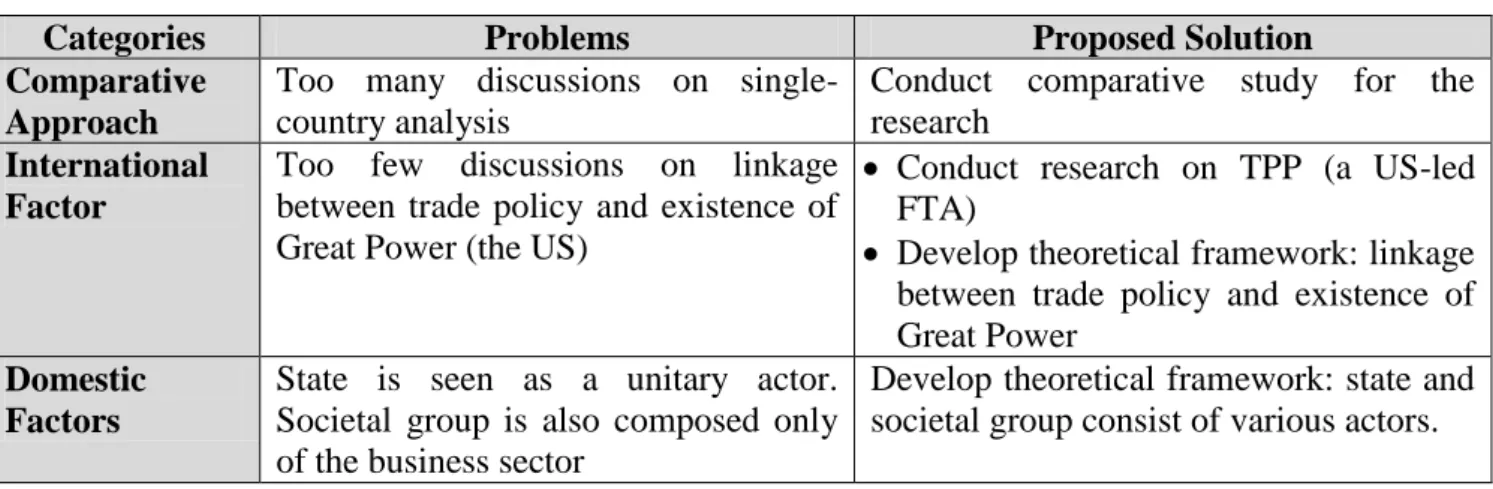
Table I.2 provides a summary of literature review on Southeast Asian
trade policy. It basically formulates three weaknessess of existing literature: 1)
lack of comparative study; 2) lack of the linkage between FTA and the existence
of Great Power (international factor); and 3) imperfect assumption that state is
unitary and a societal group is only made of business sector (domestis factor).
Table I.3 articulates such weaknessess into the solution that will be utilized within
this research. It is argued here that the case of TPP provides an important account
to address the gap. The research will be a comparative study, with a unique
opportunity to see the linkage of trade policy and the existence of Great Powers
(TPP is basically a US-led FTA). The research will also assume that the state is
not unitary and societal groups vary much more than only ones constituted by the
13
Table I.2 – Summary of Literature Review
Countries Studies Perspectives
Comparative International Aspect International and Domestic Aspect Domestic Aspect Comparative (Singapore, Malaysia, Thailand)
Hoadley (2007) Economics: market acess; fear of trade diversion
Politics: rise of export-oriented enterpreneur; closer relations to the US
Singapore Pang (2007) Closer relations to the US
Low (2008) State’s strategy for
economic survival
Lee (2006) Int’l: WTO and
ASEAN’s slow progress
Domestic: relative absence of protectionist group
Thailand Nagai (2003) Int’l: WTO’s and
ASEAN’s slow progress
Domestic: role of export-oriented group
Malaysia Suzuki (2003) State’s strategy to
protect infant industry
Okamoto (2006) State’s strategy to
protect infant industry
Vietnam - - - - -
Philippines Van de Haar (2011)
Int’l: to forge closer relations to Japan & to balance China State: protectionist Senate Domestic: pressure of protectionist group
Indonesia Bird, Hill & Cuthbertson (2008)
Fragmented power due to
democratization
Chandra (2008) The rise of ‘logical
nationalism’ ASEAN as single unit Nesadurai (2003, 2012) Role of protectionist business group
14
Table I.3 – Literature Gap and Proposed Solution
Categories Problems Proposed Solution
Comparative Approach
Too many discussions on single-country analysis
Conduct comparative study for the research
International Factor
Too few discussions on linkage between trade policy and existence of Great Power (the US)
Conduct research on TPP (a US-led FTA)
Develop theoretical framework: linkage between trade policy and existence of Great Power
Domestic Factors
State is seen as a unitary actor. Societal group is also composed only of the business sector
Develop theoretical framework: state and societal group consist of various actors.
I.3 Research Questions
The main aim of this research is to analyze the role played by international
and domestic factors in shaping trade policy. How do international factors
influence the decision to participate or not to participate in TPP? How do
domestic factors affect this very process? What is the pattern of interaction
between these two factors in shaping a country‟s trade policy? Do they perform
similar patterns across countries? What are the similarities and differences among
countries?
For the case study, the research will use 3 countries: Vietnam, Malaysia,
and Indonesia. The first two represent „participating countries‟ while the last one
represents the „not participating country‟. Practically speaking, the research aims
to answer these questions: “Why have Vietnam and Malaysia decided to join the
15 I.4 Significance
The main significance of the research is to generate more understanding
on the nature of trade policy decision making in Southeast Asia. Of particular
importance, the research is designed to identify determining factors influencing
the decision of Southeast Asian countries on TPP. On the international side, the
research seeks to improve our understanding on the linkage between „trade policy‟
and „Great Power existence‟. On the domestic side, it seeks to improve our
understanding on the linkage between „trade policy‟ and „plural interests of state
and societal groups‟.
The research is basically a comparative approach. Therefore, by using the
words of Ragin (1994), it aims to explore diversity of Southeast Asian trade
policy decision-making, namely the decision whether or not to participate in the
TPP. By doing so, it seeks to analyze similarities and differences between the 3
countries on their international trade policy behavior.
Practically, the research will be a useful account for any parties interested
in the study of trade politics in Southeast Asia. Some stakeholders potentially
taking advantages from this research are government officials, business groups
and academics.
I.5 Structure of Research
16 Chapter I - Introduction
This chapter will highlight the reasons for conducting this
particular research. It consists of background, literature review,
research questions, objectives and structure of research.
Chapter II - Research Design
The chapter will elaborate on the theoretical framework used for
this research, namely the operationalization on international and
domestic factors. The theoretical framework will mainly include
definition, indicators and hypothesis. Meanwhile, discussion on
methodology will include method, case selection, technique of
validation and data collection.
Chapter III - TPP: Development and Controversies
The chapter will focus on TPP as a US-led FTA initiative. Firstly,
it will discuss the progress of TPP, such as its evolution from
TPSEP and negotiation process so far. Secondly, it will address
TPP‟s economic issues sensitive to developing countries, such as
comprehensive liberalization and WTO-plus proposal. Thirdly, it
will position TPP within the US‟ regional approach in Asia-Pacific,
especially on its interests to balance China and to create US-led
regionalism.
Chapter IV, V, VI – Case Studies: Malaysia, Vietnam and Indonesia
Each chapter here will discuss one case study. Discussion will
17
variable is the country‟s decision regarding TPP, while the
independent variables are the international and domestic factors
affecting the outcome. Each chapter will discuss the nature of
relations between the two variables by examining how independent
variables work to influence the dependent variable and so on. Each
chapter will end with a conclusion.
Chapter VII – Conclusion
The main aim of this chapter is to compare similarities and
differences among the case studies. The chapter will also reflect the
findings with theoretical framework proposed in earlier chapters,
therefore creating a dialogue between evidence and theory. The
chapter will also position the result of research to the broader
theoretical literature of trade policy in Southeast Asia. Lastly, there
18
CHAPTER II – RESEARCH DESIGN
II. 1 Conceptual Framework
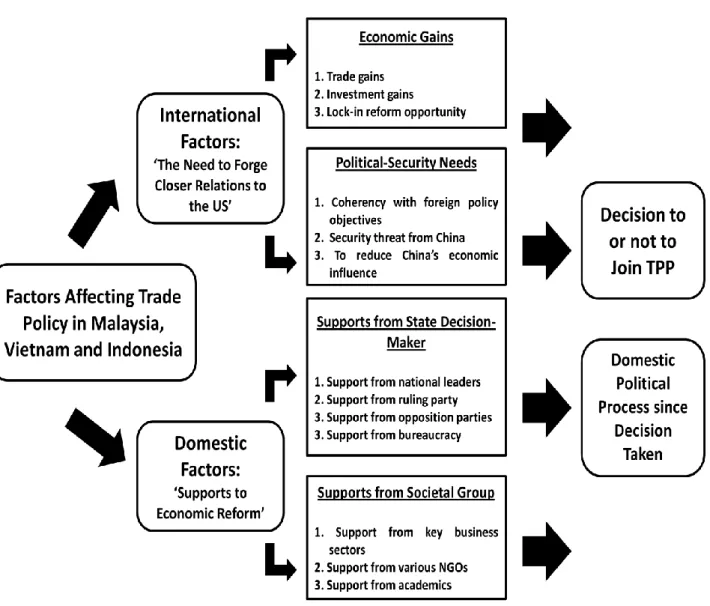
Figure II.1 – Diagram of Conceptual Framework
In regards to determinant factors affecting trade policy decision-making,
many literature put heavy emphasis on economic factors. It is not the goal of this
research to continue such a tradition. Rather, it adopts the political-economy
19
comprehensive view on the nature of trade policy. As seen from figure II.1, there
are two factors affecting Southeast Asian trade policy decision making, namely
international and domestic factors. The distinction is made based on the gap found
in the literature review section. For international factors, it is „the need to forge
closer relations to the US‟. It consists of two different variables, namely „economic gains‟ and „political-security needs‟. Meanwhile for domestic factors, it is „the support to economic reform‟, which consists of „support from state decision-makers‟ and „support from societal groups‟. The four variables affect the
decision of Southeast Asian countries, whether or not to participate on TPP.
Positioning TPP within the broader trade policy debate in Southeast Asia,
several assumptions must be made to formulate the best conceptual framework.
First, different from most existing FTAs that Southeast Asian countries currently
have, TPP entails a „US factor‟. The US has been an important economic partner for Southeast Asian countries for a long time, therefore incorporating this
particular element in essential. Yet, the US is also a Great Power in current global
politics: it is the main security guarantor in the Asia-Pacific since the end of
World War II and the winner of the Cold War against the Soviet Union. Therefore,
US‟ presence (for example through TPP) must be seen in accordance with
Southeast Asia‟s own political and security objectives, whether it is aligned or not.
Especially in the current uncertainty regarding China‟s rise (either peaceful or not), the role of the US remains critical. This is why linking FTA policy with
political-security consideration is justified. Second, TPP is an FTA promoted to
be the „high-standard‟ or 21st
20
more aggressive in promoting liberalization and economic reform. This coincides
heavily with Southeast Asian countries‟ own domestic agenda for economic
reform. Therefore, such international agreement should be seen in accordance
with the dynamic within the domestic arena. Such a reform agenda is never easy;
it always generates pros and cons among various groups. Reform agenda always
carries a great deal of wealth distribution among actors, as some may benefit and
some others may lose, be it for economic, political or even ideological reasons.
For this research, it means that seeing TPP as part of a reform agenda opens up
the possibility of seeing a different trade policy-making: state and societal groups
should be seen as consisting of many actors with different interests on reform
agenda. Thus, domestic politics even transcends beyond the decision-making of
participating/ not participating in the TPP itself. Rather, as Figure II.1 suggests, it
influences the domestic political process since the decision is being taken.
The following subchapters will discuss each variable in greater detail. It
will start by discussing the economic gains and political-security needs (both are
part of international factors), domestic support to economic reform (both from
state decision-makers and societal groups), and hypothesis. The latest part of this
chapter will discuss method, technique of validation, case selection, and data
21
II.1.1 International Factors: The Need to Forge Closer Relations to the US A. Economic Gains
Linkage between economic gain and trade policy is a very common
framework. Basically, it postulates that the more a state gains economically, the
greater the chance it will participate in an FTA. The framework is very common
in the field of Economics. Yet even within International Relations (IR) theory, the
issue of gain is also a central theme of state‟s behavior. The
neoliberal-institutionalist theory proposes the concept of absolute gain for determining state
action on international cooperation. The paradigm basically absorbs some realist
assumptions of International Relations, such as state as a unitary actor seeking
maximum gains (Grieco, 1988, p. 486-487). It will, therefore, determine their
action on a given international cooperation (TPP in this research), in which the
state will seek absolute gains. The more absolute gains it can take, the more
willing a state will be to participate in international cooperation. Within this
research, a state will pursue an FTA in order to get three types of economic gains:
trade gain, investment gain, and lock-in reform opportunity.
Trade gain is an obvious reason for fostering an FTA. By liberalizing
tariffs and other barriers, there will be more opportunity for export. Economically,
this is called a „trade creation‟ effect. In East Asia, in which many countries rely
heavily on external markets, an FTA is an important tool to access overseas
market, especially as the latter are getting more restrictive due to economic
slowdown and domestic political pressure. Particularly in Southeast Asia, trade
22
the economic growth component. The more it exports, the higher the economic
growth; the less it exports, the lower the economic growth. Consequently, it will
also lead to employment level and welfare gains. Moreover, securing an FTA is
also important against other countries competing to access the same market. One
country does not trade only with a single country. So, a country must keep an eye
on the performance of its competitors, especially those with the same export
structure and export market. Securing an FTA is a winning tool as it will reduce
tariff barriers only for members while maintaining tariffs to non-members. In a
different situation, if a country loses market share given that its competitor has
already secured an FTA with the targeted market, FTA can also be a tool to
correct the disadvantage. Solis & Katada (2008) discusses this possibility on their
work on cross-regional FTA. They argue that an FTA is arranged due to „fear of
exclusion‟ or „trade diversion‟ from the existing FTAs as a way to improve competitiveness.
For a small country, like those in Southeast Asia, there is always a danger
to secure an FTA with a bigger trading partner like the US. Due to power
asymmetry, the latter can demand higher liberalization without the former can
demand the same thing. Yet as argued by Ravenhill (2006), a small country is still
always better off with than without an FTA. It is because a bigger country is
always a more important partner for a small country than vice versa; therefore, the
trade benefit they may enjoy will be higher. This causes a small country to be
23
Another gain from an FTA is investment. As a country secures FTA, it is
anticipated that, as a member, it will experience an inflow of foreign capital. If the
agreement is between developed and developing countries, then it is the latter that
will experience higher FDI flow than the former. As an FTA is secured, there is
an opportunity to produce goods in a more cost-effective way, which means
relocating factories to developing country with the target to serve a big consumer
market in the developed country (Ravenhill, 2011, p. 183). This is what happened
in Mexico after NAFTA, in which the country received a massive surge of FDI
from around US$ 8 billion in 1990 to US$ 24 bilion in 2001 (Ravenhill, 2011, p.
183). This is also why some FTAs, such as TPP, are embedded with investment
agreement. An investment agreement is important as it creates an
investment-friendly environment for foreign capital, especially in Asia, where the
governments traditionally require many restrictive measures for FDI operation
(Aggarwal, 2006, p. 9). An investment agreement will prohibit local-content
requirement, export performance requirement, rule for expropriation, and the like.
As a result, member countries are more likely to experience more FDI. This
investment gain is very important if one observes the development process in
Southeast Asia. Throughout the second half of the 20th century, Southeast Asia
has been tying its development process with the inflow of foreign investment.
Foreign companies, either joint-venture or fully-owned, make a substantial
contribution to these countries‟ exports. They also serve as the main source of
capital, technology and working skills. Therefore, even without a substantial trade
24
(Kimura, 2006, p. 51). If one takes into account the competitive environment in
which East Asian countries compete heavily for FDI, especially from China, then
the greater the need is to secure investment gain through an FTA (Kimura, 2006, p.
51).
The last indicator relates heavily with the investment gain, e.g. opportunity to
lock-in reform. An FTA is important as it shows a commitment to a pro-business,
conducive investment climate, which will be critical for inviting foreign
investment. Therefore, FTA is seen as an external push to conduct domestic
economic reform, or to lock-in reform commitment. Within an FTA, especially
the one with a high standard like the TPP, a country is bound to many reform
agenda, such as greater liberalization, enhanced transparency, and fair competition.
This is even more important in the globalized world, in which many countries
compete with one another to attract FDI (Ravenhill, 2011, p. 180). Continuing
this logic, it makes a lot of sense to secure such commitment in an FTA as
countries‟ participation is less than the one in WTO level. Therefore, it will greatly improve a country‟s visibility in the eyes of foreign investors (Ravenhill, 2011, pp. 180-181).
B. Political-Security Needs
Some scholars have discussed the possibility of linking trade with
political-security objective. This is very relevant for developed countries, in which
Aggarwal (2006, p. 11) formulated that “...a more industrialized country has a
25
the event of adverse political security development...”. Some countries have
shown a very clear tendency to arrange such a trade-political/ security nexus. The
US arranged an FTA with Israel and Jordan as rewards for both countries‟ support
on US‟ policy in the Middle East, while China arranged a China-ASEAN FTA as a way to cool down China‟s threat perception and Japan arranged bilateral and mini-lateral FTAs with Southeast Asian countries to strengthen its regional
presence (Aggarwal & Lee, 2011, p. 17). In this research, it is argued that such a
nexus is also very possible for small and medium powers. Countries in Southeast
Asia, no different from their Great Power fellows, also possess political-security
priorities which are very likely to make them link FTA to such objectives. There
are three indicators to be utilized here, i.e. coherency with foreign policy
objectives, security threat from China, and to reduce China‟s economic influence.
For the first indicator, it is important to see trade policy as part of a state‟s broader foreign policy tools. Analyzing the Philippines‟ view on the
Japan-Philippines Economic Partnership Agreement (JPEPA), Van de Haar (2011) notes
that in the current academic literature there are only thin efforts to linkage these
two policies, in which foreign policy is seen as a less important subfield in
International Relations. Van de Haar (2011) tries to fill the gap by linking
domestic sources of foreign policy to trade policy outcome, yet this research will
formulate it differently. In this paper, it is argued that trade policy, especially on
TPP, links heavily with a country‟s foreign policy goals and objectives. If a state judges that a participation in a particular FTA will serve its foreign policy, then
26
participate. „Foreign policy objectives‟ means that one must utilize a customized approach, since each country has their own foreign policy objective. Trade policy
should be seen as a continuation of foreign policy. It can also serve as an
important tool to achieve such objectives, if other political or security tools are
considered inappropriate. Therefore, in this paper, it is assumed that a country‟s
trade policy is consistent with its foreign policy.8
The second indicator relates heavily with the broader security situation in
East Asia. As noted in many literature, the US always plays an important role as
an external security guarantor in this particular region. Tracing back to the end of
World War II, the US‟ presence is important as a significant deterrent to the expansion of communist insurgency. As the Cold War ended, the region faced
another challenge as there is one potential Great Power accumulating its power
source, namely China. The problem here is that China‟s rise also entails a high
degree of uncertainty: is China‟s rise benevolent or malevolent? The very
situation of China‟s rise relates heavily with the concept of „balance of threat‟ postulated by Stephen Walt (1987). Different from the ordinary balance-of-power
theory, balance of threat basically looks at the intention of one state to use its
capability against another state. Therefore, it has a more direct nuance and is
different from balance-of-power theory that emphasizes only capability. Does
China have the intention to use force against its neighbors? This is something very
difficult to answer.
8 By saying „trade policy is consistent with a foreign policy‟, it does not necessarily mean that the author denies the possibility of inconsistency between the two of policies. In fact, this is the case of the absence of FTA between Japan-China, China-US, and Korea-Japan, although they trade heavily with each other. However, the author wishes to show that there are cases where the two policies go hand-in-hand. The finding of the thesis (shown in the conclusion) proves it.
27
In IR, there is an assumption to arrange precautionary actions to mitigate
an unlikely scenario. A work by Mochizuki (2009) sheds light on the connection
of economic tools with such action. He mentioned that under security uncertainty,
a country‟s strategy is usually not clear-cut between either balancing nor bandwagoning but entails a mixed approach. They will engage the potential
adversaries through economic accommodation, such as what ASEAN did through
the ASEAN-China FTA. Therefore, FTA is important as an engagement mean.
Moreover, it also means that FTA can be used as a way to strengthen relations
with an external power, especially one with the capability to constrain China, such
as the US. Solis & Katada (2008) also explores this issue by arguing that one of
the motives for cross-regional FTA is a state‟s attempt to engage the US as an
extra-regional security guarantor. This is the very issue raised by Pang (2007) on
commenting the US-Singapore FTA. From Singapore‟s point of view, the
decision to arrange the deal is due to a political-security threat from surrounding
environment, especially its bigger neighbors Indonesia and Malaysia and the
broader US-China rivalry. On the TPP issue, it is argued here that the whether or
not to participate links heavily with this US-China debate in East Asia. A
Southeast Asian country will assess the level of China‟s threat based on their own customized situations, which then leads to an attempt to engage an external
security guarantor or not. If they assess that such China‟s threat is high, then the more likely they will participate on TPP. Similarly, if they assess such a threat as
relatively absent or less urgent, then the lower the need to engage the US through
28
The third indicator, to reduce China‟s economic influence, still relates to this US-China debate. Yet, it entails specifically on the very economic tools that
China may use to exert influence over Southeast Asian neighbors. China has been
engaging Southeast Asia quite dynamically especially through trade relations and,
to a lesser degree, FDI. The research will investigate how Southeast Asian
countries respond to this particular economic engagement, such as on whether
they see it as an opportunity or a threat and the very policy they formulate as a
way to respond to such a situation. A country may continuously nurture its
economic relations with China if it finds such relations beneficial. Yet, if it is not
then a country may seek ways to mitigate such „threat‟. Responses here may vary,
from developing their own competitiveness against surging import from China or
to invite external actors to offset such imbalance. TPP is an important part of this
strategy, as it gives an enormous measure for mitigating too close or too
threatening economic relations with China. This line of argument is actually
consistent if one sees the issue from the US‟ perspective. For the Great Power,
TPP has important an political-security agenda (discussed more heavily in
Chapter 3). Through TPP, the US offers a generous market access for Asia-Pacific
countries, which on one hand, is substantial for deepening relations with the
former, and on the other hand, to reduce or at least to balance the latter‟s
increasing economic relations with China. Moreover, the high standard nature of
TPP actually reflects the US‟ clear preference on neoliberal economic idea and its desire for more countries to embrace these ideals. As countries adjust their
29
development models, such as East Asian developmental state or Chinese-style
„market socialism‟ (Manthorpe, 2013). Therefore, this research will focus on the Southeast Asian view the security-generated economic agreement.
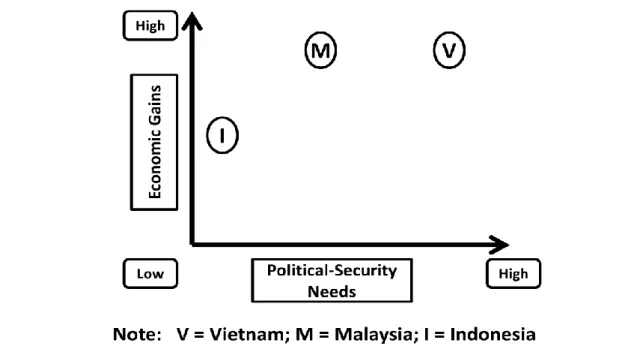
C. Proposition and Hypotheses9
Figure II.2 – The Needs to Forge Closer Relations to the US: Hypotheses
Figure II.2 shows relations between „economic gains‟ and „political-security needs‟. The figure shows the relations in X and Y axis, describing the continuum by each variable. In this research, there are four propositions worth
mentioning. Propositions here describe the logical relations between independent
variables („political-security needs‟ and „economic gains‟) and dependent variables (decision on TPP).
9 Given the qualitative nature of this research, the hypothesis proposed here should not be seen as a theory testing effort. Rather, it serves as a starting point or an early prediction to answer research questions. This position, therefore, makes the theory and hypothesis are very likely to change during the research.
30
#1 The higher the economic gains a country will get from the US, the more likely
it will join the TPP
#2 The lower the economic gains a country will get from the US, the less likely it
will join the TPP
#3 The higher a country has political-security needs to the US, the more likely it
will join the TPP
#4 The lower a country has political-security needs to the US, the less likely it
will join the TPP
Different from propositions, hypothesis concerns more on temporary
answer to the research questions. As seen from Figure II.2, there are three
hypotheses based on three case studies:
#1 High economic gains and high political-security needs most likely cause
Vietnam to join the TPP
#2 High economic gains and medium political-security needs most likely cause
Malaysia to join the TPP
#3 Medium economic gains and low political security needs most likely cause
Indonesia not to join the TPP
II.1.2 Domestic Factors: Support to Economic Reform
Within the domestic category, there will be two different variables
proposed: „support from state decision-maker‟ and „support from societal group‟. It is important to distinguish them, as they operate at different levels and are
31
constituted by different actors too. The activity of elite usually relates directly to
the decision-making process. In this category, elite is indicated by national leaders,
ruling party, opposition parties and bureaucracy. In the meantime, societal group
also relates to decision-making process, although it plays a relatively more
indirect role as a pressure group rather than the one responsible with the decision
making process. Within this category, there are business groups, various NGOs,
and academics. In this research, it is important to see the interest of those plural
actors on the domestic economic reform process.
Economic reform process means a set of policies designed to improve the
efficient allocation of resources within a country. It means that there should be an
abolition of market distortion policy and more promotion of business or
pro-investment policy. Important in this regards are basic provisions, such as
availability of infrastructure, human resources, and streamlining of investment
procedures. Basically, economic reform is derived from neoliberal thinking. The
most aggressive economic reform policy means only minimal state intervention
within the economy, in which the state should only function as a referee or
watchdog to maintain order. Therefore, market reform policies also entail
liberalization and abolition of protectionist policies such as tariffs, subsidy,
discrimination against foreign companies, and the like. TPP as a policy is of
course coherent with this thought with the aim to restructure or reform the
economy. A reform-minded government may use FTA like TPP as an additional
pressure to directly expose domestic businesses to international competition,