Computing
Abilityof Reversible and
Conservative
Cellular
Automata可逆的・保存的なセル
.
オートマトンの計算能力Kenichi
Morita, andKatsunobu
Imai
森田憲–, 今井克暢
Faculty of
Engineering, Hiroshima
University 広島大学工学部{morita,
$\mathrm{i}\mathrm{m}\mathrm{a}\mathrm{i}$}
$\mathrm{Q}\mathrm{k}\mathrm{e}.\mathrm{S}\mathrm{y}\mathrm{S}.\mathrm{h}\mathrm{i}\mathrm{r}\mathrm{o}\mathrm{s}\mathrm{h}\mathrm{i}\mathrm{m}\mathrm{a}-\mathrm{u}.\mathrm{a}\mathrm{C}\cdot \mathrm{j}\mathrm{P}$http:$//\mathrm{w}\mathrm{W}\mathrm{W}.\mathrm{k}\mathrm{e}$
.
sys.
hiroshima-u.$\mathrm{a}\mathrm{c}.\mathrm{j}\mathrm{p}/\sim_{\mathrm{m}\mathrm{o}\mathrm{r}\mathrm{i}}\mathrm{t}\mathrm{a}/$Abstract
We introduce a new model of cellular automaton called a one-dimensional
number-conserving partitioned cellular automaton (NC-PCA). AnNC-PCA isasystemsuch that a
state ofacell is represented byatripleofnon-negative integers, and the total (i.e., sum) of
integersoverthe configuration is conserved throughout its evolving (computing) process. It
can be thought as a kind of modelization of the physical conservation law ofmass
(parti-cles) orenergy. We also define a reversible version of NC-PCA, and provethat a reversible
NC-PCA is computation-universal. It is proved by showing that areversible two-counter
machine, whichhas beenknown to beuniversal, canbesimulatedbya reversibleNC-PCA.
1
Introduction
Recently, various kinds of interesting computing models which directly reflect laws of nature
have been proposed and investigated. Among others, quantum computing, DNA computing,
reversible computing, etc. have been extensively studied. A reversible computer is
a
systemsuch that its transition function ofthewhole state is a one-to-one mapping (injection), hence,
roughly speaking, it is
a
backward deterministic system. It isa
kind of model reflectingphys-ical reversibility, and has been known to be very important when studying inevitable power
dissipation in a computing process [3, 4, 5, 13]. Besides the problem of energy consumption,
such
a
system is also interesting froma
computational viewpoint, $\mathrm{b}\mathrm{e}\mathrm{c}\mathrm{a}\mathrm{U}8\mathrm{e}$ they have very richability of information processing in spite of the reversibility constraint. Until now, several
versions of computation-universality of RCAs for one- and
two-dimensional cases
have beenshown [8, 9, 10, 11, 12, 16, 17, 18, 19]. It is also possible to construct an RCA in which various
objects
can
self-reproduce $[15, 17]$.
Conservation of
mass or
energy is alsoan
important physical law as well as reversibility.Fredkin and Toffoli [5] proposed ConservativeLogic, a kind of logiccircuit theory, that models
both reversibility and conservation law of physics, and showed its universality. In this system,
each primitive logic gate must satisfy the constraints ofreversibility (i.e., its logicalfunction is
an injection), and conservation ofbits (i.e., the total number of logical value “$1$”$\mathrm{s}$ is conserved
between its input and output). Also for cellular automata, several universal models that
are
both reversible and bit-conserving havebeenknown [8, 9, 11].
In this paper, we define a new model of cellular automaton $(\mathrm{C}\mathrm{A})$ called a one-dimensional
number-conserving partitioned cellular automaton (NC-PCA), which generalize the notion of
bit-conserving$\mathrm{C}\mathrm{A}$
.
Inan
NC-PCA, each cell is partitionedintothree parts, i.e., left, center, andright parts, and the state of each part is represented bya non-negativeinteger (thus, thestate of
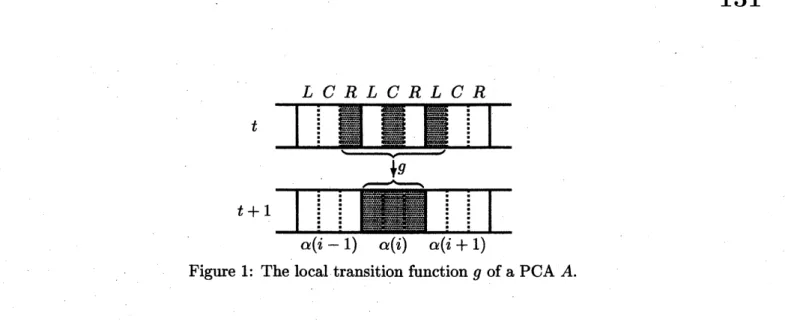
a cellisrepresented by a tripleof non-negative integers). The next state ofacellis determined
by the present states of the right part of the left-neighboring cell, the center part of this cell,
and the left part of the right-neighboring cell (not depending on the whole state of the three
cells). The total number isconserved duringthe local transition, hence the total numberover
a
Figure 1: The local transitionfunction $g$ ofa PCA $A$
.
Related to this model, afew other models inwhich each cell state isrepresented by a
non-negative integer have been known: a totalistic CA [1] and a sand pile model $[6, 7]$
.
In [1],a
CAwith
a
simple totalistic rule (but not necessarilynumber-conserving) has been shown to beuniversal. In $[6, 7]$, a kind ofan automata system having a specifictype of number-conserving
rules are studied.
Here, we investigate the computing ability ofan NC-PCA, and its reversible version. We
show that
an
NP-PCA is computation universaleven
ifit is reversible. This strengthens theprevious result that
a
one-dimensional reversible CA (not necessarilya number-conservingone)is computation-universal [10]. We prove it by showing that
a
reversible two-counter machine,which has been known to be universal [14], can be simulated by areversible NC-PCA.
2
Number-Conserving Partitioned Cellular Automata
In order to define a one-dimensional number-conserving partitioned cellular automaton
(NC-PCA),
we
first givea
definition ofa
partitionedcellular automaton (PCA) that has beenintro-ducedto design areversible cellular automaton [10].
Definition 2.1 A deterministic one-dimensional three-neighbor partitioned cellular automaton
(PCA) is
a
system defined by$A=(\mathrm{z}, (L, c, R),g, (\tilde{q}_{L},\tilde{q}_{C},\tilde{q}_{R}))$,
where $\mathrm{Z}$ is the set of all integers at which cells
are
placed, $L,$ $C$ and $R$ are non-empty finite setsofstatesof left, center, and right parts ofacell, $g;R\cross C\cross Larrow L\cross C\cross R$ isa local function,
and $(\tilde{q}_{L},\tilde{q}c,\tilde{q}_{R})\in L\cross C\cross R$ is
a
quiescent state that satisfies $g(\tilde{q}R,\tilde{q}_{C},\tilde{q}_{L})=(\tilde{q}_{L},\tilde{q}c,\tilde{q}_{R})$.
A configuration over the set $Q=L\cross C\cross R$isa mapping $\alpha:\mathrm{Z}arrow Q$
.
Let Conf$(Q)$ denotethe set of all configurations over $Q$, i.e., Conf$(Q)=\{\alpha|\alpha:\mathrm{Z}arrow Q\}$. A
qui.escent
configurationisthe one such that all the cells
are
in the quiescent states $(\tilde{q}_{L},\tilde{q}c,\tilde{q}_{R})$.Let pro$L:Qarrow L$ is
a
projection function such that $\mathrm{p}\mathrm{r}\mathrm{o}_{L}(l, c, r)=l$ for all $(l, c, r)\in Q$.
Projection functions $\mathrm{p}\mathrm{r}\mathrm{o}_{C}$
:
$Qarrow C$, and pro$R$
:
$Qarrow R$ are also defined similarly. The globalfunction
$G:\mathrm{C}_{0}\mathrm{n}\mathrm{f}(Q)arrow \mathrm{C}\mathrm{o}\mathrm{n}\mathrm{f}(Q)$of$A$ is defined as follows.$\forall x\in \mathrm{Z}:G(\alpha)(x)=g$($\mathrm{p}\mathrm{r}\mathrm{o}_{R}(\alpha(x-1)),$proC$(\alpha(x))$, pro$L(\alpha(x+1))$)
Fig. 1 shows how the local function $g$ is applied to each cell. In the following, an equation
$g(r, c, l)=(l’, d, r)$’ is called
a
ruleof$A$, and write it by$[r, c, l]arrow[l’,c’, r’]$
.
We regard the local function$g$
as
the set of such rules for convenience.Definition 2.2 Let $A=(\mathrm{Z}, (L, C, R),g, (\tilde{q}_{L},\tilde{q}_{C},\tilde{q}_{R}))$ be
a PCA.
Wesay$A$isgloballyreversibleiffits global function$G$ is $\mathrm{o}\mathrm{n}\mathrm{e}- \mathrm{t}_{0}-\mathrm{o}\mathrm{n}\mathrm{e}$, and locally reversible iffits local function$g$ is $\mathrm{o}\mathrm{n}\mathrm{e}-\mathrm{t}_{0}- \mathrm{o}\mathrm{n}\mathrm{e}$
.
It is easy to provethe folowing proposition onPCA, which has been shown in [10].
Proposition 2.1 Let $A$be
a
PCA. $A$ isglobally reversible iffit is locally reversible.By Proposition 2.1,
a
globallyor
locally reversiblePCA
is called simply “reversible” anddenoted by RPCA. By this, if
we
want to constructa
reversible $\mathrm{C}\mathrm{A}$,
it is sufficient to give aPCA whose local function$g$ is $\mathrm{o}\mathrm{n}\mathrm{e}- \mathrm{t}_{0}-\mathrm{o}\mathrm{n}\mathrm{e}$
.
This makes it easy to designareversible$\mathrm{C}\mathrm{A}$
.
When
we
designa
one-to-one localfunction $g$,
it is sufficient to define it onlyona
subset of$R\cross C\cross L$ that
are
needed to performa
given task. Because,we can
always find a $\mathrm{o}\mathrm{n}\mathrm{e}- \mathrm{t}_{0}$-oneextension from a given partial function provided that the latter function is $\mathrm{o}\mathrm{n}\mathrm{e}- \mathrm{t}_{0}$
-one on
thesubset. This isassured by the following proposition (its proofisomitted since it iseasy).
Proposition 2.2 Let $A$ and $B$ be finite sets such that $|A|=|B|$, and let $g$ be
a
mapping$A’arrow B$ for
some
$A’(\subset A)$.
If$g$ is one-to-one, then there is a $\mathrm{o}\mathrm{n}\mathrm{e}- \mathrm{t}_{\mathrm{O}}$-one
mapping$g’$ : $Aarrow B$such that $g’(a)=g(a)$ forall $a\in A’$
.
We now give adefinition ofanumber-conservingPCA. As in the
case
ofareversible$\mathrm{C}\mathrm{A}$,it isalsoconvenient to
use
theframeworkofa
PCA. Because, the thenotion ofnumber-conservationcan
be expressed bya
simpleconstrainton
a
local function ofa PCA.Definition 2.3 Let $A=(\mathrm{Z}, (\mathrm{N}_{m},\mathrm{N}_{m’ m}\mathrm{N}),g, (0, k,0))$ be
a
PCA, where $\mathrm{N}_{m}$ denotes theset of integers $\{0,1, \cdots , m-1,m\}$, and $k(\leq m)$ is
a
non-negative integer. $A$ is calleda
one-dimensional number-conserving partitioned cellular automaton (NC-PCA), iff it satisfies the
following condition: For $\mathrm{a}11’(r,c, l),$ $(l”, C, r’)\in \mathrm{N}_{m}^{3}$, if$g(r,c, l)=(l”,c, r’)$, then $r+c+l=$
$l’+d+r’$
.
A reversible NC-PCA is also definedsimilarly, and denoted by
NC-RPCA.
3
Universality
of
an
NC-RPCA
In this section, we show that for any reversible two-counter machine there is an NC-RPCA
that simulates it. Since
a
reversibletwo-counter machines has been known to becomputation-universal [14],
we can
conclude that an NC-RPCA is also universal.In [14]
a
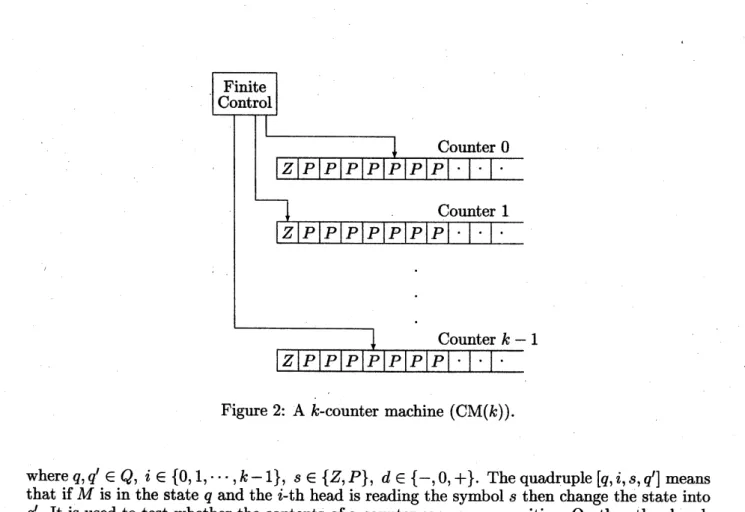
counter machine (CM) is definedas a
kind of multi-tape Turing machine whoseheads
are
read-onlyones and whose tapesare
allblank except the leftmostsquares as shown inFig. 2 ($P$
is.a
blank$\mathrm{s}.\mathrm{y}\mathrm{m}\mathrm{b}\mathrm{o}\mathrm{l}$). This definitionis convenient $\mathrm{f}\mathrm{o}\mathrm{r}\backslash$ givingthe notion of reversibility
on a CM.
Definition 3.1 A $k$-counter machine (CM$(k)$) is asystem
$M=(k, Q, \delta, q0, qf)$
,
where$k$is the numberof tapes (or counters), $Q$is
a
nonemptyfinite set of internal states, $q_{0}\in Q$is
an
initial state, and$q_{f}\in Q$ isa
final (halting) state. $M$uses
$\{Z, P\}$as
a
tape alphabet. $\delta$ isa
move
relation whichis a subset of $(Q\cross\{0,1, \cdots, k-1\}\cross\{Z, P\}\cross Q)\cup(Q\cross\{0,1,$ $\cdots$ ,$k-$$1\}\cross\{-,0, +\}\cross Q)$ (where “-,,, “$0$”, and $”+$ ” denote left-shift, no-shift, and right-shift of a
head, respectively). Tapes
are
one-way (rightward) infinite. The leftmost squares of the tapescontain the symbol “Z”s, andall the othersquares contain “P”s ($Z$ and $P$stand for “zero” and
“positive”).
Each element of$\delta$ is called
a
quadruple, and iseitherofthe formFigure 2: A $k$-counter machine (CM$(k)$).
where$q,$$q’\in Q,$ $i\in\{0,1, \cdots, k-1\},$ $s\in\{Z, P\},$ $d\in$ $\{-, 0, +\}$
.
The quadruple$[q, i, S, q’]$ meansthat if$M$ is in the state$q$ and the i-th head isreading the symbol $s$ then change the state into
$q’$
.
It isused to test whether the contents ofacounter are zero orpositive. On the other hand,$[q, i, d, q’]$ means that if$M$ isin the state$q$thenshift the i-th head to the direction$d$and change
the state into $q’$
.
It is used to incrementor
decrementa
counter byone
(or makeno
change if$d=0)$
.
$\mathrm{D}\mathrm{e}\mathrm{f}\mathrm{i}\dot{\mathrm{n}}\mathrm{i}\mathrm{t}\mathrm{i}\mathrm{o}\mathrm{n}3.2$ An instantaneous
description$(\mathrm{I}\mathrm{D})$ of
a
CM$(k)M=(k,$$Q,$$\delta,$$q0,$$qf^{)}$ isa $(k+1)-$
tuple
$(q,n_{0}, n_{1}, \cdots, n_{k1}-)\in Q\chi \mathrm{N}^{k}$,
where $\mathrm{N}=\{0,1, \cdots \}$
.
It represents that $M$ is in the state $q$ and the counter $i$ keeps$n_{i}$ (we
assume
the position ofthe leftmost square ofa tape is $0$). The transition$\mathrm{r}\mathrm{e}\mathrm{l}\mathrm{a}\mathrm{t}\mathrm{i}_{\mathrm{o}\mathrm{n}}\vdash_{M}$ over IDs
of$M$ is defined as follows:
($q,$no,$\cdots,$$n_{i-}1,n_{i},$$ni+1,$$\cdots,$$n_{k}-1$) $\vdash_{M}(q’, n_{0}, \cdots , n_{i-1},n_{i}’, n_{i+1}, \cdots, n_{k-1})$
holds iff
one
of thefollowing conditions (1)$-(5)$ is satisfied.(1) $[q,i, Z,q’]\in\delta$ and $n_{i}=n_{i}’=0$
.
(2) $[q, i,P, q]’\in\delta$ and $n_{i}=n_{i}’>0$
.
$(4)(3)$(5) $[q,i, +, q’]\in\delta$ and $n_{i}+1=n_{i}’$
.
We denote reflexive and transitive closure $\mathrm{o}\mathrm{f}\vdash_{M}$ by $\vdash^{*}M$
,
and $n$-step transition$\mathrm{b}\mathrm{y}\vdash_{M}^{n}$ $(n=$$0,1,$$\cdots)$
.
Definition 3.3 Let $M=(k, Q, \delta, q0, qf)$ be a CM$(k)$, and
$\alpha_{1}=[p_{1},i_{1,1,p_{1}’}X]$ and $\alpha_{2}=[p_{2},i_{2}, x2,p_{2}’]$
be two distinct quadruples in $\delta$
.
We say$\alpha_{1}$ and $\alpha_{2}$ overlap in domain iff the following holds,
where $D=$ $\{-, 0, +\}$
.
We say$\alpha_{1}$ and$\alpha_{2}$ overlap in rangeiff the following holds.
$p_{1}’=p_{2}’$ A [$i_{1}\neq i_{2}$ V $x_{1}=x_{2}$ V $x_{1}\in D$ V $x_{2}\in D$]
A quadruple$\alpha$ iscalled deterministic (reversible, respectively) iff there is
no
other quadruplein$\delta$ which overlaps in domain (range) with $\alpha$
.
$M$ is called deterministic (reversible, respectively)iffeveryquadruplein$\delta$ isdeterministic (reversible). A reversibleCM$(k)$ isdenoted by $\mathrm{R}\mathrm{C}\mathrm{M}(k)$
.
For example, the following pair
$[q_{1},2, P,q_{3}]$ and $[q_{4},2, +,q_{3}]$
overlaps in range, while the pair
$[q_{1},2, Z, q3]$ and $[q_{4},2, P, q_{3}]$
does not. As
seen
from this definition, every ID ofa
deterministic (reversible, respectively)CM$(k)$ has at most one ID that immediately follows (precedes) it. Hereafter,
we
consider onlydeterministic reversible and deterministic irreversible CM$(k)\mathrm{S}$
.
It has been known that
an
RCM(2) iscomputation-universal [14].Proposition 3.1 [14] For any Turing machine $T$, there is a deterministic RCM(2) $M$ that
simulates $T$
.
We need the following Lemma to proveTheorem 3.1
Lemma 3.1 For any deterministicCM(2) $M=(2,$$Q,$$\delta,$
$q0,$$qf^{)}$, thereis
a
deterministic CM$(2)$$M’=(2,$$Q’,$$\delta,$$q_{0}’’,$
$q_{f^{)}}$ that simulates $M\mathrm{s}\mathrm{a}\mathrm{t}\mathrm{i}_{\mathrm{S}}6^{r}$ing the followingconditions: (i) The initial state
$q_{0}’$
never
appearsas
the fourth element ofa quadruple in $\delta’$ (hence it appears only at time $0$).(ii) If$M$ is reversible then $M’$ is also reversible.
Proof. In the
case
$M$is irreversible,itisvery easy to constructsuch$M’$byaddinganewinitialstate to $Q$
.
So, we consider the reversible case. In [14], a construction method ofa
reversibleCM(2) $M_{2}$ that simulates a given CM$(k)M_{1}(k=1,2, \cdots)$ (that is not necessarily reversible)
has been shown. By checking the construction method shown in [14], we
can
verify that $M_{2}$satisfies the above condition (i), provided that $M_{1}$ also satisfies it. Hence the Lemma holds. $\square$
Theorem 3.1 For any deterministic CM(2) $M$, there is a deterministic NC-PCA $A$ that
sim-ulates $M$ satisfying the following condition: If$M$ is reversible then $A$ is also reversible.
Proof. Without loss of generality, we assumethat thestate set of$M$ is$Q=\{q_{0}, q_{1}, \cdots, qm-1\}$
,
and the initial and final states
are
$q_{0}$, and$q_{m-1}$, respectively. Hence,$M=(2, \{.q0, q1, \cdots, qm-1\}, \delta, q0, q_{m-1})$
.
Further
assume
that $q_{0}$never
appearsasthefourth element ofaquadruple in$\delta$ (by Lemma 3.1).
Let $\mathrm{I}\mathrm{n}\mathrm{c}_{j},$ $\mathrm{D}\mathrm{e}\mathrm{c}_{j}$, Nop, and $\mathrm{T}\mathrm{e}\mathrm{s}\mathrm{t}_{j}$ be the sets of states defined
as
follows $(j\in\{0,1\})$.
Incj
$=${
$q_{i}|[q_{i},j,$ $+,$$q_{k}]\in\delta$forsome
$q_{k}\in Q$}
$\mathrm{D}\mathrm{e}\mathrm{c}_{j}$ $=${
$q_{i}|[q_{i},j$,-,$q_{k}]\in\delta$forsome
$q_{k}\in Q$}
Nop $=$
{
$q_{i}|[q_{i},j,$$0,$ $qk]\in\delta$ forsome
$j\in\{0,1\}$, and$q_{k}\in Q$}
Testj $=$
{
$q_{i}|[q_{i},j,$$s,$$q_{k}1\in\delta$forsome
$s\in\{Z,$$P\}$, and $q_{k}\in Q$}
$\mathrm{T}\dot{\mathrm{h}}$ese
sets stand forinstructions of “increment the counter$j$”, “decrement the counter$j$”,“no-operation”, and “test if the counter$j$ is
zero
orpositive”. It is easy to seethatIncj,
Decj, Nop,and
Testj are
pairwise disjoint (for example, $\mathrm{I}\mathrm{n}\mathrm{c}_{0}\cap \mathrm{I}\mathrm{n}\mathrm{c}_{1}---\emptyset,$ $\mathrm{D}\mathrm{e}\mathrm{c}_{1}\cap \mathrm{N}\mathrm{o}\mathrm{p}=\emptyset$, etc.), since $M$ isWe
now
constructan
NC-PCA $A$that simulates $M$.
Each part ofa
cellof$A$keepsa
numberat most $m+18$, and the quiescent state is $(0,0, \mathrm{o})$
.
Thus,$A=(\mathrm{Z}, \mathrm{N}^{3}m+18’ g, (0,0,0))$
.
Before defining the local function$g$, wefixa coding methodof
an
ID of$M$ byaconfiguration of$A$
.
First, we assign an “operation code” to each state of$M$ by the $\mathrm{f}\mathrm{o}$}$\mathrm{l}\mathrm{o}\mathrm{w}\mathrm{i}\mathrm{n}\mathrm{g}$ function$\gamma$ : $Qarrow$ $\{0,2,4,6,7\}$
.
$\gamma(q_{i})=\{$ 2 if$q_{i}\in \mathrm{I}\mathrm{n}\mathrm{c}_{0}$ 4 if$q_{i}\in \mathrm{D}\mathrm{e}\mathrm{c}0$ 6 if$q_{i}\in \mathrm{I}\mathrm{n}\mathrm{c}_{1}$ 7 if$q_{i}\in \mathrm{D}\mathrm{e}\mathrm{c}\mathrm{l}$ $0$ otherwiseNote that the states in Nop$\mathrm{U}$
Testo
$\mathrm{U}\mathrm{T}\mathrm{e}\mathrm{S}\mathrm{t}_{1}$ and the halting states have thesame
operationcode$0$. Wethen define
a
codingfunction$\varphi:Q\cross \mathrm{N}^{2}arrow \mathrm{c}_{\mathrm{o}\mathrm{n}}\mathrm{f}(\mathrm{N}^{3}m+18)$ , which maps each ID of$M$ to
a
configuration of$A$.
Let $I=(q_{i}, n0, n1)$ be anID of$M$.
A configuration $\varphi(I)$ is computed bythe following procedure.
begin
$\alpha:=\mathrm{t}\mathrm{h}\mathrm{e}$ quiescent configuration;
$\mathrm{P}^{\mathrm{r}0_{L}}(\alpha(0)):=i+10$ ;
$\mathrm{p}\mathrm{r}\mathrm{o}_{C}(\alpha(0)):=(m+16)-(i+10)-\gamma(qi)$;
$\mathrm{p}\mathrm{r}\mathrm{o}_{R}(\alpha(0)):=\gamma(q_{i})$ ;
for each $j\in\{0,1\}$ do
if$n_{j}=0$ and $q_{i}\in \mathrm{I}\mathrm{n}\mathrm{c}_{j}$ then $\mathrm{p}\mathrm{r}\mathrm{o}_{R}(\alpha(.0))$ $:=\mathrm{p}\mathrm{r}\mathrm{o}_{R(}\alpha(0))+2^{j}$
else pro$c(\alpha(n_{j})):=\mathrm{p}\mathrm{r}\mathrm{o}C(\alpha(nj))+2^{g}$ ;
$\varphi(I):=\alpha$
end.
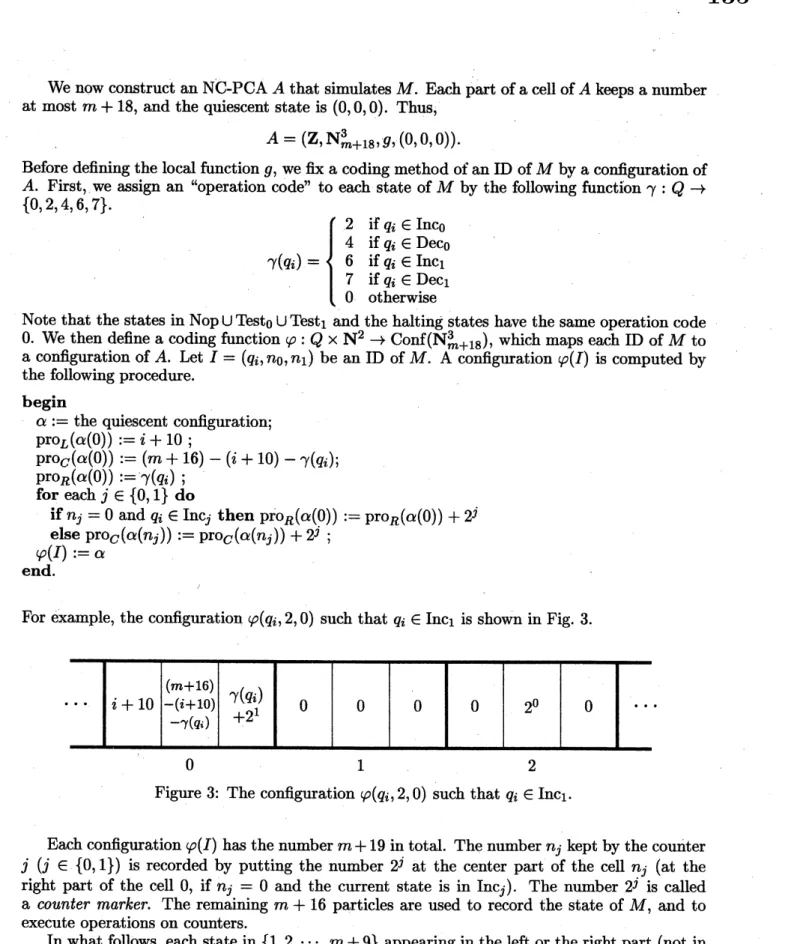
For example, the configuration $\varphi(q_{i}, 2,0)$ such that $q_{i}\in \mathrm{I}\mathrm{n}\mathrm{c}_{1}$ is shown in Fig. 3.
Figure 3: The configuration $\varphi(q_{i}, 2,0)$ such that $q_{i}\in \mathrm{I}\mathrm{n}\mathrm{c}_{1}$
.
Each configuration$\varphi(I)$ has the number$m+19$ in total. The number
$n_{j}$ kept by the counter
$j(j\in\{0,1\})$ is recorded by putting the number $2^{j}$ at the center part of the cell
$n_{j}$ (at the
right part ofthe cell $0$, if$n_{j}=0$ and the current state is in Incj). The number $2^{j}$ is called
a
counter marker. The remaining$m+16$ particlesare
used to record the state of$M$, and toexecute operationson counters.
Inwhat follows, each state in $\{1, 2, \cdots, m+9\}$ appearing in the left or the right part (not in
the centerpart) of
a
celliscalleda signal. Signals in $\{10, 11, \cdots, m+9\}$are
called state signals,and
are
used to record the current state of$M$.
State signalsare
kept by the cells $0$ and $-1$(theygo back and forth between these cells). Signals in
{2,
4,6,7}
are called operation signals,which
are
used to execute $\mathrm{i}\mathrm{n}\mathrm{c}\mathrm{r}\mathrm{e}\mathrm{m}\mathrm{e}\mathrm{n}\mathrm{t}/\mathrm{d}\mathrm{e}\mathrm{c}\mathrm{r}\mathrm{e}\mathrm{m}\mathrm{e}\mathrm{n}\mathrm{t}$operations. Each ofthe four operation signalssometimes carryacounter marker to
move
it to the right- orleft-neighboring cell. At that time,these signals “2”, “4”, “6”, and “7” temporarily become “3”, “5”, “8”, and “9”, respectively.
The signal “1” isa special one called an$initial/final$ signal (it will be explained later).
1. Rules for the
cases
whereno
signalexists:For each $x\in \mathrm{N}_{m+18}$, include the following rule in $g$
.
$[ 0, x, 0 ]$
$arrow$$[ 0, x, 0 ]$
(1)2. Rules for state signals:
For each $x\in\{10,11, \cdots,m+9\}$
,
include the following rule in $g$.
$[ 0, 0, x ]$
$arrow$$[ 0, 0, x ]$
(2)3. Rules for the increment operation:
For each$j\in\{0,1\}$ and $c\in\{0,1\}$, include the following rules in $g(\oplus \mathrm{d}\mathrm{e}\mathrm{n}\mathrm{o}\mathrm{t}\mathrm{e}\mathrm{S}$the addition in
mod 2).
$[[ 2+2+4j4j,’ 2j+C\cdot 2jC\cdot 2^{i\oplus 1},\oplus 1, 00 ]]$ $arrowarrow$ $[[ 00,’ c\cdot 2^{j\oplus 1}c\cdot 2^{j1}\oplus’ 2+4j ]$ $(3..1)$
$2+4j+2^{j}]$ (3.2)
$[[2+4j,2^{j}0^{+}’ c\cdot 2^{j\oplus 1}c\cdot 2^{j1}\oplus’, 2+4j0] arrow [2+4j, c\cdot 2^{j\oplus 1}, 00 ]]$ $(3.3)(3.4)$
$]$ $arrow$ $[2+4j,$
$2^{j}+c\cdot 2^{j\oplus}’ 1$,
4. Rules for the decrement operation:
For each $j\in\{0,1\}$ and $c\in\{0,1\}$, include the following rules in$g$
.
[
$[[[4+4+,,3j003j,’ 2j+.c \cdot 2j’,’\oplus c.2^{j\oplus 1}c\cdot 2C2^{j1}j\oplus 1\oplus 1, 4+3j00 ]] arrowarrow [[4+3j+,2^{j}4+34+30,jj" 2^{j}+c\cdot.2^{j1}cc\cdot 2^{j1^{\oplus}}C2j.\oplus 1\bigoplus_{\oplus}2j’,, 1, 4+3j000]]]$ $(4^{\cdot}.2)(4(44)1)$
$4+3j+2^{j}]]$ $arrowarrow$ [
$[$ $]$ (4.3)
5. Rules for waiting for the completionofthe$\mathrm{i}\mathrm{n}\mathrm{c}\mathrm{r}\mathrm{e}\mathrm{m}\mathrm{e}\mathrm{n}\mathrm{t}/\mathrm{d}\mathrm{e}\mathrm{c}\mathrm{r}\mathrm{e}\mathrm{m}\mathrm{e}\mathrm{n}\mathrm{t}$operation:
For each $[q_{i},j, d, q_{k}]\in\delta$such that $d\in\{+$,- $\}$, and for each $c\in\{0,1\}$
,
include the followingrule in$g$
.
$[i+10, (m+16)-(i+10)-\gamma(q_{i})+c\cdot 2^{j\oplus 1}, 0]$ $arrow$
$[i+10, (m+16)-(i+10)-\gamma(q_{i})+c\cdot 2^{j\oplus 1}, 0]$ (5)
6. Rules for simulating$M’ \mathrm{s}$ state transitionfroma state inIncj:
For each $[q_{i},j, +, q_{k}]\in\delta$ and $c\in\{0,1\}$
,
if$q_{k}\not\in \mathrm{I}\mathrm{n}\mathrm{c}j\oplus 1$, then include the following rule in $g$.
$[i+10, (m+16)-(i[k+1\overline{\mathrm{o}}+10), \gamma(m+16)(qi)+c\cdot 2-j\oplus 1(k’+10)^{)}-\gamma\gamma(q_{i}](q_{k})arrow+c\cdot 2^{j\oplus 1}, \gamma(q_{k}) ]$
(6.1)
For each $[q_{i},j, +, q_{k}]\in\delta$ and $c\in\{0,1\}$
,
if$q_{k}\in \mathrm{I}\mathrm{n}\mathrm{c}j\oplus 1$, then include the followingrule in $g$.
$[i+10, (m+16)-(i+[k+1\overline{\mathrm{o},}(m10)\gamma(qi)+c\cdot 2^{j\oplus 1}+16)-(k’+10)\gamma(qi)]-\gamma(q_{k})arrow, \gamma(q_{k})+c\cdot 2^{j\oplus 1} ]$
(6.2)
7. Rules for simulating$M’ \mathrm{s}$ state transition from a state inDecj:
For each $[q_{i},j, -, q_{k}]\in\delta$ and $c,$$c’\in\{0,1\}$
,
if$q_{k}\not\in(\mathrm{I}\mathrm{n}\mathrm{c}_{jj\oplus 1}\mathrm{U}\mathrm{I}\mathrm{n}\mathrm{c})$,
then include the followingrule in$g$
.
$[i+10, (m+16)-(i+10)-\gamma(q_{i})+d\cdot 2^{j\oplus 1}, \gamma(q_{i})+c\cdot 2^{j} ]$ $arrow$
$[ k+10, (m+16)-(k+10)-\gamma(q_{k})+c\cdot 2^{j}+c’\cdot 2^{j\oplus 1}, \gamma(q_{k}) ]$ (7.1)
For each $[q_{i},j, -, q_{k}]\in\delta$ and $c,$$c’\in\{0,1\}$, if$q_{k}\in \mathrm{I}\mathrm{n}\mathrm{c}_{j}$, theninclude the following rule in $g$
.
$[ i+10, (m+16)-(i+10)-\gamma(q_{i})+c’\cdot 2j\oplus 1, \gamma(q_{i})+c\cdot 2^{j} ]$ $arrow$
$[ k+10, (m+16)-(k+10)-\gamma(q_{k})+c’\cdot 2^{j\oplus 1}, \gamma(q_{k})+c\cdot 2^{j} ]$ (7.2)
For each $[q_{i},j, -, q_{k}]\in\delta$ and $c,$$d\in\{0,1\}$, if$q_{k}\in \mathrm{I}\mathrm{n}\mathrm{c}_{j\oplus 1}$, then include the following rulein$g$
.
$[i+10, (m+16)-(i+10)-\gamma(q_{i})+d\cdot 2^{j\oplus 1}, \gamma(q_{i})+c\cdot 2^{j} ]$ $arrow$
8. Rules for simulating$M’ \mathrm{s}$ state transition from
a
state in Nop:Foreach $[q_{i},j, 0, qk]\in\delta$ and $c,$$d\in\{0,1\}$, if$q_{k}\not\in(\mathrm{I}\mathrm{n}\mathrm{c}0^{\cup}\mathrm{I}\mathrm{n}\mathbb{C}1)$
,
then include the followingrulein$g$
.
$[ i+10, (m+16)-(i+10)+c\cdot 2^{0}+c’\cdot 2^{1}, 0 ]$ $arrow$
$[ k+10, (m+16)-(k+10)-\gamma(qk)+c\cdot 2^{0}+d\cdot 2^{1}, \gamma(q_{k}) ]$ (8.1)
For each $[q_{i},j, 0, qk]\in\delta$ and $c,$$c’\in\{0,1\}$, if$q_{k}\in \mathrm{I}\mathrm{n}\mathrm{c}_{j}$ for
some
$j$, then include the followingrulein $g$.
$[i+10, (m+16)-(i+10)+c\cdot 2^{jj\oplus}+d\cdot 21, 0]$ $arrow$
$[ k+10, (m+16)-(k+10)+\gamma(qk)+c’\cdot 2^{j\oplus 1}, \gamma(q_{k})+c\cdot 2^{j} ]$ (8.2)
9. Rules for simulating $M’ \mathrm{s}$ state transitionfrom a state in
Testj:
For each [$q_{i},j,$$z_{q_{k}]},\in\delta$and $c\in\{0,1\}$, if$qk\not\in(\mathrm{I}\mathrm{n}\mathrm{c}_{j^{\cup}.j\oplus 1}\mathrm{I}\mathrm{n}\mathrm{c})$, then include the following rule
in $g$
.
$[ i+10, (m+16)-(i+10)+2^{j}+c\cdot 2^{j\oplus 1}, 0 ]$ $arrow$
$[ k+10, (m+16)-(k+10)-\gamma(qk)+2j+c\cdot 2j\oplus 1, \gamma(q_{k})]$ (9.1)
For each [$q_{i},j,$ $z_{q_{k}]},\in\delta$ such that and $c\in\{0,1\}$, if
$q_{k}\in$
Incj,
then include the followingrulein$g$
.
$[i+10, (m+16)-(i+10)+2^{j}+c\cdot 2^{j\oplus 1}, 0 ]$ $arrow$
$[ k+10, (m+16)-(k+10)-\gamma(qk)+c\cdot 2^{j\oplus 1}, \gamma(q_{k})+2^{j}]$ (9.2)
For each [$q_{i},j,$ $z_{q_{k}]},\in\delta$ and $c\in\{0,1\}$, if$q_{k}\in \mathrm{I}\mathrm{n}\mathrm{c}_{j\oplus 1}$, then include thefollowingrule in
$g$
.
$[i+10, (m+16)-(i+10)+2j+c\cdot 2j\oplus 1, 0]$ $arrow$
$[ k+10, (m+16)-(k+10)-\gamma(qk)+2^{j}, \gamma(q_{k})+\mathrm{C}\cdot 2^{j}\oplus 1]$ (9.3)
For each $[q_{i},j, P, q_{k}]\in\delta$ and $c\in\{0,1\}$, if$q_{k}\not\in \mathrm{I}\mathrm{n}\mathrm{c}_{j\oplus 1}$, then include the following rule in
$g$
.
$[i+10, (m+16)-(i+10)+c\cdot 2^{j\oplus 1}, 0]$ $arrow$
$[ k+10, (m+16)-(k+10)-\gamma(qk)+C\cdot 2^{j\oplus 1}, \gamma(q_{k})]$ (9.4)
For each $[q_{i},j, P, q_{k}]\in\delta$ and$c\in\{0,1\}$, if$q_{k}\in \mathrm{I}\mathrm{n}\mathrm{c}_{j\oplus 1}$, then include the followingrulein
$g$
.
$[i+10, (m+16)-(i+10)+c\cdot 2^{j}\oplus 1, 0]$ $arrow$
$[ k+10, (m+16)-(k+10)-\gamma(qk), \gamma(q_{k})+C\cdot 2^{j}\oplus 1]$ (9.5)
10. Rules for the $\mathrm{i}\mathrm{n}\mathrm{i}\mathrm{t}\mathrm{i}\mathrm{a}\mathrm{l}/\mathrm{f}\mathrm{i}\mathrm{n}\mathrm{a}\mathrm{l}$signal:
Include the followingrules in$g$
.
$[ 1, 0, 0 ]$
$arrow$$[ 0, 0, 1 ]$
(10.1)$[ 0, 0, 1 ]$
$arrow$$[ 1, 0, 0 ]$
(10.2)For each$c,$$c’\in\{0,1\}$
,
if$q_{0}\not\in(\mathrm{I}\mathrm{n}\mathrm{c}0\cup \mathrm{I}\mathrm{n}\mathrm{c}\mathrm{l})$, then include the followingrule in$g$
.
$[ 1, (m+15)+C\cdot 20_{+}C’\cdot 21, 0]$ $arrow$$[ 10, (.m+16)-10-\gamma(q_{0})+c\cdot 2^{0}+c’\cdot 2^{1}, \gamma(q_{0}) ]$ (10.3)
For each $c,$$d\in\{0,1\}$, if$q_{0}\in \mathrm{I}\mathrm{n}\mathrm{c}_{j}$ for
some
$j$, then include the following rule in$g$
.
$[ 1, (m+15)+C\cdot 2j+c’\cdot 2^{j\oplus}1, 0]$ $arrow$
[ 10, $(m+16)-10-\gamma(q_{0})+c’\cdot 2j\oplus 1,$ $\gamma(q\mathrm{o})+c\cdot 2^{j}\rfloor 1$ (10.4)
For each $c,$$c’\in\{0,1\}$, include the followingrule in $g$
.
$[ (m+9), (m+16)-(m+9)+c\cdot 20_{+}2C’\cdot 1, 0]$ $arrow$
We
can see
that $A$ correctly simulates $M$ step by step. It is easy to verify that each ruleconserves
the total number between left- and right-hand sides, and hence $A$ is anNC-PCA.
Now, we show that the following statement holds: If $M$ is reversible,
so
is $A$.
Assume $M$is reversible. It suffices to show that each of the above rules has a different right-hand side
from those of the other rules. First, we can easily verify that rules (1), (2), $(3.x),$ $(4.x),$ $(10.1)$,
(10.2), and (10.5) satisfy this constraint by simply comparing their right-handsides with other
rules. The rules (10.3), and (10.4) are alsoso. Because thestate $q_{0}$ does not appear
as
the forthelement of
a
quadruple in $\delta$,
hence the right-hand sides ofthese rulesnever
matches those of$(6.x),$ $(7.x),$ $(8.x)$, and $(9.x)$,
as
wellas
the others.Next,
we
consider the rules (5), whichcorrespondto the quadruple $[q_{i},j, d,qk]\in\delta$such that$d\in\{+$,-$\}$
.
The state $q_{i}$ may appearas
the fourthelement of the other quadruples. But, since $\gamma(q_{i})>0$ (because $q_{i}\in(\mathrm{I}\mathrm{n}\mathrm{C}_{0^{\cup}}$Incl
$\cup \mathrm{D}\mathrm{c}_{0^{\mathrm{U}\mathrm{D}}1}\mathrm{e}\mathrm{e}\mathrm{C})$), the right-hand sidesofthe rules (5)never
match those of $(6.x),$ $(7.x),$ $(8.x)$, and $(9.x)$
.
We finally $\mathrm{v}\mathrm{e}\mathrm{r}\mathrm{i}\theta$that rules $(6.x),$ $(7.x),$ $(8.x)$, and $(9.x)\mathrm{s}\mathrm{a}\mathrm{t}\mathrm{i}_{\mathrm{S}}\mathrm{p}$the reversibilityconstraint.
Let Inc’, Dec’, Nop’, and
Test’
bethe sets of states of$M$ definedas
follows.Inc’
$=${
$q_{k}|[q_{i},j,$ $+,$$q_{k}]\in\delta$ forsome
$j\in\{0,1\}$, and$q_{i}\in Q$}
Dec’
$=${
$q_{k}|[q_{i},j$,-,$q_{k}]\in\delta$forsome
$j\in\{0,1\}$, and $q_{i}\in Q$}
$\mathrm{N}\mathrm{o}\mathrm{p}’$ $=$
{
$q_{k}|[q_{i},j,$$0,$$q_{k}]\in\delta$ for some $j\in\{0,1\}$, and $q_{i}\in Q$}
Test’
$=${
$q_{k}|[q_{i},j,$$s,q_{k}]\in\delta$ forsome
$j\in\{0,1\},$ $s\in\{Z,$$P\}$, and $q_{i}\in Q$}
For each $q_{k}\in$ (Inc’$\mathrm{U}$
Dec’
$\cup$Nop’) there is exactlyone
quadruple containing $q_{k}$as
the fourthelement, since$M$ is reversible (thus the quadruple is of the form $[qi,j, d, qk](q_{i}\in Q,j\in\{0,1\}$,
$d\in$ $\{-, 0, +\}))$
.
Hence, the rules in $(6.x),$ $(7.x)$, and $(8.x)$ corresponding to this quadruplehave different right-hand sides from the others. Next, for each $q_{k}\in$ Test’, there are at most
two quadruples containing $q_{k}$
as
the fourth element since $M$ is reversible. Theyare of the form$[q_{i},j, s, q_{k}](q_{i}\in Q,j\in\{0,1\}, s\in\{Z, P\})$
.
If there is only one, the rules in $(9.x)$ correspondingto this quadruple satisfy the reversibility constraint as above. In the
case
thereare
two, theymust be of the forms $[q_{i},j, Z, q_{k}]$ and $[q_{i}’,j’, P, q_{k}]$, because $M$ is reversible. Wecan see the rules
in$(9.1)-(9.3)$, and $(9.4)-(9.5)$ corresponding to the two rules have mutually different right-hand
sides, because the center part of the cell $0$ should be different between two
cases
of the contentsof the counter$j$
.
They also differs from the other rules.By above, each rule in $g$ has different right-hand side from the others, and thus
we
$\mathrm{c}\mathrm{a}\mathrm{n}\square$
conclude that if$M$ is reversible, $A$ is also reversible.
Example 3.1 Consider
a
deterministicRCM(2) $M_{2}=(2, Q, \{Z, P\}, \delta, q_{0,q6})$ havingthefollow-i.ng
quadruples as $\delta$.
$[q_{0}, 1, Z, q_{1}]$ $[q_{3}, 1, +, q_{4}]$ $[q_{1}, 0, Z, q_{6}]$ $[q_{4}, 1, +, q_{5}]$ $[q_{1}, 0, P, q_{2}]$ $[q_{5}, 1, P, q_{1}]$ $[q_{2}, 0, -, q_{3}]$
$M_{2}$ performs the computation $(q_{0}, n, 0)\vdash_{M_{2}}^{*}(q_{6},0,2n)$ for any $n(=0,1, \cdots)$
.
AnNC-RPCA
$A_{2}$constructed from $M_{2}$ by the methodgiven in Theorem
3.1
isas
follows.$A_{2}=(\mathrm{Z}, \mathrm{N}_{25}^{3},g_{2}, (0,0,0))$
The local function $g_{2}$ is defined by the following set of rules, and a simulation process of
Rules by (1) $(x\in\{0,1, \cdots , 25\})$ : Rules by (5) for $[q2,0, -, q3]$ :
$[0, x, 0]$
$arrow$$[0, x, 0]$
$[12, 7, 0]$
$arrow$$[12, 7, 0]$
Rules by (2) $(y\in\{10,11, \cdots , 16\})$ :
$[12, 9, 0]$
$arrow$$[12, 9, 0]$
$[0, 0, y]$
$arrow$$[0, 0, y]$
Rules by (5) for $[q3,1, +, q4]$ :Rules by (3.1):
$[13, 4, 0]$
$arrow$$[13, 4, 0]$
$[2, 0, 0]$
$arrow$$[0, 0, 2]$
$[13, 5, 0]$
$arrow$$[13, 5, 0]$
$[2, 2, 0]$
$arrow$$[0, 2, 2]$
Rules by (5) for $[q4,1, +, q5]$ :$[6, 0, 0]$
$arrow$$[0, 0, 6]$
$[14, 3, 0]$
$arrow$$[14, 3, 0]$
$[6, 1, 0]$
$arrow$$[0, 1, 6]$
$[$ 14, 4, . $0]$ $arrow$$[14, 4, 0]$
Rules by (3.2): Rules by (6.1) for $[q3,1, +, q4]$ :
$[2, 1, 0]$
$arrow$$[0, 0, 3]$
[13, 4, 6] $arrow$ [14, 3, 6]$[2, 3, 0]$
$arrow$$[0, 2, 3]$
[13, 5, 6] $arrow$ [14, 4, 6]$[6, 2, 0]$
$arrow$$[0, 0, 8]$
Rules by (6.1) for $[q4,1, +, q5]$ :$[6, 3, 0]$
$arrow$$[0, 1, 8]$
[14, 3, 6] $arrow$$[15, 8, 0]$
Rules by (3.3): [14, 4, 6] $arrow$
$[15, 9, 0]$
$[3[3,’ 20,’ 00]$ $arrowarrow$ $[2[2,, 31,, 0]0]$ $\mathrm{R}\mathrm{u}1\mathrm{e}[\mathrm{l}2\mathrm{s},,\mathrm{b}\mathrm{y}$ $7,4(7.3)\mathrm{f}\mathrm{o}\mathrm{r}$$arrow[13[q2,0,-,’ q3]4, 6]$
$[8, 0, 0]$
$arrow$$[6, 2, 0]$
[12, 7, 5] $arrow$ [13, 5, 6]$[8, 1, 0]$
$arrow$$[6, 3, 0]$
[12, 9, 4] $arrow$ [13, 4, 8]Rules by (3.4): [12, 9, 5] $arrow$ [13, 5, 8]
$[0, 0, 2]$
$arrow$$[2, 0, 0]$
Rules by (9.1) for $[q\mathrm{O}, 1, Z, q1]$ :$[0, 2, 2]$
$arrow$$[2, 2, 0]$
$[10, 15, 0]$ $arrow$ $[11, 14, 0]$$[0, 0, 6]$
$arrow$$[6, 0, 0]$
$[10, 16, 0]$ $arrow$ $[11, 15, 0]$$[0, 1, 6]$
$arrow$$[6, 1, 0]$
Rules by (9.1) for $[q1,0, Z, q6]$ :Ru
$\{$
les by (4.1): $[11, 13, 0]$ $arrow$
$[16, 8, 0]$
4, $0$, $0$] $arrow$
$[0, 0, 4]$
$[11, 15, 0]$ $arrow$ $[16, 10, 0]$4, 2, $0$] $arrow$
$[0, 2, 4]$
Rules by (9.4) for $[q1,0, P, q2]$ :$[7, 0, 0]$
$arrow$$[0, 0, 7]$
$[11, 12, 0]$ $arrow$ [12, 7, 4]$[7, 1, 0]$
$arrow$$[0, 1, 7]$
$[11, 14, 0]$ $arrow$ [12, 9, 4]Rules by (4.2): Rules by (9.4) for $[q5,1, P, q1]$ :
$[4, 1, 0]$
$arrow$$[5, 0, 0]$
$[15, 8, 0]$
$arrow$ $[11, 12, 0]$$[4, 3, 0]$
$arrow$$[5, 2, 0]$
$[15, 9, 0]$
$arrow$ $[11, 13, 0]$$[7, 2, 0]$
$arrow$$[9, 0, 0]$
Rules by (10.1) and (10.2):$[7, 3, 0]$
$arrow$$[9, 1, 0]$
$[0[1,’ 0, 0]$ $arrow$ $[0,$ $00,$ , $01|$ Rules by (4.3): $0,$ . $1$ ] $arrow$ [1,$[0, 0, 5]$
$arrow$$[4, 1, 0]$
Rules by (10.3):$[0, 2, 5]$
$arrow$$[4, 3, 0]$
$[1, 22, 0]$
$arrow$ $[10, 13, 0]$$[0, 0, 9]$
$arrow$$[7, 2, 0]$
$[1, 23, 0]$
$arrow$ $[10, 14, 0]$$[0, 1, 9]$
$arrow$$[7, 3, 0]$
$|11,$’ $2524,$’ $00]$ $arrowarrow$ $[10[10,, 1615,, 0]0]$ Rules by (4.4):$[0, 0, 4]$
$arrow$$[4, 0, 0]$
Rules by (10.4):$[0, 0, 7]$
$arrow$$[7, 0, 0]$
$[16, 8, 0]$
$arrow$ [1,$[0, 2, 4]$
$arrow$$[4, 2, 0]$
$[16, 7, 0]$
$arrow$ $[1, 2223,’ 0]0]$$[0, 1, 7]$
$arrow$$[7, 1, 0]$
$[16, 9, 0]$
$arrow$$[1, 24, 0]$
$[16, 10, 0]$ $arrow$I
1, 25, $0$ ]From Lemma 3.1 and Proposition3.1, universality of
an
NC-RPCA is concluded.Corollary 3.1 An NC-RPCA is computation-universal.
4
Concluding Remarks
In this paper, we proved that an NC-RPCA can simulate a reversible two-counter machine,
hence it is computation-universal. In [10], universality ofan RCA (not necessarily
number-conserving) has been shown by simulating
a
one-tape reversible Turing machine byan
RCA.It is also possible to simulate
a
one-tape reversible Turing machine byan
NC-RPCA. But, ifwe employ a simulation method in which the contents of each tape square
are
stored in eachcell, then the quiescent state of the NC-RPCA should be $(0, m, 0)$ for
some
$m>0$ rather than$(0,0,\mathrm{o})$
.
References
[1] Albert, J., and Culik II, K., A simpleuniversal cellular automaton and its one-way and totalistic
version, Complex Systems, 1, 1-16 (1987).
[2] Bennett, C.H., Logical reversibility ofcomputation, IBM J. Res. Dev., 17, 525-532 (1973).
[3] Bennett, C.H.,Notes onthe history of reversiblecomputation, IBM J. Res. Dev., 32, 16-23 (1988).
[4]
$\mathrm{R}\mathrm{e}\mathrm{a}\mathrm{d}\mathrm{i}\mathrm{F}\mathrm{e}\mathrm{y}\mathrm{n}\mathrm{m}\mathrm{a}\mathrm{n}\mathrm{g},$$\mathrm{a}\mathrm{S}\mathrm{n}_{\mathrm{M}}\mathrm{R}\mathrm{P}\mathrm{s}$” ’
$FeynmanL(1996).$
($\text{邦邦訳訳^{}t}\text{フファ}eurn\text{ァ}$
イインンママンン計計算算機機科科学学
A
」」
.J,
.
岩岩波波
He
書書
y,
店店
and19R9
9)) $))\mathrm{A}\mathrm{l}\mathrm{l}\mathrm{e}\mathrm{n})$,PerseusBooks,[5] Fredkin, E.,and Toffoli, T., Conservativelogic, Int. J. Theoret. Phys., 21, 219-253 (1982).
[6] Goles, E.,Sand pileautomata, $\dot{A}$
nn. Inst. HenriPoincar\’e, 56, 75-90 (1992).
[7] Goles, E., and Margenstern, M., Sand pile as a universal computer, Int. J. Modern Physics C, 7,
113-122 (1996).
[8] Imai, K., andMorita,K., A$\mathrm{c}\mathrm{o}\mathrm{m}\mathrm{p}\mathrm{u}\mathrm{t}\mathrm{a}\mathrm{t}\mathrm{i}\mathrm{o}\mathrm{n}-\mathrm{u}\mathrm{n}\mathrm{i}_{\mathrm{V}\mathrm{e}}\mathrm{r}\mathrm{s}\mathrm{a}1$ two-dimensional 8-state
triangularreversible
cel-lular automaton, Proc.
of
theSecondColloquiumon UniversalMachines and Computations,VolumeII (Metz), 90-99 (1998). (toappear in Theoret. Comput. Sci.)
[9] Margolus, N., Physics-like model ofcomputation, Physica, 10D, 81-95 (1984).
[10] Morita, K., and Harao, M., Computationuniversality of one-dimensional reversible (injective)
cel-lular automata, Rans. IEICE Japan, E-72, 758-762 (1989).
[11] Morita, K., and Ueno, S., Computation-universal models of two-dimensional 16-state reversible
cellular automata, IEICE $\pi ans$
.
Inf.
$\xi j$ Syst., E75-D, 141-147(1992).[12] Morita, K., Computation-universalityof one-dimensional one-way reversiblecellular automata,
In-form.
Process. Lett., 42, 325-329(1992).[13] Morita, K.,Reversible cellular automata (inJapanese), J.
Information
Processing Societyof
Japan,35, 315-321 (1994).
[14] Morita, K., Universality ofareversible two-countermachine, Theoret. Comput. Sci., 168, 303-320
(1996).
[15] Morita, K., and Imai, K., Self-reproduction in a reversible cellular space, Theoret. Comput. Sci.,
168, 337-366 (1996).
[16] Morita, K., Margenstern, M., and Imai, K., Universality of reversible hexagonal cellular automata,
MFCS’98 Workshopon Rontiersbetween Decidability and Undecidability, Bmo (1998).
[17] Morita,K.,Cellularautomata and artificial life-Computation and life in reversible cellular automata
-, Proc.
of
the 6th Summer Schoolon Complex Systems, Santiago, 1-40 (1998).[18] Toffoli, J., Computation and construction universality of reversible cellular automata, J. Comput.
Syst. Sci., 15, 213-231 (1977).