A
canonical cellular
decomposition
of
the
Teichm\"uller
space of
compact
surfaces
with
boundary
Akira
USHIJIMA’
牛島
顕Department ofMathematics, Graduate School of Science,
Osaka University, 1-1 Machikaneyama-cho, Toyonaka,
Osaka 560-0043, Japan
$E$-mail address: $\mathrm{s}\mathrm{m}\mathrm{v}\mathrm{O}\mathrm{O}\mathrm{l}\mathrm{u}\mathrm{a}\omega_{\mathrm{e}}\mathrm{x}$ .ecip.osaka-u.$\mathrm{a}\mathrm{c}$
.
jpAbstract
This article is a summary of [Usl].
Using the Euclidean decomposition of the hyperbolic surface, R. C.
Penner gaveacanonical cellulardecompositionof thedecoratedTeichm\"uller
space of punctured surfaces, which is invariantby the action of the
map-ping class group. Adapting his method, we give a canonical cellular
de-composition of the Teichn\"uller space ofcompact orientablesurfaces with
non-empty boundary.
1
Introduction
This article is
a
summary of [Usl].R. C. Penner introduced in [Pe] a method for dividing the $‘(\mathrm{d}\mathrm{e}\mathrm{c}\mathrm{o}\mathrm{r}\mathrm{a}\mathrm{t}\mathrm{e}\mathrm{d})$’
Te-ichm\"uller space of $\mathrm{p}\mathrm{u}\mathrm{n}\mathrm{c}\mathrm{t}\mathrm{u}\mathrm{r}\mathrm{e}^{}\mathrm{d}$ surfaces by “natural” cells. Here, “decorated”
means
that each puncture is given some “weight,)’ and $‘(\mathrm{n}\mathrm{a}\mathrm{t}\mathrm{u}\mathrm{r}\mathrm{a}\mathrm{l})$’ means thatthe decomposition is invariant by the action of the mapping class group. In
his method, the Euclidean decomposition of punctured surfaces with weight
$\mathrm{p}\mathrm{l}\mathrm{a}\mathrm{y}_{\mathrm{S}}$
an
important role (see [EP]). Since then, it has been tried to extend hisconstruction to the Teichm\"uller space of other kinds cf surfaces (see Table 1).
S. Kojima introduced in [Ko]
a
canonical method to decompose compacthyperbolic manifolds with non-empty totally geodesic boundary into truncated
polyhedra. In this paper, using this decomposition and Penner’s method, we
give
a canonical
cellular decomposition of the Teichn\"uller space of compactorientable surfaces with non-empty boundary (see Theorem 2.1).
On the other hand, for the decomposition, M. N\"a\"at\"anen obtained
a
cellular decomposition of the Teichm\"ullerspace
of closed surfaces with a distinguishedpoint in [N\"a]. In her study, the decomposition of such surfaces introduced in [NP] plays a role of Euclidean decomposition in Penner’s work.
Table 1: Cellular decompositions ofTeichm\"uller spaces bythe canonical
decom-position ofthe surface
surface
canon.
decomp. $Tei$.
$sp$.
applicationcusped srfc. [EP] [Pe] Penner et. al.
srfc. with
a
point [NP] [N\"a] $[\mathrm{N}\mathrm{N}.]$.
$.\mathrm{e}\mathrm{t}\mathrm{c}$.
$\mathrm{c}\mathrm{p}\mathrm{t}$.
srfc. with bdry. [Ko] [Usl]2
Main
theorem
Let $F_{g,r}$ be
a
compact orientable surfaceobtained $\mathrm{h}\mathrm{o}\mathrm{m}$ closed orientable surfaceof genus $g$ by removing the interior of $r$ disjoint closed disks
on
the surface.Moreover we
assume
2$g-2+r>0$
.
This assumptionmeans
that $F_{g,r}$ admitsa
complete hyperbolic structure. Now we denote by $\mathcal{T}_{g,r}$ the Teichm\"uller spaceof $F_{g,r}$
.
By the assumption as above,we
regard $T_{g,r}$as
the set of hyperbolicstructures
on
$F_{g,r}$ (with each boundary component being totally geodesic) upto $\mathrm{D}\mathrm{i}\mathrm{f}\mathrm{f}_{0}F_{g,r}$, the set of diffeomorphisms acting
on
$F_{g,r}$, which is homotopicto the identity relative to the boundary. Each element of $\mathcal{T}_{g,r}$ determines
a
marked discrete subgroup of the
group
consisting of the orientation-preservingisometries of the hyperbolic plane $\mathrm{H}^{2}$
.
Sbwe
denote by$\Gamma_{m}$ the element of
$\mathcal{T}_{g,r}$
.
We denote by $\mathrm{M}\mathrm{C}_{g,r}$ the mapping class group of $F_{g,r}$, namely $\mathrm{M}\mathrm{C}_{g,r}$ $:=$$\mathrm{D}\mathrm{i}\mathrm{f}\mathrm{f}F_{g,r}/\mathrm{D}\mathrm{i}\mathrm{f}\mathrm{f}_{0^{F_{g,r}}}$, where $\mathrm{D}\mathrm{i}\mathrm{f}\mathrm{f}F_{g_{)}r}$ is the set of diffeomorphisms acting on $F_{g,r}$
.
For detailed definitions, please see, for example, [Ra, Th].
Fix
an
element $\Gamma_{m}$ of$T_{g,r}$.
Then,as we
saw
the above, it givesa
hyperbolicstructure
on
$F_{g,r}$ with each boundary component being totally geodesic. Nowthe set ofpoints in$F_{g,r}$ each ofwhich admits at least two distinct shortest paths
to the boundary consists the graph (see the left of Figure 1). We call this graph the cut locus, and the decomposition of $F_{g,r}$ obtained by the dual of the cut
locus the canonical decomposition of $F_{g,r}$ with respect to $\Gamma_{fn}$ (see the center of
Figure 1). It is known that the decomposition is actually cellular, that is, each piece obtained by the decomposition is homeomorphic to
a
disk. For detaileddefinitions, please
see
[Ko].Let $\triangle$ be
a
set ofarcs
in $F_{g,r}$ with the following two conditions: eacharc
is
a
disjointly embedded simplearc
connecting boundaries (maybe thesame
boundary), and the closure of each complementary region of
arcs
isa
hexagon.$F_{g,r}$
.
Euler characteristic considerations show that there are 6$g-6+3r$ arcs
in $\triangle$
.
We call the cellular decomposition of$F_{g,r}$ obtained by deleting several
arcs
(maybe empty) ffom atruncated triangulation a truncated cellulardecom-position of $F_{g,r}$ (see the right of Figure 1). Of
course
ifwe
delete mucharcs
from $\triangle$, then the decomposition is not
even
cellular. For a truncated cellulardecomposition $\triangle$ of
$F_{g,r}$,
we
denote by $C\circ(\triangle)$ the set of points in $T_{g,r}$ each ofwhose canonical decomposition coincides (topologically) to $\triangle$
.
Bythe definitionofthe canonical decomposition, it is easyto
see
thatthe union of$C\circ(\triangle)$ throughalltruncated cellular decompositions gives
an
$\mathrm{M}\mathrm{C}_{g,r}$-invariant decomposition of$\mathcal{T}_{g,r}$
.
Furthermorewe
can prove the followingtheorem, the main theorem ofthisarticle:
Theorem 2.1 ($[\mathrm{U}\mathrm{s}1$
,
Theorem 6.6])If
$\triangle$ isa
truncated cellulardecom-position
of
$F_{g,r}$, $C\circ(\triangle)$ isan
open cellof
dimension $\neq\triangle$. The set$\{C\circ(\triangle)|\triangle$ is a truncated cellular decomposition
of
$F_{g,r,\backslash }\}$ isa
$\mathrm{M}\mathrm{C}_{g,r^{-}}inva\dot{n}ant$ cellular decompositionof
$\mathcal{T}_{g,r}$itself.
Furthermore, the isotropy groupof
$C(\triangle)$in $\mathrm{M}\mathrm{C}_{g,r}$ is isomorphic to the (finite) group
of
mapping classesof
$F_{g,r}$ leaving$\triangle$ invariant.
Figure 1: A canonical decomposition of $F_{0,3}$
3
Proof of the
main
theorem
In this section, under the assumption that $\triangle$ is
a
truncated triangulation, nota truncated cellular decomposition,
we
explain the proof that $C\circ(\triangle)$ ishomeo-morphic to
an
open ball of dimension$q:=6g-6+3r$
by the following four steps.3.1
$s$-length
coordinate
Let $\triangle=(c_{1}, c_{2,\ldots,q}c)$ be
a
truncated triangulation of $F_{g,r}$.
For any element$\Gamma_{m}$ of$\mathcal{T}_{g,r}$,
we
define the $s$-lengthof
$\mathrm{q}$ relative to $\Gamma_{m}$as
follows:$s(c_{i}; \mathrm{r}_{m}):=\sqrt{2}\cosh\frac{d_{i}}{2}\in \mathrm{R}_{s}$,
where$d_{i}$
means
the hyperbolicdistanceofthegeodesic$c_{i}$
,
and$\mathrm{R}_{s}:=\{t\in \mathrm{R}|t>\sqrt{\mathit{2}}\}$.
Using $s$-lengths, we define the mapping $S_{\triangle}$ from $\mathcal{T}_{g,r}$ to $\mathrm{R}_{s}^{q}$
as
follows:$S_{\triangle}(\Gamma_{m}):=(s(c_{1};\Gamma_{m}), s(C2;\Gamma_{m}),$
$\ldots,$$S(C_{q};\Gamma m))\in \mathrm{R}_{\mathit{8}}^{q}$
.
For this mapping
we
have the following theorem:Theorem 3.1 ($[\mathrm{U}\mathrm{s}1$
,
Theorem 4.1])If
$\triangle$ isa
truncated triangulation$of\square$
$F_{g,rf}$ then $S_{\triangle}$ is
a
homeomorphism.$\mathcal{T}_{g,r}\mathrm{B}\mathrm{y}\mathrm{t}$
.his
theorem, for
a
fixed $\Sigma\in \mathrm{R}_{s}^{q}$, the pair $(\triangle, \Sigma)$ isrega.rded
as a
point ofDefinition 3.2 (short) Fix a point $(\triangle, \Sigma)$ of $\mathcal{T}_{g,r}$
.
(1) For any
arc
$e$ in $\triangle$,we
denote by$\Sigma(e)$ the $s$-length of $e$
.
Thenwe
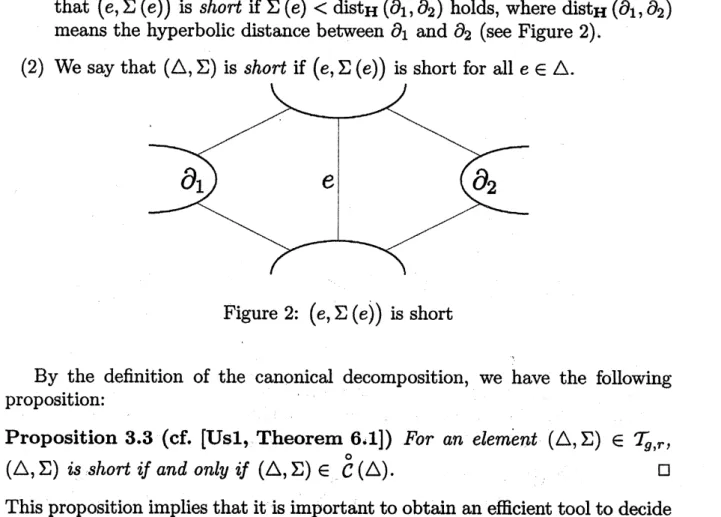
saythat $(e, \Sigma(e))$ is short if$\Sigma(e)<\mathrm{d}\mathrm{i}\mathrm{s}\mathrm{t}_{\mathrm{H}}(\partial_{1}, \partial_{2})$ holds, where $\mathrm{d}\mathrm{i}\mathrm{s}\mathrm{t}_{\mathrm{H}}(\partial_{1}, \partial_{2})$
means
the hyperbolic distance between $\partial_{1}$ and $\partial_{2}$ (see Figure 2).Figure 2: $(e, \Sigma(e))$ is short
By the definition of the $\mathrm{c}\mathrm{a}\mathrm{n}\mathrm{o}\mathrm{n}\mathrm{i}_{\mathrm{C}\mathrm{a}}.1$ decomposition,
we
have the followingproposition:
Proposition 3.3 (cf. [Usl, Theorem 6:1]) For
an
eleme$nt(\triangle, \Sigma)\in T_{g,r}$,$(\triangle, \Sigma)$ is short
if
and onlyif
$(\triangle, \Sigma)\in$. $C\circ(\triangle)$
.
$\square$This proposition implies that it is important
to
obtainan
efficient toolto decide the givenarc
isshort
or
not, and the following $h$-length coordinate is theone.
3.2
$h$-length
coordinate
For a truncated triangulation $\triangle$, the boundary of
$F_{g,r}$ is decomposed into
several segments. We denote by $B_{\triangle}$ the set of such segments. Let $\mathrm{R}_{+}$ $:=$
$\{t\in \mathrm{R}|t>0\}$
.
Fix $\Sigma\in \mathrm{R}_{s}^{q}$, andwe
define the $h$-lengthof
$E\in B_{\triangle}$for
$\Gamma_{m}=(\triangle, \Sigma)$
as
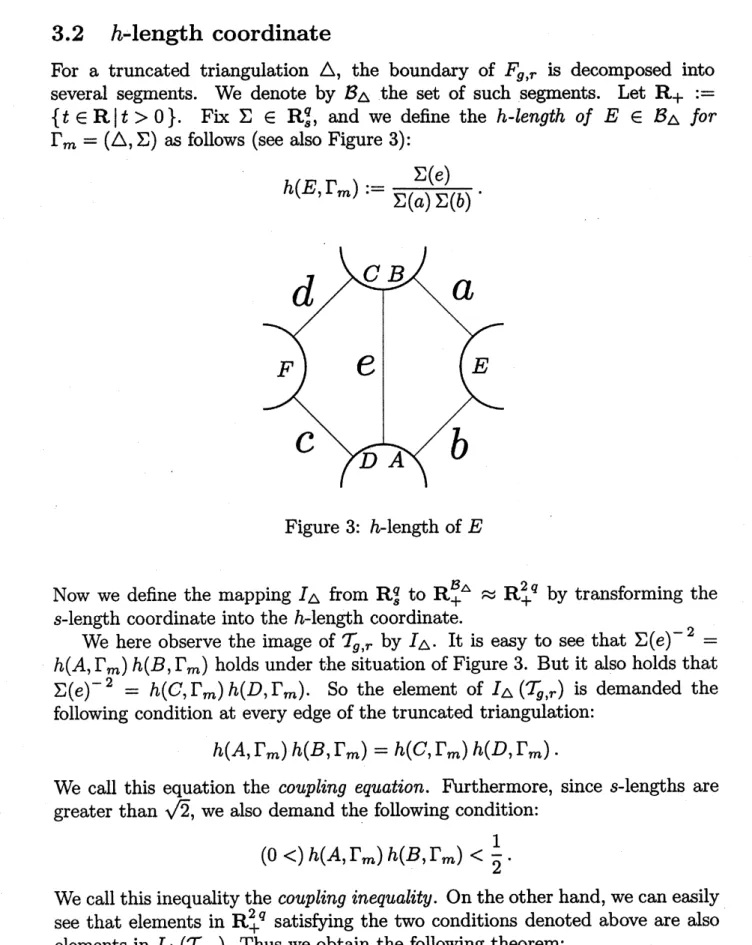
follows (see also Figure 3):$h(E, \Gamma_{m}):=\frac{\Sigma(e)}{\Sigma(a)\Sigma(b)}$
.
Figure 3: $h$-length of $E$
Now
we
define the mapping $I_{\triangle}$ from $\mathrm{R}_{s}^{q}$ to $\mathrm{R}_{+}^{B_{\Delta}}\approx \mathrm{R}_{+}^{2q}$ by transforming the$s$-length coordinate into the $h$-length coordinate.
We here observe the image of $\mathcal{T}_{g,r}$ by $I_{\triangle}$. It is easy to
see
that $\Sigma(e)^{-2}=$$h(A, \Gamma_{m})h(B, \Gamma m)$ holds under the situation of Figure 3. But it also holds that
$\Sigma(e)^{-2}=h(C, \Gamma m)h(D, \Gamma m)$
.
So the element of $I_{\triangle}(\mathcal{T}_{g_{)}r})$ is demanded thefollowing condition at every edge of the truncated triangulation:
$h(A, \Gamma_{m})h(B, \Gamma m)=h(C, \Gamma_{m})h(D, \Gamma m)$
.
We call this equation the coupling equation. Furthermore, since $s$-lengths
are
greater than $\sqrt{\mathit{2}}$, we also demand the following condition:$(0<)h(A, \Gamma m)h(B,\Gamma m)<\frac{1}{\mathit{2}}$
.
We callthis inequality the coupling inequality. On the other hand, we
can
easilysee
that elements in $\mathrm{R}_{+}^{2q}$ satisfying the two conditions denoted aboveare
alsoelements in $I_{\triangle}(\mathcal{T}_{g,r})$
.
Thus we obtain the following theorem:Theorem 3.4 ($[\mathrm{U}\mathrm{s}1$
,
Proposition 4.4]) The mapping $I_{\triangle}$ isan
embeddingof
$\mathcal{T}_{g,r}$ into$\mathrm{R}_{+}^{B_{\Delta}}$ Explicitly, $I_{\triangle}(\tau_{\mathit{9}},r)\subset \mathrm{R}_{+}^{B_{\Delta}}$ is characterized by the
$couplin_{\square }g$
Using the $h$-length coordinate,
we
can
easilysee
whether the given edge isshort
or
not.Proposition 3.5 ($[\mathrm{U}\mathrm{s}1$
,
Theorem 6.1]) Under the situationof
Figure 3,$(e, \Sigma(e))$ is short
if
and onlyif
the inequality$h(A,\Gamma_{m})+h(B,\Gamma_{m})+h(c,\Gamma_{m})+\square$
$h(D,\Gamma_{m})>h(E,\Gamma_{m})+h(F, \Gamma_{m})$ holds.
Note
We
can
extend Proposition3.5
to the followingone:
Proposition 3.6 Under the situation
of
Figure $\mathit{3}_{f}\Sigma(e)=\mathrm{d}\mathrm{i}\mathrm{s}\mathrm{t}_{\mathrm{H}}(E, F)$ (resp.$>)$
if
and onlyif
$h(A,\Gamma_{m})+h(B, \Gamma_{m})+h(C, \Gamma_{m})+h(D, \Gamma_{m})=h(E, \Gamma_{m})+\square$
$h(F, \Gamma_{m})$ (resp. $<$) holds.
These two propositions
are
kinds of so-called “tilt proposition.” In [Us2],we
study
a
generalization ofthe tilt proposition.3.3
Changing bases
As
we saw
the preceding subsection, Though the $h$-length coordinate givesan
effective formulato decidewhether thegiven edge is short
or
not. But the spaceis twice the dimension of$\mathcal{T}_{g,r}$
.
Sowe
extract the information ofthe short fromthe half-dimensional space of$\mathrm{R}^{2q}$
.
For each edge $e\in\triangle$,
we
definea
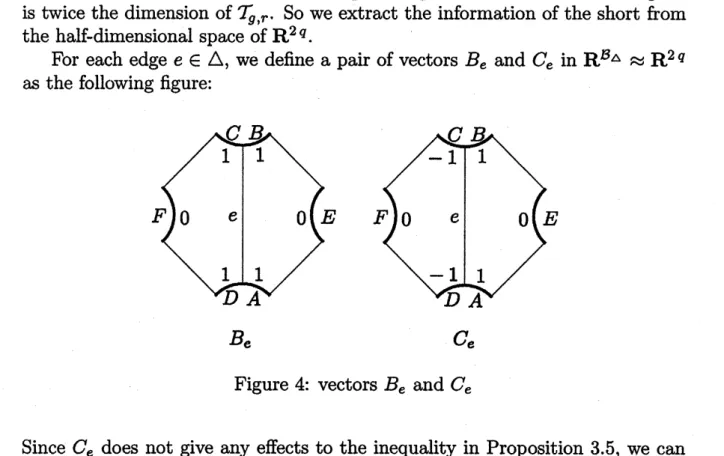
pair ofvectors $B_{e}$and
$C_{e}$ in $\mathrm{R}^{\mathcal{B}_{\Delta}}\approx \mathrm{R}^{2q}$as
the following figure:$B_{e}$ $C_{e}$ Figure 4: vectors $B_{e}$ and $C_{e}$
Since $C_{e}$ does not give any effects to the inequality in Proposition 3.5,
we can
easily obtain the following proposition:
Proposition 3.7 ($[\mathrm{U}\mathrm{s}1$
,
Lemma 6.3]) (1) The setof
vectors $\{B_{e}, c_{e}\}_{6}\in\triangle$is
a
basisof
$\mathrm{R}^{B_{\Delta}}\approx \mathrm{R}^{2q}$.
Namely(2) Suppose $I_{\triangle}(( \triangle, \Sigma))=\sum_{e\in\triangle}x_{ee}$$B+ \sum_{e\in\triangle}yeC_{e}$
for
some
$x_{e},y_{e},$$\in$ R. Then $(\triangle, \Sigma)$ is short
if
and onlyif
$x_{e}>0$for
every $e\in\triangle$.
$\square$3.4
The
core
of
the
proof
We define subsets of$\mathrm{R}_{+}^{B_{\Delta}}$
as
follows:$X^{\mathrm{o}}$
$:=$ $\{\sum_{e\in\triangle}xeBe\in \mathrm{R}_{+}^{B}\Delta$ $x_{e}>0\}$ ,
$v_{\triangle()}\circ\triangle$
$:=$ $\{z\in \mathrm{R}_{+^{\Delta}}B|\mathrm{a}\mathrm{n}\mathrm{d}(z\mathrm{s}\mathrm{a}\mathrm{t}\mathrm{i}\mathrm{s}\mathrm{f}\mathrm{i}\mathrm{e}\mathrm{S}\triangle, I^{-}1(_{Z}\triangle)\mathrm{t}\mathrm{h}\mathrm{e}\mathrm{C}\mathrm{o})\mathrm{i}\mathrm{s}\mathrm{s}\mathrm{t}\mathrm{u}\mathrm{p}1\mathrm{i}\mathrm{n}_{\mathrm{h}}\mathrm{g}_{\mathrm{o}\mathrm{r}}\mathrm{e}\mathrm{q}\mathrm{u}\mathrm{a}\mathrm{t}\mathrm{i}\mathrm{o}\mathrm{n}\mathrm{S},$ $\}$ ,
$g_{\triangle}\circ(\triangle)$
$:=$ $\{z\in D\mathrm{o}_{\triangle}(\triangle)|z$ satisfies the coupling $\mathrm{i}\mathrm{n}\mathrm{e}\mathrm{q}\mathrm{u}\mathrm{a}\mathrm{l}\mathrm{i}\mathrm{t}\mathrm{i}\mathrm{e}\mathrm{s}\}$
We note that $I_{\triangle}\circ S_{\triangle}(C(\circ\triangle))=\mathcal{G}_{\triangle}\circ(\triangle)$ by
an
immediate consequence ofTheo-rem
3.1, Proposition 3.3 and Theorem 3.4.Now the following theorem holds:
Theorem 3.8 ($[\mathrm{U}\mathrm{s}1$
,
Theorem 6.4]or
[Pe, Theorem 5.4]) The projection$\Pi_{\triangle}$ induces
a
homeomorphismfrom
$D_{\triangle}\circ(\triangle)$
to $x^{\mathrm{o}}$
.
$\square$
By the definition ofthe coupling inequality,
we
can
easilyprove that $\mathcal{G}_{\triangle}\circ(\triangle)$is homeomorphic to the intersection of$D\mathrm{o}_{\triangle}(\triangle)$
and the open unit ball in $\mathrm{R}^{B_{\Delta}}$
centered at the origin. Thus
we
obtain the following theorem, which is the goalof this section:
Theorem 3.9 ($[\mathrm{U}\mathrm{s}1$
,
Theorem 6.5]) The set $C\circ(\triangle)$ is $h_{omeom}o\mathit{7}phiC$ to $an\square$open ball
of
dimension $q=\mathit{6}g-\mathit{6}+3r$.
A
Examples
Example
1.
$\mathcal{T}_{0,3}$$x:= \sqrt{2}\cosh\frac{d_{X}}{\mathit{2}}$ ,
$y:= \sqrt{\mathit{2}}\cosh\frac{d_{Y}}{\mathit{2}}$ ,
Example
2.
$\mathcal{T}_{1,1}$$x:= \sqrt{2}\cosh\frac{d_{X}}{2}$ ,
$y:= \sqrt{2}\cosh\frac{d_{Y}}{\mathit{2}}$ ,
$[egg1]$ $[egg2]$ $[egg3]$ $[egg4]$ $[egg5]$ $[egg6]$ $[egg7]$ $[egg8]$ $[egg9]$ ${ }$
References
[EP] D. B. A. Epstein and R. C. Penner, Euclidean decompositions
of
non-compact hyperbolic manifolds, Journal ofDifferential Geometry 27 (1988),
67-80.
[Ko] Sadayoshi Kojima, Polyhedral decomposition
of
hyperbolicmanifolds
withboundary, On the Geometric Structure of Manifolds, edited by Dong Pyo Chi, Proceedings of Workshops in Pure Mathematics, Volume 10, Part III (1990),
37-57.
[N\"a] Marjatta N\"a\"at\"anen, A cellularparameterization
for
dosedsurfaces
witha
distinguished point, Annales
Academiae
Scientiarum Fennicae Series A. I.Mathematica 18 (1993),
45-64.
[NN] Toshihiro Nakanishi and Marjatta N\"a\"at\"anen, The Teichm\"uller space
of
a
punctured
surface
representedas a
real algebraic space, MichiganMathe-matical Journal 42 (1995),
235-258.
[NP] M. N\"a\"at\"anen and R. C. Penner, The
convex
hull constructionfor
compactsurfaces
and the Dirichlet polygon, Bulletin of the London Mathematical Society 23 (1991), 568-574.[Pe] R. C. Penner, The decorated Teichm\"ullerspace
of
punctured surfaces,Com-munications in Mathematical Physics 113 (1987), 299-339.
[Ra] John G. Ratcliffe, Foundations
of
Hyperbolic Manifolds, Graduate Textsof Mathematics, 149, Springer-Verlag, 1994.
[Th] William P. Thurston, Three Dimensional
Geometw
and Topology,Prince-ton Mathematical Series, 35, Princeton University Press, 1997.
[Usl] Akira Ushijima,
A
canonical cellular decompositionof
the Teichm\"ullerspace
of
compactsurfaces
with boundary, Communications inMathematicalPhysics 201 (1999), 305-326.
[Us2] Akira Ushijima, The tilt